A mortgage is a legal arrangement that allows a borrower to use property as security for a debt, usually when buying a home. Understanding the mortgage meaning, mortgage loan meaning, and differences between a mortgage vs. loan can help you make sense of home financing and common legal terms. The word also connects to related concepts such as collateral, rent, pledge, mortgagee, and mortgagor.
Whether you’re learning financial vocabulary, comparing renting with homeownership, or preparing to apply for a home loan, knowing these distinctions makes the process easier to understand. This guide explains each term in simple words, uses practical examples, and compares the concepts that people often confuse.
What Is a Mortgage in Simple Words?
A mortgage is a legal arrangement in which property serves as security for a debt. People commonly use mortgages to buy homes because they can borrow money to purchase a property and repay it over time. If the borrower fails to meet the loan terms, the lender may have legal rights to enforce its security, subject to applicable laws.
For example, if you buy a house using money borrowed from a bank, the mortgage gives the lender a legal interest in the property as security for repayment.
Mortgage Meaning and Definition
The word mortgage has a specific meaning in finance and law. It generally refers to an arrangement that secures a debt with real property, such as a house, apartment, or piece of land.
In everyday conversation, people often use the word to describe the home loan itself. For example, someone might say, “I have a 20-year mortgage.” They usually mean that they borrowed money to purchase a home and must repay it over 20 years.
However, the legal distinction matters. A loan is the money borrowed, while a mortgage is the legal security arrangement connected to the property. The exact legal structure depends on the country and the terms of the agreement.
A mortgage commonly involves these elements:
- Borrower: The person who borrows money.
- Lender: The bank, financial institution, or other party that provides the loan.
- Property: The real estate used as security.
- Principal: The original amount borrowed.
- Interest: The cost of borrowing money.
- Repayment term: The period allowed to repay the debt.
- Mortgage agreement: The legal documentation establishing the security arrangement.
Understanding these elements helps you see how a mortgage differs from other types of borrowing.
Mortgage Loan Meaning Explained
A mortgage loan is money borrowed to purchase, refinance, or sometimes renovate real estate, with the property securing repayment under the loan arrangement.
Suppose a house costs $250,000. The buyer pays a $50,000 down payment and borrows the remaining $200,000 from a lender. The buyer then repays that loan according to the agreed schedule, which may include principal and interest.
The lender does not simply give away the money. The loan agreement establishes the borrower’s repayment obligations, while the mortgage or equivalent security arrangement gives the lender rights connected to the property.
Mortgage loans commonly include:
- Fixed-rate mortgages: The interest rate stays the same throughout the agreed fixed-rate period, which may cover the entire term.
- Adjustable-rate mortgages: The interest rate can change under the agreement’s terms.
- Conventional mortgages: In some markets, these are loans that do not fall under particular government-insured or government-guaranteed programs.
- Government-backed mortgages: These loans receive support through specific public programs where available.
- Refinance mortgages: These replace an existing mortgage with a new loan, often to change the rate, term, or other conditions.
The availability and names of mortgage products vary by country. Always review the specific loan terms rather than assuming every mortgage follows the same structure.
Mortgage Example in Everyday Life
Imagine that Maya wants to buy a home for $300,000. She has saved $60,000 and applies for a mortgage to cover the remaining $240,000.
Here is how the transaction might work:
| Item | Example amount |
| Home purchase price | $300,000 |
| Down payment | $60,000 |
| Mortgage loan | $240,000 |
| Repayment period | 30 years |
| Interest rate | 6.5% fixed |
Assuming a fully amortizing loan with a fixed 6.5% annual interest rate, monthly principal-and-interest payments would be approximately $1,517. This estimate excludes property taxes, homeowners insurance, mortgage insurance, and other fees.
Maya makes regular payments according to her agreement. Part of each payment goes toward interest, and part reduces the principal balance. Early in a typical amortizing loan, a larger share of each payment goes toward interest.
If Maya stops paying, the lender may be able to begin foreclosure or another legally authorized enforcement process. The exact process depends on local law and the mortgage documents.
This example shows why a mortgage is more than a monthly payment. It combines borrowing, repayment obligations, and a legal claim connected to property.
How Do You Pronounce Mortgage?
The word mortgage is generally pronounced with two syllables, with the stress on the first syllable. In American English, a common pronunciation is represented by the IPA as /ˈmɔːrɡɪdʒ/, although the vowel can vary by accent.
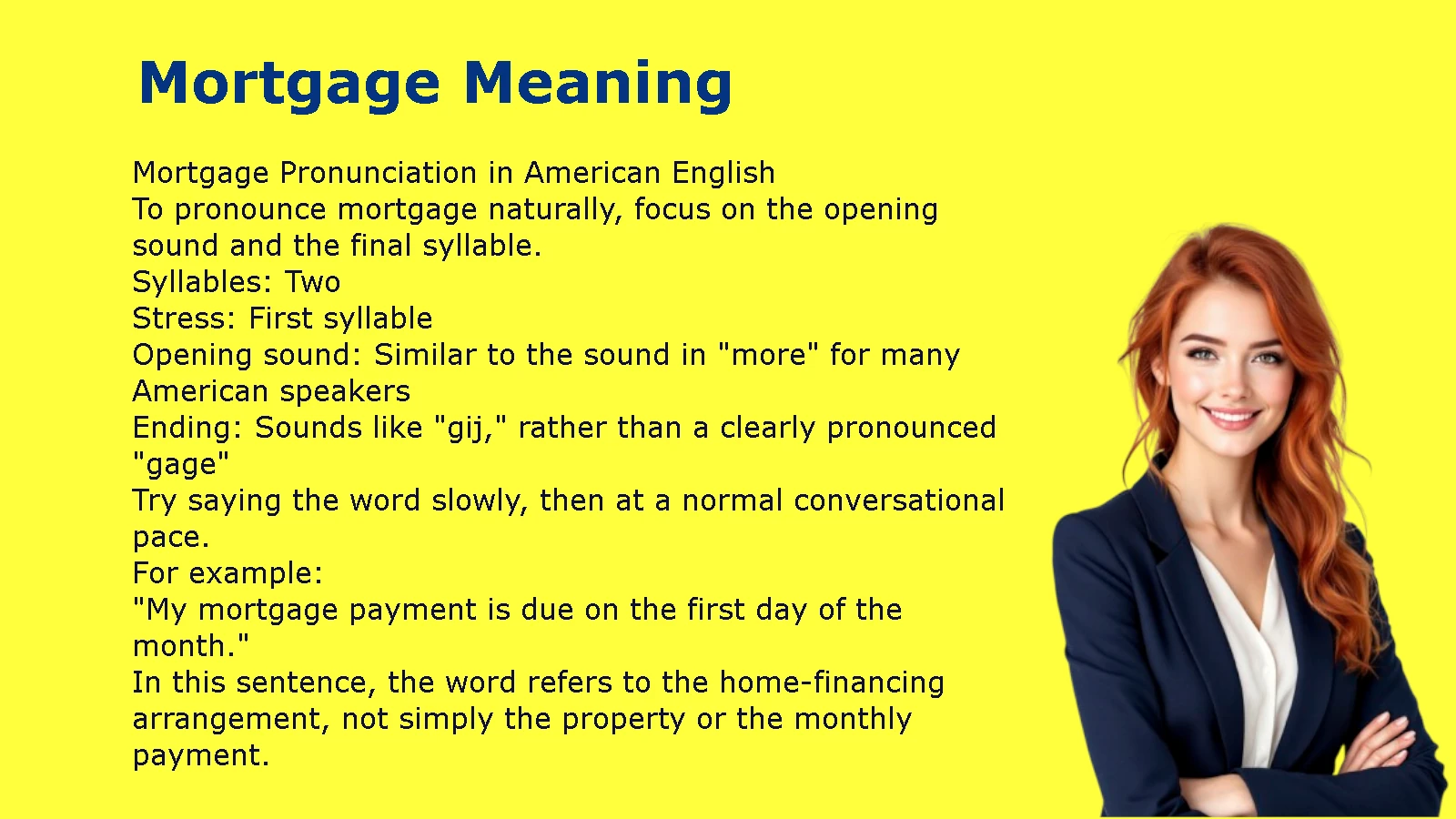
Mortgage Pronunciation in American English
To pronounce mortgage naturally, focus on the opening sound and the final syllable.
- Syllables: Two
- Stress: First syllable
- Opening sound: Similar to the sound in “more” for many American speakers
- Ending: Sounds like “gij,” rather than a clearly pronounced “gage”
Try saying the word slowly, then at a normal conversational pace.
For example:
“My mortgage payment is due on the first day of the month.”
In this sentence, the word refers to the home-financing arrangement, not simply the property or the monthly payment.
Why Is Mortgage Pronounced Differently From Its Spelling?
English spelling preserves patterns from the language’s history, and pronunciation does not always follow the sound that a reader might expect from individual letters.
In mortgage, the final letters do not sound like the word “gage” when pronounced separately. The ending has a soft sound, and the final syllable is unstressed.
Common mistakes include:
- Pronouncing every written letter separately.
- Giving the final syllable too much emphasis.
- Pronouncing the ending as though it rhymes with “cage.”
The easiest way to improve is to listen to a reliable pronunciation recording and repeat the word in a full sentence.
How to Use Mortgage in a Sentence
The word commonly appears in financial, legal, and everyday contexts.
Examples:
- “We applied for a mortgage to buy our first home.”
- “Her mortgage has a fixed interest rate.”
- “The bank approved his mortgage application.”
- “They want to pay off their mortgage before retirement.”
- “The property serves as security under the mortgage agreement.”
These examples show that mortgage can refer to a financing arrangement or, in everyday usage, the associated home loan.
Mortgage vs. Loan: What Is the Difference?
A mortgage is a specific type of property-backed financing arrangement, while a loan is a broader term for money borrowed under an agreement to repay it. A mortgage commonly secures a home loan with real estate. Other loans may be secured by different assets or may not require collateral at all.
Mortgage vs. Loan at a Glance
| Feature | Mortgage | Loan |
| Meaning | A property-related security arrangement; commonly used to describe home financing | Money borrowed under a repayment agreement |
| Typical purpose | Buying or refinancing real estate | Personal expenses, education, vehicles, businesses, property, and other needs |
| Security | Usually connected to real estate | May be secured or unsecured |
| Repayment | Commonly spread over many years | Can range from short-term to long-term |
| Interest | Depends on the mortgage agreement | Depends on the loan agreement |
| Consequences of default | May include enforcement against the property | Depend on the agreement, collateral, and applicable law |
The key distinction is that a mortgage is associated with property security, while a loan describes the borrowing itself.
Is a Mortgage a Type of Loan?
In everyday financial language, a mortgage is commonly treated as a type of loan because it involves borrowing money and repaying it over time.
For example, a bank may offer personal loans, auto loans, business loans, and mortgage loans. Each involves borrowing, but the purpose, security, and repayment conditions differ.
A personal loan might be unsecured, meaning the borrower does not pledge a particular asset as collateral. A mortgage loan, by contrast, generally uses real estate as security.
If the borrower defaults on an unsecured loan, the lender may still pursue lawful debt-collection remedies. However, the lender does not automatically have a mortgage-based claim against a particular house.
With a mortgage, the lender may have specific rights against the secured property, subject to the agreement and local law.
Mortgage vs. Mortgage Loan
The expressions mortgage and mortgage loan often mean nearly the same thing in everyday conversation. However, they can refer to different parts of the same transaction.
A mortgage is the legal security arrangement involving the property. A mortgage loan is the money borrowed under the financing agreement.
Consider this example:
A bank lends Jordan $180,000 to purchase a home. The loan agreement establishes Jordan’s obligation to repay the money. The mortgage establishes the lender’s security rights in the property.
People might say, “Jordan took out a mortgage,” and most readers would understand the meaning. In a legal document, however, distinguishing the loan from the mortgage can be important.
Mortgage vs. Collateral: How Are They Different?
Collateral is an asset used to secure repayment of a debt. A mortgage is a legal security arrangement generally involving real estate. The property connected to a mortgage acts as collateral, but the words do not mean the same thing: one describes the asset, while the other describes the legal arrangement.
What Does Collateral Mean?
Collateral is something of value that a borrower provides as security for a debt. If the borrower fails to repay the debt, the lender may have legal rights to take or sell the asset to recover the money, depending on the agreement and applicable law.
Common examples of collateral include:
- Real estate: A house or commercial building securing a mortgage.
- Vehicles: A car securing an auto loan.
- Equipment: Business machinery securing commercial financing.
- Investments: Certain financial assets securing an eligible credit arrangement.
Not every loan requires collateral. Credit cards and many personal loans, for example, are commonly unsecured.
Collateral reduces some of the lender’s risk, but it does not guarantee that the lender will recover the full amount owed. The asset’s value may fall, and enforcement may involve legal costs.
Mortgage vs. Collateral Comparison
| Feature | Mortgage | Collateral |
| What it means | A legal security arrangement involving property | An asset used to secure a debt |
| Category | Legal or financial arrangement | Property or asset |
| Example | A mortgage over a residential property | The residential property securing the debt |
| Main purpose | Establishes security rights connected to repayment | Provides value that may help satisfy the debt |
| Can exist without the other? | A mortgage generally involves property as security | Collateral can secure many types of arrangements, not only mortgages |
The difference becomes clearer when you look at a car loan. The vehicle may be collateral, but the security arrangement is not necessarily a mortgage. The legal structure depends on the type of asset and the law governing the transaction.
Can a Mortgage Be Collateral?
A property subject to a mortgage serves as security for the associated debt. In ordinary language, people may say that the house is collateral for the mortgage loan.
Strictly speaking, however, the house is the asset, while the mortgage establishes the lender’s legal security interest or related rights.
Suppose a borrower takes out a mortgage to purchase an apartment. The apartment serves as the property security. If the borrower fails to repay the debt, the lender may seek to enforce its rights against that property.
The lender does not necessarily become the unrestricted owner of the apartment simply because a mortgage exists. Ownership and enforcement rights depend on the legal system and the documents governing the transaction.
Mortgage vs. Rent: What Is the Difference?
A mortgage payment generally goes toward repaying a home loan secured by property, while rent pays for the right to occupy a property under a rental agreement. Buying with a mortgage can build equity over time, but ownership also brings additional costs and responsibilities. Renting offers housing without requiring the tenant to purchase the property.
Mortgage vs. Rent Comparison Table
| Feature | Buying with a mortgage | Renting |
| Property ownership | The buyer generally owns the property, subject to applicable legal rights and obligations | The landlord owns the property |
| Monthly payment | Commonly includes principal and interest | Pays for occupancy under the rental agreement |
| Equity | Principal repayments can build equity | Rent does not normally build ownership equity |
| Upfront costs | May include a down payment, closing costs, and other fees | May include a security deposit, advance rent, and fees |
| Maintenance | The owner usually bears major ownership costs, subject to local arrangements | The landlord often handles major repairs, subject to the lease and local law |
| Flexibility | Selling can involve time, fees, and market risk | Moving may be easier when the lease permits it |
| Financial risks | Interest rates, repairs, taxes, and property-value changes | Rent increases, lease restrictions, and the risk of having to move |
Neither option is automatically better. The right choice depends on your financial position, housing needs, and plans.
Is Paying a Mortgage Better Than Paying Rent?
Paying a mortgage may make sense when you can afford the purchase, expect to stay for several years, and want the opportunity to build equity. Renting may make more sense when you need flexibility, have limited savings, or do not want responsibility for property maintenance.
Consider the full cost of ownership rather than comparing only the rent with the mortgage payment.
Homeownership may involve:
- Mortgage principal and interest.
- Property taxes.
- Homeowners insurance.
- Repairs and routine maintenance.
- Homeowners association fees, where applicable.
- Closing costs and future selling costs.
- Mortgage insurance, if required.
For example, a $1,500 monthly mortgage principal-and-interest payment does not necessarily make a home cheaper than a rental costing $1,500 per month. Once taxes, insurance, repairs, and other expenses enter the calculation, the total ownership cost may be considerably higher.
However, mortgage principal repayments can increase the owner’s equity. Equity is the difference between the property’s market value and the debts secured against it. Changes in property value can increase or reduce that equity.
When Renting May Make More Sense
Renting can be a sensible choice in several situations.
You may need flexibility. If your job requires frequent relocation, renting may help you avoid the costs and delays involved in selling a home.
You have limited savings. Buying usually requires money upfront. Using every available dollar for a down payment can leave you unprepared for emergencies or unexpected repairs.
You prefer predictable responsibilities. Renters often do not pay directly for major structural repairs, although their obligations depend on the lease and local law.
You are uncertain about your plans. If you expect to move within a short period, transaction costs may outweigh the financial benefits of buying.
Renting is not necessarily wasted money. It pays for housing and can preserve savings for other goals.
When a Mortgage May Make More Sense
A mortgage may suit buyers who have stable finances, sufficient savings, and a clear reason to own a particular property.
It can offer benefits such as:
- Potential equity growth: Paying down principal can increase equity, provided other factors do not offset the gain.
- Housing stability: Owners generally have greater control over their living arrangements, subject to legal restrictions and financial obligations.
- Long-term planning: A fixed-rate mortgage can provide predictable principal-and-interest payments during the fixed-rate period.
- Property control: Owners can usually make permitted improvements without seeking a landlord’s approval.
Still, buying a home involves financial risk. Property values can decline, major repairs can be expensive, and missed mortgage payments can lead to enforcement proceedings.
A Practical Mortgage vs. Rent Example
Suppose Alex can rent a similar home for $1,400 per month or buy one with a mortgage requiring $1,600 per month in principal and interest.
At first glance, renting appears to cost $200 less each month. However, that comparison leaves out ownership expenses, potential equity growth, rent increases, and transaction costs.
Alex should estimate:
- The total monthly cost of ownership, including taxes, insurance, and maintenance.
- The upfront cost of buying, including the down payment and closing costs.
- How long Alex expects to live in the home.
- The amount of principal repaid over that period.
- The opportunity cost of using savings for a down payment.
- Potential selling costs and changes in the property’s value.
This comparison gives Alex a better basis for deciding than the mortgage payment alone.
Mortgage vs. Pledge: What Is the Legal Difference?
A mortgage generally involves real property serving as security for a debt. A pledge traditionally involves an asset being delivered into the creditor’s possession as security, particularly in legal systems that distinguish pledges from mortgages in this way. The exact rules vary by jurisdiction, so the terms should not be treated as universally interchangeable.
What Is a Pledge in Law?
A pledge is a legal arrangement in which a person provides an asset as security for an obligation. Under traditional pledge principles, the creditor receives possession of the pledged asset while the debtor retains an interest in it.
For example, a person might pledge certain valuable movable property to secure a debt. If the borrower fails to meet the obligation, the creditor may have rights to enforce the security under the applicable law.
A pledge can differ from a mortgage in the type of property involved and whether possession transfers to the creditor. Modern legal systems may also recognize other forms of security over movable assets that do not follow the traditional pledge model.
Mortgage vs. Pledge Comparison Table
| Feature | Mortgage | Pledge |
| Typical property | Real estate, such as a house or land | Traditionally movable property |
| Possession | The borrower commonly remains in possession of the property | Traditional pledge arrangements involve delivery of possession |
| Main function | Secures a debt through rights connected to property | Secures an obligation using an asset |
| Example | A house securing a home loan | Valuable movable property securing a debt |
| Legal treatment | Depends on the mortgage law governing the transaction | Depends on the relevant pledge and security laws |
These distinctions provide a general framework, not a substitute for the law of a specific country.
Are Mortgage and Pledge Interchangeable?
No, not in every legal context. A mortgage and a pledge can both secure a debt, but they may involve different assets, possession rules, documentation, and enforcement procedures.
For instance, a mortgage over a house may need to satisfy specific registration requirements. A traditional pledge may require delivery of the pledged asset to the creditor.
The details matter because using the wrong term in a legal document can create confusion about the parties’ rights and obligations. If you are reviewing an actual agreement, check the governing law and the wording of the document.
Mortgagee vs. Mortgagor: Who Is Who?
A mortgagor is the person who grants a mortgage or provides the property security. A mortgagee is the party that receives the mortgage security. In a typical home purchase, the mortgagor is the borrower or property owner, and the mortgagee is the lender.
What Does Mortgagor Mean?
The mortgagor is the party that grants the mortgage security over property. In a common home-financing arrangement, this is the person buying the house and borrowing money from a lender.
For example, if Olivia buys a house with a mortgage from a bank, Olivia is generally the mortgagor because she grants the mortgage over the property.
The mortgagor’s obligations may include:
- Repaying the debt under the loan agreement.
- Meeting relevant insurance and property-related obligations.
- Maintaining the property as required by the agreement or applicable law.
- Complying with restrictions that apply to the secured property.
The exact duties depend on the mortgage documents and local legal requirements.
What Does Mortgagee Mean?
The mortgagee is the party that receives the mortgage security. In a typical residential mortgage, this is the bank or other lender providing the financing.
For example, if a bank lends Olivia money to buy a house and receives a mortgage over that property, the bank is generally the mortgagee.
The mortgagee may have rights that include:
- Receiving repayment under the loan agreement.
- Requiring compliance with applicable mortgage conditions.
- Enforcing its security when legally permitted.
- Seeking foreclosure or another authorized remedy if the borrower defaults.
A mortgagee does not automatically become the unrestricted owner of the property simply by receiving mortgage security. Its rights depend on the agreement and governing law.
Mortgagee vs. Mortgagor Comparison Table
| Term | Typical role | What the party does | Example |
| Mortgagor | Borrower or property owner granting security | Grants the mortgage over the property | Olivia, who buys a house with a mortgage |
| Mortgagee | Lender or party receiving security | Provides financing and receives mortgage security | The bank financing Olivia’s purchase |
Easy Ways to Remember Mortgagee and Mortgagor
These two words look similar, so it is easy to confuse them.
Try this memory aid:
- Mortgagor: The party that grants the mortgage.
- Mortgagee: The party that receives the mortgage.
The endings can help. In legal terminology, the person or party ending in -or often performs an action, while -ee can identify the recipient. This is a memory aid rather than a rule that applies to every English word.
Consider this simple example:
“Sam borrowed $200,000 from a bank and granted a mortgage over his home.”
Sam is the mortgagor. The bank is the mortgagee.
Is Mortgage a Noun or a Verb?
Mortgage can function as both a noun and a verb. As a noun, it usually describes a legal security arrangement or, in everyday usage, a home loan. As a verb, it means to grant property as security for a debt.
Mortgage as a Noun
The noun form appears in conversations about home financing, legal agreements, and personal budgets.
Examples include:
- “Their mortgage has a fixed interest rate.”
- “She applied for a mortgage last month.”
- “The mortgage agreement explains the lender’s rights.”
- “He wants to reduce his mortgage balance.”
In the first three examples, the word refers to a financing arrangement or its legal documentation. In the last example, it refers to the outstanding mortgage debt in everyday usage.
Mortgage as a Verb
As a verb, mortgage means to use property as security for a debt.
Examples:
- “They decided to mortgage the property to obtain financing.”
- “The company mortgaged its real estate to secure a loan.”
- “He was unwilling to mortgage his home for a business venture.”
The verb appears more often in formal, financial, or legal writing than in everyday conversation.
Common Phrases That Use Mortgage
| Phrase | Meaning | Example |
| Mortgage payment | A payment made toward a mortgage loan | “Our mortgage payment is due Friday.” |
| Mortgage lender | A person or institution that provides mortgage financing | “The mortgage lender reviewed her income.” |
| Mortgage interest | The cost charged for borrowing under the mortgage loan | “Mortgage interest increased the total borrowing cost.” |
| Mortgage debt | The amount still owed under the mortgage financing | “They want to reduce their mortgage debt.” |
| Mortgage agreement | A legal document establishing the mortgage arrangement | “The lawyer reviewed the mortgage agreement.” |
| Mortgage application | A request for mortgage financing | “The bank approved the mortgage application.” |
| Mortgage balance | The remaining amount owed, often referring to principal outstanding | “The mortgage balance fell after several years of payments.” |
These expressions appear frequently in property listings, bank documents, loan discussions, and personal-finance articles.
Common Misunderstandings About Mortgages
Mortgage terminology can be confusing because people often use the same word for the loan, the legal arrangement, and the ongoing repayment obligation. Understanding the distinctions helps prevent common errors.
Does a Mortgage Mean You Own the House Outright?
No. Having a mortgage does not mean you own the house free of debt. A buyer may own the property while a lender holds a mortgage or another security interest connected to the outstanding loan.
For example, a homeowner may own a house worth $350,000 but still owe $220,000 on the mortgage. Ignoring other claims and selling costs, the homeowner’s equity would be approximately $130,000.
The calculation is:
Equity = Property value − Outstanding secured debt
In this example:
$350,000 − $220,000 = $130,000
Equity can change as the owner repays principal or as the property’s market value rises or falls. It may also be affected by other debts secured against the property.
Is a Mortgage the Same as a Home Loan?
In everyday speech, the terms often refer to the same home-financing transaction. In more precise legal or financial language, a home loan refers to the money borrowed, while a mortgage refers to the security arrangement connected to the property.
The distinction is useful when reading loan documents, comparing financial products, or learning legal terminology.
For example, a lender’s loan agreement may describe the repayment schedule and interest rate. A separate mortgage document may establish the lender’s rights in the property.
The documents work together, but they do not necessarily perform the same legal function.
Does Every Loan Require a Mortgage?
No. Many loans do not involve a mortgage.
Examples include:
- Unsecured personal loans: Borrowers receive money without pledging a specific asset as security.
- Credit cards: Cardholders borrow through a revolving credit arrangement, generally without a mortgage over their property.
- Auto loans: The vehicle may secure the debt through a security arrangement other than a real-estate mortgage.
- Business loans: Depending on the agreement, the loan may be unsecured or backed by business assets, real estate, guarantees, or other security.
A mortgage is one way to secure a debt, not a requirement for all borrowing.
What Happens When a Mortgage Is Paid Off?
When a borrower makes the final required payment, the debt is generally satisfied under the loan agreement. However, the borrower may still need to complete administrative or legal steps to remove the registered mortgage or other security interest from the property’s records.
The process varies by jurisdiction. It may involve the lender issuing a discharge, release, or similar document and submitting it to the relevant registry.
A borrower should confirm that the debt has been settled and that any required release has been properly recorded. Paying the final installment does not always mean the public property record updates automatically.
Frequently Asked Questions About Mortgages
What Is a Mortgage in Simple Words?
A mortgage is a legal arrangement that uses property as security for a debt, often money borrowed to buy a home. The borrower repays the debt according to an agreed schedule, and the lender may have legal rights against the property if the borrower defaults.
Is a Mortgage a Loan or Collateral?
A mortgage is a legal security arrangement commonly associated with a home loan, while collateral is the asset used to secure repayment. In a typical home purchase, the property serves as collateral for the mortgage loan.
What Is the Difference Between a Mortgage and a Mortgage Loan?
A mortgage generally refers to the legal arrangement securing a debt with property. A mortgage loan refers to the money borrowed to purchase or refinance real estate. People often use the terms interchangeably in everyday conversation.
What Is the Difference Between a Mortgagee and a Mortgagor?
The mortgagor grants the mortgage security, while the mortgagee receives it. In a typical home loan, the borrower or property owner is the mortgagor, and the lender is the mortgagee.
Is a Mortgage Better Than Rent?
Neither option is always better. Buying with a mortgage may help build equity, but it also involves upfront costs, maintenance, taxes, and property-market risk. Renting may offer greater flexibility and lower initial expenses. Compare the full costs and your expected length of stay before deciding.
How Do You Pronounce Mortgage?
In American English, mortgage is commonly pronounced with two syllables and stress on the first syllable. Its IPA representation is /ˈmɔːrɡɪdʒ/, with some variation across accents.
Conclusion: Understand Mortgage Meaning Before You Borrow
Understanding mortgage meaning gives you a clearer picture of how home financing works. A mortgage generally connects a debt to property used as security, while a mortgage loan describes the borrowing itself. Collateral is the asset that supports repayment, rent pays for occupancy, and a pledge is a different form of security arrangement in many legal systems.
Remember the key distinctions:
- Mortgage vs. loan: A mortgage is a specific property-related security arrangement; a loan is money borrowed.
- Mortgage vs. collateral: A mortgage is the legal arrangement, while collateral is the asset securing the debt.
- Mortgage vs. rent: A mortgage commonly finances property ownership, while rent pays for the right to occupy a property.
- Mortgage vs. pledge: Both can secure debts, but their legal structures and possession rules may differ.
- Mortgagee vs. mortgagor: The mortgagee receives the security, while the mortgagor grants it.
If you’re considering a home purchase, start by reviewing your borrowing capacity, down payment, interest rate, repayment term, and total ownership costs. If you’re learning the terminology, use the comparison tables and examples to distinguish each concept confidently. A clear understanding of these terms makes financial documents easier to read and helps you ask better questions before signing an agreement.