Incentivise and incentivize are both correct spellings of the same verb, meaning to encourage someone to take action by offering a reward, benefit, or other motivation. The main difference is regional spelling: incentivise is more common in British English, while incentivize is the standard form in American English. Both words relate to incentives, which can include bonuses, discounts, prizes, and other benefits that encourage a particular behavior. Whether you’re writing a business report, an academic paper, or an everyday message, choose the spelling that matches your audience and use it consistently.
Incentivise vs Incentivize: What’s the Difference?
The difference between incentivise and incentivize is spelling, not meaning. Both words describe the act of encouraging a person or group to do something by offering an incentive. British English generally favors the -ise ending, while American English typically uses -ize. The correct choice depends on your preferred English convention and the expectations of your readers.
Incentivise Meaning and Definition
Incentivise is a verb that means to encourage a particular action or behavior by providing a reward, advantage, or other incentive. It commonly appears in British English, especially in discussions about business, education, public policy, and workplace performance.
For example, a company might incentivise employees by offering bonuses for meeting sales targets. A school could incentivise students by recognizing academic improvement.
The word often suggests a practical arrangement: someone offers a benefit to influence another person’s choices.
Examples:
- The company plans to incentivise employees with performance-based bonuses.
- The government introduced tax benefits to incentivise investment in renewable energy.
- Teachers can incentivise students by rewarding consistent effort.
- The retailer wants to incentivise customers to shop during the holiday season.
In British English, incentivise is a suitable choice for formal documents, professional communication, and everyday writing.
Incentivize Meaning and Definition
Incentivize is a verb that means to motivate or encourage someone to act by offering an incentive. It has the same definition as incentivise but is the preferred spelling in American English.
Businesses frequently use the word when discussing employee compensation, sales strategies, customer loyalty, and productivity. Governments and organizations also use it to describe policies designed to encourage specific decisions.
Examples:
- The manager wants to incentivize employees to improve customer service.
- Lower interest rates may incentivize businesses to invest in new equipment.
- The program aims to incentivize homeowners to install energy-efficient appliances.
- The school introduced a new system to incentivize regular attendance.
The spelling incentivize is particularly appropriate for American business writing, marketing materials, reports, and professional emails.
Incentivise or Incentivize: Which Spelling Is Correct?
Both incentivise and incentivize are correct. Neither spelling changes the meaning or grammatical function of the word. The difference comes from regional spelling preferences.
Use incentivize when writing primarily for an American audience. Choose incentivise when following a British English style guide that favors -ise endings.
| Context | Preferred spelling | Example |
| American English | Incentivize | We incentivize employees with bonuses. |
| British English | Incentivise | We incentivise employees with bonuses. |
| American business report | Incentivize | The policy will incentivize investment. |
| British business report | Incentivise | The policy will incentivise investment. |
| International organization | Follow its style guide | Use one spelling consistently. |
Quick rule: If you use American spellings such as organize, prioritize, and recognize, choose incentivize. If your chosen British style uses organise, prioritise, and recognise, incentivise may fit better.
However, British English also accepts many -ize spellings. The choice depends on the style convention you follow, not a strict rule that every British writer must use -ise.
Is Incentivise British or American English?
Incentivise is primarily associated with British English. Writers in the United Kingdom and other English-speaking regions that commonly use British spelling may prefer this form.
The -ise ending appears in words such as organise, realise, and modernise. Writers who follow this convention often use incentivise for consistency.
For example:
- The government hopes to incentivise businesses to hire more apprentices.
- The new policy will incentivise investment in rural communities.
- Employers can incentivise staff through flexible benefits.
The spelling is also used in some international business and policy documents. However, British English does not universally prohibit -ize endings, so the preferred form can vary by publication or organization.
Is Incentivize British or American English?
Incentivize is the standard American English spelling. American writers generally use it in business communication, marketing, education, government policy, and everyday writing.
The -ize ending also appears in American words such as organize, prioritize, and modernize. This makes incentivize the natural choice for writers who follow American spelling conventions.
Examples:
- The company will incentivize sales representatives to reach their quarterly goals.
- The new tax credit could incentivize homeowners to improve energy efficiency.
- Managers should avoid policies that incentivize employees to sacrifice quality for speed.
Although incentivize is strongly associated with American English, it is not exclusive to the United States. Writers in other regions may use it, especially when following an international or American style guide.
What Does Incentivize Mean?
To incentivize means to encourage a behavior by offering a benefit or reward. The incentive gives someone a reason to take a particular action, such as meeting a target, completing a task, buying a product, or adopting a new habit. The word describes the act of creating motivation rather than the reward itself.
Incentivize Meaning in Simple Words
In simple words, incentivize means to give someone a reason to do something by offering something they value.
Imagine that a store wants more customers to shop during the weekend. It offers a 10% discount to people who spend at least $50. The discount is the incentive, and the store is trying to incentivize customers to spend more.
Here are a few everyday situations:
- At work: An employer offers a bonus for meeting a sales goal.
- At school: A teacher recognizes students who complete their assignments on time.
- In business: A company offers loyalty points to encourage repeat purchases.
- At home: A parent promises extra screen time after household chores.
- In public policy: A government offers a rebate for installing solar panels.
Each example involves an action and a benefit intended to make that action more appealing.
However, an incentive does not guarantee a particular result. A bonus might motivate one employee but have little effect on another. People respond differently depending on their goals, circumstances, and the value they place on the reward.
Incentivize in a Sentence
The verb incentivize usually takes a person, group, or organization as its object. It can also describe encouraging a specific activity.
Here are original sentence examples showing different grammatical patterns:
- The company wants to incentivize its employees to develop new skills.
- Financial rewards can incentivize customers to make repeat purchases.
- The program will incentivize small businesses to adopt digital payment systems.
- Managers should not incentivize speed at the expense of accuracy.
- The city introduced parking discounts to incentivize residents to use public transportation.
- A loyalty program can incentivize shoppers without requiring permanent price cuts.
Notice the common structure: the subject offers or introduces something intended to encourage a particular action.
A useful sentence pattern is:
Subject + incentivize + person or group + to + verb
For example: The scholarship incentivizes students to maintain strong academic performance.
You can also use the verb with an activity: The new policy incentivizes investment.
Incentivize Examples in Business, Education, and Everyday Life
The word appears in several fields because incentives can influence financial decisions, personal habits, and organizational behavior.
Business and employment
Companies use incentives to encourage productivity, improve sales, attract employees, and retain customers.
- The retailer will incentivize repeat purchases with a points-based loyalty program.
- The manager plans to incentivize teamwork instead of rewarding individual sales alone.
- The company introduced bonuses to incentivize employees to meet quarterly targets.
A well-designed incentive should reward the result the company actually wants. If a call center rewards employees only for handling calls quickly, representatives may rush customers instead of solving their problems. Adding a customer satisfaction measure can help balance speed and quality.
Education
Schools and educational programs can use incentives to encourage attendance, participation, and consistent effort.
- The school hopes to incentivize regular attendance through recognition programs.
- Teachers may incentivize reading by letting students choose books for classroom discussions.
- The scholarship aims to incentivize academic improvement among eligible students.
Educational incentives work best when they support learning rather than replace it. Recognition for progress, for example, can encourage students who need time to master a subject.
Everyday life
People use incentives informally to encourage habits and cooperation.
- The family decided to incentivize recycling by setting a shared weekly goal.
- The gym offers discounted memberships to incentivize regular exercise.
- The delivery service gives customers free shipping to incentivize larger orders.
Public policy and environmental programs
Governments and public organizations may use financial benefits to encourage behavior that supports wider social goals.
- Tax credits can incentivize investment in energy-efficient equipment.
- Rebates may incentivize homeowners to upgrade insulation.
- Public transportation discounts can incentivize commuters to leave their cars at home.
These examples show that incentives can take many forms. They may involve money, convenience, recognition, access, or other benefits.
What Does Incentivized Mean?
Incentivized is the past tense and past participle of incentivize. It describes a person, group, or activity that received an incentive or was encouraged through an incentive.
The word often appears in business reports and discussions about motivation.
Examples:
- Employees were incentivized to meet their targets through quarterly bonuses.
- The company incentivized customers with discounts on repeat purchases.
- Students are incentivized by recognition and academic awards.
- The policy created a system that incentivized long-term investment.
The word can also appear in passive constructions, as in Employees were incentivized to improve performance. In this sentence, the employees received the incentive, but the sentence does not identify who provided it.
In British English, the corresponding spelling is incentivised. Both forms express the same meaning.
How to Use Incentivise and Incentivize in Sentences
Both spellings function as verbs. You can use them in the present tense, past tense, continuous forms, and passive constructions. The main difference is the spelling convention you follow.
Incentivise in a Sentence: Examples
Use incentivise when writing in a style that favors British spelling.
- The employer plans to incentivise staff through professional development opportunities.
- Discounts can incentivise customers to purchase products in larger quantities.
- The government wants to incentivise investment in local manufacturing.
- Schools can incentivise participation by giving students meaningful responsibilities.
- The company introduced a bonus scheme to incentivise better customer service.
- Managers should avoid incentives that incentivise employees to cut corners.
- The new scheme is designed to incentivise households to reduce energy consumption.
The verb can describe a positive or negative outcome. For instance, a poorly designed payment structure may incentivise employees to prioritize sales over customer satisfaction.
Incentivize in a Sentence: Examples
Use incentivize when writing in American English or following a style guide that prefers the -ize form.
- The company wants to incentivize employees to complete training.
- Free delivery may incentivize customers to place larger orders.
- The new policy could incentivize businesses to hire more workers.
- The school introduced awards to incentivize consistent attendance.
- Managers should incentivize quality rather than speed alone.
- The program aims to incentivize homeowners to install efficient heating systems.
- The retailer uses loyalty points to incentivize repeat purchases.
These examples also show why context matters. An incentive can encourage an action, but it does not automatically make that action beneficial or ethical.
Incentivised vs. Incentivized
Incentivised and incentivized are alternative spellings of the past tense and past participle of the same verb.
| Word | Preferred usage | Example |
| Incentivised | British-style spelling | The staff were incentivised with bonuses. |
| Incentivized | American spelling | The staff were incentivized with bonuses. |
Both sentences mean that the staff received incentives intended to encourage a particular behavior.
Use incentivised if your document follows a British -ise convention. Use incentivized if it follows American spelling.
The same distinction applies when the word functions as an adjective. For example, an incentivized program describes a program structured around incentives. In many contexts, however, the exact meaning depends on the surrounding sentence.
Incentivising vs. Incentivizing
Incentivising and incentivizing are the present participle forms of the verb. They can appear in continuous tenses or describe an ongoing process.
| Word | Preferred usage | Example |
| Incentivising | British-style spelling | The firm is incentivising employees to improve retention. |
| Incentivizing | American spelling | The firm is incentivizing employees to improve retention. |
Examples in context:
- The company is incentivising customers to use its mobile app.
- The business is incentivizing employees to complete optional training.
- The government is incentivising investment through tax relief.
- The new strategy focuses on incentivizing sustainable behavior.
The spelling changes, but the grammatical function and meaning remain the same.
Incentivises vs. Incentivizes
Incentivises is the third-person singular present form in British-style spelling, while incentivizes is the corresponding American form.
Use these forms with singular subjects such as he, she, it, or a singular noun.
Examples:
- The company incentivises employees through annual bonuses.
- The company incentivizes employees through annual bonuses.
- The policy incentivises renewable energy investment.
- The policy incentivizes renewable energy investment.
For plural subjects, use the base form:
- The companies incentivise their employees.
- The companies incentivize their employees.
A common grammar mistake is adding -s to the verb when the subject is plural. Remember that the company incentivizes, but the companies incentivize.
Incentivise vs Incentivize in American and British English
Regional spelling conventions influence which form readers expect, particularly in formal writing. Both versions remain understandable across English-speaking regions, but consistent spelling makes a document look more polished.
Incentivize in American English
American English generally uses incentivize, along with related forms such as incentivizes, incentivized, and incentivizing.
This spelling appears in corporate reports, workplace policies, marketing plans, and discussions of economics.
For example:
The new compensation plan will incentivize employees to focus on customer retention.
An American business might also write:
- We incentivize customers with loyalty rewards.
- The program incentivized local businesses to adopt new technology.
- Managers are incentivizing employees to improve service quality.
If your website targets American readers, using incentivize as the main spelling is a sensible choice. Keep related forms consistent throughout the article, including headings, image text, and examples.
Incentivise in British English
British English commonly uses incentivise, particularly in publications and organizations that prefer -ise spellings.
Examples include:
- The scheme will incentivise businesses to recruit apprentices.
- Employers can incentivise staff through training and career development.
- The policy incentivised investment in regional infrastructure.
- Retailers are incentivising customers to shop online.
This spelling fits naturally with other British-style forms such as organise, prioritise, and recognise.
However, British spelling conventions are not completely uniform. Some British publishers and dictionaries favor -ize forms for many words, so always check the style guide that applies to your publication.
Which Spelling Is Used in Australia, Canada, and Other English-Speaking Countries?
Usage outside the United States and United Kingdom can vary. Writers often follow local publishing conventions, workplace standards, or the preferences of their organization.
| Region | Practical guidance |
| United States | Incentivize is the standard choice. |
| United Kingdom | Incentivise is common, though incentivize is also accepted in some styles. |
| Australia | Incentivise is common in British-style writing; follow the organization’s style guide. |
| Canada | Both forms occur. Choose the form preferred by your publisher or organization. |
| New Zealand | Incentivise is a familiar British-style choice; follow local editorial guidance. |
| International organizations | Use the designated house style consistently. |
Do not assume that every country follows one spelling rule without exceptions. A multinational organization may use American English for all global communications, even when its headquarters are in a country that commonly uses British spelling.
Should You Use Incentivise or Incentivize in Professional Writing?
Choose the spelling that matches your audience, publication, and style guide. Consistency matters more than choosing one version as universally correct.
Use incentivize when preparing:
- American business reports
- US-focused blog posts
- American marketing materials
- Workplace policies written in American English
Use incentivise when preparing:
- British-style business documents
- UK-focused articles
- Publications that prefer -ise endings
- Professional communication that follows a British English house style
For international content, decide on one spelling convention before drafting. Then apply it to the main word and all its related forms.
Practical editing tip: Search your document for incentivise, incentivize, incentivised, incentivized, incentivising, and incentivizing. Check that the forms match the convention you selected.
Incentivise Word Forms and Verb Conjugation
The verb changes according to tense and grammatical structure. The spelling difference between British-style -ise and American -ize carries through most of its common forms.
Incentivise, Incentivises, and Incentivised
These forms are commonly used in British-style spelling.
- Incentivise: The base form. Example: We incentivise employees through recognition.
- Incentivises: The third-person singular present form. Example: The program incentivises regular attendance.
- Incentivised: The past tense and past participle. Example: The company incentivised customers with discounts.
- Incentivising: The present participle. Example: The company is incentivising customers to return.
The base form also appears after modal verbs and the word to.
Examples:
- The company may incentivise additional training.
- Managers want to incentivise collaboration.
- The policy could incentivise investment.
Incentivize, Incentivizes, and Incentivized
These forms are common in American English.
- Incentivize: The base form. Example: We incentivize employees through recognition.
- Incentivizes: The third-person singular present form. Example: The program incentivizes regular attendance.
- Incentivized: The past tense and past participle. Example: The company incentivized customers with discounts.
- Incentivizing: The present participle. Example: The company is incentivizing customers to return.
The verb follows standard English grammar. You do not need to learn a separate set of tense rules for the American spelling.
Incentivising vs. Incentivizing
Both forms describe an ongoing action or process. The choice depends on spelling convention rather than tense or meaning.
Examples:
- British style: The business is incentivising employees to improve productivity.
- American style: The business is incentivizing employees to improve productivity.
Both sentences use the present continuous tense, formed with is plus the present participle.
The forms can also function as modifiers in some contexts, as in an incentivizing reward structure. However, a clearer phrase such as a reward structure designed to motivate employees may suit formal writing better.
What Is the Past Tense of Incentivize?
The past tense of incentivize is incentivized. In British-style spelling, the corresponding form is incentivised.
Examples:
- The manager incentivized the sales team last quarter.
- The company incentivised employees with performance bonuses.
- The new policy incentivized investment in equipment.
- The retailer incentivised customers to join its loyalty program.
Both forms can also serve as the past participle.
For example, The employees have been incentivized to complete the training. The phrase have been incentivized uses the past participle in a passive construction.
What Is the Noun Form of Incentivize?
The main noun associated with incentivize is incentive. It refers to something that encourages a person to act, such as a financial reward, discount, benefit, or recognition.
Examples:
- The company offered a financial incentive for meeting the target.
- Free shipping provided an incentive for customers to order online.
- The scholarship serves as an incentive for academic achievement.
The plural form is incentives.
You may also encounter incentivization, which refers to the process or practice of creating incentives. However, it often sounds more technical or abstract than simply saying the use of incentives.
For clearer writing, prefer the simpler expression when it communicates the same idea.
- Wordier: The incentivization of employees improved participation.
- Clearer: Employee incentives improved participation.
The second sentence is more direct and easier to read.
Incentivise vs Incentivize: Comparison Table
The following table summarizes the spelling, regional preferences, grammatical forms, and usage of both words.
| Feature | Incentivise | Incentivize |
| Part of speech | Verb | Verb |
| Meaning | Encourage through incentives | Encourage through incentives |
| Common regional preference | British-style English | American English |
| Base form | Incentivise | Incentivize |
| Third-person singular | Incentivises | Incentivizes |
| Past tense | Incentivised | Incentivized |
| Past participle | Incentivised | Incentivized |
| Present participle | Incentivising | Incentivizing |
| Example sentence | We incentivise employees with bonuses. | We incentivize employees with bonuses. |
Key takeaway: The words have the same meaning and grammatical function. Choose the form that fits your chosen English convention, then use it consistently.
Incentivise Synonyms and Antonyms
Several words express ideas similar to incentivise and incentivize. However, they do not always communicate exactly the same meaning. The best alternative depends on whether you want to emphasize a reward, general motivation, encouragement, or a direct benefit.
Synonyms for Incentivise and Incentivize
Common synonyms include motivate, encourage, reward, stimulate, persuade, prompt, and induce.
| Synonym | Meaning | Example |
| Motivate | Give someone a reason or desire to act | The manager motivated the team to improve service. |
| Encourage | Support or promote an action | The school encouraged students to read daily. |
| Reward | Give something in recognition of an action | The company rewarded employees for excellent work. |
| Stimulate | Increase activity, interest, or growth | Lower taxes may stimulate investment. |
| Persuade | Convince someone to take action | The adviser persuaded the client to review the plan. |
| Prompt | Cause or encourage a response | The reminder prompted customers to renew. |
| Induce | Bring about an action or response | The discount induced some customers to buy sooner. |
These alternatives are useful when you want to avoid repeating incentivize throughout a paragraph.
Choose the word that best matches the situation. For example, reward emphasizes the benefit given, while motivate focuses on the person’s willingness to act.
Opposite of Incentivize
There is no single perfect antonym for incentivize in every context. However, discourage, deter, disincentivize, and disincentivise can express opposing ideas.
- Discourage: Make an action seem less appealing.
- Deter: Prevent or discourage an action, often through a threat or consequence.
- Disincentivize: Remove or reduce the motivation to take an action.
- Disincentivise: The British-style spelling of disincentivize.
Examples:
- High fees may discourage customers from renewing.
- Strict penalties can deter people from violating the rules.
- The additional paperwork could disincentivize small businesses from applying.
- Poorly designed rules may disincentivise investment.
The choice depends on the intended meaning. A reward can incentivize an action, while a penalty may deter it. Removing a reward can disincentivize the action without necessarily prohibiting it.
Incentivize vs. Motivate
Incentivize means to encourage action through an incentive, while motivate has a broader meaning. Motivation can come from financial rewards, personal ambition, interest, recognition, values, or a sense of responsibility.
For example, an employer may incentivize staff with a bonus. The same employer may motivate staff by explaining how their work helps customers.
| Word | Main emphasis | Example |
| Incentivize | A benefit or incentive that encourages action | The bonus incentivized employees to reach the target. |
| Motivate | A reason, desire, or drive to act | The manager motivated employees by recognizing their contributions. |
Use incentivize when a specific incentive plays an important role. Use motivate when discussing the broader reasons people take action.
Incentivize vs. Encourage
Encourage means to support, promote, or give someone confidence to act. Incentivize specifically emphasizes using an incentive to influence behavior.
For example, a teacher can encourage a student by offering constructive feedback. The teacher can incentivize participation by awarding points for completing activities.
- The company encouraged employees to share ideas.
- The company incentivized employees with a reward for useful suggestions.
The first sentence does not require a tangible benefit. The second suggests that a reward or other incentive helped influence behavior.
In everyday writing, encourage often sounds more natural and less technical. In business or policy discussions, incentivize may describe a specific mechanism more precisely.
Incentivize vs. Reward
Incentivize describes the act of encouraging behavior through an incentive. Reward describes giving someone a benefit or something valuable in recognition of an action, achievement, or result.
The two words often appear in the same situation, but they emphasize different parts of the process.
For example, a company may incentivize employees by announcing a bonus for meeting a target. When employees meet that target, the company rewards them with the promised bonus.
- Incentivize: The company offered bonuses to encourage higher sales.
- Reward: The company rewarded the sales team for exceeding its target.
An incentive may be offered before an action occurs. A reward often follows the action, although some rewards can be promised in advance to encourage performance.
Common Spelling Mistakes
Because incentivise and incentivize differ by only a few letters, writers sometimes confuse them with incorrect spellings. Learning the standard forms can help you avoid mistakes in professional documents and online content.
Incentivise vs. Insentivise
Incentivise is the correct spelling in the British-style form. Insentivise is a common misspelling.
The word begins with incent-, not insent-. It is related to incentive, which also begins with the letter sequence incent-.
Incorrect: The company plans to insentivise its employees.
Correct: The company plans to incentivise its employees.
In American English, use incentivize instead:
Correct: The company plans to incentivize its employees.
Spelling tip: Remember the related noun incentive. The correct verb retains the same opening letters.
Incentivize vs. Incentivice
Incentivize is the correct American spelling. Incentivice is not the standard spelling of this verb.
The final letters matter because the word uses the -ize ending rather than -ice.
Incorrect: The new program will incentivice customers to return.
Correct: The new program will incentivize customers to return.
If you follow British-style spelling, write:
Correct: The new program will incentivise customers to return.
The correct forms are incentivise and incentivize. Avoid creating alternative endings by analogy with unrelated words.
How to Spell Incentivise Correctly
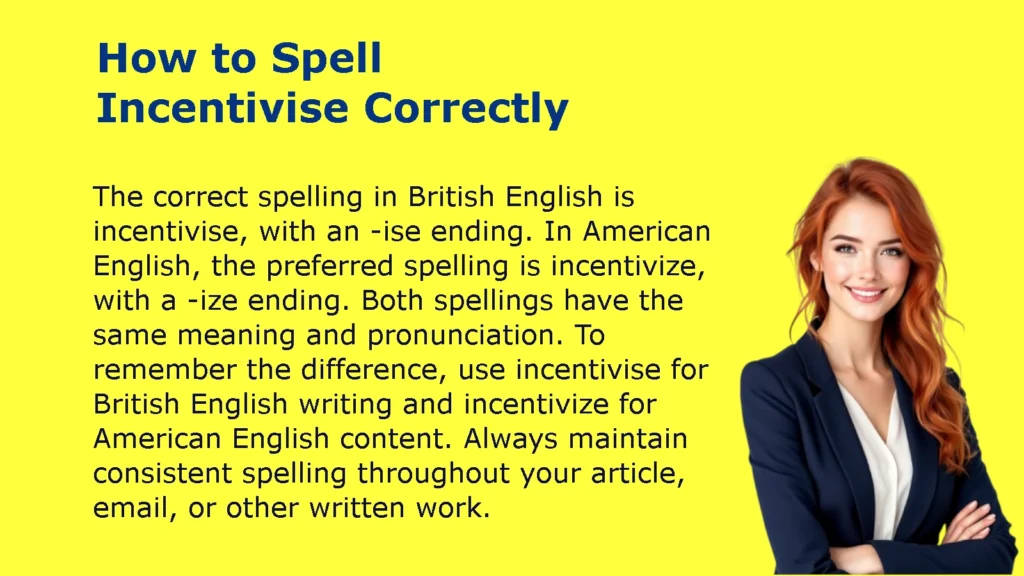
Use incentivise when following a spelling convention that favors British-style -ise endings.
Remember these related forms:
- Base form: incentivise
- Third-person singular: incentivises
- Past tense: incentivised
- Past participle: incentivised
- Present participle: incentivising
Example: The organization incentivised employees to complete the training program.
To check your spelling, compare the word with incentive. Both begin with incent-.
Do not confuse incentivise with insentivise or incentivice. Those forms are incorrect for the intended meaning.
How to Spell Incentivize Correctly
Use incentivize when following American English spelling conventions.
Its common forms are:
- Base form: incentivize
- Third-person singular: incentivizes
- Past tense: incentivized
- Past participle: incentivized
- Present participle: incentivizing
Example: The organization incentivized employees to complete the training program.
A useful way to remember the American spelling is to connect it with other familiar -ize verbs, such as organize, prioritize, and recognize.
If you are editing a document, check the entire word family rather than correcting only the base form. Consistency across headings, paragraphs, tables, and examples helps prevent avoidable spelling errors.
Frequently Asked Questions
Is It Incentivise or Incentivize?
Both incentivise and incentivize are correct spellings of the same verb. Incentivise is common in British-style English, while incentivize is standard in American English. Both mean to encourage someone to act by offering an incentive, such as a bonus, discount, or other benefit.
What Does Incentivise Mean?
Incentivise means to encourage someone to take action by offering an incentive. For example, a company might incentivise employees by providing bonuses for meeting performance targets. The word describes the act of using a benefit or reward to influence behavior.
What Does Incentivized Mean?
Incentivized is the past tense and past participle of incentivize. It describes someone or something that received an incentive or was encouraged through one. For example, The company incentivized customers with discounts. The British-style spelling is incentivised.
Is Incentivize Correct in British English?
Yes, incentivize is also acceptable in British English. Although incentivise is common in British-style writing, some British publications use -ize endings. Follow your publisher’s or organization’s style guide and maintain consistency throughout the document.
Is Incentivise Correct in American English?
Incentivise is understandable, but incentivize is the standard American English spelling. Writers targeting a US audience should generally use incentivize, along with incentivizes, incentivized, and incentivizing.
What Is the Difference Between Incentivised and Incentivized?
There is no difference in meaning. Incentivised is the British-style spelling, while incentivized is the standard American form. Both are the past tense and past participle of the verb. For example, The team was incentivised with bonuses and The team was incentivized with bonuses mean the same thing.
What Is the Past Tense of Incentivize?
The past tense of incentivize is incentivized. For example, The company incentivized employees to improve customer satisfaction. The British-style alternative is incentivised. Both forms also work as past participles.
What Is Another Word for Incentivise?
Common alternatives include motivate, encourage, stimulate, reward, persuade, and prompt. The best synonym depends on the context. Use motivate for general encouragement, reward when someone receives a benefit, and incentivise when a specific incentive encourages an action.
Conclusion
Incentivise and incentivize are two correct spellings of the same verb. Both mean to encourage someone to take action by offering a reward, benefit, or other incentive. The main distinction is regional preference: incentivise is common in British-style English, while incentivize is standard in American English.
Their related forms follow the same pattern. British-style writing uses incentivises, incentivised, and incentivising. American English uses incentivizes, incentivized, and incentivizing.
When choosing between the two, consider your readers and the style guide you follow. If you write for an American audience, use incentivize. For a British-style publication that favors -ise endings, choose incentivise. For other English-speaking regions, check the relevant editorial preference.