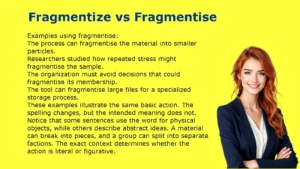
Fragmentize vs fragmentise comes down to a spelling difference between American and British English, not a difference in meaning. Fragmentize is the usual American English form, while fragmentise is preferred by writers who follow British-style -ise spelling conventions. Both words mean to break something into smaller pieces or separate parts.
The word also connects to several related concepts, including fragment meaning, fragmentation, fragment synonyms, and fragmented vs concentrated. You may encounter these terms in everyday writing, science, computing, and gaming. Understanding their differences helps you choose the right word for your sentence and avoid confusing a general definition with a specialized technical meaning.
This guide explains fragmentize vs fragmentise, provides original sentence examples, compares related words, and explores the meaning of fragmentation in biology and other fields. It also answers common questions such as Is fragmentize a word?, What does fragmentize mean?, and What are the best synonyms for fragmentize?
Fragmentize vs Fragmentise: Which Spelling Is Correct?
Both fragmentize and fragmentise are valid spelling variants of the same verb. American English generally favors fragmentize, while British English writers who follow an -ise convention may use fragmentise. The words share the same basic meaning, pronunciation pattern, and grammatical function. Choose the spelling that matches your audience or preferred style guide.
Fragmentize vs Fragmentise in American and British English
The difference between these words follows a broader spelling pattern in English. Some verbs ending in -ize have alternative forms ending in -ise. Examples include organize/organise, recognize/recognise, and prioritize/prioritise.
American English generally uses the -ize form. British English accepts both spelling patterns, although many British publications and style guides prefer -ise.
Here is how the distinction works:
| Feature | Fragmentize | Fragmentise |
| Spelling pattern | -ize | -ise |
| Common usage | American English | British English using the -ise convention |
| Meaning | To break into fragments | To break into fragments |
| Part of speech | Verb | Verb |
| Pronunciation | Essentially the same | Essentially the same |
| Example | The impact could fragmentize the material. | The impact could fragmentise the material. |
Neither spelling changes the action being described. Both refer to breaking something into smaller pieces or parts.
However, fragmentize is not necessarily the only correct form in British English. British spelling conventions vary, and some British dictionaries and publishers use -ize forms. The important point is to follow one consistent spelling system.
Fragmentize vs Fragmentise Examples in Sentences
Seeing the words in context makes their interchangeable meanings easier to understand.
Examples using fragmentize:
- The machine can fragmentize large pieces of plastic before recycling them.
- Repeated impacts may fragmentize the brittle rock.
- The software helps fragmentize a complex data set into manageable sections.
- Poor leadership can fragmentize a team that once worked toward a common goal.
Examples using fragmentise:
- The process can fragmentise the material into smaller particles.
- Researchers studied how repeated stress might fragmentise the sample.
- The organization must avoid decisions that could fragmentise its membership.
- The tool can fragmentise large files for a specialized storage process.
These examples illustrate the same basic action. The spelling changes, but the intended meaning does not.
Notice that some sentences use the word for physical objects, while others describe abstract ideas. A material can break into pieces, and a group can split into separate factions. The exact context determines whether the action is literal or figurative.
Fragmentize or Fragmentise: Which Should You Use?
Choose the spelling based on your audience and the style you follow.
Use fragmentize when:
- You write for a primarily American audience.
- Your website follows American English spelling.
- Your publication consistently uses verbs ending in -ize.
- You want to match common American spelling patterns.
Use fragmentise when:
- Your publication follows a British -ise convention.
- Your existing content uses spellings such as organise and prioritise.
- Your organization requires that spelling style.
For example, an American science website might write, “The impact could fragmentize the sample.” A British publication that follows an -ise convention might write, “The impact could fragmentise the sample.”
Both sentences communicate the same idea.
Writing tip: Do not switch randomly between fragmentize and fragmentise within the same article. Consistent spelling makes your content look professional and helps readers follow your chosen language convention.
Fragmentize Meaning and Definition
Fragmentize is a verb that means to break something into fragments or divide it into smaller parts. The word can describe physical breakage, the division of information, or the separation of a larger group into smaller units. Its meaning depends on the context, but the central idea remains the same: a whole becomes divided.
What Does Fragmentize Mean in Simple English?
In simple English, to fragmentize something means to break it into smaller pieces.
Imagine dropping a dry biscuit on a hard floor. The biscuit breaks into several pieces. You could describe the result as fragmentation, although in everyday conversation, “the biscuit broke into pieces” sounds more natural.
The word can also describe situations that do not involve physical objects.
For example, a company might have one central database containing all its customer information. If the company spreads that information across many disconnected systems, someone might describe the information as fragmented.
Here are several ways to understand the word:
- Physical meaning: Breaking a solid object into smaller pieces.
- Digital meaning: Dividing data or files into separate sections.
- Social meaning: Splitting a group into smaller, disconnected factions.
- Organizational meaning: Separating a system into units that no longer work together effectively.
The word emphasizes division. It does not automatically suggest that the resulting pieces are useless or damaged. In some technical processes, dividing a whole into smaller parts is intentional and beneficial.
Is Fragmentize a Word?
Yes. Fragmentize is an English verb formed from fragment and the verb-forming suffix -ize. It describes the action of breaking or dividing something into fragments.
Although the word is valid, it is less common in everyday conversation than expressions such as break up, split, or divide. Writers often choose it in technical or analytical contexts where the idea of creating fragments matters.
Consider these examples:
- The machine fragmentizes the material before further processing.
- The application fragmentizes the data into smaller units.
- The policy could fragmentize the organization into competing groups.
In ordinary conversation, someone might say, “The machine breaks the material into smaller pieces.” That sentence is often clearer because it uses familiar language.
The choice depends on the intended audience. A technical report may benefit from a precise term, while a general-interest article may communicate the same idea more effectively with simpler wording.
Fragmentize Pronunciation and Word Forms
Fragmentize follows a regular English pronunciation pattern. The stress falls on the first syllable of fragment, and the ending follows the familiar pattern found in words such as organize.
The word also has several grammatical forms.
| Word form | Grammatical role | Example |
| Fragmentize | Base verb | The machine can fragmentize the material. |
| Fragmentizes | Third-person singular present | The process fragmentizes the sample. |
| Fragmentized | Past tense or past participle | The process fragmentized the sample. |
| Fragmentizing | Present participle or gerund | Fragmentizing the material reduces its size. |
| Fragmentization | Noun | Fragmentization changes the structure of the material. |
The related spelling fragmentise follows the same general pattern:
- Fragmentises
- Fragmentised
- Fragmentising
- Fragmentisation
These forms are understandable, although their frequency varies by context and spelling convention. In many situations, fragmentation is the more familiar noun.
Fragmentize Example Sentences
The following examples show how to use the verb naturally in different situations.
Physical objects
“The repeated impacts could fragmentize the brittle surface.”
This sentence describes a material breaking into smaller pieces under stress. A simpler alternative would be, “Repeated impacts could break the surface into pieces.”
Computing and data
“The program can fragmentize a large data set into smaller sections for separate processing.”
Here, the word describes dividing information rather than physically breaking an object. The technical context makes the meaning clear.
Business and organizations
“Unclear responsibilities can fragmentize a department into isolated teams.”
The sentence uses the word figuratively. The department remains a single organization, but its members become divided into groups that may not cooperate effectively.
Social relationships
“Repeated disagreements may fragmentize a community that previously shared common goals.”
This example emphasizes the loss of unity. In everyday writing, divide or split apart may sound more natural.
Science
“The researchers examined whether the applied force could fragmentize the test material.”
The sentence describes a possible physical effect, although a scientific report should use a more precise term when the material, force, and mechanism are known.
The main lesson is simple: use fragmentize when the action of creating fragments is important. Otherwise, a familiar verb may communicate your meaning more clearly.
Fragment Definition and Related Word Forms
A fragment is a small part of something larger, especially a piece that has broken off or become separated. The word can also function as a verb meaning to break or divide into parts. Related terms include fragmented, fragmentation, and fragmentize, but each has a different grammatical role.
What Is a Fragment?
A fragment is a portion of a larger whole. It may be a physical piece, an incomplete part of a written text, or a section of information.
For example, a fragment of glass is a piece of broken glass. A fragment of a conversation is a small portion of what someone said. In grammar, a sentence fragment is a group of words that does not express a complete sentence.
The word has several common uses:
- Physical fragment: A small piece of glass, stone, metal, or another material.
- Text fragment: A portion of a sentence, document, or written passage.
- Memory fragment: A partial recollection of an event.
- Data fragment: A portion of a larger body of digital information.
- Historical fragment: A surviving piece of an ancient object or incomplete record.
The context helps readers identify the intended meaning.
For instance, “The archaeologist discovered a fragment of pottery” refers to a physical object. “The report contains a fragment of the original interview” refers to a portion of recorded information.
Fragment vs Fragmentize
Although the words share a root, they perform different grammatical jobs.
Fragment can function as a noun or a verb. As a noun, it identifies a piece. As a verb, it describes breaking or dividing something.
Fragmentize functions as a verb. It emphasizes the action of breaking something into fragments.
Compare these sentences:
- “A fragment of the plate remained on the floor.” Here, fragment is a noun.
- “The impact caused the plate to fragment.” Here, fragment is a verb.
- “The impact could fragmentize the plate.” Here, fragmentize is a verb that emphasizes the creation of fragments.
The first sentence identifies a piece. The second describes an action. The third uses a less common verb to express a similar action.
In most everyday writing, fragment as a verb or the phrase break into fragments will sound more natural than fragmentize. Choose the more specialized word only when it fits the context and improves precision.
Fragment, Fragmented, Fragmentation, and Fragmentize
These related terms describe different aspects of the same general idea.
| Word | Part of speech | Meaning | Example |
| Fragment | Noun or verb | A small piece, or to break into pieces | A fragment of stone lay nearby. |
| Fragmented | Adjective or verb form | Divided, broken, or incomplete | The company operates through fragmented systems. |
| Fragmentation | Noun | The process or result of division | Market fragmentation increased competition. |
| Fragmentize | Verb | To break something into fragments | The machine can fragmentize the material. |
| Fragmentise | Verb | Alternative spelling of fragmentize | The process may fragmentise the material. |
The distinction matters because the words are not interchangeable in every sentence.
For example, “The fragmentation of the market” names a process or condition. “The fragmented market” describes the resulting condition. “The company may fragmentize the market” describes an action that could produce that result.
Understanding these differences helps you avoid awkward sentences and choose a word that matches your intended meaning.
Fragmentize Synonyms and Alternatives
The best synonyms for fragmentize include break up, divide, split, break apart, shatter, and disintegrate. However, these words carry different meanings. Some describe physical damage, others emphasize separation, and a few suggest that a structure is losing its integrity.
Common Synonyms for Fragmentize
Use the following table to choose an alternative that fits your sentence.
| Synonym | Meaning | Best context | Example |
| Break up | Separate into smaller parts | Everyday situations | The machine breaks up the material. |
| Divide | Separate into sections or groups | General and formal writing | The team divided the project into stages. |
| Split | Separate into two or more parts | Groups, objects, and opinions | The organization split into two factions. |
| Break apart | Separate through force or division | Physical or figurative contexts | The old structure began to break apart. |
| Shatter | Break violently into many pieces | Glass and brittle materials | The falling object shattered the glass. |
| Disintegrate | Break down or lose structural unity | Materials and abstract systems | The weakened surface began to disintegrate. |
| Disperse | Spread out in different directions | Crowds, particles, or groups | The wind dispersed the dust. |
| Subdivide | Divide into smaller sections | Land, categories, or systems | The planner subdivided the property into lots. |
| Separate | Move or divide things apart | General situations | The process separates the mixture into parts. |
These alternatives do not all mean exactly the same thing.
For instance, shatter suggests forceful breaking and often applies to brittle objects. Subdivide usually describes deliberate organization into smaller units. Disperse emphasizes spreading apart rather than breaking something into pieces.
When you want a broad, natural alternative, break up or divide often works well.
Fragmentize vs Fragment vs Break Up
The difference between these words is largely a matter of grammar, emphasis, and style.
| Expression | Main emphasis | Example |
| Fragment | The piece or the act of breaking into pieces | The rock fragmented on impact. |
| Fragmentize | The action of creating fragments | The process fragmentizes the material. |
| Break up | General separation into smaller parts | The machine breaks up the material. |
Imagine a manufacturer processing a large piece of plastic.
A report might say, “The plastic fragmented under pressure.” This is concise and natural. Another report might say, “The equipment fragmentizes the plastic before recycling.” This places emphasis on the machine’s action. An instruction manual might simply say, “Break up the plastic before processing it.”
Each sentence has a different style, but all describe some form of division.
For most general audiences, break up and divide are easier to understand. In technical writing, use fragment or fragmentize if the specific idea of creating fragments adds value.
Antonyms of Fragmentize
An antonym expresses the opposite idea. Since fragmentize describes breaking something into parts, its antonyms generally involve joining, uniting, or bringing parts together.
| Antonym | Meaning | Example |
| Unite | Bring people or things together | The agreement united the divided groups. |
| Combine | Put separate elements together | The software combines several data sets. |
| Consolidate | Bring separate parts into a more unified whole | The company consolidated its regional offices. |
| Integrate | Join parts into a functioning system | The team integrated the separate databases. |
| Assemble | Put components together | The technician assembled the machine. |
| Reunify | Make a previously divided whole united again | The agreement helped reunify the organization. |
The correct antonym depends on the subject.
If you fragmentize a physical object, assemble may describe the reverse action if its pieces can be put back together. If a political or social group becomes fragmented, unite or reunify may be more appropriate.
For a fragmented database, integrate or consolidate usually expresses the opposite idea more precisely than assemble.
Fragmentize in MTG: What Does It Mean?
MTG commonly stands for Magic: The Gathering, a collectible card game in which players build decks and use cards with specific abilities and rules. A search for fragmentize MTG may refer to a card name, a gameplay discussion, or the ordinary meaning of the word. It is important to distinguish official game terminology from informal descriptions.
What Does Fragmentize Mean in Magic: The Gathering?
In a gaming context, the meaning of fragmentize depends on how the player or source uses the term.
If someone says that an effect fragmentizes a game object, they may be using the verb descriptively to suggest that something breaks into smaller parts. That does not automatically make fragmentize an official keyword or card name.
Magic: The Gathering uses defined card text and game rules to determine what happens during play. Players should rely on the actual wording of a card rather than infer an effect from the ordinary English meaning of a word.
When researching this keyword, distinguish among three possibilities:
- Card name: The searcher may be looking for a card with a similar or exact name.
- Gameplay description: A player may use fragmentize informally to describe an effect.
- Rules terminology: The searcher may assume the word represents an official game mechanic.
These are different search needs. A useful explanation should identify the exact card or rules reference before making claims about a card’s abilities, cost, or effect.
How Fragmentation Concepts Apply to Games
Fragmentation can describe several general ideas in games, although the exact meaning depends on the game.
For example, a strategy game may divide a large army into smaller units. A digital game may split a map into separate regions. A card game may use tokens, copies, or effects that create several objects from one source.
These examples illustrate fragmentation as a general concept. They do not establish that a particular Magic: The Gathering card uses the word or has any specific ability.
If you are writing about a specific MTG card, verify its exact name and rules text. That approach prevents a dictionary definition from being mistaken for an official game rule.
Fragmentation Meaning in Science and Biology
Fragmentation is the process or result of breaking a whole into smaller parts. In science, its meaning depends on the subject being studied. It may describe the reproduction of certain organisms, the physical breakdown of materials, or the division of a larger structure into smaller units.
What Is Fragmentation in Biology?
For example, some multicellular organisms can reproduce asexually when a portion of the parent organism separates and develops into a new individual. Filamentous organisms may also spread when their filaments break into smaller sections that continue growing under suitable conditions.
However, not every biological fragment becomes a new organism. The outcome depends on the organism’s biology, the nature of the fragment, and the surrounding conditions.
Three ideas are worth separating:
- Reproductive fragmentation: A portion of an organism separates and develops into a new individual.
- Physical fragmentation: A biological structure breaks into smaller pieces without necessarily producing new organisms.
- Genetic fragmentation: DNA or other genetic material breaks into smaller sections, which can occur through several biological or experimental processes.
These processes share the general idea of division, but their mechanisms and consequences differ.
Fragmentation in Prokaryotes
Prokaryotes are organisms whose cells lack a membrane-bound nucleus. The two major groups are bacteria and archaea.
Many prokaryotes reproduce through binary fission, a process in which one cell divides into two daughter cells. Fragmentation is not the standard description for this process.
However, fragmentation can occur in certain filamentous prokaryotes. Some filamentous bacteria grow as chains or threads of connected cells. When those structures break into shorter pieces, the fragments may continue growing under favorable conditions.
For example, some filamentous cyanobacteria form specialized short segments called hormogonia. These segments can detach from the original filament and contribute to dispersal and growth elsewhere. Their behavior depends on the organism and environmental conditions.
The key distinction is that a filament breaking into sections is not the same process as an individual bacterial cell dividing into two daughter cells.
Fragmentation vs Binary Fission
Fragmentation and binary fission both involve separation, but they describe different biological processes.
| Feature | Fragmentation | Binary fission |
| Basic process | A larger structure separates into pieces | One cell divides into two daughter cells |
| Typical context | Certain filamentous organisms and other organisms capable of reproductive fragmentation | Many bacteria and archaea |
| Starting structure | A filament or another larger biological structure | An individual cell |
| Outcome | Fragments may continue growing or develop further | Two daughter cells form |
| Main distinction | Separation of a larger structure | Division of a single cell |
Consider a filament made up of connected cells. If the filament breaks into shorter segments, that is fragmentation of the filament. If one bacterial cell replicates its genetic material and divides into two daughter cells, that is binary fission.
The distinction matters in biology exams and scientific writing. Describing all prokaryotic reproduction as fragmentation would be inaccurate because binary fission is the common reproductive process in many prokaryotes.
Fragmentation in Other Scientific Fields
Fragmentation also appears in physics, geology, computing, and environmental science.
Material science: A material may fragment when stress exceeds its ability to withstand force. The resulting pieces vary in size depending on the material and the conditions.
Geology: Rocks can fragment through weathering, pressure, temperature changes, or other physical processes. The exact mechanism determines how the fragments form.
Computing: File fragmentation can occur when a file’s data occupies separate, noncontiguous locations on a storage device. This is a specific technical meaning, not the same as physically breaking an object.
Ecology: Habitat fragmentation occurs when a large, continuous habitat becomes divided into smaller, separated patches. Roads, buildings, agriculture, and other changes in land use can contribute to this process.
In each case, the central idea is division into parts. However, the scientific mechanism and consequences differ. A fragmented habitat can isolate populations, while file fragmentation concerns data storage and material fragmentation concerns physical structure.
Fragmented and Concentrated: Meaning and Difference
Fragmented means divided into separate parts, while concentrated means gathered, focused, or present in a relatively high amount within a particular area. The terms describe different conditions, and their precise meanings depend on the subject. A fragmented market has many separate participants, while a concentrated market has a larger share held by relatively few participants.
What Does Fragmented Mean?
Something is fragmented when it consists of separate pieces, sections, or groups rather than functioning as one unified whole.
The word can describe physical objects, information systems, markets, communities, and attention.
Examples include:
- Fragmented information: Important records are spread across separate systems.
- Fragmented market: Many businesses serve different portions of a market.
- Fragmented organization: Departments work independently without effective coordination.
- Fragmented attention: A person repeatedly switches between tasks instead of focusing on one.
Fragmentation does not always mean something is broken or defective. A system may intentionally separate work into smaller units. The term becomes negative when the division creates problems such as duplication, poor coordination, or loss of information.
For example, a company may have customer records spread across five unrelated applications. That arrangement is fragmented if employees cannot easily see a complete customer history.
What Does Concentrated Mean?
Concentrated describes something gathered in one place, focused on one objective, or present in a relatively high amount within a particular area.
The word has several uses:
- Concentrated population: Many people live within a relatively small area.
- Concentrated market: A relatively small number of firms account for a large share of market activity.
- Concentrated solution: A mixture contains a relatively high proportion of a dissolved substance.
- Concentrated effort: Attention and resources focus on a specific goal.
The opposite of fragmented is not always concentrated. A fragmented population may be spread across many separate locations, while a concentrated population may gather in one location. Yet a system can also be distributed across several well-connected locations without being fragmented in the negative sense.
Context matters because the terms measure different characteristics.
Fragmented vs Concentrated Examples
| Context | Fragmented | Concentrated |
| Market | Many smaller firms serve separate portions of the market | A few firms account for a large share |
| Information | Data is scattered across disconnected sources | Data is gathered in one central location |
| Population | People live in separate, disconnected clusters | People are densely grouped in one area |
| Attention | Focus is divided among several tasks | Focus is directed toward one task |
| Organization | Teams work separately with little coordination | Authority or resources are gathered in a central unit |
Example in business: Imagine a company that uses several disconnected tools to manage orders, customer service, and billing. Its information systems are fragmented. If the company consolidates those records into a coordinated platform, it reduces fragmentation.
However, consolidation does not always mean every function must occupy one system or location. A well-designed distributed system can keep information in different places while allowing those parts to work together.
The key distinction is between separation and concentration. Fragmentation describes division, while concentration describes gathering, density, or focus.
How to Use Fragmentize Correctly
Use fragmentize when you want to describe breaking something into fragments, especially in a technical or analytical context. Before choosing it, consider whether fragment, divide, or break up would communicate the idea more clearly. The best word is the one that accurately describes the action without making the sentence unnecessarily complicated.
Fragmentize in Formal and Technical Writing
Fragmentize may suit specialized writing when the process of creating fragments is central to the explanation.
For example:
“The equipment fragmentizes the sample before the next stage of testing.”
This sentence communicates a technical process. However, if the audience is unfamiliar with the term, a clearer version might be:
“The equipment breaks the sample into smaller pieces before testing.”
Both sentences describe the same general action. The second version is more accessible to a broad audience.
Use the following guidelines:
- Choose fragmentize when the creation of fragments is the focus.
- Choose fragment when the verb’s simpler form conveys the intended action.
- Choose divide when the object is separated into sections or groups.
- Choose break up for general explanations and conversational writing.
- Choose a specific scientific term when the mechanism has a recognized name.
For example, use binary fission when describing the division of a bacterial cell into two daughter cells. Calling the process fragmentization would blur an important scientific distinction.
Common Usage Mistakes
Several mistakes can make writing about fragmentize less accurate or less natural.
Mistake: Treating fragmentize and fragmentise as different in meaning
The two spellings represent the same verb. Choose the variant that matches your preferred English spelling convention.
Mistake: Using fragment, fragmented, and fragmentation interchangeably
These words have different grammatical roles. A fragment is a piece, fragmented describes a divided condition, and fragmentation names a process or result.
Mistake: Assuming every type of fragmentation means reproduction
In biology, some organisms can reproduce through fragmentation, but the term also describes physical or genetic breakdown. Context determines the meaning.
Mistake: Confusing fragmented with concentrated
A fragmented system is divided into separate parts. A concentrated system gathers something into a particular place, area, or focus.
Mistake: Using fragmentize when a simpler verb would be clearer
“The machine fragmentizes the material” may work in a technical report. “The machine breaks the material into smaller pieces” may work better for general readers.
Mistake: Assuming fragmentize is an official MTG term
A search containing MTG does not establish that the word is an official game mechanic. Verify the relevant card or rules text before describing a specific effect.
Quick Guide to Choosing the Right Word
Use this guide when editing a sentence.
| If you mean… | Choose… | Example |
| One small piece of a larger whole | Fragment | A fragment of the original document survived. |
| To break into pieces | Fragment or break apart | The rock fragmented under pressure. |
| To cause something to break into fragments | Fragmentize | The process fragmentizes the material. |
| The process or result of division | Fragmentation | Fragmentation affected the structure. |
| Something already divided | Fragmented | The company uses fragmented systems. |
| To separate something into sections | Divide | Divide the report into three sections. |
| To bring separate parts together | Integrate or consolidate | The team integrated the databases. |
When writing for a US audience, prefer fragmentize. If you follow a British -ise convention, fragmentise may fit your style. For general readers, however, break into pieces or divide may offer the clearest wording.
Frequently Asked Questions
Is Fragmentize or Fragmentise Correct?
Both are valid spelling variants. American English generally favors fragmentize, while writers who follow British -ise conventions may prefer fragmentise. Both words have the same meaning: to break something into smaller pieces or parts.
Is Fragmentize a Real Word?
Yes. Fragmentize is a verb that means to break or divide something into fragments. It can describe physical objects, information, and abstract systems. Although it is less common than break up or divide in everyday speech, it is a valid English word.
What Is the Meaning of Fragmentize?
Fragmentize means to break something into smaller pieces or separate parts. For example, a machine might fragmentize a material before processing it. The word can also describe the division of a group, organization, or information system.
What Are the Best Synonyms for Fragmentize?
Common alternatives include break up, divide, split, break apart, shatter, and disintegrate. Use shatter for forceful breaking, divide for separating sections, and break up for a general, everyday description. The best synonym depends on the object and the type of division.
What Is Fragmentation in Prokaryotes?
Fragmentation can occur when a filamentous prokaryotic structure breaks into smaller sections that continue growing under suitable conditions. However, many prokaryotes reproduce through binary fission, in which one cell divides into two daughter cells. Fragmentation of a filament and division of an individual cell are distinct processes.
What Is the Difference Between Fragmented and Concentrated?
Fragmented describes something divided into separate parts, while concentrated describes something gathered, focused, or present in a high amount within a particular area. A fragmented market has many separate participants, whereas a concentrated market has a relatively large share held by fewer firms.
Conclusion
The main difference in fragmentize vs fragmentise is spelling, not meaning. Fragmentize is the common American English form, while fragmentise suits writers who follow a British -ise convention. Both describe the act of breaking something into fragments or dividing a whole into smaller parts.
Related words help express the idea more precisely. A fragment is a piece, fragmented describes a divided condition, and fragmentation names the process or result. Synonyms such as break up, divide, and split may sound more natural in everyday writing, while scientific terms such as binary fission describe specific biological processes.
When you use the word, consider your audience, the subject, and the level of technical detail your sentence needs. Choose one spelling convention and apply it consistently. If a simpler word communicates your meaning more clearly, use it.