Hyphens and dashes help you connect words, clarify meaning, show ranges, and add emphasis to sentences. However, the hyphen (-), en dash (–), and em dash (—) serve different purposes. Using the correct punctuation mark makes your writing easier to read and more professional.
A hyphen joins words such as well-known and user-friendly. An en dash commonly shows a range, as in 2020–2025, while an em dash adds an interruption or explanation, as in She finally understood—the answer was right in front of her. Each mark has its own symbol, grammar rules, and keyboard shortcuts.
This guide explains the difference between hyphens and dashes, covers common uses with original sentence examples, and shows you how to type each symbol on a keyboard. You’ll also learn when to use spaces, how to avoid common punctuation mistakes, and how to choose the right mark for any sentence.
What Are Hyphens and Dashes?
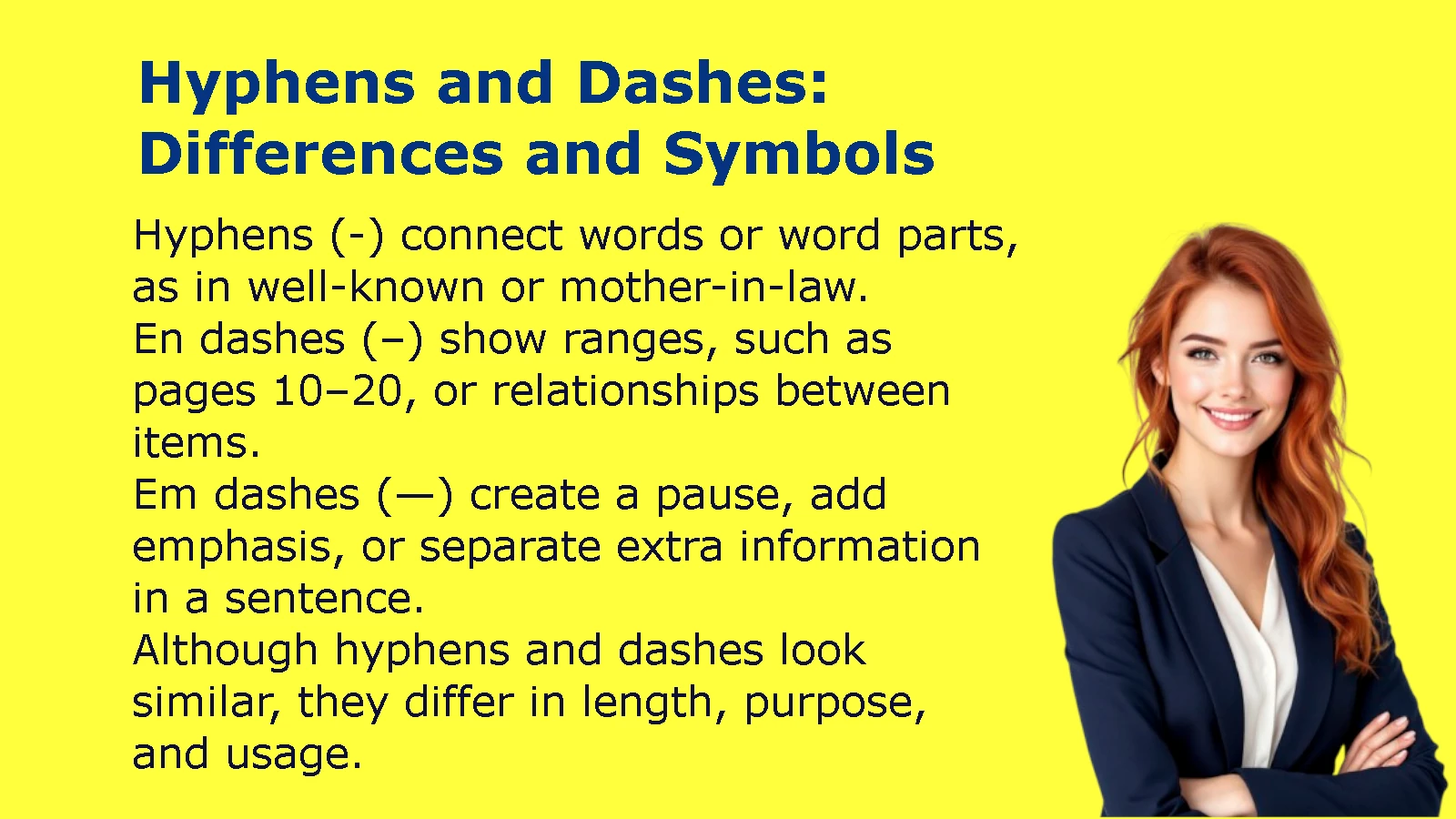
Hyphens and dashes are punctuation marks that perform different jobs in written English. A hyphen connects words or word parts, an en dash usually indicates a range or relationship, and an em dash separates sentence elements to add emphasis, clarification, or interruption. Recognizing their shapes and functions helps you choose the right mark.
What Is a Hyphen?
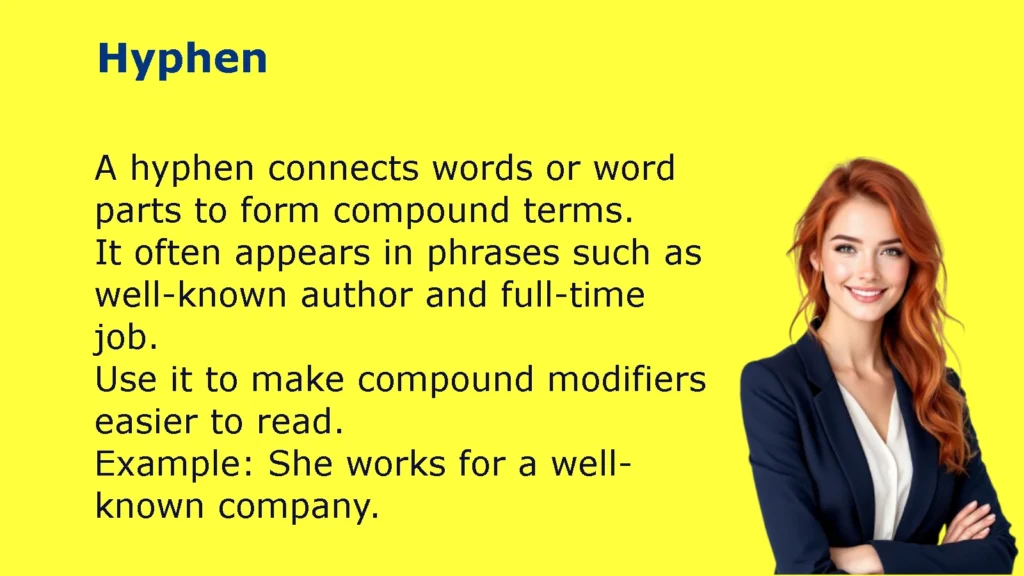
A hyphen (-) is a short punctuation mark that connects two or more words or word parts. Writers commonly use it to form compound words, clarify meaning, and connect words that work together as a description.
Here are some examples:
- Well-known: She interviewed a well-known author.
- Self-esteem: Positive feedback improved his self-esteem.
- Mother-in-law: My mother-in-law is visiting this weekend.
- Twenty-one: The class has twenty-one students.
- User-friendly: The website has a user-friendly design.
Hyphens can also prevent confusion. For example, re-sign means to sign something again, while resign means to leave a job or position.
Not every combination of words requires a hyphen. Some compounds change over time, and dictionaries and style guides may recommend different spellings. When you’re unsure, check the established spelling of the particular word.
What Is a Dash?
A dash is a punctuation mark that separates or connects parts of a sentence. English writing commonly uses two types: the en dash (–) and the em dash (—).
The en dash often connects numbers, dates, and related concepts. The em dash creates a stronger break in a sentence and can replace commas, parentheses, or a colon in certain situations.
Examples include:
- En dash: The museum is open Tuesday–Saturday.
- En dash: Read pages 25–40 before class.
- Em dash: I had one concern—the deadline.
- Em dash: Her answer—although unexpected—was correct.
The marks may look similar on a screen, but they aren’t interchangeable in every context.
Hyphen vs. En Dash vs. Em Dash
The main difference between a hyphen, en dash, and em dash is their function. Use a hyphen to connect words, an en dash to indicate a range or relationship, and an em dash to create a break, interruption, or emphasis. The correct choice depends on the meaning you want to communicate.
Hyphen (-): Symbol and Uses
The hyphen symbol (-) is the shortest of these three marks. It appears in many compound words and expressions.
Common uses include:
- Compound words: part-time, check-in, editor-in-chief.
- Compound adjectives: well-written article, long-term plan.
- Numbers: thirty-two, ninety-nine.
- Prefixes in specific cases: ex-president, self-aware.
- Meaning clarification: re-cover and recover have different meanings.
Example: The company hired a part-time assistant to manage customer emails.
The hyphen connects part and time because they form a compound modifier in this sentence.
En Dash (–): Symbol and Uses
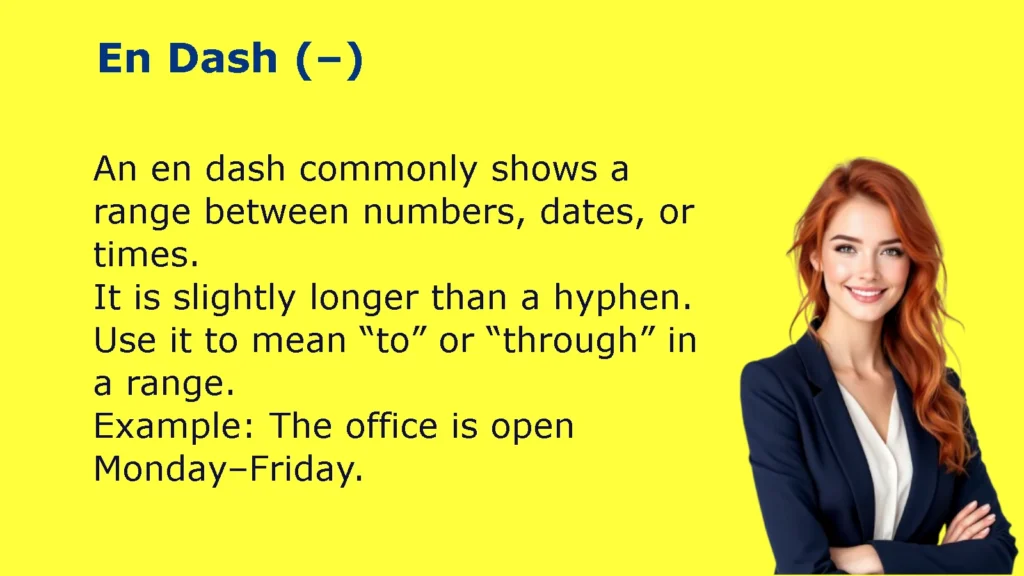
An en dash (–) is longer than a hyphen and shorter than an em dash. Writers commonly use it to show a range between two endpoints or a relationship between two connected terms.
Examples include:
- Years: The program ran from 2021–2024.
- Pages: Review pages 18–27.
- Time: The workshop runs 9:00 a.m.–11:00 a.m.
- Routes: The Boston–New York train was delayed.
- Relationships: The teacher–student discussion continued after class.
For a formal sentence, you can write, The program ran from 2021 to 2024. If you use an en dash to express the same range, avoid combining it with from or between in a way that makes the sentence grammatically awkward.
For example:
- Correct: The program ran from 2021 to 2024.
- Correct: The program ran 2021–2024.
- Incorrect: The program ran from 2021–2024.
The en dash also appears in compound expressions when one element already contains a multiword name or an open compound. For example, the New York–London route uses an en dash to connect the two place names.
Em Dash (—): Symbol and Uses
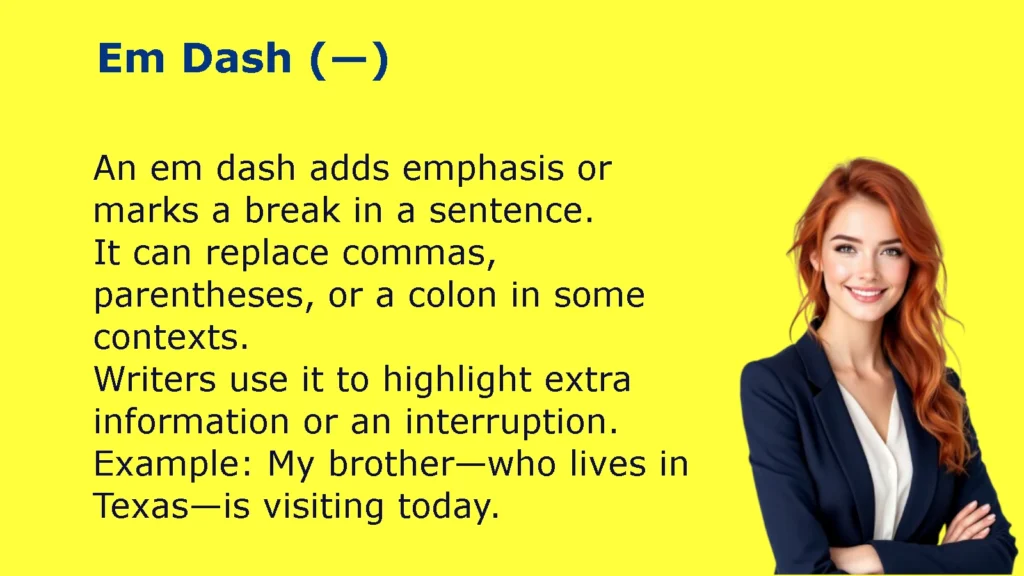
An em dash (—) is longer than an en dash. Writers use it to create a noticeable break, insert additional information, or emphasize a particular part of a sentence.
Examples include:
- Interruption: I wanted to explain—but she had already left.
- Emphasis: He needed one thing—time.
- Additional information: The report—which took six months to complete—was finally published.
- Abrupt change: We were ready to leave—then the power went out.
An em dash often gives writing a more conversational tone than a colon or semicolon. It can make a sentence feel direct, dramatic, or spontaneous.
However, using too many em dashes can make a paragraph feel fragmented. Use them when the break serves a clear purpose, not simply to add variety to every sentence.
Comparison Table: Hyphen vs. En Dash vs. Em Dash
| Feature | Hyphen | En dash | Em dash |
| Symbol | – | – | — |
| Relative length | Shortest | Medium | Longest |
| Main purpose | Connect words | Show ranges or relationships | Create breaks or emphasis |
| Typical example | well-known | 2020–2025 | The answer—finally—was clear. |
| Spaces in common US usage | Usually none | Usually none for ranges | Usually none |
| Common context | Compound words | Dates, numbers, connected terms | Explanations, interruptions, emphasis |
Quick rule: If you’re joining words, start with a hyphen. If you’re showing a range, consider an en dash. If you’re interrupting a sentence to add emphasis or information, consider an em dash.
What Are the Uses of a Hyphen? (With Examples)
A hyphen serves several purposes in English grammar. It helps readers recognize compound words, understand descriptions, interpret numbers, and distinguish between expressions that might otherwise look alike. The following examples explain ten common applications of hyphenation.
Form Compound Words
A hyphen can join words that function together as one expression. Some compounds retain their hyphens as established spellings, although usage can change over time.
Examples:
- Check-in: We completed the check-in process online.
- Self-esteem: Her self-esteem improved after the presentation.
- Editor-in-chief: The editor-in-chief approved the article.
- Mother-in-law: His mother-in-law lives nearby.
Some compound words appear with hyphens in one dictionary but as single words in another. When you write for a particular publication, follow its preferred style.
Connect Compound Adjectives
Writers often use a hyphen when two or more words work together as an adjective before a noun.
Examples:
- She submitted a well-written report.
- We booked a last-minute appointment.
- They launched a customer-focused campaign.
- The team developed a long-term strategy.
The hyphen shows that the words form one descriptive unit.
Compare these sentences:
- She is a well-known singer.
- The singer is well known.
In the first sentence, well-known appears before the noun and functions as a compound adjective. In the second, it follows the verb and generally doesn’t need a hyphen.
This rule has exceptions. Established compounds, adverbs ending in -ly, and certain style-specific expressions may follow different conventions. For instance, writers generally don’t hyphenate highly effective solution because highly is an adverb ending in -ly.
Clarify Meaning
A hyphen can distinguish words that have different meanings when written together or separately.
| Expression | Meaning | Example |
| Re-sign | Sign again | Please re-sign the updated form. |
| Resign | Leave a position | She decided to resign from her job. |
| Re-cover | Cover again | We need to re-cover the sofa. |
| Recover | Return to a normal state | He hopes to recover soon. |
The hyphen doesn’t merely change the appearance of these expressions. It helps readers identify the intended meaning.
When a sentence contains an unusual combination of words, consider whether a hyphen would make the meaning clearer.
Add Prefixes in Specific Cases
Prefixes such as ex-, self-, and all- sometimes take a hyphen.
Examples:
- Ex-president: The ex-president attended the ceremony.
- Self-aware: A self-aware writer recognizes repeated phrases.
- All-inclusive: The resort offers an all-inclusive package.
Other prefixes usually attach directly to the word, as in rewrite, preview, and unhappy.
Some words require a hyphen to prevent awkward letter combinations or ambiguity. For example, co-owner is common in edited writing, while coordinate is normally written without a hyphen.
Don’t add a hyphen to every word with a prefix. Check the established spelling and follow the relevant style guide.
Write Numbers and Fractions
English uses hyphens in many compound numbers written as words.
Examples:
- Twenty-one: She bought twenty-one notebooks.
- Forty-five: The meeting lasted forty-five minutes.
- Ninety-nine: The shop sold ninety-nine tickets.
- Two-thirds: Two-thirds of the class passed the test.
- Three-quarters: Three-quarters of the cake remained.
The exact rules can depend on the construction. Whole numbers such as one hundred generally don’t take a hyphen between one and hundred, while numbers such as one hundred and twenty-five use a hyphen in twenty-five.
For measurements, hyphenation also depends on whether the expression functions as a compound modifier.
- Correct: a five-year-old child
- Correct: The child is five years old.
Use Suspended Hyphenated Compounds
A suspended hyphen lets writers avoid repeating a shared word in a series of compound modifiers.
Examples:
- The school hired full- and part-time employees.
- We compared short- and long-term plans.
- The project requires first- and second-stage reviews.
The first hyphen indicates that the first element shares a word with the following compound. This construction can make formal writing more concise.
However, don’t use suspended hyphens when they make a sentence difficult to understand. Repeating the shared word may be clearer for a general audience.
Use Hyphens in Certain Names and Expressions
Some surnames, titles, and established expressions contain hyphens.
Examples:
- Jean-Paul: Jean-Paul joined the discussion.
- Editor-in-chief: The editor-in-chief reviewed the final draft.
- Merriam-Webster: She checked the spelling in Merriam-Webster.
Names follow the spelling chosen by the person or organization. Don’t add or remove a hyphen from someone’s name based on a general grammar rule.
Write Age and Measurement Modifiers
Hyphens commonly appear in age descriptions and measurement expressions when they work as compound adjectives before nouns.
Examples:
- A ten-year-old student won the competition.
- They completed a 20-mile journey.
- The company launched a two-hour training session.
- We ordered a 12-inch pizza.
Compare the modifier with a predicate expression:
- She is a ten-year-old student.
- She is ten years old.
The first expression modifies student, so it takes hyphens. The second describes the student’s age and doesn’t need them.
Separate Letters or Clarify Specialized Terms
Writers sometimes use hyphens when discussing letters, spelling, or technical expressions.
Examples:
- The word re-enter contains a hyphen.
- The prefix self- appears in words such as self-control.
- The expression X-ray uses a hyphen in its standard spelling.
In technical writing, follow the terminology used in the relevant field. A hyphen may be part of an established term rather than a general grammatical choice.
Divide Words at Line Breaks
Some publications divide a word at the end of a line and continue it on the next line with a hyphen. This practice is called hyphenation at line breaks.
For example, a typesetting system might divide a long word between syllables to keep text within a narrow column.
Modern word processors can perform automatic hyphenation, but automatic settings don’t always produce the best result. Review line breaks in headings, names, and specialized terminology to prevent confusing divisions.
In digital articles, you usually don’t need to insert manual hyphens just to control line wrapping. Responsive layouts handle line breaks differently across screen sizes.
What Are the Uses of a Dash? (With Examples)
A dash can create a pause, separate an interruption, show a range, or connect related terms. The en dash and em dash serve different purposes, so the best choice depends on the sentence. These examples cover ten common dash functions without treating every use as a separate grammatical rule.
Add Extra Information
An em dash can set off a phrase that adds information to a sentence.
Example: My brother—the one who lives in Dallas—is visiting next week.
The phrase the one who lives in Dallas identifies the brother. The em dashes separate this detail from the main sentence.
You could also use commas or parentheses, but each option changes the tone slightly. Em dashes usually give the added information more emphasis.
Emphasize an Explanation
Use an em dash when you want to introduce a point with force.
Example: She wanted only one thing—an honest answer.
The dash creates a pause before the explanation. This pause draws attention to an honest answer.
A colon could work in the same sentence, but an em dash often feels more conversational.
Show an Interruption
An em dash can show that a speaker interrupts another person or stops speaking abruptly.
Example:
“I thought you said—”
“I said the meeting starts at nine,” Maria replied.
The em dash signals that the first speaker’s sentence stops before completion. It can also mark a sudden interruption in thought.
In dialogue, distinguish an interruption from an ellipsis. An em dash usually signals an abrupt break, while an ellipsis often suggests trailing off, hesitation, or omitted words.
Introduce a Summary or Conclusion
An em dash can introduce a final phrase that summarizes the preceding information.
Example: Time, patience, and consistent practice—all three matter.
The final phrase reinforces the list. It doesn’t introduce a new topic but highlights the point the writer wants readers to remember.
Show a Range of Numbers or Dates
An en dash commonly replaces to or through in ranges.
Examples:
- The course runs September–December.
- Read pages 15–28.
- The exhibition features works from 1980–1995.
- Office hours are 2:00–4:00 p.m.
When the sentence already uses from, write from September to December instead of from September–December.
For ranges with negative numbers or complicated units, use wording that removes ambiguity.
Connect Related Places or Concepts
An en dash can connect two places, organizations, or concepts that have a relationship.
Examples:
- The New York–London flight takes several hours.
- The teacher–student relationship depends on trust.
- Researchers studied the cause–effect relationship.
A hyphen may still be correct in other compounds. The choice depends on the structure and the style guide you’re following. En dashes are particularly useful when the terms on both sides remain independent or already contain multiple words.
Set Off a Parenthetical Phrase
An em dash can set off a phrase in the middle of a sentence.
Example: The proposal—which took months to prepare—was approved.
Here, the dashes isolate the extra information. A pair of commas or parentheses could also work.
Choose the punctuation based on emphasis:
- Commas: The proposal, which took months to prepare, was approved.
- Parentheses: The proposal (which took months to prepare) was approved.
- Em dashes: The proposal—which took months to prepare—was approved.
The em dashes create a stronger break than commas and usually give the aside more prominence than parentheses.
Create a Dramatic Pause
Writers often use em dashes to build anticipation or highlight an unexpected result.
Example: There was only one problem—nobody had the key.
The dash delays the explanation for a moment, giving the second half of the sentence more impact.
This technique works well in narrative writing, blog introductions, and conversational articles. In academic writing, use it only when it fits the required style.
Mark a Sudden Change in Thought
An em dash can indicate that a writer changes direction or adds a qualification.
Example: I planned to leave early—but the rain changed everything.
The dash signals a shift from the original plan to the unexpected obstacle.
A comma may be enough in many sentences. Choose an em dash when the change deserves a more noticeable pause.
Mark an Abrupt Change in Dialogue
An em dash can also show when a speaker cuts off a thought or changes direction mid-sentence.
Example:
“If we leave now, we can still—”
“The train has already departed,” Sam said.
The punctuation makes the dialogue easier to follow. It also helps the reader hear the interruption without an explanatory phrase such as he stopped speaking suddenly.
Hyphen Examples in Sentences
Hyphen examples in sentences show how the mark connects words and clarifies meaning. Hyphens often appear in compound adjectives, established expressions, numbers written in words, and certain prefix constructions. The correct spelling depends on the word and how you use it in the sentence.
Examples of Hyphens in Compound Words
- The check-in desk opens at noon.
- He values self-control during difficult conversations.
- My mother-in-law brought a homemade dessert.
- The editor-in-chief approved the article.
- We discussed the cost-benefit analysis.
These examples use hyphens as part of established compound expressions. Some compounds become closed words over time, so check the preferred spelling rather than assuming every combination needs a hyphen.
Examples of Hyphens in Compound Adjectives
- The editor praised her well-written article.
- We need a long-term solution.
- He submitted a last-minute request.
- The company offers a customer-friendly service.
- They developed a high-quality product.
The hyphens connect words that work together to describe a noun.
However, compare a high-quality product with the product is high quality. In the second sentence, the expression follows the linking verb, so many style guides leave it open.
Examples of Hyphens That Change Meaning
- Please re-sign the agreement before Friday.
- The manager plans to resign next month.
- We need to re-cover the damaged chair.
- She hopes to recover from the illness soon.
- The small-business owner attended the conference.
The first four examples show how hyphens can distinguish meanings. The last example demonstrates how a hyphen can connect words into a descriptive unit.
When Should You Use a Hyphen in a Sentence?
Use a hyphen when it helps readers understand a compound expression or when a word’s established spelling requires one.
Consider these examples:
- Before a noun: They launched a well-planned campaign.
- After a linking verb: The campaign was well planned.
- To clarify meaning: Please re-create the original design.
- In compound numbers: She waited twenty-five minutes.
When in doubt, read the sentence without the hyphen. If the words become confusing, a hyphen may help. Still, clarity alone doesn’t override established spelling conventions.
Em Dash Examples in Sentences
Em dash examples demonstrate how writers create emphasis, add explanations, and represent interruptions. An em dash is more flexible than a hyphen, but it shouldn’t replace every comma, colon, or semicolon. Use it when a noticeable break improves the sentence.
Em Dash Examples for Extra Information
- The library—which opened in 1925—still serves the community.
- My laptop—a model I bought last year—needs a new battery.
- Her final essay—written after weeks of research—earned the highest grade.
- The restaurant—despite its small dining room—attracts many visitors.
The paired em dashes set off information that readers can remove without destroying the main sentence.
Em Dash Examples for Emphasis
- One thing mattered most—trust.
- He finally understood the problem—the instructions were incomplete.
- The team had one remaining task—finish the presentation.
- Her greatest strength was simple—persistence.
The dash makes the explanation stand out. It often works well when the writer wants a stronger pause than a comma provides.
Em Dash Examples in Dialogue
- “I was going to explain—but you left.”
- “If you had checked the schedule—”
- “Wait—I forgot my keys!”
These sentences use the em dash to show interruption, a sudden change, or an abrupt stop.
In published fiction, punctuation conventions vary. Follow the publisher’s style and keep the treatment of dialogue consistent throughout the manuscript.
Em Dash vs. Commas vs. Parentheses
The three punctuation options can communicate similar information but create different effects.
| Punctuation | Example | Effect |
| Commas | The plan, which took weeks, finally worked. | Neutral, integrated information |
| Parentheses | The plan (which took weeks) finally worked. | Background or less prominent information |
| Em dashes | The plan—which took weeks—finally worked. | Stronger pause and emphasis |
Practical tip: Use commas for ordinary sentence flow, parentheses for secondary details, and em dashes when the interruption deserves attention.
How to Type a Hyphen and Dash Symbol on a Keyboard
You can type a hyphen directly on most keyboards, but the en dash and em dash often require a keyboard shortcut, character picker, or automatic formatting feature. The exact method depends on your operating system, keyboard layout, and writing application.
How to Type a Hyphen (-)
On a standard US keyboard, the hyphen key usually appears beside the number 0 on the top row. Press it without Shift to type a hyphen.
For example:
- Type well-known to create a hyphenated compound.
- Type twenty-one to write a compound number.
- Type part-time to describe a job schedule.
Some keyboard layouts place the hyphen in a different position. If you use a non-US layout, check the punctuation keys shown by your operating system.
How to Type an En Dash (–)
The en dash isn’t usually printed on a standard keyboard key. You can insert it using a shortcut or character picker.
On Windows:
- In applications that support numeric Alt codes, hold Alt and type 0150 on the numeric keypad.
- In Microsoft Word, Ctrl + – on the numeric keypad can insert an en dash in supported configurations.
- You can also open the Windows character picker or use the application’s symbol menu.
On Mac:
- Press Option + – to type an en dash in the standard macOS layout.
Shortcut behavior can vary by application and keyboard configuration. If a shortcut doesn’t work, use the symbol menu or copy the character below.
How to Type an Em Dash (—)
The em dash is longer than both the hyphen and en dash. It’s commonly used for interruptions and explanatory breaks.
On Windows:
- In Microsoft Word, Ctrl + Alt + – on the numeric keypad can insert an em dash in supported configurations.
- In applications that support numeric Alt codes, hold Alt and type 0151 on the numeric keypad.
- Use the application’s special-character or symbol menu if the shortcut isn’t available.
On Mac:
- Press Shift + Option + – to type an em dash in the standard macOS layout.
Some applications automatically replace two hyphens (–) with an em dash. This feature depends on the program’s settings and may not work in plain-text editors.
Hyphen and Dash Symbols to Copy and Paste
Copy the symbol you need from this table.
| Punctuation mark | Symbol | HTML entity | Common use |
| Hyphen-minus | – | - | Compound words |
| En dash | – | – | Ranges |
| Em dash | — | — | Emphasis and interruptions |
The ordinary keyboard character – is technically a hyphen-minus, a character that serves as the standard keyboard hyphen in everyday writing. Typography systems distinguish it from the dedicated Unicode hyphen character, but most general writing doesn’t require that distinction.
How to Type Hyphens and Dashes on a Phone
On iPhone and Android devices, the hyphen usually appears on the main or secondary keyboard screen.
To find an en dash or em dash:
- Open the punctuation keyboard.
- Press and hold the hyphen key if your keyboard supports additional punctuation options.
- Check the symbol or special-character screen.
- Copy the required dash from a trusted text source if your keyboard doesn’t provide it.
The available options depend on your keyboard app and language settings. You can also set up text replacements for marks you use frequently.
For example, you could configure a text replacement that converts a custom sequence into an em dash, provided your device or app supports that feature.
How Is Hyphen Pronounced?
The word hyphen is pronounced HY-fən, with the stress on the first syllable. It names the short punctuation mark used to connect words and word parts. When reading a sentence aloud, you usually don’t say the word hyphen; you simply read the sentence naturally.
Hyphen Pronunciation
Hyphen has two syllables:
- First syllable: HY
- Second syllable: fən
The stress falls on the first syllable. The final syllable sounds like the unstressed ending in words such as happen.
Example: If you see user-friendly, you would normally read the expression as “user friendly,” not say “user hyphen friendly.”
Is a Hyphen the Same as a Dash When Speaking?
No. A hyphen and a dash are different punctuation marks, although people may use the terms loosely in everyday conversation.
When describing written punctuation, use these names:
- Hyphen: The short mark in user-friendly.
- En dash: The mark in a range such as 2020–2025.
- Em dash: The mark used in I tried—but failed.
When reading aloud, you usually express the punctuation through pauses, phrasing, or emphasis rather than naming the symbol. In proofreading or editing, however, naming the exact mark helps prevent confusion.
Common Hyphen and Dash Mistakes
Writers often confuse hyphens and dashes because the marks look similar and some word processors substitute one for another. Avoiding these common mistakes improves punctuation consistency and makes your writing easier to scan.
Using a Hyphen Instead of an En Dash
A hyphen is appropriate in compound words, while an en dash commonly represents a range.
Compare:
- Compound word: The part-time employee arrived early.
- Date range: The exhibition runs 2020–2025.
- Page range: The relevant section appears on pages 15–22.
A keyboard hyphen may appear in informal text ranges, but an en dash is generally preferred in polished typography.
Using Two Hyphens Instead of an Em Dash
Some plain-text systems use two hyphens (–) to represent an em dash because the longer character isn’t readily available.
For example:
The answer–after several revisions–was finally approved.
In many modern word processors, you can type two hyphens and let automatic formatting replace them with an em dash. In finished documents, use the actual em dash when your style guide calls for it.
Adding Spaces Around Hyphens
A hyphen usually connects words without spaces.
Correct:
- a well-written article
- a long-term plan
- a twenty-one-year-old student
Incorrect in standard usage:
- a well – written article
- a long – term plan
Spaces change the appearance of the compound and can interfere with its meaning. Don’t add spaces around a hyphen simply to make the expression look more open.
Using Too Many Em Dashes
Em dashes can make writing lively, but excessive use can interrupt the flow.
Consider this sentence:
The report—which was long—which was expensive—which took months—was finally complete.
A clearer version is:
The long, expensive report took months to complete.
Use a dash when the break adds meaning or emphasis. If the sentence works better with commas or a simpler structure, revise it instead.
Hyphenating Every Compound Word
Not every compound needs a hyphen. Common examples include:
- Website: Usually one word.
- Email: Commonly one word.
- Notebook: One word.
- Long-term: Usually hyphenated when used as a compound modifier.
- Well known: Commonly open after a linking verb.
Some spellings vary by dictionary, publication, or regional convention. Check the preferred form when the spelling matters to a formal document.
How to Choose Between a Hyphen, En Dash, and Em Dash
The simplest way to choose the right punctuation mark is to identify what the sentence needs. Are you connecting words, showing a range, or creating a break? Once you identify the function, the correct mark becomes easier to select.
Use a Hyphen to Connect Words
Choose a hyphen when two or more words form a compound or when an established spelling requires one.
Examples:
- User-friendly interface
- Five-minute break
- Self-confidence
- Part-time position
Remember that compound adjectives before nouns often take hyphens, but the same expressions may appear open after linking verbs.
Use an En Dash for Ranges and Relationships
Choose an en dash when you want to express a range or connect two related elements.
Examples:
- 2018–2022
- Pages 40–55
- The Chicago–Detroit route
- The parent–child relationship
For a range, the en dash usually means to or through. If the sentence already includes from or between, use a grammatical construction with to or and.
Use an Em Dash for Emphasis and Interruptions
Choose an em dash when you want to interrupt a sentence, insert an aside, or emphasize a final thought.
Examples:
- I needed only one thing—an answer.
- The meeting—which lasted two hours—ended at noon.
- “I thought we had agreed—”
- She opened the envelope—and gasped.
Use the mark deliberately. A strong dash can improve a sentence, but several unnecessary dashes can make the writing harder to follow.
Quick Decision Table
| If you want to… | Use | Example |
| Connect words | Hyphen | user-friendly |
| Write a compound number | Hyphen | twenty-five |
| Show a range | En dash | 9:00–11:00 a.m. |
| Connect two place names | En dash | Boston–New York route |
| Add extra information with emphasis | Em dash | The report—which was late—arrived. |
| Show an interruption | Em dash | “But I thought—” |
| Introduce an emphatic explanation | Em dash | The cause was simple—poor planning. |
A Practical Editing Example
Imagine you’re editing this sentence:
The well known author discussed the 2020-2025 publishing trend—and its long term effects.
A polished version could read:
The well-known author discussed the 2020–2025 publishing trend—and its long-term effects.
The revised sentence uses hyphens in well-known and long-term because both expressions function as compound modifiers. It uses an en dash for the date range and an em dash to introduce an emphatic addition.
This example shows why punctuation matters. Each mark contributes something different to the sentence, and using the right one makes the relationships between ideas clearer.
Frequently Asked Questions
What Is the Difference Between a Hyphen and a Dash?
A hyphen (-) connects words or word parts, as in well-known. A dash creates a break or connection between sentence elements. The en dash (–) commonly shows ranges, while the em dash (—) adds emphasis, explanations, or interruptions.
What Are the Three Types of Hyphens and Dashes?
The three marks most commonly compared are the hyphen (-), en dash (–), and em dash (—). The hyphen connects words, the en dash indicates ranges or relationships, and the em dash marks a strong break or adds emphasis. Technically, only the first is a hyphen.
How Do I Type an Em Dash on My Keyboard?
On a standard Mac keyboard layout, press Shift + Option + – to type an em dash. In Microsoft Word on Windows, Ctrl + Alt + the numeric keypad minus key works in supported configurations. You can also copy this symbol: —.
What Are Ten Uses of a Dash With Examples?
Common dash functions include showing ranges, connecting related places, adding extra information, emphasizing explanations, marking interruptions, creating dramatic pauses, introducing summaries, showing changes in thought, setting off parenthetical phrases, and representing abrupt dialogue breaks. Use an en dash primarily for ranges and relationships, and an em dash for sentence breaks and emphasis.
Should There Be Spaces Around an Em Dash?
In standard US English publishing, writers generally place no spaces around an em dash. For example, The result—unexpected but welcome—changed the plan. Some publications and style guides use spaces around em dashes, so follow the required house style.
How Do You Pronounce Hyphen?
Hyphen is pronounced HY-fən, with stress on the first syllable. When reading a hyphenated word such as user-friendly, you normally read the words naturally rather than saying the word hyphen aloud.
Conclusion
Hyphens and dashes may look similar, but each mark has a distinct purpose. A hyphen (-) connects words and word parts, an en dash (–) commonly shows a range or relationship, and an em dash (—) creates a break, adds information, or emphasizes an idea.
When editing your writing, ask yourself three questions: Am I connecting words? Am I showing a range? Or am I creating a pause or interruption? Those questions will help you select the correct mark in most everyday situations.
Keep the comparison table handy, practice with the examples, and check your preferred style guide when a compound spelling or spacing rule isn’t clear. If you’re editing a blog post, essay, email, or report, a quick punctuation review can make the finished text clearer and more professional.