Modernize vs modernise is a common spelling question for writers, students, and English learners. Modernize is the standard American English spelling, while modernise is widely used in British English. Both words mean to update something, improve its design, or make it more suitable for present-day needs.
The difference goes beyond the final letter. Related words follow the same general pattern: American English uses modernized, modernizing, and modernization, while British English commonly uses modernised, modernising, and modernisation. Both forms have the same basic meaning and pronunciation.
Understanding the difference helps you choose the correct spelling for your audience. Whether you are writing a business proposal, updating a website, preparing an academic assignment, or editing an article, this guide explains the meaning of modernise, modernize sentence examples, synonyms, pronunciation, grammar, and the difference between American and British spelling.
Modernize vs Modernise: Which Spelling Is Correct?
Both modernize and modernise are correct spellings of the same verb. American English generally uses modernize, while British English commonly uses modernise. The spelling does not change the word’s meaning or pronunciation. Choose the form that matches your intended audience and maintain that spelling throughout your writing.
The main difference is regional spelling preference, not grammar or meaning.
| Feature | Modernize | Modernise |
| Main regional association | American English | British English |
| Part of speech | Verb | Verb |
| Meaning | To make something more modern | To make something more modern |
| Past tense | Modernized | Modernised |
| Present participle | Modernizing | Modernising |
| Noun form | Modernization | Modernisation |
| Pronunciation | Generally the same | Generally the same |
| Example | We will modernize the office. | We will modernise the office. |
Although these patterns are common, British English does not reject every word ending in -ize. Some British dictionaries and style guides accept or prefer -ize spellings for certain words. However, modernise remains a familiar and widely accepted British form.
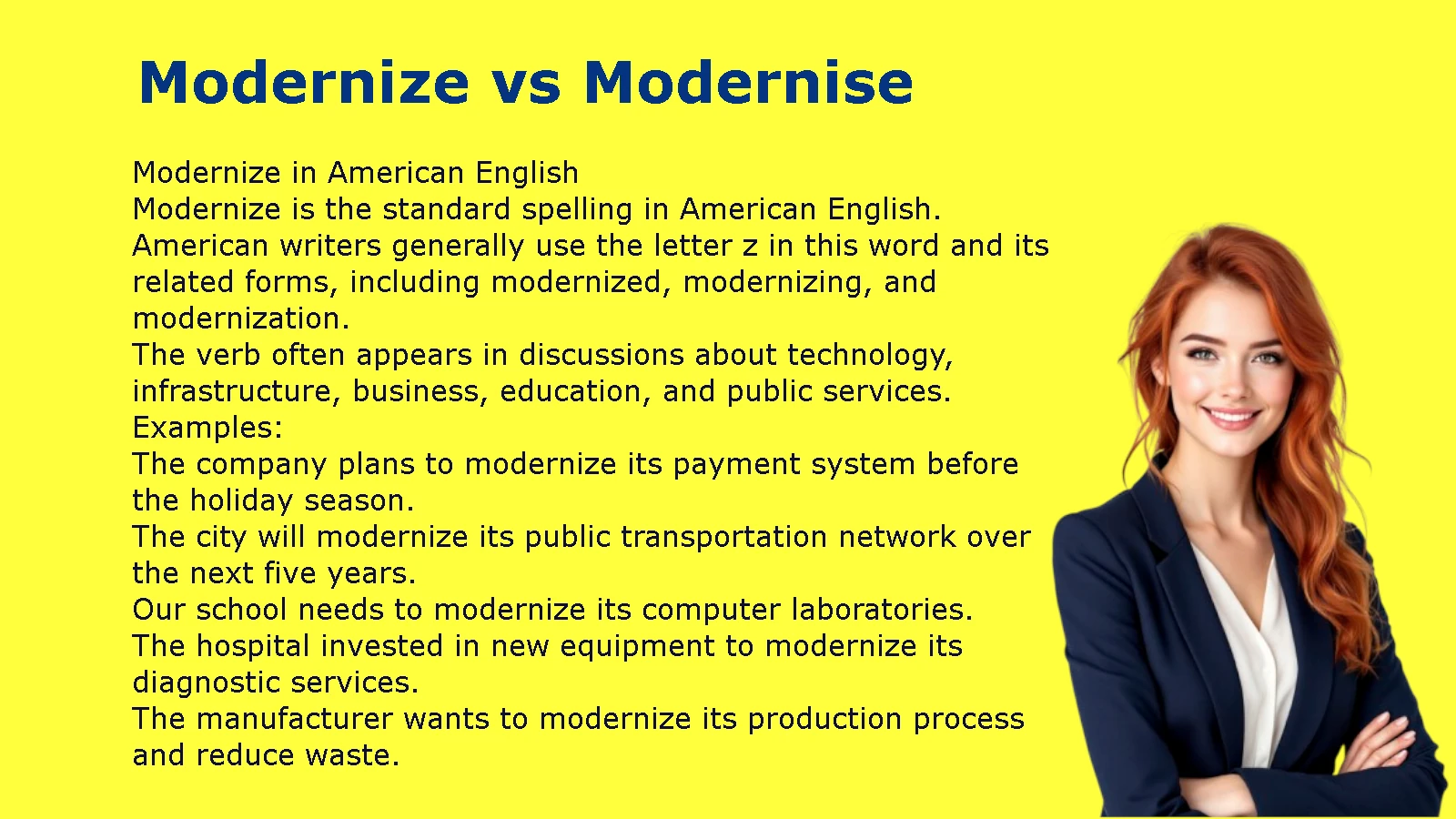
Modernize in American English
Modernize is the standard spelling in American English. American writers generally use the letter z in this word and its related forms, including modernized, modernizing, and modernization.
The verb often appears in discussions about technology, infrastructure, business, education, and public services.
Examples:
- The company plans to modernize its payment system before the holiday season.
- The city will modernize its public transportation network over the next five years.
- Our school needs to modernize its computer laboratories.
- The hospital invested in new equipment to modernize its diagnostic services.
- The manufacturer wants to modernize its production process and reduce waste.
In each sentence, modernize describes an update intended to make something more current, efficient, useful, or suitable for present-day requirements.
American writers also use modernize in formal reports and everyday conversations. You might modernize a website, modernize an old building, or modernize the way a team manages its projects.
Writing tip: If your article uses American spellings such as color, organize, and analyze, choose modernize to maintain consistency.
Modernise in British English
Modernise is widely used in British English. It carries the same meaning as modernize but follows the common British -ise spelling pattern.
British writers use the word in everyday communication, news articles, business documents, academic work, and discussions about public services.
Examples:
- The council plans to modernise the local library.
- The company wants to modernise its customer service process.
- The school will modernise its classrooms with new equipment.
- The government announced plans to modernise the railway network.
- The museum hopes to modernise its visitor facilities without losing its historic character.
These sentences describe changes intended to improve existing systems, places, or methods.
British spelling conventions can vary by publication. Some British style guides prefer -ise endings, while others accept or favor -ize in certain words. The important point is to follow the required style guide rather than assume that every British writer must use s.
Writing tip: If you are writing for a British audience and already use forms such as organise, realise, and recognise, use modernise unless your publisher specifies otherwise.
Modernise or Modernize in the UK?
Both forms can appear in British writing, but modernise is a widely used British spelling. Modernize is also accepted in some British publishing and dictionary conventions. The right choice depends on the style guide, organization, or publication you are writing for.
For example, a British company might write:
We plan to modernise our customer support system.
Another organization that follows a style guide favoring -ize spellings may write:
We plan to modernize our customer support system.
Neither sentence changes the intended meaning.
When deciding which spelling to use, consider these points:
- Follow the publisher’s rules. A university, newspaper, or company may have a preferred spelling convention.
- Check existing content. If the website consistently uses British -ise forms, maintain that pattern.
- Consider your readers. Use familiar regional spelling in localized content when appropriate.
- Avoid unnecessary mixing. Don’t switch between modernise and modernize without a clear reason.
The same principle applies to the related noun. A British publication may prefer modernisation, while an American publication generally uses modernization.
Modernise Meaning and Definition
Modernise means to change or update something so that it becomes more modern, efficient, practical, or suitable for current needs. It is a verb used for physical objects, technology, organizations, systems, and methods. Modernize has exactly the same meaning; the difference lies in the spelling convention.
For example, a company might modernise its website by improving its design, making it mobile-friendly, and adding secure payment options. The company is not necessarily replacing the entire website. It is updating the existing system to meet present-day expectations.
Simple Meaning of Modernise
In simple English, to modernise something means to bring it up to date.
Imagine that a school still uses outdated computers, printed attendance sheets, and an old filing system. The school decides to install newer computers, introduce digital attendance, and store student records electronically.
These changes modernise the school’s operations because they replace outdated methods with more current ones.
Here are a few everyday examples:
- Modernise a kitchen: Install updated appliances and improve the layout.
- Modernise a website: Improve its design, speed, security, and mobile experience.
- Modernise a business: Introduce better software and more efficient procedures.
- Modernise a transport system: Upgrade vehicles, ticketing, and passenger information.
- Modernise education: Update teaching materials, classroom technology, and learning methods.
The word does not always mean replacing something old with something completely new. Sometimes, small changes can modernise an existing product or process.
For example, adding online booking to a traditional doctor’s office can modernise its service without changing how doctors diagnose or treat patients.
Modernise Meaning in Different Contexts
The exact application of modernise depends on what someone wants to improve. The central idea remains the same: update an existing thing to meet present-day needs.
Modernise in Technology
In technology, modernise often means replacing outdated tools, software, hardware, or digital processes with newer alternatives.
For example:
The retailer plans to modernise its inventory system so employees can track stock in real time.
The retailer may introduce cloud-based software, barcode scanning, or automated alerts. These changes help staff work with more accurate information.
Common technology-related uses include:
- Modernise an IT infrastructure.
- Modernise an outdated database.
- Modernise a mobile application.
- Modernise cybersecurity systems.
- Modernise a company’s digital services.
Modernisation does not automatically mean adopting the newest available technology. A sensible upgrade should solve a real problem, improve performance, or support a clear business goal.
Modernise in Business
In business, modernise means updating the way a company operates, serves customers, manages employees, or delivers products.
Consider a small retailer that records every sale manually. As the business grows, the owner introduces digital payments, inventory software, and automated sales reports.
The retailer modernises its operations because the new tools reduce repetitive work and provide better information.
Business examples include:
- The firm wants to modernise its accounting procedures.
- Management decided to modernise the customer service department.
- The owner modernised the ordering process to reduce delays.
- The company is modernising its marketing strategy for online customers.
The goal is not simply to make a business look contemporary. A useful modernisation project should address a specific need, such as lower costs, fewer errors, faster service, or improved customer satisfaction.
Modernise Buildings and Infrastructure
When applied to buildings, modernise often means upgrading facilities, equipment, safety features, or energy performance.
For example:
The university will modernise its older buildings by improving accessibility and installing energy-efficient lighting.
The work might include updated electrical systems, better heating and cooling, improved insulation, or accessible entrances.
Modernising infrastructure can involve:
- Roads and bridges.
- Railway stations.
- Water supply systems.
- Public buildings.
- Electricity networks.
- Hospitals and schools.
The scope of the project matters. Modernising a historic building may require careful planning to preserve its original features while improving safety and usability.
Modernise in Education
In education, modernise means updating teaching practices, learning materials, facilities, or administrative systems.
For example:
The school introduced interactive learning tools to modernise its science lessons.
Other examples include replacing outdated textbooks, improving internet access, introducing digital assessments, and training teachers to use new educational tools.
Modernising education does not mean abandoning every traditional teaching method. A school can retain effective classroom discussions and practical exercises while adding technology where it helps students learn.
Modernise Synonyms
Several words can replace modernise, but each has a slightly different meaning. The best synonym depends on the change being described.
| Synonym | Meaning | Example |
| Update | Bring something up to date | We need to update the website. |
| Upgrade | Improve quality, capability, or performance | The company will upgrade its servers. |
| Revamp | Change something significantly to improve it | The store plans to revamp its interior. |
| Renovate | Repair or improve a building or space | They will renovate the old office. |
| Improve | Make something better in a general sense | The team wants to improve its workflow. |
| Overhaul | Make extensive changes to a system or process | Management decided to overhaul the booking system. |
| Refurbish | Restore or improve the condition of something | The hotel will refurbish its guest rooms. |
| Reform | Change a system or institution to improve how it works | The agency plans to reform its procedures. |
These alternatives overlap with modernise, but they are not interchangeable in every sentence.
For instance, renovate a building usually emphasizes physical improvements. Modernise a building can include those improvements while also suggesting updated technology, facilities, or standards.
Similarly, upgrade software often refers to a specific improvement, whereas modernise a company’s IT systems may describe a broader project involving software, hardware, security, and working practices.
Choose the word that describes the actual change rather than selecting a synonym merely to avoid repetition.
Modernize in a Sentence: Examples of Correct Usage
Modernize means to update something to make it more current or effective. Use it when describing improvements to technology, buildings, organizations, products, or methods. In American English, modernize is the usual spelling; British English commonly uses modernise. Both forms work with the same grammatical patterns.
The following examples show how the word works in different situations.
Modernize Examples in American English
Use modernize when writing for an American audience or following an American English style guide.
- The bank plans to modernize its online banking platform.
- Our company needs to modernize its outdated filing system.
- The city wants to modernize its public transportation network.
- The university invested in new laboratories to modernize its science program.
- The factory will modernize its equipment to improve production efficiency.
- The hotel plans to modernize its rooms while preserving the building’s historic character.
- The nonprofit organization is working to modernize its donation process.
- The retailer decided to modernize its website before expanding into new markets.
Each example uses modernize as the base form of the verb.
You can also use the word after to:
- We need to modernize the software.
- The council hopes to modernize the library.
- The company wants to modernize its internal procedures.
Here, to modernize is an infinitive phrase that explains the intended action.
Modernise Examples in British English
The same sentences work in British English when you replace the z spelling with s.
- The bank plans to modernise its online banking platform.
- Our company needs to modernise its outdated filing system.
- The city wants to modernise its public transport network.
- The university invested in new laboratories to modernise its science facilities.
- The factory will modernise its equipment to improve production efficiency.
- The hotel plans to modernise its rooms while preserving the building’s historic character.
- The charity is working to modernise its donation process.
- The retailer decided to modernise its website before expanding into new markets.
Notice that regional vocabulary may also change. For instance, British writers often use public transport, while American writers commonly use public transportation. That difference is separate from the spelling of modernise.
Modernized vs Modernised
Modernized is the standard American spelling of the past tense and past participle. Modernised is common in British English. Both forms describe something that received an update or the completed action of making something more modern.
Compare these examples:
| American English | British English |
| The company modernized its offices. | The company modernised its offices. |
| The system was modernized last year. | The system was modernised last year. |
| They have modernized the website. | They have modernised the website. |
| The city modernized the railway station. | The city modernised the railway station. |
The word can function in different grammatical structures.
Simple past:
The hospital modernized its patient records system.
The verb describes a completed action in the past.
Present perfect:
The hospital has modernized its patient records system.
The sentence connects a past action with the present situation.
Passive voice:
The patient records system was modernized last year.
The sentence emphasizes the system rather than the people who updated it.
The British equivalents use modernised in all three examples. The grammar stays the same; only the spelling changes.
Modernize vs Modernise: Grammar and Word Forms
Modernize and modernise follow the same grammatical rules because they are spelling variants of the same verb. Both can appear in the present tense, past tense, present participle, infinitive, and passive voice. The main difference appears in the spelling of the base verb and its related forms.
Understanding the word family helps you use the correct form in sentences.
Modernize, Modernized, and Modernizing
American English generally follows this pattern:
| Word form | Part of speech or function | Example |
| Modernize | Base verb | We plan to modernize the office. |
| Modernizes | Third-person singular | The company modernizes old equipment. |
| Modernized | Past tense or past participle | They modernized the website. |
| Modernizing | Present participle or gerund | The team is modernizing the system. |
| Modernization | Noun | Modernization improved the process. |
The spelling changes according to the grammatical form.
For example, add -s to form modernizes for a third-person singular subject in the simple present:
The manufacturer modernizes its equipment every few years.
Add -ed to form the past tense:
The manufacturer modernized its equipment last year.
Add -ing to form the present participle:
The manufacturer is modernizing its production line.
The noun modernization describes the process or result of making something more modern.
The modernization of the factory reduced production delays.
Modernise, Modernised, and Modernising
British English commonly uses these corresponding forms:
| Word form | Part of speech or function | Example |
| Modernise | Base verb | We plan to modernise the office. |
| Modernises | Third-person singular | The company modernises old equipment. |
| Modernised | Past tense or past participle | They modernised the website. |
| Modernising | Present participle or gerund | The team is modernising the system. |
| Modernisation | Noun | Modernisation improved the process. |
The same grammatical rules apply to both spelling variants.
For example:
- Present tense: The council modernises public buildings.
- Past tense: The council modernised the library.
- Present participle: The council is modernising the transport network.
- Infinitive: The council hopes to modernise the town centre.
- Passive voice: The town centre was modernised last year.
The word modernising can also function as a noun-like gerund:
Modernising the transport network will take several years.
Here, the phrase modernising the transport network acts as the subject of the sentence.
Modernisation vs Modernization
Modernisation is the common British English noun form, while modernization is standard American English. Both refer to the process of updating something or the changes made to bring it in line with current needs.
The spelling difference follows the same regional pattern as modernise and modernize.
Examples:
British English: The modernisation of the railway network will improve passenger services.
American English: The modernization of the railway network will improve passenger services.
Other examples include:
- The school announced a major modernisation project.
- The company invested in the modernization of its computer systems.
- Public modernisation projects can require long-term planning.
- The factory’s modernization improved the reliability of its equipment.
In both varieties of English, modernisation and modernization are nouns. They describe a process, project, or broader set of changes rather than the act of updating something in a particular sentence.
Compare these two structures:
- The company will modernise its offices. — The verb describes the action.
- The modernisation of its offices will take six months. — The noun describes the process.
Choosing the correct word form matters just as much as choosing the regional spelling.
Modernise Pronunciation
Modernise and modernize are generally pronounced the same way. In standard English pronunciations, the difference between s and z in the spelling does not normally change the sound of the word. The pronunciation has three syllables, with the main stress on the first syllable.
How to Pronounce Modernise
A common pronunciation in both British and American English is represented by the IPA as /ˈmɒd.ən.aɪz/ in a British-style transcription. American pronunciation commonly uses a different vowel in the first syllable, often represented as /ˈmɑː.dɚ.naɪz/.
The exact vowel quality varies by accent, but the main stress falls on the first syllable.
To practice:
- Say the first syllable clearly.
- Keep the middle syllable relatively light.
- Finish with the sound that rhymes with eyes.
The final sound is voiced, like the z sound in size. This remains true even when the word is written with an s in modernise.
Is Modernize Pronounced Differently?
No. In ordinary use, modernize and modernise have the same pronunciation within the same accent.
The spelling difference reflects regional writing conventions rather than a different spoken meaning.
For example, an American speaker might write:
We need to modernize the website.
A British speaker might write:
We need to modernise the website.
Both sentences normally use the same pronunciation for the verb. The difference appears on the page, not in the intended sound.
Keep in mind that English accents vary. A British speaker and an American speaker may pronounce the first vowel differently because of their accents, but that variation does not arise from the s versus z spelling.
Modernize vs Modernise: Common Mistakes to Avoid
The most common mistakes involve treating one spelling as universally correct, mixing regional conventions, or choosing a related word that does not accurately describe the intended change. You can avoid these problems by identifying your audience, checking the grammatical form, and using the word consistently.
Mixing American and British Spellings
Mixing spelling conventions can make a document look inconsistent, especially when the same word family appears several times.
Consider this example:
The company plans to modernize its offices and modernise its customer service platform.
The sentence uses both variants without explaining why. If the writer intends to follow American English, the second verb should also use z. If the writer intends to follow British English, the first verb should use s.
Consistent American English:
The company plans to modernize its offices and modernize its customer service platform.
Consistent British English:
The company plans to modernise its offices and modernise its customer service platform.
You can make the sentence more natural by avoiding unnecessary repetition:
American English: The company plans to modernize its offices and update its customer service platform.
British English: The company plans to modernise its offices and update its customer service platform.
The last two examples maintain regional spelling consistency while improving the sentence’s flow.
When editing a long article, check the entire word family rather than searching for the base form alone. Look for modernized, modernizing, modernisation, and modernization as well.
Confusing Modernise With Renovate or Upgrade
Modernise, renovate, and upgrade overlap in meaning, but each emphasizes a different type of improvement.
Modernise has the broadest application when the goal is to bring something up to date. It can describe a building, software, a business process, a transport system, or an educational approach.
Renovate usually refers to repairing or improving a physical place or structure.
Upgrade usually emphasizes a better version, higher performance, or improved capability.
Compare these examples:
| Situation | Best-fitting word | Why |
| Replacing an old payment system with current software | Modernise or upgrade | The system receives a technological improvement. |
| Repairing a damaged kitchen and replacing its cabinets | Renovate | The work focuses on the physical space. |
| Improving a company’s entire operating model | Modernise | The changes may affect several processes and systems. |
| Installing a faster processor in a computer | Upgrade | The change improves a specific component. |
| Changing outdated government procedures | Modernise or reform | The wording depends on whether the focus is updating methods or changing institutional rules. |
For example, a business may renovate its office, upgrade its computers, and modernise its overall operations.
All three verbs can describe improvements, but they do not mean exactly the same thing.
Choosing a Spelling for Academic and Professional Writing
The best spelling depends on the document’s intended audience and required style.
For academic work, check the university’s language and formatting guidance. Some institutions require American English, while others expect British English. A journal or publisher may also have its own house style.
For professional writing, use the convention adopted by the organization. A business with an American website may prefer modernize, while a British organization may use modernise.
Follow this practical process:
- Identify your audience. Decide whether the content targets American, British, or another English-speaking readership.
- Check the style guide. Follow any explicit spelling rules from your institution, publisher, or client.
- Review related words. Check forms such as modernized, modernising, and modernization.
- Use a spellchecker carefully. Set its language preference to the intended variety of English.
- Proofread for consistency. Search for both modernize and modernise before publishing.
A spellchecker may flag a valid regional variant if its dictionary uses another convention. That does not automatically mean the word is incorrect.
For websites, consistency also helps readers recognize a coherent editorial style. It is more useful to choose one convention and apply it across related pages than to alternate spellings without a reason.
A Practical Case Study: Modernize or Modernise in a Business Article
Imagine a company that wants to update an old customer support system. Its website serves readers in both the United States and the United Kingdom, and the marketing team is preparing two localized versions of the same article.
The underlying facts do not change. The spelling does.
American version:
The company plans to modernize its customer support system by introducing automated ticket routing, updating its knowledge base, and improving mobile access.
British version:
The company plans to modernise its customer support system by introducing automated ticket routing, updating its knowledge base, and improving mobile access.
Both versions communicate the same project and benefits. The difference appears in the verb’s spelling.
The team should also check related forms elsewhere in the article.
| American version | British version |
| Modernize the system | Modernise the system |
| The system was modernized | The system was modernised |
| Modernizing customer support | Modernising customer support |
| A modernization project | A modernisation project |
This approach is useful for websites with regional landing pages, help centers, product descriptions, and localized marketing content.
However, localization involves more than changing s to z. Teams should also review regional vocabulary, dates, measurements, punctuation, and other spelling conventions when relevant.
Practical lesson: Treat modernize and modernise as two regional spellings of one word. Localize the spelling to fit your audience, then apply that choice consistently across the full document.
Quick Comparison: Modernize vs Modernise
The table below summarizes the main differences so you can select the right form quickly.
| Question | Answer |
| Is modernize correct? | Yes. It is the standard American English spelling. |
| Is modernise correct? | Yes. It is widely used in British English. |
| Do the words mean different things? | No. Both mean to make something more modern. |
| Is modernized American or British? | Modernized is standard American spelling. |
| Is modernised correct? | Yes. It is common in British English. |
| Is it modernisation or modernization? | Modernisation is common in British English; modernization is standard in American English. |
| Do modernize and modernise sound different? | Generally not within the same accent. |
| Can I use modernize in British English? | Yes. Some British style guides and dictionaries accept or prefer -ize spellings. |
| Which form should I use in an article? | Follow the spelling convention required by your audience or style guide. |
If you remember one rule, make it this: modernize is standard in American English, while modernise is widely used in British English. Both spellings are correct, and both carry the same meaning.
Frequently Asked Questions
Is modernise or modernize correct in British English?
Both spellings can appear in British English. Modernise is widely used, while modernize is accepted by some British dictionaries and style guides. Follow the spelling convention used by your publisher, organization, or academic institution.
What does modernise mean?
Modernise means to update something to make it more modern, efficient, or suitable for current needs. You can modernise a building, business process, website, computer system, or teaching method. Modernize has the same meaning.
Is modernized American or British spelling?
Modernized is the standard American spelling. British English commonly uses modernised. Both are past-tense and past-participle forms of the verb, and the difference does not affect the meaning.
What are synonyms for modernise?
Common synonyms include update, upgrade, revamp, renovate, improve, overhaul, and refurbish. The best choice depends on the context. Renovate usually emphasizes a physical space, while modernise can describe broader changes to technology, methods, and systems.
How do you pronounce modernise?
Modernise is generally pronounced with three syllables and stress on the first syllable. The final sound is a voiced z sound, as in size. Modernize is usually pronounced the same way, although accents may affect the vowel sounds.
Is it modernisation or modernization?
Modernisation is the common British English form, while modernization is the standard American English form. Both are nouns describing the process of making something more modern or the changes made during that process.
Conclusion: Choose Modernize or Modernise Based on Your Audience
The difference between modernize and modernise is straightforward once you understand regional spelling conventions. Modernize is the standard American English form, while modernise is widely used in British English. Both mean to update something, improve its design, or make it more suitable for present-day needs.
The related word forms follow the same general pattern: American English commonly uses modernized, modernizing, and modernization, while British English commonly uses modernised, modernising, and modernisation.
Before publishing an article, check your audience, follow the relevant style guide, and review the full word family for consistency. These simple steps help you avoid unnecessary spelling errors and make your writing easier to read.