Customized or customised—which spelling should you use? Both spellings are correct, but your choice depends on the variety of English you write. Customized is the standard form in American English, while customised is widely used in British English, Australian English, and other English varieties that favor the -ise ending.
Both words mean modified or adapted to meet someone’s specific needs, preferences, or requirements. You might order a customized laptop, request a customised travel package, or create customized software for a business. The meaning remains the same; only the spelling changes.
Understanding the difference between American English and British English spelling, along with related forms such as customization vs. customisation and customizing vs. customising, helps you write clearly and consistently. Whether you’re preparing a website, business proposal, academic paper, or everyday email, the right choice depends on your audience and preferred style guide.
Customized vs. Customised: What’s the Difference?
Customized and customised have the same meaning, pronunciation, and grammatical function. The difference is regional spelling preference. American English generally uses customized, while British English commonly uses customised. Neither spelling is universally incorrect, so choose the form that matches your intended audience.
| Feature | Customized | Customised |
| Preferred English variety | American English | British English |
| Base verb | Customize | Customise |
| Meaning | Adapted to specific needs | Adapted to specific needs |
| Present participle | Customizing | Customising |
| Noun form | Customization | Customisation |
| Pronunciation | The same | The same |
| Example | We offer customized plans. | We offer customised plans. |
The distinction follows a broader spelling pattern. American English often uses -ize, while British English frequently uses -ise. You can see the same pattern in pairs such as organize/organise, personalize/personalise, and prioritize/prioritise.
However, British English does not always require -ise. Some British dictionaries and style guides accept or prefer -ize in words such as organize. Therefore, the distinction is a common regional preference rather than an absolute rule for every English word.
Customized Meaning
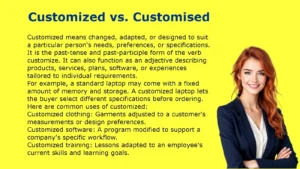
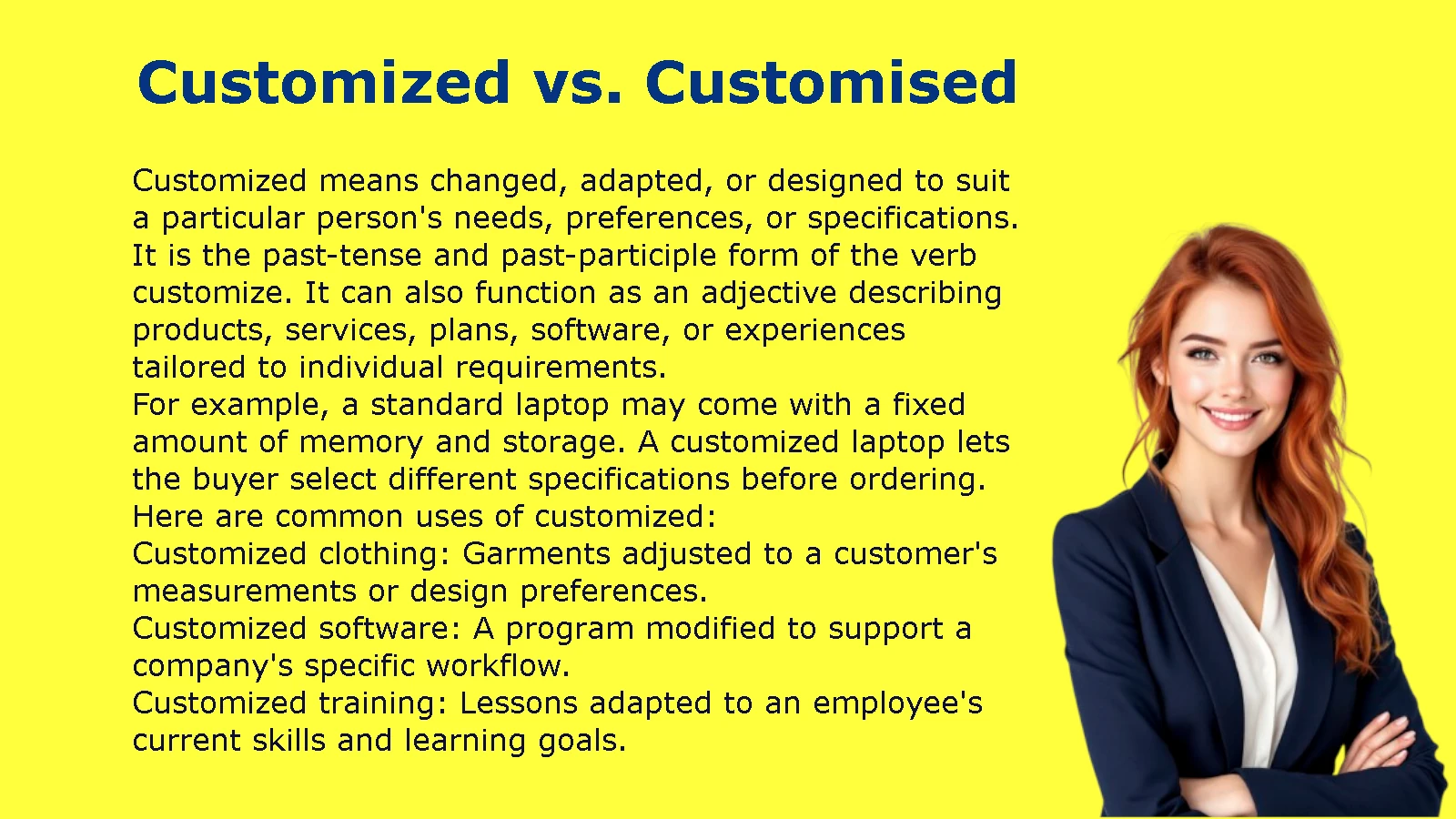
Customized means changed, adapted, or designed to suit a particular person’s needs, preferences, or specifications. It is the past-tense and past-participle form of the verb customize. It can also function as an adjective describing products, services, plans, software, or experiences tailored to individual requirements.
For example, a standard laptop may come with a fixed amount of memory and storage. A customized laptop lets the buyer select different specifications before ordering.
Here are common uses of customized:
- Customized clothing: Garments adjusted to a customer’s measurements or design preferences.
- Customized software: A program modified to support a company’s specific workflow.
- Customized training: Lessons adapted to an employee’s current skills and learning goals.
- Customized recommendations: Suggestions selected to match a person’s interests.
- Customized furniture: A desk, cabinet, or sofa made to fit a particular space.
Consider this sentence:
The company developed customized software to manage its inventory and track incoming orders.
The adjective customized tells readers that the software was adapted to the company’s requirements rather than used entirely in its standard form.
The word also appears in everyday situations. For example, Maya ordered a customized phone case with her initials and a photograph of her dog.
In both examples, something has been changed to suit a particular preference or purpose.
Customised Meaning
Customised means the same thing as customized: modified or adapted to meet particular needs, preferences, or specifications. It is the past-tense and past-participle form of the British English verb customise. Writers also use it as an adjective to describe personalized products, tailored services, and specially adapted experiences.
Common examples include:
- Customised clothing: Clothing adjusted to a customer’s measurements.
- Customised software: Software adapted to an organization’s needs.
- Customised training: Instruction designed around a learner’s goals.
- Customised service: A service tailored to an individual customer.
- Customised travel package: A trip planned around a traveler’s budget and interests.
Consider this sentence:
The travel agency created a customised holiday package for a family visiting Scotland.
Here, customised describes a travel package adapted to the family’s preferences. The agency might have adjusted the itinerary, accommodation, transportation, and activities to meet their needs.
The spelling does not change the meaning. An American writer could describe the same package as customized, while a British writer would commonly choose customised.
Customized vs. Customised in American and British English
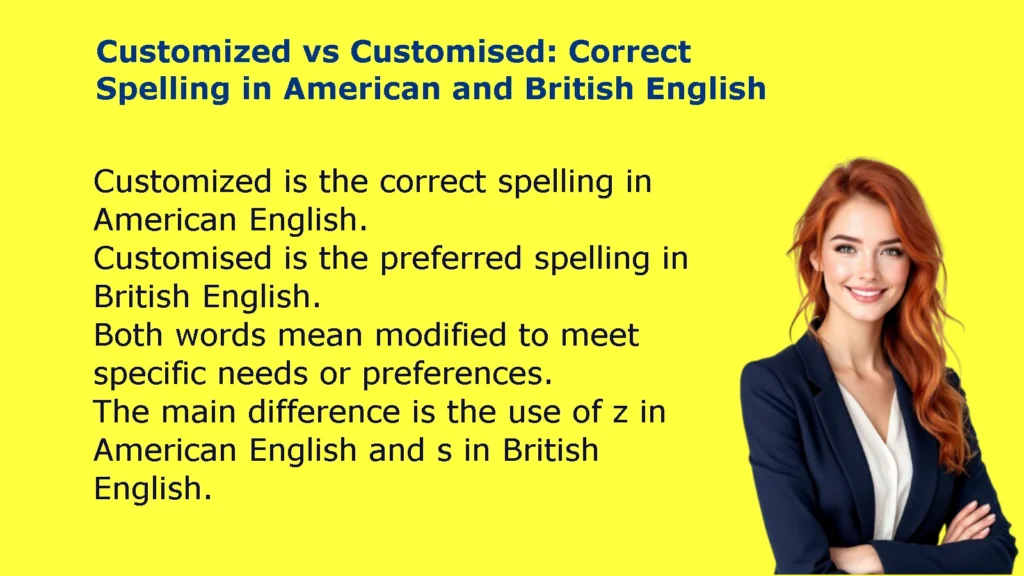
American English generally favors customized, whereas British English commonly favors customised. This difference reflects broader spelling conventions found in words ending in -ize and -ise. Both forms communicate the same idea, but choosing the locally preferred spelling makes your writing feel consistent with its intended audience.
The difference becomes particularly noticeable in professional writing, marketing, and online content.
| Situation | Common American spelling | Common British spelling |
| Product description | Customized design | Customised design |
| Business service | Customized solution | Customised solution |
| Website heading | Customized Settings | Customised Settings |
| Software feature | Customization options | Customisation options |
| Ongoing process | Customizing the dashboard | Customising the dashboard |
Imagine that a software company operates two websites. Its US website says, “Build your own customized dashboard,” while its UK website says, “Build your own customised dashboard.”
Both sentences are correct. The company changes the spelling to suit each audience without changing the product or the message.
A practical rule: Follow the spelling convention used by your audience, publication, employer, or chosen style guide. If you’re writing for a general American audience, use customized. If you’re targeting readers in Britain, customised is a natural choice.
Are Customized and Customised Pronounced the Same?
Yes. Customized and customised are pronounced the same way in standard English. The difference appears in writing, not in the spoken word. Both forms contain the same sounds, stress pattern, and syllable structure, so listeners generally cannot tell which spelling a speaker would use.
The pronunciation follows the base word customize or customise, with the same ending sound in both versions.
For example, these sentences sound identical when spoken:
- “We offer customized services.”
- “We offer customised services.”
The same pronunciation pattern applies to related pairs such as customizing/customising and customization/customisation.
This distinction matters when learning English because spelling differences do not always indicate pronunciation differences. In this case, you can learn one pronunciation and use either spelling according to your regional writing convention.
Customized or Customised: Which Spelling Should You Use?
Choose customized for American English and customised for British English when those conventions match your audience. In countries with mixed spelling practices, follow the style guide used by your school, workplace, publisher, or client. Consistency matters more than treating one accepted spelling as universally correct.
Before choosing, consider three questions:
- Who will read your writing? A US customer base usually calls for American spelling, while a UK audience often expects British spelling.
- Does your organization follow a style guide? Company documentation may require one spelling across all products and communications.
- Are you matching existing content? When editing an established website or document, preserve its spelling convention unless you have a reason to change it.
For example, a US-based e-commerce store would normally describe its products as customized. A British retailer would commonly use customised. An international business might use different spellings on regional websites while maintaining the same brand voice.
When to Use Customized in American English
Use customized when writing in American English. This spelling is standard in US product descriptions, business communications, software documentation, advertising, and general writing. The same convention applies to customize, customizing, and customization.
Here are practical situations where customized fits naturally:
Product descriptions
Choose a customized desk that fits your office space.
Business communication
We prepared a customized proposal for your company’s needs.
Technology and software
Users can create customized reports from their sales data.
Education and training
The instructor developed a customized learning plan for each student.
Marketing and customer service
Our team provides customized recommendations based on your preferences.
Notice that the spelling remains consistent across different subjects. The word describes something tailored to a specific person, purpose, or set of requirements.
If you’re writing an American English article, also check related words. Use customizing rather than customising and customization rather than customisation to maintain a consistent style.
When to Use Customised in British English
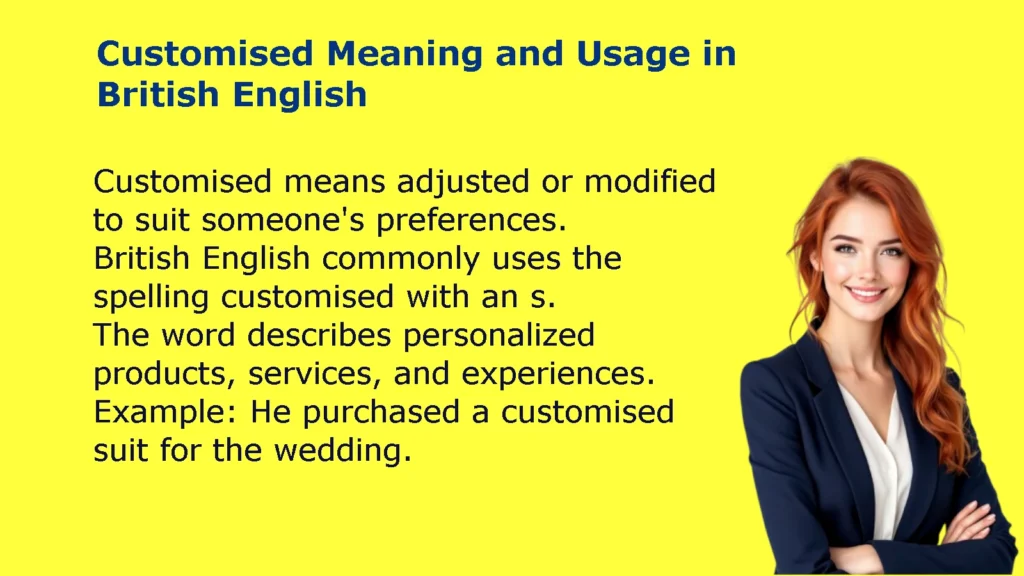
Use customised when writing in British English if that matches your chosen spelling convention. The form commonly appears in British business writing, product descriptions, customer service materials, and general communication. Related forms include customise, customising, and customisation.
For example:
- Retail: Customers can choose a customised gift box for special occasions.
- Business: Our consultants created a customised strategy for the client.
- Technology: The application offers customised settings for different users.
- Education: Each learner receives a customised study plan.
- Travel: The company specialises in customised tours of the countryside.
These sentences use British-style spelling while keeping the same meaning as their American equivalents.
British English also includes variation between publishers and style guides. Some British organizations use -ize spellings, so check the rules that apply to your particular project rather than assuming every British writer must use -ise.
For a British website, however, customised is a familiar and natural choice when the site’s editorial style follows the common -ise convention.
Which Spelling Is Used in Canada, Australia, and Other English-Speaking Countries?
The preferred spelling varies by country and by the style guide an organization follows. Customised is common in British-influenced English varieties, including Australian English, while Canadian English often favors British-style forms for some words but also uses American-style spellings in many contexts. Check local conventions when accuracy matters.
| Country or region | Common approach | Recommended practice |
| United States | Customized | Use American English consistently. |
| United Kingdom | Customised is common; -ize is also accepted in some styles | Follow the publisher’s preferred convention. |
| Australia | Customised is common | Use the organization’s Australian English style. |
| New Zealand | Customised is common | Follow the local editorial style. |
| Canada | Usage can vary by publisher and context | Check the relevant Canadian style guide. |
| International organizations | May use either form | Apply one consistent house style. |
For example, an Australian company might advertise customised business software, while an American software provider promotes customized business software. Both phrases are natural within their respective spelling conventions.
Canadian English deserves particular care because it does not simply copy every American or British spelling rule. Canadian publications may use British-style spellings for some words and American-style forms for others. If you are writing for a Canadian audience, follow the client’s preferred style instead of relying on a single rule for all -ize and -ise words.
For international websites, regional consistency can also improve the reading experience. You can use customized on a US landing page and customised on a UK or Australian page without changing the underlying content’s meaning.
Customized vs. Customised Examples in Sentences
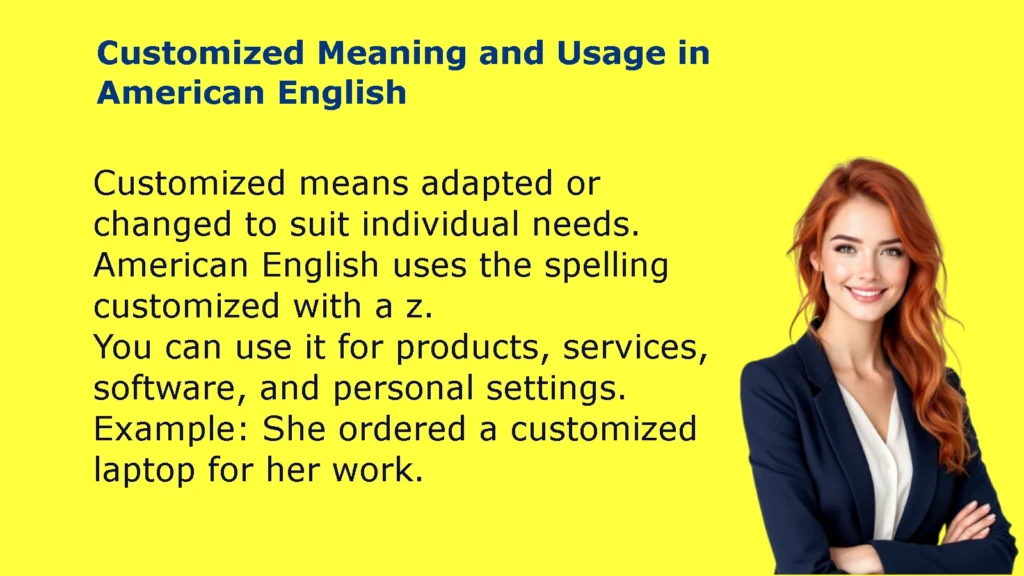
The best way to understand customized vs. customised is to compare the words in complete sentences. Both forms describe something adapted to particular requirements. The only change is the spelling convention, so you can often convert one version into the other by changing the relevant -ize or -ise ending.
Customized in American English: 5 Examples
Here are five original examples using customized in American English.
- Technology: The developer built customized software to automate the company’s billing process.
- Shopping: I ordered a customized backpack with my name embroidered on the front.
- Education: The tutor created a customized study schedule to help Jordan prepare for the exam.
- Business: Our agency offers customized marketing plans for small businesses.
- Home design: They installed customized cabinets to make better use of the kitchen’s limited space.
In each sentence, customized indicates that someone adapted a product, service, or plan to meet specific needs.
For instance, the customized study schedule in the third example reflects Jordan’s preparation goals. It is not necessarily a standard timetable used for every student.
The same principle applies to customized software and marketing plans. The word emphasizes adaptation rather than simply describing an ordinary, off-the-shelf product.
Customised in British English: 5 Examples
These five examples use customised in a British English context.
- Technology: The company provides customised software for independent retailers.
- Shopping: She bought a customised notebook with her initials on the cover.
- Education: The school developed a customised programme for pupils who needed extra support.
- Business: We prepared a customised proposal to meet the client’s requirements.
- Travel: The tour operator arranged a customised itinerary for visitors interested in local history.
Each example could use customized without changing the meaning. The British spelling simply matches the convention used in the surrounding text.
The school example also illustrates why customization can be useful. A standard programme may not meet every pupil’s needs, so the school adapts the instruction to provide more appropriate support.
Common Phrases Using Customized and Customised
Both spellings appear in common expressions related to products, services, technology, and personal preferences. When you recognize these phrases, you can use the appropriate spelling without changing the sentence’s meaning.
| American English | British English | Meaning |
| Customized software | Customised software | Software adapted to specific requirements |
| Customized solutions | Customised solutions | Answers or services tailored to a problem |
| Customized products | Customised products | Products modified to customer preferences |
| Customized settings | Customised settings | Options adjusted for a particular user |
| Customized experience | Customised experience | An experience adapted to an individual’s needs |
| Customized plan | Customised plan | A plan designed for a particular situation |
| Customized service | Customised service | Service adjusted to customer requirements |
| Customized design | Customised design | A design developed for a specific purpose |
Here are additional examples:
- The platform provides customized recommendations based on user activity.
- The platform provides customised recommendations based on user activity.
Both sentences are correct. The difference is regional spelling rather than meaning or grammar.
When writing product pages, choose the spelling that matches the rest of your website. A page that uses customized products, personalised offers, and customisation options mixes conventions and may look inconsistent. Align related terms with the style guide you have selected.
Customized vs. Customised: Spelling Rules
The difference between customized and customised follows a wider pattern in English spelling. American English commonly favors -ize, while British English often uses -ise. The choice affects the base verb, its inflected forms, and the related noun. Learning the full word family helps you avoid inconsistent spelling in longer documents.
Why American English Uses Customized
American English generally uses customize, customized, customizing, and customization. These forms follow the common American preference for the -ize spelling in this word family.
For example:
- Present tense: We customize each order.
- Past tense: We customized the order yesterday.
- Present participle: We are customizing the order.
- Noun: The customization took two days.
The ending changes according to grammar, but the z remains part of the spelling pattern.
A common mistake is to write customized in one paragraph and customising in another. That inconsistency can distract readers, particularly in professional or technical writing.
To avoid it, check the entire word family rather than correcting only the main keyword. If your article follows American English, use customize, customized, customizing, and customization throughout.
Why British English Uses Customised
British English commonly uses customise, customised, customising, and customisation. This pattern reflects the -ise convention used by many British publications and organizations.
Examples include:
- Present tense: We customise each order.
- Past tense: We customised the order yesterday.
- Present participle: We are customising the order.
- Noun: The customisation took two days.
The letter s remains in the relevant forms, even when the grammatical ending changes.
However, British spelling is not entirely uniform. Some British dictionaries, publishers, and style guides accept or prefer -ize in many words, including customize. Therefore, it is more accurate to describe customised as a common British spelling than to claim that customized is always wrong in the UK.
If your organization follows an established British style guide, use that guide consistently across articles, reports, and customer communications.
Customize, Customized, and Customizing
In American English, the verb family follows the -ize spelling pattern. Each form serves a different grammatical purpose, so choosing the correct one depends on how you use it in a sentence.
| Word | Grammatical use | Example |
| Customize | Base verb | We customize every package. |
| Customizes | Third-person singular | The service customizes each recommendation. |
| Customized | Past tense or past participle; also an adjective | The team customized the dashboard. |
| Customizing | Present participle or gerund | She is customizing the settings. |
| Customization | Noun | The customization improved the user experience. |
Consider these sentences:
The company customizes its software for hospitals.
Here, customizes describes an action performed regularly.
The company customized its software last month.
In this sentence, customized describes an action completed in the past.
The company is customizing its software for a new client.
The word customizing describes an ongoing process.
The client requested additional customization.
Here, customization is a noun referring to the act or result of adapting the software.
Understanding these differences helps you use the correct form in both everyday writing and SEO content.
Customise, Customised, and Customising
The British-style word family follows the same grammatical pattern but generally uses s instead of z.
| Word | Grammatical use | Example |
| Customise | Base verb | We customise every package. |
| Customises | Third-person singular | The service customises each recommendation. |
| Customised | Past tense or past participle; also an adjective | The team customised the dashboard. |
| Customising | Present participle or gerund | She is customising the settings. |
| Customisation | Noun | The customisation improved the user experience. |
The grammatical rules do not change between the two spelling systems. Only the spelling of the word family differs.
For example, both of these sentences are grammatically correct:
The team is customizing the website.
The team is customising the website.
The first follows common American spelling, while the second follows a common British convention.
When editing an article, check all five forms. A consistent word family makes your writing easier to read and helps maintain a professional editorial style.
Customized vs. Customised vs. Customization
The words customized, customised, and customization are related, but they do not all serve the same grammatical role. Customized and customised usually describe something that has been adapted, while customization and customisation are nouns referring to the process or result of making those changes.
Knowing the distinction prevents errors such as using a noun where an adjective belongs.
Customized vs. Customised
The difference between customized and customised is regional spelling, not meaning. Both are past-tense or past-participle forms of the same verb and can function as adjectives.
Compare these examples:
- American: The customer received a customized gift.
- British: The customer received a customised gift.
Both sentences describe a gift adapted to a customer’s preferences.
You can also use the words as past-tense verbs:
- American: We customized the website last week.
- British: We customised the website last week.
In each case, the word describes an action completed in the past.
The important point is that changing z to s does not create a different word or a different meaning. It simply aligns the spelling with a regional convention.
Customization vs. Customisation
Customization is the standard American English noun, while customisation is common in British English. Both refer to the act of adapting something or the resulting changes made to suit particular needs.
For example:
- American: The customization of the software required additional testing.
- British: The customisation of the software required additional testing.
In these sentences, the noun refers to the process of adapting the software.
The noun can also describe a feature or option. For example, The app offers several customization options and The app offers several customisation options communicate the same idea.
Use the noun when you are talking about the process, the result, or the available ability to make changes. Use customized or customised when describing the thing that has been adapted.
Compare:
The customization took three days.
The customized application took three days to develop.
The first sentence focuses on the process of adaptation. The second describes an application that has been adapted.
Customizing vs. Customising
Customizing is the common American spelling, while customising is common in British English. Both forms can function as present participles in continuous verb tenses or as gerunds when the action itself serves as a noun.
Examples:
- American: We are customizing the online store.
- British: We are customising the online store.
Both sentences describe an ongoing action.
As a gerund, the word can appear at the beginning of a sentence:
- American: Customizing the dashboard makes the software easier to use.
- British: Customising the dashboard makes the software easier to use.
In these examples, the action functions as the subject of the sentence.
The spelling follows the same regional pattern as the other forms. If you use customized in an American English article, pair it with customizing and customization. If you use customised in a British-style article, the related forms will commonly be customising and customisation.
Common Mistakes When Using Customized and Customised
Most mistakes involving customized and customised happen when writers mix spelling conventions or confuse related terms. You can avoid these problems by understanding the regional distinction, using each word according to its meaning, and checking the consistency of the entire document.
Mixing American and British Spelling in the Same Document
One common mistake is switching between American and British spelling without a clear reason.
For example:
We offer customized products and customising options for every customer.
This sentence mixes customized with customising. Neither word is inherently wrong, but the combination may look inconsistent in a document that follows one spelling convention.
A consistent American version would be:
We offer customized products and customizing options for every customer.
A consistent British-style version would be:
We offer customised products and customising options for every customer.
How to avoid the mistake: Decide which spelling convention you will follow before writing. Then check the base verb, past tense, present participle, and noun form.
Assuming One Spelling Is Universally Incorrect
Another mistake is claiming that customised is always wrong or that customized is incorrect outside the United States.
Neither claim is accurate. Both spellings are accepted, although regional preferences differ. American English typically favors customized, and British English commonly uses customised.
For example, a British retailer can correctly advertise a customised gift box. An American retailer can correctly advertise a customized gift box.
How to avoid the mistake: Think in terms of regional conventions rather than correct versus incorrect spelling. Check your target publication’s style guide when a specific standard applies.
Confusing Customized With Custom-Made
Customized and custom-made are related, but they do not always mean exactly the same thing.
Customized describes something adapted or modified to suit specific requirements. The item might begin as a standard product and receive changes later.
Custom-made usually describes something made specifically for a particular person, purpose, or set of specifications.
Compare these examples:
- I purchased a customized bicycle with a different seat and upgraded handlebars.
- I ordered a custom-made bicycle frame built to match my measurements.
In the first example, the bicycle may have started as a standard model before the owner selected changes. In the second, the frame was made specifically to meet the buyer’s measurements.
The distinction is useful in product descriptions because it helps customers understand whether a company modifies an existing item or creates something from the beginning.
However, actual business usage can overlap. Some companies use customized for products manufactured to order, so the surrounding context determines the precise meaning.
Using Inconsistent Spelling in Professional Writing
Inconsistent spelling can make a report, website, or business proposal look poorly edited. The issue becomes especially noticeable when the same term appears repeatedly in headings, product descriptions, navigation menus, and body text.
Imagine a company website that uses:
- Customized plans
- Customised services
- Customization options
- Customising your account
Readers can understand all four phrases, but the mixture may suggest that different sections were written without a shared editorial standard.
A simple editing checklist can help:
- Choose American or British-style spelling before drafting.
- Search for customize, customized, customizing, and customization.
- Check the corresponding customise, customised, customising, and customisation forms.
- Review headings, image text, buttons, and metadata as well as body content.
- Preserve the spelling used in official product names or quotations when necessary.
For websites, consistency also helps maintain a clear regional identity. It is fine to use different spellings on separate US and UK versions of a site, provided each version follows its own consistent style.
Customized or Customised: Quick Comparison Table
The table below summarizes the main differences between customized and customised, including their base verbs, present participles, noun forms, and typical usage. Use it as a quick reference when proofreading an article or choosing a spelling convention for professional writing.
| Feature | American English | Common British-style spelling |
| Main spelling | Customized | Customised |
| Preferred context | US writing | UK and other British-influenced writing |
| Base verb | Customize | Customise |
| Third-person singular | Customizes | Customises |
| Past tense | Customized | Customised |
| Past participle | Customized | Customised |
| Present participle | Customizing | Customising |
| Noun form | Customization | Customisation |
| Meaning | Adapted to specific needs | Adapted to specific needs |
| Pronunciation | Same | Same |
| Example sentence | We customized the software. | We customised the software. |
The table shows that the grammatical structure remains the same. The main spelling difference appears in the z and s forms of the word family.
Frequently Asked Questions
Is Customized or Customised Correct?
Both customized and customised are correct spellings. Customized is the standard choice in American English, while customised is common in British English and other varieties that favor the -ise ending. Both words have the same meaning and pronunciation.
For example, an American business might offer customized products, while a British business might advertise customised products. Neither spelling changes the meaning of the sentence.
Is Customized American or British English?
Customized is the standard American English spelling. It follows the -ize spelling pattern used in words such as organize, personalize, and prioritize. American writers generally use the related forms customize, customizing, and customization as well.
For example: The company offers customized solutions for small businesses.
Although customised is understandable to American readers, customized is the conventional choice for US-focused content.
Is Customised British or American English?
Customised is commonly associated with British English. It follows the -ise spelling pattern used in words such as organise, personalise, and prioritise. Writers who follow this convention also use customise, customising, and customisation.
For example: The retailer offers customised gifts for birthdays and weddings.
However, British spelling conventions vary. Some British publishers and style guides accept or prefer -ize spellings, so customized can also appear in British writing.
Which Is Correct: Customised or Customized in Australia?
Both spellings are understandable, but customised is the common choice in Australian English. Australian writing generally follows many British spelling conventions, including the use of -ise in words such as customise and personalise.
For example: Australian customers can order customised furniture through the company’s website.
If you’re preparing content for an Australian business, use customised unless the organization follows a different style guide. Apply the same convention to related words, such as customising and customisation.
Does Customized Mean the Same as Customised?
Yes. Customized and customised mean exactly the same thing in ordinary usage. Both describe something adapted, modified, or designed to meet specific needs or preferences. The difference is spelling, not definition.
Compare these sentences:
- The team created a customized training plan.
- The team created a customised training plan.
Both sentences describe a training plan adapted to particular requirements. The first uses the American spelling, while the second follows a common British-style convention.
Is Customised Incorrect in American English?
No. Customised is not an inherently incorrect spelling, and American readers can understand it easily. However, customized is the conventional spelling in American English and is generally the better choice for US-focused writing.
For example, an American company would usually write customized software in its product descriptions. Using customised software instead would introduce a spelling convention more commonly associated with British English.
If you’re writing an American English article, choose customized for consistency. If you’re quoting a British source or preserving an official product name, you may need to retain the original spelling.
What Is the Difference Between Customized and Custom-Made?
Customized describes something adapted to meet particular needs, while custom-made usually describes something specifically made for a person or purpose. The terms overlap, but they can emphasize different stages of production.
For example:
- Customized shoes: Existing shoes may have been modified with different colors, materials, or features.
- Custom-made shoes: The shoes may have been produced from the beginning to match the customer’s measurements.
A company might customize a standard desk by adding drawers and changing its finish. A carpenter might build a custom-made desk from scratch to fit an unusual room layout.
The exact distinction depends on the product and the manufacturer’s terminology. When writing product descriptions, explain what the customer actually receives instead of relying on the label alone.
Conclusion
Both customized and customised are correct spellings of the same word. The main difference is regional preference: American English generally uses customized, while British English, Australian English, and other varieties commonly use customised.
The same pattern appears in related forms. American writers usually choose customize, customizing, and customization, while writers following the common British -ise convention use customise, customising, and customisation.
Remember these simple rules:
- Use customized for American English content.
- Use customised when following a British-style spelling convention.
- Check the relevant style guide when writing for Canada, international audiences, or a specific organization.
- Keep related words consistent throughout your article, website, report, or business document.
- Use customized or customised to describe something adapted to specific needs, and distinguish these terms from custom-made when the production method matters.
If you’re editing an existing article or creating content for a business website, review the entire word family before publishing. Choose the spelling that suits your audience, apply it consistently, and focus on communicating your meaning clearly.