Plastify vs plastifise is a spelling and word-meaning comparison that raises an important question: which term should you use when describing something covered with plastic or made more plastic-like? The answer depends on the intended meaning, the audience, and the material involved. Plastify is an understandable verb, but plasticize and laminate are often more precise choices in standard English. Plastified is a related word form, while plastify paper usually refers to protecting paper with a plastic layer.
Understanding the difference between plastify, plastifise, plasticize, and laminate helps you choose accurate words for everyday writing, manufacturing, packaging, and document protection. These terms overlap in some contexts, but they do not describe exactly the same process. A plastic coating, a laminated document, and a material modified to become more flexible can have very different properties.
What Does Plastify Mean?
Plastify is a verb formed from plastic and the verb-forming suffix -ify. It suggests making something plastic, plastic-like, or covered with plastic, depending on the context. However, it is less established than terms such as plasticize and laminate, so writers should consider whether a more specific word would communicate the intended meaning more clearly.
Plastify Definition
The basic meaning of plastify is to make something plastic-like or to give it a plastic covering or quality. Its precise meaning depends on the material and the process being described.
For example, someone might use plastify informally to describe adding a protective plastic layer to a paper document. In a technical context, however, the word could create confusion because it does not identify the exact treatment or manufacturing process.
Consider these possible uses:
- Paper protection: Making a printed sheet resistant to moisture by covering it with plastic film.
- Surface treatment: Giving a surface a plastic-like finish.
- Material modification: Describing a change that makes a material more plastic or moldable, although plasticize is generally more suitable for this meaning.
- Informal description: Referring broadly to the process of making an object look or feel more like plastic.
The important point is that plastify does not automatically identify a specific industrial process. If the exact method matters, use a more established technical term.
How to Use Plastify in a Sentence
You can use plastify when the intended meaning is clear, especially in informal or descriptive writing. In formal writing, choose a more precise verb whenever possible.
Here are original examples:
- The craft instructor decided to plastify the paper artwork to help protect it from splashes.
- The designer wanted to plastify the decorative surface to give it a smooth, plastic-like appearance.
- The packaging team discussed whether to plastify the printed inserts or use a standard laminating film.
- The customer asked the print shop to plastify the menu, although the shop recommended lamination.
- The manufacturer needed to explain whether the treatment would coat the surface or change the material itself.
These examples illustrate possible interpretations rather than a single standardized technical definition.
Notice how the fourth sentence replaces the general word plastify with lamination. That change helps the reader understand what the print shop will actually do.
Is Plastify a Standard English Word?
Plastify is understandable as a word, but it is not the usual first choice for many technical or everyday contexts. English frequently forms verbs by adding -ify to a noun or adjective, as in simplify and solidify. However, a word’s grammatical formation does not guarantee that it is the established term for every related process.
For example, plasticize has a recognized technical meaning associated with changing a material’s plasticity or flexibility. Laminate describes joining layers or applying a protective layer in relevant contexts.
If you are writing instructions, product descriptions, scientific material, or business documents, select the term that identifies the actual process.
| Intended meaning | Recommended word | Example |
| Protecting a document with a film | Laminate | Please laminate the certificate. |
| Changing a material’s plasticity | Plasticize | The additive helps plasticize the polymer. |
| Adding a plastic coating | Apply a plastic coating | Apply a plastic coating to the paper surface. |
| Giving something a plastic-like quality | Plastify may work in descriptive writing | The treatment plastifies the surface. |
Writing tip: A precise verb often helps more than an unusual synonym. Readers should understand the action without having to guess what the word means.
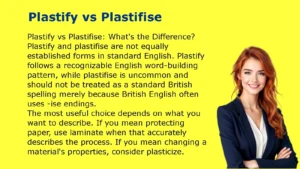
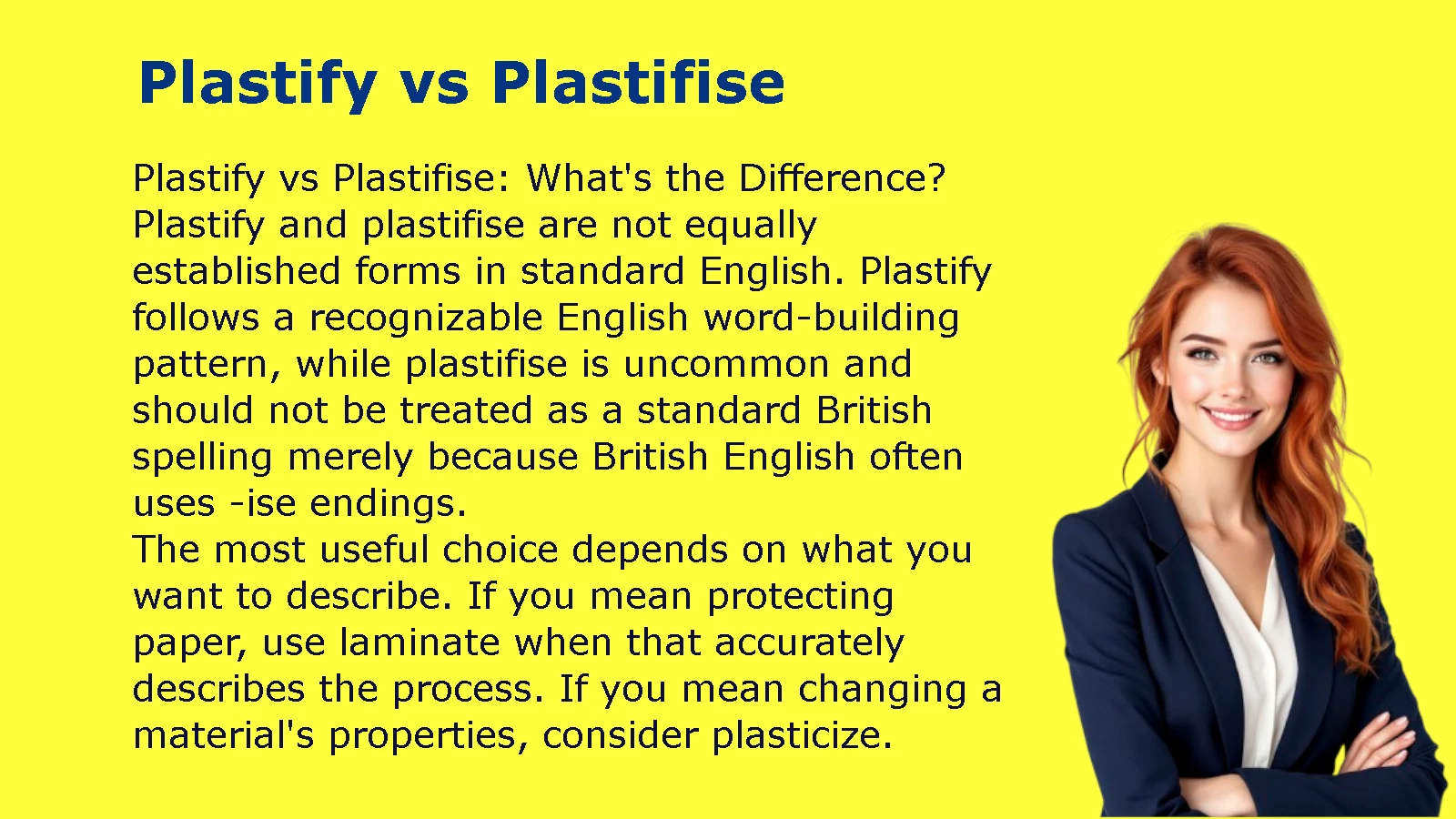
Plastify vs Plastifise: What’s the Difference?
Plastify and plastifise are not equally established forms in standard English. Plastify follows a recognizable English word-building pattern, while plastifise is uncommon and should not be treated as a standard British spelling merely because British English often uses -ise endings.
The most useful choice depends on what you want to describe. If you mean protecting paper, use laminate when that accurately describes the process. If you mean changing a material’s properties, consider plasticize.
Plastify vs Plastifise Spelling
The difference between plastify and plastifise involves both spelling and conventional usage.
Plastify ends in -ify, a suffix commonly used to form verbs that express making or becoming something. Examples include:
- Clarify: Make something clearer.
- Simplify: Make something simpler.
- Solidify: Make something solid or become solid.
- Plastify: Suggest making something plastic-like or plastic-coated.
Plastifise appears to combine the idea of plastify with the -ise spelling pattern. However, English spelling conventions do not allow writers to replace any verb ending in -ify with -ifise and assume the resulting form is standard.
Compare organize and organise. Both forms are established spellings, with preferences that vary by region and style guide. That does not mean plastifise automatically has the same status.
When spelling accuracy matters, avoid assuming that a plausible-looking variant is widely accepted.
Which Spelling Should You Use in American English?
For American English, do not use plastifise as a routine spelling choice. The word is uncommon, and readers may not recognize it as an established verb.
Choose your wording according to the meaning:
- Use laminate when applying a protective film to paper or another suitable material.
- Use plasticize when describing a process that changes a material’s plasticity.
- Use coat with plastic when the process involves applying a plastic coating.
- Use plastify only when its intended meaning is clear and the context supports it.
For instance, a school administrator might write, “Please laminate the classroom signs.” That instruction is clearer than “Please plastifise the classroom signs.”
British English does use many established verbs ending in -ise, such as organise and recognise. Nevertheless, regional spelling preferences apply to established words; they do not automatically validate every newly formed alternative.
Plastify vs Plastifise: Example Sentences
The following sentences show how to handle both forms.
Example 1: Protecting a paper document
Less precise: “We will plastifise the certificate.”
Clearer: “We will laminate the certificate.”
The revised sentence identifies a familiar process and avoids an uncommon spelling.
Example 2: Describing a plastic-like surface
Possible descriptive usage: “The treatment helps plastify the surface.”
More specific alternative: “The treatment gives the surface a plastic-like finish.”
The second sentence works well when the writer wants to describe the result without claiming that a particular technical process occurred.
Example 3: Writing a manufacturing instruction
Less precise: “Plastify the material before assembly.”
Clearer, depending on the actual process: “Apply the plastic coating before assembly.”
The revised instruction tells workers what action to perform.
| Feature | Plastify | Plastifise |
| Word formation | Recognizable -ify construction | Uncommon form |
| Standard usage | Understandable, but context-dependent | Not a routine standard spelling |
| American English recommendation | Use cautiously and define the intended process | Avoid unless a specific source or context establishes it |
| Better alternative for paper protection | Laminate | Laminate |
| Better alternative for material modification | Plasticize, where appropriate | Plasticize, where appropriate |
The central lesson is simple: choose the established word that matches the process instead of relying on a spelling variant that readers may not recognize.
What Does Plastified Mean?
Plastified is the past-tense and past-participle form of plastify. It can also function as an adjective when it describes something that has been treated to become plastic-like or plastic-coated. However, the exact meaning depends on context, and the word does not specify a particular coating, chemical treatment, or manufacturing method.
Plastified Meaning and Word Form
The word plastified follows a familiar English pattern. Verbs ending in -ify commonly form their past tense and past participle by changing -y to -ied.
For example:
- Simplify → simplified
- Solidify → solidified
- Clarify → clarified
- Plastify → plastified
This grammatical pattern explains how the word is formed. It does not establish that every possible use is equally common or technically precise.
In a sentence such as “The plastified document resisted light splashes,” the adjective suggests that the document received some kind of plastic treatment. A reader may still need more information to determine whether the document was laminated, coated, or treated in another way.
When the process matters, name it directly.
Plastified in Example Sentences
Here are examples showing how plastified might appear in different contexts.
- The plastified paper had a smoother surface than the untreated sheet.
- The craft project used plastified images to improve their resistance to handling.
- The supplier described the samples as plastified, but the product specification did not identify the coating.
- The plastified labels were easier to wipe clean than the uncoated labels.
- The technician replaced the vague description “plastified material” with a more precise description of the applied coating.
These sentences demonstrate possible descriptive uses. They should not be interpreted as proof that plastified is the preferred technical term for every coated material.
Consider the last example. A supplier’s description may be understandable, but a specification should identify the coating type, application method, or relevant performance requirements when those details affect purchasing or production.
Plastified vs Plasticized
Plastified generally suggests that something has been made plastic-like or given a plastic treatment. Plasticized more specifically describes something that has undergone plasticization, a process that changes a material’s plasticity or flexibility.
The distinction matters in materials science and manufacturing.
For example, manufacturers may add plasticizers to certain polymers to improve flexibility, workability, or other properties. This does not necessarily involve applying a plastic film to the material’s surface.
Compare the following examples:
- “The paper was laminated to protect the printed surface.”
- “The polymer was plasticized to improve its flexibility.”
- “The surface was given a plastic coating to improve its resistance to moisture.”
Each sentence describes a different action.
| Term | Main idea | Example context |
| Plastified | Made plastic-like or treated with plastic, depending on context | General description of a treated object |
| Plasticized | Changed through plasticization | Polymer formulation and material processing |
| Laminated | Joined to another layer or covered with a suitable film | Documents, labels, packaging |
| Plastic-coated | Covered with a plastic layer | Paper, metal, fabric, and other surfaces |
Do not confuse a surface coating with a change in the material itself. A laminated sheet can contain a protective outer film while its paper core remains paper. A plasticized polymer, by contrast, may have changed properties throughout the relevant material.
What Does Plastify Paper Mean?
Plastify paper usually suggests protecting paper with a plastic layer or giving its surface a plastic-like finish. However, the phrase does not identify one universal process. Depending on the product, the intended method may be lamination, plastic coating, or another surface treatment.
If you need a clear instruction, use a phrase that describes the actual method, such as laminate the paper or apply a plastic coating.
Plastify Paper Meaning
People may use plastify paper when they want to make paper more durable, easier to wipe clean, or less vulnerable to moisture and handling.
For example, a teacher may want to protect classroom flashcards that students handle every day. A restaurant may want menus that withstand frequent cleaning. An office may need to preserve a frequently used reference sheet.
In each case, a plastic film or coating might help. However, the appropriate solution depends on the intended use.
Common goals include:
- Protecting printed content: Reduce wear caused by frequent handling.
- Improving moisture resistance: Limit water contact with the paper.
- Making cleaning easier: Create a surface that can be wiped, if the selected material permits it.
- Improving durability: Reduce tearing and surface damage during normal use.
- Preserving appearance: Help printed colors and text remain presentable.
These benefits are not guaranteed by the word plastify itself. Performance depends on the paper, ink, coating, adhesive, thickness, and application method.
A thin coating may offer different protection from a sealed laminating pouch. Neither solution automatically makes paper waterproof under every condition.
How Is Paper Plastified or Laminated?
The process varies with the equipment and materials used. For ordinary documents, lamination is often the most recognizable approach.
A common document-lamination process works as follows:
- Prepare the paper. Make sure the printed sheet is dry, clean, and suitable for the chosen film.
- Choose the protective material. Select a film and adhesive system appropriate for the document and its intended use.
- Position the sheet. Place the paper correctly inside the laminating pouch or prepare it for the relevant laminating equipment.
- Apply the film. Use the specified equipment and settings to bond the film to the paper.
- Allow the material to settle. Follow the manufacturer’s instructions before trimming or handling the finished document.
- Inspect the result. Check for bubbles, wrinkles, poor adhesion, or exposed edges.
Not every plastic coating follows these steps. Industrial coating may involve specialized machinery, controlled application conditions, drying, or curing.
For a home or school project, use the equipment manufacturer’s instructions rather than assuming that all films and adhesives work the same way.
Also consider disposal and recycling. Combining paper with plastic can complicate recycling because the materials may require separation. Local recycling rules and the specific product design determine whether a finished sheet belongs in a recycling stream.
Plastify Paper vs Laminate Paper
The phrase plastify paper describes an intended result in broad terms. Laminate paper more clearly identifies a process when a protective film or additional layer is bonded to the sheet.
| Feature | Plastify paper | Laminate paper |
| Meaning | Broad, context-dependent description | More specific description of joining or applying a protective layer |
| Process | Not defined by the word alone | Uses a laminating process appropriate to the material |
| Common use | Informal descriptions of plastic-treated paper | Documents, menus, signs, cards, and printed materials |
| Surface protection | Depends on the treatment | Depends on the film, adhesive, and edge coverage |
| Moisture resistance | Depends on the method and material | Can improve resistance, but does not guarantee complete waterproofing |
| Clarity of instructions | May require explanation | Usually clearer when lamination is intended |
Example: If a customer asks a print shop to “plastify” a menu, the staff may reasonably interpret the request as lamination. However, confirming the intended finish helps prevent misunderstandings about thickness, flexibility, surface appearance, and durability.
For a professional order, describe the expected outcome and any performance requirements rather than relying on an ambiguous term.
Plastify Synonyms: Which Word Fits Best?
There is no single perfect synonym for plastify because the word can suggest different actions. Laminate, plasticize, coat, cover, and seal each describe a particular process or result. The best replacement depends on what happens to the material.
Plasticize
Plasticize means to make a material more plastic or to change its plasticity. In technical contexts, it often describes improving a material’s ability to deform or become flexible.
Plasticization may involve adding a plasticizer or using another suitable method to alter a material’s properties.
For example:
“The formulation was adjusted to plasticize the polymer and improve its flexibility.”
This sentence describes a change in the material’s properties, not simply the application of a surface film.
Use plasticize when discussing:
- Polymer processing
- Material flexibility
- Plasticity and deformation
- The effects of plasticizers
- Relevant chemical or manufacturing processes
Do not use plasticize as a general substitute for laminate. A document covered with film has not necessarily undergone plasticization.
Laminate
Laminate means to join layers of material or, in common document-protection contexts, to apply a protective film to a surface.
The word can function as both a verb and a noun.
As a verb: “The office will laminate the reference cards.”
As a noun: “The countertop uses a decorative laminate.”
The exact meaning varies by industry, but the central idea often involves layers.
Common applications include:
- Laminating certificates and identification cards
- Protecting menus and instructional signs
- Producing layered packaging
- Manufacturing decorative surfaces
- Creating composite materials
When paper receives a protective film, laminate is usually clearer than plastify.
Coat, Cover, and Seal
These words can also replace plastify, but each carries a different meaning.
Coat means to apply a layer of a substance to a surface.
Example: “The manufacturer coated the paper with a moisture-resistant material.”
This wording is appropriate when the treatment involves applying a surface layer. The coating might be plastic, wax, varnish, or another material.
Cover means to place something over a surface. It is broad and does not necessarily imply bonding or chemical treatment.
Example: “Cover the printed card with a transparent protective sheet.”
Seal means to close, protect, or make a surface or opening less vulnerable to outside conditions. The exact result depends on the sealant and construction.
Example: “Seal the package to reduce the risk of moisture entering through the edges.”
These words are not interchangeable in every situation. A coating may not seal an opening, and covering a document does not necessarily mean that the covering has bonded to it.
Plastify vs Plasticize vs Laminate
The three words describe different ideas, so choosing between them requires understanding the process.
| Term | What it describes | Best-fit example |
| Plastify | A broad, context-dependent idea of making something plastic-like or plastic-treated | A descriptive sentence about a plastic-like finish |
| Plasticize | Changing a material’s plasticity or flexibility | Modifying a polymer formulation |
| Laminate | Joining layers or applying a protective film | Protecting a paper certificate |
| Coat | Applying a layer to a surface | Adding a plastic coating to paper |
| Cover | Placing something over an object | Covering a card with a transparent sheet |
| Seal | Closing or protecting a surface, joint, or opening | Sealing a package against moisture entry |
Use the table as a practical writing guide. If you are describing a real process, verify what the material undergoes before choosing a technical term.
What Does Laminate Mean?
Laminate can describe the action of joining layers or applying a protective film, as well as the layered material created by a manufacturing process. In document protection, lamination commonly involves bonding a suitable film to paper. In other industries, a laminate may contain multiple layers that serve structural, decorative, or protective purposes.
Laminate Meaning as a Verb
As a verb, laminate refers to joining layers of material or applying a suitable protective layer.
For paper documents, the process commonly involves placing a printed sheet between films or bonding film to its surface using an appropriate method.
Examples include:
- “Please laminate the certificate before displaying it.”
- “The school laminates classroom labels to help them withstand repeated handling.”
- “The print shop laminated the menu using a protective film.”
- “The manufacturer laminated several material layers to produce the finished panel.”
The word is useful because it identifies a recognizable process. However, it does not specify every detail of the finished product. Film type, thickness, adhesive, equipment, and edge treatment can affect performance.
Laminate Meaning as a Noun
As a noun, laminate can refer to a material made by bonding layers together.
Examples include:
- A decorative laminate used on furniture or countertops
- A laminated sheet used in a manufactured product
- A composite laminate made from multiple material layers
The noun does not always mean a thin plastic cover applied to paper. In engineering and manufacturing, a laminate may combine several layers with different functions.
For instance, one layer might provide strength while another provides a decorative finish or barrier property. The material’s performance depends on the complete construction, not simply the fact that it is laminated.
Laminate vs Plasticize
The difference between laminate and plasticize is important in technical writing.
Laminate describes a layered construction or the process of joining layers. Plasticize describes a change in material plasticity.
Consider these examples:
- A printed card receives a film to protect its surface. The card is laminated.
- A polymer receives an appropriate plasticizer to change its flexibility. The polymer is plasticized.
- A paper product receives a surface coating. The paper is coated.
These actions can produce different physical results. A laminated sheet may retain a relatively rigid paper core. A plasticized polymer may become more flexible without receiving any outer film.
The distinction also matters when evaluating a product’s performance. Lamination does not automatically guarantee water resistance, chemical resistance, heat resistance, or suitability for outdoor use. Those properties depend on the specific materials and construction.
How to Choose the Correct Word
The simplest way to choose between plastify, plastifise, plasticize, and laminate is to identify the action you want to describe. Start with the material, determine what changes, and select the verb that communicates that change accurately.
Use Laminate for Documents and Paper Protection
Choose laminate when a document receives a bonded protective film or layer.
Examples include:
- Laminating school worksheets used repeatedly
- Protecting a frequently handled reference card
- Applying film to a printed restaurant menu
- Protecting a sign from everyday wear
- Preserving a paper instruction sheet for repeated use
The word also helps when communicating with a print shop. A request such as “Please laminate these ten menus with a clear protective film” gives the supplier a clearer starting point than “Please plastify these menus.”
You may still need to specify the film’s finish, thickness, flexibility, and intended use.
For example, a menu used indoors may need different protection from a sign exposed to sunlight and rain. Confirm the relevant product specifications before assuming that lamination will meet every requirement.
Use Plasticize for Changes to Material Properties
Choose plasticize when the process changes the plasticity or flexibility of a material.
This term commonly appears in chemistry, polymer science, and manufacturing. It is especially useful when discussing the role of plasticizers in polymer formulations.
For example:
“The manufacturer adjusted the formulation to plasticize the polymer and improve its flexibility.”
This sentence focuses on a property change within the material. It does not imply that someone applied a protective film.
If you are writing for a general audience, explain the technical term the first time you use it. A simple explanation such as “The treatment made the polymer more flexible” can help readers understand the process without prior materials-science knowledge.
Use Plastify Only When the Context Supports It
Plastify may work in informal or descriptive writing when the intended meaning is clear. However, avoid relying on it in instructions or technical documents if readers could interpret it in different ways.
Before using the word, ask yourself:
- Does the material receive a coating?
- Does the process join layers together?
- Does the material itself change its plasticity?
- Am I describing a visual appearance rather than a manufacturing process?
- Will the reader understand the intended action without additional explanation?
If the answer points to a known process, use its established name.
For example, “The shop laminated the paper” is more direct than “The shop plastified the paper” when lamination is what actually occurred.
Similarly, “The manufacturer applied a plastic coating” is more informative when coating is the relevant process.
Practical Case Study: Choosing a Word for a School Project
Imagine a teacher preparing reusable vocabulary cards for a classroom. The cards will be handled daily, and the teacher wants to reduce tearing and make the surfaces easier to wipe.
The teacher considers three instructions:
- “Plastify the cards.”
- “Plasticize the cards.”
- “Laminate the cards.”
The third instruction is the clearest if the plan is to protect the cards with a laminating film.
Why do the other options create problems?
“Plastify the cards” communicates a general intention but does not identify the process precisely.
“Plasticize the cards” suggests a change in the material’s plasticity, which is not the intended task.
“Laminate the cards” identifies the expected process in familiar terms.
The teacher can make the instruction even clearer by adding the desired result: “Laminate the vocabulary cards with a clear film suitable for frequent handling.”
The example demonstrates a useful principle for SEO content, technical writing, and everyday communication: the best word is the one that conveys the intended action with the least ambiguity.
Frequently Asked Questions
Is plastify a real word?
Plastify is an understandable verb formed using the common -ify pattern. However, its usage is less established than terms such as plasticize and laminate. Choose a more precise alternative when describing a specific manufacturing or paper-protection process.
Is plastifise the correct spelling in British English?
Not as a routine spelling choice. British English accepts many established -ise spellings, including organise and recognise, but that pattern does not automatically make plastifise a standard form. Use a recognized term that expresses your intended meaning.
What does plastified mean?
Plastified is the past-tense or past-participle form of plastify. It may describe something made plastic-like or treated with plastic, depending on context. When the exact process matters, specify whether the material was laminated, coated, or otherwise treated.
What does plastify paper mean?
Plastify paper generally suggests adding a plastic layer or giving paper a plastic-like finish. If you mean bonding a protective film to a document, laminate the paper is usually clearer. Use apply a plastic coating when that better describes the actual process.
What is a synonym for plastify?
Suitable alternatives include laminate, plasticize, coat, cover, and seal. However, each has a different meaning. Use laminate for layered protection, plasticize for changes in plasticity, coat for applying a surface layer, and seal when the goal is to close or protect a surface or opening.
What is the difference between plasticize and laminate?
Plasticize generally describes changing a material’s plasticity or flexibility. Laminate describes joining layers or applying a protective film. A laminated document may retain a paper core, while a plasticized polymer may change its properties without receiving an outer covering.
Conclusion: Plastify vs Plastifise
The difference between plastify vs plastifise is not simply a matter of choosing between American and British spelling. Plastify is an understandable but context-dependent verb, while plastifise is uncommon and should not be assumed to be a standard British alternative.
The more important decision is choosing the word that matches the actual process:
- Laminate paper or documents when applying a suitable protective film.
- Plasticize a material when changing its plasticity or flexibility.
- Coat a surface when applying a layer of another substance.
- Use plastify only when its intended meaning is clear to your readers.
For accurate writing, identify the action first and select the most specific established term. If you are preparing instructions, product descriptions, or technical content, this approach makes your message easier to understand and reduces confusion.