Disperse vs Disburse is a common word-choice question because these two words look and sound similar but have different meanings. Disperse means to scatter people or things in different directions, while disburse means to pay out or release money from a fund or account. Knowing the difference helps you write accurately about crowds, particles, bank loans, grants, and financial transactions.
The distinction becomes easier when you compare related words such as distribute, dispense, dissipate, diffuse, dissolve, scatter, disseminate, and reimburse. These terms share some meanings, but each serves a different purpose. For example, a crowd can disperse after a concert, a bank can disburse a loan, and an employer can reimburse an employee for business expenses.
This guide explains the meaning of disperse and disburse, their synonyms, common mistakes, and the differences between related words. You’ll also find original sentence examples and comparison tables to help you choose the right word in everyday, academic, and professional writing.
Disperse vs Disburse: What’s the Difference?
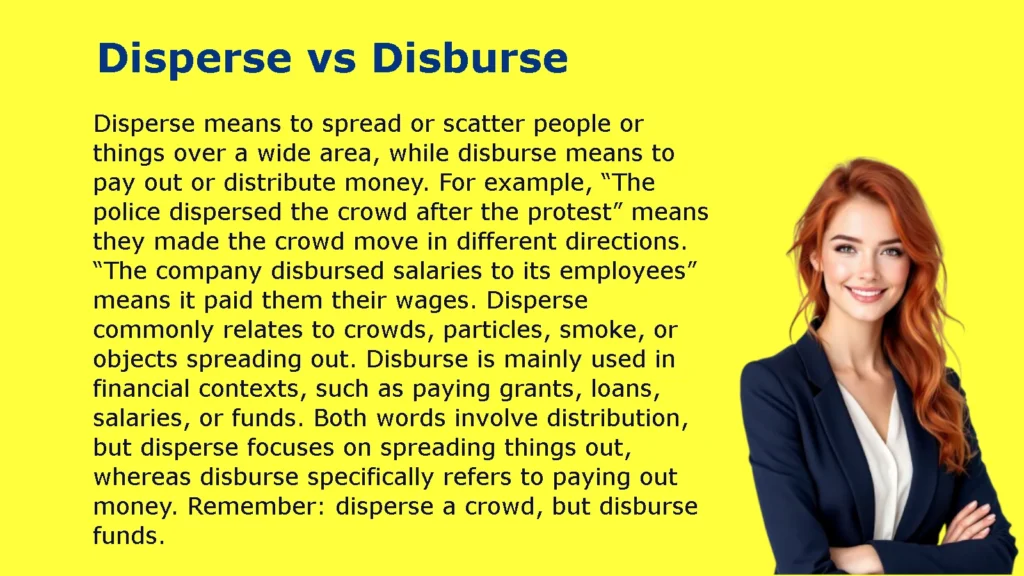
Disperse means to scatter or spread people or things apart. Disburse means to pay out money from a fund, account, or other financial source. The main difference is that disperse describes scattering or spreading, while disburse usually describes a financial payment.
| Feature | Disperse | Disburse |
| Meaning | To scatter or spread apart | To pay out money |
| Part of speech | Verb | Verb |
| Common context | Crowds, seeds, smoke, particles | Loans, grants, salaries, funds |
| Related noun | Dispersal or dispersion | Disbursement |
| Common synonym | Scatter | Pay out |
| Example | The crowd began to disperse. | The bank will disburse the loan. |
When to Use Disperse
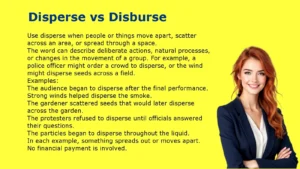
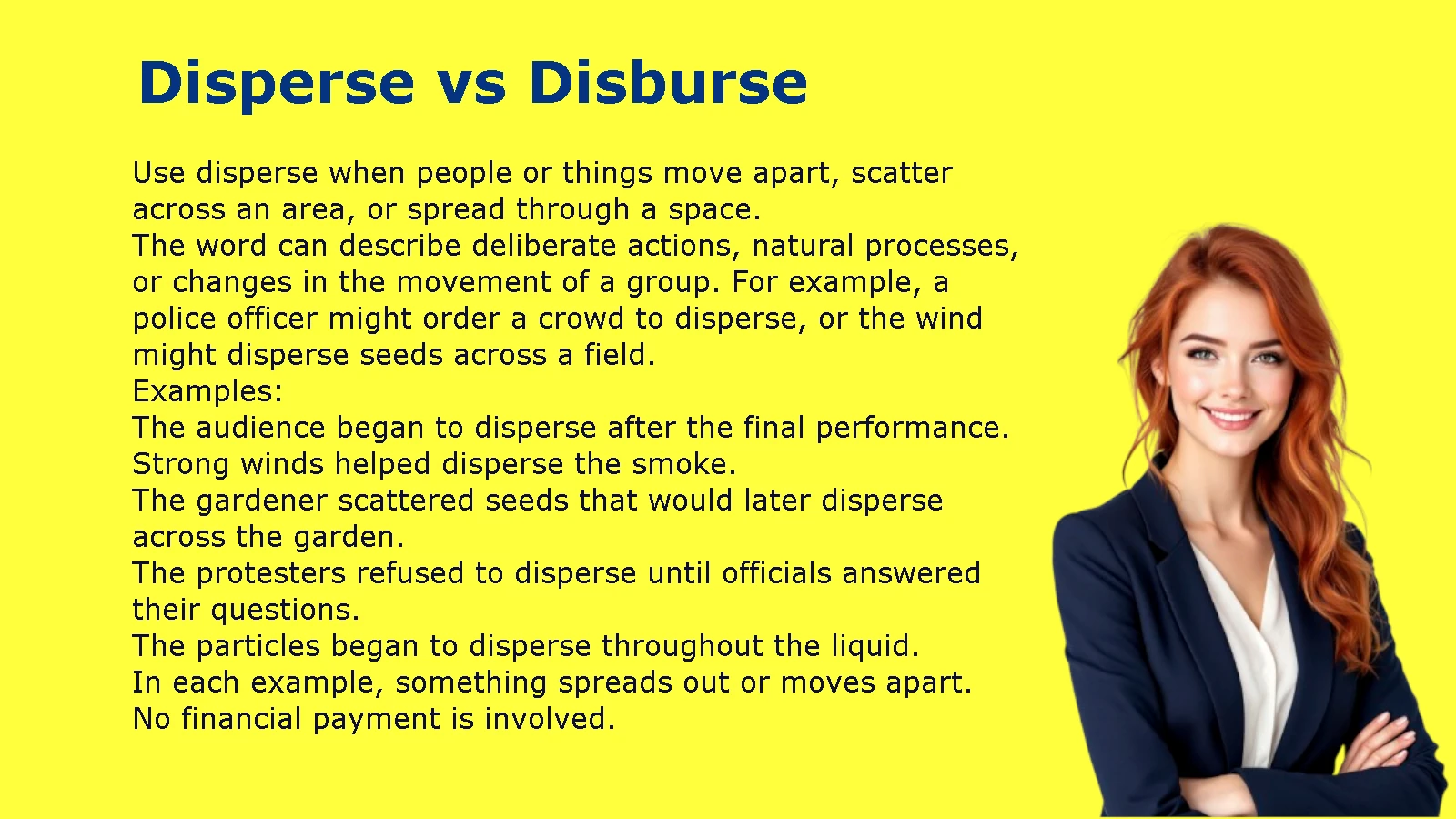
Use disperse when people or things move apart, scatter across an area, or spread through a space.
The word can describe deliberate actions, natural processes, or changes in the movement of a group. For example, a police officer might order a crowd to disperse, or the wind might disperse seeds across a field.
Examples:
- The audience began to disperse after the final performance.
- Strong winds helped disperse the smoke.
- The gardener scattered seeds that would later disperse across the garden.
- The protesters refused to disperse until officials answered their questions.
- The particles began to disperse throughout the liquid.
In each example, something spreads out or moves apart. No financial payment is involved.
When to Use Disburse
Use disburse when someone pays out money from a fund, account, budget, or financial arrangement.
The word often appears in banking, accounting, government administration, education, lending, and business. It emphasizes the release or payment of funds rather than the physical movement of people or objects.
Examples:
- The university will disburse student aid before the semester begins.
- The bank plans to disburse the approved loan next week.
- The company disbursed payments to its contractors.
- The charity will disburse grant funds to eligible organizations.
- The accountant recorded every disbursement made during the month.
The key question is whether the sentence describes money being paid out. If it does, disburse is usually the more precise choice.
Easy Ways to Remember Disperse vs Disburse
A simple memory trick can help you avoid confusing these words:
- Disperse = spread.
- Disburse = pay.
Think of a crowd leaving a stadium. People move in different directions, so they disperse.
Now imagine a bank releasing money to a borrower. The bank pays out funds, so it disburses the loan.
You can also test the sentence by replacing the verb:
- If scatter fits the meaning, consider disperse.
- If pay out fits the meaning, consider disburse.
For example, “The bank will scatter the loan tomorrow” does not express the intended financial meaning. “The bank will pay out the loan tomorrow” does. Therefore, disburse is the appropriate verb.
Disperse Meaning, Definition, and Examples
Disperse means to scatter, spread, or move apart in different directions. It can describe people leaving a gathering, particles spreading through a substance, or something becoming distributed over an area. The word works in everyday English as well as scientific, academic, and formal writing.
Examples of Disperse in Sentences
The following examples show how disperse works in different contexts.
Everyday situations
- The shoppers began to disperse when the store closed.
- The children dispersed across the playground.
- After the announcement, the audience slowly dispersed.
- The hikers dispersed along the trail to take photographs.
Nature and science
- The wind helped disperse pollen across the valley.
- Rain caused the dust to disperse into the surrounding soil.
- The chemical was designed to disperse oil in the water.
- Sunlight warmed the air and helped the mist disperse.
Formal and professional writing
- Security personnel asked the gathering to disperse.
- The organization created a plan to disperse emergency supplies across several locations.
- Researchers examined how particles disperse through the atmosphere.
Notice that disperse does not always mean that something disappears. A crowd that disperses still exists, but its members move apart. Likewise, seeds may disperse across a field without disappearing.
Disperse Synonyms and Related Words
Several words can replace disperse, but the best choice depends on the sentence.
| Synonym | Meaning | Example |
| Scatter | Spread things irregularly or in different directions | She scattered seeds across the soil. |
| Spread | Extend over an area or among people | The news spread throughout the town. |
| Distribute | Deliver or divide things among recipients or locations | Volunteers distributed food to families. |
| Diffuse | Spread gradually through a space or substance | The fragrance diffused through the room. |
| Dissipate | Gradually fade or lose intensity | The fog dissipated after sunrise. |
| Disseminate | Spread information, ideas, or knowledge widely | The agency disseminated safety guidance. |
These synonyms overlap, but they are not interchangeable in every situation.
For example, you can say that information was disseminated to the public, but disseminate sounds more formal than spread. Similarly, smoke can disperse or dissipate, although the first emphasizes scattering and the second often emphasizes fading or becoming less concentrated.
Choose a synonym based on what the sentence emphasizes: movement, distribution, gradual fading, or the spread of information.
What Does Disperse the Crowd Mean?
Disperse the crowd means to cause a group of people to separate and move away from a gathering place. The phrase often appears in discussions about public safety, protests, concerts, emergencies, and large events.
For example:
- Police asked the crowd to disperse after the event ended.
- Event organizers guided visitors toward several exits to disperse the crowd safely.
- Officials ordered the gathering to disperse because it blocked an emergency entrance.
There is a small grammatical distinction worth knowing.
When people leave on their own, the verb is usually intransitive:
“The crowd dispersed after the concert.”
When someone causes the crowd to separate, the verb takes an object:
“Security officers dispersed the crowd.”
The first sentence describes what the crowd did. The second describes what security officers caused the crowd to do.
This distinction also applies to other uses of disperse. The smoke dispersed, but the ventilation system dispersed the smoke.
Disburse Meaning, Definition, and Examples
Disburse means to pay out or release money from a fund, account, or financial source. It commonly appears in banking, business, government programs, education, and accounting. For example, a lender may disburse a loan, an employer may disburse payroll funds, and a foundation may disburse a grant.
Examples of Disburse in Sentences
These examples demonstrate how the word appears in financial and professional writing.
- The bank will disburse the approved loan after the required documents are completed.
- The university disbursed financial aid to eligible students.
- The nonprofit plans to disburse emergency funds to affected families.
- The accountant reviewed every payment the business disbursed during the quarter.
- The trustee must disburse the estate’s remaining funds according to the applicable instructions.
- The government agency delayed the disbursement of financial assistance.
In these sentences, disburse describes money leaving a fund or financial source. The word does not necessarily mean that the recipient receives cash directly. Funds may move through a bank transfer, electronic payment, check, or another payment method.
What Does Disburse Money Mean?
To disburse money means to pay it out or release it for a particular purpose. The phrase often describes a step in a financial process, such as paying a supplier, releasing a loan, or sending approved grant funds to a recipient.
Consider a small business that receives a loan to purchase equipment.
- The business applies for financing.
- The lender reviews the application.
- The lender approves the loan.
- The lender disburses the money according to the loan agreement.
- The business uses the funds to purchase equipment.
Approval and disbursement are not the same thing. A lender can approve a loan before it releases the money.
The same distinction applies to other financial arrangements. A grant may receive approval in January, but the organization might not disburse the funds until March.
Disbursement refers to the payout itself, not merely the decision to provide money.
Disburse Synonyms and Their Differences
Common synonyms for disburse include pay, pay out, release funds, remit, and, in some contexts, distribute.
| Word or phrase | Meaning | Best use |
| Pay | Give money in exchange for something or to meet an obligation | Salaries, bills, purchases |
| Pay out | Release money to a recipient | Loans, claims, winnings |
| Release funds | Make money available or send it for use | Grants, budgets, financing |
| Remit | Send money to a person or organization, often to settle an obligation | Invoices, taxes, payments |
| Allocate | Assign money to a purpose or recipient | Budgets, project funding |
| Distribute | Deliver or divide resources among recipients | Funds, supplies, payments |
These terms describe different stages or aspects of financial activity.
For instance, a company might allocate $50,000 to a marketing project but disburse the money over several months as it pays invoices. Allocation assigns the budget. Disbursement records the actual payouts.
Similarly, remit often emphasizes sending money to settle an amount owed, while disburse emphasizes paying funds out.
What Is a Disbursement?
A disbursement is an amount of money paid out or the act of paying money out. Businesses use the term to describe payments made from their accounts, while lenders and institutions use it to describe funds released to borrowers or recipients.
Examples include:
- Loan disbursement: Money released to a borrower.
- Cash disbursement: A payment made from available cash or a cash account.
- Grant disbursement: Grant funds paid to an approved recipient.
- Payroll disbursement: Money paid to employees.
- Expense disbursement: Funds paid to cover an expense.
In accounting, businesses often record disbursements to track outgoing payments. A company might review its disbursement records to confirm that supplier invoices, rent, and employee expenses were paid correctly.
A disbursement is the opposite direction of a receipt in the basic sense of cash movement. A business makes a disbursement when money leaves its account, while it records a receipt when money comes in.
However, the terms depend on whose perspective you use. A payment can be a disbursement for the payer and a receipt for the recipient.
Disbursement vs. Dispersement: Which Spelling Is Correct?
Disbursement is the standard spelling for the act of paying money out or the amount paid. Dispersement is generally considered nonstandard when used to mean a financial payout. If you are writing about loans, grants, business payments, or public funds, use disbursement.
Disbursement Examples
Here are correct examples of the word in context:
- The bank confirmed the disbursement of the loan.
- The charity tracks each disbursement to ensure proper use of its funds.
- The first grant disbursement will cover equipment costs.
- The accountant prepared a report of monthly cash disbursements.
- The agency announced a delay in the disbursement of assistance payments.
The plural form is disbursements. Use it when discussing multiple payments or payouts.
For example:
“The finance department reviewed all disbursements made during the previous quarter.”
Why Dispersement Is Usually Incorrect
The confusion comes from the similarity between disperse and disburse. Both verbs can involve something being distributed, but their standard noun forms differ.
- Disperse → dispersal or dispersion
- Disburse → disbursement
Use dispersal when describing the act of scattering or spreading something. Use dispersion when referring to the state or process of spreading, particularly in scientific contexts.
| Sentence | Correct word |
| The bank delayed the ___ of funds. | Disbursement |
| The crowd’s ___ began after the announcement. | Dispersal |
| Scientists measured the ___ of particles in the liquid. | Dispersion |
| The agency recorded several grant ___. | Disbursements |
The important point is not simply the spelling. Each noun belongs to a different word family and expresses a different meaning.
Disburse vs. Distribute: What’s the Difference?
Disburse usually means to pay out money, while distribute means to deliver, divide, or spread something among people, places, or groups. You can distribute money as well as goods, information, and supplies, but disburse is more specifically associated with financial payouts.
When Disburse Is Better
Use disburse when the sentence focuses on money leaving a fund or account.
Examples:
- The foundation will disburse grants to five community organizations.
- The company disbursed payroll funds on Friday.
- The lender will disburse the loan after the borrower meets the conditions.
- The government plans to disburse the approved assistance payments.
In these examples, the emphasis is on releasing or paying money.
When Distribute Is Better
Use distribute when you mean to hand out, divide, or deliver items or resources.
Examples:
- Volunteers distributed blankets to families during the cold weather.
- The teacher distributed worksheets to the class.
- The company distributed product samples at the exhibition.
- The organization distributed supplies among its regional offices.
You can also distribute money. For example, a charity may distribute funds among several projects. This is correct because distribute has a broader meaning.
Disburse vs. Distribute Examples
Compare these sentences:
| Sentence | Meaning |
| The agency disbursed $100,000 in grants. | The agency paid out the grant money. |
| The agency distributed $100,000 among five projects. | The agency divided or allocated the money among the projects. |
| Volunteers distributed food to residents. | Volunteers handed out food. |
| The company disbursed payments to suppliers. | The company paid suppliers. |
The difference can be subtle when money is involved. Disburse emphasizes the payment or release of funds. Distribute emphasizes how something is shared among recipients.
Dispense vs. Disperse: What’s the Difference?
Disperse means to scatter or spread apart, while dispense means to give out, provide, or administer something. Disperse often describes movement, but dispense usually describes delivering a product, service, substance, or piece of advice to someone.
When to Use Disperse
Use disperse when people or things spread out.
Examples:
- The crowd began to disperse after the announcement.
- The fan helped disperse the smoke.
- The wind dispersed seeds throughout the field.
- The particles dispersed evenly through the mixture.
When to Use Dispense
Use dispense when someone or something provides or gives out an item, substance, or service.
Examples:
- The pharmacist dispensed the prescribed medication.
- The vending machine dispenses bottled water.
- The supervisor often dispenses practical advice.
- The clinic dispensed supplies to patients.
A useful distinction is the direction of the action. When a crowd moves apart, it disperses. When a pharmacist provides medication, the pharmacist dispenses it.
The verbs may appear in technical settings, but they do not mean the same thing. A machine might dispense a liquid that later disperses through another substance.
Disperse vs. Dissipate: What’s the Difference?
Disperse emphasizes scattering or spreading apart, while dissipate often means gradually fading, weakening, or becoming less concentrated. Both words can describe smoke, fog, or particles, but dissipate more strongly suggests that something loses its intensity or concentration over time.
Disperse Examples
- The wind dispersed the smoke across the valley.
- The crowd dispersed through several exits.
- The chemical helped disperse the oil across the water’s surface.
- The seeds dispersed beyond the original planting area.
These examples focus on things spreading apart or over a larger area.
Dissipate Examples
- The morning fog dissipated as the temperature rose.
- Her nervousness gradually dissipated before the presentation.
- The heat dissipated into the surrounding air.
- The tension in the room dissipated after everyone clarified the misunderstanding.
Here, the emphasis falls on a gradual reduction in intensity or concentration.
Can Disperse and Dissipate Be Used Interchangeably?
Sometimes, yes, but the intended meaning matters.
“The smoke dispersed” suggests that the smoke spread out. “The smoke dissipated” suggests that it became less concentrated or faded away.
Likewise, a crowd may disperse, but saying that a crowd dissipated sounds less natural in ordinary usage. People move apart, while tension, heat, fog, and other conditions can dissipate.
Disperse vs. Diffuse: What’s the Difference?
Disperse means to scatter or spread things apart, while diffuse often means to spread gradually through a space, substance, or medium. Diffuse is common in science and descriptions of light, sound, gas, and fragrance. Disperse is often used for crowds, seeds, particles, and materials spread across an area.
Disperse in Everyday and Scientific Contexts
Examples:
- The wind dispersed pollen across the meadow.
- The crowd dispersed after the event.
- The machine helped disperse particles through the mixture.
- The seeds dispersed far from the parent plant.
The verb emphasizes scattering or spreading apart.
Diffuse in Everyday and Scientific Contexts
Examples:
- A translucent curtain helps diffuse sunlight.
- Gas molecules diffuse through the available space.
- The aroma diffused through the kitchen.
- The lamp produces a soft, diffuse glow.
In these examples, diffuse suggests spreading through a medium or becoming less concentrated in one place.
In scientific writing, the distinction can be more specific. Diffusion describes the net movement of particles from regions of higher concentration toward regions of lower concentration due to random motion. Dispersion can refer more broadly to particles or materials spreading through a medium, depending on the field.
For everyday writing, use disperse when you want to emphasize scattering, and diffuse when you want to emphasize gradual spreading through a space or medium.
Disperse vs. Dissolve: What’s the Difference?
Disperse means to spread particles or objects apart, while dissolve means to form a solution by mixing a substance into a solvent at the molecular or ionic level. A material can disperse without dissolving, so the words are not interchangeable in chemistry or everyday descriptions of mixtures.
Examples of Disperse
- The powder dispersed throughout the water, but small particles remained visible.
- The wind dispersed dust across the road.
- The seeds dispersed across the garden.
- The pigment was designed to disperse evenly through the coating.
Dispersal does not necessarily change the chemical identity of the material or mean that it forms a solution.
Examples of Dissolve
- The sugar dissolved in warm water.
- Salt dissolves in water to form a solution.
- The tablet was designed to dissolve in liquid.
- The cook stirred the mixture until the crystals dissolved.
When sugar dissolves, its molecules separate and mix with the water. The sugar does not simply break into visible pieces that float around.
Why the Difference Matters
Imagine adding flour and sugar to water.
The flour may disperse through the water while remaining suspended or forming clumps. Sugar, by contrast, can dissolve and form a solution.
The result depends on the material and the conditions. Some substances disperse and dissolve to different degrees, while others remain insoluble.
Use disperse when you mean to spread particles around. Use dissolve when you mean that a substance forms a solution in a solvent.
Scatter vs Disperse: What’s the Difference?
Disperse and scatter both describe spreading things apart, but scatter often suggests irregular or random placement. Disperse can sound more formal and often describes groups, particles, or substances moving apart or spreading over an area.
When to Use Disperse
Examples:
- The crowd dispersed after the ceremony.
- The wind dispersed the pollen.
- The particles dispersed throughout the liquid.
- The organization worked to disperse emergency supplies across the region.
When to Use Scatter
Examples:
- She scattered seeds over the soil.
- The dog scattered the papers across the floor.
- The children scattered when the bell rang.
- The storm scattered leaves along the road.
The words can overlap. Both scatter and disperse can describe seeds spreading across a field, for example.
However, scatter often highlights the resulting irregular arrangement or the act of throwing things in different directions. Disperse more often emphasizes the movement of a group apart or the spreading of something through an area.
Choose the word that best reflects the action you want to describe.
Disperse vs. Disseminate: What’s the Difference?
Disperse generally means to scatter or spread people or things apart, while disseminate means to spread information, knowledge, ideas, or findings widely. Disseminate is more formal and often appears in academic, scientific, government, and professional communication.
Examples of Disperse
- The police asked the crowd to disperse.
- The wind dispersed the seeds.
- The ventilation system helped disperse the smoke.
- The particles dispersed throughout the container.
Examples of Disseminate
- The health department disseminated safety information to residents.
- Researchers disseminated their findings through academic journals.
- The organization uses workshops to disseminate practical knowledge.
- Officials disseminated updated guidance to local agencies.
You might say that a crowd disperses after a public announcement, but an agency disseminates the announcement to the public.
The distinction is useful in professional writing. Disseminate specifically highlights the spread of information or ideas, whereas disperse usually highlights scattering or movement.
Although disperse can describe the spread of some abstract things, such as rumors or attention, disseminate is often the more precise choice when you mean to communicate knowledge to a wider audience.
Disperse vs. Spread: What’s the Difference?
Spread is a broad, everyday verb that means to extend over an area, affect more people, or distribute something across a surface. Disperse is more specific and often means to scatter things apart or cause a group to separate.
Examples of Disperse
- The crowd dispersed after the performance.
- The wind dispersed the seeds across the meadow.
- The chemical helped disperse the particles evenly.
- Security staff worked to disperse the gathering safely.
Examples of Spread
- The news spread quickly through the neighborhood.
- She spread butter on the toast.
- The infection spread through the community.
- The company plans to spread its operations across several regions.
Spread has more uses than disperse. You can spread a rumor, spread butter, spread a blanket, or spread a payment over several months. Disperse generally focuses on scattering or moving apart.
Compare these examples:
- “The crowd spread out across the park” describes people occupying more space.
- “The crowd dispersed” suggests that people moved away from the gathering or separated into different directions.
Both can be correct, but they emphasize different aspects of the action.
Disburse vs. Reimburse: What’s the Difference?
Disburse means to pay out money, while reimburse means to repay someone for money they have already spent on an eligible expense. A reimbursement can be a type of disbursement from the payer’s perspective, but not every disbursement is a reimbursement.
When to Use Disburse
Use disburse when describing the release of funds.
Examples:
- The bank disbursed the loan to the borrower.
- The foundation disbursed grant money to the nonprofit.
- The company disbursed payments to its suppliers.
- The trustee disbursed the estate’s remaining assets according to the applicable instructions.
These payments do not necessarily repay someone for an expense they previously covered.
When to Use Reimburse
Use reimburse when a person or organization pays someone back for an expense that person already paid.
Examples:
- The employer reimbursed the employee for business travel.
- The insurer reimbursed the customer for an eligible claim.
- The company will reimburse staff for approved equipment purchases.
- The school reimbursed the teacher for classroom supplies.
Disburse vs. Reimburse at a Glance
| Feature | Disburse | Reimburse |
| Meaning | Pay out money | Repay someone for an expense |
| Must someone have paid first? | Not necessarily | Usually, yes |
| Common context | Loans, grants, payroll, funds | Travel costs, business expenses, eligible claims |
| Example | The lender disbursed the loan. | The employer reimbursed the employee. |
Consider a practical example. An employee spends $150 on approved business travel using personal money. After reviewing the receipts, the employer pays the employee back.
The employer reimburses the employee. From the employer’s accounting perspective, that payment is also a disbursement because money leaves the company’s account.
The distinction depends on what you want to emphasize: the general payout or the repayment of a previous expense.
Common Mistakes When Using Disperse and Disburse
The words are easy to confuse because they share a similar spelling and can both involve something being distributed. The best way to avoid errors is to identify the action in the sentence before choosing the verb.
Using Disburse for a Crowd
Incorrect: The police disbursed the crowd after the demonstration.
Correct: The police dispersed the crowd after the demonstration.
The sentence describes people moving apart, not money being paid out. Therefore, disperse is the appropriate verb.
Another correct example is:
“The audience dispersed through the building’s exits after the show.”
Using Disperse for a Financial Payment
Incorrect: The bank will disperse the loan funds tomorrow.
Better: The bank will disburse the loan funds tomorrow.
The sentence describes a financial payout. Disburse is more precise because it identifies the release of money.
However, disperse is not always wrong when the subject is money. You could describe funds as being dispersed across several accounts if you specifically mean that the money is spread among different locations. In a formal financial context, though, distribute or allocate may express that meaning more clearly.
Confusing Disbursement and Dispersal
Incorrect: The organization delayed the dispersement of grant money.
Correct: The organization delayed the disbursement of grant money.
Incorrect: The crowd’s disbursement continued until midnight.
Better: The crowd’s dispersal continued until midnight.
Remember the word families:
- Disperse: dispersal, dispersion, dispersed.
- Disburse: disbursement, disbursed, disbursing.
Using the correct noun is just as important as choosing the right verb.
Choosing the Correct Word in Context
Use this quick process whenever you are unsure.
Step one: Identify what is happening.
Is something scattering, spreading, or moving apart? Or is money being paid out?
Step two: Replace the word with a simple alternative.
Try scatter for disperse and pay out for disburse.
Step three: Check the sentence’s purpose.
If you are writing a financial report, choose the term that precisely describes the transaction. If you are describing a crowd, scientific particles, or seeds, consider disperse.
For example:
“The foundation will ___ the approved grant next month.”
Replacing the blank with “scatter” does not fit the intended meaning. Replacing it with “pay out” does. Therefore, the correct word is disburse.
Now consider:
“The crowd began to ___ after the event ended.”
“Pay out” does not fit, but “scatter” does. Therefore, the correct word is disperse.
Frequently Asked Questions
What Is the Main Difference Between Disperse and Disburse?
Disperse means to scatter or spread apart, while disburse means to pay out money. You disperse a crowd or particles, but you disburse a loan, grant, or payment.
Does Disburse Always Mean Paying Money?
Yes, in standard modern usage, disburse primarily refers to paying out money or funds. It commonly appears in banking, accounting, government, legal administration, and business writing. If you mean to scatter people or objects, use disperse instead.
Is It Disbursement or Dispersement?
Disbursement is the standard noun for money paid out or the act of paying it out. Dispersement is generally nonstandard when used with this financial meaning. For the act of scattering people or things, use dispersal or, in suitable contexts, dispersion.
What Does Disburse Money Mean?
To disburse money means to pay it out or release it from a fund, account, or financial arrangement. For example, a lender disburses a loan when it releases the approved funds to the borrower or another designated recipient.
Is Disburse the Same as Distribute?
No. Disburse usually emphasizes paying out money, while distribute means delivering or dividing something among recipients. You can distribute food, documents, information, or money. You generally disburse funds when you make financial payments.
What Is Another Word for Disperse?
Common synonyms for disperse include scatter, spread, diffuse, and distribute. The best alternative depends on context. Use scatter for things moving in different directions, diffuse for spreading through a medium, and disseminate for spreading information or knowledge.
Conclusion: Choose Disperse or Disburse Based on Meaning
The difference between Disperse vs Disburse comes down to the action you want to describe. Disperse means to scatter, spread, or move apart. Disburse means to pay out or release money from a financial source.
Use these simple rules to remember the distinction:
- Disperse a crowd when people move apart.
- Disperse particles when they spread through an area or substance.
- Disburse a loan when a lender releases funds.
- Disburse a grant when an organization pays out approved money.
- Reimburse an employee when you repay an expense the employee already covered.
- Distribute supplies when you hand out goods to recipients.
Also remember that disbursement is the standard financial noun, while dispersal and dispersion relate to spreading or scattering.
Before publishing an article, writing a report, or sending a business email, check whether your sentence describes scattering or a financial payout. That one quick check will help you choose the correct word and avoid one of the most common spelling and usage mistakes in English.