Etherize vs etherise comes down to a difference in English spelling, not meaning. Etherize is the standard American English spelling, while etherise is a recognized British English variant. Both words mean to anesthetize someone with ether or, in literary contexts, to suggest a state of numbness, helplessness, or reduced awareness. Understanding this distinction also helps explain related terms such as etherization, etherized upon a table, etherized synonyms, and the pronunciation of etherized. These words have particular significance in medical history and literature, especially in T. S. Eliot’s poem The Love Song of J. Alfred Prufrock.
Etherize vs Etherise: Which Spelling Is Correct?
Both etherize and etherise are accepted spellings. The main difference lies in regional spelling preferences. American English generally favors etherize, while British English may use etherise. The two forms share the same basic meaning and usually have the same pronunciation.
Etherize Is the Preferred American English Spelling
Etherize is the standard spelling for American English. It follows the spelling pattern found in words such as organize, realize, and recognize.
The verb refers to administering ether to produce anesthesia. Writers may also use it figuratively to describe someone who appears emotionally numb or mentally unresponsive.
Examples:
- The physician prepared to etherize the patient before the historical surgical procedure.
- The novelist described the character as emotionally etherized after years of disappointment.
- The poem uses an unsettling image to suggest a mind that feels etherized and unable to act.
- The narrator seemed etherized by the repetitive routine of everyday life.
In contemporary American writing, choose etherize when you need this verb. Use its related forms, such as etherized, etherizing, and etherization, according to the sentence.
Etherise Is the British English Variant
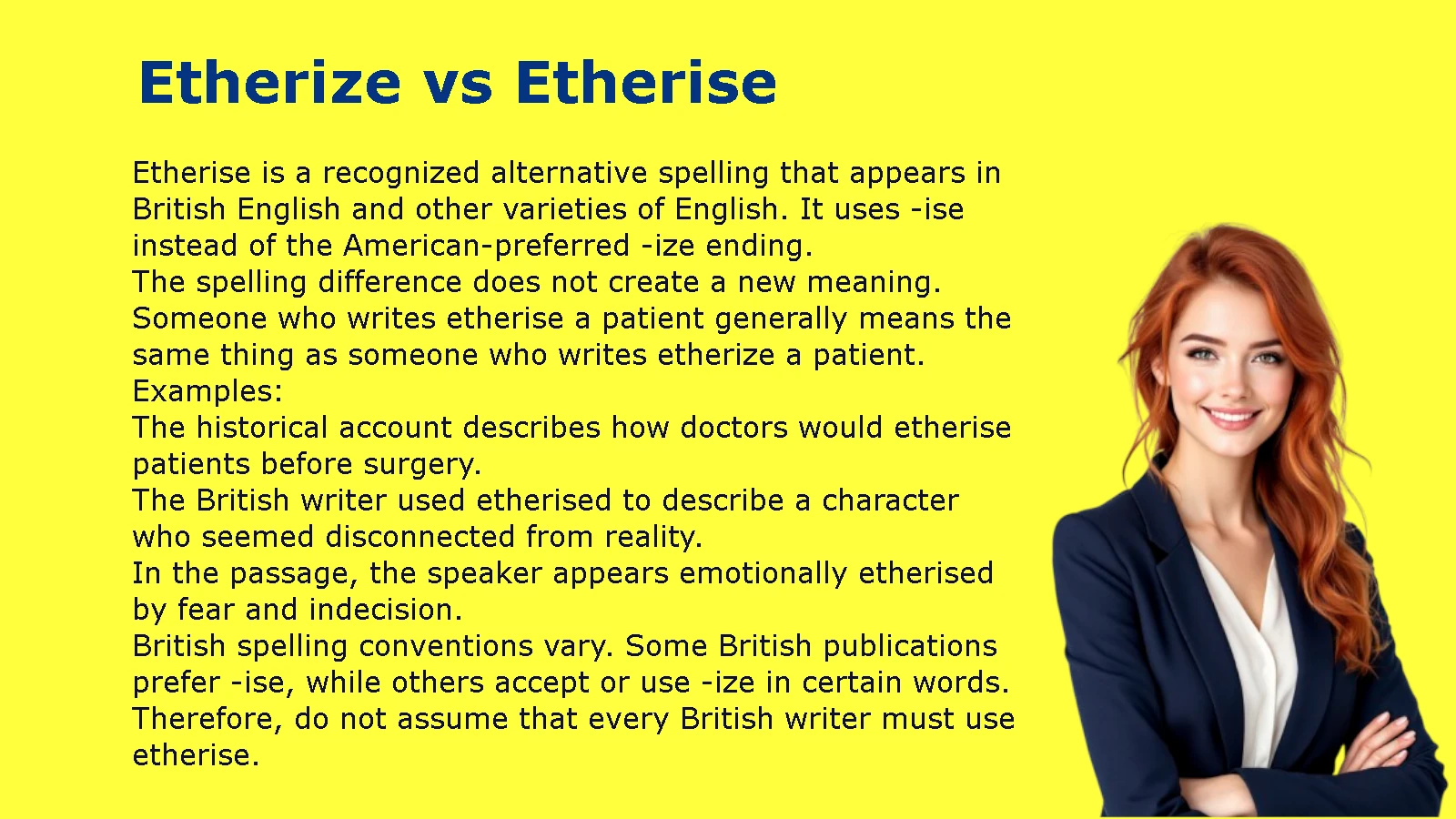
Etherise is a recognized alternative spelling that appears in British English and other varieties of English. It uses -ise instead of the American-preferred -ize ending.
The spelling difference does not create a new meaning. Someone who writes etherise a patient generally means the same thing as someone who writes etherize a patient.
Examples:
- The historical account describes how doctors would etherise patients before surgery.
- The British writer used etherised to describe a character who seemed disconnected from reality.
- In the passage, the speaker appears emotionally etherised by fear and indecision.
British spelling conventions vary. Some British publications prefer -ise, while others accept or use -ize in certain words. Therefore, do not assume that every British writer must use etherise.
Etherize vs Etherise Comparison Table
| Feature | Etherize | Etherise |
| Spelling pattern | -ize | -ise |
| Typical usage | American English | British English variant |
| Meaning | To anesthetize with ether | To anesthetize with ether |
| Pronunciation | Generally the same | Generally the same |
| Past tense | Etherized | Etherised |
| Present participle | Etherizing | Etherising |
| Related noun | Etherization | Etherisation |
| Example | The doctor would etherize the patient. | The doctor would etherise the patient. |
The choice depends mainly on your audience and preferred style guide. Both forms communicate the same basic idea.
Etherize or Etherise: Which Should You Use?
Choose the spelling that fits your intended audience.
Use etherize when:
- You are writing for readers in the United States.
- Your website follows American English spelling.
- You want to maintain consistency with words such as organize and realize.
Use etherise when:
- Your publication prefers British -ise spellings.
- You are reproducing a historical passage that uses this form.
- Your editor or style guide specifically requests it.
For SEO content aimed at American readers, etherize vs etherise is the most useful comparison phrase. Include etherise naturally in the explanation so readers searching for either spelling can find the answer.
Avoid treating one spelling as universally correct and the other as a typo. Regional conventions determine which form best suits a particular document.
Etherize Meaning and Definition
Etherize means to administer ether to someone to produce anesthesia. Ether was historically used to make patients unconscious or insensitive to pain during medical procedures. In literature, etherize and its related form etherized can also suggest emotional numbness, passivity, or a loss of alertness.
What Does Etherize Mean?
The verb etherize has a specific historical medical meaning. It refers to using ether, particularly diethyl ether, as an anesthetic.
Ether is a volatile chemical compound that was used extensively in the development of surgical anesthesia. When administered under medical supervision, it could produce a state in which patients experienced reduced awareness and pain during surgery.
The word can also carry a figurative meaning. A writer might describe someone as etherized to suggest that the person feels numb, detached, passive, or unable to respond normally to the world.
Consider these examples:
- Literal: The historical account describes how physicians would etherize patients before certain operations.
- Figurative: After months of repetitive work, he felt etherized by the same routine.
- Literary: The speaker’s etherized state suggests that he has become disconnected from his surroundings.
These examples share an idea of reduced awareness or responsiveness, but they do not describe identical situations. The first concerns historical anesthesia, while the others use the concept metaphorically.
Etherize in Medical and Historical Contexts
Etherize belongs to the vocabulary of medical history. Before modern anesthetic techniques became available, surgery often involved severe pain and considerable physical distress.
The public demonstration of ether anesthesia at Massachusetts General Hospital in Boston in 1846 became a landmark in the history of surgery. William T. G. Morton administered ether during a procedure performed by surgeon John Collins Warren. The demonstration helped establish ether anesthesia as an important development in surgical practice.
This history explains why the word etherize appears in older medical accounts and literary works. It refers to a recognizable medical practice rather than a general synonym for making someone sleepy.
A useful distinction is that etherize specifically refers to ether, whereas anesthetize is a broader term for producing anesthesia through an appropriate anesthetic method.
For example:
- The historical record describes the use of ether to anesthetize a patient.
- A modern medical text may discuss anesthesia without mentioning ether at all.
- A literary passage may borrow the word etherized without describing an actual medical procedure.
Ether has important risks and is not an appropriate substance for self-administration. Here, the term is discussed for its historical, linguistic, and literary significance.
Etherize in Figurative and Literary Contexts
Writers sometimes use medical vocabulary to describe emotional experiences. In this context, etherize suggests that a person’s awareness or ability to respond has become dulled.
Imagine an office worker who follows the same routine every day. The person attends meetings, answers messages, and completes tasks but feels emotionally absent. A writer might say that the routine has etherized the worker’s imagination.
The sentence does not suggest that the worker has received ether. Instead, it uses the image of anesthesia to communicate detachment.
Figurative uses may suggest:
- Emotional numbness: Someone struggles to feel excitement, sadness, or affection.
- Mental passivity: A person finds it difficult to make decisions or take action.
- Social detachment: Someone feels disconnected from other people.
- Dreamlike awareness: A character experiences the world as distant or unreal.
- Paralysis through fear: A person understands a situation but cannot bring themselves to act.
These meanings depend on context. The word does not always imply complete unconsciousness. It may describe a subtler state in which a person remains aware but feels unable to respond meaningfully.
Etherize Definition and Example Sentences
The best way to understand etherize is to examine how it works in different sentences.
| Sentence | Meaning |
| The historical physician would etherize the patient. | Administer ether to produce anesthesia. |
| The account explains how doctors etherized patients during early surgical procedures. | Describes a past medical practice. |
| The monotonous routine seemed to etherize his imagination. | Suggests that the routine dulled his creativity. |
| Fear appeared to etherize her ability to respond. | Suggests that fear left her mentally or emotionally paralyzed. |
| The writer used an etherized character to represent passivity. | Uses the word as a literary description. |
Notice that the object and surrounding words help determine the intended meaning. A patient in a historical medical account points toward literal anesthesia. Words such as imagination, fear, and routine often signal figurative usage.
Etherization Meaning and Related Word Forms
Etherization means the process of administering ether to produce anesthesia. It is the noun form related to the verb etherize. Other related forms include etherized, etherizing, and etherisation, which follows the alternative -ise spelling pattern.
What Does Etherization Mean?
Etherization refers to the process or act of using ether to produce anesthesia, especially in historical medical contexts.
The noun describes a procedure or process rather than the action expressed directly by the verb.
Compare these examples:
- Etherize: The physician would etherize the patient.
- Etherization: Etherization was an important development in the history of surgical anesthesia.
- Etherized: The patient was etherized before the procedure.
- Etherizing: The historical account describes physicians etherizing patients.
The distinction is similar to the relationship between anesthetize and anesthesia. One word describes an action, while the other names a process or resulting medical state.
Etherize, Etherized, Etherizing, and Etherization
Each word form serves a different grammatical purpose.
| Word form | Part of speech | Meaning | Example |
| Etherize | Verb | Administer ether to produce anesthesia | The physician planned to etherize the patient. |
| Etherized | Past-tense verb or participle | Administered ether; affected by ether | The patient had been etherized. |
| Etherizing | Present participle or gerund | Administering ether | The text describes etherizing patients. |
| Etherization | Noun | The process of administering ether | Etherization changed the history of surgery. |
| Etherise | Verb variant | British spelling of etherize | The historical physician would etherise the patient. |
| Etherisation | Noun variant | Alternative spelling of etherization | The account discusses etherisation. |
The spelling pattern carries through related forms. If you use etherise, you will generally use etherised, etherising, and etherisation. With etherize, use etherized, etherizing, and etherization.
Etherize vs Etherization
The main difference is grammatical.
Etherize expresses an action. Etherization names the process associated with that action.
For example, a medical historian might write, “The physician used ether to etherize the patient.” The historian could then explain, “This method of etherization represented an important step in surgical history.”
The first sentence focuses on what the physician did. The second focuses on the procedure itself.
This distinction matters when choosing keywords and writing definitions. Someone searching for etherize meaning probably wants the verb defined. A person searching for etherization meaning may want the related noun and its historical context.
Etherized Upon a Table Meaning in Literature
Etherized upon a table refers literally to someone rendered unconscious with ether and lying on a table. In literature, the image can suggest helplessness, passivity, emotional numbness, and an inability to act. Its best-known literary use appears near the beginning of T. S. Eliot’s The Love Song of J. Alfred Prufrock.
What Does Etherized Upon a Table Mean?
The phrase combines a medical image with an unsettling comparison. An etherized person has been made unconscious or insensible through anesthesia and placed on a table for a procedure.
As a literary image, this scene can communicate more than physical unconsciousness. It can suggest a person who has lost control, cannot respond to the world, or remains suspended in a state of helplessness.
The meaning depends on the passage, but the phrase often brings several ideas to mind:
- Helplessness: The person cannot act independently.
- Passivity: The person receives events rather than directing them.
- Reduced awareness: The person seems detached from ordinary experience.
- Vulnerability: The person is exposed and unable to protect themselves.
- Emotional paralysis: The person struggles to turn thoughts or feelings into action.
The image can feel disturbing because it compares a familiar human experience with a clinical scene. Instead of presenting a peaceful or comforting image, it creates distance and unease.
Etherized Upon a Table in T. S. Eliot’s The Love Song of J. Alfred Prufrock
T. S. Eliot uses the phrase near the beginning of The Love Song of J. Alfred Prufrock, first published in 1915. The poem opens with a striking comparison between an evening sky and a patient under anesthesia.
The image immediately disrupts the reader’s expectations. Evening skies often suggest romance, beauty, calm, or reflection. Eliot replaces that familiar association with a medical image of unconsciousness and vulnerability.
This contrast helps establish the poem’s psychological atmosphere.
Prufrock is a speaker who repeatedly considers what he might say or do but struggles to act decisively. He worries about social judgment, questions his own importance, and imagines possible conversations without confidently entering them.
The opening image anticipates these concerns. The world seems suspended, and the speaker’s ability to act appears dulled.
Several aspects of the image deserve attention:
The loss of control: A patient under anesthesia cannot direct the procedure or respond normally to the surroundings. This parallels Prufrock’s difficulty taking control of his social life.
The absence of romantic comfort: The comparison replaces a conventional evening image with something clinical and unsettling. It signals that the poem will challenge familiar expectations.
The sense of suspension: An etherized patient occupies a state between ordinary awareness and unconsciousness. Prufrock similarly seems caught between thinking about action and carrying it out.
The emotional distance: The image creates a detached, almost impersonal atmosphere. This reflects the speaker’s tendency to observe, analyze, and hesitate rather than engage confidently.
A useful literary interpretation is that the image turns emotional and psychological paralysis into something readers can picture. Instead of merely telling us that the speaker feels stuck, Eliot presents an image of a body rendered unable to respond.
Etherized Definition in Literature
In literary analysis, etherized can describe a person, atmosphere, or state of mind that appears dulled, immobilized, or disconnected from normal awareness.
The word’s literal medical meaning gives the metaphor its force. Readers already understand that anesthesia reduces a person’s ability to respond. A writer can use that association to describe characters who seem trapped in passivity.
For example:
“The city moved around him, but he remained etherized by regret.”
This sentence suggests that regret has weakened the character’s ability to participate in life. The city continues to move, yet he feels detached from its activity.
Another example:
“Her etherized imagination could no longer turn ordinary events into possibilities.”
Here, the word suggests diminished creativity rather than literal unconsciousness.
When analyzing a literary passage, separate three elements:
- Literal meaning: What would the word mean in a medical or physical context?
- Figurative association: What emotions or conditions does the literal meaning suggest?
- Contextual meaning: How do the surrounding images and themes shape the interpretation?
This method prevents readers from treating a metaphor as a simple dictionary definition.
How to Interpret Etherized in a Literary Passage
Start with the literal meaning, then examine the writer’s purpose.
Suppose a character sits silently at a family gathering. The narrator describes the character as etherized by grief. The character is not necessarily unconscious. Instead, grief appears to have weakened the character’s emotional responses.
Ask these questions when interpreting the word:
- Who or what is etherized? A person, a mind, an atmosphere, or a larger social setting?
- What caused the state? Fear, grief, boredom, social pressure, or a literal medical procedure?
- What actions become difficult? Speaking, deciding, feeling, responding, or connecting with others?
- What mood does the image create? Unease, sadness, alienation, vulnerability, or detachment?
- Does the surrounding passage support a literal or figurative reading? Medical details may support the literal sense, while emotional and symbolic imagery often supports a metaphorical one.
In Eliot’s poem, the opening comparison establishes a mood of unease and anticipates the speaker’s hesitation. It does not simply tell readers that someone has received anesthesia. It makes passivity and disconnection central to the poem’s atmosphere.
Etherized Pronunciation and Word Forms
Etherized is generally pronounced with the same opening sound as ether. In standard American English, the word is commonly represented as /ˈiːθəraɪzd/. The alternative spelling etherised generally has the same pronunciation.
How to Pronounce Etherized
The standard American English pronunciation of etherized is:
IPA: /ˈiːθəraɪzd/
The word begins with the long ee vowel sound, followed by the th sound found in think. The middle contains an unstressed vowel, and the final part sounds like -ized.
Break the pronunciation into three parts:
- First part: The long ee sound.
- Middle part: The unstressed syllable containing the th sound.
- Ending: The sound represented by -ized, with a final voiced /d/ sound.
The stress falls on the first syllable.
The pronunciation of etherize is commonly represented as /ˈiːθəraɪz/. The final sound changes when the past-tense ending is added.
How to Pronounce Etherize and Etherise
The two spellings generally sound alike. The difference between etherize and etherise is primarily visual rather than phonetic.
| Word | General pronunciation | Stress |
| Etherize | /ˈiːθəraɪz/ | First syllable |
| Etherise | Generally the same | First syllable |
| Etherized | /ˈiːθəraɪzd/ | First syllable |
| Etherised | Generally the same as etherized | First syllable |
| Etherization | /ˌiːθərəˈzeɪʃən/ | Commonly on the syllable containing -za- |
Pronunciation can vary slightly by accent. The main point is that the spelling difference does not normally create a different spoken word.
When reading Eliot’s poem aloud, focus on the meaning and tone of the image as well as the pronunciation. The word’s clinical associations contribute to the unsettling effect of the opening comparison.
Common Grammar Patterns
The verb etherize usually takes a direct object when it describes the literal act of administering ether.
Examples:
- The physician planned to etherize the patient.
- The historical account explains how doctors etherized patients.
- The medical historian described the process of etherizing a patient.
The form etherized can function as a past-tense verb or as a participle.
Past-tense verb: “The physician etherized the patient.”
Past participle: “The patient had been etherized before the procedure.”
Participial adjective: “The etherized patient lay motionless.”
Figurative usage follows similar grammatical patterns:
- The endless routine etherized his imagination.
- She felt etherized by fear.
- The character seemed etherized and detached from the conversation.
These patterns help distinguish the word’s grammatical role. When etherized describes a person or condition, it may function adjectivally. When it reports an action in the past, it functions as part of a verb phrase.
Etherized Synonyms and Related Expressions
The best etherized synonym depends on whether the word refers to literal anesthesia or figurative numbness. Anesthetized is close to the medical meaning, while numb, dazed, dulled, and stupefied may fit literary contexts. These alternatives carry different shades of meaning, so they should not be treated as perfect replacements.
Synonyms for Etherized in the Literal Sense
When etherized describes someone who has received ether for anesthesia, the closest general alternative is anesthetized.
Other related words include unconscious and sedated, but each has a different meaning.
| Word | Meaning | Best use |
| Anesthetized | Given an anesthetic to reduce awareness or sensation | General medical context |
| Unconscious | Not awake or aware of one’s surroundings | Describing a state of awareness |
| Sedated | Given a substance to calm or reduce alertness | Medical contexts involving sedation |
| Insensible | Not responsive to sensation or external stimuli | Formal or historical writing |
| Etherized | Given ether to produce anesthesia | Specific historical or literary contexts |
These words overlap, but they are not medically interchangeable. For example, someone can be sedated without being fully unconscious. A person can also lose consciousness for reasons unrelated to anesthesia.
Use anesthetized when you need a broad medical term. Keep etherized when the historical substance or literary reference matters.
Synonyms for Etherized in Figurative Writing
In figurative writing, the best synonym depends on the effect you want to communicate.
Numb emphasizes reduced emotional or physical sensation.
Example: “After the loss, he felt numb and struggled to speak.”
Dazed suggests confusion or reduced awareness, often following a shocking event.
Example: “She stood dazed in the hallway, unable to understand what had happened.”
Stupefied emphasizes a state of mental dullness or astonishment.
Example: “The unexpected announcement left the audience stupefied.”
Dulled suggests that a person’s senses, emotions, or abilities have lost their sharpness.
Example: “Years of repetition had dulled his curiosity.”
Unresponsive emphasizes the absence of a clear reaction.
Example: “The character remained unresponsive while everyone around him argued.”
Detached suggests emotional distance rather than physical unconsciousness.
Example: “He watched the argument with a detached expression.”
Paralyzed suggests an inability to act, whether physical or psychological.
Example: “Fear had paralyzed her before she could answer.”
Each word highlights a different feature of the experience. If you want to emphasize Prufrock’s hesitation, paralyzed may be clearer. If you want to suggest emotional emptiness, numb may work better.
Etherized vs Anesthetized vs Numb
These three words are related, but they serve different purposes.
| Word | Core meaning | Typical tone | Example |
| Etherized | Made insensible using ether; figuratively dulled or passive | Historical or literary | The speaker feels etherized by routine. |
| Anesthetized | Given an anesthetic or deprived of sensation | Medical or technical | The patient was anesthetized before surgery. |
| Numb | Unable to feel normally, physically or emotionally | Everyday or literary | He felt numb after hearing the news. |
Choose etherized when the historical or literary association matters. Use anesthetized for a general medical description. Choose numb when you want a simple, direct expression of reduced sensation or emotion.
Writers should also consider the tone of the surrounding sentence. Etherized may sound formal or deliberately literary in modern prose. Numb is more common in everyday conversation and often communicates the idea with less effort.
Malingers Meaning and Example Sentences
Malingers is the third-person singular present-tense form of malinger. It means to pretend to be ill or to exaggerate an illness, usually to avoid work, responsibility, or another obligation.
The word generally carries a negative implication because it suggests deliberate deception.
Examples:
- He malingers whenever the team faces a difficult assignment.
- The supervisor suspected that the employee malingers to avoid unpleasant tasks.
- In the story, the character malingers because he wants to escape his responsibilities.
- The narrator accuses the soldier of malingering, although the passage leaves the accusation open to doubt.
The last example illustrates an important distinction. A character’s accusation does not prove that someone is pretending to be ill. In literary analysis, readers should distinguish what a narrator claims from what the story establishes.
Related forms include:
| Word | Grammatical role | Meaning |
| Malinger | Base verb | Pretend to be ill or exaggerate illness |
| Malingers | Third-person singular verb | they pretends to be ill |
| Malingered | Past tense or past participle | Pretended to be ill |
| Malingering | Present participle or gerund | The act of pretending to be ill |
| Malingerer | Noun | A person who malingers |
For example, “The manager accused him of malingering” uses the noun-like form malingering to identify the alleged behavior.
Do not confuse malingering with genuine illness. The word specifically implies intentional deception, so use it carefully when describing real people.
Muttering Meaning and Example Sentences
Muttering means speaking quietly, often in a way that makes the words difficult to hear or understand. People may mutter because they feel annoyed, nervous, embarrassed, distracted, or unwilling to speak openly.
Examples:
- She walked away muttering under her breath.
- He kept muttering about the unfair decision.
- The character sat by the window, muttering to himself.
- I heard someone muttering in the next room, but I could not make out the words.
- The student began muttering an answer while searching for the right explanation.
Muttering does not always indicate anger. Someone might mutter a reminder to themselves, repeat a phrase while thinking, or speak quietly because they feel uncomfortable.
The word also has a useful role in fiction. A writer can use muttering to show a character’s mood without explaining it directly.
For instance:
“Daniel left the room, muttering about the meeting.”
This sentence suggests dissatisfaction, but it does not tell readers exactly what Daniel said or whether his complaint was justified.
Another example:
“She stood beside the desk, muttering the instructions to herself.”
Here, the muttering may show concentration rather than anger.
Common related forms include:
- Mutter: The base verb.
- Mutters: The third-person singular form.
- Muttered: The past-tense form.
- Muttering: The present participle or gerund.
- A mutter: A quiet or indistinct utterance.
In literary writing, muttering can reveal irritation, uncertainty, private thought, or social discomfort. The surrounding scene determines which interpretation makes the most sense.
Are Malingers and Muttering Related to Etherized?
The three terms have different meanings and grammatical functions.
| Word | Part of speech | Core meaning | Common literary use |
| Etherized | Past participle or adjective | Made insensible; figuratively numb or passive | Suggesting paralysis or detachment |
| Malingers | Verb | Pretends to be ill to avoid responsibility | Showing avoidance or dishonesty |
| Muttering | Verb form or gerund | Speaking quietly or indistinctly | Revealing irritation, anxiety, or private thought |
A writer could use all three words in the same story without implying that they mean the same thing.
For example:
“The etherized patient lay still while the nurse listened to a visitor muttering in the hallway. Across town, an employee malingers to avoid a difficult meeting.”
The words describe three distinct situations: anesthesia, quiet speech, and deliberate avoidance.
This distinction matters for SEO as well as vocabulary learning. A page targeting etherize vs etherise can answer related word questions, but it should not present unrelated terms as synonyms simply because readers search for them together.
Common Mistakes When Using Etherize and Etherise
Writers can avoid confusion by checking regional spelling, grammatical form, and context. The most common errors involve treating etherise as universally incorrect, confusing ether anesthesia with every form of sedation, or overlooking the figurative meaning of etherized in literature.
Treating Etherise as an Automatic Misspelling
The spelling etherise is not automatically wrong. It is a recognized variant associated with British English and other spelling traditions.
A US-focused article will usually use etherize. A British publication may use etherise, depending on its style guide.
The important rule is consistency. Avoid switching between etherize and etherise without a reason.
Confusing Etherize With General Sedation
Etherize has a specific connection to ether. It does not simply mean to calm someone, make someone sleepy, or administer any type of anesthetic.
Compare these sentences:
- The historical physician used ether to etherize the patient.
- The clinician sedated the patient using an appropriate medication.
- The writer described the character as numb with grief.
Each sentence describes a different situation. The first identifies a particular anesthetic substance. The second describes sedation more generally. The third uses emotional language.
Choose the word that accurately represents the situation rather than substituting terms based only on their association with reduced awareness.
Misreading Etherized Upon a Table as Purely Literal
In Eliot’s poem, the image has a literal medical basis, but its literary effect extends beyond that meaning.
The comparison helps establish an atmosphere of unease and suggests a condition of passivity. Reading it only as a description of a patient would miss its role in the poem’s psychological and symbolic structure.
When analyzing the phrase, consider the speaker’s emotional state, the contrast between conventional evening imagery and the clinical scene, and the poem’s recurring concern with hesitation.
Using Etherized Synonyms Without Checking Context
Synonyms can change the tone and precision of a sentence.
For example, numb emphasizes a lack of feeling. Dazed suggests confusion. Anesthetized points toward a medical process, while paralyzed emphasizes an inability to act.
Consider these alternatives:
- “He felt numb after the conversation.” This emphasizes emotion.
- “He remained dazed by the unexpected news.” This emphasizes confusion.
- “Fear paralyzed him.” This emphasizes an inability to act.
- “The historical patient was anesthetized.” This emphasizes the medical context.
Although these expressions overlap with some figurative uses of etherized, they are not interchangeable in every sentence. Choose the word that conveys the precise meaning you intend.
Frequently Asked Questions
Is Etherize or Etherise Correct?
Both spellings are recognized. Etherize is the standard American English spelling, while etherise is a British English variant. They generally have the same meaning and pronunciation, so choose the form that matches your audience and style guide.
What Does Etherize Mean in Simple Terms?
Etherize means to administer ether to make someone insensible or anesthetized. In literature, it can also mean to make someone seem emotionally numb, passive, or unable to respond. The intended meaning depends on the context.
What Does Etherized Upon a Table Mean?
Etherized upon a table literally describes someone who has been rendered unconscious with ether and placed on a table. In T. S. Eliot’s The Love Song of J. Alfred Prufrock, the image suggests helplessness, passivity, and psychological unease.
What Is the Meaning of Etherization?
Etherization is the process of administering ether to produce anesthesia. The term appears particularly in historical medical contexts. It is the noun related to the verb etherize, while etherisation is an alternative spelling.
How Do You Pronounce Etherized?
In standard American English, etherized is commonly pronounced /ˈiːθəraɪzd/. The stress falls on the first syllable. Etherised generally has the same pronunciation despite its different spelling.
What Are Synonyms for Etherized?
Suitable alternatives include anesthetized, unconscious, numb, dazed, dulled, and stupefied. The best choice depends on context. Anesthetized suits medical writing, while numb or paralyzed may better express emotional detachment or an inability to act.
Conclusion: Choose Etherize or Etherise Based on Context
The difference between etherize vs etherise is primarily a matter of spelling convention. Etherize is the standard American English form, while etherise is a recognized British English variant. Both refer to administering ether to produce anesthesia, and both can support figurative descriptions of numbness, passivity, or reduced awareness.
Understanding the related vocabulary adds depth to the distinction. Etherization names the process of administering ether, while etherized describes someone or something affected by it. In literature, the phrase etherized upon a table takes on particular significance through T. S. Eliot’s The Love Song of J. Alfred Prufrock, where it helps communicate psychological paralysis and emotional distance.
Words such as malingers and muttering serve different purposes. The former concerns pretending to be ill to avoid responsibility, while the latter describes quiet or indistinct speech. Recognizing these distinctions helps you interpret vocabulary accurately and choose more precise words in your own writing.
If you are writing for an American audience, use etherize. If your publication follows a British -ise convention, etherise may be the better fit. Keep your spelling consistent, check the surrounding context, and use the word that expresses your intended meaning.