Vulcanized and unvulcanized rubber differ in how their polymer chains behave, how manufacturers process them, and how they perform in finished products. Vulcanized rubber has undergone a curing process that creates cross-links between polymer chains, improving its elasticity, dimensional stability, and resistance to wear. Unvulcanized rubber has not completed this process, so manufacturers can shape, layer, and process it before curing.
Understanding the difference between vulcanized and unvulcanized rubber helps you choose the right material for industrial rubber sheets, tires, shoes, gym flooring, seals, and molded components. The rubber vulcanization process also explains why uncured rubber works well during manufacturing but generally cannot replace finished rubber in demanding applications. Whether you’re researching unvulcanized rubber for sale or comparing the performance of different rubber products, the material’s intended use should guide your decision.
What Is Vulcanized and Unvulcanized Rubber?
Vulcanized rubber is rubber that has undergone a controlled curing process to develop a network of cross-links between its polymer chains. Unvulcanized rubber has not completed that process. The two materials may start with similar base polymers, but their structures and performance can differ significantly after curing.
What Does Vulcanized Rubber Mean?
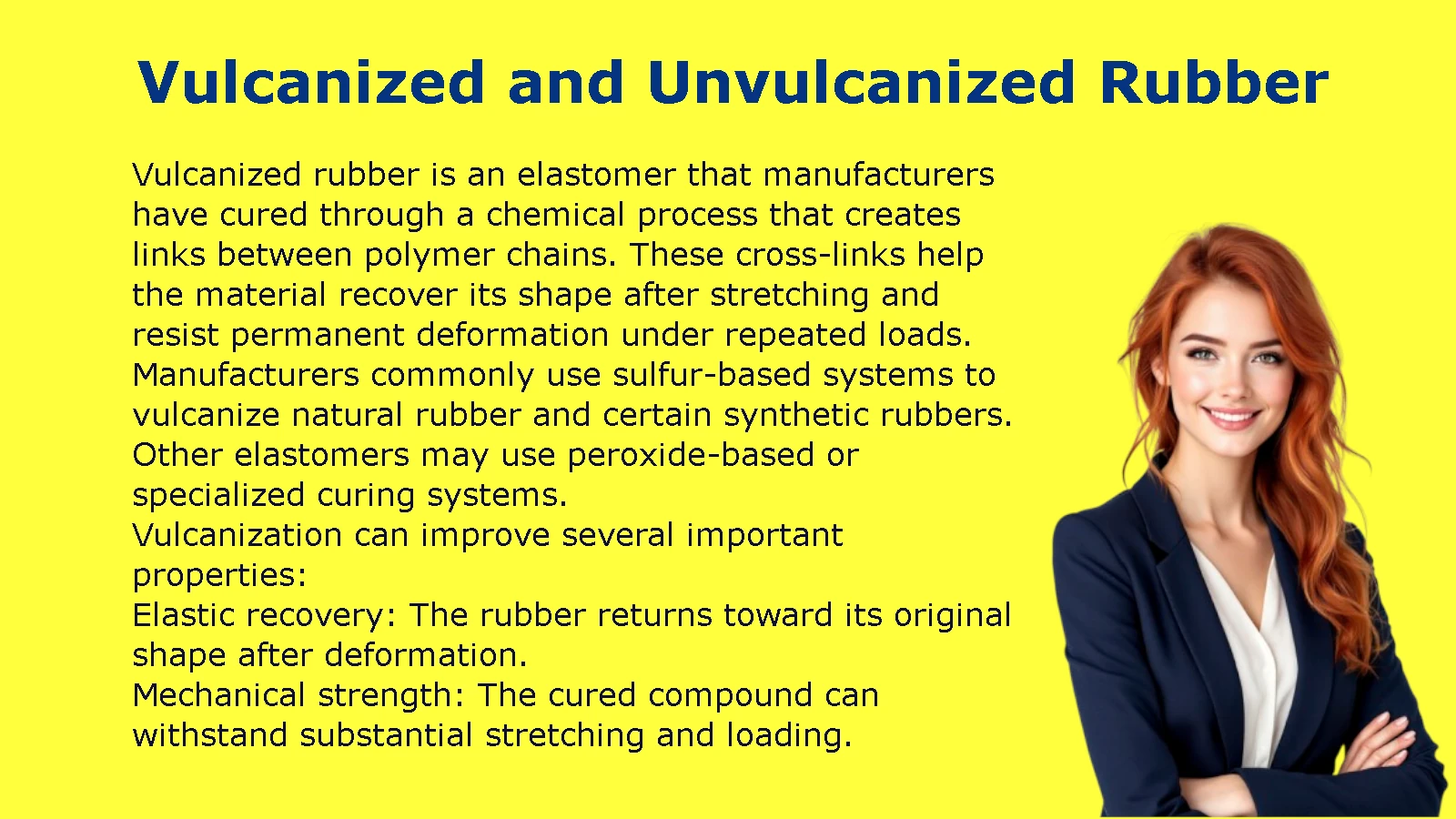
Vulcanized rubber is an elastomer that manufacturers have cured through a chemical process that creates links between polymer chains. These cross-links help the material recover its shape after stretching and resist permanent deformation under repeated loads.
Manufacturers commonly use sulfur-based systems to vulcanize natural rubber and certain synthetic rubbers. Other elastomers may use peroxide-based or specialized curing systems.
Vulcanization can improve several important properties:
- Elastic recovery: The rubber returns toward its original shape after deformation.
- Mechanical strength: The cured compound can withstand substantial stretching and loading.
- Abrasion resistance: Properly formulated rubber can resist surface wear from friction.
- Dimensional stability: The material holds its shape more reliably during use.
- Heat resistance: Cross-linking can improve resistance to softening and permanent deformation at elevated temperatures.
- Service life: The right compound can withstand repeated use better than its uncured counterpart.
However, vulcanization does not make every rubber compound equally strong or heat-resistant. Polymer selection, filler content, curing conditions, and the finished product’s design all affect performance.
For example, a vulcanized rubber gasket must maintain a seal under compression, while a vulcanized shoe outsole needs grip and abrasion resistance. Both use cured rubber, but their formulations serve different purposes.
What Is the Meaning of Unvulcanized Rubber?
Unvulcanized rubber is rubber that has not yet undergone its intended vulcanization process. Manufacturers often call this material uncured rubber, although terminology can vary depending on the product and manufacturing stage.
Unvulcanized rubber remains suitable for processing operations such as molding, extrusion, layering, and tire building. Its exact consistency depends on the base polymer, fillers, oils, processing aids, and other ingredients.
Common characteristics include:
- Processability: Manufacturers can shape and form the compound before curing.
- Tackiness: Some uncured compounds adhere to compatible surfaces or to other layers of rubber.
- Limited elastic recovery: The material may not return to its original shape as effectively as the finished compound.
- Sensitivity to storage conditions: Temperature and time can affect shelf life and processing behavior.
- Need for further processing: Many uncured compounds require a specified curing cycle before they can function as finished products.
Unvulcanized rubber is not necessarily raw, untreated natural rubber. It may already contain several ingredients and may have undergone mixing, milling, or other preparation steps. Its defining feature is that it has not completed the intended curing process.
Are Vulcanized and Cured Rubber the Same?
The terms vulcanized rubber and cured rubber often describe the same finished state in everyday manufacturing discussions. Both refer to rubber that has undergone a process that develops the required material properties.
The distinction is that curing is the broader term. Vulcanization traditionally refers to forming cross-links in rubber, often through sulfur chemistry. However, manufacturers also cure elastomers with peroxides, resins, and other chemical systems.
For practical purposes, check the product specification rather than relying on the terminology alone. A supplier’s technical data should identify the polymer, curing system where relevant, hardness, and performance limits.
Vulcanized vs. Unvulcanized Rubber: Key Differences
The main difference between vulcanized and unvulcanized rubber is the material’s state of cure. Vulcanization changes how the polymer chains interact, which affects elasticity, strength, resistance to deformation, and suitability for service.
| Property | Vulcanized rubber | Unvulcanized rubber |
| State of cure | Cured | Not fully cured |
| Polymer structure | Contains a developed cross-linked network | Has not developed the intended final cross-linked network |
| Elastic recovery | Generally better | Often more limited |
| Shape retention | Generally better | May deform more easily |
| Processing | Usually ready for its intended use after finishing | Often requires further processing |
| Tackiness | Depends on formulation and surface | May be tacky and easier to bond during manufacturing |
| Heat performance | Depends on the compound; often improved by curing | May soften, flow, or cure further when heated |
| Abrasion resistance | Can be engineered for demanding wear conditions | Usually not suitable as a finished wear surface without the required processing |
| Dimensional stability | Generally higher | Often lower |
| Typical role | Finished products and components | Intermediate manufacturing material |
| Examples | Gaskets, tire treads, flooring, shoe outsoles | Green tire components, uncured sheets, molding compounds |
Which Type of Rubber Is Stronger and More Durable?
Vulcanized rubber generally provides better mechanical stability and elastic recovery because its cross-linked structure limits excessive movement between polymer chains.
When a cured rubber component stretches, the cross-links help the chains return toward their previous arrangement. Without the intended cross-link network, an uncured compound may deform permanently or behave more like a soft, moldable mass.
Durability still depends on the compound. A poorly formulated or incorrectly cured rubber product may wear faster than a well-designed alternative.
Manufacturers must balance several variables, including:
- Polymer type and molecular structure.
- Filler selection and loading.
- Cross-link density.
- Curing temperature and duration.
- Operating temperature and chemical exposure.
- Repeated loading, friction, and environmental aging.
For example, a conveyor belt needs resistance to repeated bending and surface abrasion. A sealing gasket needs controlled compression and recovery. Both may use vulcanized rubber, but their performance requirements differ.
Which Type of Rubber Is More Flexible?
The answer depends on what you mean by flexibility.
Unvulcanized rubber is often easier to shape during manufacturing, but that does not mean it provides better flexibility in a finished product. A cured elastomer can bend, stretch, and recover repeatedly without permanently losing its shape when its formulation suits the application.
Consider a rubber band. It stretches under tension and returns toward its original length when released. Its cured polymer network supports this elastic recovery.
An uncured rubber compound may stretch or deform, but it may not recover in the same way. That difference matters when a component must maintain its dimensions after thousands of loading cycles.
Hardness also matters. A soft vulcanized compound can remain flexible, while a highly filled or specially formulated cured compound can be relatively stiff. Curing state alone does not determine flexibility.
Which Type Handles Heat, Wear, and Pressure Better?
Vulcanized rubber generally performs better as a finished component exposed to repeated pressure, friction, or mechanical loading. Its cured structure helps it maintain its shape and resist permanent deformation.
Heat resistance, however, requires closer attention. Vulcanization can improve a compound’s performance, but the underlying polymer still determines much of its temperature capability.
For instance, an ordinary natural rubber compound and a purpose-formulated silicone rubber compound will not have the same heat limits. Their resistance to oils, fuels, weather, and chemicals also differs.
Before choosing rubber for demanding conditions, check:
- The specified continuous and intermittent temperature limits.
- Compression set and stress relaxation data.
- Tensile strength and elongation.
- Abrasion and tear resistance.
- Resistance to oils, fuels, cleaning agents, or other chemicals.
- Relevant industry specifications and test results.
The best material is the one that meets the operating requirements, not simply the one labeled vulcanized.
How Does the Rubber Vulcanization Process Work?
The rubber vulcanization process transforms a prepared rubber compound into a cured elastomer with the properties needed for its intended use. Manufacturers select a suitable curing system, apply controlled processing conditions, and verify that the finished product meets its specifications.
Preparing the Rubber Compound
The process begins with a base elastomer, such as natural rubber, styrene-butadiene rubber, nitrile rubber, or another suitable polymer.
Manufacturers mix the polymer with ingredients that adjust processing behavior and final performance. Depending on the formulation, these ingredients may include:
- Carbon black or silica: Reinforces the rubber and helps control mechanical properties.
- Oils and processing aids: Improve mixing and processing behavior.
- Antioxidants and antiozonants: Help protect susceptible compounds against environmental degradation.
- Curing agents: Create the intended cross-linked network.
- Accelerators and activators: Help control the curing reaction in applicable systems.
The exact recipe depends on the product. A tire tread, industrial gasket, and rubber floor tile require different combinations of grip, wear resistance, flexibility, and environmental durability.
Adding the Curing System
Manufacturers select a curing system that suits the polymer and the required performance.
Sulfur vulcanization is widely used for natural rubber and several unsaturated synthetic elastomers. The sulfur system forms cross-links between polymer chains during curing.
Other formulations use peroxide curing or specialized chemical systems. These approaches can produce different cross-link structures and performance characteristics.
The curing system affects more than the final hardness. It can influence heat aging, compression set, tensile behavior, and the time required to complete curing.
Applying Heat, Pressure, or Other Curing Conditions
Many rubber products require controlled heat during curing. Depending on the process, manufacturers may also apply pressure to shape the material and maintain contact with a mold.
Common manufacturing methods include:
- Compression molding: A prepared rubber charge cures inside a heated mold.
- Transfer molding: Rubber moves into a mold cavity before curing.
- Injection molding: A rubber compound enters a mold through an injection system and cures there.
- Extrusion followed by curing: The compound passes through a die to create a continuous profile, then enters a suitable curing system.
- Tire curing: An assembled green tire undergoes a controlled cycle to develop its final shape and properties.
The correct temperature and duration depend on the compound, part thickness, equipment, and manufacturing process. A thicker component may need a different curing cycle from a thin sheet because heat takes time to reach the interior.
Forming Cross-Links Between Polymer Chains
The key chemical change during vulcanization is the formation of a cross-linked network.
Think of individual polymer chains as long pieces of string. Without enough connections, the strings can slide past one another. Cross-links act like ties between the strings, limiting that movement while allowing the overall structure to stretch.
This network helps rubber combine two useful characteristics:
- It can deform under an applied force.
- It can recover its shape when the force disappears.
The degree of cross-linking matters. Too little curing may leave the material soft or unstable. Excessive curing can also harm performance, depending on the polymer and curing system.
Inspecting and Testing the Finished Product
Manufacturers check whether the cured product meets its design requirements. The relevant tests depend on the application, but common checks include:
- Hardness.
- Tensile strength and elongation.
- Tear resistance.
- Compression set.
- Abrasion resistance.
- Dimensional accuracy.
- Adhesion between layers.
- Heat aging and chemical resistance.
A part can look finished but still contain curing defects or weak bonding between layers. Testing helps manufacturers identify these problems before the product enters service.
What Are the Main Uses of Vulcanized Rubber?
Vulcanized rubber appears in products that need controlled elasticity, shape retention, and resistance to repeated use. Its applications range from thin sealing sheets to tires and heavy-duty industrial components.
Vulcanized Rubber Sheets
A vulcanized rubber sheet is a flat rubber product that has undergone curing. Manufacturers produce sheets in different thicknesses, hardness levels, colors, and compound formulations.
Common applications include:
- Industrial gaskets and seals.
- Protective linings.
- Vibration-isolation pads.
- Workbench and equipment coverings.
- Flooring and protective mats.
- Washers and custom-cut components.
The right sheet depends on the conditions it must withstand. An oil-resistant sheet may require nitrile rubber, while an outdoor application may need a compound with suitable weather and ozone resistance.
When buying a vulcanized rubber sheet, check its:
- Thickness and dimensional tolerance.
- Hardness, commonly expressed in Shore A for many flexible rubber products.
- Polymer type and chemical compatibility.
- Continuous operating temperature.
- Tensile, tear, and compression properties.
- Surface finish and any applicable compliance requirements.
A sheet that works well as a general-purpose protective liner may not be suitable for contact with fuel or aggressive chemicals. Confirm the compound’s compatibility before installation.
Vulcanized Rubber Shoes
Vulcanized rubber shoes use a manufacturing process in which rubber components, often including the outsole, undergo curing. In some footwear processes, manufacturers assemble the rubber with other shoe components before applying heat and pressure.
Vulcanized outsoles can offer:
- Good abrasion resistance.
- Flexible movement.
- Reliable adhesion when properly manufactured.
- Useful traction when the tread and compound suit the surface.
- A durable structure for everyday footwear.
However, not all shoes use the same process. Some footwear relies on vulcanized rubber, while other designs use injection-molded, directly attached, or separately manufactured soles.
The term describes a manufacturing method rather than a guarantee of quality. Outsole design, rubber formulation, tread pattern, and bonding quality all affect performance.
For example, a skate shoe may prioritize board feel and grip, while an outdoor work shoe may require a tread designed for a particular surface and working environment.
Vulcanized Rubber Gym Flooring
Vulcanized rubber gym flooring can provide a durable, resilient surface for weight rooms, fitness studios, and commercial training areas. Rubber flooring is available in rolls, tiles, and interlocking mats, although the manufacturing and curing methods vary by product.
Its practical benefits may include:
- Resistance to routine wear from foot traffic and equipment.
- A surface with useful traction.
- Impact and vibration reduction, depending on thickness and construction.
- Easier cleaning than some porous floor materials.
- Protection for the underlying floor from dropped equipment.
The term vulcanized alone does not establish how well a floor will absorb impact or reduce noise. Thickness, density, compound design, installation, and the subfloor also matter.
Consider these factors before buying gym flooring:
| Factor | Why it matters |
| Thickness | Influences cushioning, equipment stability, and impact protection |
| Density | Affects firmness and how the flooring responds to loads |
| Surface texture | Influences traction and cleaning |
| Material composition | Affects odor, emissions, and chemical characteristics |
| Installation method | Determines how well the floor stays in place |
| Intended activity | A cardio area and a heavy weightlifting zone may need different flooring |
For a home gym, interlocking tiles may simplify installation and replacement. Commercial facilities may prefer rolls or larger tiles to reduce seams. Heavy lifting areas may require flooring specifically tested for the intended equipment and impact loads.
Also consider ventilation when installing new rubber flooring. Some products release a noticeable odor, especially when new. Ask the supplier about composition, emissions testing, and recommended installation procedures if odor or indoor air quality is a concern.
Vulcanized Tires and Automotive Components
Tires are among the best-known examples of vulcanized rubber products. Manufacturers assemble rubber compounds and reinforcing materials into a green tire, then cure it under controlled conditions.
Curing helps the tire develop its intended geometry, mechanical properties, and bonding between components. Tire compounds must balance several competing needs:
- Grip on wet and dry surfaces.
- Tread wear resistance.
- Heat generation and dissipation.
- Flexibility during repeated deformation.
- Resistance to cracking and environmental aging.
The balance varies by tire type. A passenger-car tire, heavy truck tire, racing tire, and off-road tire face different loads and operating conditions.
Vulcanized rubber also appears in automotive hoses, belts, seals, bushings, and vibration-control components. Each product requires a compound suited to its exposure to temperature, oil, ozone, pressure, or repeated movement.
Industrial and Household Rubber Products
Manufacturers use vulcanized rubber in many other products, including:
- Conveyor belts.
- Industrial rollers.
- Rubber feet and bumpers.
- Flexible couplings.
- Sealing rings.
- Protective pads.
- Appliance components.
- Weather-resistant profiles.
A conveyor belt may need abrasion resistance and strength, while a flexible seal needs to compress and recover. Choosing the correct polymer and compound is just as important as confirming that the rubber has been cured.
What Is Unvulcanized Rubber Used For?
Unvulcanized rubber is valuable because manufacturers can process it before it develops its final cured structure. They can shape the compound, build multiple layers, and position it in a mold before completing the curing cycle.
Manufacturing and Molding
Manufacturers often process uncured rubber through milling, extrusion, calendering, or molding preparation.
During these stages, the material must remain workable enough to form the required shape. Once the compound reaches the correct position, curing creates the network needed for the finished product.
For example, a manufacturer making a molded rubber seal may prepare an uncured compound, place it into a mold, and cure it under controlled conditions. The mold defines the shape, while the curing cycle develops the required properties.
Unvulcanized rubber is therefore an intermediate material rather than an inferior version of every finished rubber product.
Tire Building and Retreading
Tire manufacturing uses uncured rubber compounds in several stages. Manufacturers assemble rubber components and reinforcing materials into a structure called a green tire.
The green tire then undergoes curing to develop its finished form and properties.
Retreading also uses uncured rubber materials. A specialist may apply a new tread compound or tread layer to a prepared tire casing before curing or bonding it through an appropriate process.
These operations require compatible materials, suitable equipment, and carefully controlled procedures. They are not equivalent to applying ordinary uncured rubber to a damaged tire.
Rubber Adhesion, Repair, and Layering
Some uncured rubber compounds are designed to bond to compatible rubber surfaces during curing. This property helps manufacturers build layered components and perform specialized repairs.
The result depends on surface preparation, material compatibility, cure conditions, and the intended service requirements.
Not every uncured rubber compound functions as an adhesive. A general-purpose compound may not bond reliably to an existing cured surface. Manufacturers must select materials designed for the specific bonding process.
For critical products, such as pressure-containing hoses or tires, follow the applicable repair procedures and safety requirements rather than improvising with uncured rubber.
Storage and Handling of Unvulcanized Rubber
Unvulcanized rubber compounds can change during storage. Excessive heat may trigger premature curing in some formulations, while poor storage conditions can affect tack, processing behavior, or shelf life.
Manufacturers and buyers should follow the supplier’s handling instructions.
Good practices include:
- Keeping the material within its specified storage temperature range.
- Protecting it from contamination and direct environmental exposure.
- Maintaining packaging until the material is ready for use.
- Recording batch numbers and expiration or retest dates where provided.
- Rotating stock so older material does not remain unused.
- Avoiding contact with incompatible substances.
The correct storage period varies by formulation. Ask the supplier for the technical data sheet and storage recommendations instead of assuming every uncured compound has the same shelf life.
What Is an Unvulcanized Tire?
An unvulcanized tire, often called a green tire during manufacturing, is a tire assembly that has not completed its final curing process. It contains assembled components but does not yet have all the properties required of a finished tire.
Unvulcanized Tire vs. Finished Tire
A green tire may contain a carcass, reinforcing plies, bead components, belts, sidewall rubber, and tread material, depending on its design. Manufacturers assemble these parts before the curing stage.
The finished tire has undergone the specified curing process to develop its intended shape, tread pattern, and material properties.
| Feature | Green tire | Finished tire |
| Curing status | Not fully cured | Cured to the specified requirements |
| Shape | Intermediate assembled form | Final designed form |
| Tread | May not have its final molded pattern | Finished tread geometry |
| Mechanical properties | Not ready for normal service | Designed for the intended operating conditions |
| Intended purpose | Further manufacturing | Installation and use when approved and serviceable |
A green tire is a normal part of tire production. Its uncured state allows the manufacturer to assemble and shape the components before curing.
Why Must a Tire Be Vulcanized?
Tires face repeated deformation, friction, heat, and substantial loads. Vulcanization helps their rubber compounds withstand these conditions while maintaining their intended structure.
Curing also helps establish the finished tread and sidewall geometry. Proper bonding between components is important because the tire must function as an integrated structure.
An incorrect curing cycle can compromise the finished tire. Manufacturers therefore control the process and inspect the result against established requirements.
Can You Drive on an Unvulcanized Tire?
No. An unvulcanized green tire is not safe for normal road use. It has not completed the manufacturing process required to produce a finished, serviceable tire.
Its components have not developed the intended final properties, shape, and bonding. A green tire is an intermediate production item, not a substitute for a properly manufactured tire.
Never attempt to make a green tire road-ready through improvised heating or curing. Tire manufacturing and repair require appropriate materials, equipment, and validated procedures.
Unvulcanized Rubber for Sale: What Should You Know?
If you’re searching for unvulcanized rubber for sale, start by identifying the application and processing method. Suppliers may offer uncured rubber compounds, sheets, strips, slabs, or specialized materials intended for tire building, molding, extrusion, or repair.
The material’s intended curing system matters as much as its shape.
Where Can You Buy Unvulcanized Rubber?
Potential suppliers include:
- Rubber compound manufacturers.
- Industrial rubber material distributors.
- Specialist molding and extrusion suppliers.
- Tire manufacturing and retreading material suppliers.
- Industrial raw-material vendors.
- Companies that supply custom rubber formulations.
Availability varies by region and industry. Some suppliers sell prepared compounds in production quantities, while others offer specific uncured materials for specialist applications.
Before ordering, explain how you intend to process the material. A supplier can then help determine whether the product is compatible with your equipment and curing method.
Common Forms of Unvulcanized Rubber
Uncured rubber may be supplied in several forms.
Uncured sheets and strips: These can suit layering, fabrication, or specific manufacturing processes when the compound and dimensions match the application.
Slabs and bulk compounds: Manufacturers may supply larger quantities for molding, extrusion, or other production work.
Preformed compounds: These are prepared for a particular processing method or product type.
Specialty tire materials: Tire building and retreading use materials formulated for the appropriate manufacturing or repair process.
Do not assume that every form can be substituted for another. A sheet designed for one curing process may not suit a different mold, temperature, or bonding requirement.
How to Choose the Right Unvulcanized Rubber
Use the following checklist before buying:
- Identify the polymer: Determine whether you need natural rubber, nitrile rubber, EPDM, silicone, or another elastomer.
- Define the application: Specify whether you plan to mold, extrude, layer, bond, or retread the material.
- Confirm curing compatibility: Ask which curing system, temperature range, and processing conditions the compound requires.
- Check dimensions and quantity: Match the supplied form to your production needs.
- Review technical data: Request information on processing behavior, intended properties, and relevant test results.
- Check storage requirements: Confirm shelf life, storage temperature, and packaging conditions.
- Confirm safety requirements: Review the relevant safety data and handling precautions.
- Verify supplier support: For custom work, ask whether the supplier can help troubleshoot processing or curing issues.
A compound that looks suitable may still fail if its curing requirements do not match your equipment.
What Affects the Price of Unvulcanized Rubber?
The price of unvulcanized rubber depends on several variables rather than a single standard market rate.
| Pricing factor | How it affects the cost |
| Polymer type | Different elastomers have different raw-material costs and performance characteristics |
| Formulation | Specialized additives or performance requirements may increase costs |
| Order quantity | Minimum order sizes and volume pricing affect the unit price |
| Product form | Sheets, strips, slabs, and custom compounds involve different preparation requirements |
| Dimensions | Thickness, width, and length influence material usage |
| Shelf life | Storage-sensitive compounds may require tighter inventory control |
| Technical specifications | Custom testing, certification, or documented performance may affect the total cost |
| Shipping and storage | Packaging, transport, and handling can add to the final purchase price |
For a useful comparison, request quotations from multiple suppliers using the same material specification, dimensions, quantity, and delivery terms.
The cheapest compound may not provide the lowest overall cost if it creates processing problems, generates excess waste, or fails to meet the final product requirements.
How to Choose Between Vulcanized and Unvulcanized Rubber
The best choice depends on whether you need a finished component or a material for further manufacturing. Vulcanized rubber generally suits finished products, while unvulcanized rubber suits processing stages that require shaping or curing.
Choose Vulcanized Rubber for Finished Products
Consider vulcanized rubber when the component needs to retain its shape, recover after deformation, and withstand repeated mechanical use.
Common examples include:
- Finished gaskets and seals.
- Industrial rubber sheets.
- Rubber flooring.
- Shoe outsoles.
- Automotive hoses and belts.
- Vibration-isolation components.
However, confirm that the compound matches the environment. A finished rubber sheet may still fail if it encounters a chemical that attacks its polymer or operates outside its specified temperature range.
Choose Unvulcanized Rubber for Manufacturing and Processing
Choose unvulcanized rubber when the production process requires a compound that can be shaped, layered, or molded before curing.
Typical uses include:
- Manufacturing molded rubber components.
- Building tire assemblies.
- Producing extruded rubber profiles.
- Creating layered rubber products.
- Performing specialized bonding or retreading processes.
Before purchase, confirm that you have the required processing equipment and the supplier’s curing instructions. Uncured rubber is not automatically suitable for every manufacturing process.
Match Rubber Type to the Application
| Application | Typical material choice | Main consideration |
| Finished rubber gasket | Vulcanized rubber | Sealing performance and chemical compatibility |
| Industrial rubber sheet | Usually vulcanized rubber | Hardness, thickness, and operating conditions |
| Tire manufacturing | Unvulcanized compounds during assembly | Curing requirements and component adhesion |
| Rubber shoe outsole | Usually a finished, processed rubber compound | Grip, abrasion resistance, and flexibility |
| Gym flooring | Finished rubber flooring | Impact performance, traction, and durability |
| Custom molded component | Unvulcanized compound before curing | Mold design and curing specifications |
| Rubber repair or retreading | Application-specific uncured material | Compatibility and validated repair procedures |
Questions to Ask Before Purchasing
Before placing an order, answer these questions:
- What will the rubber do, and what loads will it experience?
- Will it contact oil, fuel, cleaning agents, or other chemicals?
- What temperatures will it encounter?
- Does the finished product need a particular hardness or level of elasticity?
- Will you process the material yourself or buy a finished component?
- Does the supplier provide technical data and handling instructions?
- Are there industry standards or regulatory requirements you must meet?
These answers help narrow the options and prevent a common purchasing mistake: selecting rubber based on its name rather than its actual performance requirements.
Common Myths About Vulcanized and Unvulcanized Rubber
Several misconceptions make rubber selection more confusing than it needs to be. Understanding the difference between curing state, hardness, and material formulation helps you evaluate products more accurately.
Myth: All Vulcanized Rubber Is Hard
Vulcanized rubber can be soft, flexible, firm, or relatively rigid. Its hardness depends on the polymer, fillers, plasticizers, cross-link structure, and other formulation choices.
A soft sealing compound and a firm industrial roller can both use vulcanized rubber. Their different properties reflect their intended applications.
Myth: Unvulcanized Rubber Is Always Weak or Useless
Unvulcanized rubber plays an essential role in manufacturing. Its ability to flow, conform, or adhere to compatible layers helps manufacturers form products before curing.
The limitation is its state of processing. An uncured compound may not provide the dimensional stability or mechanical properties required of the final product.
Myth: Every Rubber Product Uses Sulfur Vulcanization
Sulfur vulcanization is common, but it is not the only curing method. Manufacturers select curing systems according to the elastomer, required performance, and production process.
Peroxide curing and other specialized systems are used for certain compounds. The appropriate method depends on the formulation rather than a universal rule.
Myth: All Vulcanized Rubber Products Perform the Same
Curing alone does not determine the performance of a rubber product. Polymer type, additives, cross-link density, manufacturing quality, and operating conditions all matter.
For example, a rubber compound designed for oil resistance may be unsuitable for a different chemical environment. Similarly, a floor tile intended for light exercise may not provide the same impact performance as flooring designed for heavy weightlifting.
Always review the product specifications instead of treating the word vulcanized as a complete performance guarantee.
Practical Examples: Applying the Difference
The following examples show how the choice between vulcanized and unvulcanized rubber changes with the task.
Example: Buying Rubber Sheets for a Workshop
A workshop needs rubber sheets to protect work surfaces and reduce vibration beneath machinery.
The buyer should start with the operating conditions: equipment weight, expected movement, contact with oils or solvents, and required thickness. A finished vulcanized sheet may be appropriate because it offers a stable surface for everyday use.
However, the buyer still needs to check the compound’s chemical resistance and load requirements. A general-purpose sheet may not suit a machine that leaks oil or generates substantial heat.
Lesson: Select the finished rubber compound based on the environment, not simply its thickness or hardness.
Example: Manufacturing a Custom Rubber Seal
A manufacturer wants to produce a seal with a nonstandard shape.
The production team may select an uncured compound, prepare the mold, place the compound into the mold, and follow the specified curing cycle. The finished seal must then meet the required dimensions and sealing properties.
If the team uses an incompatible compound or an incorrect curing cycle, the seal may fail to recover after compression or may not fit the assembly correctly.
Lesson: Unvulcanized rubber provides manufacturing flexibility, but successful production depends on compound selection and process control.
Example: Choosing Flooring for a Home Gym
A homeowner wants rubber flooring for a room with dumbbells, exercise equipment, and regular foot traffic.
The buyer compares finished rubber tiles based on thickness, density, surface texture, odor, and installation requirements. If the room will contain heavy weights, the buyer also checks whether the flooring suits the expected impact and loading conditions.
Buying uncured rubber would not solve the problem because the homeowner needs a finished floor covering, not a raw material for manufacturing.
Lesson: Match the material’s processing state to the job you need it to perform.
Frequently Asked Questions About Vulcanized and Unvulcanized Rubber
What Is the Difference Between Vulcanized and Unvulcanized Rubber?
Vulcanized rubber has undergone curing that develops a cross-linked polymer network. This generally improves elastic recovery, shape retention, and mechanical stability. Unvulcanized rubber has not completed that process and is often used for molding, extrusion, tire building, or other manufacturing stages.
Is Vulcanized Rubber Better Than Unvulcanized Rubber?
Vulcanized rubber generally suits finished products that need stable dimensions and repeated mechanical performance. Unvulcanized rubber suits manufacturing processes that require shaping, layering, or curing. Neither is universally better because the correct choice depends on the intended task.
Can Unvulcanized Rubber Be Vulcanized at Home?
Some rubber compounds can be cured outside an industrial factory, but the process requires a suitable formulation, specified curing conditions, and appropriate equipment. Household heating is not a reliable substitute for a validated curing process. Follow the material supplier’s instructions and safety requirements.
What Is Vulcanized Rubber Sheet Used For?
Vulcanized rubber sheets are used for gaskets, seals, protective linings, vibration-control pads, flooring, and custom-cut components. The correct sheet depends on its thickness, hardness, polymer type, temperature limits, and resistance to chemicals or abrasion.
Where Can I Buy Unvulcanized Rubber?
You can look for unvulcanized rubber through rubber compound manufacturers, industrial material distributors, specialist molding suppliers, and tire-processing material suppliers. Check the compound grade, supplied form, curing requirements, shelf life, and minimum order quantity before buying.
Why Are Tires Made from Vulcanized Rubber?
Tires use vulcanized rubber because curing helps develop the mechanical properties, shape retention, and bonding required for service. The process allows tire compounds to withstand repeated deformation, friction, and loading when the material and finished tire meet the relevant specifications.
Conclusion: Which Type of Rubber Should You Choose?
The difference between vulcanized and unvulcanized rubber comes down to the material’s curing state and intended use. Vulcanized rubber generally suits finished products that need elastic recovery, durability, and dimensional stability. Unvulcanized rubber serves an important role in manufacturing because workers can shape, layer, mold, and process it before curing.
When comparing rubber sheets, shoes, tires, gym flooring, or industrial components, look beyond the product name. Consider the polymer, hardness, temperature range, chemical exposure, mechanical loads, and applicable technical specifications.
If you’re buying unvulcanized rubber for sale, start by identifying your processing method and asking the supplier for the relevant technical data. If you need a finished component, compare cured products designed for your actual application.