Sandwich vs sandwhich is a common spelling question, but only one form is correct in standard English. The correct spelling is sandwich, while sandwhich is a misspelling. The standard plural is sandwiches, and the word refers to food made with bread and a filling. Its history also connects to John Montagu, the 4th Earl of Sandwich, whose title helped give the food its name.
Whether you are checking the correct spelling of sandwich, learning how to spell its plural, or wondering why a sandwich is called a sandwich, understanding the word is simple once you know its letter order and usage. This guide explains the spelling difference, grammar rules, pronunciation, meaning, historical origin, and common examples so you can use the word confidently in everyday writing.
Sandwich vs Sandwhich: Which Spelling Is Correct?
Sandwich is the correct spelling in standard English. Sandwhich is a common misspelling that adds an unnecessary “h” after the “w.” Use sandwich when referring to food or when using the word as a verb. When you mean more than one, use sandwiches.
The difference comes down to the order of the letters. Although sandwhich may look plausible at first glance, it does not follow the accepted spelling of the word.
| Word | Correct spelling? | Meaning or explanation |
| Sandwich | Yes | The standard singular spelling |
| Sandwhich | No | A common spelling mistake |
| Sandwiches | Yes | The standard plural form |
| Sandwichs | No | An incorrect standard plural |
Sandwich Is the Correct Spelling
The word sandwich contains eight letters:
S-A-N-D-W-I-C-H
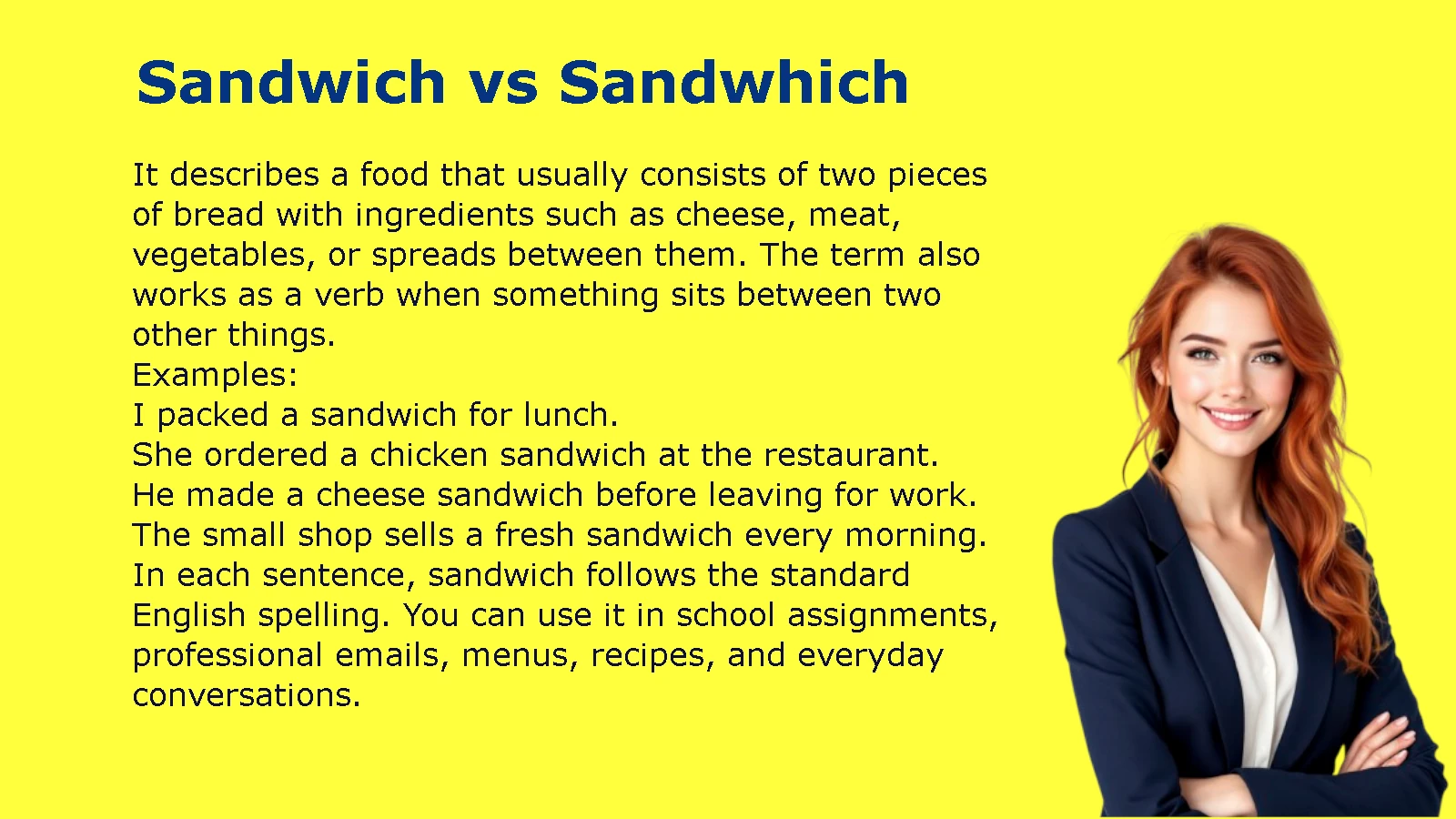
It describes a food that usually consists of two pieces of bread with ingredients such as cheese, meat, vegetables, or spreads between them. The term also works as a verb when something sits between two other things.
Examples:
- I packed a sandwich for lunch.
- She ordered a chicken sandwich at the restaurant.
- He made a cheese sandwich before leaving for work.
- The small shop sells a fresh sandwich every morning.
In each sentence, sandwich follows the standard English spelling. You can use it in school assignments, professional emails, menus, recipes, and everyday conversations.
Sandwhich Is a Common Misspelling
Sandwhich is incorrect because it places an extra “h” between the “w” and “i.” The accepted spelling places the letters in this order: w-i-c-h.
People may make this mistake because English spelling does not always follow predictable sound patterns. A writer might remember the word’s ending incorrectly or type an extra letter without noticing it.
Consider these examples:
- Incorrect: I made a ham sandwhich for lunch.
- Correct: I made a ham sandwich for lunch.
- Incorrect: Would you like a sandwhich with cheese?
- Correct: Would you like a sandwich with cheese?
The misspelling does not represent a separate type of food or a recognized alternative spelling. If you see sandwhich in a document, correct it to sandwich.
Why Do People Spell Sandwich Incorrectly?
The most likely reasons are typing errors, uncertainty about letter order, and reliance on how a word looks rather than how it is spelled.
Common causes include:
- Letter confusion: Writers remember the final letters incorrectly.
- Fast typing: An extra letter slips into the word.
- Weak spelling memory: Someone recognizes the word but cannot recall its exact sequence.
- Autocorrect assumptions: A writer may trust a suggested correction without checking the final text.
The best solution is to memorize the word as a complete unit rather than trying to guess its spelling from pronunciation.
How to Spell Sandwich Correctly
To spell sandwich correctly, write S-A-N-D-W-I-C-H. The word begins with sand and ends with wich. There is no extra “h” between the “w” and “i.” Remembering the sequence makes it easier to avoid the common error sandwhich.
Break Sandwich Into Letters and Sounds
Breaking a word into smaller parts can make it easier to remember. For sandwich, start with the familiar sequence sand and then add wich.
Sand + wich = sandwich
The word has eight letters and is commonly pronounced as two syllables. The spelling remains the same even when speakers shorten or soften some sounds in casual conversation.
You can practice the spelling with this simple method:
- Read the word sandwich slowly.
- Divide it mentally into sand and wich.
- Write the complete word without looking.
- Compare your version with the correct spelling.
- Repeat the exercise in a sentence.
For example: “I brought a sandwich to school.”
Writing the word in context reinforces its spelling better than memorizing isolated letters alone.
Common Sandwich Spelling Mistakes
Several errors can appear when people write the word or its plural.
| Incorrect form | Correct form | Explanation |
| Sandwhich | Sandwich | Removes the extra “h” |
| Sandwitch | Sandwich | Uses the wrong final consonant sequence |
| Sandwihc | Sandwich | Corrects the misplaced letters |
| Sandwichs | Sandwiches | Uses the standard plural ending |
| Sandwiche | Sandwich | Removes the unnecessary final “e” |
The most relevant distinction is between sandwich and sandwhich. The first is the accepted spelling; the second is a mistake.
If you write for a website, check headings, image captions, page titles, and alternative text as well as the main article. A spelling error in a heading can be especially noticeable because readers often scan headings before reading the full page.
Tips to Remember the Correct Spelling
Use these practical methods to remember how to spell sandwich:
- Remember “sand” first: Write the familiar four-letter sequence before adding the ending.
- Memorize “wich”: The word ends with wich, not which.
- Use a short sentence: Write “I ate a sandwich” several times.
- Read before submitting: Check for the extra “h” that creates sandwhich.
- Use spellcheck as a backup: A spelling tool can catch many errors, but you should still review the final text.
A helpful memory trick is to think of the spelling as sand + wich. This breaks the word into two manageable parts without changing any letters.
What Is the Plural of Sandwich?
The plural of sandwich is sandwiches. English generally adds “-es” to nouns ending in -ch when forming the plural. For example, one sandwich becomes two sandwiches, just as one watch becomes two watches. The spelling sandwichs is not the standard plural form.
Sandwich or Sandwiches: Which Form Should You Use?
Use sandwich when you mean one item and sandwiches when you mean more than one.
| Singular | Plural | Example |
| One sandwich | Two sandwiches | I packed two sandwiches. |
| A sandwich | Several sandwiches | We prepared several sandwiches. |
| This sandwich | These sandwiches | These sandwiches are fresh. |
| That sandwich | Those sandwiches | Those sandwiches look delicious. |
Examples in context:
- I bought one sandwich for lunch.
- We ordered three sandwiches for the group.
- This sandwich contains grilled chicken.
- These sandwiches contain grilled chicken.
The number of items determines which form you should use. The same rule applies whether you are writing a shopping list, a restaurant menu, a school assignment, or a food blog.
Why Does Sandwich Become Sandwiches?
English uses several plural patterns, and nouns ending in -ch commonly take -es. This ending helps form the plural naturally.
Compare these words:
| Singular | Plural |
| Sandwich | Sandwiches |
| Watch | Watches |
| Church | Churches |
| Bench | Benches |
| Match | Matches |
| Branch | Branches |
The rule is straightforward: when a noun ends in -ch, add -es to form its usual plural.
However, English has exceptions and other plural patterns. You should not apply one ending to every noun without checking its spelling. For sandwich, sandwiches is the established standard form.
Is Sandwichs a Correct Plural?
No. Sandwichs is not the standard English plural of sandwich. The correct form is sandwiches.
For example:
- Incorrect: We bought four sandwichs.
- Correct: We bought four sandwiches.
- Incorrect: The cafe sells different sandwichs every day.
- Correct: The cafe sells different sandwiches every day.
The mistake usually happens when writers add only “s” to the singular form. That pattern works for many English nouns, such as book → books, but it does not apply to sandwich.
Singular and Plural Agreement With Sandwich
The singular and plural forms also affect the verb in a sentence.
Use is with a singular subject and are with a plural subject.
| Singular sentence | Plural sentence |
| This sandwich is fresh. | These sandwiches are fresh. |
| The sandwich tastes good. | The sandwiches taste good. |
| My sandwich has cheese. | My sandwiches have cheese. |
| One sandwich was missing. | Two sandwiches were missing. |
Notice that the noun and verb change together. For example, “The sandwich tastes good” is correct, while “The sandwiches tastes good” is not.
Pay attention to these changes when writing longer sentences. Correct pluralization improves both spelling and grammar.
How Do You Pronounce Sandwich?
Sandwich is commonly pronounced with two syllables in English. In American English, a standard pronunciation is /ˈsæn(d)wɪtʃ/. The first syllable carries the stress, and the final sound resembles the ending in witch. Everyday pronunciation can vary, so some speakers soften or omit the “d” sound.
Sandwich Pronunciation in American English
The standard American pronunciation can be represented as SAN-wich, with stress on the first syllable.
The IPA transcription /ˈsæn(d)wɪtʃ/ indicates that the “d” may be pronounced or reduced in connected speech.
To practice:
- Begin with the vowel sound in sand.
- Move into the short “i” sound found in sit.
- Finish with the “ch” sound in church.
- Keep the main stress on the first syllable.
Try saying the word in a short sentence:
“I made a sandwich for lunch.”
Repeating the word in a sentence helps you connect pronunciation with natural speech.
Why Does Sandwich Sometimes Sound Different From How It Is Spelled?
English speakers often simplify sounds when they speak quickly. As a result, the “d” in sandwich may become less noticeable in casual speech.
This does not change the spelling. The written form remains sandwich, regardless of whether a speaker clearly articulates every sound.
You may also hear differences between regional accents. Some speakers pronounce the word more carefully, while others use a more relaxed version during everyday conversation.
The important distinction is between pronunciation variation and spelling variation. Different accents may produce different sounds, but sandwich remains the standard spelling.
How to Use Sandwich in Spoken English
You can use sandwich in ordinary questions and statements.
Examples:
- “Would you like a sandwich?”
- “I usually eat a sandwich at noon.”
- “Can you make me a cheese sandwich?”
- “Where did you buy that sandwich?”
If you are learning English, practice both the singular and plural forms aloud:
- “I want a sandwich.”
- “We want two sandwiches.”
This exercise reinforces pronunciation, spelling, and grammatical number at the same time.
What Does Sandwich Mean?
A sandwich is a food made by placing a filling between or inside pieces of bread. Common fillings include meat, cheese, vegetables, eggs, and spreads. The word can also function as a verb, meaning to place or fit something between two other things. Its meaning depends on the context.
Sandwich as a Noun
As a noun, sandwich most commonly refers to a meal or snack built around bread and a filling.
Examples include:
- Chicken sandwich: Bread filled with cooked chicken and other ingredients.
- Grilled cheese sandwich: Bread filled with cheese and toasted or grilled.
- Club sandwich: A layered sandwich often made with poultry, bacon, lettuce, and tomato.
- Egg sandwich: Bread filled with egg, sometimes combined with cheese or vegetables.
- Peanut butter and jelly sandwich: Bread spread with peanut butter and jelly or jam.
The word can refer to different sizes, ingredients, and preparation methods. A sandwich may be served cold, toasted, grilled, or heated.
The exact ingredients do not determine the spelling. Whether you write about a vegetable sandwich or a turkey sandwich, the word remains sandwich.
Sandwich as a Verb
The word sandwich can also be a verb. It means to place something between two other things or to fit something into a limited space between other items.
Examples:
- She sandwiched the cheese between two slices of bread.
- The small apartment is sandwiched between two office buildings.
- I had to sandwich a short meeting between two appointments.
The verb changes form depending on tense:
| Form | Example |
| Sandwich | I sandwich the filling between two slices of bread. |
| Sandwiches | She sandwiches the filling between two slices of bread. |
| Sandwiched | He sandwiched the note between two pages. |
| Sandwiching | They are sandwiching the new task between two deadlines. |
These examples show why understanding the word’s grammatical role matters. Sandwich can name a food or describe the action of placing something between other things.
Common Expressions With Sandwich
The word appears in several expressions beyond food.
Sandwich generation: A term for adults who support aging parents while also caring for their children. They face responsibilities from two generations at the same time.
Example: “The sandwich generation often balances childcare with support for older relatives.”
Sandwiched between: A phrase that describes being physically or figuratively positioned between two things.
Example: “Our meeting was sandwiched between two long training sessions.”
Sandwich board: A portable advertising sign, often designed to stand on a pavement or sidewalk.
Example: “The cafe placed a sandwich board outside to advertise its lunch special.”
These expressions demonstrate how the original food-related word has developed broader meanings in English.
What Is the Origin of the Word Sandwich?
The English word sandwich is traditionally linked to John Montagu, the 4th Earl of Sandwich, an eighteenth-century British nobleman. A popular story says that he wanted food he could eat without leaving a card game, so bread and meat were served together. The familiar story helps explain the name, although some details remain uncertain.
Who Was the Earl of Sandwich?
John Montagu (1718–1792) held the title 4th Earl of Sandwich. He was a British statesman who served in government and held several important public offices during the eighteenth century.
His title came from Sandwich, a historic town in Kent, England. The name of the food became associated with the nobleman’s title, which is why the history of an everyday lunch item connects to a person and a place.
The word’s history is a useful reminder that English vocabulary often develops through people’s names, place names, occupations, and cultural habits.
Why Is a Sandwich Called a Sandwich?
The traditional account says that Montagu wanted a meal he could eat conveniently while continuing a game of cards. Bread and meat offered a practical solution because he could hold the food without handling the meat directly.
Other people reportedly began ordering food in the same style by referring to the earl’s title. Over time, sandwich became the name for this type of food.
However, the popular story should not be treated as a complete, unquestionable record of how the food itself originated. People had combined bread with fillings in different forms long before the eighteenth century. The historical association explains the English name more clearly than it establishes who first invented the food.
How the Word Sandwich Became Common
The word gradually became established in English as the name of a recognizable food category. As eating habits and food service changed, sandwiches became practical choices for travel, work, school, and quick meals.
The modern term covers a broad range of foods. Some contain two separate slices of bread, while others use rolls, buns, or other bread forms. Usage also differs across countries and food traditions.
Despite these variations, the standard spelling remains sandwich, and its standard plural remains sandwiches.
What Are Some Common Types of Sandwiches?
Sandwiches come in many forms, from simple homemade lunches to layered restaurant meals. Common examples include grilled cheese, club sandwiches, BLTs, and peanut butter and jelly sandwiches. Knowing these names can help you understand how the word appears in menus, recipes, and everyday conversations.
Popular Sandwich Examples
Here are several familiar types:
| Sandwich type | Common ingredients | Typical description |
| Grilled cheese | Bread and cheese | Toasted bread with melted cheese |
| Club sandwich | Poultry, bacon, lettuce, tomato | A layered sandwich often served with several fillings |
| BLT | Bacon, lettuce, tomato | A sandwich named after its main ingredients |
| Egg sandwich | Egg, bread, optional cheese | A breakfast or lunch option |
| Tuna sandwich | Tuna, bread, often mayonnaise | A cold sandwich with a tuna filling |
| Peanut butter and jelly | Peanut butter, jelly or jam, bread | A familiar sweet-and-savory combination |
| Vegetable sandwich | Vegetables, bread, spreads | A sandwich centered on vegetable fillings |
The word sandwich does not refer to one specific recipe. It describes a broad category, and ingredients depend on personal preference, local food traditions, and the menu.
Sandwich Recipes and Everyday Usage
If you are looking for sandwich recipes, start with the type of filling you want and choose bread that complements it.
For example, a grilled cheese sandwich needs bread that browns well and cheese that melts smoothly. A vegetable sandwich may work well with crisp lettuce, tomato, cucumber, and a spread that adds moisture without making the bread soggy.
A simple homemade sandwich follows these steps:
- Choose two slices of bread or a suitable roll.
- Prepare the filling, such as cheese, egg, chicken, or vegetables.
- Add spreads or seasonings to improve flavor.
- Assemble the sandwich and toast it if desired.
- Serve it promptly, especially when the filling contains perishable ingredients.
For a website focused on food, detailed recipes deserve their own articles with ingredient quantities, preparation times, instructions, and serving suggestions. A spelling article should keep the main focus on language while using food examples to explain the word.
How to Search for Sandwiches Near You
The phrase sandwich near me has a different search intent from sandwich vs sandwhich. People using it usually want to find nearby restaurants, cafes, takeaway counters, or delivery options.
To find a suitable place, search for a specific type of sandwich or add your location to the query. For example:
- Sandwich shops near me
- Chicken sandwich restaurants nearby
- Grilled cheese near me
- Sandwich delivery near me
Check the business’s current hours, menu, prices, and delivery options before visiting or placing an order. These details can change, so a recent listing is more useful than an outdated mention.
For content creators, this distinction matters. A spelling article serves readers who need a language answer, while a local sandwich guide should focus on places, menus, location, and availability.
Sandwich vs Sandwhich: Examples of Correct Usage
The easiest way to learn the difference between sandwich and sandwhich is to see the correct spelling in realistic sentences. The standard spelling is always sandwich in the singular and sandwiches in the plural. The misspelling sandwhich should be corrected before publication.
Correct Sandwich Spelling in Everyday Sentences
Use these original examples to understand how the word fits into different contexts.
School: “I put a cheese sandwich in my lunchbox before leaving for school.”
Work: “He ate a sandwich at his desk because his afternoon was full of meetings.”
Restaurant: “The customer ordered a grilled chicken sandwich with lettuce and tomato.”
Home: “We made a vegetable sandwich using cucumber, tomato, and fresh spinach.”
Travel: “She packed two sandwiches for the train journey.”
Each sentence uses the standard spelling. The last example also demonstrates the correct plural form.
Incorrect and Correct Spelling Examples
Use this table as a quick proofreading reference.
| Incorrect sentence | Correct sentence |
| I ate a sandwhich before class. | I ate a sandwich before class. |
| She ordered two sandwichs. | She ordered two sandwiches. |
| He packed a sandwitch for work. | He packed a sandwich for work. |
| We made three sandwhiches. | We made three sandwiches. |
| This sandwhich has fresh vegetables. | This sandwich has fresh vegetables. |
When proofreading, check both the base word and its ending. Fixing sandwhich but leaving sandwichs in the same article would solve only part of the problem.
How to Proofread Sandwich in Your Writing
A reliable proofreading process takes only a few seconds.
- Check the letter order: Confirm that the word reads s-a-n-d-w-i-c-h.
- Check the number: Use sandwich for one and sandwiches for more than one.
- Read the whole sentence: Make sure the noun agrees with the verb.
- Check headings and captions: Errors can hide outside the main body text.
- Review automated suggestions: Spellcheck can help, but do not accept a correction without checking the sentence.
Imagine you are editing a restaurant menu that lists “Ham Sandwhich” and “Three Cheese Sandwichs.” Both entries need correction. The first should read “Ham Sandwich,” while the second should read “Three Cheese Sandwiches.”
This simple example shows why proofreading needs to cover both spelling and grammar.
Quick Comparison: Sandwich, Sandwhich, and Sandwiches
The difference between these forms is easy to remember once you separate spelling from grammatical number.
| Form | Status | When to use it |
| Sandwich | Correct | Referring to one item or using the word in its base form |
| Sandwhich | Incorrect | Avoid this misspelling |
| Sandwiches | Correct | Referring to two or more items |
| Sandwichs | Incorrect | Avoid this nonstandard plural |
Remember these two rules:
- Sandwich is the correct singular spelling.
- Sandwiches is the correct standard plural.
The extra “h” in sandwhich does not create a different meaning. It simply makes the spelling incorrect.
Frequently Asked Questions
Is It Sandwich or Sandwhich?
Sandwich is the correct spelling in standard English. Sandwhich is a misspelling caused by incorrect letter order. Use sandwich when referring to the food or when using the word as a verb.
How Do You Spell Sandwich in English?
Spell it S-A-N-D-W-I-C-H. The word has eight letters and ends in wich, not which. Remembering the sequence sand + wich can help you avoid adding an extra “h.”
What Is the Plural of Sandwich?
The standard plural is sandwiches. English generally adds “-es” to nouns ending in -ch. For example, one sandwich becomes two sandwiches, and one watch becomes two watches.
Why Is Sandwich Called Sandwich?
The English name is traditionally associated with John Montagu, the 4th Earl of Sandwich. A popular story links the name to his preference for a convenient meal of bread and meat, although the full historical details of the story remain uncertain.
How Do You Pronounce Sandwich?
In American English, sandwich is commonly pronounced with two syllables and stress on the first syllable. A standard IPA representation is /ˈsæn(d)wɪtʃ/. Casual pronunciation may soften or omit the “d” sound.
Is Sandwich a Real Word and Is Sandwhich Ever Correct?
Yes, sandwich is a standard English word used as both a noun and a verb. Sandwhich is not a standard alternative spelling. Use sandwich for the singular and sandwiches for the plural.
Conclusion: Remember the Correct Sandwich Spelling
The difference between sandwich vs sandwhich comes down to one extra letter. Sandwich is the correct spelling, while sandwhich is a common mistake. When you need the plural, write sandwiches, not sandwichs.
You can also use the word as a verb, recognize its common pronunciation, and understand its historical connection to John Montagu, the 4th Earl of Sandwich. These details make it easier to use the word correctly in schoolwork, emails, recipes, menus, and online content.
Before publishing your next piece of writing, check the spelling and make sure the singular or plural form fits the sentence. If you are building a vocabulary or grammar website, consider linking this article to related guides on common spelling mistakes, English plural rules, and words that are often misspelled to help readers find more useful answers.