Underpaid vs underpay can be confusing because both words are related to giving someone too little money, but they are used differently in a sentence. If you’ve come across “underpaid” or “underpay” and wondered which word is correct, the difference mainly depends on grammar, tense, and whether you are describing a situation or an action.
Underpaid is the past tense and past participle of underpay, and it is also commonly used as an adjective to describe someone who receives less money than they deserve or should receive. Underpay is a verb that means to pay someone less than the appropriate, expected, or agreed amount. Related terms include underpayment, underpaying, underpaid, low-paid, poorly paid, and insufficiently compensated, but each can have a slightly different use.
In this guide, you’ll learn the difference between “underpaid” and “underpay,” how to use each word correctly, which form to use in different sentences, and how their meanings change depending on context. You’ll also see clear examples to make the distinction easy to understand.
By the end, you’ll know exactly when to use underpaid and underpay and how to use both words naturally and correctly in everyday and professional writing.
Underpaid vs Underpay at a Glance
Here is the quickest way to understand the difference:
| Word | Grammatical role | Meaning | Example |
| underpay | Base-form verb | To pay too little | Some companies underpay workers. |
| underpays | Third-person singular verb | Pays too little | The company underpays its staff. |
| underpaid | Past-tense verb | Paid too little in the past | The company underpaid its workers. |
| underpaid | Past participle | Paid too little | The workers have been underpaid. |
| underpaid | Adjective | Receiving insufficient pay | The workers are underpaid. |
| underpaying | Present participle/gerund | Paying too little | The company is underpaying employees. |
The key point is that underpaid is not simply an alternative spelling of underpay.
The two forms belong to different parts of the verb’s conjugation. Oxford lists the forms as underpay, underpays, underpaid, and underpaying, with underpaid serving as both the past simple and past participle.
The simplest rule
Remember this:
Underpay = the action of paying too little.
Underpaid = someone or something that received too little, or the past form of underpay.
For example:
- Employers underpay workers.
- An employer underpays a worker.
- An employer underpaid a worker last year.
- A worker was underpaid.
- Workers are underpaid.
- The company has underpaid its staff.
Once you identify whether your sentence needs the base verb, past form, or adjective, the choice becomes much easier.
What Does Underpaid Mean?
Underpaid has two closely connected grammatical uses.
First, it is the past tense and past participle of underpay. Second, it functions as an adjective describing someone or something that receives insufficient payment.
Cambridge lists underpaid as an adjective meaning “paid too little for the work you do.” Oxford gives the same basic meaning: not paid enough for the work performed.
Underpaid as an adjective
When underpaid describes a person, job, or group, it tells you that the amount of compensation is considered too low.
Examples include:
- The nurses are underpaid.
- She feels underpaid for the amount of responsibility she has.
- Many workers consider themselves underpaid.
- The company has a reputation for employing underpaid staff.
- He left his underpaid position after finding a better opportunity.
In these examples, underpaid describes a state or condition.
The sentence does not necessarily tell you who performed the act of paying too little. It simply tells you that the compensation received is insufficient.
For example:
The employees are underpaid.
The subject is employees, and underpaid describes their condition.
Compare that with:
The company underpays the employees.
Now the subject is company, and underpays describes what the company does.
That difference is one of the most important points in the underpaid vs underpay comparison.
Underpaid as a past-tense verb
Underpaid can also be a verb.
Consider:
The company underpaid its workers last month.
Here, underpaid is not an adjective. It is the simple past tense of underpay.
The sentence describes an action that happened in the past.
The same form appears in:
- The employer underpaid the staff.
- The contractor underpaid several workers.
- The company underpaid him for overtime.
- They underpaid the employee by mistake.
- The business underpaid its workers for several months.
Cambridge also gives underpaid as the past form of underpay.
What Does Underpay Mean?
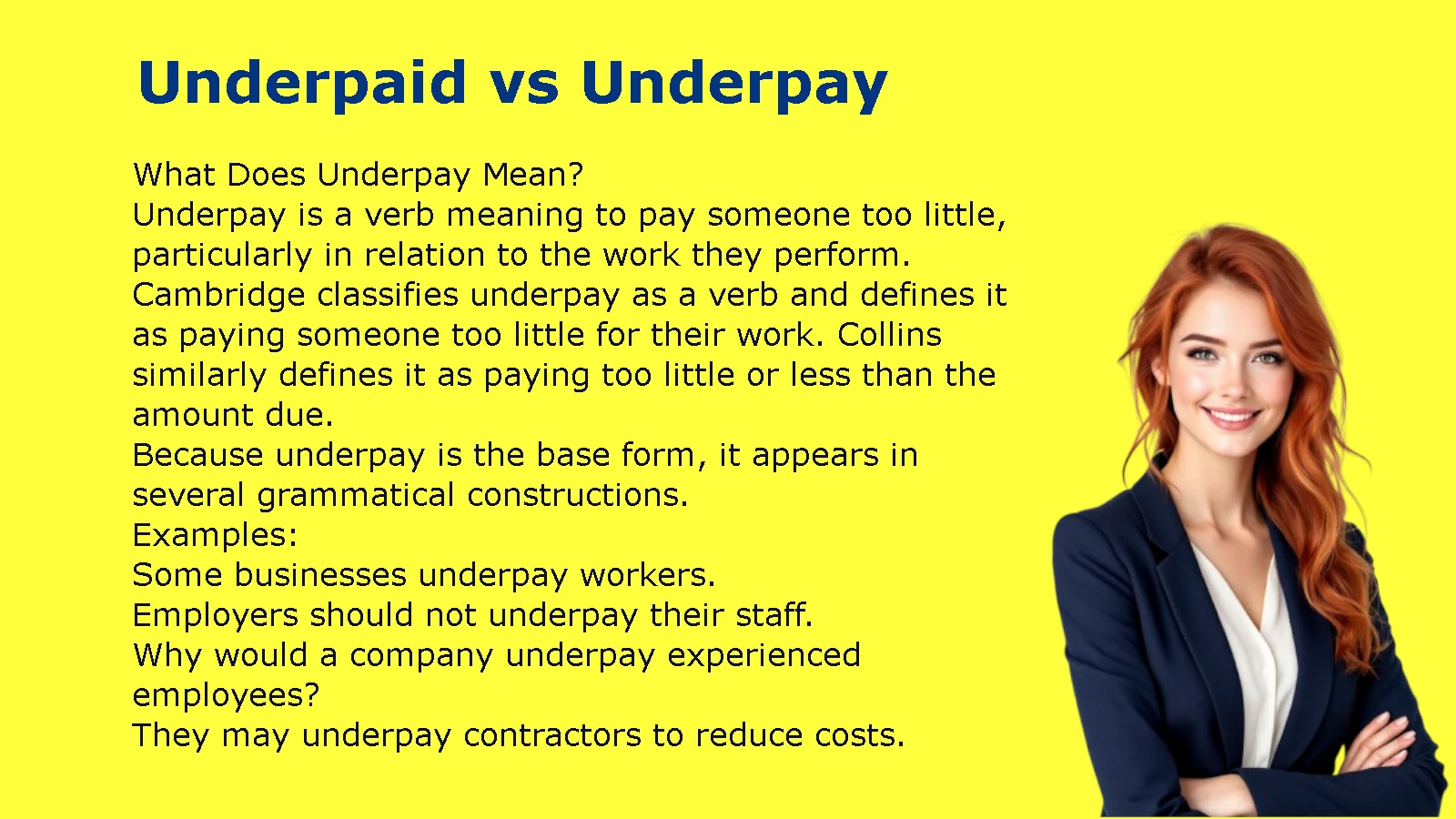
Underpay is a verb meaning to pay someone too little, particularly in relation to the work they perform.
Cambridge classifies underpay as a verb and defines it as paying someone too little for their work. Collins similarly defines it as paying too little or less than the amount due.
Because underpay is the base form, it appears in several grammatical constructions.
Examples:
- Some businesses underpay workers.
- Employers should not underpay their staff.
- Why would a company underpay experienced employees?
- They may underpay contractors to reduce costs.
Notice that the word after underpay usually identifies the person or group receiving the payment.
Underpay in the present tense
With I, you, we, and they, use underpay:
- I underpay? — grammatically possible but uncommon because the speaker would be admitting to paying too little.
- You underpay your employees.
- We underpay our contractors.
- They underpay their workers.
With he, she, or it, the verb becomes underpays:
- He underpays his staff.
- She underpays her assistants.
- The company underpays its workers.
This is an ordinary third-person singular -s ending, just as pay becomes pays.
Therefore:
- The company underpay its workers. ❌
- The company underpays its workers. ✅
The same rule applies regardless of whether the sentence uses underpay or another ordinary present-tense verb.
Underpaid vs Underpay: Key Differences
The most useful way to distinguish these words is to focus on what the sentence is doing.
Underpay names the action.
Underpaid can describe the result of that action, or it can indicate that the action happened in the past.
| Sentence | Function | Explanation |
| The company underpays workers. | Present-tense verb | The company currently pays too little. |
| The company underpaid workers. | Past-tense verb | The company paid too little in the past. |
| The workers are underpaid. | Adjective | The workers receive insufficient pay. |
| The workers were underpaid. | Adjective/passive construction | The workers received insufficient pay. |
| The company has underpaid workers. | Past participle | The action has occurred. |
| The company is underpaying workers. | Present participle | The action is currently happening. |
This gives you a reliable pattern:
Who performs the action?
Use a form of underpay.
Who receives the insufficient payment?
Underpaid is often the natural choice.
For example:
The restaurant underpays its servers.
The restaurant performs the action.
The servers are underpaid.
The servers receive the insufficient compensation.
Neither sentence is inherently a replacement for the other. They simply organize the information differently.
When to Use Underpaid
There are two major situations where underpaid is appropriate: describing a person or thing and forming a past or perfect construction.
Underpaid as an adjective
Use underpaid before or after a noun when you want to describe insufficient compensation.
Examples:
- underpaid employees
- underpaid workers
- underpaid teachers
- underpaid nurses
- underpaid contractors
- an underpaid position
- an underpaid profession
You can also place it after a linking verb:
- The employees are underpaid.
- The staff were underpaid.
- She feels underpaid.
- He believes he is underpaid.
The adjective can describe either a person or, in some contexts, the work itself.
For example:
The workers are underpaid.
and
It is an underpaid profession.
Cambridge specifically notes that a job can be described as underpaid when the people doing that job do not earn enough.
Underpaid as a verb form
Use underpaid when the sentence needs the past tense or past participle of underpay.
Simple past:
The company underpaid its employees last year.
Present perfect:
The company has underpaid its employees.
Past perfect:
The company had underpaid several workers before the audit began.
Passive construction:
Several employees were underpaid.
Perfect passive:
Several employees have been underpaid.
The spelling remains underpaid in all these forms.
When to Use Underpay
Use underpay when you need the base form of the verb.
Underpay in the present tense
The basic structure is:
Subject + underpay + object
Examples:
- Some companies underpay workers.
- They underpay contractors.
- We should not underpay employees.
- Businesses sometimes underpay temporary staff.
With a singular third-person subject, use underpays:
- The employer underpays its staff.
- The company underpays workers.
- The contractor underpays employees.
Underpay after modal verbs
The base form underpay is also used after modal verbs such as can, could, may, might, should, and will.
Examples:
- Companies should not underpay employees.
- Some employers may underpay temporary workers.
- A business could underpay a contractor accidentally.
- Employers must not underpay workers where applicable legal wage requirements apply.
- The company will underpay its contractors if the calculation is incorrect.
Notice that you do not add -s or change the verb to underpaid after a modal:
- should underpay ✅
- should underpays ❌
- should underpaid ❌
Underpaid vs Underpay in Sentences
Looking at the words side by side makes the difference easier to remember.
| Underpay form | Example | Why it works |
| underpay | Some employers underpay workers. | Base verb after a plural subject |
| underpays | The employer underpays workers. | Present tense with singular subject |
| underpaid | The employer underpaid workers. | Past-tense action |
| underpaid | The workers are underpaid. | Adjective describing workers |
| underpaid | The company has underpaid workers. | Past participle |
| underpaying | The company is underpaying workers. | Ongoing action |
Consider these pairs:
Present action vs present condition
The company underpays its employees.
The company is the subject performing the action.
The employees are underpaid.
The employees are the subject being described.
Past action vs past condition
The company underpaid its employees last year.
The focus is on what the company did.
The employees were underpaid last year.
The focus is on what happened to the employees.
Perfect construction
The company has underpaid its workers.
The word underpaid follows has, so it is the past participle.
You would not write:
The company has underpay its workers. ❌
The correct form is:
The company has underpaid its workers. ✅
Underpaid vs Underpay vs Underpays vs Underpaying
These four forms belong to the same verb family, but each has a particular grammatical function.
Underpay
This is the base form.
Employers should not underpay their workers.
Underpays
This is the third-person singular present-tense form.
The company underpays its employees.
Underpaid
This is both the simple past and past participle.
The company underpaid its workers.
The company has underpaid its workers.
It can also function as an adjective:
The workers are underpaid.
Oxford’s verb entry explicitly lists this conjugation: underpay, underpays, underpaid, and underpaying.
Underpaying
This is the -ing form.
The company is underpaying its staff.
It can also function as a gerund:
Underpaying employees can create serious workplace problems.
The important point is that underpay and underpaid are not competing spellings. They are different forms of the same verb.
Common Grammar Mistakes With Underpaid and Underpay
Because underpaid can act as both a verb form and an adjective, it is easy to use the wrong form.
Mistake: Using underpay with a singular subject
Incorrect:
The company underpay its employees.
Correct:
The company underpays its employees.
The subject company is singular, so the present-tense verb needs -s.
Mistake: Using underpaid after does
Incorrect:
The company doesn’t underpaid its workers.
Correct:
The company doesn’t underpay its workers.
After doesn’t, use the base form.
The same applies to questions:
Does the company underpay its employees?
Not:
Does the company underpaid its employees? ❌
Mistake: Using underpay for a past event
Incorrect:
The company underpay its workers last year.
Correct:
The company underpaid its workers last year.
The time expression last year places the action in the past, so underpaid is required.
Mistake: Confusing adjective and verb functions
Compare:
The workers are underpaid.
Here, underpaid describes the workers.
But:
The company underpaid the workers.
Here, underpaid is the verb.
The spelling is identical, but the grammatical function changes.
Mistake: Using underpaid after a modal
Incorrect:
Employers should underpaid workers.
Correct:
Employers should underpay workers.
A modal verb such as should takes the base form.
Underpaid vs Underpay in Workplace and Salary Contexts
The words are particularly common when discussing salary, wages, compensation, employment, and workplace conditions.
Typical expressions include:
- underpaid employee
- underpaid worker
- underpaid staff
- underpaid teacher
- underpaid nurse
- underpaid contractor
- underpay employees
- underpay workers
- underpay staff
- underpay contractors
There is also an important noun form: underpayment.
Cambridge defines underpayment as the act of paying someone too little or an instance in which this happens. It can also refer to paying less than necessary or less than the value of something.
For example:
The investigation found several cases of underpayment.
Here, underpayment names the situation or act itself.
That gives you a useful word family:
| Word | Function | Example |
| underpay | Base verb | Some employers underpay workers. |
| underpays | Present-tense verb | The company underpays staff. |
| underpaid | Past verb | The company underpaid employees. |
| underpaid | Adjective | The employees are underpaid. |
| underpaying | -ing form | The company is underpaying workers. |
| underpayment | Noun | The audit revealed underpayment. |
Salary example
Suppose an employee earns less than they believe is appropriate for their duties.
You could write:
The employee is underpaid.
If you want to describe the employer’s action:
The employer underpays the employee.
If the problem happened in the past:
The employer underpaid the employee last year.
If the issue is being discussed as a noun:
The employee reported an underpayment.
The choice depends on the grammatical role, not on a difference in basic meaning.
Underpaid vs Underpay: A Practical Case Study
Imagine a business employs ten workers.
The business currently pays them less than the amount considered appropriate for their work.
Several sentences could describe the situation:
The business underpays its workers.
This uses the present-tense verb and focuses on the employer’s action.
You could instead say:
The workers are underpaid.
This uses underpaid as an adjective and focuses on the workers’ condition.
Suppose an audit discovered that the business paid too little during the previous year.
Now you could say:
The business underpaid its workers last year.
If the issue has continued over a period of time, you could write:
The business has underpaid its workers.
Finally, if you are naming the problem itself:
The audit identified underpayment.
The underlying situation is similar, but each sentence emphasizes something different.
This is why replacing underpay with underpaid simply because the two words look related can create a grammatical error.
Underpaid Synonyms and Related Words
Underpaid has several related expressions, but they are not always exact substitutes.
Undercompensated
Undercompensated means receiving less compensation than is considered appropriate.
The employee felt undercompensated for the additional responsibilities.
It is somewhat broader because compensation can include more than direct wages.
Low-paid
Low-paid describes someone or a group receiving relatively low pay.
The industry employs many low-paid workers.
It does not always carry exactly the same implication as underpaid. Someone can be low-paid without necessarily being underpaid relative to the value of their work.
Poorly paid
Poorly paid is another common expression.
Many seasonal workers are poorly paid.
It is close to underpaid, although the exact implication depends on context.
Inadequately compensated
This is more formal.
The employees were inadequately compensated for the additional work.
It may be suitable for formal reports, workplace documents, or professional discussions.
Unfairly paid
This phrase emphasizes perceived unfairness.
The employees believed they were unfairly paid.
It is not always identical to underpaid, because a person can consider a compensation arrangement unfair for reasons other than simply receiving too little money.
How to Remember the Difference Between Underpaid and Underpay
If you regularly confuse underpaid vs underpay, use the action-versus-condition test.
Ask yourself:
Am I describing the act of paying too little?
Use a form of underpay.
The employer underpays workers.
Am I describing the person who receives too little pay?
Use underpaid.
The workers are underpaid.
Am I talking about a completed action?
Use underpaid.
The employer underpaid the workers.
Am I using a modal such as should, could, may, or might?
Use underpay.
Employers should not underpay workers.
A second useful trick is to look at the subject.
Compare:
The employer underpays the employee.
The employer performs the action.
The employee is underpaid.
The employee experiences the result.
That distinction will solve most underpaid or underpay questions.
Underpaid vs Underpay FAQs
Is underpaid or underpay correct?
Both are correct, but they have different grammatical uses.
Underpay is the base form of the verb, while underpaid is the past tense and past participle. Underpaid can also function as an adjective meaning paid too little.
What is the difference between underpaid and underpay?
Underpay means to pay someone too little and is the base form of the verb.
Underpaid is the past tense and past participle of underpay and is also an adjective describing someone who receives too little pay.
Compare:
- The company underpays its workers.
- The workers are underpaid.
Is underpaid a verb or an adjective?
It can be both.
In:
The company underpaid its workers.
it is the past-tense verb.
In:
The workers are underpaid.
it functions as an adjective describing the workers.
Dictionary sources recognize both uses. Cambridge lists underpaid as an adjective and identifies it as the form associated with underpay.
What is the past tense of underpay?
The past tense of underpay is underpaid.
- Present: They underpay workers.
- Past: They underpaid workers.
Oxford also lists underpaid as both the past simple and past participle form.
Is it correct to say someone is underpaid?
Yes.
She is underpaid.
This is a standard use of underpaid as an adjective. It means that she receives too little pay for her work.
Should I say underpay or underpaid employees?
It depends on the sentence.
Use underpaid employees when underpaid describes the employees:
The company employs underpaid employees.
Use underpay employees when underpay is the verb:
Some companies underpay employees.
The first phrase describes the employees. The second describes the employer’s action.
What is the difference between underpaid and underpays?
Underpays is the present-tense form used with a singular third-person subject.
The company underpays its employees.
Underpaid is the past form and past participle.
The company underpaid its employees.
Can underpaid describe a job?
Yes. Underpaid can describe a job or type of work when the people performing it receive insufficient compensation.
For example:
It is an underpaid profession.
Cambridge specifically includes this use in its definition of underpaid.
What is another word for underpaid?
Depending on the context, possible alternatives include:
- undercompensated
- low-paid
- poorly paid
- inadequately compensated
- unfairly paid
They are related, but their meanings are not always identical. Choose the term that matches the exact point you want to make.
What is the noun form of underpay?
The noun is underpayment.
It refers to the act of paying too little or an instance in which insufficient payment occurs.
Example:
The employee reported an underpayment of wages.
Is “underpay” a real word?
Yes. Underpay is a standard English verb recorded in major dictionaries, including Cambridge, Oxford, and Collins. Its basic meaning is to pay someone too little.
Final Difference Between Underpaid and Underpay
The difference between underpaid vs underpay is straightforward once you look at their grammatical roles.
Underpay is the base verb:
Some employers underpay workers.
Underpays is the present-tense form for a singular third-person subject:
The company underpays its workers.
Underpaid is the past tense:
The company underpaid its workers.
It is also the past participle:
The company has underpaid its workers.
And it can work as an adjective:
The workers are underpaid.
The easiest rule to remember is:
Underpay describes the action; underpaid describes the result or refers to a completed action.
Once you recognize whether your sentence needs a base verb, present-tense verb, past form, participle, or adjective, choosing between underpaid and underpay becomes much easier.
For everyday writing, remember these four examples:
- Employers underpay workers.
- The employer underpays workers.
- The employer underpaid workers.
- The workers are underpaid.
Those four sentences capture the essential difference and provide a reliable model for using the words correctly.