Possess is the correct spelling, while posess is a common misspelling. The word possess means to own, have, hold, or display something, such as property, knowledge, or a personal quality. Understanding possess meaning, possess pronunciation, and the difference between possess and possesses will help you use the word correctly in everyday writing, school assignments, and professional communication.
The main grammar rule is simple: use possess with subjects such as I, you, we, and they, but use possesses with he, she, and it in the simple present tense. You can also use related words such as possession and possessive when the context calls for a noun or adjective. Below, you’ll find the correct spelling, clear definitions, practical examples, synonyms, pronunciation tips, and answers to common questions.
Is It Possess or Posess?
Possess is the correct spelling in standard English. The spelling posess is incorrect because it leaves out one of the two s’s in the middle of the word. If you are writing about owning something, having a quality, or controlling something, use possess.
| Spelling | Correct? | Explanation |
| Possess | Yes | The standard spelling of the verb |
| Posess | No | Misspells the word by omitting an s |
| Possesses | Yes | The present-tense form used with he, she, it, and singular nouns |
| Possessed | Yes | The past-tense and past-participle form |
| Possessing | Yes | The -ing form of the verb |
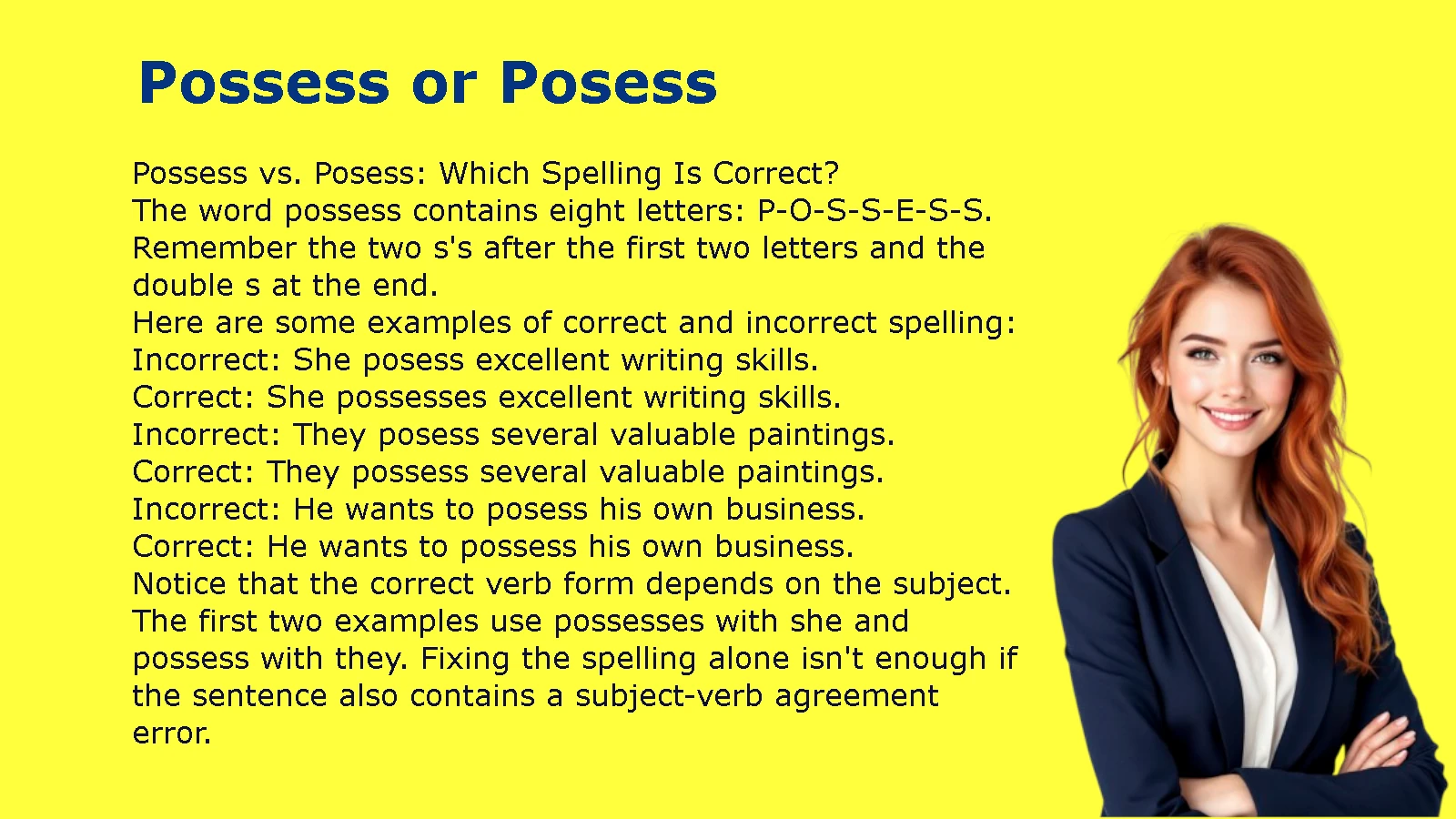
Possess vs. Posess: Which Spelling Is Correct?
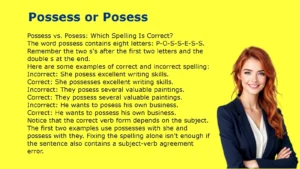
The word possess contains eight letters: P-O-S-S-E-S-S. Remember the two s’s after the first two letters and the double s at the end.
Here are some examples of correct and incorrect spelling:
- Incorrect: She posess excellent writing skills.
- Correct: She possesses excellent writing skills.
- Incorrect: They posess several valuable paintings.
- Correct: They possess several valuable paintings.
- Incorrect: He wants to posess his own business.
- Correct: He wants to possess his own business.
Notice that the correct verb form depends on the subject. The first two examples use possesses with she and possess with they. Fixing the spelling alone isn’t enough if the sentence also contains a subject-verb agreement error.
Why Is Possess Spelled With Two S’s?
Possess follows an established English spelling pattern that you need to memorize rather than a simple rule that applies to every word. Its standard spelling contains double s in the middle and at the end.
A useful memory trick is to think of the word as having two pairs of s’s:
- possess
When you type the word, look for both pairs. This quick check can prevent the common posess mistake.
You can also connect possess with related words:
- Possess: They possess valuable property.
- Possesses: She possesses valuable property.
- Possessed: They possessed valuable property.
- Possession: The property is in their possession.
- Possessive: He used a possessive expression.
Learning these related forms together helps you recognize the spelling pattern and understand how the word functions in different sentences.
Common Misspellings of Possess
Writers sometimes misspell possess because they remember its sound but not its exact letter sequence. Other errors occur when they confuse the verb with a related form.
| Common error | Correct form | Example |
| Posess | Possess | They possess useful information. |
| Posesses | Possesses | She possesses strong leadership skills. |
| Posses, when the base verb is intended | Possess | I want to possess the necessary knowledge. |
| Posses, when the noun is intended | Possessions | He packed his personal possessions. |
The last distinction matters because posses is a real English word in another context: it is the plural of posse, a group of people organized for a particular purpose, traditionally to pursue or capture someone. However, it is not the correct spelling of the verb possess.
When proofreading, check the meaning first. If you mean to say that someone owns, has, or displays something, the word you need is possess or one of its grammatical forms.
What Does Possess Mean?
Possess means to own, have, hold, or control something. It can also describe having a particular skill, quality, characteristic, or ability. In supernatural contexts, the verb can mean taking control of a person through a spirit or supernatural force. The intended meaning depends on how the word appears in a sentence.
Possess Meaning in Everyday English
In everyday English, possess usually refers to ownership, possession, or the presence of a quality or ability. The word often sounds more formal than have or own, making it common in academic, legal, business, and descriptive writing.
Consider these common uses:
Ownership: A person or organization owns something.
Example: “The family possesses a large house near the coast.”
Here, possesses means that the family owns the house.
Skills and abilities: Someone has a particular skill, talent, or ability.
Example: “The candidate possesses excellent problem-solving skills.”
The sentence describes the candidate’s abilities rather than something the person physically owns.
Personal qualities: Someone displays a characteristic such as patience, courage, or determination.
Example: “A good teacher must possess patience and empathy.”
In this sentence, possess refers to qualities that help someone perform a role well.
Control or influence: A person or organization has control over something.
Example: “The company possesses the rights to distribute the software.”
The word indicates that the company holds particular rights.
The meaning remains connected to the idea of having something, but the object can be physical, abstract, legal, or personal.
Possess Meaning in a Sentence
The easiest way to understand possess is to study how writers use it in different situations.
| Example sentence | Meaning of possess |
| I possess a valid passport. | I have or hold a passport. |
| She possesses remarkable patience. | She has a valuable personal quality. |
| The museum possesses several rare artifacts. | The museum owns or holds the artifacts. |
| He possesses the skills required for the job. | He has the necessary abilities. |
| The business possesses exclusive distribution rights. | The business holds those rights. |
| The character is believed to possess supernatural powers. | The character is believed to have unusual powers. |
Possess often emphasizes a quality, right, or form of ownership more formally than have. For instance, “She has great confidence” sounds natural in everyday conversation, while “She possesses great confidence” can sound more descriptive or formal.
Neither version is automatically better. Choose the one that fits your tone and intended meaning.
Possess Meaning in Supernatural Contexts
In ghost stories, horror films, and supernatural discussions, possess can mean that a spirit or supernatural force takes control of a person’s body or behavior. This meaning differs from ordinary ownership.
For example:
“The legend claims that a restless spirit can possess a living person.”
The sentence describes a supernatural belief or story. It does not use possess to mean owning the person as property.
Here are additional examples:
- “The horror film follows a family who believes a ghost possesses their child.”
- “The character fears that an evil spirit will possess him.”
- “The story describes a possessed person behaving in an unusual way.”
In this context, possession refers to the alleged state of being controlled by a supernatural force, while possessed describes the person or character believed to be affected.
Keep the distinction clear:
- Ordinary meaning: She possesses a valuable collection.
- Supernatural meaning: The story claims that a spirit possesses her.
The same verb serves both purposes. The surrounding words determine which meaning the reader should understand.
Possess Synonyms and Similar Words
The best possess synonym depends on what you want to communicate. Own works well for property, have suits everyday conversation, and exhibit or demonstrate can describe qualities and behavior. Although these words overlap, they are not interchangeable in every sentence.
Synonyms for Possess When Talking About Ownership
Use these alternatives when possess refers to owning, holding, or keeping something.
| Synonym | Best use | Example |
| Own | Legal or personal ownership | They own a small apartment. |
| Have | General possession | I have a spare key. |
| Hold | Rights, shares, records, or authority | She holds a valid license. |
| Keep | Retaining something | He keeps important documents in a safe. |
| Retain | Continuing to have something | The company retains ownership of the design. |
| Control | Having power over something | The organization controls the distribution network. |
Each synonym emphasizes a slightly different idea. Own focuses on ownership, while hold often appears with rights, licenses, and positions. Retain suggests keeping something that you already have, and control emphasizes authority rather than ownership.
For example, a company might control a building without owning it. In that case, replacing control with possess could change the meaning of the sentence.
Synonyms for Possess When Describing Qualities or Skills
When you describe a person’s qualities, talents, or abilities, the following words may fit better than own or hold.
- Have: “She has excellent communication skills.”
- Exhibit: “The student exhibits strong critical-thinking skills.”
- Display: “He displays remarkable patience.”
- Demonstrate: “The applicant demonstrates excellent judgment.”
- Be endowed with: “The character is endowed with unusual strength.”
These alternatives differ in emphasis. Have simply states that a quality exists. Exhibit and display focus on how the quality appears in someone’s behavior. Demonstrate often suggests that a person provides evidence of an ability through actions or results.
For example, “He possesses leadership skills” describes an ability he has. “He demonstrates leadership skills” suggests that his actions show those skills in practice.
Choose the synonym that expresses the precise relationship you want to describe.
Possess vs. Own vs. Have
Although possess, own, and have can all describe possession, they differ in tone and meaning.
| Word | Main emphasis | Typical tone | Example |
| Possess | Having or holding something | Formal or descriptive | She possesses valuable knowledge. |
| Own | Ownership | Direct and specific | She owns a bookstore. |
| Have | General possession or experience | Everyday and conversational | She has a bookstore. |
Use own when legal or personal ownership matters. Choose have when you want a natural, uncomplicated sentence. Use possess when the context calls for a more formal description or when you want to emphasize a skill, quality, or attribute.
For example, “He owns three houses” clearly states ownership. “He possesses three houses” is grammatically correct, but it sounds more formal. By contrast, “He possesses strong analytical skills” is a natural use of the word in professional writing.
A good synonym preserves the original meaning, not just the general idea. Always check whether the alternative changes the degree of ownership, control, or emphasis.
How Do You Pronounce Possess?
The standard American English pronunciation of possess is /pəˈzɛs/. The word has two syllables, and the second syllable carries the stress. The middle consonant sounds like /z/, not /s/. Remembering the syllable stress and consonant sound will help you pronounce the word clearly.
Possess Pronunciation in American English
The word possess sounds like “puh-ZESS.” The first syllable is unstressed, while the second syllable receives the emphasis.
Break it down this way:
- First syllable: /pə/ — a short, relaxed sound.
- Second syllable: /ˈzɛs/ — the stressed part of the word.
The complete pronunciation is /pəˈzɛs/.
Pay attention to the middle sound. Although the word contains the letter s, the consonant between the two vowel sounds is pronounced /z/. This is a voiced sound, similar to the sound at the beginning of zoo.
Try saying the word slowly, then at a natural speaking pace. Keep the first syllable short and place the emphasis on the second syllable.
Common Possess Pronunciation Mistakes
English learners sometimes make three mistakes when pronouncing possess.
Putting the stress on the first syllable: Avoid emphasizing the opening sound. The second syllable should stand out.
Using an /s/ sound in the middle: The middle consonant is voiced, so it sounds like /z/. This detail helps distinguish the correct pronunciation from a pronunciation based only on the written letters.
Confusing possess with process: The words have different vowel and consonant patterns. Possess ends with the sound /s/ and has a voiced /z/ in the middle, while process has a different opening and internal sound pattern.
Practice with a short sentence:
“She possesses the confidence to lead.”
Reading the sentence aloud helps you connect the pronunciation with the correct grammatical form.
Is Possesses a Word?
Yes, possesses is a correct English word. It is the third-person singular present-tense form of possess. Use it with he, she, it, or a singular noun when describing something that a person, animal, organization, or other subject has.
For example, “He possesses valuable experience” is correct, while “He possess valuable experience” is incorrect in standard simple-present English.
When to Use Possess, Possesses, and Possessed
The form of possess changes depending on the tense and the subject. Understanding these forms helps you avoid common grammar mistakes.
| Verb form | Grammatical use | Example |
| Possess | Base form; I, you, we, they | They possess useful knowledge. |
| Possesses | Third-person singular present | She possesses excellent judgment. |
| Possessed | Simple past and past participle | He possessed a rare collection. |
| Possessing | -ing form | Possessing the right skills helps. |
Use possess with I, you, we, and they in the simple present tense. Use possesses with he, she, it, and singular third-person nouns.
For the past tense, use possessed regardless of whether the subject is singular or plural:
- “She possessed a rare book.”
- “They possessed several rare books.”
The form possessing can appear in continuous tenses or as a participle:
- “She is possessing” is grammatically possible in unusual contexts but sounds unnatural for ordinary ownership because possess generally describes a state.
- “Possessing the right qualifications can improve your chances” uses the -ing form naturally.
For everyday writing, remember the main forms first: possess, possesses, possessed, possessing.
Is Possess Singular or Plural?
The word possess is a verb, not a noun, so it does not have singular and plural forms in the same way that countable nouns do. Instead, its form changes according to the subject and tense. In the simple present, possess works with several subjects, while possesses agrees with a third-person singular subject.
Compare these examples:
- Singular subject: “The student possesses a strong vocabulary.”
- Plural subject: “The students possess strong vocabularies.”
- First-person singular: “I possess the necessary documents.”
- Third-person singular: “She possesses the necessary documents.”
The noun related to the verb is possession. Its plural form is possessions.
Examples:
- Singular noun: “The passport is her most important possession.”
- Plural noun: “Her personal possessions were packed in two bags.”
This distinction answers two different questions. If you are asking about the verb, think about subject-verb agreement. If you are asking about the noun, use possession or possessions.
What Is the Plural of Possess?
Strictly speaking, possess has no plural form because it is a verb. If you mean the noun that describes something someone owns, the singular is possession and the plural is possessions.
| Word | Part of speech | Example |
| Possess | Verb | They possess several properties. |
| Possesses | Verb | She possesses a valuable property. |
| Possession | Noun, singular | The ring is a family possession. |
| Possessions | Noun, plural | He moved his possessions into storage. |
Don’t use possessions as a replacement for possess. The words have related meanings, but they perform different grammatical jobs.
For example, “They possess several books” is correct because possess is the verb. “They packed their possessions” is also correct because possessions is the plural noun referring to their belongings.
He Possesses or He Possess: Which Is Correct?
He possesses is correct in the simple present tense. English grammar requires the verb to take an -es ending when the subject is he, she, or it. Therefore, write “He possesses a strong vocabulary,” not “He possess a strong vocabulary.”
Why Do We Say He Possesses?
In the simple present tense, most English verbs add -s or -es when the subject is third-person singular.
The pattern works like this:
- I possess.
- You possess.
- We possess.
- They possess.
- He possesses.
- She possesses.
- It possesses.
The same rule applies to singular nouns:
- “The student possesses excellent research skills.”
- “The company possesses the necessary licenses.”
- “My brother possesses a collection of old coins.”
When the subject changes from a singular third-person subject to I, you, we, or they, the verb returns to the base form possess.
This rule also applies when the sentence contains additional information. For example, “He possesses the experience needed to manage the project” remains correct regardless of how long the sentence becomes.
Examples of Possesses in Sentences
Here are original examples showing how to use possesses naturally:
- “He possesses the patience required to train new employees.”
- “She possesses a rare ability to explain difficult ideas simply.”
- “The company possesses the rights to the original design.”
- “The athlete possesses exceptional speed and coordination.”
- “The fictional character possesses supernatural powers.”
- “The building possesses several features that improve energy efficiency.”
In each sentence, the subject is singular and third-person, so possesses is the correct form.
Now compare those examples with plural subjects:
- “The employees possess the skills required for the project.”
- “The athletes possess exceptional speed and coordination.”
- “The characters possess supernatural powers.”
The change in the subject determines the verb form. This is one of the most reliable ways to check your grammar.
Possess vs. Possesses vs. Have vs. Has
The verbs possess and have follow similar subject-verb agreement patterns in the simple present.
| Subject | Possess | Have |
| I | I possess | I have |
| You | You possess | You have |
| We | We possess | We have |
| They | They possess | They have |
| He | He possesses | He has |
| She | She possesses | She has |
| It | It possesses | It has |
This table shows that both verbs change with third-person singular subjects.
A common question is whether “he possess” can ever be correct. In standard modern English, it is incorrect as a simple-present statement. However, the base form appears after the auxiliary does:
- Incorrect: “He possess the required experience.”
- Correct: “He possesses the required experience.”
- Correct: “He does possess the required experience.”
- Correct: “Does he possess the required experience?”
The reason is that does already carries the third-person singular marking. The main verb therefore stays in its base form.
This rule applies to negatives, too:
- “He does not possess the required experience.”
- “She does not possess a valid license.”
Avoid writing “He does not possesses.” The auxiliary does takes the grammatical marking, so the main verb must remain possess.
Possess Spelling Rules and Grammar Tips
The easiest way to use possess correctly is to learn its spelling, common verb forms, and subject-verb agreement rule together. These details cover most everyday mistakes. A quick review of the sentence’s meaning, subject, and tense can help you choose the right form before you publish or submit your writing.
How to Remember the Spelling of Possess
Use these simple techniques to remember the correct spelling.
Look for the two pairs of s’s. Write the word as po-ss-e-ss when practicing. The visual pattern makes the spelling easier to recognize.
Learn the related forms together. Practice possess, possesses, possessed, possessing, possession, and possessive as a group. This reinforces the shared spelling pattern.
Use the word in a sentence. Memorizing a word in context often works better than repeating its letters alone. Try “They possess the skills to complete the task” and “She possesses the skills to complete the task.”
Check for the missing s. If you type posess, pause and compare it with the correct spelling before moving on.
Here is a quick proofreading checklist:
- Does the verb mean to have, own, or hold something?
- Have you written possess with all its letters?
- Does the subject require possess or possesses?
- Is the sentence in the present or past tense?
- Do you need the verb possess or the noun possession?
These checks take only a few seconds and can prevent both spelling and grammar errors.
How to Use Possess in Different Tenses
The verb possess appears in several tenses, although some forms are more natural than others when discussing ownership or personal qualities.
| Tense or construction | Example | Explanation |
| Simple present | They possess the required documents. | Describes a current state or fact. |
| Third-person singular present | She possesses excellent judgment. | Uses possesses with a singular subject. |
| Simple past | He possessed the property for years. | Describes possession in the past. |
| Future | She will possess the skills needed for the role. | Describes a future state. |
| Present perfect | He has possessed the property since 2020. | Connects a past starting point to the present. |
| Past perfect | They had possessed the land before the sale. | Describes an earlier past state. |
| -ing form | Possessing the right qualifications can help. | Uses the verb form as part of a gerund phrase. |
One important point: possess commonly describes a state rather than an action in progress. As a result, continuous constructions such as “I am possessing a house” usually sound unnatural when you simply mean that you own the house. Say “I possess a house” or, more naturally in conversation, “I own a house.”
However, the -ing form works well in sentences such as “Possessing a valid license is a requirement.” Here, the phrase functions as the subject of the sentence.
Possess vs. Possession vs. Possessive
These words share the same root but have different grammatical roles.
| Word | Part of speech | Meaning | Example |
| Possess | Verb | To have or own something | They possess valuable records. |
| Possession | Noun | The state of owning or having something; an item owned | The watch is a family possession. |
| Possessions | Plural noun | Items owned by someone | She packed her possessions. |
| Possessive | Adjective or noun | Showing ownership; a grammatical form indicating a relationship | The possessive pronoun is “hers.” |
| Possessed | Verb form or adjective | Owned or controlled in the past; in supernatural contexts, believed to be controlled by a spirit | The character appeared possessed. |
The adjective possessive can also describe a person who wants to control someone else’s attention, time, or relationships. For example, “He became possessive of his partner” describes controlling behavior rather than ordinary ownership.
In grammar, a possessive word indicates a relationship or ownership. Examples include my, your, his, her, our, their, and mine.
Don’t confuse a possessive form with the verb possess. In “She possesses a car,” possesses is the main verb. In “Her car is new,” her is a possessive determiner.
A Practical Case Study: Correcting Possess in Real Writing
Imagine a student writing a short paragraph for a school assignment:
“Every successful leader must posess patience. My teacher possess excellent communication skills, and she has helped many students improve their writing.”
The paragraph contains two errors:
- Posess should be possess because the word is misspelled.
- My teacher possess should be my teacher possesses because my teacher is a singular third-person subject.
The corrected paragraph reads:
“Every successful leader must possess patience. My teacher possesses excellent communication skills, and she has helped many students improve their writing.”
This example demonstrates why proofreading should cover more than spelling. The writer must check both the letters in the word and the relationship between the subject and the verb.
A simple editing routine can catch both errors:
- Check the spelling of each unfamiliar or commonly misspelled word.
- Identify the subject of each sentence.
- Check whether the verb agrees with that subject.
- Read the sentence aloud to catch awkward phrasing.
- Review the final version before submitting or publishing it.
An AI writing assistant or spellchecker may help identify a misspelling, but you should still review the correction in context. Automated tools can miss grammatical issues or suggest a form that doesn’t fit your intended meaning.
Frequently Asked Questions About Possess
Is Possess or Posess Correct?
Possess is correct, while posess is a misspelling. The correct form contains eight letters, including two pairs of s’s. Use possess when you mean to own, have, hold, or display something.
What Is the Meaning of Possess?
Possess means to own, have, hold, or control something. It can also describe having a skill, quality, or characteristic. In supernatural stories, it can mean that a spirit or force takes control of a person.
Is Possesses a Real Word?
Yes, possesses is a correct English word. It is the third-person singular present-tense form of possess. Use it with he, she, it, or a singular noun, as in “She possesses excellent judgment.”
What Is the Plural of Possess?
Possess is a verb, so it does not have a plural form like a noun. If you mean the related noun, the singular is possession and the plural is possessions. For verbs, choose possess or possesses according to the subject.
How Do You Pronounce Possess?
The standard American English pronunciation is /pəˈzɛs/. The word has two syllables, with the stress on the second syllable. The middle consonant sounds like /z/, which helps distinguish the word’s pronunciation from spellings that might suggest an /s/ sound.
What Does It Mean When a Ghost Possesses Someone?
In supernatural stories, a ghost is said to possess someone when it takes control of that person’s body or behavior. This meaning describes a supernatural belief or fictional event, not ordinary ownership. The related word possessed describes the person believed to be under that control.
Conclusion: Remember the Correct Spelling of Possess
The correct spelling is possess, not posess. The word means to own, have, hold, or display something, and it can also describe supernatural control in ghost stories. Once you understand its meaning, spelling, and grammar, you can use it confidently in everyday writing and formal communication.
Remember these key rules:
- Write possess with two pairs of s’s.
- Use possesses with he, she, it, and singular third-person nouns in the simple present tense.
- Use possessed for the simple past and past participle.
- Use possessions when you mean multiple items that someone owns.
- Pronounce possess with the stress on the second syllable.
Before you submit your next assignment, email, or article, check whether you need possess, possesses, or possession. A quick review can improve both your spelling and your grammar.