Surprise is the correct spelling in both American and British English, while suprise is a common misspelling. The word describes something unexpected, a feeling of astonishment, or an action that catches someone off guard. Understanding the difference between surprise vs suprise also helps you spell the word correctly, pronounce it naturally, and use it in everyday conversations.
The spelling stays the same across English-speaking countries, but pronunciation can vary by accent. The word also has useful meanings in French and Tagalog, appears in expressions such as pleasant surprise and take someone by surprise, and can show up in searches for clothing brands or products. This guide explains the correct spelling, definition, grammar, pronunciation, translations, and common mistakes with practical examples.
Surprise vs Suprise: Which Spelling Is Correct?
Surprise is the only correct spelling in standard English. Suprise is a misspelling that occurs when someone leaves out the first letter r. Both British and American English use surprise, so you should write this word the same way regardless of which variety of English you follow.
| Word | Correct or incorrect? | Meaning or explanation | Example |
| Surprise | Correct | An unexpected event, feeling, or action | The party was a complete surprise. |
| Suprise | Incorrect | A misspelling of surprise | Incorrect: We planned a suprise for Mia. |
| Surprised | Correct | Felt astonishment because something unexpected happened | I was surprised by the news. |
| Surprising | Correct | Causing astonishment or unexpected reactions | The result was surprising. |
| Surprisingly | Correct | In an unexpected way | Surprisingly, everyone agreed. |
The important difference is the spelling, not the meaning. When you write suprise, readers will usually understand what you mean, but the word remains incorrect.
Why Is Surprise Spelled With Two Rs?
The word surprise contains two instances of the letter r. Its correct letter sequence is:
S – U – R – P – R – I – S – E
The first r appears immediately after su, while the second comes after p. Writers sometimes overlook the first r because they remember the general sound of the word rather than its exact spelling.
Here is a simple way to remember it:
- Start with sur.
- Add prise.
- Put the two parts together to form surprise.
The word’s pronunciation can make the first r less noticeable in quick conversation. However, pronunciation does not change the written form.
For example:
- Correct: I have a surprise for you.
- Incorrect: I have a suprise for you.
- Correct: The announcement surprised the entire team.
- Incorrect: The announcement suprised the entire team.
The same spelling rule applies to related forms, including surprised, surprising, and surprisingly.
Is Suprise Ever an Accepted Spelling?
No. Suprise is not a standard spelling variant in British, American, Canadian, or Australian English. It is generally treated as a spelling mistake.
You may occasionally encounter suprise in social media posts, informal messages, usernames, product listings, or website names. Those appearances do not make it an accepted English spelling.
A business or individual may deliberately use an unusual spelling in a brand name. Proper names can have their own spelling conventions, but that does not change the standard spelling of the ordinary English word.
If you are writing an essay, email, blog post, school assignment, or professional document, use surprise.
Surprise or Suprise in British and American English
Surprise is correct in both British and American English. Unlike words such as colour and color, this word does not have separate UK and US spellings. The spelling remains unchanged even when pronunciation differs between accents.
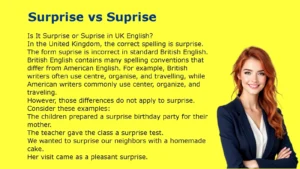
Is It Surprise or Suprise in UK English?
In the United Kingdom, the correct spelling is surprise. The form suprise is incorrect in standard British English.
British English contains many spelling conventions that differ from American English. For example, British writers often use centre, organise, and travelling, while American writers commonly use center, organize, and traveling.
However, those differences do not apply to surprise.
Consider these examples:
- The children prepared a surprise birthday party for their mother.
- The teacher gave the class a surprise test.
- We wanted to surprise our neighbors with a homemade cake.
- Her visit came as a pleasant surprise.
All four sentences use the standard British spelling. You do not need to change the word when writing for a UK audience.
If you search for surprise or suprise UK, the answer remains the same: choose surprise.
Surprise vs Suprise in American English
American English also uses surprise. Writers in the United States do not drop the first r, and the misspelling suprise has no standard regional status.
For example:
- I have a surprise waiting for you.
- The final score was a surprise to everyone.
- They decided to surprise their friend with concert tickets.
These sentences follow standard American spelling rules.
The easiest way to avoid confusion is to separate genuine regional spelling differences from ordinary spelling mistakes.
| British English | American English | Is the spelling different? |
| Surprise | Surprise | No |
| Colour | Color | Yes |
| Centre | Center | Yes |
| Organise | Organize | Often, depending on the style followed |
| Travelling | Traveling | Yes |
| Suprise | Suprise | Incorrect in both varieties |
One detail deserves attention: British and American dictionaries may recognize different pronunciation patterns, but both use the same spelling for surprise.
Surprise or Suprise UK: Common Spelling Mistakes
People often misspell surprise when typing quickly or relying on memory. The error becomes easier to catch when you look for the first r.
Here are several common mistakes:
| Incorrect spelling | Correct spelling |
| Suprise | Surprise |
| Suprised | Surprised |
| Suprising | Surprising |
| Suprisingly | Surprisingly |
A useful proofreading technique is to search your document for suprise before publishing it. In a word processor, use the Find feature to locate every occurrence. Replace each accidental misspelling with the correct form.
You can also check the word’s related forms. Correcting surprise but leaving suprised elsewhere in an article creates an inconsistent result.
For website owners, students, and professional writers, this quick check helps prevent a small typo from appearing in a page title, heading, email subject, or published article.
Surprise Meaning and Definition
Surprise means an unexpected event, experience, or feeling that causes someone to feel astonished, excited, confused, or shocked. It can also describe the action of making someone experience that reaction. The word functions as both a noun and a verb, so its exact meaning depends on how you use it in a sentence.
Surprise as a Noun
As a noun, surprise refers to something unexpected or the feeling caused by an unexpected event.
A surprise can be pleasant, unpleasant, exciting, confusing, or even frightening. The word itself does not automatically mean something good. The surrounding context tells you how the person feels about the event.
Examples include:
- The birthday party was a wonderful surprise.
- The sudden cancellation came as a surprise to the entire team.
- Her unexpected visit was a pleasant surprise.
- Finding my missing wallet in the car was a real surprise.
- The company announced a surprise change to its schedule.
Notice how the meaning changes with the situation. A surprise party usually creates happiness, while a surprise bill might cause frustration.
The noun can also refer to a person’s emotional reaction.
For example, you might say, “She looked at him in surprise.” Here, surprise describes the feeling visible in her expression.
Surprise as a Verb
As a verb, surprise means to cause someone to experience astonishment or to do something unexpected.
The verb often takes a person as its object. You surprise someone when your action, arrival, news, or behavior differs from what they expected.
Examples:
- We plan to surprise our father on his birthday.
- The unexpected result surprised the researchers.
- Her sudden arrival surprised everyone at the office.
- The magician surprised the audience with his final trick.
- I wanted to surprise my friend with a thoughtful gift.
The verb changes form according to tense:
| Verb form | Example |
| Base form: surprise | I want to surprise her. |
| Third-person singular: surprises | The news surprises him. |
| Past tense: surprised | The announcement surprised us. |
| Present participle: surprising | The ending is surprising. |
| Past participle: surprised | We were surprised by the result. |
A common grammatical distinction is worth remembering: surprising usually describes the thing that causes astonishment, while surprised usually describes the person experiencing it.
Compare these sentences:
- The movie had a surprising ending.
- I was surprised by the ending.
The ending caused the reaction, so it was surprising. You experienced the reaction, so you were surprised.
Surprise Word: Synonyms and Related Expressions
The best synonym for surprise depends on the intensity of the reaction and the situation. Some alternatives describe a mild feeling of wonder, while others suggest shock or disbelief.
| Synonym | Meaning | Example |
| Astonishment | Strong surprise or amazement | She stared in astonishment. |
| Amazement | Surprise mixed with wonder | We watched the performance in amazement. |
| Shock | A sudden, often upsetting reaction | The announcement came as a shock. |
| Wonder | A feeling of curiosity or admiration | The children looked at the fireworks in wonder. |
| Startlement | A sudden reaction to something unexpected | The loud noise caused momentary startlement. |
| Unexpected event | Something that happens without being anticipated | The delay was an unexpected event. |
| Revelation | New information that changes someone’s understanding | The final chapter revealed a major revelation. |
The final example illustrates why context matters: revelation often involves learning something previously unknown, while surprise can involve an event, action, gift, or piece of information.
You can also use common expressions with the word.
Pleasant surprise: Something unexpected that makes you happy.
Example: The discount was a pleasant surprise.
Take someone by surprise: Catch someone unprepared.
Example: The difficult question took me by surprise.
Surprise someone with something: Give someone an unexpected experience or item.
Example: We surprised our mother with flowers.
Much to my surprise: A phrase used to introduce an unexpected result.
Example: Much to my surprise, the application was approved.
No surprise: Something expected or unsurprising.
Example: It was no surprise that the experienced team won.
These expressions make your writing more natural and help you avoid repeating the same sentence structure.
Surprise Pronunciation: How to Say the Word Correctly
The English word surprise has two syllables and typically receives stress on the second syllable. Its pronunciation varies slightly by accent, but the spelling remains the same. Learning the stress pattern can help you say the word clearly and avoid confusing it with the common misspelling suprise.
Surprise Pronunciation in American English
A common American English pronunciation is /sərˈpraɪz/.
The pronunciation contains two syllables, with the main stress on the second syllable. The final sound resembles the voiced z in zoo.
Break the word into these parts:
- First syllable: a reduced sound similar to sər.
- Second syllable: prize, with the main stress.
- Final sound: a voiced /z/.
The stress pattern matters more than trying to pronounce every letter separately. English spelling does not always match pronunciation perfectly, and the letter u does not receive a strong, separate vowel sound in the common American pronunciation.
Practice with this sentence:
“The news was a complete surprise.”
Say the word naturally within the sentence rather than pausing between its syllables. That helps you develop a more fluent rhythm.
Surprise Pronunciation in British English
A common British English pronunciation is also represented as /səˈpraɪz/. Individual speakers may pronounce the first syllable or the vowel sounds somewhat differently depending on their regional accent.
The main stress still falls on the second syllable, and the final sound is voiced.
For example:
- “What a surprise!”
- “I was surprised to see you.”
- “They planned a surprise celebration.”
British speakers may differ in vowel quality and rhythm, but they do not use a different spelling. Both surprise and surprised retain the letter r in writing.
When learning British pronunciation, focus on the natural stress pattern and the flow of the entire sentence. An isolated word can sound different from the same word in connected speech.
Why Do People Mispronounce Surprise?
Some people struggle with surprise because the consonant sounds occur close together. Others pronounce the word based on the misspelling suprise, leaving out the first r mentally as well as in writing.
A few habits can help:
- Learn the word as a whole. Avoid trying to pronounce each written letter individually.
- Focus on the second syllable. The main stress falls on the part that sounds like prize.
- Practice related forms. Say surprise, surprised, and surprising in complete sentences.
- Listen to your own speech. Record a sentence and check whether the word sounds natural.
- Keep spelling and pronunciation separate. A reduced sound does not mean the corresponding letter disappears from the written word.
A useful practice sequence is:
- The surprise was wonderful.
- I was surprised by the news.
- The result was surprising.
- We planned to surprise our guests.
Repeating these sentences helps you become familiar with the word in different grammatical forms.
How to Spell Surprise Correctly
To spell surprise correctly, remember that the word contains eight letters and two instances of r. The most common mistake is to omit the first r, producing suprise. A simple letter-by-letter check can help you catch this error before you submit an assignment, publish a post, or send a professional message.
A Simple Trick to Remember Surprise
Use the phrase “Sure, a surprise has two Rs” as a memory aid. The wording is playful, but the important detail is that both instances of the letter r belong in the spelling.
You can also divide the word into two visual parts:
SUR + PRISE = SURPRISE
This method works because it makes the first r easier to notice.
Another option is to connect the spelling with a familiar sentence:
“I was surprised by the surprise.”
The sentence uses two forms of the same word, allowing you to practice the spelling more than once.
When proofreading, pay special attention to the following forms:
- Surprise: The base noun or verb.
- Surprised: The past-tense verb or an adjective describing a person’s reaction.
- Surprising: An adjective describing something unexpected.
- Surprisingly: An adverb describing an unexpected result or manner.
For example, “Surprisingly, the team was not surprised by the result” contains both the adverb and the adjective. Each form retains the correct spelling.
Surprise Spelling Examples in Everyday Sentences
Original examples can help you recognize how the word works in different contexts.
At home
- We planned a surprise dinner for our parents.
- My sister surprised me with a handmade card.
- The package arrived as a pleasant surprise.
At school
- The teacher announced a surprise quiz.
- I was surprised when my project received the highest grade.
- The final question was more surprising than the first.
work
- The manager surprised the team with an extra day off.
- The unexpected deadline came as a surprise.
- Surprisingly, the client approved the proposal immediately.
In everyday conversation
- “What a surprise! I didn’t expect to see you here.”
- “I have a little surprise for you.”
- “You caught me by surprise.”
These examples also demonstrate how the word changes meaning according to its grammatical role.
Common Mistakes With Surprise
The most common mistake is writing suprise instead of surprise. However, other errors can occur when writers change the word’s ending or use the wrong grammatical form.
| Incorrect usage | Correct usage | Reason |
| It was a suprise. | It was a surprise. | The first r is missing. |
| I was surprise. | I was surprised. | The sentence needs the adjective or past participle surprised. |
| The news was surprised. | The news was surprising. | The news causes surprise; it does not experience it. |
| She surprise me yesterday. | She surprised me yesterday. | The past-tense verb needs -ed. |
| I am surprise to hear that. | I am surprised to hear that. | The sentence describes a person’s reaction. |
A quick editing routine can prevent these errors:
- Search the document for suprise.
- Check every occurrence of surprised and surprising.
- Confirm that each form fits the sentence’s grammar.
- Read the sentence aloud to catch awkward wording.
For bloggers, editors, and website owners, this process is particularly useful when proofreading page titles, meta descriptions, image alt text, and headings.
Surprise in French: Pronunciation and Meaning
In French, surprise is a valid word that commonly means a surprise or an unexpected event. Its spelling matches the English word, but the pronunciation differs because French and English use different sound patterns. The French noun is feminine, so it commonly appears with the article une.
How to Pronounce Surprise in French
The French word surprise is commonly pronounced /syʁ.pʁiz/ in the International Phonetic Alphabet (IPA).
A few sound differences help distinguish the French pronunciation from the English one:
- The French u: The vowel /y/ does not have an exact equivalent in standard English. To produce it, round your lips as if saying “oo” while positioning your tongue closer to the position used for “ee.”
- The French r: French commonly uses a uvular /ʁ/, produced toward the back of the mouth, rather than the English /r/.
- The final sound: The ending includes a voiced /z/ sound.
French speakers pronounce the word with two syllables, and the final syllable receives prominence in the word’s natural rhythm.
A useful French example is:
“Quelle surprise !”
English translation: “What a surprise!”
Another example is:
“C’est une surprise.”
English translation: “It’s a surprise.”
When learning French, avoid applying the English pronunciation automatically just because the spelling looks familiar. Words that share a spelling across languages do not always share the same pronunciation.
What Does Surprise Mean in French?
The French noun surprise refers to an unexpected event or the feeling associated with it. Its meaning often closely matches the English noun, although the surrounding sentence determines the exact translation.
Here are several common expressions:
| French expression | English meaning |
| Une surprise | A surprise |
| Quelle surprise ! | What a surprise! |
| Une belle surprise | A lovely surprise |
| Une grande surprise | A big surprise |
| Faire une surprise à quelqu’un | To surprise someone or arrange a surprise for someone |
Examples in context:
French: “J’ai une surprise pour toi.”
English: “I have a surprise for you.”
French: “Son arrivée a été une surprise.”
English: “His or her arrival was a surprise.”
The phrase faire une surprise à quelqu’un is especially useful because it shows how French expresses the idea of arranging something unexpected for another person.
Although English and French share the spelling, the languages differ in pronunciation, grammar, and sentence structure. Learning those differences helps you use the word naturally in each language.
Surprise in Tagalog: Meaning and Usage
In Tagalog, the best translation of surprise depends on the context. The word gulat often describes a feeling of shock or being startled, while sorpresa commonly refers to a surprise, unexpected event, or arranged surprise. Filipino speakers also use borrowed English words in everyday conversation, so the most natural expression can vary by setting.
How to Say Surprise in Tagalog
The words gulat and sorpresa are related, but they are not interchangeable in every sentence.
Gulat generally emphasizes the feeling or reaction caused by something unexpected.
Example:
“Nagulat ako.”
English translation: “I was surprised.”
The sentence describes a person’s reaction to something unexpected.
Sorpresa commonly refers to a surprise event, gift, or planned gesture.
Example:
“May sorpresa ako para sa iyo.”
English translation: “I have a surprise for you.”
Here, sorpresa refers to something the speaker intends to reveal or give to another person.
Compare these examples:
| Tagalog expression | English meaning | Typical use |
| Gulat | Surprise, shock, or startlement | Describing a reaction |
| Nagulat ako | I was surprised | Explaining a personal reaction |
| Sorpresa | A surprise | Describing an unexpected event or gift |
| May sorpresa ako | I have a surprise | Introducing a planned surprise |
| Nakakagulat | Surprising or startling | Describing something that causes surprise |
The best translation depends on whether you mean the emotion, the unexpected event, or the act of surprising someone.
Common Tagalog Expressions With Surprise
Here are some natural examples to help you understand the difference.
“Nagulat ako sa balita.”
Translation: “I was surprised by the news.”
This sentence emphasizes the speaker’s reaction to unexpected information.
“May sorpresa kami para sa kanya.”
Translation: “We have a surprise for him or her.”
The sentence refers to something planned for another person.
“Nakakagulat ang resulta.”
Translation: “The result is surprising.”
This expression describes the result as something that causes surprise.
“Sorpresa ang handa namin para sa kaarawan niya.”
Translation: “We prepared a surprise for their birthday.”
This conveys the idea of a planned birthday surprise, although the exact wording can vary with context.
In casual Filipino conversation, you may also hear English phrases such as surprise party or birthday surprise. Code-switching between English and Filipino is common in many settings.
For language learners, the most useful distinction is simple: use gulat when describing the feeling of being startled or astonished, and use sorpresa when referring to a surprise event or gift.
Surprise Clothing: Is It a Brand or a Search for the Word?
The phrase surprise clothing has a different search intent from surprise vs suprise. Someone searching for it may be looking for a clothing brand, a product listing, a surprise clothing box, or apparel associated with a place named Surprise. The phrase alone does not identify one specific retailer or product.
How to Find the Right Surprise Clothing Result
If you are looking for clothing, adding more detail to your search can help you find the intended product or business.
Try refining the search with a more specific phrase:
- Surprise clothing brand: Useful when you know the business name or want to identify a label.
- Surprise clothing box: Useful when looking for mystery clothing packages or curated apparel bundles.
- Surprise T-shirts: Useful when searching for shirts featuring the word or a related design.
- Clothing stores in Surprise, Arizona: Useful when looking for local retailers in that city.
- Surprise gift clothing: Useful when shopping for apparel as an unexpected gift.
The distinction matters because search engines may interpret Surprise as a brand name, a location, or an ordinary English word.
If you are researching a particular clothing company, check its exact business name, official website, product catalog, and location before assuming that a search result refers to the right brand.
For someone checking spelling rather than shopping, the clothing-related query does not change the answer: the ordinary English word is still spelled surprise.
Quick Comparison: Surprise vs Suprise
The difference between surprise and suprise is straightforward. One is the standard English spelling, and the other is a misspelling. The correct word works in British and American English and can function as both a noun and a verb.
| Feature | Surprise | Suprise |
| Standard spelling | Yes | No |
| Accepted in British English | Yes | No |
| Accepted in American English | Yes | No |
| Meaning | An unexpected event, feeling, or action | No standard dictionary meaning as an English variant |
| Pronunciation | Varies slightly by accent | Intended to represent the same word but incorrectly spelled |
| Example | The visit was a surprise. | Incorrect: The visit was a suprise. |
Keep these three points in mind:
- Spelling: Always write surprise in standard English.
- Pronunciation: Stress the second syllable in common British and American pronunciations.
- Meaning: Use the word as a noun for an unexpected event or feeling and as a verb for causing someone to feel astonished.
If you are unsure, remember the first r. That single letter separates the correct spelling from the most common mistake.
Frequently Asked Questions
Is It Surprise or Suprise?
Surprise is the correct spelling. Suprise is a misspelling because it omits the first r. Use surprise in school assignments, emails, professional writing, and everyday messages.
Is Surprise Spelled Differently in the UK?
No. British and American English both use surprise. Although some words have different regional spellings, such as colour and color, this word follows the same spelling convention in both varieties.
How Do You Pronounce Surprise?
A common pronunciation is /sərˈpraɪz/ in American English. The word has two syllables, and the second syllable carries the main stress. British pronunciation varies slightly by accent, but the stress pattern remains similar.
What Does Surprise Mean?
Surprise means an unexpected event, feeling, or action that causes astonishment or another strong reaction. As a noun, it can describe a surprise gift. As a verb, it means to cause someone to feel astonished.
How Do You Say Surprise in French?
The French word is surprise, commonly pronounced /syʁ.pʁiz/. For example, Quelle surprise ! means “What a surprise!” The French pronunciation differs from the English version, especially in the vowel and the French r sound.
What Is Surprise in Tagalog?
Two common translations are gulat and sorpresa. Gulat usually describes the feeling of shock or being startled, while sorpresa often refers to an unexpected event, gift, or planned surprise.
Conclusion: Always Use Surprise, Not Suprise
The spelling question has a simple answer: surprise is correct, and suprise is incorrect. Both British and American English use the same spelling, even though speakers may pronounce the word a little differently.
Remember that surprise can function as a noun or a verb. You can experience a surprise, give someone a surprise, or surprise someone with unexpected news. In French, the word has a related meaning but a different pronunciation. In Tagalog, gulat and sorpresa express different aspects of the same general idea.
Before publishing an article or sending an important message, check for the missing r. If you are building an English-learning website, you can also link this topic to related guides about commonly misspelled words, British vs American spelling, word meanings, and English pronunciation to help readers explore similar questions.