Lightning vs lightening is a common English spelling confusion because both words look almost identical and usually sound the same. However, lightning refers to the electrical flash during a storm, while lightening means making something lighter in color, weight, mood, or intensity. Understanding the difference helps you choose the correct spelling in weather reports, photography, skin-care discussions, and everyday writing.
The distinction becomes easier when you compare lightning vs lightening pronunciation, examine examples in context, and separate related terms such as lightning vs thunder and lighting vs lightning in photography. You’ll also learn whether lightening is a real word, how British English uses both spellings, and which mistakes to avoid.
Lightning vs Lightening: What’s the Difference?
Lightning is the bright electrical discharge that occurs during a storm. Lightening is the process of making something lighter, brighter, less heavy, or less serious. Both are correctly spelled English words, but they serve different purposes. The surrounding sentence usually tells you which spelling you need.
| Feature | Lightning | Lightening |
| Meaning | An electrical discharge in the atmosphere | The act or process of making something lighter |
| Part of speech | Noun | Present participle or gerund of lighten |
| Main context | Storms, weather, electrical activity | Color, weight, mood, intensity, and workload |
| Example | Lightning flashed across the sky. | The sky was lightening at dawn. |
| Memory clue | Think of a storm and a flash | Think of something becoming lighter |
| British spelling | Lightning | Lightening |
| American spelling | Lightning | Lightening |
The key difference is the extra e in lightening. That letter connects the word to the verb lighten, which means to make something lighter. Without the extra e, lightning names the electrical phenomenon.
What Does Lightning Mean?
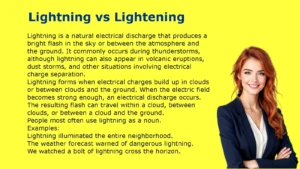
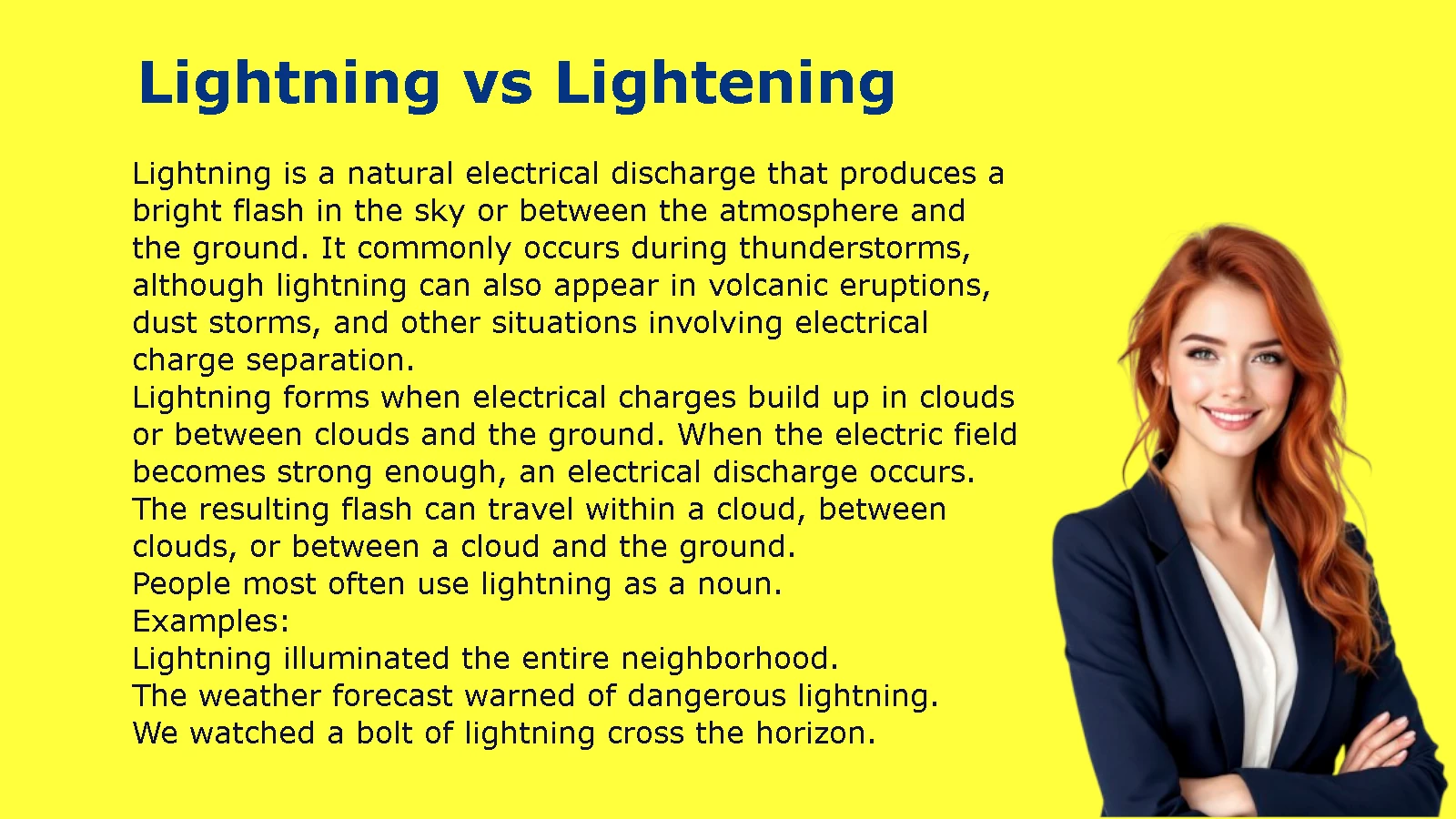
Lightning is a natural electrical discharge that produces a bright flash in the sky or between the atmosphere and the ground. It commonly occurs during thunderstorms, although lightning can also appear in volcanic eruptions, dust storms, and other situations involving electrical charge separation.
Lightning forms when electrical charges build up in clouds or between clouds and the ground. When the electric field becomes strong enough, an electrical discharge occurs. The resulting flash can travel within a cloud, between clouds, or between a cloud and the ground.
People most often use lightning as a noun.
Examples:
- Lightning illuminated the entire neighborhood.
- The weather forecast warned of dangerous lightning.
- We watched a bolt of lightning cross the horizon.
- The tree was damaged when lightning struck it.
- She captured a photograph of lightning during the storm.
The word also appears in figurative expressions. For example, lightning speed describes something that happens extremely quickly, while a lightning decision suggests a decision made very fast.
These expressions use lightning as a symbol of speed, suddenness, or intensity. They don’t refer to making something lighter.
What Does Lightening Mean?
Lightening is the present participle or gerund of the verb lighten. It describes the process of making something lighter or becoming lighter. Depending on the context, the word can refer to color, physical weight, mood, workload, or intensity.
The verb lighten has several related meanings:
- Making a color lighter: The painter is lightening the blue paint.
- Reducing physical weight: The engineer is lightening the structure.
- Improving a mood: Her funny story is lightening the atmosphere.
- Reducing a burden: The new software is lightening the team’s workload.
- Making something less severe: The treatment is lightening the appearance of certain dark spots.
Examples:
- The sky was lightening as sunrise approached.
- She is lightening her hair by a few shades.
- The company is lightening employees’ workloads.
- His cheerful attitude was lightening the mood.
- The designer is lightening the room with pale colors.
Notice that lightening doesn’t always mean changing a color. It can describe any process that makes something less heavy, intense, dark, or serious.
Lightning vs Lightening: A Simple Memory Trick
The easiest way to remember lightning vs lightening is to connect each spelling with a familiar idea.
- Lightning: Think of a flash in the sky during a thunderstorm.
- Lightening: Think of making something lighter, such as a color, load, or mood.
Try replacing lightening with the phrase making lighter. If the sentence still makes sense, you probably need lightening.
For example:
- The curtains are lightening the room. → The curtains are making the room lighter.
- Lightning struck the building. → Making lighter struck the building doesn’t make sense.
The second sentence clearly needs lightning because it describes an electrical discharge.
Lightning vs Lightening Pronunciation
Lightning and lightening are generally pronounced the same way in standard English. Both usually have two syllables, with the stress on the first syllable. Their similar pronunciation explains why people often confuse them in writing, even when they understand the meanings.
The difference is primarily spelling and meaning, not sound.
How to Pronounce Lightning
The word lightning is usually pronounced /ˈlaɪt.nɪŋ/ in IPA. It has two syllables, and the first syllable receives the stress.
The first syllable sounds like light, while the second resembles the ending in running.
Example:
“Lightning flashed over the hills.”
When speaking, keep the word compact. The middle consonant sequence connects the two syllables, so the word doesn’t need an extra vowel sound.
How to Pronounce Lightening
The word lightening is also commonly pronounced /ˈlaɪt.nɪŋ/. In ordinary speech, the extra written e doesn’t create an additional syllable or a different vowel sound.
Example:
“The clouds are lightening near the horizon.”
The two words can therefore sound identical even though their spellings differ.
Why Do Lightning and Lightening Sound the Same?
The pronunciation comes from the way English forms words from related roots. Lightening derives from lighten, while lightning developed as the name for the electrical phenomenon. Over time, their spoken forms came to overlap.
This is an example of a homophone relationship: two words that sound alike but have different spellings and meanings. More precisely, the words are commonly homophonous in standard English accents.
Other familiar examples of homophones include:
- Their / there: Possession versus a place or introductory expression.
- Flour / flower: An ingredient used in baking versus a plant’s bloom.
- Brake / break: A device for slowing a vehicle versus separating or damaging something.
Because lightning and lightening sound alike, context does most of the work. Readers rely on surrounding words to determine whether a sentence describes a storm or a process of becoming lighter.
Is Lightening a Word?
Yes, lightening is a valid English word. It is the -ing form of the verb lighten, which means to make something lighter or to become lighter. The word is correct when discussing changes in color, weight, mood, or intensity. It is incorrect only when someone uses it to mean an electrical discharge.
Is Lightening Correct English?
The word lightening follows a standard English word-formation pattern.
Start with the verb lighten. Add -ing to describe an ongoing action or to turn the verb into a gerund.
- Lighten → lightening
- Darken → darkening
- Brighten → brightening
- Soften → softening
- Widen → widening
These forms describe processes or ongoing changes.
For example:
- The room is lightening as the sun rises.
- The designer is brightening the walls with a pale shade.
- The road is widening near the intersection.
In each sentence, the -ing form describes an action or process.
However, lightning isn’t simply another form of lighten. It is a separate noun with its own established meaning.
When Should You Use Lightening Instead of Lightning?
Use lightening when the sentence describes something becoming lighter. Use lightning when the sentence refers to the electrical discharge associated with storms.
| Incorrect or confusing sentence | Correct sentence | Why |
| Lightening struck the tree. | Lightning struck the tree. | The sentence describes an electrical discharge. |
| The storm produced bright lightening. | The storm produced bright lightning. | The bright flash is lightning. |
| The sky is lightning near sunrise. | The sky is lightening near sunrise. | The sky is becoming brighter. |
| She is lightning her hair. | She is lightening her hair. | She is making her hair a lighter color. |
| His joke was lightning the mood. | His joke was lightening the mood. | The joke was making the atmosphere less serious. |
The most reliable test is to identify the action or object. If the word names a flash of electricity, choose lightning. If it describes a change toward a lighter state, choose lightening.
Common Lightning vs Lightening Mistakes
Writers often make this mistake because the two words look nearly identical. A quick spelling check can prevent errors, especially in articles about weather, beauty, or photography.
Mistake: “Lightening struck near our house.”
Correction: “Lightning struck near our house.”
Why: The sentence describes an electrical discharge.
Mistake: “The room is lightning up.”
Correction: “The room is lighting up.”
Why: Lighting up means becoming illuminated. It uses the verb light, not lighten. This example highlights a third word that people sometimes confuse with the other two.
Mistake: “The painter is lightning the walls.”
Correction: “The painter is lightening the walls.”
Why: The painter is making the wall color paler.
Mistake: “The storm clouds were lightening the sky with electrical flashes.”
Better: “Lightning was flashing through the storm clouds.”
Why: The original sentence mixes the meaning of lightening with the weather-related meaning of lightning.
Always read the complete sentence rather than judging the word by appearance alone. A word can be correctly spelled but still be wrong for the meaning you intend.
Lightning or Lightening in British English?
British English uses both lightning and lightening, with the same distinction found in American English. Neither word is a regional spelling variant of the other. British writers use lightning for the electrical phenomenon and lightening for the process of making something lighter.
Is There a UK Spelling Difference?
Some English words change spelling between British and American English. For example, British English commonly uses colour, while American English uses color. Similarly, centre is common in British English, while center is the standard American spelling.
However, lightning vs lightening isn’t a British-versus-American spelling issue.
| Meaning | British English | American English |
| Electrical discharge | Lightning | Lightning |
| Making something lighter | Lightening | Lightening |
| Arranging illumination | Lighting | Lighting |
| Sound caused by lightning | Thunder | Thunder |
The correct spelling depends on meaning, not location.
Lightning vs Lightening: UK Usage Examples
Here are examples that work naturally in British English:
- The Met Office issued a warning about lightning during the storm.
- The sky was lightening as the sun rose over the countryside.
- She noticed the lightening of her hair after using the product.
- The photographer adjusted the lighting before the portrait session.
- We heard thunder shortly after seeing the lightning.
British and American readers can use the same spelling rules for these terms. If you’re writing for a UK audience, focus on the sentence’s meaning rather than trying to choose a different regional form.
Lightning vs Thunder: What’s the Difference?
Lightning is an electrical discharge, while thunder is the sound produced when lightning rapidly heats the surrounding air. The two phenomena often occur during the same storm, but they aren’t interchangeable. You see lightning and hear thunder, although bright flashes and loud sounds may happen too close together to distinguish clearly.
What Is Lightning?
Lightning is a rapid electrical discharge caused by differences in electrical charge. It can occur within a cloud, between clouds, or between a cloud and the ground.
A lightning flash heats the air along its path to extremely high temperatures, often around 30,000 kelvins. That sudden heating causes the air to expand rapidly and creates a pressure wave.
Lightning can be dangerous because it can injure people, ignite fires, damage buildings, and affect electrical systems.
Examples:
- Lightning flashed across the sky.
- The storm produced several powerful lightning strikes.
- The hikers moved away from exposed ground when lightning approached.
What Is Thunder?
Thunder is the sound associated with lightning. When lightning heats the surrounding air, the air expands rapidly and produces a shock wave that develops into sound waves.
You usually see the flash before you hear the thunder because light travels much faster than sound. The delay can help you estimate how far away a storm is.
A rough rule is to count the seconds between the flash and the thunder, then divide by five to estimate the distance in miles. For kilometers, divide by about three.
For example, if you count 15 seconds between lightning and thunder, the storm is roughly three miles, or five kilometers, away. This estimate is only approximate and should never replace safety precautions.
Lightning vs Thunder Comparison Table
| Feature | Lightning | Thunder |
| What it is | Electrical discharge | Sound produced by lightning |
| What you experience | A bright flash | A rumbling or cracking sound |
| Cause | Electrical charge separation and discharge | Rapid heating and expansion of air |
| Travels at | Approximately the speed of light | Approximately the speed of sound, depending on conditions |
| Typical sentence | Lightning lit up the clouds. | Thunder shook the windows. |
Remember: Lightning causes the rapid air expansion that produces thunder. Thunder doesn’t create lightning.
If you hear thunder, lightning is close enough to pose a potential danger. Move into a substantial enclosed building or a hard-topped vehicle and follow local weather safety guidance.
Lighting or Lightning in Photography?
Lightning and Lighting have different meanings in photography. Lighting describes how a photographer illuminates a subject, while lightning refers to the electrical flashes that photographers may capture during storms. Choosing the right word helps distinguish a photography technique from a weather event.
What Does Lighting Mean in Photography?
In photography, lighting refers to the placement, direction, quality, intensity, and color of light used to illuminate a scene.
Photographers control lighting to shape the subject’s appearance. A portrait with soft lighting may have gentle shadows, while dramatic lighting can create strong contrast and a more intense mood.
Common photography lighting terms include:
- Natural lighting: Sunlight or other available environmental light.
- Studio lighting: Light produced by equipment such as strobes or continuous lamps.
- Soft lighting: Light that creates gradual shadows and smooth transitions.
- Hard lighting: Light that produces sharp shadows and strong contrast.
- Backlighting: Light placed behind a subject.
- Low-key lighting: A technique that emphasizes dark tones and selective illumination.
Example: “The photographer changed the lighting to make the subject’s face look more dimensional.”
The word lighting can also refer to the equipment or overall illumination in a room, studio, or set.
When Does Lightning Apply to Photography?
Lightning photography usually means photographing electrical flashes during thunderstorms. Photographers may use a tripod, a suitable shutter setting, and a safe location to capture lightning bolts.
For example:
- She photographed lightning over the ocean.
- The photographer captured a dramatic lightning strike behind the skyline.
- He used a long exposure to record several lightning flashes in one frame.
Lightning photography requires special attention to safety. Never stand in an open field, near isolated trees, or on an exposed hill to capture a storm. A camera setup isn’t worth the risk of a lightning strike.
Lighting vs Lightning: Photography Examples
| Sentence | Correct term | Explanation |
| The photographer adjusted the studio lighting. | Lighting | The sentence describes illumination. |
| She captured lightning over the mountains. | Lightning | The sentence describes electrical flashes. |
| The lighting made the portrait look warmer. | Lighting | The sentence describes the quality of light. |
| The lightning illuminated the landscape for a split second. | Lightning | The sentence describes a storm flash. |
| The photographer used soft lighting for the interview. | Lighting | The sentence describes a lighting technique. |
A useful editing test is to ask whether you mean controlling illumination or capturing an electrical flash. Use lighting for the first and lightning for the second.
Lightening Skin Meaning and Usage
Skin lightening refers to reducing the appearance of pigmentation or making skin look lighter in tone. The term appears in discussions of dermatology, cosmetics, and beauty products. It has nothing to do with lightning, the electrical discharge, even though the words sound alike.
What Does Skin Lightening Mean?
Skin lightening is a broad term used for cosmetic or dermatological approaches intended to reduce the appearance of darker areas or uneven pigmentation.
People may use the term when discussing:
- Dark spots caused by previous skin inflammation.
- Uneven skin tone.
- Melasma and other pigmentation concerns.
- Cosmetic products marketed for a brighter-looking complexion.
- Treatments intended to reduce excess pigmentation.
The meaning depends on the context. Someone might use skin lightening to describe a product marketed for dark spots, while another person might use it to describe a broader change in skin tone.
The phrase itself doesn’t identify a specific treatment or guarantee a particular result. Product ingredients, intended uses, and risks can vary.
Skin Lightening vs Skin Whitening
Skin lightening and skin whitening often overlap in everyday beauty marketing, but their intended meanings can vary by product and region.
| Term | Common usage | Important context |
| Skin lightening | Reducing the appearance of pigmentation or uneven tone | May refer to targeted dark spots or broader changes in tone |
| Skin whitening | Marketing language for products intended to make skin appear lighter | May carry broader cosmetic or cultural meanings |
| Skin brightening | Improving the appearance of dullness or uneven tone | Doesn’t necessarily mean reducing overall skin color |
These terms aren’t precise medical categories in every context. Read product labels carefully and consult a qualified dermatologist about persistent pigmentation concerns.
Some skin-lightening products can contain harmful ingredients or carry risks when used incorrectly. Avoid unregulated products that promise rapid, dramatic changes, and don’t use potent prescription ingredients without appropriate medical guidance.
Examples of Lightening in Skin-Care Contexts
Here are examples showing how the word works in sentences:
- “The dermatologist discussed options for lightening dark spots.”
- “The product is marketed for skin lightening.”
- “She asked whether the treatment could help with the lightening of post-inflammatory marks.”
- “The article explains the risks associated with certain skin-lightening products.”
In these examples, lightening describes a change in pigmentation or appearance. It doesn’t refer to weather or electrical activity.
The grammatical structure can also help you identify the meaning. In skin lightening, the word acts as a noun modifier, describing the type of process or product. In the skin is lightening, it functions as part of a verb phrase.
Lightening in a Sentence: Examples and Usage
Lightening works when you describe something becoming lighter, less heavy, less intense, or less serious. Lightning works when you describe the electrical discharge in a storm. Reviewing complete sentences is one of the fastest ways to learn the difference and use each spelling confidently.
Lightening Examples in Everyday English
The following examples cover several meanings of lightening.
Color and brightness
- The sky was lightening as the sun rose.
- The artist was lightening the green paint with white.
- The curtains helped with the gradual lightening of the room.
Hair and appearance
- She was lightening her hair before the summer holidays.
- The stylist explained the process of lightening dark hair.
- The gradual lightening of the fabric changed its original appearance.
Mood and emotions
- His funny comment was lightening the mood after a difficult meeting.
- The music was lightening the atmosphere in the waiting room.
- Her smile contributed to the lightening of an otherwise tense conversation.
Weight and workload
- The new equipment is lightening the workers’ physical burden.
- The manager is lightening the team’s workload by redistributing tasks.
- Engineers are exploring ways of lightening the vehicle without compromising safety.
These examples show that lightening can describe physical changes and abstract improvements.
Lightning Examples in Everyday English
Use lightning for the electrical phenomenon and in expressions associated with speed.
Weather
- Lightning flashed behind the dark clouds.
- The storm produced several bolts of lightning.
- We saw lightning before the first clap of thunder.
- A flash of lightning illuminated the road.
Photography and observation
- The photographer captured lightning above the coastline.
- We watched lightning flicker across the distant horizon.
- The camera recorded a bright bolt of lightning during the storm.
Figurative expressions
- The athlete moved at lightning speed.
- The team made a lightning-fast decision.
- The company launched a lightning campaign to respond to the competitor.
The figurative uses retain the idea of something sudden or fast. They don’t describe a process of becoming lighter.
Lighting Examples to Avoid Confusion
Although lighting isn’t the main focus of this comparison, it’s worth understanding because it creates a third common spelling confusion.
- The lighting in the studio was too harsh.
- She installed new lighting in the kitchen.
- Good lighting helps photographers capture accurate colors.
- The stage lighting changed during the performance.
Lighting relates to illumination. Lightening relates to making something lighter. Lightning refers to an electrical discharge.
Lightning vs Lightening: Common Errors and Corrections
| Incorrect sentence | Correct sentence | Reason |
| Lightening struck the power line. | Lightning struck the power line. | The sentence refers to an electrical discharge. |
| The walls are lightning up. | The walls are lighting up. | The walls are becoming illuminated. |
| The painter is lightning the ceiling. | The painter is lightening the ceiling. | The painter is making the color paler. |
| We heard lightening during the storm. | We heard thunder during the storm. | Thunder is the sound associated with lightning. |
| The lighting bolt crossed the sky. | The lightning bolt crossed the sky. | Lightning bolt is the correct expression. |
| She captured lightening with her camera. | She captured lightning with her camera. | The photograph shows an electrical flash. |
| The joke was lightning the mood. | The joke was lightening the mood. | The joke made the atmosphere less serious. |
| The photographer adjusted the lightning. | The photographer adjusted the lighting. | The photographer changed the illumination. |
These corrections demonstrate why spelling checks should consider meaning, grammar, and context together.
Quick Test: Should You Use Lightning or Lightening?
Test your understanding by choosing the correct word in each sentence. Pay attention to whether the sentence describes a storm, a change in color, or a change in mood.
Complete each sentence with lightning, lightening, lighting, or thunder.
- The storm produced a bright flash of ______.
- The sky was ______ as dawn approached.
- The photographer adjusted the studio ______.
- We heard a loud rumble of ______ after the flash.
- Her cheerful comment was ______ the mood in the room.
Answers and Explanations
Lightning: The storm produced a bright flash of lightning.
The sentence describes an electrical discharge.
Lightening: The sky was lightening as dawn approached.
The sky was becoming brighter.
Lighting: The photographer adjusted the studio lighting.
The photographer changed the illumination.
Thunder: We heard a loud rumble of thunder after the flash.
Thunder is the sound associated with lightning.
Lightening: Her cheerful comment was lightening the mood in the room.
The comment made the atmosphere less serious.
If you answered all five correctly, you understand the main distinction. If you missed one, return to the comparison table and identify the meaning before choosing a spelling.
Frequently Asked Questions
Is lightening a word or a misspelling of lightning?
Lightening is a valid English word, not automatically a misspelling. It comes from the verb lighten and describes making something lighter in color, weight, mood, or intensity. However, if you’re referring to the electrical discharge during a storm, the correct spelling is lightning.
Are lightning and lightening pronounced the same?
Yes, lightning and lightening are generally pronounced the same way in standard English. Both usually have two syllables and stress the first syllable. Their similar pronunciation makes them easy to confuse when writing, so context and meaning determine which spelling you should use.
Is it lightning or lightening in British English?
British English uses both lightning and lightening with the same meanings as American English. Lightning refers to the electrical discharge, while lightening describes making something lighter. Neither spelling is an exclusively British or American variant.
What is the difference between lightning, lightening, and lighting?
Lightning is the electrical discharge associated with storms. Lightening means making something lighter in color, weight, mood, or intensity. Lighting refers to illumination or the equipment and techniques used to produce it. For example, a photographer adjusts the lighting but may photograph lightning during a storm.
Is lightning the same as thunder?
No. Lightning is an electrical discharge, while thunder is the sound produced by the rapid heating and expansion of air along the lightning channel. You usually see lightning before hearing thunder because light travels much faster than sound. Both commonly occur during thunderstorms.
What does lightening mean in skin care?
Skin lightening refers to attempts to reduce the appearance of pigmentation or make skin look lighter. The phrase appears in cosmetic and dermatological discussions involving dark spots, uneven skin tone, and related concerns. It isn’t connected to lightning, the electrical phenomenon, and the results and risks of products vary.
Conclusion: Lightning vs Lightening Made Simple
The difference between lightning vs lightening comes down to meaning. Lightning is the electrical discharge that creates a flash during a storm, while lightening describes making something lighter in color, weight, mood, or intensity. Both are correct English words, and neither is a regional spelling variant.
Remember these three terms:
- Lightning: An electrical discharge in the sky.
- Lightening: The process of making something lighter.
- Lighting: The illumination used in a room, photograph, or scene.
The extra e in lightening connects the word to lighten. That small spelling clue can help you avoid common errors in weather reports, photography articles, skin-care discussions, and everyday writing.