Payed vs paid is a common spelling confusion, especially when talking about giving money, settling a bill, or receiving compensation. If you’ve wondered whether “payed” or “paid” is the correct past tense of pay, the answer depends on how the word is being used. In most everyday situations involving money, wages, bills, purchases, debts, or expenses, paid is the correct form.
The payed vs paid difference mainly comes down to meaning and usage. Paid is the standard past tense and past participle of pay, as in “She paid the bill yesterday.” Payed is a much less common word that is mainly used in specific nautical contexts, such as paying out rope, cable, or chain. Although the two words look similar, they are not interchangeable in ordinary English.
In this guide, you’ll learn whether “payed” or “paid” is correct, what each word means, when to use “paid” in a sentence, and why “payed” sometimes appears in English writing. You’ll also see clear examples, common mistakes, and a simple comparison of payed vs paid to make the difference easy to remember.
By the end, you’ll know exactly when to use paid and when payed can be correct, so you can choose the right spelling confidently in everyday and formal writing.
Payed vs Paid: Quick Answer
The simplest answer is:
Use “paid” for ordinary English. Use “payed” only in specific nautical contexts.
| Word | Main use | Example |
| Paid | Past tense and past participle of pay | I paid the bill. |
| Payed | Specialized nautical usage | The crew payed out the line. |
The difference becomes clearer when you look at the verb forms:
| Form | Verb |
| Present | pay |
| Past simple | paid |
| Past participle | paid |
| -ing form | paying |
Oxford gives the verb forms as pay → paid → paid, with paying as the -ing form.
That means sentences such as these are correct:
- I paid for dinner.
- She paid the rent.
- We paid the employees.
- He has paid the invoice.
- They have paid their debt.
- I paid attention.
- She got paid on Friday.
In normal financial or everyday contexts, payed is not the form you want.
Paid: The Standard Past Tense of Pay
Paid is the standard past form of pay. The verb pay generally refers to giving money in exchange for goods, services, work, or something that is owed. Cambridge lists paid as both the past tense and past participle of pay.
For example:
I paid $50 for the tickets.
Here, paid describes an action that happened in the past. The present-tense version would be:
I pay $50 for the tickets.
The past form changes pay to paid, not payed.
Paid as a Past Tense Verb
The simple past describes an action that happened before now.
Compare:
- Present: I pay the bill every month.
- Past: I paid the bill yesterday.
- Present: She pays the rent online.
- Past: She paid the rent online yesterday.
The irregular spelling is similar to other common English verbs whose past forms do not simply take -ed.
For example:
| Present | Past |
| pay | paid |
| say | said |
| make | made |
| take | took |
| buy | bought |
The fact that pay ends in y does not mean its past tense is automatically formed by adding -ed.
Paid as a Past Participle
Paid also functions as the past participle of pay. It can appear with auxiliary verbs such as have, has, and had.
Examples include:
- I have paid the bill.
- She has paid for the service.
- We had already paid.
- They have paid their employees.
- He had paid the full amount.
This is another reason paid is the form you need in ordinary English.
Payed: A Specialized Nautical Term
Payed is not simply a second spelling of ordinary paid. Its legitimate use is much narrower.
In nautical terminology, pay out can mean to release or let out a rope or cable in a controlled manner. Cambridge specifically records this meaning for pay something out and gives the verb’s forms as paid | paid in its dictionary entry.
This specialized vocabulary is where you may encounter payed in some nautical writing or technical usage.
For example, a nautical text might use payed in connection with a line or cable being released.
The important point is that this meaning has nothing to do with paying money.
Why the Nautical Meaning Matters
Consider the difference between these two ideas:
Financial payment:
The customer paid the invoice.
Nautical action:
The crew payed out the line.
The first sentence concerns money. The second concerns the controlled release of a line.
That distinction explains why saying that “payed is always wrong” is too simplistic. In ordinary writing, it is usually wrong when intended as the past tense of pay. However, specialized vocabulary can preserve forms that are uncommon in everyday English.
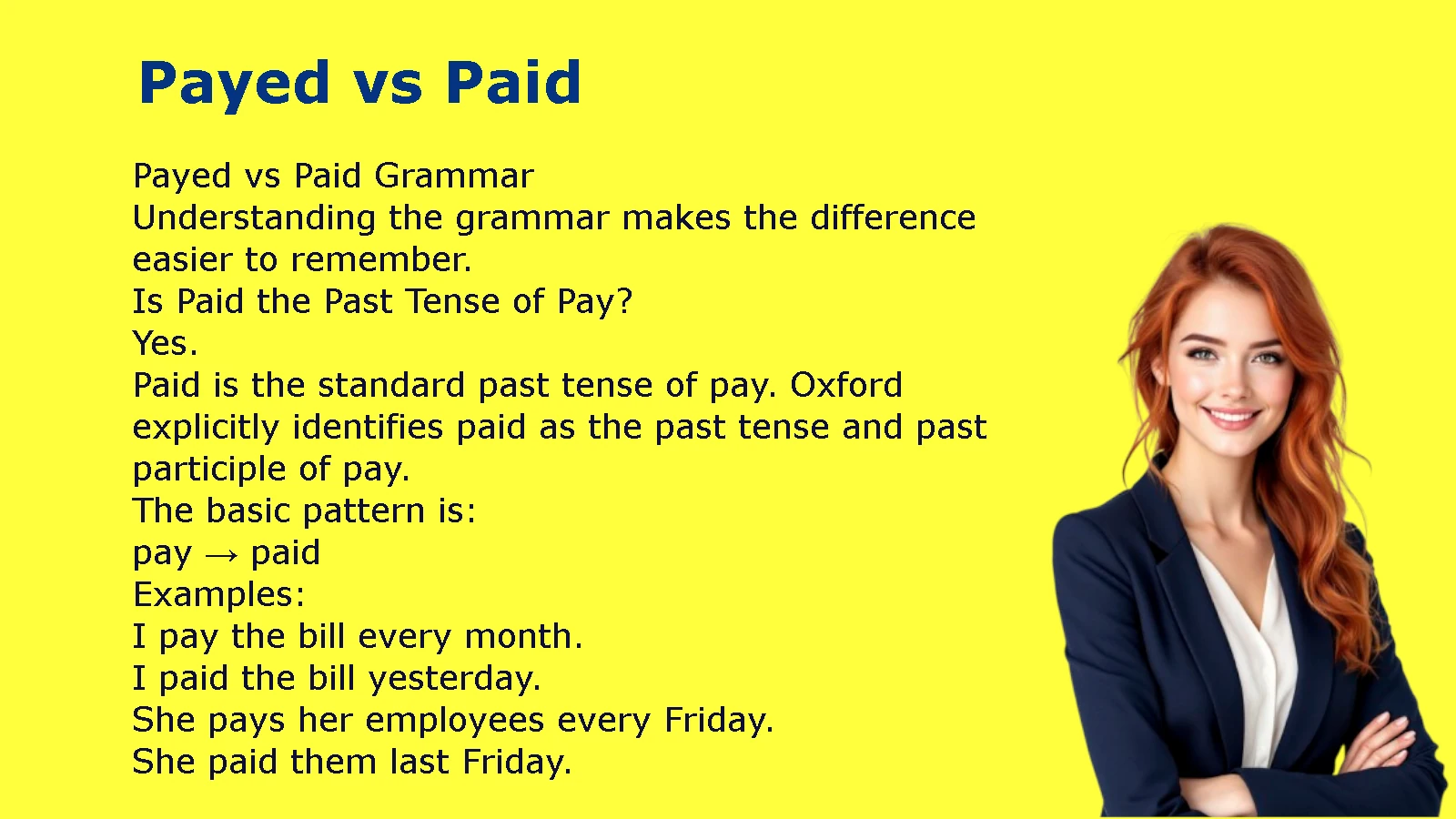
Payed vs Paid Grammar
Understanding the grammar makes the difference easier to remember.
Is Paid the Past Tense of Pay?
Yes.
Paid is the standard past tense of pay. Oxford explicitly identifies paid as the past tense and past participle of pay.
The basic pattern is:
pay → paid
Examples:
- I pay the bill every month.
- I paid the bill yesterday.
- She pays her employees every Friday.
- She paid them last Friday.
The word payed does not replace paid in these sentences.
Is Payed Ever Correct?
Yes, but only in specialized usage.
The word can occur in nautical terminology associated with paying out a rope, cable, or line. Cambridge distinguishes the rope-and-cable meaning of pay out from its financial meaning.
This gives you a useful rule:
If money is involved, use “paid.”
If the sentence describes a specialized nautical action involving a line, cable, or rope, payed may be appropriate depending on the terminology and construction being used.
Payed vs Paid Examples
The easiest way to understand the distinction is to see the words in context.
Examples With Paid
Here are common examples where paid is correct:
- I paid the bill yesterday.
- She paid for the groceries.
- We paid $200 for the tickets.
- He paid his rent on time.
- They paid the workers.
- I have already paid the fee.
- She paid the full amount.
- We paid the restaurant by credit card.
- He finally paid his debt.
- I paid attention to the instructions.
- She got paid on Friday.
- The company paid its employees.
- We paid in advance.
- They paid for the repairs.
- He paid the invoice this morning.
Every one of these examples involves the ordinary meanings of pay, so paid is the correct form.
Examples With Payed
The specialized form appears in a very different setting.
For example:
The crew payed out the line as the vessel moved.
Here, payed is connected with releasing or letting out a line rather than handing over money.
Another technical example could describe a rope or cable being gradually released:
The sailors payed out more cable as the load moved.
The exact terminology can vary by nautical or technical context, so payed should not be used simply because a writer wants an alternative spelling of paid.
A Simple Context Test
Ask yourself:
“Am I talking about giving or receiving money?”
If the answer is yes, choose paid.
She paid for the meal.
If you are describing a specialized nautical action involving the release of a line or cable, investigate whether payed is the appropriate technical form.
This simple test prevents most errors.
Payed vs Paid in a Sentence
The following table shows how the two forms behave in different contexts.
| Sentence | Correct word | Why |
| I ___ the bill. | paid | Financial payment |
| She ___ attention. | paid | Fixed expression |
| He got ___. | paid | Received wages |
| We ___ for the tickets. | paid | Financial payment |
| They ___ the debt. | paid | Money owed |
| She has ___ the fee. | paid | Past participle |
| The crew ___ out the line. | payed | Specialized nautical context |
| I ___ $100 for the service. | paid | Financial payment |
| He ___ the employee yesterday. | paid | Gave wages |
| They had already ___ the invoice. | paid | Past participle |
The pattern is consistent: paid dominates ordinary English, while payed belongs to a narrow technical area.
Common Phrases: Paid or Payed?
Many spelling questions arise because writers remember the sound of the word but not its spelling. Common phrases make the correct choice especially easy to see.
Paid Attention or Payed Attention?
The correct expression is:
paid attention
Not:
payed attention
Examples:
- She paid attention during the meeting.
- Please pay attention to the instructions.
- He paid close attention to the warning.
The expression has nothing to do with nautical terminology, so paid is required.
Paid in Full or Payed in Full?
The correct phrase is:
paid in full
Examples:
- The invoice has been paid in full.
- Your balance is now paid in full.
- The loan was paid in full last month.
Using payed here is a spelling error.
Paid the Bill or Payed the Bill?
Use:
I paid the bill.
Not:
I payed the bill.
The verb refers directly to making a financial payment.
I Got Paid or I Got Payed?
The correct phrase is:
I got paid.
Examples:
- I got paid yesterday.
- She got paid at the end of the month.
- We finally got paid for the work.
Cambridge also uses paid as the ordinary form associated with money given for work and other payment contexts.
Paid for It or Payed for It?
Use:
I paid for it.
Examples:
- She paid for the meal.
- We paid for the repairs.
- He paid for the tickets.
The correct construction is always paid for when referring to an ordinary payment.
Paid Off or Payed Off?
The correct form is:
paid off
This phrase can have several meanings. It can refer to completely repaying a debt, or it can mean that an effort produced a successful result.
Examples:
- She paid off her credit card.
- He paid off the loan.
- All that studying paid off.
Cambridge lists paid as the past form used in pay off, including meanings related to repaying a debt and achieving success.
Why Do People Confuse Paid and Payed?
The confusion is understandable because payed looks like the regular past-tense form of a verb ending in y.
Many English verbs form the past tense with -ed. That pattern can tempt writers to turn pay into payed.
However, pay is an irregular verb.
Its past forms are:
pay → paid → paid
The spelling must therefore be learned rather than created by simply attaching -ed.
The Spelling Pattern Behind the Confusion
Consider these verbs:
| Present | Past |
| pay | paid |
| say | said |
| lay | laid |
| buy | bought |
| bring | brought |
English has many irregular forms, and pay → paid is one of them.
A writer who automatically applies the regular -ed pattern may produce payed. In ordinary financial contexts, that is incorrect.
Paid and Payed Pronunciation
In ordinary speech, paid is pronounced /peɪd/. Oxford and Cambridge both give this pronunciation.
Because the spoken form does not provide an obvious spelling clue for most writers, people may write payed based on the regular spelling pattern.
This is especially common when someone has learned English primarily through listening rather than extensive reading.
The solution is simple: associate the everyday verb with its fixed form:
pay → paid
When to Use Paid
You should use paid whenever pay has its ordinary meaning.
That includes payment for:
Goods
I paid for the shoes.
Services
She paid for the repair.
Bills
We paid the electricity bill.
Rent
He paid the rent on time.
Debts
They paid the debt.
Wages
The company paid its employees.
Fees
I paid the application fee.
Tickets
She paid for the concert tickets.
Attention
He paid attention to the details.
The last example is particularly important because paid attention is a very common phrase that is sometimes mistakenly written as payed attention.
When Can You Use Payed?
Payed belongs to a specialized area of vocabulary rather than everyday financial English.
The important distinction involves nautical terminology concerning lines, ropes, and cables.
Cambridge documents pay something out as meaning to release a piece of rope or cable in a controlled way.
That is a useful clue because it shows that the verb pay has a meaning beyond financial transactions.
However, writers should be careful not to generalize this into a rule that payed can be used whenever pay has a non-financial meaning. It cannot.
For example:
- paid attention is correct.
- paid the price is correct.
- paid the cost is correct.
- paid respect is correct.
The specialized spelling is not a general alternative to paid.
Payed vs Paid: Common Mistakes
“I Payed the Bill”
Incorrect:
I payed the bill.
Correct:
I paid the bill.
The sentence describes a financial payment, so paid is required.
“I Payed Attention”
Incorrect:
She payed attention in class.
Correct:
She paid attention in class.
This is one of the most recognizable examples of the error.
“I Got Payed”
Incorrect:
I got payed yesterday.
Correct:
I got paid yesterday.
The phrase refers to receiving money for work, so paid is the correct past participle.
“She Payed for Dinner”
Incorrect:
She payed for dinner.
Correct:
She paid for dinner.
Again, this is ordinary financial usage.
“They Payed the Employee”
Incorrect:
They payed the employee last Friday.
Correct:
They paid the employee last Friday.
The employer gave the employee money, so paid is the correct form.
Usage Case Study: Choosing the Right Form
Imagine three different writers.
Writer A: A Student
The student writes:
I payed attention during the lecture.
The intended meaning is clear, but the spelling is wrong. The sentence should read:
I paid attention during the lecture.
There is no specialized nautical context, so payed has no place here.
Writer B: An Office Employee
The employee writes:
Our company has payed the invoice.
The correct version is:
Our company has paid the invoice.
Because has is followed by a past participle, and paid is the past participle of pay, the correction is straightforward.
Oxford identifies paid as both the past tense and past participle of pay.
Writer C: A Nautical Writer
A technical writer describes a crew gradually releasing a rope:
The crew payed out the line.
This is fundamentally different from the first two cases because the sentence concerns a specialized nautical action rather than money.
The lesson is not that payed is an ordinary alternative spelling. The lesson is that English contains specialized vocabulary whose forms can differ from everyday usage.
Payed vs Paid Comparison Table
| Feature | Paid | Payed |
| Standard past tense of pay | Yes | No |
| Standard past participle | Yes | No |
| Used for buying goods | Yes | No |
| Used for services | Yes | No |
| Used for wages | Yes | No |
| Used for bills | Yes | No |
| Used in “paid attention” | Yes | No |
| Used in “got paid” | Yes | No |
| Used in “paid off” | Yes | No |
| Specialized nautical usage | Not the form normally intended in this distinction | Yes, in specialized usage |
| Common in everyday English | Yes | No |
Cambridge’s entries consistently give paid as the past form of pay, while its entry for pay out separately identifies the nautical sense involving the controlled release of rope or cable.
Payed vs Paid: Easy Rule to Remember
If you want one rule that works for almost every everyday sentence, remember:
For ordinary payments, use PAID.
Think:
- paid a bill
- paid a fee
- paid a worker
- paid for dinner
- paid attention
- paid a debt
- got paid
- paid in full
Only stop and consider payed when you are dealing with specialized nautical terminology involving the release or handling of a line, rope, or cable.
A One-Second Spelling Test
Before writing payed, ask:
“Am I talking about money?”
If yes:
PAID.
If not, ask a second question:
“Am I using a specialized nautical meaning involving a line or cable?”
If the answer is no, paid is almost certainly the form you need in ordinary English.
Payed vs Paid: Quick Test
Choose the correct word in each sentence.
- I ___ the restaurant bill.
- She ___ attention to the teacher.
- We have ___ for the tickets.
- He got ___ yesterday.
- They ___ the rent on time.
- The company has ___ the invoice.
- The crew ___ out the line.
- I ___ the application fee.
- She ___ off her loan.
- He ___ for the repairs.
Answers
- paid
- paid
- paid
- paid
- paid
- paid
- payed — specialized nautical context
- paid
- paid
- paid
The seventh example stands apart because it describes the specialized rope-and-line meaning.
Payed vs Paid in Formal Writing
When writing an email, report, essay, application, business document, or academic assignment, use paid for ordinary payment-related meanings.
For example:
The customer paid the outstanding balance.
The organization has paid the required fee.
All participants paid the registration cost.
Avoid writing:
The customer payed the outstanding balance.
The error can make otherwise polished writing look careless.
This matters particularly in formal documents because spelling errors in common verbs are easy for readers to notice.
A Useful Editing Strategy
When proofreading, search your document for:
payed
Then examine every occurrence.
If it refers to money, wages, a bill, attention, a debt, a fee, or an ordinary payment, change it to:
paid
If it occurs in a technical nautical passage, check whether the specialized meaning actually requires the form being used.
This is much more reliable than simply assuming that every occurrence of payed must be deleted.
Payed vs Paid: Related Forms You Should Know
Learning the entire verb pattern makes future mistakes less likely.
| Form | Example |
| pay | I need to pay the bill. |
| pays | She pays the rent monthly. |
| paid | He paid yesterday. |
| paid | She has paid already. |
| paying | They are paying now. |
The key irregular form is:
pay → paid → paid
There is no ordinary everyday form payed in this conjugation.
Paid as an Adjective
Another reason paid appears so often is that it can also function as an adjective.
Cambridge lists paid as an adjective meaning that someone is receiving money for something. Examples include expressions such as paid work, paid employment, paid leave, and well-paid.
For example:
- She found a paid job.
- He works in paid employment.
- The company offers paid leave.
- She is a well-paid professional.
- They advertised several paid positions.
This is not a past-tense use, but the spelling is still paid.
Related Expressions That Always Use Paid
Once you recognize the pattern, many common expressions become easier to spell correctly.
Paid Leave
Employees receive paid leave.
Paid Work
He is looking for paid work.
Well-Paid
She has a well-paid job.
Low-Paid
The industry has many low-paid workers.
Paid in Advance
The customer paid in advance.
Paid in Full
The balance was paid in full.
Paid Off
Her hard work paid off.
These expressions reinforce the same basic rule: paid is the standard form in ordinary English.
Why “Payed Attention” Is Incorrect
The phrase pay attention can cause particular confusion because attention is not something you literally purchase.
However, the verb is still pay, and its past tense is still paid.
Present:
Please pay attention.
Past:
Please paid attention. ❌
The correct past-tense sentence is:
She paid attention.
The expression has developed an established figurative meaning, but its grammatical form remains connected to pay → paid.
Cambridge identifies pay as a verb that can be used beyond literal financial transactions, including figurative uses.
Payed vs Paid: Frequently Asked Questions
Is “payed” a correct word?
Payed can occur in specialized nautical usage, but it is not the standard past tense or past participle of pay. For ordinary English, use paid.
Is paid or payed the correct past tense of pay?
Paid is the correct past tense.
The standard conjugation is:
pay → paid
Oxford lists paid as the past tense and past participle of pay.
Should I say “paid attention” or “payed attention”?
You should say paid attention.
She paid attention during the presentation.
Payed attention is incorrect in standard everyday English.
Is it “I got paid” or “I got payed”?
The correct expression is:
I got paid.
Here, paid is the past participle used after got in the passive construction.
Is “payed” ever correct?
Yes, payed can appear in specialized nautical terminology. It is associated with the controlled release of a rope, cable, or line.
That does not make it an alternative spelling for ordinary financial paid.
What is the difference between paid and payed?
Paid is the normal past tense and past participle of pay. Payed has a limited specialized nautical use.
Why is payed sometimes used in nautical writing?
Nautical vocabulary includes a specialized sense of pay out, meaning to release a rope or cable in a controlled manner. Cambridge documents this meaning separately from the financial sense of pay.
What is the past tense of pay?
The past tense is paid.
Present: I pay the bill.
Past: I paid the bill.
Is “paid” also a past participle?
Yes. Paid serves as both the simple past and past participle of pay.
Examples:
- I paid yesterday.
- I have paid already.
- She had paid before we arrived.
Is “payed for” correct?
For ordinary financial payment, no. The standard expression is paid for.
I paid for the meal.
Is “payed off” correct?
For ordinary uses of pay off, use paid off.
She paid off her loan.
All his hard work paid off.
Cambridge gives paid as the past form of pay off.
Payed vs Paid: Final Answer
The difference between payed vs paid is easier once you separate everyday English from specialized terminology.
Paid is the correct choice for virtually every ordinary use of pay. It is the past tense and past participle used for bills, wages, fees, purchases, debts, services, attention, and many common expressions. Oxford and Cambridge both identify paid as the standard past form of pay.
Payed has a much narrower role in specialized nautical language, particularly around the controlled release of a rope, cable, or line. Cambridge documents this specialized sense under pay out.
The easiest rule is:
Money or ordinary figurative usage? Write “paid.”
Specialized nautical line or cable terminology? “Payed” may apply.
So write:
- paid the bill
- paid attention
- paid for dinner
- paid the fee
- paid the employee
- got paid
- paid in full
- paid off the debt
Do not write payed in these ordinary contexts.
If you remember only one thing about payed vs paid, remember this: paid is the everyday past form of pay; payed is a specialized exception, not a general alternative spelling.