Quick Answer: Strength or Strenght?
Strength is the correct spelling. Strenght is a misspelling.
The correct sequence of letters is:
S-T-R-E-N-G-T-H
The mistake usually happens because strength has an unusual group of consonants near the end. When writing the word quickly, it is easy to put the h before the t, producing the incorrect form strenght.
However, strenght is not an alternative spelling of strength. Standard English uses strength.
The word strength is a noun that can describe physical power, mental or emotional resilience, the ability of something to resist force, an advantage or strong quality, and several other kinds of power. Major dictionaries, including Oxford and Cambridge, recognize these different uses.
| Spelling | Status | Meaning |
| strength | Correct | Power, force, resilience, ability, or advantage |
| strenght | Incorrect | Misspelling of strength |
So, if you’re deciding between strength vs strenght, use strength.
Strength vs Strenght: Which Spelling Is Correct?
There is no genuine spelling variation between these two forms.
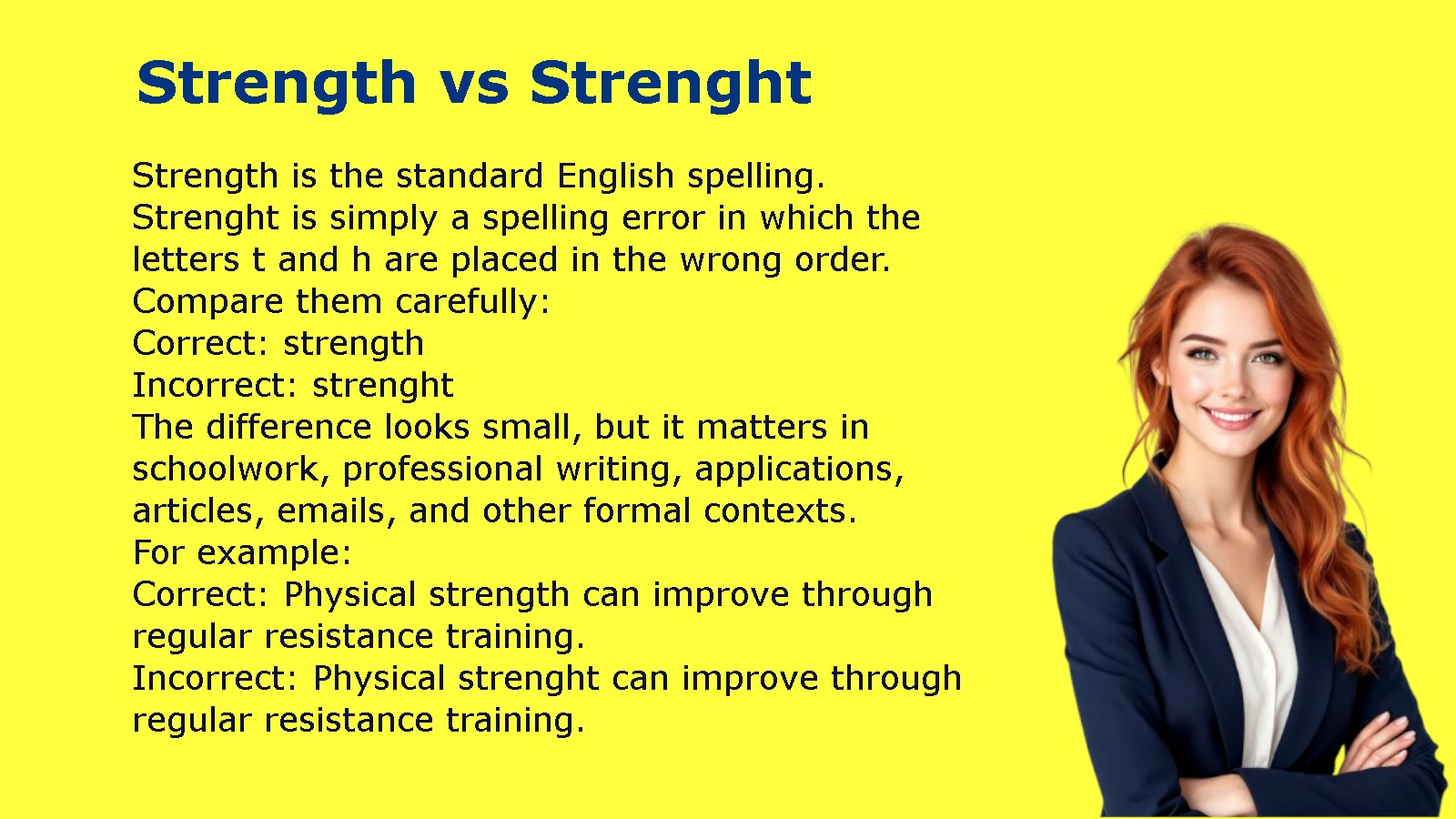
Strength is the standard English spelling.
Strenght is simply a spelling error in which the letters t and h are placed in the wrong order.
Compare them carefully:
- Correct: strength
- Incorrect: strenght
The difference looks small, but it matters in schoolwork, professional writing, applications, articles, emails, and other formal contexts.
For example:
Correct: Physical strength can improve through regular resistance training.
Incorrect: Physical strenght can improve through regular resistance training.
The first sentence uses the standard English word. The second contains a spelling error.
Strength vs Strenght at a Glance
| Feature | Strength | Strenght |
| Standard English word | Yes | No |
| Correct spelling | Yes | No |
| Dictionary headword | Yes | No |
| Standard noun | Yes | No |
| Meaning | Power, ability, resilience, advantage, etc. | No separate standard meaning |
| Correct form to use | Yes | No |
The important point is that you don’t need to choose between two meanings. Strenght does not represent a different meaning of strength.
What Does Strength Mean?
Strength is a noun with several related meanings. At its core, it refers to power, force, ability, or the quality of being strong.
Oxford lists uses involving physical power, resistance to force, bravery, influence, intensity, advantage, natural force, substances, currency, and the size of a group.
Cambridge likewise defines strength in terms of the ability to perform tasks requiring substantial physical or mental effort and also uses the word for the degree to which something is strong or powerful.
Because the word has several senses, its exact meaning depends on the context.
Physical Strength
The most familiar meaning is physical power.
A person’s physical strength describes their ability to exert force, lift something, push something, carry a load, or perform physically demanding activities.
For example:
His strength allowed him to carry the heavy box upstairs.
In this sentence, strength refers to bodily power.
Oxford specifically defines this sense as the quality of being physically strong and gives examples involving building, regaining, and using physical strength.
Other examples include:
- The athlete developed impressive strength through training.
- She needed more strength to open the heavy door.
- Regular exercise can help maintain muscle strength.
- The climber relied on his upper-body strength.
Mental and Emotional Strength
Strength can also describe someone’s ability to remain determined, brave, or resilient during difficult circumstances.
For example:
She showed remarkable strength during a difficult period in her life.
Here, strength does not refer to muscles. It refers to inner resilience and determination.
Oxford describes this use as the quality of being brave and determined in a difficult situation.
You might see expressions such as:
- inner strength
- mental strength
- emotional strength
- strength of character
- strength of mind
For example:
His strength of character helped him remain honest under pressure.
This meaning is especially common when discussing perseverance, courage, and difficult experiences.
Strength as an Advantage
A person’s strength can also be a quality or ability that gives them an advantage.
For example:
Writing is one of her greatest strengths.
This doesn’t mean she has unusually powerful muscles. It means writing is one of her strongest abilities.
Oxford identifies this as a countable use of strength: a quality or ability that gives someone or something an advantage.
This meaning appears frequently in:
- job interviews
- resumes
- performance reviews
- education
- business
- sports
- personal development
For example:
One of his strengths is his ability to explain complicated ideas clearly.
Strength of a Material
The word can describe an object’s ability to resist force, pressure, weight, or damage.
For example:
The strength of the rope made it suitable for heavy loads.
Engineers tested the strength of the material before using it.
This is a technical but common use. Oxford defines this sense as the ability of something to resist force or hold heavy weights without breaking or being damaged.
You can therefore talk about:
- tensile strength
- structural strength
- material strength
- the strength of steel
- the strength of concrete
- the strength of a rope
Strength of an Argument or Position
Strength can also describe how convincing or powerful an argument, case, or position is.
For example:
The strength of her argument came from the evidence she presented.
Here, strength means effectiveness or persuasive power.
You might also see:
- strength of the evidence
- strength of the argument
- strength of the case
- strength of the position
- strength of the claim
This use is common in academic and professional writing.
Why Is “Strenght” Incorrect?
The main problem with strenght is the order of the final letters.
The correct spelling is:
strength
The incorrect form is:
strenght
Notice the ending:
- strength → …gth
- strenght → …ght
The t comes before the h in the correct spelling.
A Simple Letter-by-Letter Comparison
Strength
S → T → R → E → N → G → T → H
Strenght
S → T → R → E → N → G → H → T
The only difference is the position of the final T and H.
That tiny reversal creates the misspelling.
Why Is This Mistake So Easy to Make?
Strength is not an easy word to spell purely from its sound.
The word contains a dense consonant sequence near the end. Cambridge gives the US and UK pronunciation as /streŋθ/, while Oxford also records a pronunciation containing a k sound in some dictionary transcriptions.
That means a learner who tries to spell the word only by listening to it may struggle to identify every written letter.
This is one reason visual familiarity with the word is useful.
How to Spell Strength Correctly
The safest way to spell the word is to memorize its exact letter sequence:
S-T-R-E-N-G-T-H
A useful visual pattern is:
str + eng + th
The important part to remember is the ending:
G-T-H
Not:
G-H-T
A Practical Spelling Tip
When you write strength, mentally check the final three letters:
G-T-H
That small check can prevent the common strenght error.
You can also connect the word with related forms:
- strong
- strength
- strengthen
- strongly
These words belong to the same word family, although their spellings are not identical. Oxford lists strong, strength, and strengthen together as related forms.
Strength Pronunciation vs Spelling
Pronunciation can explain some of the difficulty surrounding strength.
Cambridge gives the pronunciation as /streŋθ/ for both British and American English.
The pronunciation contains several consonant sounds close together, which makes the word more difficult to sound out than a simple word such as strong.
This creates an important spelling lesson:
Pronunciation tells you how a word sounds. It does not always tell you exactly how the word is spelled.
That distinction is especially useful with English words containing silent letters, unusual letter combinations, or historical spellings.
Why “Strength” Can Sound Different From What You Expect
The spelling contains gth, while the pronunciation compresses several sounds together.
For a learner, it can therefore be tempting to write the word based on an imagined sound sequence.
That can produce errors such as:
- strenght
- other omitted-letter forms
- incorrectly ordered letters
The solution isn’t to change the spelling. It is to become familiar with the standard written form:
strength
Strength Meaning and Examples
Because strength has several meanings, looking at it in different sentences makes the word easier to understand.
| Context | Meaning of strength | Example |
| Physical | Bodily power | He has impressive physical strength. |
| Mental | Ability to cope with difficulty | She showed great mental strength. |
| Character | Courage or determination | His strength of character impressed everyone. |
| Ability | A strong skill or quality | Organization is one of her strengths. |
| Material | Resistance to force | The bridge depends on the strength of its supports. |
| Argument | Persuasive power | The strength of the evidence was clear. |
| Signal | Power or intensity | The phone has poor signal strength indoors. |
| Force | Degree of power | The storm increased in strength. |
| Substance | Concentration or potency | The product is available in different strengths. |
| Group | Number of members | The team returned to full strength. |
These uses are not unrelated meanings. They all develop from the central idea of being strong or having power.
Strength in a Sentence
Here are natural examples showing how strength works in everyday English.
Physical Strength
Regular exercise can improve your physical strength.
The noun refers to bodily power.
Mental Strength
She showed remarkable strength when dealing with the setback.
Here, strength means resilience and determination.
Personal Ability
Problem-solving is one of his greatest strengths.
In this case, strength means a valuable ability.
Material Resistance
The engineers tested the strength of the steel.
The word describes the steel’s ability to resist force.
Argument
The strength of the argument depends on the quality of the evidence.
Here, strength means persuasive power.
Signal
The signal strength drops inside the building.
The noun describes the intensity of the signal.
Strength vs Strong vs Strengthen vs Strongest
These words belong to the same word family, but they perform different grammatical jobs.
| Word | Part of speech | Main function | Example |
| strong | Adjective | Describes something powerful | She is strong. |
| strength | Noun | Names the quality or power | She has great strength. |
| strengthen | Verb | Describes becoming or making stronger | Exercise can strengthen muscles. |
| strongly | Adverb | Describes the manner or degree of an action | I strongly support the proposal. |
| strongest | Adjective | Describes the highest degree of strength | This is the strongest material. |
Oxford identifies strong, strength, and strengthen as members of the same word family.
Strong
Use strong when you need an adjective.
He is strong.
The bridge is strong.
Strength
Use strength when you need a noun.
He has great strength.
The strength of the bridge is impressive.
Strengthen
Use strengthen when you mean to make or become stronger.
The exercises strengthen the muscles.
Oxford defines strengthen as becoming more powerful or effective or making something more powerful or effective.
Strongest
Use strongest for the superlative form of strong.
This is the strongest material available for the project.
Strength vs Strengths
Another common question is the difference between strength and strengths.
The singular strength can refer to strength in general or to one particular quality.
Patience is a strength.
The plural strengths refers to multiple qualities or advantages.
Patience and creativity are her strengths.
This distinction becomes particularly important when discussing someone’s abilities.
Compare These Sentences
Communication is one of his strengths.
This means communication is one of several abilities in which he performs well.
Physical strength is important for this job.
Here, strength refers to the general quality of being physically powerful.
Is “Strenght” a Word?
No. “Strenght” is not the standard spelling of the English noun.
The correct word is strength.
If you encounter strenght in an email, social media post, comment, document, or search query, it is normally best understood as a misspelling of strength rather than as a separate English word.
That distinction is important because seeing an incorrect spelling repeatedly does not turn it into a standard spelling.
For formal writing, use:
strength
not:
strenght
Common Spelling Mistakes With Strength
The most obvious mistake is strenght, but learners can make other errors when writing the word.
Reversing T and H
Incorrect: strenght
Correct: strength
This is the exact mistake addressed by the Strength vs Strenght question.
Omitting Letters
Because the word has several consonants close together, a writer may accidentally leave out a letter.
The safest approach is to check the complete written form rather than spelling it entirely from pronunciation.
Confusing Strength With Strong
Some writers know the adjective strong but aren’t sure how to turn it into the noun strength.
For example:
Correct: Physical strength is important.
Not:
Physical strong is important.
Strong describes something.
Strength names the quality.
Confusing Strength With Strengthen
These forms also have different grammatical roles.
Strength is a noun.
Strengthen is a verb.
For example:
Exercise can strengthen your muscles.
But:
Exercise can improve your muscle strength.
Strength vs Strenght: Common Mistake Case Study
Imagine a student writing a sentence about personal qualities:
“My greatest strenght is communication.”
The meaning is understandable, but the spelling is incorrect.
The corrected sentence is:
“My greatest strength is communication.”
Now consider a second example:
“Physical strenght is important for this activity.”
The corrected version is:
“Physical strength is important for this activity.”
In both cases, the writer doesn’t need a different word. They simply need to replace strenght with strength.
What This Shows
The mistake is primarily orthographic, not grammatical.
The sentence structure can be completely correct while the spelling is wrong.
That distinction matters when proofreading. A spell checker may identify strenght, but understanding the pattern helps you avoid making the error repeatedly.
Common Phrases With Strength
Strength appears in many established English expressions and collocations.
Physical Strength
Used for bodily power.
The training program focuses on physical strength.
Mental Strength
Used for resilience and psychological endurance.
The experience required considerable mental strength.
Inner Strength
Refers to a person’s internal resilience or courage.
She drew on her inner strength during the difficult period.
Strength of Character
Describes courage, principles, or determination.
His strength of character became clear when he refused to compromise his principles.
Strength in Numbers
This expression means that being part of a larger group can provide greater power or influence.
They realized there was strength in numbers.
Oxford lists “there’s strength in numbers” as an established saying.
Strengths and Weaknesses
This phrase is commonly used when assessing advantages and limitations.
The report discusses the strengths and weaknesses of the proposal.
At Full Strength
This can mean having all expected members or resources available.
The team will return at full strength next week.
Oxford includes this as an established expression.
Go From Strength to Strength
This idiom means to become increasingly successful.
The business has gone from strength to strength.
Oxford lists this as an established idiom.
Strength vs Weakness
Strength and weakness are often presented as opposites.
A strength is a quality, ability, or condition that provides power or an advantage.
A weakness is a limitation, deficiency, or disadvantage.
| Strength | Weakness |
| Strong quality | Limitation |
| Advantage | Disadvantage |
| Capability | Area needing improvement |
| Physical power | Physical limitation |
| Strong point in an argument | Weak point in an argument |
For example:
Attention to detail is her strength.
Public speaking is her weakness.
The words can describe people, arguments, businesses, materials, systems, and many other things.
Strength Synonyms
The best synonym for strength depends on the context.
There is no single replacement that works in every sentence.
For Physical Strength
Possible alternatives include:
- power
- force
- might
- muscular power
Example:
The athlete demonstrated tremendous power.
That sentence isn’t always interchangeable with:
The athlete demonstrated tremendous strength.
The exact choice depends on the intended meaning.
For Mental or Emotional Strength
Useful words include:
- resilience
- fortitude
- courage
- determination
- resolve
For example:
Her resilience helped her recover from the setback.
Here, resilience captures a particular aspect of strength rather than every meaning of the word.
For Strength as an Advantage
Depending on context, you might use:
- advantage
- asset
- ability
- capability
- strong point
For example:
Organization is one of her greatest strengths.
You could say:
Organization is one of her greatest assets.
But the tone and exact meaning can change.
Strength Spelling: A Quick Memory Guide
When you’re unsure about strength vs strenght, remember one simple rule:
The correct ending is G-T-H.
Write:
strength
Not:
strenght
You can also remember the word visually:
STRENGTH
The final three letters are:
GTH
That is the part most worth checking.
Quick Proofreading Method
When proofreading a sentence containing strength, look specifically at the final four letters:
G T H
If you see:
G H T
you have the common strenght error.
This is a tiny proofreading habit, but it can prevent an otherwise easy-to-miss spelling mistake.
Strength in Different Contexts
One reason strength is such a useful word is that it can describe both concrete and abstract forms of power.
In Fitness
The program is designed to improve muscle strength.
In Personal Development
She discovered an inner strength she didn’t know she had.
In Business
The company’s greatest strength is its customer service.
In Academic Writing
The strength of the study lies in its large sample size.
In Engineering
Engineers measured the tensile strength of the material.
In Communication
The strength of his argument comes from reliable evidence.
In Technology
The router provides strong signal strength throughout most of the building.
These examples show why context matters when defining strength.
Facts About the Word Strength
Here are some useful facts that help clarify the word:
- Strength is a noun.
- Its plural form is strengths.
- The adjective is strong.
- The related verb is strengthen.
- The adverb is strongly.
- Strenght is a misspelling, not a standard alternative spelling.
- Oxford traces strength to Old English strengthu, from the Germanic base associated with strong.
- Cambridge gives the US and UK pronunciation as /streŋθ/.
- Strength can refer to physical power, emotional resilience, material resistance, influence, intensity, ability, and more.
Frequently Asked Questions About Strength vs Strenght
Is “strenght” correct?
No. Strenght is a misspelling. The correct spelling is strength.
Why do people spell strength as “strenght”?
The word contains an unusual sequence of consonants, and the pronunciation doesn’t make the written order completely obvious. This can cause writers to reverse the final t and h.
How do you spell strength?
The correct spelling is:
S-T-R-E-N-G-T-H
The key sequence to remember is G-T-H.
What is the difference between strength and strenght?
Strength is the correct English word. Strenght is an incorrect spelling of that word.
There is no separate standard definition for strenght.
Is strength a noun?
Yes. Strength is a noun.
It can refer to physical power, resilience, an advantage, material resistance, intensity, influence, and other forms of power.
What is the plural of strength?
The plural is strengths.
For example:
Communication and creativity are two of her greatest strengths.
What is the adjective form of strength?
The related adjective is strong.
She is strong.
He has great strength.
What is the verb form of strength?
The related verb is strengthen.
Exercise can strengthen your muscles.
Oxford identifies strengthen as the verb in this word family.
What is a simple sentence with strength?
Exercise can improve your strength.
Here, strength refers to physical power.
Is strength the same as power?
Not always.
The two words overlap in some contexts, but strength can refer to a specific quality, ability, resistance, intensity, or advantage. Power can have broader meanings involving force, authority, control, or capacity.
The best word depends on the sentence.
What is the correct spelling: strenght or strength?
Strength is correct.
Strenght is incorrect.
Final Answer: Strength vs Strenght
When comparing Strength vs Strenght, there is a clear answer:
Strength is the correct spelling. Strenght is a misspelling.
The correct form is:
S-T-R-E-N-G-T-H
The word strength is a noun that can refer to physical power, mental or emotional resilience, the resistance of a material, the effectiveness of an argument, an advantage or ability, the intensity of a force or signal, and several other related ideas.
The easiest way to avoid the common mistake is to remember the final three letters:
G-T-H
So, the next time you hesitate between strength vs strenght, choose strength.