Have you ever paused while writing because you weren’t sure whether unforeseen or unforseen was the correct spelling? You’re not alone. The two forms look almost identical, but one is the standard English spelling, while the other is a common misspelling that leaves out an important e.
Unforeseen is the correct spelling. Unforseen is incorrect because the word is formed from foresee with the prefix un-, so the spelling keeps the e before the ending. The word unforeseen describes something that was not expected, predicted, or anticipated, such as an unforeseen delay, problem, expense, or event.
In this guide, you’ll learn why unforeseen is correct, why unforseen is incorrect, how to remember the spelling, and how to use unforeseen correctly in sentences. You’ll also see clear examples, related words, common mistakes, and useful alternatives such as unexpected, unanticipated, unpredictable, and surprising.
By the end, you’ll know exactly why unforeseen is the correct spelling and how to use it naturally and confidently in your writing.
Unforeseen vs Unforseen: Which Spelling Is Correct?
Have you ever paused over unforeseen vs unforseen and wondered which spelling is correct? The answer is straightforward: unforeseen is the correct spelling, while unforseen is a misspelling.
Unforeseen is an adjective meaning not expected, anticipated, or predicted. Dictionaries commonly use it for unexpected delays, problems, circumstances, consequences, and other events. Cambridge defines it as “not expected,” while Oxford gives the related sense of something you did not expect to happen.
The easiest way to remember the spelling is to connect it to the word foresee:
foresee → foreseen → unforeseen
The spelling keeps fore + seen, so the correct form is unforeseen, not unforseen.
| Word | Correct? | Meaning |
| Unforeseen | ✅ Yes | Not expected or anticipated |
| Unforseen | ❌ No | Misspelling of unforeseen |
This article explains the difference, shows how to use unforeseen naturally, and covers common phrases such as unforeseen circumstances, unforeseen problems, and unforeseen consequences.
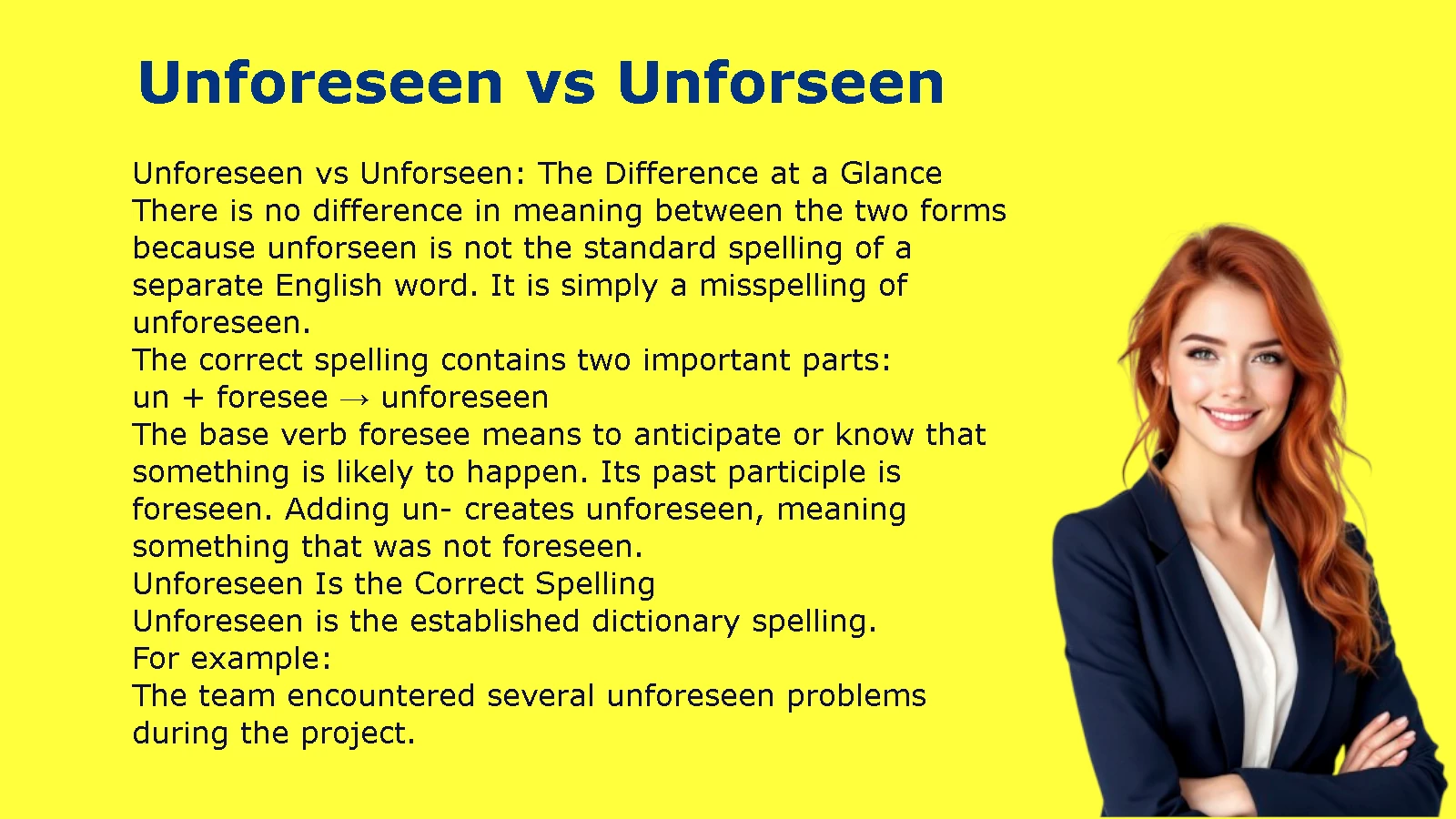
Unforeseen vs Unforseen: The Difference at a Glance
There is no difference in meaning between the two forms because unforseen is not the standard spelling of a separate English word. It is simply a misspelling of unforeseen.
The correct spelling contains two important parts:
un + foresee → unforeseen
The base verb foresee means to anticipate or know that something is likely to happen. Its past participle is foreseen. Adding un- creates unforeseen, meaning something that was not foreseen.
Unforeseen Is the Correct Spelling
Unforeseen is the established dictionary spelling.
For example:
The team encountered several unforeseen problems during the project.
Here, the problems were not anticipated when the project was planned.
Oxford lists combinations such as unforeseen delays, unforeseen problems, and unforeseen circumstances, while Cambridge similarly gives examples involving unforeseen problems, expenses, and complications.
Unforseen Is a Misspelling
Unforseen leaves out the second e in the middle of the word.
The incorrect form:
The project was delayed because of unforseen circumstances.
The correct form:
The project was delayed because of unforeseen circumstances.
A useful spelling check is to remove the prefix un-:
un + foreseen = unforeseen
If you can remember foreseen, you can reconstruct the correct spelling of unforeseen.
What Does Unforeseen Mean?
Unforeseen means not expected, anticipated, or predicted in advance.
It describes something that happens even though people did not expect it to happen.
For example:
An unforeseen delay pushed the flight back by several hours.
The delay was not part of the original expectation or plan.
The word often describes events that interfere with an existing plan. That is why you frequently see it alongside nouns such as circumstances, problems, delays, complications, expenses, consequences, obstacles, and events. Oxford specifically identifies several of these as common collocations.
Unforeseen in Simple English
You can understand unforeseen as:
- not expected
- not anticipated
- not predicted
- not planned for
- something that was not seen coming
However, these expressions are not always perfect substitutes.
For example:
We had an unexpected visitor.
This sounds natural because the visitor surprised us.
But:
The construction project faced unforeseen obstacles.
This emphasizes that the obstacles were not anticipated when the project was planned.
Is Unforeseen Always Negative?
Not necessarily.
The word itself simply means that something was not expected. However, it often appears in contexts involving problems or unwanted changes.
Cambridge notes the American-dictionary sense as “unexpected and often unwanted,” which explains why phrases such as unforeseen circumstances frequently appear when plans have gone wrong.
For example:
The discovery of an unforeseen opportunity changed the company’s plans.
Here, the unforeseen event is positive.
So unforeseen does not inherently mean bad. Context determines whether the unexpected event is beneficial, harmful, neutral, or simply surprising.
Unforeseen Meaning in Different Contexts
The word works across everyday, professional, academic, and formal English.
Unforeseen Circumstances
Unforeseen circumstances means circumstances that were not anticipated when a decision or plan was made.
This is probably the most familiar phrase containing unforeseen.
For example:
The event was postponed due to unforeseen circumstances.
The phrase is common in formal announcements because it allows the writer to explain a change without describing every specific circumstance.
You may encounter it in:
- cancellation notices
- business communications
- travel announcements
- contracts
- event information
- workplace messages
- customer-service notices
Cambridge uses unforeseen circumstances in examples involving increased costs and canceled performances.
Unforeseen Events
An unforeseen event is an event that was not expected or anticipated.
For example:
An unforeseen event forced the organizers to change the schedule.
The phrase does not necessarily tell us what happened. It only tells us that the event was outside the original expectations.
Unforeseen Problems
An unforeseen problem is a difficulty that planners did not anticipate.
For example:
The developers encountered an unforeseen problem with the software.
This usage is especially natural in project management, engineering, construction, technology, and business writing.
Unforeseen Consequences
Unforeseen consequences are results that people did not anticipate.
For example:
The policy produced several unforeseen consequences.
This differs slightly from unintended consequences.
An unintended consequence is an outcome that was not intended. An unforeseen consequence emphasizes that the outcome was not anticipated.
A result can therefore be unintended but foreseeable.
That distinction matters.
Unforeseen in a Sentence
Here are natural examples showing how the word works in different situations:
- The flight was delayed because of unforeseen weather conditions.
- We had to postpone the meeting due to unforeseen circumstances.
- The construction team encountered several unforeseen obstacles.
- The project ran over budget because of unforeseen expenses.
- An unforeseen technical problem interrupted the presentation.
- The researchers discovered an unforeseen effect during testing.
- The company had to revise its schedule after an unforeseen delay.
- The trip changed because of an unforeseen emergency.
- The decision led to several unforeseen consequences.
- The team prepared backup plans for potential unforeseen problems.
Notice that the word normally appears directly before a noun.
unforeseen + noun
Examples:
- unforeseen delay
- unforeseen problem
- unforeseen circumstance
- unforeseen expense
- unforeseen consequence
- unforeseen complication
- unforeseen obstacle
Unforeseen Synonyms
Several words overlap with unforeseen, but they do not always carry exactly the same emphasis.
| Word | Core meaning | Typical emphasis |
| Unforeseen | Not anticipated | Something was not expected in advance |
| Unexpected | Not expected | Surprise |
| Unanticipated | Not anticipated | Lack of prior anticipation |
| Unpredicted | Not predicted | Lack of prediction |
| Unplanned | Not planned | Absence of prior planning |
| Surprising | Causing surprise | Emotional reaction |
| Sudden | Happening quickly | Speed or abruptness |
Unforeseen vs Unexpected
Unforeseen and unexpected are close synonyms.
Oxford directly gives unexpected as a synonym for unforeseen.
Compare:
The company faced an unexpected delay.
The company faced an unforeseen delay.
Both sentences work.
The difference is mostly one of emphasis and tone. Unexpected is broader and very common in ordinary conversation. Unforeseen often sounds more formal and emphasizes that the event was not anticipated beforehand.
Unforeseen vs Unanticipated
These words are also very close.
Unforeseen focuses on something that was not seen or expected in advance.
Unanticipated focuses more directly on something that was not anticipated.
For example:
The project experienced unforeseen difficulties.
The project experienced unanticipated difficulties.
Both are grammatical. Unforeseen is often the more natural choice in established phrases such as unforeseen circumstances.
Unforeseen vs Unpredicted
Unpredicted specifically relates to prediction.
For example:
The model failed to account for an unpredicted event.
Unforeseen is broader. Something can be unforeseen without anyone having explicitly attempted to predict it.
Unforeseen vs Unplanned
These words describe different ideas.
Unplanned means something was not planned in advance.
Unforeseen means something was not expected or anticipated.
Consider:
We took an unplanned trip.
This means the trip was not arranged beforehand.
But:
We faced an unforeseen problem during the trip.
The problem was not anticipated.
An unplanned event does not have to be unforeseen, and an unforeseen event does not necessarily result from a lack of planning.
Unforeseen vs Foreseen
These words are opposites.
Foreseen means anticipated or expected.
Unforeseen means not anticipated or expected.
| Word | Meaning | Example |
| Foreseen | Expected or anticipated | The risk was foreseen by the engineers. |
| Unforeseen | Not expected or anticipated | The engineers encountered an unforeseen problem. |
The connection becomes particularly clear when you look at the word family:
foresee → foreseen → unforeseen
For example:
The delay was foreseen.
means someone expected it.
The delay was unforeseen.
means someone did not expect it.
Unforeseen vs Unexpected: Are They Interchangeable?
Often, yes.
Both can describe something that was not expected.
For example:
We experienced an unexpected delay.
and:
We experienced an unforeseen delay.
Both communicate essentially the same basic idea.
The difference becomes more noticeable in tone.
Unexpected works comfortably in casual conversation:
That was unexpected!
Unforeseen is more common in formal or professional contexts:
The project was delayed due to unforeseen circumstances.
That does not mean unforeseen is too formal for ordinary speech. It simply has a more formal feel in many contexts.
Oxford and Cambridge both associate the word with formal combinations involving delays, problems, circumstances, complications, and expenses.
Is Unforeseen One Word or Two?
Unforeseen is written as one word.
Correct:
unforeseen circumstances
Incorrect:
un foreseen circumstances
The spelling follows the standard formation of the word:
un + foreseen = unforeseen
The prefix un- commonly attaches directly to adjectives to create a negative meaning. In this case, it creates the opposite of foreseen.
You should therefore write:
- unforeseen delay
- unforeseen problem
- unforeseen event
- unforeseen circumstances
not separate the word into un foreseen.
Is Unforeseen Formal?
Unforeseen is standard English and works particularly well in formal and professional writing.
You can use it in:
- business emails
- project reports
- academic writing
- official notices
- customer communication
- contracts and policies
- everyday conversation
The phrase unforeseen circumstances is especially associated with formal communication.
For example:
Due to unforeseen circumstances, the meeting has been postponed.
This sounds professional and neutral.
In a casual conversation, you might instead say:
Something unexpected came up, so we had to postpone the meeting.
Both versions are correct. The second simply sounds more conversational.
Unforeseen in Workplace Writing
The word can be useful when you need to explain a delay without sounding overly casual.
For example:
The launch has been delayed due to unforeseen technical issues.
This is concise and professional.
You could also write:
We encountered an unforeseen issue during testing, so the release date has been moved to Friday.
The second version gives the reader more concrete information.
That distinction matters because unforeseen circumstances can sometimes sound vague. If you know the actual issue and can disclose it, a specific explanation is usually more informative.
Common Mistakes With Unforeseen
Writing “Unforseen”
This is the central spelling mistake.
❌ unforseen
✅ unforeseen
Remember:
foresee → foreseen → unforeseen
The extra e belongs to the foreseen part of the word.
Confusing Unforeseen With Unusual
These words are not synonyms.
Unusual means uncommon or different from what is normal.
Unforeseen means not anticipated.
Something can be unusual but completely foreseeable.
For example:
The unusually heavy traffic was unforeseen by the organizers.
The traffic was both unusual and unforeseen in this particular situation, but the concepts are different.
Confusing Unforeseen With Unintended
These words describe different aspects of an event.
Unforeseen = not anticipated.
Unintended = not intended.
Consider:
The advertisement had an unintended effect.
This means the effect was not the advertiser’s intention.
Now:
The advertisement had an unforeseen effect.
This means the effect was not anticipated.
An outcome can be both unintended and unforeseen, but the words are not interchangeable in every sentence. Cambridge and Oxford define unintended in terms of something not planned or intended, reinforcing this distinction.
Using Unforeseen for Every Surprise
Not every surprising thing needs to be called unforeseen.
In casual English, unexpected, surprising, or sudden may sound more natural.
For example:
Your visit was unexpected!
is much more conversational than:
Your visit was unforeseen!
The second sentence is grammatical in some contexts, but it sounds unusual because unforeseen commonly describes events, circumstances, difficulties, consequences, and situations rather than ordinary social surprises.
How to Remember the Spelling of Unforeseen
The simplest method is to remember the word family rather than memorizing unforeseen letter by letter.
The Word Family
Foresee → Foreseen → Unforeseen
Start with the base verb:
I can foresee a problem.
Change it to the past participle:
The problem was foreseen.
Add un-:
The problem was unforeseen.
This makes the spelling much easier to remember.
A Simple Memory Trick
Think:
UN + FORE + SEEN = UNFORESEEN
The middle contains foreseen, not forseen.
That means the correct spelling has:
u n f o r e s e e n
The double e near the end is part of seen, while the earlier e comes from fore.
Unforeseen Word Forms and Related Words
Understanding related words can make the spelling and meaning easier to remember.
Foresee
Foresee is a verb meaning to anticipate or predict something before it happens.
We could not foresee the problems that would arise.
Foreseen
Foreseen is the past participle of foresee.
The risk had been foreseen by the team.
Unforeseen
Unforeseen means not foreseen.
The team encountered an unforeseen risk.
Foreseeable
Foreseeable means able to be foreseen or reasonably anticipated.
The risks were foreseeable.
Unforeseeable
Unforeseeable means not reasonably able to be foreseen.
This is a stronger concept than simply saying something was unforeseen.
Unforeseen vs Unforeseeable
These two words look similar but have an important difference.
Unforeseen describes what was not anticipated.
Unforeseeable describes something that could not reasonably have been anticipated.
For example:
The company experienced an unforeseen delay.
This tells us that the delay was not expected.
But:
The event was unforeseeable.
This suggests that the event could not reasonably have been predicted.
That distinction becomes particularly important in technical, legal, insurance, and risk-management contexts, where the question may not simply be Was this expected? but Could a reasonable person have anticipated it?
So don’t automatically replace unforeseen with unforeseeable.
Unforeseen Pronunciation
The standard pronunciation is approximately:
un-for-SEEN
Cambridge gives the US pronunciation as /ˌʌn.fɚˈsiːn/ and the UK pronunciation as /ˌʌn.fəˈsiːn/.
The main stress falls on the final syllable:
un-for-SEEN
This is useful because the pronunciation clearly connects with foreseen.
The word does not sound like a separate word such as un-for-seen. It is pronounced as one adjective.
Can You Use Unforeseen in Professional Writing?
Yes. Unforeseen is particularly useful in professional writing when discussing unexpected changes, delays, costs, risks, or difficulties.
Project Management
The schedule was revised because of unforeseen technical difficulties.
Business Communication
The delivery date may change because of unforeseen circumstances.
Customer Service
We apologize for the delay caused by unforeseen operational issues.
Academic Writing
The researchers encountered several unforeseen challenges during the study.
Formal Notices
The event has been postponed due to unforeseen circumstances.
One caution: don’t use unforeseen circumstances simply to make a message sound professional. If the reader needs to know what actually happened, give the concrete reason when appropriate.
Compare:
Due to unforeseen circumstances, the shipment is delayed.
with:
Due to an unexpected customs inspection, the shipment is delayed by two days.
The second version gives the reader useful information instead of relying on a broad phrase.
Real-World Examples of Unforeseen
Travel
Imagine that a traveler has planned a flight connection with a two-hour gap. A mechanical problem delays the first flight.
The mechanical problem could be described as an unforeseen issue, especially if the traveler and airline did not anticipate it.
An unforeseen mechanical problem delayed the aircraft.
Work
A software team schedules a product launch for Friday but discovers a serious security issue during final testing.
The team postponed the launch because of an unforeseen security problem.
The problem was not part of the original expectation.
Weather
An outdoor event is scheduled for Saturday. Severe weather arrives earlier than expected.
The organizers canceled the event because of unforeseen weather conditions.
Finance
A business prepares its annual budget but later discovers a major repair requirement.
The company faced an unforeseen expense.
The expense was not included in the original financial plan.
Personal Plans
Someone plans to attend a dinner but suddenly needs to deal with an emergency.
An unforeseen situation prevented her from attending the dinner.
The phrase works because the situation was not anticipated.
A Practical Case Study: Why the Spelling Matters
Imagine that a project manager sends this message to a client:
“The delivery has been delayed because of unforseen circumstances.”
The meaning is understandable, but the spelling is incorrect.
Now compare:
“The delivery has been delayed because of unforeseen circumstances.”
The second version uses the standard spelling and looks appropriate for professional communication.
The lesson is simple: a spelling mistake does not necessarily prevent understanding, but it can reduce the accuracy and credibility of formal writing.
This is particularly relevant for words such as unforeseen, where the incorrect version can look plausible because the pronunciation does not reveal the extra letter.
Quick Comparison: Unforeseen vs Unforseen
| Feature | Unforeseen | Unforseen |
| Standard spelling | ✅ Yes | ❌ No |
| Dictionary word | ✅ Yes | ❌ Misspelling |
| Meaning | Not expected or anticipated | No separate standard meaning |
| Part of speech | Adjective | — |
| Common phrase | Unforeseen circumstances | Incorrect |
| Example | Unforeseen delays affected the project. | Unforseen delays affected the project. |
| Professional use | Appropriate | Avoid |
Facts to Remember About Unforeseen
Here are the key points to keep in mind:
- Unforeseen is the correct spelling.
- Unforseen is a misspelling.
- Unforeseen is an adjective.
- It means not expected or anticipated.
- The word is related to foresee and foreseen.
- Unforeseen circumstances is one of its most common phrases.
- It frequently modifies words such as delays, problems, expenses, complications, obstacles, and consequences.
- Unexpected is a close synonym.
- Unintended is related but focuses on intention rather than anticipation.
- Unforeseeable is stronger and suggests something could not reasonably have been anticipated.
- The standard pronunciation places the main stress on seen: un-for-SEEN.
Frequently Asked Questions About Unforeseen vs Unforseen
Is unforeseen or unforseen correct?
Unforeseen is correct. Unforseen is a misspelling.
What does unforeseen mean?
Unforeseen means not expected, anticipated, or predicted in advance. It commonly describes unexpected circumstances, problems, delays, expenses, and consequences.
Is unforseen a word?
Unforseen is not the standard spelling. If you mean something that was not expected or anticipated, use unforeseen.
What is an example of unforeseen?
The project was delayed because of an unforeseen technical problem.
Here, the technical problem was not anticipated when the project was planned.
What does unforeseen circumstances mean?
Unforeseen circumstances means circumstances or situations that were not anticipated or expected.
For example:
The meeting was canceled due to unforeseen circumstances.
The phrase is particularly common in formal and professional communication.
What is a synonym for unforeseen?
Common synonyms include unexpected, unanticipated, and unpredicted. The best choice depends on the context.
Unexpected is usually the most natural general alternative.
Is unforeseen formal English?
Yes. Unforeseen is standard English and is especially common in professional, academic, business, and formal contexts. It can also appear in everyday English.
How do you remember the spelling of unforeseen?
Remember the word family:
foresee → foreseen → unforeseen
The key is to preserve foreseen inside the longer word.
What is the difference between unforeseen and unforeseeable?
Unforeseen means something was not anticipated.
Unforeseeable suggests that something could not reasonably have been anticipated.
The latter makes a stronger claim about the possibility of prediction.
Is unforeseen the same as unexpected?
They are very close in meaning, and they can often be used interchangeably. Unforeseen tends to sound more formal and often emphasizes that something was not anticipated in advance. Oxford lists unexpected as a synonym.
Can unforeseen describe a positive event?
Yes. The word does not inherently mean something negative.
For example:
The team received an unforeseen opportunity to expand into a new market.
The opportunity was unexpected, but it was positive.
Conclusion: Unforeseen vs Unforseen
When choosing between unforeseen vs unforseen, there is a clear answer: unforeseen is the correct spelling.
Unforseen is a common spelling error caused by dropping the e from the middle of the word. The correct form comes from the word family foresee → foreseen → unforeseen.
The adjective means not expected or anticipated. It works naturally with nouns such as circumstances, delays, problems, expenses, complications, obstacles, and consequences. Major dictionaries, including Cambridge and Oxford, define it in terms of something that was not expected or anticipated.
If you are writing an email, report, article, or formal notice, use:
due to unforeseen circumstances
not:
due to unforseen circumstances
And when you’re unsure of the spelling, return to the simplest pattern:
FORESEE → FORESEEN → UNFORESEEN
That one connection makes the correct spelling much easier to remember.