Roiling describes something that is moving, boiling, swirling, or becoming intensely turbulent. It is often used for water, clouds, smoke, emotions, conflicts, and situations that seem to churn or become increasingly unsettled. If you’ve come across the word “roiling” and wondered what it means, how it is used, or why something might be described as roiling, the term is closely connected to turbulence, agitation, movement, unrest, turmoil, and intense activity.
The roiling meaning refers to something that is churning, swirling, or violently moving, either literally or figuratively. For example, roiling waves are rough and turbulent, while roiling emotions describe strong feelings that are difficult to control. The word can also describe a tense or unsettled situation, such as a roiling political debate or a roiling dispute.
In this guide, you’ll learn what “roiling” means, how the word is used in sentences, what contexts it commonly appears in, and how “roiling” differs from related words such as “boiling,” “churning,” “turbulent,” and “agitated.” You’ll also see clear examples to make the meaning easy to understand.
By the end, you’ll know exactly what roiling means and how to use this descriptive word naturally and correctly.
Quick Answer: What Does “Roiling” Mean?
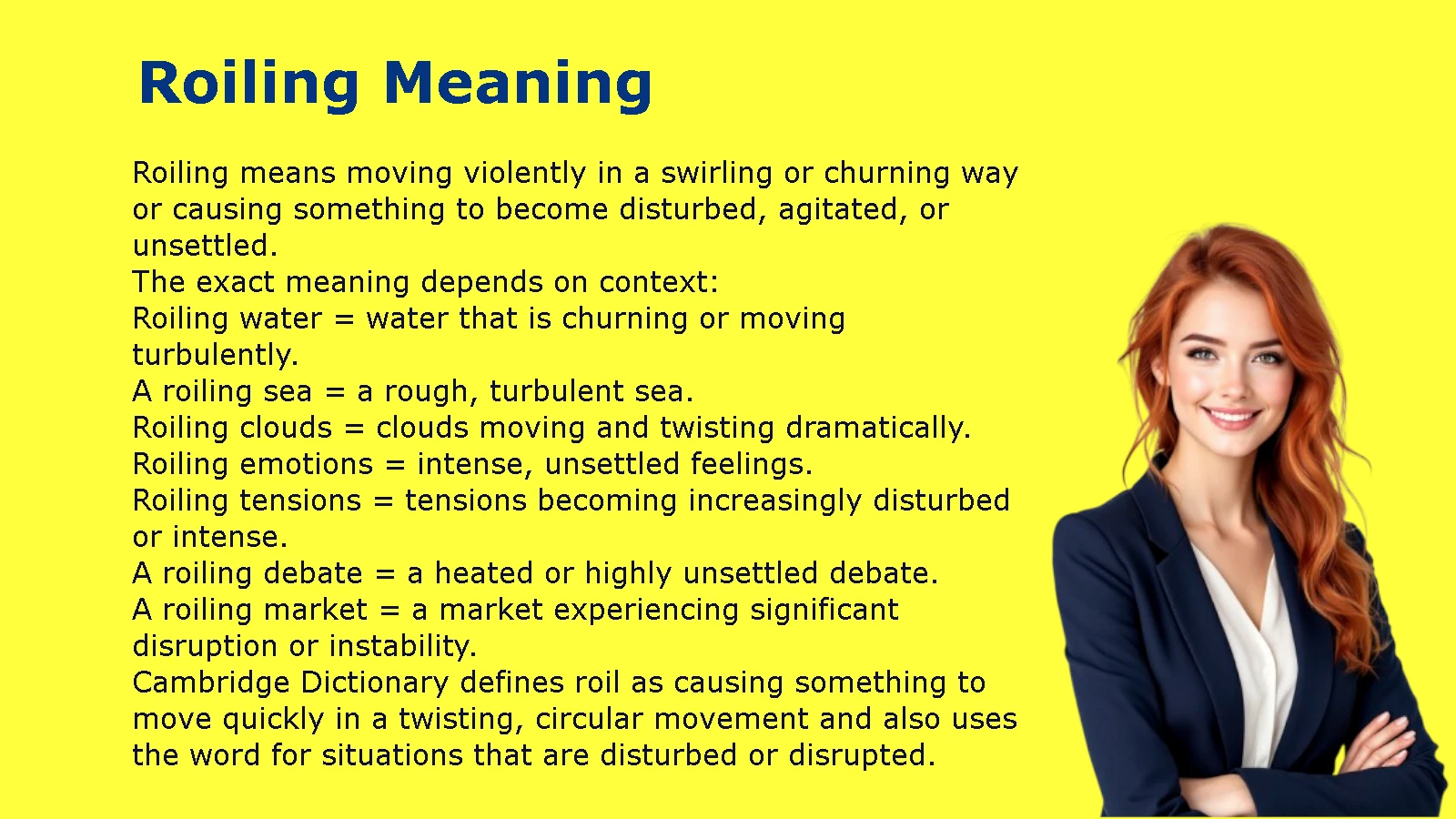
Roiling means moving violently in a swirling or churning way or causing something to become disturbed, agitated, or unsettled.
The exact meaning depends on context:
- Roiling water = water that is churning or moving turbulently.
- A roiling sea = a rough, turbulent sea.
- Roiling clouds = clouds moving and twisting dramatically.
- Roiling emotions = intense, unsettled feelings.
- Roiling tensions = tensions becoming increasingly disturbed or intense.
- A roiling debate = a heated or highly unsettled debate.
- A roiling market = a market experiencing significant disruption or instability.
Cambridge Dictionary defines roil as causing something to move quickly in a twisting, circular movement and also uses the word for situations that are disturbed or disrupted.
In simple English, roiling means strongly stirred up.
What Does “Roiling” Mean?
Roiling is the -ing form of the verb roil. It can function as part of a verb phrase or as an adjective describing something that is turbulent or agitated.
The physical sense is especially common with water and weather-related imagery. Something roiling does not simply move. It usually suggests forceful, irregular, swirling, or turbulent movement.
Consider these examples:
The storm created roiling waves.
The waves are not merely moving forward. They are churning and surging because of the storm.
The word also works figuratively:
Anger was roiling beneath the surface.
Here, anger is not physically moving like water. The writer uses the image of turbulent water to describe powerful emotions that are building or remaining unsettled.
Oxford lists roiling as an adjective, particularly for things such as the sea or clouds that are moving around violently, while its entry for roil identifies both physical and figurative uses.
Roiling Meaning in Simple English
A useful way to understand roiling is to imagine a calm body of water suddenly being disturbed by strong wind.
Instead of remaining smooth, the water:
- churns,
- twists,
- swirls,
- rises,
- crashes,
- and moves unpredictably.
That visual idea carries over into figurative language.
For instance:
“The roiling debate” suggests that the debate is highly unsettled, heated, or disruptive.
“Roiling anger” suggests anger that is intense and active beneath the surface.
The central idea is therefore disturbance and agitation, whether the subject is physical or figurative.
Roiling Water Meaning
Roiling water is water that is churning, swirling, or moving turbulently.
The phrase is often used when water has been disturbed by:
- strong winds,
- storms,
- rapids,
- underwater obstacles,
- waves,
- currents,
- or another force.
For example:
The boat struggled to cross the roiling water.
The sentence suggests that the water is rough and turbulent rather than calm and smooth.
Does Roiling Water Have to Be Hot?
No.
This is one of the most important points about the word.
Roiling does not require high temperature. Water can be cold and still be roiling.
That distinction separates roiling from one important sense of boiling.
Boiling water is associated with heat and a particular physical state. Roiling water is described primarily in terms of movement and agitation.
A cold ocean can be roiling during a storm.
A river can become roiling because of strong currents.
A pot of liquid can also appear roiling when it is being heated and moving vigorously.
Therefore, context matters.
Roiling Sea Meaning
A roiling sea is a sea that is rough, turbulent, and violently moving.
The expression is particularly common in descriptive writing because it creates a strong visual image. Instead of simply saying that the sea is rough, roiling emphasizes movement, turbulence, and continual agitation.
For example:
The fishing vessel disappeared behind the roiling sea.
The phrase makes the sea sound powerful and unstable.
Oxford specifically gives “the roiling sea” as an example of roiling used to describe something moving around violently.
Examples of “Roiling Sea”
- The sailors watched the roiling sea from the safety of the harbor.
- Huge waves rose from the roiling sea.
- The storm transformed the normally calm water into a roiling sea.
- The small boat struggled against the roiling sea.
- Dark clouds gathered above the roiling sea.
In each example, roiling communicates more than ordinary movement. It suggests turbulence and force.
Roiling vs. Boiling: Are They the Same?
Roiling and boiling can overlap in some contexts, but they are not exact synonyms.
The main difference is what each word emphasizes.
| Word | Main idea | Does heat have to be involved? | Common examples |
| Roiling | Churning or turbulent movement | No | Roiling sea, roiling water, roiling clouds |
| Boiling | Reaching or producing vigorous bubbling, usually from heat | Usually, in the literal sense | Boiling water, boiling soup |
| Roiling | Figuratively disturbed or agitated | No | Roiling emotions, roiling tensions |
| Boiling | Figuratively extremely angry or intense | No | Boiling with anger |
The distinction becomes clearer with an example.
The storm produced roiling waves.
There is no suggestion that the ocean has become hot.
By contrast:
The water is boiling.
This normally refers to water heated to the boiling point and producing vigorous bubbles.
So, if you see roiling water, think first about turbulent movement, not temperature.
Why Do “Roiling” and “Boiling” Sometimes Sound Similar?
Both words can describe vigorous movement, especially when liquid is moving intensely.
However, boiling has a much stronger association with heat, while roiling emphasizes agitation, churning, and turbulence.
That difference becomes even more important in figurative expressions.
How “Roiling” Is Used in a Sentence
The word roiling can describe physical movement or figurative disturbance.
Literal Examples
The river was roiling after several hours of heavy rain.
Roiling waves battered the rocky shoreline.
Smoke was roiling above the burning structure.
The boat moved slowly through the roiling water.
Dark clouds were roiling across the horizon.
These examples describe things that appear to move in a turbulent or twisting manner.
Figurative Examples
Anger was roiling beneath the surface.
The scandal left the organization roiling.
The announcement triggered a roiling debate.
Economic uncertainty continued to roil the industry.
The community was roiling with disagreement.
Here, the word no longer describes literal water. Instead, it conveys disturbance, agitation, instability, or conflict.
Cambridge provides examples of roil being used for financial markets and public debates, demonstrating that the figurative sense extends well beyond physical movement.
Examples of “Roiling” in Context
Understanding the word becomes easier when you see how its meaning changes according to the noun it modifies.
| Phrase | Meaning |
| Roiling water | Water moving turbulently |
| Roiling waves | Waves churning or surging strongly |
| Roiling sea | A rough, turbulent sea |
| Roiling clouds | Clouds twisting or moving dramatically |
| Roiling smoke | Smoke rising or swirling in thick, irregular movements |
| Roiling emotions | Strong, unsettled feelings |
| Roiling tensions | Increasingly disturbed or strained relations |
| Roiling debate | A heated or unsettled discussion |
| Roiling conflict | A conflict characterized by continuing disturbance or tension |
| Roiling market | A market experiencing significant disruption or instability |
The noun following roiling often tells you whether the meaning is literal or figurative.
Roiling as a Figurative Expression
One of the most useful aspects of roiling is its figurative power.
The word takes the physical image of turbulent water and applies it to something that cannot literally churn.
Roiling Emotions Meaning
Roiling emotions are strong, unsettled, or turbulent feelings.
For example:
She struggled to control her roiling emotions after the argument.
The sentence does not mean that emotions physically move like water. Instead, roiling creates an image of feelings churning internally.
Common emotions described this way include:
- anger,
- fear,
- frustration,
- resentment,
- grief,
- anxiety,
- excitement.
Roiling Anger Meaning
Roiling anger refers to anger that is intense, unsettled, or continually building.
For example:
Years of frustration had left him with roiling anger.
The expression suggests that the anger is not calm or passive. It is active and turbulent.
Roiling Tensions Meaning
Roiling tensions are tensions that are highly unsettled or increasingly disturbed.
For example:
The disagreement added to the roiling tensions within the organization.
This use is common in news reporting, business writing, and analytical prose because it conveys instability without simply saying that something is “bad.”
Roiling Conflict Meaning
A roiling conflict is a conflict marked by continuing agitation, disagreement, or instability.
The word can emphasize that the conflict is not static. Like turbulent water, it keeps moving and changing.
Roiling Debate Meaning
A roiling debate is a highly active, heated, or unsettled debate.
The phrase does not necessarily mean that the debate is irrational or chaotic. It simply emphasizes strong disagreement, controversy, or continuing agitation.
Is “Roiling” a Verb or an Adjective?
Roiling is the present participle of the verb roil. It can also function adjectivally.
Compare these sentences:
The storm is roiling the sea.
Here, roiling is part of the verb phrase is roiling.
Now consider:
The roiling sea made navigation difficult.
Here, roiling directly describes the noun sea, so it functions adjectivally.
This distinction is useful when analyzing grammar.
Forms of the Verb “Roil”
| Verb form | Example |
| roil | Strong winds roil the water. |
| roils | The storm roils the sea. |
| roiled | The storm roiled the ocean. |
| roiling | The storm is roiling the ocean. |
Oxford identifies roiled as the past form and roiling as the -ing form of roil.
Roil, Roiled, Roiling, and Roils
These forms all come from the same verb.
Roil is the base form:
Strong currents can roil the water.
Roils is used with a third-person singular subject in the present tense:
The storm roils the coastline.
Roiled is the past tense or past participle:
Heavy winds roiled the bay.
Roiling is the present participle:
The roiling waves were difficult to navigate.
The word can be either transitive or intransitive depending on construction. In other words, something can roil something else, or something can itself roil or move turbulently. Cambridge identifies roil as a verb that can be used in both ways.
Roiling Synonyms
The best synonym for roiling depends on what you are describing.
For Water and Physical Movement
Useful alternatives include:
- Churning
- Turbulent
- Swirling
- Agitated
- Surging
- Raging
- Rough
For example:
The roiling water
could become:
The churning water
Both communicate strong movement, although churning often emphasizes the repeated mixing or turning motion.
For Emotions
Depending on the context, alternatives include:
- Agitated
- Turbulent
- Unsettled
- Seething
- Intense
- Disturbed
For example:
roiling emotions
could be expressed as:
turbulent emotions
or
deeply unsettled emotions
However, these alternatives are not always interchangeable. Roiling retains its distinctive image of something churning beneath or within a surface.
For Situations and Conflicts
Possible alternatives include:
- Unsettled
- Turbulent
- Heated
- Disruptive
- Volatile
- Troubled
The best choice depends on what you want to emphasize.
Roiling Antonyms
The opposite of roiling depends on the context.
For physical movement, useful antonyms include:
- Still
- Calm
- Smooth
- Quiet
- Tranquil
emotions or situations, possible opposites include:
- Peaceful
- Settled
- Stable
- Composed
- Calm
- Serene
example:
The lake was roiling.
The opposite might be:
The lake was still.
Similarly:
Roiling emotions
could contrast with:
Calm emotions
There is no single antonym that works perfectly in every sentence because roiling has both literal and figurative meanings.
Roiling vs. Churning
Roiling and churning are closely related, particularly when describing liquids.
Churning often emphasizes repeated mixing, turning, or agitation. Roiling can emphasize a more forceful, turbulent, twisting movement.
Compare:
The machine churned the mixture.
This focuses on the process of mixing.
The sea was roiling beneath the storm.
This creates a stronger image of rough, uncontrolled movement.
In many descriptive contexts, the two words can overlap, but they are not identical in every situation.
Roiling vs. Seething
Roiling and seething can both describe emotional or figurative disturbance, but their typical emphasis differs.
Seething often suggests intense anger that is held beneath the surface.
He was seething with anger.
Roiling is broader.
Conflicting emotions were roiling inside her.
The second sentence could describe anger, fear, sadness, excitement, or several emotions at once.
Roiling can also describe physical things such as water and clouds, while seething is much more strongly associated with boiling or intense emotional agitation.
Common Phrases With “Roiling”
Several expressions appear naturally with roiling.
Roiling Water
Water moving in a turbulent or churning manner.
Roiling Sea
A rough, turbulent sea, especially during bad weather.
Roiling Waves
Waves that are surging, twisting, or breaking forcefully.
Roiling Emotions
Strong feelings that are unsettled or turbulent.
Roiling Tensions
Relations or circumstances characterized by significant and continuing tension.
Roiling Debate
A heated, active, or unsettled debate.
Roiling Conflict
A conflict characterized by continuing disturbance, disagreement, or instability.
These combinations work because roiling carries a consistent underlying idea: something is not calm; it is actively disturbed or churning.
Is “Roiling” the Same as “Boiling”?
No. Roiling and boiling are related in some contexts, but they emphasize different things.
A liquid can be roiling without being hot.
For example:
Cold seawater was roiling around the rocks.
The water is turbulent, but nothing suggests that it is hot.
A liquid can also be boiling without the writer emphasizing turbulence:
The water was boiling on the stove.
The defining idea here is heat and the boiling state.
There is also figurative overlap:
She was boiling with anger.
She was roiling with anger.
Both sentences communicate intense emotion, but they use different imagery.
Boiling often suggests extreme intensity, while roiling suggests turbulence or internal agitation.
How to Pronounce “Roiling”
The word roiling is pronounced with the same opening sound as roy followed by an ending similar to -ling.
Cambridge gives the pronunciation as /rɔɪlɪŋ/.
The word has two syllables:
- roil
- ing
The first syllable carries the main stress.
A common mistake is to confuse roiling with rolling because the two words look and sound somewhat similar.
They have different meanings.
Roiling vs. Rolling
Roiling means churning, agitating, or becoming turbulent.
Rolling generally describes something moving by turning over and over or progressing in a continuous motion.
| Word | Meaning | Example |
| Roiling | Churning or becoming turbulent | The roiling sea crashed against the rocks. |
| Rolling | Moving by turning over and over | The ball was rolling down the road. |
Consider the difference:
The waves were roiling.
The waves are turbulent.
waves were rolling toward the shore.
The waves are moving in a repeated, rounded motion toward land.
The two words can occasionally describe similar physical movement, but they emphasize different qualities.
Is “Roiling” Used in Formal Writing?
Yes.
Roiling can be appropriate in formal writing, journalism, literature, business reporting, and analytical writing. Cambridge’s examples include uses involving financial markets, industries, and public debates.
However, it is more descriptive than a basic word such as disturbed or rough.
For example:
The storm disrupted the market.
is straightforward.
The storm left the market roiling.
is more vivid and emphasizes continuing instability.
In academic or technical writing, choose the word based on precision. If you simply mean unstable, unstable may be clearer. If you want to convey a sense of active disturbance or turbulence, roiling can be more effective.
Word Origin and History of “Roiling”
The history of roil is surprisingly complicated.
Etymonline dates the relevant English verb to the 1580s, when roil meant to make a liquid turbid or muddy by stirring up sediment. The word also developed a figurative sense involving anger or disturbance. Its ultimate origin is considered uncertain.
One proposed connection is with French words associated with rust, mud, or making something muddy. Another possible source involves an Old French verb meaning to mix mortar. Etymologists have not established one completely certain origin.
The Oxford University Press has also discussed the complicated history of roil and rile, noting that their development and relationship have been debated by etymologists.
This history helps explain why roil has meanings connected with both physical disturbance and emotional agitation.
The original physical image is especially useful: something settled becomes stirred up.
That same idea survives in modern expressions such as:
roiling water
and
roiling emotions
In both cases, something that might otherwise be settled becomes agitated and unsettled.
Common Mistakes With “Roiling”
Assuming “Roiling” Always Means Hot
This is probably the most important mistake to avoid.
Roiling does not inherently mean hot.
A cold river, lake, or ocean can be roiling.
Using “Roiling” Only for Water
The word is frequently associated with water, but its modern use extends far beyond liquids.
You can have:
- roiling emotions,
- roiling tensions,
- a roiling debate,
- a roiling market,
- a roiling conflict.
Treating “Roiling” and “Boiling” as Exact Synonyms
They overlap in some descriptions, but boiling strongly relates to heat in its literal sense.
Roiling primarily emphasizes turbulent movement or disturbance.
Confusing “Roiling” With “Rolling”
The spellings are similar, but their meanings differ.
Roiling = churning or agitated.
Rolling = moving by turning over and over or progressing continuously.
Assuming “Roiling” Must Be Negative
The word often appears in negative contexts because turbulence and disturbance are common subjects. However, the basic meaning is descriptive.
For example:
The roiling clouds created a dramatic sunset.
Here, roiling describes the clouds’ movement without necessarily saying that the situation is harmful.
A Practical Case Study: Understanding “Roiling” From Context
Consider three sentences:
The roiling water surrounded the boat.
Here, roiling has a literal physical meaning. The water is turbulent.
She tried to calm her roiling emotions.
Here, the meaning is figurative. Her feelings are intense and unsettled.
The announcement left the industry roiling.
Here, roiling describes disruption and instability within an industry.
The same word works in all three sentences because they share the central concept of agitation.
| Sentence | Meaning of roiling |
| Roiling water surrounded the boat. | Turbulent physical movement |
| Her roiling emotions were difficult to control. | Intense, unsettled feelings |
| The announcement left the industry roiling. | Significant disruption or instability |
This is the key to understanding the word: do not memorize one narrow definition. Look at what is being described.
Facts to Remember About the Roiling Meaning
Here are the most useful points to remember:
- Roiling comes from the verb roil.
- It describes turbulent, churning, or agitated movement.
- It can describe water, waves, seas, clouds, smoke, and other physical things.
- It also has a figurative meaning involving emotional or situational disturbance.
- Roiling water does not have to be hot.
- Roiling and boiling can overlap but are not exact synonyms.
- Roiling and rolling are different words with different meanings.
- Roiling emotions means intense or unsettled emotions.
- A roiling sea means a rough, turbulent sea.
- Roiling tensions means tensions that are highly unsettled or disturbed.
- The word is suitable for descriptive, journalistic, literary, and other forms of formal writing when its meaning fits the context.
- The verb forms are roil, roils, roiled, and roiling.
FAQs About Roiling Meaning
What does roiling mean in English?
Roiling means churning, swirling, or moving turbulently. Figuratively, it can mean causing or experiencing strong disturbance, agitation, or instability.
What does roiling water mean?
Roiling water is water that is moving turbulently, often because of waves, currents, storms, rapids, or another force.
What does a roiling sea mean?
A roiling sea is a rough and turbulent sea with strong, churning movement.
Does roiling mean boiling?
Not exactly. Roiling emphasizes turbulent movement, while boiling usually refers to a liquid heated to its boiling point. Roiling does not require heat.
What is a synonym for roiling?
Depending on the context, synonyms include churning, turbulent, agitated, swirling, surging, unsettled, and raging.
What is the opposite of roiling?
Depending on the context, possible opposites include calm, still, peaceful, tranquil, smooth, and settled.
What does roiling emotions mean?
Roiling emotions are strong, unsettled, or turbulent feelings. The phrase uses the image of churning water to describe emotional agitation.
Is roiling a verb or adjective?
Roiling is the present participle of the verb roil, but it can also function as an adjective. In “The storm is roiling the sea,” it forms part of the verb phrase. In “the roiling sea,” it describes the noun sea.
How do you pronounce roiling?
Roiling is pronounced /ˈrɔɪlɪŋ/, with the main stress on the first syllable. Cambridge lists the pronunciation as /rɔɪlɪŋ/.
What is the difference between roiling and rolling?
Roiling means churning or becoming turbulent, while rolling generally means moving by turning over and over or progressing in a continuous motion.
Can roiling describe emotions?
Yes. Roiling emotions is a common figurative construction describing intense or unsettled feelings.
Can roiling describe clouds?
Yes. Roiling clouds describes clouds that appear to move, twist, or billow turbulently. Oxford specifically includes clouds among the things that can be described as roiling.
Conclusion: Roiling Meaning in Context
The simplest way to remember roiling meaning is strongly stirred, churning, or turbulent.
In its literal sense, roiling describes physical movement. Roiling water churns and swirls, while a roiling sea is rough and turbulent. The word can also describe clouds, smoke, waves, and other things that move in an agitated way.
Its figurative meaning extends the same image to things that cannot physically churn. Roiling emotions are intense and unsettled. Roiling tensions are highly disturbed. A roiling debate is heated and active, while a roiling market can be experiencing serious disruption or instability.
The biggest distinction to remember is that roiling does not necessarily mean boiling. Heat is central to the literal meaning of boiling, while roiling focuses on turbulent movement or disturbance.
Likewise, roiling is not the same as rolling. If something is rolling, it is generally moving by turning over and over. If it is roiling, it is being churned, agitated, or violently disturbed.
Once you understand that central idea of agitation, the word becomes much easier to recognize and use correctly in both everyday and formal English.