Teetering describes something that is unsteady, unstable, or close to falling, collapsing, or changing suddenly. If you’ve come across the word “teetering” and wondered what it means, how it is used, or why someone or something might be described as teetering, the term is closely connected to balance, instability, uncertainty, movement, risk, and being on the edge of change.
The teetering meaning refers to being in an unstable or precarious position, often with the possibility of falling, failing, or moving in one direction or another. The word can describe a person physically struggling to maintain balance, but it can also be used figuratively for situations, relationships, businesses, or plans that are close to a difficult outcome. Terms such as wobbling, tottering, swaying, wavering, unstable, precarious, and on the verge are related but can have slightly different uses.
In this guide, you’ll learn what “teetering” means, how the word is used in sentences, where it comes from, and how to use it naturally in different contexts. You’ll also see clear examples, synonyms, related expressions, and explanations of the difference between “teetering” and similar words such as “tottering,” “wobbling,” and “wavering.”
By the end, you’ll know exactly what teetering means and how to use this useful word naturally and correctly.
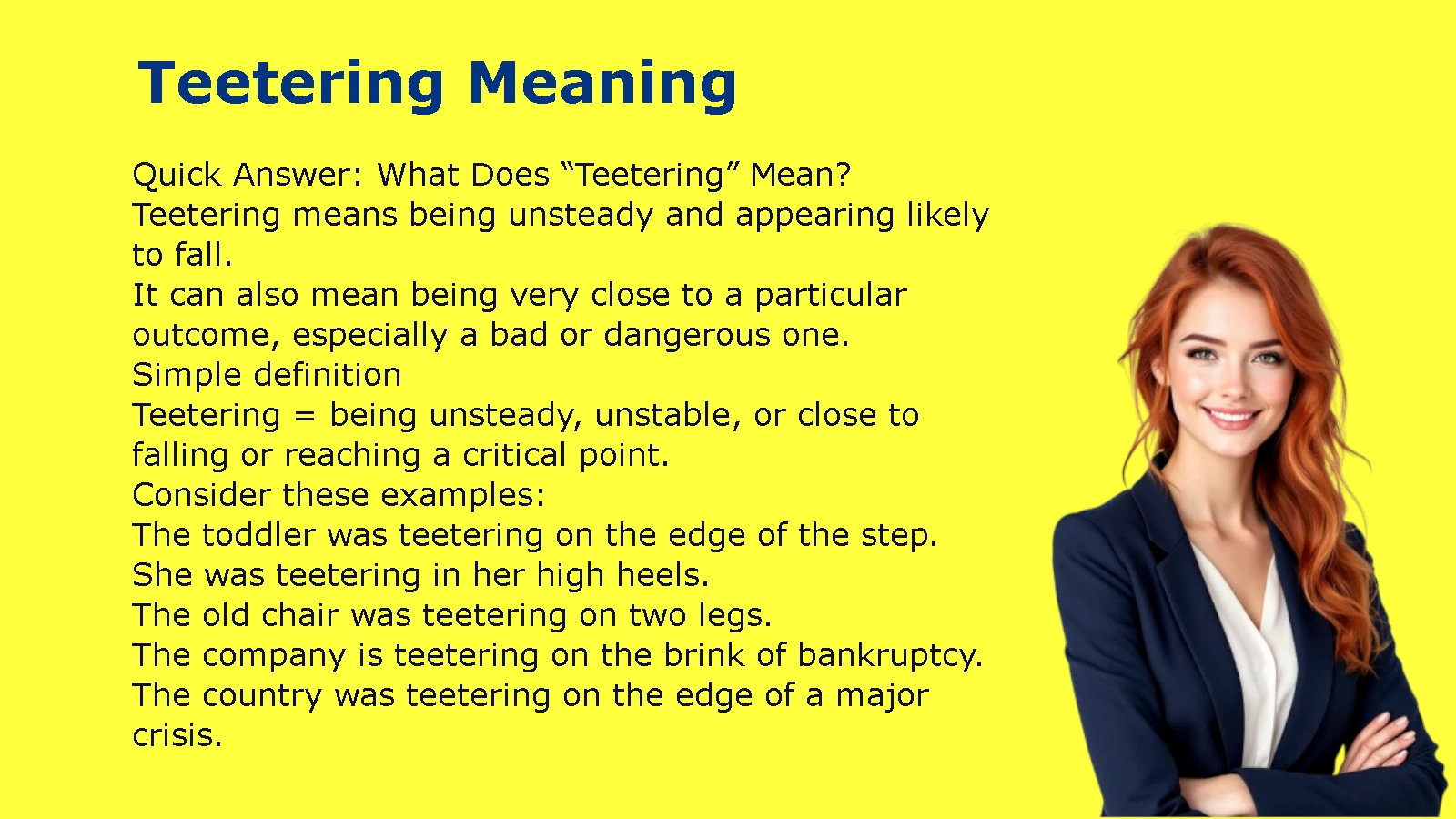
Quick Answer: What Does “Teetering” Mean?
Teetering means being unsteady and appearing likely to fall.
It can also mean being very close to a particular outcome, especially a bad or dangerous one.
Simple definition
Teetering = being unsteady, unstable, or close to falling or reaching a critical point.
Consider these examples:
- The toddler was teetering on the edge of the step.
- She was teetering in her high heels.
- The old chair was teetering on two legs.
- The company is teetering on the brink of bankruptcy.
- The country was teetering on the edge of a major crisis.
The first three examples describe physical instability. The last two use teetering figuratively to describe a situation approaching a serious outcome.
Cambridge specifically identifies teetering as the present participle of teeter and gives the physical meaning of appearing about to fall while standing or moving.
What Does “Teetering” Mean?
The core idea behind teetering is instability.
When someone or something teeters, it is not firmly balanced. It may move slightly from one side to another, and there is a sense that it could fall or change position suddenly.
The word can describe:
- A person struggling to maintain balance
- An object that is unstable
- Someone walking awkwardly
- A structure that appears close to falling
- A business close to failure
- An economy approaching a serious downturn
- A relationship close to breaking down
- A situation approaching a dangerous outcome
Oxford defines teeter as standing or moving in an unsteady way so that you look as if you are going to fall. It also gives the figurative meaning associated with being very close to an unpleasant or dangerous situation.
Teetering in simple words
If you want the meaning in the simplest possible language:
Teetering means not being steady and looking as though you might fall or move into a bad situation.
The important idea is not simply movement. It is movement or a position that suggests instability.
For instance:
The box was teetering on the shelf.
This tells us that the box was not securely positioned. It looked as though it might fall.
Compare that with:
The box was moving on the shelf.
The second sentence tells us about movement but does not necessarily suggest that the box was in danger of falling.
That difference is one reason teetering is more precise than some general movement words.
Teetering as a Form of the Verb “Teeter”
Teetering is the -ing form and present participle of teeter.
The basic verb is:
| Verb form | Example |
| Teeter | I teeter when I lose my balance. |
| Teeters | The chair teeters on the uneven floor. |
| Teetered | He teetered near the edge. |
| Teetering | She is teetering on the platform. |
Oxford lists teeter as an intransitive verb, meaning it normally does not take a direct object. Its listed forms include teeter, teeters, teetered, and teetering.
How “teetering” works in a sentence
You will commonly see teetering in progressive constructions:
The child is teetering.
Here, teetering describes an action happening at the time of speaking.
It can also appear after another verb:
The cyclist kept teetering from side to side.
It can function as a modifier:
The teetering stack of books finally fell.
It also appears frequently in fixed or semi-fixed figurative expressions:
The company is teetering on the brink of collapse.
So although teetering is fundamentally a verb form, its grammatical behavior can vary depending on the sentence. Cambridge notes that present and past participles can also be used as adjectives.
Teetering Meaning in Different Contexts
The meaning of teetering becomes clearer when you look at the context.
Teetering in a Physical Sense
The literal meaning involves physical balance.
Someone who is teetering may be standing, walking, or moving in a way that makes them look as though they could fall.
For example:
The little boy was teetering as he tried to walk across the narrow beam.
The boy is physically unstable. His balance is uncertain, and falling is a realistic possibility.
Another example is:
She was teetering in her high heels as she crossed the uneven pavement.
This use is especially natural because high heels can make walking less stable.
Cambridge gives a similar example involving someone moving around in very high heels.
Teetering Objects
Objects can also teeter.
The vase was teetering on the edge of the table.
Here, the vase is not necessarily moving dramatically. Instead, its position is unstable enough that it appears likely to fall.
You might also say:
- The stack of books was teetering.
- The ladder was teetering against the wall.
- The suitcase was teetering on the luggage cart.
- The chair was teetering on two legs.
The word therefore works especially well when balance and possible falling are central to the description.
Teetering in a Figurative Sense
The figurative meaning extends the idea of physical instability to situations.
A business cannot literally lose its balance like a person standing on one foot. However, a business can reach a position where its future is uncertain and failure is close.
For example:
The small company was teetering on the brink of bankruptcy.
This means the company was very close to bankruptcy.
The same pattern can describe many other situations:
- teetering on the brink of collapse
- teetering on the edge of disaster
- teetering on the verge of failure
- teetering on the brink of war
- teetering on the edge of extinction
Oxford explicitly defines teeter on the brink/edge of something as being very close to a very unpleasant or dangerous situation.
What Does “Teetering on the Edge” Mean?
Teetering on the edge means being very close to a particular point or outcome, especially one that is dangerous, negative, or unstable.
The phrase can be literal or figurative.
Literal meaning
The hiker was teetering on the edge of the cliff.
Here, edge refers to a physical boundary. The hiker is physically close to falling.
Figurative meaning
The business was teetering on the edge of collapse.
The business is not standing on a physical edge. Instead, its condition is unstable, and collapse appears close.
This figurative use transfers the physical image of someone struggling to maintain balance to an abstract situation.
More examples
- The country was teetering on the edge of a political crisis.
- The company was teetering on the edge of failure.
- Their relationship seemed to be teetering on the edge of collapse.
- The fragile agreement was teetering on the edge of collapse.
The phrase therefore communicates more than simple possibility. It suggests instability combined with proximity to an outcome.
What Does “Teetering on the Brink” Mean?
Teetering on the brink means being very close to a serious, unpleasant, or dangerous situation.
Oxford gives examples involving situations such as collapse, war, death, and disaster under the meaning of brink.
For example:
The economy was teetering on the brink of collapse.
This means the economy was in such an unstable condition that collapse seemed very close.
Another example:
The company was teetering on the brink of bankruptcy.
The company was not necessarily bankrupt yet. The phrase indicates that bankruptcy was a very real and immediate possibility.
“Teetering on the edge” vs. “teetering on the brink”
These expressions overlap considerably.
| Phrase | General meaning | Typical effect |
| Teetering on the edge | Very close to a particular point or outcome | Broad and vivid |
| Teetering on the brink | Very close to a serious or dangerous outcome | Often more dramatic or serious |
| Teetering on the verge | Very close to a change or outcome | Common for both positive and negative outcomes |
The word brink itself commonly refers to being almost in a new, dangerous, or otherwise significant situation.
Teetering Synonyms
Several words are related to teetering, but they do not all mean exactly the same thing.
| Synonym | Main meaning | How it differs from “teetering” |
| Wobbling | Moving repeatedly from side to side | Focuses more on movement |
| Tottering | Moving or standing unsteadily | Often describes a person or unstable movement |
| Swaying | Moving slowly from side to side | Does not necessarily imply falling |
| Staggering | Walking unsteadily | Usually describes a person’s movement |
| Faltering | Losing confidence, strength, or steadiness | Often figurative |
| Unsteady | Lacking physical or figurative stability | Broader adjective |
| Floundering | Struggling to cope or succeed | Primarily figurative in this comparison |
Teetering vs. wobbling
Wobbling emphasizes movement from side to side.
The wheel was wobbling.
This does not necessarily mean the wheel is about to fall.
Teetering, however, often creates an image of unstable balance:
The chair was teetering on two legs.
The second sentence suggests a possible fall.
Teetering vs. tottering
Tottering is another close synonym. Oxford lists totter among the related ways of describing uncontrolled or uneven walking in its discussion of teeter.
However, tottering often describes a person or object moving with weak, unstable steps.
The older people man tottered across the room.
By contrast:
The ladder was teetering against the wall.
Both involve instability, but teetering is particularly useful when something appears close to losing its balance.
Teetering vs. swaying
Swaying means moving back and forth.
The trees were swaying in the wind.
That movement is not necessarily dangerous.
The sign was teetering in the strong wind.
Now there is a stronger suggestion that the sign may fall.
Teetering vs. staggering
Staggering usually describes someone walking or moving without proper balance.
He was staggering down the road.
Teetering can also describe a person, but it does not carry exactly the same suggestion of uncontrolled walking.
Teetering in a Sentence: Examples
The easiest way to understand teetering meaning is to see the word used naturally.
Physical examples
- The child was teetering on the narrow wall.
- She was teetering in her oversized shoes.
- The cyclist was teetering as he tried to regain his balance.
- The ladder was teetering against the side of the house.
- The vase was teetering on the edge of the shelf.
- The stack of boxes was teetering dangerously.
- He was teetering near the edge of the platform.
Figurative examples
- The company is teetering on the brink of bankruptcy.
- The organization was teetering on the edge of collapse.
- The agreement was teetering on the verge of failure.
- The industry is teetering toward a major downturn.
- The relationship seemed to be teetering on the edge of collapse.
- The fragile peace was teetering on the brink of conflict.
Why the examples differ
Notice that the physical examples involve actual balance.
The figurative examples involve stability, risk, or an approaching outcome.
That is the central semantic connection between the two uses.
How to Use “Teetering” Correctly
The most natural constructions usually give the reader information about where the instability is occurring or what outcome is approaching.
Teetering + adverb
The child was teetering awkwardly.
The adverb explains how the person was moving.
Teetering + prepositional phrase
The vase was teetering on the shelf.
The phrase on the shelf gives the location.
Teetering on the edge of + noun
The company was teetering on the edge of bankruptcy.
This is a common figurative structure.
Teetering on the brink of + noun
The country was teetering on the brink of war.
This construction emphasizes proximity to a serious outcome.
Teetering toward + outcome
The word can also appear in constructions describing movement toward an outcome:
The discussion was teetering toward chaos.
However, teeter on the edge/brink of is the more established and recognizable idiomatic pattern. Cambridge and Oxford both specifically record it.
Is “Teetering” a Verb or an Adjective?
Teetering is primarily the present participle of the verb teeter.
However, like other present participles, it can sometimes function as an adjective.
Compare:
The ladder was teetering against the wall.
Here, teetering is part of the verb phrase was teetering.
Now consider:
The teetering ladder looked dangerous.
Here, teetering modifies the noun ladder, so it has an adjective-like function.
This distinction matters if you are analyzing the grammar of a sentence. Dictionary.com also identifies teetering as a present participle and explains that present participles can function within progressive constructions or as modifiers.
Quick grammar test
Ask what teetering is doing:
- If it forms the action: The ladder is teetering. → verb phrase
- If it describes a noun: the teetering ladder → participial modifier
Both uses are grammatically normal.
Teetering Pronunciation
Teetering is pronounced approximately:
TEE-ter-ing
Cambridge gives the pronunciation of teeter as approximately /ˈtiː.tə/ in British English and /ˈtiː.t̬ɚ/ in American English.
Oxford gives the corresponding forms for teeter and lists the -ing form as teetering.
Pronunciation breakdown
You can think of the word as three parts:
tee + ter + ing
The first syllable receives the main stress:
TEE-ter-ing
The word should not be pronounced as though the first syllable were short or unstressed.
Word Origin and Etymology of “Teetering”
The history of teetering comes from the verb teeter.
Oxford dates teeter to the mid-19th century and identifies it as a variant of dialect titter, ultimately connected with Old Norse titra, meaning “shake” or “shiver.”
Etymonline gives more historical detail, dating teeter to 1843 in the sense of moving up and down in a seesaw-like manner and to 1844 for moving unsteadily or being on the edge of imbalance. It also connects the word with Scandinavian vocabulary associated with shaking and trembling.
Collins likewise traces the word to the 19th century and connects it with older words related to trembling and unsteady movement.
The historical development helps explain why the modern word combines ideas of:
- Movement
- Shaking
- Instability
- Loss of balance
- Being close to falling
The figurative sense developed naturally from the physical image: something that is barely maintaining its position can be compared with a situation that is barely maintaining stability.
Common Phrases With “Teetering”
Several constructions appear frequently with teetering.
Teetering on the edge
Means being very close to a particular point or outcome.
The business was teetering on the edge of failure.
Teetering on the brink
Usually suggests being very close to a serious or dangerous outcome.
The company was teetering on the brink of collapse.
Teetering on the verge
Means being very close to a particular change or result.
The negotiations were teetering on the verge of failure.
Teetering toward collapse
Describes an unstable situation moving toward collapse.
The old structure was teetering toward collapse.
Teetering on the edge of disaster
A strongly figurative expression meaning that disaster appears very close.
The project was teetering on the edge of disaster after months of delays.
The most important expressions to remember are teetering on the edge and teetering on the brink, both of which are established dictionary constructions.
A Practical Case Study: Understanding “Teetering” in Context
Consider these two sentences:
The tower was teetering in the wind.
and:
The company was teetering on the brink of bankruptcy.
At first glance, the sentences seem unrelated. One concerns a physical structure, while the other concerns a business.
Yet the underlying idea is exactly the same: unstable balance.
In the first sentence, the tower may physically lose its balance.
In the second, the company may lose its financial stability.
What changes?
| Feature | Physical use | Figurative use |
| Subject | Person or object | Business, economy, relationship, situation |
| Type of instability | Physical | Abstract |
| Possible outcome | Falling | Failure, collapse, crisis, etc. |
| Typical construction | Teetering on/in/near something | Teetering on the brink/edge of something |
| Core idea | Unstable balance | Unstable condition |
This is why understanding the core concept of instability is more useful than memorizing a single translation.
Common Mistakes With “Teetering”
Assuming “teetering” only means falling
Not exactly.
Someone who is teetering may look as though they are about to fall, but they have not necessarily fallen.
She was teetering on the edge but managed to regain her balance.
The sentence would make little sense if teetering automatically meant falling.
Confusing “teetering” with “wobbling”
These words overlap, but they are not identical.
Wobbling emphasizes side-to-side movement.
Teetering emphasizes unstable balance and the possibility of falling or reaching a critical point.
Assuming every use is literal
The figurative meaning is important.
The economy is teetering on the brink of recession.
No physical object is involved. The word describes an unstable economic condition.
Using “teetering” without an idea of instability
Simply moving does not automatically mean teetering.
For example:
The trees were moving in the wind.
is neutral.
The sign was teetering in the wind.
suggests that the sign was unstable and might fall.
The second sentence gives the reader a much stronger sense of risk.
Teetering Meaning in Urdu
The best Urdu translation depends on the context.
For the physical sense, useful equivalents can include:
- ڈگمگانا
- لڑکھڑانا
- غیر متوازن ہونا
- جھولنا in some contexts
figurative sense, translations may include:
- خطرناک صورتِ حال کے قریب ہونا
- تباہی کے قریب ہونا
- زوال کے دہانے پر ہونا
- غیر مستحکم حالت میں ہونا
For example:
The company is teetering on the brink of bankruptcy.
A natural Urdu rendering would convey the idea that:
کمپنی دیوالیہ ہونے کے دہانے پر ہے۔
The important point is that teetering does not have one universal Urdu equivalent. The appropriate translation changes depending on whether the sentence describes physical balance or a figurative situation.
Facts to Remember About the Word “Teetering”
Here are the key facts in one place:
| Fact | Detail |
| Word | Teetering |
| Base verb | Teeter |
| Word form | Present participle / -ing form |
| Basic meaning | Being unsteady or appearing close to falling |
| Figurative meaning | Being very close to a difficult, dangerous, or unwanted outcome |
| Common phrase | Teetering on the edge |
| Another common phrase | Teetering on the brink |
| Pronunciation | TEE-ter-ing |
| Grammar | Verb form that can also function as a modifier |
| Common physical contexts | Walking, standing, unstable objects |
| Common figurative contexts | Bankruptcy, collapse, crisis, failure, conflict |
| Origin | Mid-19th-century teeter, with Scandinavian connections |
Cambridge, Oxford, and Collins all support the basic relationship between teetering and teeter, while Oxford specifically documents the figurative teeter on the brink/edge construction.
Frequently Asked Questions About Teetering
What does teetering mean?
Teetering means being unsteady and appearing as though you might fall. Figuratively, it can mean being very close to an unpleasant, dangerous, or unwanted situation.
What does teetering on the edge mean?
Teetering on the edge means being very close to a particular point or outcome. Literally, it can mean being physically close to an edge while struggling to maintain balance. Figuratively, it means being close to a significant or dangerous outcome.
What does teetering on the brink mean?
Teetering on the brink means being very close to a serious or dangerous situation, such as collapse, bankruptcy, war, or disaster. Oxford specifically records this idiomatic construction.
Is teetering a verb or adjective?
Teetering is the present participle of the verb teeter. It can also function as a modifier in sentences such as “the teetering ladder.”
What is a synonym for teetering?
Depending on context, possible synonyms include wobbling, tottering, swaying, staggering, faltering, and unsteady. They are not exact replacements in every sentence.
What is the difference between teetering and tottering?
Both describe instability. Teetering often emphasizes being close to losing balance or falling, while tottering commonly describes unsteady movement, particularly when walking.
What is the difference between teetering and wobbling?
Wobbling mainly describes movement from side to side. Teetering adds a stronger sense of unstable balance or the possibility of falling.
How do you use teetering in a sentence?
You can use it for physical instability:
The ladder was teetering against the wall.
You can also use it figuratively:
The company was teetering on the brink of bankruptcy.
What does teetering mean in simple words?
In simple words, teetering means being unsteady or being very close to falling or reaching a critical point.
What is the meaning of teetering in Urdu?
In a physical context, teetering can mean ڈگمگانا، لڑکھڑانا، or غیر متوازن ہونا. In a figurative context, it can describe being قریبِ زوال or being دہانے پر of a serious outcome.
Conclusion: Teetering Meaning in Context
The word teetering describes a state of instability.
In its literal sense, it means standing or moving unsteadily as though you are about to fall. A person in high heels, an unstable ladder, or a vase near the edge of a table can all be described as teetering.
The word also has an important figurative meaning. When a business is teetering on the brink of bankruptcy, it is not physically moving from side to side. Instead, its financial condition is unstable and bankruptcy is dangerously close.
The most useful expressions to remember are teetering on the edge and teetering on the brink. Both extend the physical idea of unstable balance to abstract situations involving risk, failure, crisis, or major change.
In short:
Teetering means being unsteady and close to falling, or being very close to a particular outcome, especially a serious or undesirable one.
Understanding that central idea of unstable balance makes the word much easier to recognize and use correctly in both everyday English and more formal writing.