Handkerchief is the correct spelling of the word for a small piece of fabric used for personal hygiene or as a clothing accessory. The spelling stays the same in American and British English, although pronunciation can vary slightly between the two varieties. The correct plural is handkerchiefs, and common synonyms include hanky and hankie. When you compare a handkerchief with a pocket square, the main difference lies in how you use it: a handkerchief often serves a practical purpose, while a pocket square usually adds style to a suit.
Whether you want to check the handkerchief spelling, learn the American or British pronunciation, understand the plural form, or choose a handkerchief for men, this guide explains the word’s meaning, grammar, and everyday uses.
Is Handkerchief the Correct Spelling?
Yes, handkerchief is the correct spelling in standard American and British English. It refers to a small piece of fabric, traditionally carried in a pocket, that people use to wipe their nose, dab their face, or perform other personal tasks. The word can also describe a decorative cloth accessory, although a pocket square is more specific for formal clothing.
The correct spelling contains the letters in this order:
H-A-N-D-K-E-R-C-H-I-E-F
The spelling can confuse readers because the word combines several familiar letter patterns, including hand, ker, and chief. The final part also creates uncertainty because some English nouns ending in -f change to -ves in the plural. However, handkerchief follows a different pattern.
Handkerchief Spelling: The Correct Form
The standard spelling is handkerchief, with -chief at the end. You should use this form in school assignments, business writing, emails, product descriptions, and everyday communication.
Here are some examples:
- She carried a clean handkerchief in her handbag.
- He used a cotton handkerchief to wipe his forehead.
- My grandfather always kept a white handkerchief in his jacket pocket.
- The groom chose a silk pocket square instead of a traditional handkerchief for his suit.
Notice that the word keeps the same spelling regardless of the fabric, color, or purpose. A cotton handkerchief, a linen handkerchief, and a decorative handkerchief all use the same spelling.
Writing tip: If you are unsure how to spell the word, remember the ending chief. The same ending appears in words such as chief and brief, which can help you recall the letter sequence.
Common Handkerchief Misspellings
People sometimes misspell handkerchief because they confuse the order of its letters or assume that its pronunciation reveals its exact spelling.
| Spelling | Correct or incorrect? | Explanation |
| Handkerchief | Correct | The standard spelling |
| Handkercheif | Incorrect | Reverses the i and e in the final part |
| Hankerchief | Incorrect | Omits the d after han |
| Handkerchif | Incorrect | Omits the second e |
| Handkerchieves | Incorrect as the regular plural | The standard plural is handkerchiefs |
| Handkerchiefs | Correct | The standard plural form |
These mistakes usually happen when someone writes the word from memory. The pronunciation does not make every letter obvious, so spelling it correctly requires familiarity with the written form.
For example, someone might type “I packed three handkercheifs” in an online product listing. Readers can probably understand the intended meaning, but the misspelling looks unprofessional and may affect the quality of the listing.
For websites, product catalogs, and educational content, use the correct form consistently. If you publish an article about handkerchiefs, include common spelling questions naturally without repeating incorrect forms unnecessarily.
Handkerchief vs Handkerchief: Is There Any Difference?
There is no difference when both sides contain exactly the same spelling: Handkerchief vs Handkerchief compares one word with itself. Both forms have the same meaning, pronunciation, grammatical function, and standard usage.
A meaningful comparison requires two different words or spellings. For example, you could compare handkerchief vs. pocket square to explain their different purposes, or handkerchief vs. handkercheif to distinguish the correct spelling from a misspelling.
Here is a quick comparison:
| Comparison | What it tells you |
| Handkerchief vs Handkerchief | No difference; both spellings are identical |
| Handkerchief vs. handkercheif | Correct spelling versus misspelling |
| Handkerchief vs. hanky | Standard word versus informal alternative |
| Handkerchief vs. pocket square | Functional cloth versus a primarily decorative suit accessory |
If you are creating content around spelling comparisons, make sure the two terms in your title actually differ. That approach gives readers a clear answer and helps the article match their search intent.
How Do You Pronounce Handkerchief?
The word handkerchief usually has three syllables and carries its main stress on the first syllable. In American English, a common pronunciation is /ˈhæŋ.kɚ.tʃɪf/. In many British accents, it is /ˈhæŋ.kə.tʃɪf/. The middle syllable accounts for much of the difference, although individual accents can vary.
The spelling can make the word look harder to pronounce than it really is. Once you identify the syllables and listen for the main stress, the word becomes easier to say naturally.
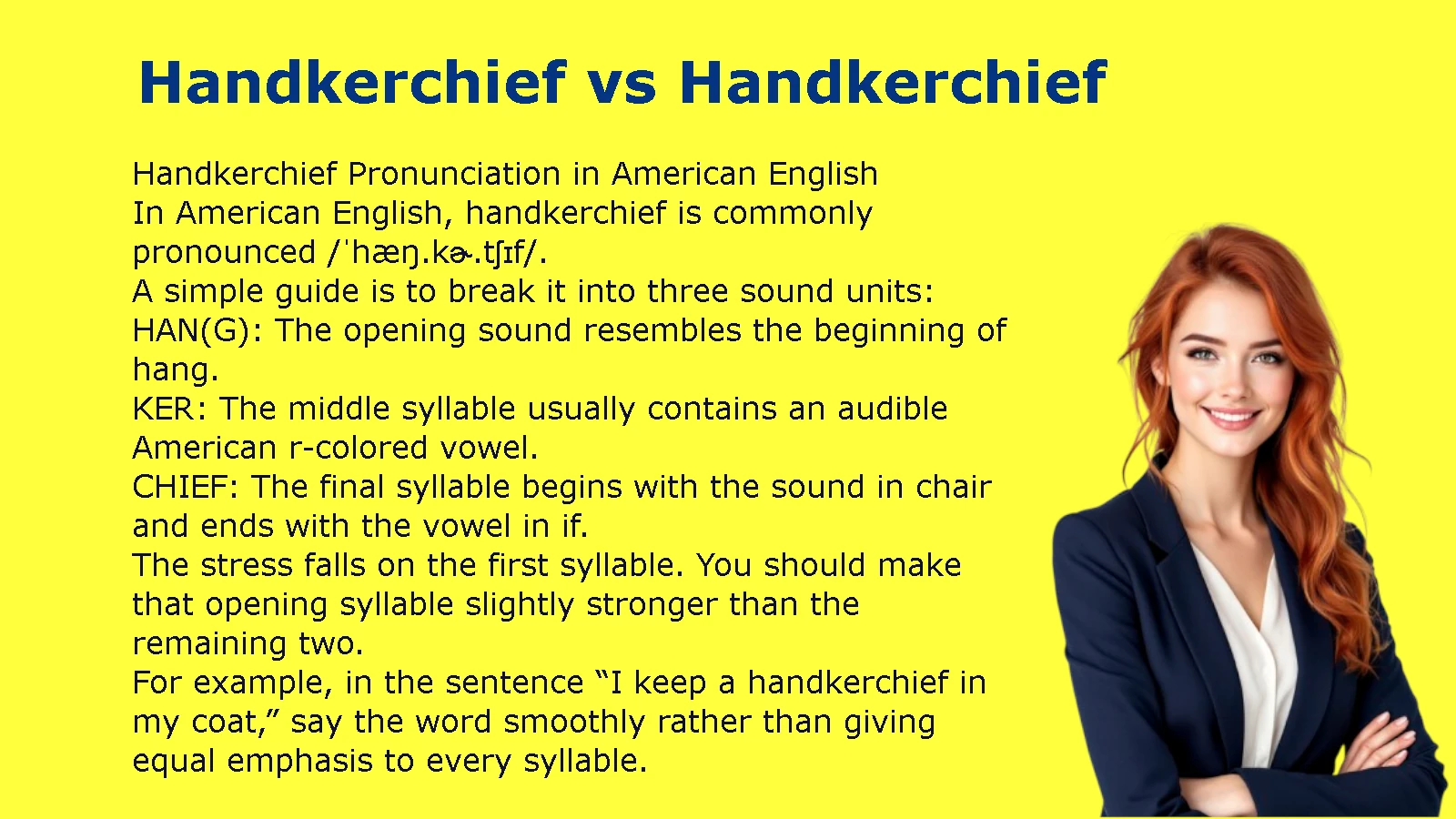
Handkerchief Pronunciation in American English
In American English, handkerchief is commonly pronounced /ˈhæŋ.kɚ.tʃɪf/.
A simple guide is to break it into three sound units:
- HAN(G): The opening sound resembles the beginning of hang.
- KER: The middle syllable usually contains an audible American r-colored vowel.
- CHIEF: The final syllable begins with the sound in chair and ends with the vowel in if.
The stress falls on the first syllable. You should make that opening syllable slightly stronger than the remaining two.
For example, in the sentence “I keep a handkerchief in my coat,” say the word smoothly rather than giving equal emphasis to every syllable.
American speakers may pronounce the written d less distinctly than learners expect. The sounds flow together, which helps explain why some people struggle to connect the spoken word with its written form.
Pronunciation tip: Focus on the sound of the whole word instead of trying to pronounce each written letter separately. English spelling often preserves historical patterns that do not correspond perfectly to modern speech.
Handkerchief Pronunciation in British English
A common British English pronunciation is /ˈhæŋ.kə.tʃɪf/, particularly in non-rhotic accents. The word still has three syllables, and the first syllable generally receives the main stress.
The key difference appears in the middle syllable. In many British accents, speakers do not pronounce the r as an independent sound in this position. Instead, the vowel sounds more like a short, unstressed “uh.”
However, British English includes many regional accents. Some speakers may use a pronunciation closer to American English, while others may reduce the middle syllable further during casual conversation.
Consider this example:
“Would you like a clean handkerchief?”
A British speaker may pronounce the middle syllable without the noticeable r-colored vowel common in American speech. The word remains the same in writing.
Remember these points:
- The spelling is handkerchief in both varieties.
- The first syllable usually carries the main stress.
- The middle vowel can vary by accent.
- The final syllable sounds like chief.
You do not need to change the spelling to reflect these pronunciation differences.
American vs. British Handkerchief Pronunciation
American and British speakers use the same standard spelling, but their accents can shape the middle vowel differently. This pattern occurs in many English words, particularly when a written r follows a vowel.
| Feature | American English | British English |
| Standard spelling | Handkerchief | Handkerchief |
| Common IPA | /ˈhæŋ.kɚ.tʃɪf/ | /ˈhæŋ.kə.tʃɪf/ |
| Syllables | Three | Three |
| Main stress | First syllable | First syllable |
| Middle vowel | Often r-colored | Often non-rhotic in many accents |
| Final syllable | Similar to chief | Similar to chief |
These pronunciations represent common patterns, not rigid rules for every speaker. Regional accents, speech speed, and individual habits can all influence how someone says the word.
For English learners, the most useful goal is clear communication. You can use either pronunciation that matches the variety of English you are learning, provided you say the word clearly.
Common Handkerchief Pronunciation Mistakes
The word can trip up learners because its written form does not make every sound obvious. A few simple adjustments can help.
Putting the stress on the wrong syllable
The first syllable usually receives the main stress. Avoid giving the final syllable the strongest emphasis.
Pronouncing the written letters one by one
English spelling often contains silent or blended sounds. Reading every letter separately can make handkerchief sound unnatural.
Confusing the middle vowel
The middle syllable often sounds different in American and British English. Do not assume that one accent’s vowel must match the other exactly.
Changing the ending
The final syllable sounds like the word chief. Avoid replacing its vowel with the vowel sound in chef, which is different.
Confusing spelling with pronunciation
Even when two speakers pronounce the word differently, they still use the same standard spelling. Pronunciation differences do not create separate spelling variants.
What Is the Plural of Handkerchief?
The plural of handkerchief is handkerchiefs. Add -s to the singular form without changing the ending to -ves. For example, one handkerchief becomes two handkerchiefs. This form follows the pattern used by nouns such as chiefs and beliefs, even though other English words ending in -f change to -ves.
The rule is straightforward once you recognize that English does not apply one plural pattern to every noun with the same final letter.
Handkerchief or Handkerchiefs?
Use handkerchief when you mean one item and handkerchiefs when you mean more than one.
| Singular | Plural | Example |
| Handkerchief | Handkerchiefs | I bought a handkerchief and two handkerchiefs for my family. |
| Cotton handkerchief | Cotton handkerchiefs | These cotton handkerchiefs are easy to wash. |
| Silk handkerchief | Silk handkerchiefs | The shop sells silk handkerchiefs in several colors. |
| White handkerchief | White handkerchiefs | The hotel provided fresh white handkerchiefs. |
The plural form does not depend on the material or intended use. Whether you are talking about everyday cloths or decorative accessories, handkerchiefs remains the standard plural.
Here are additional examples:
- I keep a spare handkerchief in my desk.
- She packed three clean handkerchiefs for the trip.
- The store sells embroidered handkerchiefs for weddings.
- He folded his handkerchief and returned it to his pocket.
One common error is writing “handkerchieves.” That form incorrectly applies a plural pattern found in words such as thief and knife. The standard plural is handkerchiefs.
Why Is the Plural Handkerchiefs Instead of Handkerchieves?
English nouns ending in -f or -fe use different plural patterns. Some take -s, while others change the ending to -ves. You must learn the standard plural for each word rather than assuming that all nouns follow the same rule.
Compare these examples:
| Singular | Plural | Pattern |
| Chief | Chiefs | Add -s |
| Belief | Beliefs | Add -s |
| Handkerchief | Handkerchiefs | Add -s |
| Thief | Thieves | Change -f to -ves |
| Knife | Knives | Change -fe to -ves |
| Leaf | Leaves | Change -f to -ves |
The ending -chief in handkerchief is the helpful clue. The word follows the plural pattern used by chief, so the correct form is handkerchiefs.
Practical rule: When you encounter a noun ending in -f or -fe, check its accepted plural instead of relying on a universal rule. English has several patterns and exceptions.
Example Sentences Using Handkerchief and Handkerchiefs
Examples make the singular and plural distinction easier to recognize.
Singular examples
- My father carries a white handkerchief in his pocket.
- She embroidered a small flower on the handkerchief.
- A clean handkerchief can be useful during a long journey.
Plural examples
- We bought several handkerchiefs as gifts.
- The drawer contains clean handkerchiefs and folded napkins.
- These linen handkerchiefs match the table decorations.
Possessive examples
- My brother’s handkerchief has blue stripes.
- The handkerchief’s pattern matches his tie.
- The handkerchiefs’ designs differ from one another.
The possessive examples highlight another grammar point. Use an apostrophe before s for the singular possessive (handkerchief’s) and an apostrophe after the plural s for the plural possessive (handkerchiefs’).
What Does Handkerchief Mean?
A handkerchief is a small piece of fabric that a person carries for personal use. People traditionally use it to wipe their nose, dab sweat from their face, or handle other minor personal needs. Some handkerchiefs also serve as decorative accessories, especially when they feature embroidery, fine fabric, or a formal design.
Handkerchiefs are often made from cotton, linen, silk, or other lightweight materials. Reusable fabric versions can be washed and used again, while disposable paper tissues serve a similar practical purpose.
Handkerchief Definition
The noun handkerchief describes a small cloth, often square, that someone carries in a pocket, bag, or purse.
Its meaning depends on the context. In everyday conversation, it usually refers to a practical cloth used for personal hygiene. In clothing and fashion discussions, it may refer to a decorative cloth, although pocket square is generally the more precise term for a suit accessory.
For example:
- Everyday use: “He pulled a handkerchief from his pocket and wiped his forehead.”
- Traditional use: “Her grandmother gave her an embroidered handkerchief.”
- Fashion context: “The designer displayed a silk handkerchief beside the suit jacket.”
The word is a countable noun. You can say a handkerchief, one handkerchief, or several handkerchiefs.
It can also appear in compound phrases, such as cotton handkerchief, men’s handkerchief, and embroidered handkerchief.
Handkerchief Synonyms and Related Words
Several words can replace handkerchief in certain contexts. However, they do not all mean exactly the same thing.
| Word | Meaning | Best context |
| Hanky | Informal word for a handkerchief | Casual conversation |
| Hankie | Alternative spelling of hanky | Informal writing |
| Pocket square | Decorative cloth worn in a jacket’s breast pocket | Formalwear and men’s fashion |
| Cloth | General term for fabric or a piece of fabric | Broad descriptions |
| Tissue | Usually a disposable paper product for wiping the nose or face | Everyday hygiene |
| Kerchief | A piece of cloth worn or tied around the head or neck, depending on context | Clothing and traditional dress |
Hanky and hankie are the closest informal alternatives. Both refer to a handkerchief and sound casual rather than formal.
A pocket square is related but more specific. It usually serves a decorative purpose in a suit jacket’s breast pocket. A tissue, by contrast, generally refers to disposable paper rather than reusable fabric.
Choose a synonym based on the item and the situation. Replacing handkerchief with pocket square in a sentence about personal hygiene could confuse readers because the two items serve different purposes.
Handkerchief vs. Pocket Square
A handkerchief and a pocket square can look similar, but their typical purposes differ. A handkerchief usually serves a practical function, while a pocket square adds a decorative touch to formal clothing.
| Feature | Handkerchief | Pocket square |
| Main purpose | Personal hygiene or practical use | Decorative styling |
| Common material | Cotton or linen; sometimes silk | Silk, linen, cotton, or other decorative fabrics |
| Typical storage | Trouser pocket, jacket pocket, purse, or bag | Breast pocket of a suit jacket |
| Design | Plain, patterned, embroidered, or decorative | Often selected to complement a jacket, shirt, or tie |
| Washing | Usually washable when made from reusable fabric | Care depends on the material |
| Best example | A cotton cloth carried for everyday use | A folded silk square worn with a suit |
The distinction is not absolute. Some people use a clean handkerchief as a pocket accessory, and some decorative squares are made from cotton or linen. The intended use provides the clearest difference.
Imagine a wedding guest wearing a navy suit. He chooses a white linen pocket square to complement his shirt. That accessory adds visual detail to his outfit. Separately, he carries a cotton handkerchief in his trouser pocket for practical use.
The two items may share similar dimensions, but keeping them separate makes more sense when one is meant for display and the other for personal hygiene.
How Is Handkerchief Used in Everyday English?
The word handkerchief appears in conversations about clothing, personal care, gifts, traditional customs, and everyday routines. It works as a regular countable noun and can take descriptive adjectives such as clean, white, cotton, silk, and embroidered.
Understanding the context helps you choose the right word and avoid confusing a functional cloth with a decorative accessory.
Handkerchief in Formal and Informal Sentences
The word works in both formal and informal English. The surrounding sentence determines whether the tone feels casual, descriptive, or formal.
Everyday conversation
- “Do you have a handkerchief I can borrow?”
- “I left my handkerchief in the car.”
- “She always carries a clean handkerchief.”
Formal or descriptive writing
- “The groom carried an embroidered handkerchief as a family keepsake.”
- “The shop offers linen handkerchiefs with personalized initials.”
- “Each guest received a handkerchief as a wedding favor.”
Product descriptions
- “This cotton handkerchief features a reinforced hem.”
- “The set includes six reusable handkerchiefs in neutral colors.”
- “The silk accessory complements formal suits and eveningwear.”
These examples show how the same noun can describe a practical item, a sentimental gift, or a fashion accessory.
Handkerchief in British and American English
The spelling handkerchief is standard in both British and American English. Unlike some words that have regional spelling differences, this word does not normally change its written form between the two varieties.
For example, an American writer might say, “I keep a handkerchief in my jacket pocket.” A British writer can use exactly the same spelling and sentence.
The main differences relate to accent and pronunciation rather than spelling.
Keep these distinctions in mind:
- Spelling: Handkerchief in both varieties.
- Plural: Handkerchiefs in both varieties.
- Meaning: Essentially the same in both varieties.
- Pronunciation: May differ, especially in the middle syllable.
- Usage: The word works in everyday and formal contexts in both varieties.
If you are writing for a British or American audience, you do not need to localize the spelling. Focus instead on vocabulary that genuinely differs between regional varieties.
Handkerchief vs. Hanky: Which Word Should You Use?
Use handkerchief when you want a standard, neutral term. Choose hanky or hankie when the situation calls for an informal expression.
| Situation | Recommended word | Example |
| School assignment | Handkerchief | “He carried a handkerchief.” |
| Business product listing | Handkerchief | “Cotton handkerchief set, six pieces.” |
| Casual conversation | Hanky or hankie | “Have you got a hanky?” |
| Formalwear description | Pocket square, when appropriate | “A silk pocket square completes the outfit.” |
| Everyday hygiene | Handkerchief or hanky | “She reached for her handkerchief.” |
The informal alternatives often sound warmer or more conversational. For example, “Grandma gave me a little hankie” may suit a personal story better than a formal product description.
However, the standard word is usually the safer option when you want broad clarity. It also fits naturally into educational content, professional writing, and product specifications.
Handkerchiefs for Men: Style, Materials, and Uses
Men’s handkerchiefs serve several purposes, from everyday personal care to traditional accessories and formal gifts. The right choice depends on whether you need a washable cloth for practical use or a decorative square for a suit.
Material, size, color, stitching, and care requirements can all affect the buying decision. Understanding these details helps you choose an item that suits your routine rather than buying one based on appearance alone.
How to Choose a Handkerchief for Men
Start by deciding how you plan to use the handkerchief. A cloth carried daily has different requirements from a decorative accessory worn at a wedding or formal event.
Cotton handkerchiefs
Cotton is a common choice for everyday use. It is generally comfortable, absorbent, and easy to wash. A plain cotton handkerchief can work well for daily routines, travel, or keeping in a bag.
Linen handkerchiefs
Linen offers a crisp appearance and works well for both practical and traditional uses. It can feel less soft initially than some cotton fabrics, but washing and regular use can soften it.
Silk handkerchiefs
Silk is associated with a smooth texture and refined appearance. It can suit decorative use and special occasions, although it often requires more careful handling than cotton.
Embroidered handkerchiefs
Personalized embroidery can make a handkerchief a thoughtful gift. Initials, a date, or a small design can add sentimental value without changing its practical purpose.
Before buying, consider these factors:
- Purpose: Everyday use, gifting, traditional wear, or formal styling.
- Material: Cotton for practical use, linen for a crisp finish, or silk for a decorative appearance.
- Size: Choose a size that fits comfortably in the intended pocket.
- Care: Check washing instructions, especially for delicate fabrics.
- Design: Select plain, patterned, or embroidered styles based on your needs.
- Durability: Examine the hem and stitching if you plan to wash and reuse the cloth regularly.
For everyday use, a simple washable cotton handkerchief is often a practical starting point. If the goal is to complete a formal outfit, focus on the design and fabric of a pocket square instead.
How to Wear a Handkerchief With a Suit
When people discuss a handkerchief with a suit, they often mean a pocket square. This accessory sits in the breast pocket of a suit jacket and adds a finishing detail to the outfit.
Follow these steps to choose and wear one:
Choose a suitable fabric. Silk creates a smooth, decorative look. Linen gives the pocket a crisp appearance, while cotton can provide a less formal finish.
Coordinate the colors. You do not need to match the pocket square exactly to your tie. Instead, choose a color that complements the suit, shirt, or another accessory.
Consider the pattern. If your tie has a bold pattern, a simpler pocket square may create balance. A patterned square can add interest to a plain suit.
Select a fold. A straight fold creates a clean horizontal line. A puff fold looks softer and more relaxed. Pointed folds add structure.
Keep the proportions balanced. The square should sit neatly in the breast pocket without appearing excessively bulky or slipping down throughout the event.
For example, a navy suit with a white shirt can work with a white linen pocket square for a restrained look. A burgundy silk square can introduce color without requiring the tie to match it exactly.
One important rule: keep the decorative pocket square separate from the handkerchief you use for personal hygiene. Carrying a clean functional cloth elsewhere is more practical and helps preserve the appearance of your outfit.
Handkerchief vs. Pocket Square for a Suit
The best choice depends on the role the cloth needs to play. A functional handkerchief should be comfortable and easy to clean, while a pocket square should complement your clothing.
| Occasion | Suitable choice | Why |
| Daily office wear | Cotton handkerchief for practical use; optional pocket square for styling | Separates function from appearance |
| Wedding | Decorative pocket square | Adds a formal finishing detail |
| Business meeting | Simple pocket square or no accessory | Keeps the outfit understated |
| Travel | Washable handkerchief | Useful for everyday personal needs |
| Formal dinner | Silk or linen pocket square | Complements eveningwear |
| Personalized gift | Embroidered handkerchief | Offers practical and sentimental value |
A pocket square is optional. You can wear a suit without one and still look appropriately dressed. If you choose to wear one, consider the formality of the event and the overall balance of your outfit.
For a simple, versatile combination, start with a white or neutral pocket square. You can experiment with colors and patterns once you understand how the accessory works with your other clothing.
Quick Reference: Handkerchief Spelling, Pronunciation, and Grammar
If you need a quick answer, use this table to review the most important facts about handkerchief.
| Question | Answer |
| What is the correct spelling? | Handkerchief |
| What is the plural? | Handkerchiefs |
| Is handkercheif correct? | No, it is a misspelling |
| How many syllables does handkerchief have? | Three |
| Where is the main stress? | Usually on the first syllable |
| What is the American pronunciation? | Commonly /ˈhæŋ.kɚ.tʃɪf/ |
| What is a common British pronunciation? | /ˈhæŋ.kə.tʃɪf/ in many non-rhotic accents |
| What part of speech is it? | Countable noun |
| What are informal synonyms? | Hanky and hankie |
| Is a pocket square the same thing? | Not exactly; it usually serves a decorative purpose |
| Does British English use a different spelling? | No, the standard spelling is the same |
The most important distinction is simple: handkerchief is the singular, handkerchiefs is the plural, and the standard spelling remains the same in American and British English.
Frequently Asked Questions About Handkerchief
Is Handkerchief or Handkercheif Correct?
Handkerchief is correct. Handkercheif is a common misspelling caused by reversing the i and e in the final part of the word. Remember the ending -chief to help you spell it correctly.
How Do You Pronounce Handkerchief in American English?
A common American pronunciation is /ˈhæŋ.kɚ.tʃɪf/. The word has three syllables, with the main stress on the first. The middle syllable usually contains an r-colored vowel, which distinguishes this pronunciation from many British varieties.
Is the British Pronunciation of Handkerchief Different From the American Pronunciation?
Yes, it can differ slightly. In many British non-rhotic accents, the middle syllable lacks the pronounced r-colored vowel common in American English. Both varieties use the same spelling, and regional pronunciation can vary within each variety.
What Is the Plural of Handkerchief?
The plural is handkerchiefs. Add -s to the singular form. Do not write handkerchieves as the regular plural because the word follows the pattern used by chiefs and beliefs.
What Is Another Word for Handkerchief?
Hanky and hankie are common informal alternatives. Both refer to a handkerchief. A pocket square is a related term, but it usually refers to a decorative accessory worn in the breast pocket of a suit jacket.
Is a Handkerchief the Same as a Pocket Square?
Not exactly. A handkerchief usually serves a practical purpose, such as wiping the nose or face. A pocket square primarily adds style to a suit. Although the materials and appearance can overlap, the intended use distinguishes the two.
Final Thoughts on Handkerchief Spelling, Pronunciation, and Usage
The word handkerchief has one standard spelling in American and British English. Its plural is handkerchiefs, not handkerchieves, and its pronunciation usually places the main stress on the first syllable. The middle vowel may differ between American and British accents, but those differences do not affect the spelling.
For everyday writing, remember these three rules:
- Spell the word handkerchief.
- Use handkerchiefs when referring to more than one.
- Use hanky or hankie for an informal alternative, and pocket square when you mean a decorative suit accessory.
If you are writing an article, preparing a school assignment, or creating a product listing, use the standard spelling consistently. When choosing a cloth for personal use, focus on comfort, absorbency, and care. For a suit, select a pocket square that complements your outfit without confusing decoration with function.