Have you ever stopped while writing because you weren’t sure whether disappear or dissapear was the correct spelling? You’re not alone. The two forms look very similar, and it’s easy to accidentally add an extra s when writing the word from memory.
Disappear is the correct spelling. Dissapear is a common misspelling that incorrectly uses two s letters after the first syllable. Disappear means to go out of sight, stop being visible, or cease to exist or be present.
The correct spelling is:
d-i-s-a-p-p-e-a-r
Dissapear is not an alternative spelling of disappear. It is simply a misspelling and should not be used in standard English.
| Spelling | Correct? | Meaning |
| Disappear | ✅ Correct | To go out of sight or cease to be present |
| Dissapear | ❌ Incorrect | Misspelling of disappear |
The confusion is understandable because disappear contains a double p, while the s appears only once. When writing quickly, it’s easy to remember the word incorrectly as dissapear and accidentally add another s.
The key point is simple: use disappear, not dissapear.
In this guide, you’ll learn the complete difference between Disappear vs Dissapear, including their meaning, pronunciation, correct spelling, origin, and usage. You’ll also learn why dissapear is incorrect, how to remember the correct spelling of disappear, and how to use the word correctly in clear English sentences.
Quick Answer: Disappear or Dissapear?
Disappear is the correct spelling.
Dissapear is an incorrect spelling and should not be used in standard English.
| Spelling | Correct? | Meaning |
| disappear | ✅ Yes | To become impossible to see, find, or perceive; to cease to exist |
| dissapear | ❌ No | Misspelling of disappear |
Correct examples
- The sun began to disappear behind the clouds.
- My keys seem to have disappeared.
- The stain will eventually disappear.
- Several traditional practices are gradually disappearing.
Incorrect examples
- The sun began to dissapear behind the clouds.
- My keys have dissapeared.
- The stain will dissapear soon.
The correct forms all retain the spelling of appear after the prefix dis-.
What Does Disappear Mean?
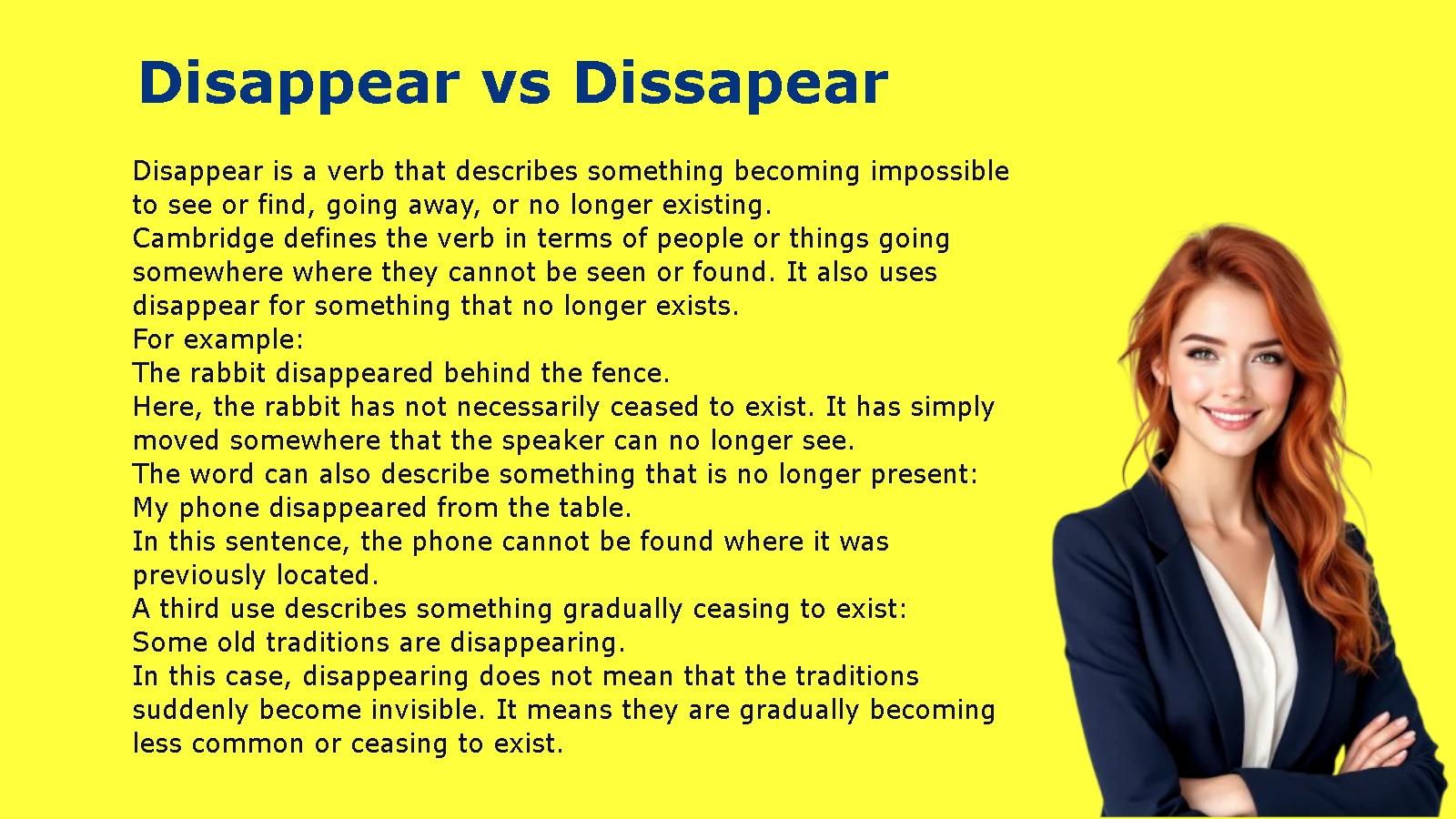
Disappear is a verb that describes something becoming impossible to see or find, going away, or no longer existing.
Cambridge defines the verb in terms of people or things going somewhere where they cannot be seen or found. It also uses disappear for something that no longer exists.
For example:
The rabbit disappeared behind the fence.
Here, the rabbit has not necessarily ceased to exist. It has simply moved somewhere that the speaker can no longer see.
The word can also describe something that is no longer present:
My phone disappeared from the table.
In this sentence, the phone cannot be found where it was previously located.
A third use describes something gradually ceasing to exist:
Some old traditions are disappearing.
In this case, disappearing does not mean that the traditions suddenly become invisible. It means they are gradually becoming less common or ceasing to exist.
Main meanings of disappear
The word can therefore describe several related situations:
- Becoming impossible to see: The bird disappeared into the trees.
- Becoming impossible to find: My wallet disappeared.
- Going away: He disappeared for several hours.
- Ceasing to exist: The species eventually disappeared.
- Becoming less noticeable: The mark disappeared after cleaning.
- Moving out of sight: The train disappeared around the corner.
The Oxford English Dictionary records multiple senses of disappear, including ceasing to be visible, ceasing to be present, ceasing to exist, and causing something to vanish.
Why Is Disappear the Correct Spelling?
The spelling becomes much easier to understand when you divide the word into its components:
dis + appear = disappear
The base word is appear:
- appear
- appearance
- appearing
- appeared
When dis- is added, the resulting word is:
disappear
The important point is that appear keeps its spelling.
Why not dissapear?
The incorrect form dissapear effectively treats the beginning of the word as though it were dis + sapear, which is not how the word is formed.
The spelling is not:
diss + apear
It is:
dis + appear
That gives you:
disappear
The Oxford English Dictionary traces disappear to dis- + appear and notes that the word was modeled on a French lexical item. Its earliest recorded English use dates to around 1425.
A simple spelling trick
When you are unsure, cover the first three letters:
dis | appear
You already know that appear contains two p’s.
Therefore:
dis + appear → disappear
This is more reliable than trying to memorize disappear as one long sequence of letters.
Disappear vs Dissapear: Key Difference
The difference is spelling, not meaning.
Disappear is an established English verb. Dissapear is simply a misspelling of it.
| Feature | Disappear | Dissapear |
| Standard English word | Yes | No |
| Correct spelling | Yes | No |
| Part of speech | Verb | — |
| Meaning | Become unseen, go away, or cease to exist | — |
| Example | The fog will disappear. | Incorrect |
| Dictionary entry | Yes | No |
If you see dissapear in a text, the intended word is almost certainly disappear.
Compare these sentences
Correct:
The magician made the coin disappear.
Incorrect:
The magician made the coin dissapear.
The first sentence uses the standard English spelling.
Disappear: Meaning and Usage
The verb disappear is flexible because the thing that disappears can be physical, abstract, temporary, or permanent.
A person can disappear
Sarah disappeared into the crowd.
The person is still presumably present, but the speaker can no longer see her.
An object can disappear
My glasses disappeared from the desk.
Here, disappear means the glasses are no longer where the speaker expected them to be.
Something can disappear from view
The boat disappeared over the horizon.
The boat has moved beyond what the observer can see.
Something can disappear gradually
The snow disappeared as the temperature increased.
The snow becomes smaller and eventually is no longer present.
Something abstract can disappear
Her fear gradually disappeared.
Fear is not a physical object, but the word works because the emotional state is no longer present.
Something can disappear from existence
The custom disappeared over time.
This means the custom stopped existing or stopped being practiced.
Cambridge specifically gives examples of disappear for becoming impossible to see or find and for something no longer existing.
Disappear in Sentences
Seeing the word in different contexts can make its usage clearer.
| Context | Example |
| Person | The child disappeared into the crowd. |
| Animal | The cat disappeared under the bed. |
| Object | My keys have disappeared again. |
| Weather | The clouds disappeared by noon. |
| Landscape | The road disappeared into the fog. |
| Emotion | His nervousness disappeared after a few minutes. |
| Problem | The problem did not simply disappear. |
| Tradition | The old custom is slowly disappearing. |
| Physical mark | The scratch eventually disappeared. |
| Technology | The notification disappeared from the screen. |
Notice that disappear does not always mean that something has literally vanished forever.
The surrounding context determines whether the thing has merely moved out of sight, cannot be found, or has actually ceased to exist.
Is Disappear a Verb?
Yes. Disappear is a verb.
More specifically, it is commonly used as an intransitive verb, meaning it normally does not take a direct object.
For example:
The bird disappeared.
The subject is the bird, and disappeared tells us what happened to it.
You would not normally say:
She disappeared the bird.
In ordinary usage, you would instead say:
The bird disappeared.
or:
She made the bird disappear.
Modern dictionaries also record specialized transitive uses of disappear, including constructions involving secretly removing something or the passive expression be disappeared in particular political or historical contexts. These are distinct from the ordinary everyday use of the verb.
For everyday English learners, the central pattern to remember is:
subject + disappear
Examples:
- The sun disappeared.
- The dog disappeared.
- The stain disappeared.
- The sound disappeared.
- The opportunity disappeared.
Disappear Verb Forms
Disappear is a regular verb.
| Verb form | Word | Example |
| Base form | disappear | The clouds may disappear. |
| Third-person singular | disappears | The fog disappears quickly. |
| Past tense | disappeared | The bird disappeared suddenly. |
| Past participle | disappeared | The problem has disappeared. |
| Present participle | disappearing | The snow is disappearing. |
Oxford lists these same principal forms: disappear, disappears, disappeared, and disappearing.
Disappear
Use the base form after modal verbs and with infinitives.
The clouds may disappear soon.
I expected the pain to disappear.
Disappears
Use disappears with a singular third-person subject in the present tense.
The moon disappears behind the clouds.
Disappeared
Use disappeared for the past tense and past participle.
The rabbit disappeared into the bushes.
The stain has disappeared.
Disappearing
Use disappearing as the present participle.
The sun is disappearing behind the mountain.
Cambridge explains that English verbs have forms including the base form, past form, past participle, -ing form, and third-person singular -s form.
Common Spelling Mistakes With Disappear
The most obvious mistake is dissapear, but writers sometimes make other errors because of the unusual-looking sequence of letters.
Dissapear
❌ dissapear
✅ disappear
The error usually comes from incorrectly doubling the s.
Disapear
❌ disapear
✅ disappear
This version removes one of the two p’s from appear.
Dissappeare
❌ dissappeare
✅ disappear
This combines several common spelling mistakes.
Dissapeared
❌ dissapeared
✅ disappeared
Remember that the past-tense ending is added to the correctly spelled base:
disappear + ed = disappeared
A useful correction pattern
| Incorrect | Correct |
| dissapear | disappear |
| disapear | disappear |
| dissappeared | disappeared |
| dissapearing | disappearing |
| dissapears | disappears |
The safest method is to identify appear inside the word.
dis + appear
Once you recognize that structure, the spelling becomes much easier.
Disappear vs Disappeared vs Disappearing
These forms come from the same verb, but they perform different grammatical jobs.
Disappear
Disappear is the base form.
The stars will disappear when the sun rises.
Disappears
Disappears is the present-tense form used with he, she, or it and other singular third-person subjects.
The stain disappears after several washes.
Disappeared
Disappeared is the past tense.
The dog disappeared through the open gate.
It is also the past participle:
The dog has disappeared.
Disappearing
Disappearing is the present participle and is used in continuous constructions.
The light is disappearing.
It can also function adjectivally in some contexts:
The disappearing coastline concerned local residents.
Cambridge identifies disappearing as the present participle of disappear.
Disappear vs Dissapear Examples
Here are common corrections that show exactly how the two spellings differ.
| Incorrect | Correct |
| The magician made the coin dissapear. | The magician made the coin disappear. |
| The pain should dissapear soon. | The pain should disappear soon. |
| The bird dissapeared behind the tree. | The bird disappeared behind the tree. |
| The fog is dissapearing. | The fog is disappearing. |
| The stain dissapears after washing. | The stain disappears after washing. |
| The old tradition is dissapearing. | The old tradition is disappearing. |
Case study: catching the error before publishing
Imagine you are proofreading this sentence:
The village slowly dissapeared into the distance.
The problem is not the tense. Dissapeared correctly attempts to form the past tense, but it starts with the wrong spelling.
Start with the base form:
disappear
Then add -ed:
disappeared
The corrected sentence is:
The village slowly disappeared into the distance.
This approach works for the other forms, too. Correct the base spelling first, then apply the appropriate grammatical ending.
Is Dissapear a Word?
No. “Dissapear” is not the standard spelling of the English verb.
The standard form is disappear.
Major dictionaries have entries for disappear, including Cambridge, Oxford, and the Oxford English Dictionary.
If you encounter dissapear online, in a message, or in an unpublished document, it is generally a spelling error rather than a separate English word with its own meaning.
That distinction matters because a word can appear frequently online and still be misspelled. Search engines, social media, informal writing, and user-generated content contain many spelling errors. Frequency alone does not make a spelling standard.
How to Remember the Spelling of Disappear
The simplest memory trick is to preserve the word appear.
Start with:
appear
Then add:
dis-
The result is:
disappear
Think of the word as two parts
DIS + APPEAR
The important visual pattern is:
APPEAR
not:
APEAR
and not:
SAPEAR
So when you add the prefix:
DIS + APPEAR = DISAPPEAR
Another useful memory sentence
You can remember:
If it appears and then goes away, it can disappear.
The words appear and disappear are closely connected in both form and meaning.
Disappear in Different Contexts
The meaning of disappear changes slightly depending on what disappears.
Disappear in everyday English
In ordinary conversation, disappear often means that someone or something is no longer visible or cannot be found.
Where did my phone go? It just disappeared.
The children disappeared into the house.
The dog disappeared around the corner.
This is one of the most common uses of the verb.
Disappear in formal writing
Formal writing often uses disappear for trends, practices, species, evidence, differences, or other abstract things.
Traditional methods are gradually disappearing.
The distinction disappears when the two categories are combined.
Several older features have disappeared from modern usage.
Cambridge gives examples of disappear referring to things that no longer exist, including flowers disappearing from fields and ways of life disappearing.
Disappear in figurative language
The word can describe abstract experiences too.
Her doubts disappeared after she received an explanation.
His confidence disappeared after the mistake.
The tension disappeared once everyone started laughing.
Nothing physically vanishes in these examples. Instead, a feeling or condition is no longer present.
Disappear With Common Prepositions and Patterns
Several constructions occur naturally with disappear.
Disappear from
Use disappear from when something is no longer present in a particular place, source, or situation.
The species disappeared from the region.
The option disappeared from the menu.
Disappear into
Use disappear into when someone or something moves into a place and becomes difficult or impossible to see.
She disappeared into the crowd.
The car disappeared into the tunnel.
Disappear behind
Use disappear behind when something moves out of sight behind another object.
The sun disappeared behind the clouds.
Disappear from sight
This phrase emphasizes becoming impossible to see.
The plane quickly disappeared from sight.
Oxford specifically lists constructions such as disappear behind, disappear from, and disappear into, along with phrases such as disappear from sight and disappear from view.
Disappear vs Similar Words
It has several close synonyms, but they are not always interchangeable.
| Word | Main idea | Example |
| disappear | Become unseen, unavailable, or nonexistent | The boat disappeared into the fog. |
| vanish | Disappear, often suddenly or completely | The magician made the coin vanish. |
| fade | Gradually become weaker, less visible, or less noticeable | The color faded in the sunlight. |
| dissolve | Break down or become incorporated into a liquid or another substance | The tablet dissolved in water. |
| evaporate | Change from liquid to vapor; also used figuratively | The water evaporated. |
| go away | Leave or cease to be present | The headache finally went away. |
| go missing | Become lost or impossible to locate | The documents went missing. |
Disappear vs vanish
The train disappeared around the bend.
Vanish can suggest something sudden, complete, or mysterious.
The coin vanished from his hand.
Cambridge lists vanish, go away, go missing, and fade away among words related to disappear, but their precise meanings and typical contexts differ.
Disappear vs fade
Fade usually suggests a gradual reduction rather than a sudden loss.
The photograph faded over time.
The photograph disappeared.
The first sentence suggests that the image gradually became less clear or less visible. The second can suggest that it ultimately became impossible to see.
Disappear Synonyms
The best synonym depends on what you want to communicate.
For becoming unseen
- vanish
- go out of sight
- become invisible
- pass from view
Example:
The plane vanished into the clouds.
For gradually becoming less noticeable
- fade
- fade away
- diminish
- weaken
Example:
The sound gradually faded away.
For becoming absent
- go away
- leave
- go missing
- be gone
Example:
The documents went missing overnight.
For ceasing to exist
- vanish
- cease to exist
- die out
- become extinct
Example:
Some languages have ceased to exist.
Using the most precise synonym makes your writing clearer. Disappear is often the safest general choice when you simply mean that something is no longer visible, present, or existing.
What Is the Noun Form of Disappear?
The main noun related to disappear is disappearance.
Disappear → verb
Disappearance → noun
For example:
The child disappeared.
The child’s disappearance was reported to the police.
The noun refers to the fact or event of being lost, becoming impossible to find, or no longer existing.
Oxford defines disappearance as the fact of being lost or impossible to find, as well as the fact of no longer existing or becoming impossible to see.
Examples of disappearance
- The police investigated the disappearance.
- The disappearance of the species happened gradually.
- His sudden disappearance surprised everyone.
- The disappearance of the old building changed the neighborhood.
Is Disappear an Adjective?
Disappear is a verb, not an adjective.
However, related forms can work adjectivally depending on context.
For example:
The disappearing coastline was a major concern.
Here, disappearing modifies coastline.
Similarly, disappeared can function as a participial adjective in some constructions:
The disappeared document was eventually found.
However, the most important distinction for learners is simple:
- disappear = verb
- disappearance = noun
- disappearing = present participle and sometimes adjective
- disappeared = past tense and past participle
Disappear Meaning for Kids
For children, a simple definition works best:
Disappear means to go somewhere or change so that you cannot see or find something anymore.
Examples:
- The rabbit disappeared behind the bush.
- My toy disappeared under the bed.
- The clouds disappeared after the rain.
- The ice disappeared as the sun became warmer.
A child does not need the more specialized meanings of the word to understand its basic use. The central idea is no longer visible or present.
Common Mistakes When Using Disappear
Spelling is not the only possible problem. Writers can also misuse the word grammatically or choose it when another verb would be more precise.
Mistake: Writing dissapear
❌ The fog will dissapear.
✅ The fog will disappear.
Mistake: Dropping a p
❌ The fog will disapear.
✅ The fog will disappear.
Remember:
appear → disappear
The two p’s remain.
Mistake: Using disappear when you mean fade
The paint disappeared.
This is possible, but if the paint gradually became less bright while remaining visible, faded may be more precise.
The paint faded in the sunlight.
Mistake: Assuming disappearance always means permanent loss
If someone says:
He disappeared into the kitchen.
they usually mean that he moved into the kitchen and is no longer visible, not that he ceased to exist.
Context determines the intended meaning.
A Practical Proofreading Test for Disappear vs Dissapear
If you regularly confuse these spellings, use a three-step check.
Step one: Find the base word
Identify appear.
Step two: Add the prefix
Add dis-.
Step three: Check the result
dis + appear = disappear
This method also helps with the related forms:
- disappear
- disappears
- disappeared
- disappearing
- disappearance
The spelling of the core appear sequence remains recognizable throughout these words.
Facts to Remember About Disappear
Here are the key facts in one place:
- Disappear is the correct spelling.
- Dissapear is a misspelling.
- Disappear is a verb.
- The word can mean becoming impossible to see or find.
- It can also mean going away or ceasing to exist.
- The word is formed from dis- + appear.
- Its past tense is disappeared.
- Its present participle is disappearing.
- Its third-person singular form is disappears.
- The main noun form is disappearance.
- Vanish is a close synonym, but it can suggest a more sudden or complete disappearance.
- Fade usually emphasizes a gradual reduction in visibility, strength, or intensity.
- The Oxford English Dictionary dates the earliest known English use of disappear to around 1425.
Frequently Asked Questions About Disappear vs Dissapear
Is disappear or dissapear correct?
Disappear is correct. Dissapear is a misspelling.
Why is disappear spelled with two p’s?
Because the word is formed from dis- + appear. The word appear already contains two p’s, so the spelling becomes disappear.
Is dissapear a word?
No. Dissapear is not the standard spelling of the English verb. The correct word is disappear.
How do you spell disappear correctly?
Spell it:
D-I-S-A-P-P-E-A-R
A useful way to remember it is:
dis + appear = disappear
What is the past tense of disappear?
The past tense is disappeared.
The bird disappeared into the trees.
What is the present participle of disappear?
The present participle is disappearing.
The fog is disappearing.
What is the noun form of disappear?
The main noun form is disappearance.
The police investigated his disappearance.
Is disappear a verb?
Yes. Disappear is a verb. Cambridge and Oxford both classify it as a verb.
What is the difference between disappear and vanish?
Both can mean that something becomes impossible to see or find. Disappear is the more general term, while vanish can emphasize a sudden, complete, or mysterious disappearance.
What is the opposite of disappear?
Depending on the context, possible opposites include:
- appear
- arrive
- emerge
- become visible
- come into view
- remain
The most direct opposite is usually appear.
Can disappear mean stop existing?
Yes. For example:
Some traditional practices are slowly disappearing.
Here, disappearing means that the practices are gradually ceasing to exist or be used. Cambridge explicitly includes this meaning.
Can you say disappear from?
Yes.
The species disappeared from the region.
Disappear from is a standard construction.
Can you say disappear into?
Yes.
The child disappeared into the crowd.
This construction describes movement into a place or group where the person or thing becomes difficult or impossible to see. Oxford lists disappear into among the word’s common constructions.
Conclusion: Disappear vs Dissapear
When choosing between disappear vs dissapear, there is only one correct standard spelling: disappear.
The easiest way to remember it is to recognize that the word consists of dis- + appear. Since appear contains two p’s, the correct spelling is:
disappear
not:
dissapear
The word is a verb that can mean to become impossible to see or find, go away, or cease to exist. Its main forms are disappear, disappears, disappeared, and disappearing, while disappearance is the related noun.
So if you’re proofreading an email, essay, article, school assignment, or professional document, use disappear every time.
Correct: disappear
Incorrect: dissapear
Once you remember dis + appear, this spelling mistake becomes much easier to avoid.