Challenge vs challange is a common spelling question, but only one form is correct in standard English. Challenge is the correct spelling, while challange is a misspelling. You can use challenge as a noun for a difficult task, test, or competition and as a verb meaning to question something or test someone’s abilities. Understanding its spelling, meaning, pronunciation, synonyms, and common expressions will help you use the word confidently in everyday conversations, academic writing, and professional communication.
The word also appears in familiar phrases such as “challenge accepted,” “life challenges,” and “challenge yourself.” Each expression carries a slightly different meaning. This guide explains the difference between challenge and challange, provides original sentence examples, compares related words, and shows how to use the term naturally in different situations.
Challenge vs Challange: Which Spelling Is Correct?
Challenge is the correct spelling in standard English. Challange is incorrect and should not appear in formal writing, school assignments, business emails, or published content. The mistake usually occurs when writers remember the sound of the word but confuse the letters in its middle.
Here is the difference at a glance:
| Word | Correct spelling? | Meaning | Example |
| Challenge | Yes | A difficult task, test, competition, or act of questioning | Learning to drive was a challenge. |
| Challange | No | A common misspelling of challenge | Incorrect: She accepted the challange. |
| Challenged | Yes | The past tense of the verb challenge or an adjective in certain contexts | He challenged the final decision. |
| Challenging | Yes | Difficult, demanding, or testing | The course was challenging. |
| Challenges | Yes | The plural noun or third-person singular verb form | Every job has challenges. |
The key is to remember the correct letter sequence: c-h-a-l-l-e-n-g-e.
For example:
- Correct: The teacher gave us a challenging assignment.
- Incorrect: The teacher gave us a challanging assignment.
- Correct: She accepted the challenge without hesitation.
- Incorrect: She accepted the challange without hesitation.
The same spelling rule applies to related forms. Write challenged, challenging, and challenges, not variations that preserve the incorrect spelling.
Why Is Challange Incorrect?
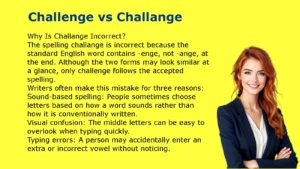
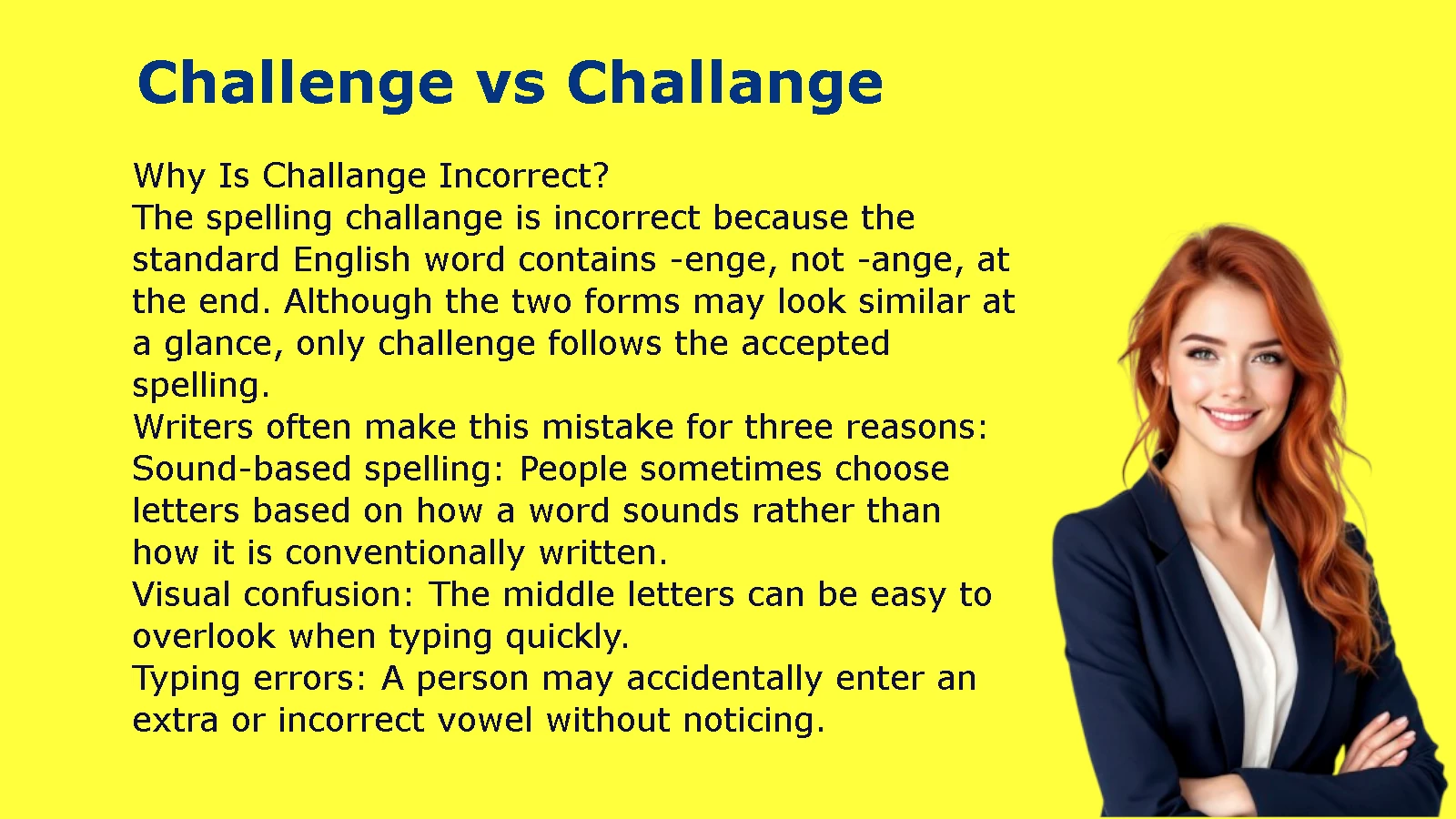
The spelling challange is incorrect because the standard English word contains -enge, not -ange, at the end. Although the two forms may look similar at a glance, only challenge follows the accepted spelling.
Writers often make this mistake for three reasons:
- Sound-based spelling: People sometimes choose letters based on how a word sounds rather than how it is conventionally written.
- Visual confusion: The middle letters can be easy to overlook when typing quickly.
- Typing errors: A person may accidentally enter an extra or incorrect vowel without noticing.
The solution is simple: memorize the final part of the word as lenge, with an e before the final n sound sequence is completed.
Compare these spellings:
- Challenge — correct
- Challange — incorrect
- Chalenge — incorrect
- Challenging — correct
- Challenged — correct
Spell-checking tools can help catch the mistake, but they should not replace proofreading. A useful habit is to check words that you frequently mistype before submitting an assignment or publishing an article.
Challenge vs Challange Examples
Examples make the spelling difference easier to recognize. In each pair below, the first sentence uses the correct spelling, while the second shows the mistake.
| Correct sentence | Incorrect sentence |
| The puzzle was a real challenge. | The puzzle was a real challange. |
| She enjoys every new challenge. | She enjoys every new challange. |
| We faced several challenges at work. | We faced several challanges at work. |
| He challenged the referee’s decision. | He challanged the referee’s decision. |
| The final examination was challenging. | The final examination was challanging. |
You can also practice the correct spelling in everyday contexts.
At school: Completing the science project was a challenge because the experiment required careful planning.
At work: Our team accepted the challenge of finishing the presentation before Friday.
In personal life: Moving to a new city presented challenges, but it also created opportunities to meet new people.
In conversation: “You think I can’t solve this puzzle? Challenge accepted!”
Notice that the word changes form according to the sentence, but the spelling pattern remains consistent.
Challenge Meaning and Definition
A challenge is something that tests your abilities, effort, knowledge, or determination. As a noun, it can describe a difficult task, competition, or objection. As a verb, challenge means to test someone, invite competition, or question whether a statement or decision is correct.
The exact meaning depends on the context. A challenging examination tests knowledge, a sporting challenge tests skill, and a legal challenge questions the validity of a decision.
Challenge as a Noun
As a noun, challenge refers to a task, situation, or demand that requires effort or ability. It can also describe a contest or a formal objection.
Consider these common meanings:
A difficult task
A challenge may require you to learn something new, solve a problem, or overcome an obstacle.
Example: Learning to speak confidently in public was her biggest challenge.
A test of ability
A challenge can measure how well someone performs under pressure.
Example: The coding competition offered a challenge to experienced programmers.
An invitation to compete
People sometimes issue a challenge to invite others to prove their skills.
Example: The chess player accepted his friend’s challenge.
A formal objection
In legal, political, or professional contexts, a challenge may question a decision, claim, or procedure.
Example: The company filed a legal challenge against the ruling.
Although these meanings differ, they share one central idea: a challenge puts an ability, claim, decision, or situation to the test.
Challenge as a Verb
As a verb, challenge describes the act of testing, confronting, or questioning someone or something.
Here are the main uses:
- To test someone’s ability: The instructor challenged the students with a complex problem.
- To question a statement: The journalist challenged the official’s explanation.
- To invite competition: The runner challenged his teammate to a race.
- To oppose a decision: The organization challenged the new policy in court.
- To encourage improvement: A good coach challenges athletes to improve their performance.
The verb can be used in several grammatical forms.
| Verb form | Example |
| Base form: challenge | I challenge you to solve this riddle. |
| Third-person singular: challenges | The course challenges every student. |
| Past tense: challenged | She challenged the result. |
| Present participle: challenging | They are challenging the decision. |
| Past participle: challenged | The original claim was challenged. |
A useful distinction is that challenge does not always mean making something harder. It can also mean questioning an idea that others accept without examination.
For example, a student who challenges an answer may be asking the teacher to explain the reasoning. The student is not necessarily being disrespectful; the student may simply be testing whether the answer is correct.
Challenge in a Sentence
The following examples demonstrate how the word works in different situations.
| Sentence | Meaning of challenge |
| Starting a new business is a challenge. | A demanding task |
| The coach challenged the team to improve. | Tested or encouraged ability |
| She challenged the accuracy of the report. | Questioned a claim |
| The two players accepted the challenge. | Agreed to compete |
| Finding affordable housing can be challenging. | Difficult or demanding |
| He challenged himself to read every day. | Set a personal test |
| The lawyer challenged the evidence. | Formally questioned its validity |
| Our biggest challenge was meeting the deadline. | Main obstacle or demand |
When writing your own sentences, ask yourself what the word describes. If it refers to a demanding situation, use it as a noun. If it describes questioning, testing, or confronting something, use it as a verb.
How to Spell Challenge Correctly
To spell challenge correctly, write the letters in this order: C-H-A-L-L-E-N-G-E. The word contains nine letters. Its ending is -enge, which distinguishes it from the common misspelling challange.
You do not need a complicated spelling rule to remember it. Focus on the word’s written form and practice using it in a few meaningful sentences.
Easy Ways to Remember the Spelling
These techniques can help you avoid typing challange by mistake.
Remember the ending
The correct spelling ends in -enge. Picture the final letters together rather than trying to remember the entire word at once.
Use a complete sentence
Writing the word in context can make the spelling easier to recall.
For example: “Every challenge gives me a chance to learn.”
Practice related words
Learn the main forms together:
- Challenge
- Challenges
- Challenged
- Challenging
Seeing the same spelling pattern in several words reinforces the correct form.
Proofread slowly
When checking a document, look specifically for challange and challanging. A quick search in your word processor can help identify these mistakes.
Use a memory cue
You might remember the phrase: “A challenge requires a change in effort.” The phrase is a memory aid, not a spelling rule, but it can help you recall the correct form.
Common Misspellings of Challenge
Several incorrect forms appear when people type the word quickly or rely on sound.
| Misspelling | Correct form | Explanation |
| Challange | Challenge | Incorrect vowel in the ending |
| Chalenge | Challenge | Missing one l |
| Challanging | Challenging | Incorrect spelling of the base word |
| Challanged | Challenged | Incorrect spelling of the base word |
| Challanges | Challenges | Incorrect spelling of the base word |
Remember that challenging is correct, even though it looks longer and contains a different ending. The spelling changes from challenge to challenging according to the usual English spelling pattern for words ending in silent e.
For example:
- The assignment presents a challenge.
- The assignment is challenging.
- The assignment challenged the students.
- The students overcame several challenges.
Learning these forms as a group can prevent errors in essays, reports, emails, and online articles.
Challenge Synonyms and Related Words
Challenge synonyms include difficulty, obstacle, hurdle, test, trial, contest, and dispute. However, these words are not interchangeable in every sentence. Choose a synonym based on whether you mean a difficult task, a competition, or an act of questioning.
For example, obstacle emphasizes something that blocks progress, while contest emphasizes competition. The word dispute often refers to disagreement over a claim or decision.
Challenge Synonyms by Meaning
| Synonym | Best use | Example |
| Difficulty | A problem that requires effort | She experienced difficulty understanding the instructions. |
| Obstacle | Something that blocks progress | Lack of funding became an obstacle. |
| Hurdle | A problem that must be overcome | Passing the entrance exam was the first hurdle. |
| Test | A situation that measures ability | The interview was a test of his communication skills. |
| Trial | A difficult experience or formal test | The first year brought several trials. |
| Contest | A competition between people | She entered a writing contest. |
| Dare | An invitation to do something bold | He accepted the dare. |
| Dispute | A disagreement over a claim or decision | The parties entered a dispute over the contract. |
| Question | An act of examining a claim | The researcher questioned the assumption. |
| Demand | A requirement that needs effort | The new role placed heavy demands on the team. |
For SEO writers and students, understanding these distinctions helps prevent awkward word substitutions. A synonym should preserve the original meaning, not merely sound similar.
Challenge vs Difficulty
Both challenge and difficulty describe situations that require effort, but they emphasize different aspects.
A difficulty usually highlights the problem itself. A challenge often emphasizes the task of responding to that problem or testing one’s ability.
Compare these sentences:
- “The difficult instructions caused confusion.”
- “Learning the new system was a challenge.”
The first sentence focuses on the problem. The second presents the learning process as something demanding that the person must work through.
However, the words can overlap. You can say, “We faced difficulties during the project,” or “We faced challenges during the project.” Both are correct.
Challenge vs Obstacle
An obstacle is something that stands in the way of progress. A challenge is a demanding task or situation that tests your ability.
For example, a lack of reliable internet access may be an obstacle to completing an online course. Learning to manage a demanding course schedule may be a challenge.
The distinction matters because one word describes a barrier, while the other can describe the broader task of dealing with that barrier.
Use obstacle when you want to emphasize what is blocking progress. Use challenge when you want to describe the demanding situation as a whole.
Challenge vs Dare
A dare usually invites someone to do something bold, risky, unusual, or difficult. A challenge has a broader meaning and can involve learning, competition, problem-solving, or questioning an idea.
For example:
- Dare: “I dare you to sing in front of the entire class.”
- Challenge: “I challenge you to improve your test score by ten points.”
A dare often carries a playful or provocative tone. A challenge may be serious, professional, educational, or recreational.
Although people sometimes use the words similarly, challenge is generally the more flexible choice.
What Does “Challenge Accepted” Mean?
“Challenge accepted” means that someone agrees to attempt a difficult task, meet a demanding goal, or respond to an invitation to compete. People often use the expression confidently or humorously when someone suggests that a task may be too difficult.
The phrase is common in everyday conversation, games, competitions, and social media captions. It communicates willingness to try, but it does not guarantee success.
Challenge Accepted Examples
Here are examples of how people use the phrase naturally.
Example: Fitness
Friend A: “I bet you can’t complete thirty push-ups.”
Friend B: “Challenge accepted!”
The second person agrees to attempt the physical task.
Example: Cooking
Roommate: “Can you make a restaurant-quality meal with only five ingredients?”
Cook: “Challenge accepted.”
The cook accepts the task as a test of creativity and skill.
Example: Work
Manager: “We need to prepare the presentation by tomorrow morning.”
Team member: “Challenge accepted. I’ll organize the slides and divide the research.”
Here, the expression communicates confidence and readiness to act.
Example: Games
Player A: “I can finish this level without losing a life.”
Player B: “Challenge accepted.”
The second player agrees to attempt the same test.
How to Use “Challenge Accepted” in Conversation
The expression works best when someone presents a task, goal, or competition.
Use it when:
- A friend proposes a difficult puzzle.
- A colleague sets an ambitious target.
- Someone doubts your ability to complete a task.
- You want a playful caption for a personal achievement.
- You agree to participate in a friendly competition.
You can also use it in writing, although the tone is usually casual.
For a professional email, a more direct alternative may be appropriate:
- “I’m happy to take this on.”
- “I’m ready to work toward that goal.”
- “I’ll do my best to meet the deadline.”
- “I accept the challenge and will share an update tomorrow.”
These alternatives communicate commitment without the playful tone of “challenge accepted.”
What Does “Challenges in Life” Mean?
Challenges in life are difficult situations that test a person’s patience, abilities, decisions, resources, or resilience. They can arise from work, finances, education, relationships, family responsibilities, or unexpected changes. Some challenges last only a short time, while others require long-term planning and support.
The phrase does not mean that every difficulty automatically leads to success. It simply describes situations that require a person to respond, adapt, or make decisions.
Common Challenges in Life
People face different challenges depending on their circumstances. Some common examples include the following.
Financial pressure
Managing expenses, paying bills, saving money, or dealing with an unexpected cost can place pressure on individuals and families.
Example: “One of his biggest challenges was managing his expenses while studying.”
Work and academic demands
Deadlines, difficult exams, new responsibilities, and unfamiliar skills can require sustained effort.
Example: “Balancing a full-time job with university classes was a major challenge.”
Relationship problems
Misunderstandings, disagreements, and changing family responsibilities can require patience and clear communication.
Example: “Their biggest challenge was learning to discuss disagreements calmly.”
Adjusting to change
Moving to a new city, starting a new job, or adapting to a different routine can disrupt familiar habits.
Example: “Starting over in a new country presented several challenges.”
Personal setbacks
A missed opportunity, an unsuccessful project, or a change in plans may force someone to reconsider their next steps.
Example: “The failed business venture became a challenge that required careful reflection.”
These examples show why the meaning of challenges in life depends on context. The phrase can describe practical problems, emotional demands, or situations that require a change in behavior.
How to Deal With Life’s Challenges
You cannot control every difficult situation, but you can often control how you respond. A structured approach makes large problems easier to understand and manage.
Identify the actual problem.
Describe what is happening without exaggerating it. Instead of saying, “Everything is going wrong,” identify the specific issue: “I have three assignments due this week and only two evenings available.”
Break the problem into smaller steps.
Large tasks often feel overwhelming because they combine several smaller responsibilities. Divide them into manageable actions.
For example, a job seeker might update a résumé, identify suitable openings, submit applications, and prepare for interviews rather than treating the entire job search as one enormous task.
Focus on what you can control.
You may not control another person’s decision or an unexpected delay. You can still control your preparation, communication, and next action.
Ask for support when necessary.
A teacher, colleague, friend, mentor, or qualified professional may offer advice or practical help. Seeking support is a sensible response to a demanding situation.
Review your progress.
Check what is working and what needs to change. If your original approach does not help, adjust it instead of repeating the same steps indefinitely.
A Practical Example of Overcoming a Challenge
Imagine a student who struggles to complete assignments on time.
At first, the student describes the problem as “being bad at studying.” That description is too broad to guide action.
After reviewing the week, the student discovers that most assignments begin late because the student spends too much time deciding which task to start.
The student then creates a short daily task list, estimates the time required for each assignment, and starts with the nearest deadline.
The original challenge has not disappeared, but it has become easier to manage because the student identified a specific cause and chose practical steps.
This example illustrates an important point: understanding a challenge is often the first step toward addressing it.
Challenge Pronunciation
The word challenge is commonly pronounced /ˈtʃæl.ɪndʒ/ in English. It has two syllables, with the stress on the first syllable. The opening sound is the same sound heard at the beginning of chair, while the final sound resembles the ending of change.
Pronunciation can vary slightly between accents, but the standard spelling remains challenge.
How to Pronounce Challenge
Use these points to practice:
- Syllables: Two
- Stress: First syllable
- First sound: The “ch” sound heard in chair
- Middle vowel: Similar to the short vowel in cat
- Ending: A sound similar to the ending of change
Say the word slowly, then repeat it at a natural conversational speed. Focus on the first syllable rather than placing equal stress on both parts.
Practice with these sentences:
- “This is a difficult challenge.”
- “She accepted the challenge.”
- “The course is challenging.”
- “We faced several challenges.”
Reading the word in context can help you develop a more natural rhythm than repeating it in isolation.
Challenge vs Challange: Does Pronunciation Change?
Challenge is the accepted English spelling. Challange is a misspelling, so it is not a standard alternative spelling with an established pronunciation of its own.
Someone who reads the misspelling may guess how to say it, but that does not make it a correct form.
If you are learning English, focus on learning the written form and pronunciation together. For example, write challenge in a sentence, say the sentence aloud, and check the spelling before moving to another example.
This method helps connect the word’s appearance, sound, and meaning.
Challenge in Videos, Movies, and Online Trends
The word challenge also appears in entertainment, social media, and film discussions. These uses connect to the general idea of testing abilities or attempting something difficult, but searches for a specific video or movie may have a different intent from searches about spelling.
A spelling article can answer these related questions briefly without losing focus on the main topic.
What Is a Challenge Video?
A challenge video is a video in which someone attempts a task, participates in a competition, follows a trend, or tests a skill. Creators may record the process, share the result, or invite viewers to try the same activity.
Common examples include:
- Fitness challenges that track exercise progress.
- Cooking challenges that limit ingredients or preparation time.
- Learning challenges that document progress over several days.
- Puzzle challenges that test memory or problem-solving.
- Creative challenges that encourage drawing, photography, or writing.
For example, a creator might publish a video documenting thirty days of language practice. The challenge is the structured task, while the video shows the process and results.
Not every challenge is safe or suitable for everyone. Activities involving dangerous stunts, harmful substances, or pressure to take unnecessary risks should be avoided.
What Does Challenge Mean in Movies?
In a movie, a challenge can refer to a difficult goal, conflict, competition, or personal test that a character must face. The challenge may involve defeating an opponent, solving a mystery, rebuilding a relationship, or confronting a personal weakness.
For example, a character might face the challenge of protecting a family while dealing with limited resources. Another character might challenge an unfair rule or question an authority figure’s decision.
The term can also appear in film titles. If you are searching for a particular movie called Challenge, the spelling article alone may not identify the film you want. The country, release year, language, actor, or plot can help distinguish one title from another.
This difference matters for search intent: someone searching for challenge meaning needs a definition, while someone searching for challenge movie may want film information.
Challenge as an Online Trend
An online challenge invites people to complete an activity and share their results through social media or another digital platform.
These trends can encourage creativity, exercise, learning, or community participation. For instance, a daily drawing challenge may help participants practice a skill by completing one small task each day.
However, popularity does not make every trend worthwhile. Before participating, consider whether the activity is physically safe, respects other people’s privacy, and avoids damaging property or encouraging harmful behavior.
The word challenge describes the activity, not whether that activity is beneficial or sensible.
Challenge vs Challange: Quick Summary
The difference between challenge vs challange is straightforward: challenge is the correct English spelling, while challange is a misspelling.
Remember these key points:
- Correct spelling: Challenge
- Incorrect spelling: Challange
- Noun meaning: A difficult task, test, competition, or objection
- Verb meaning: To test, question, confront, or invite competition
- Common expression: “Challenge accepted” means agreeing to attempt a task
- Life challenges: Difficult situations that require effort, decisions, or adaptation
- Pronunciation: Two syllables, with stress on the first
Here is one final example that brings the main points together:
“Although learning a new language was a challenge, she challenged herself to practice every day and gradually improved her skills.”
In this sentence, the noun challenge describes the demanding task, while the verb challenged describes the action of setting a personal test.
When writing, remember the correct letter sequence and check related forms such as challenged, challenging, and challenges. If you are writing an article, you can also connect this topic naturally to related pages about commonly confused spellings, English vocabulary, synonyms, and word meanings.