A “no problem” is a common expression used to tell someone that something is okay, acceptable, or not an inconvenience. It is often used as a response to an apology, a request, a thank-you, or a minor mistake. If you’ve come across “no problem” and wondered what other expressions you can use instead, there are many alternatives that can sound more friendly, casual, professional, polite, or reassuring, depending on the situation.
The other ways to say “no problem” include expressions such as “you’re welcome,” “no worries,” “not at all,” “of course,” “my pleasure,” “don’t worry about it,” “it’s all good,” and “happy to help.” However, these alternatives are not always interchangeable. Some work best when responding to “thank you,” while others are more natural after an apology, request, or inconvenience.
In this guide, you’ll learn the best ways to say “no problem” in different situations, including casual conversations, professional emails, workplace communication, customer service, and friendly interactions. You’ll also see clear examples of how to use each alternative and learn which expressions are more appropriate for formal and informal situations.
By the end, you’ll know exactly what to say instead of “no problem” and how to choose the right expression based on the context, tone, and person you’re speaking or writing to.
The Best Alternatives to “No Problem” at a Glance
Here are some of the most useful replacements, depending on the situation:
| Alternative | Tone | Formality | Best For | Example |
| You’re welcome | Polite | Neutral | Thank-you responses | “You’re welcome. Glad I could help.” |
| No worries | Relaxed | Casual | Friends and coworkers | “No worries. I’ve got it.” |
| My pleasure | Warm | Professional | Clients and customers | “My pleasure. I’m glad I could help.” |
| Happy to help | Friendly | Professional | Workplace communication | “Happy to help. Let me know if you need anything else.” |
| Of course | Helpful | Neutral | Requests | “Of course. I’ll send it over.” |
| Certainly | Confident | Formal | Business communication | “Certainly. I’ll take care of that.” |
| Anytime | Warm | Casual | Friends and family | “Anytime! Just let me know.” |
| Not at all | Polite | Neutral/Formal | Thanks or apologies | “Not at all. It was no trouble.” |
| Sure thing | Cheerful | Casual | Requests | “Sure thing. I’ll handle it.” |
| Don’t mention it | Modest | Neutral | Small favors | “Don’t mention it. Happy to help.” |
| Glad to help | Warm | Professional | Work and support | “Glad to help with the project.” |
| Absolutely | Enthusiastic | Neutral | Requests | “Absolutely. I’ll get that done.” |
The important point is that these phrases aren’t perfect synonyms. “You’re welcome” usually responds to gratitude, while “certainly” is more naturally used to accept a request. “It’s okay” is more appropriate when someone apologizes.
What Does “No Problem” Mean?
“No problem” has several related meanings in everyday English.
Cambridge defines it as an informal expression used to show that you will or can do what someone has asked, and also as a friendly response when someone thanks you.
Collins likewise notes several uses, including responding to a request, indicating that something is acceptable, and functioning as a casual equivalent of “you’re welcome.”
“No Problem” as a Response to “Thank You”
This is probably the use you’re most likely to encounter.
“Thanks for helping me with that.”
“No problem!”
Here, “no problem” means something like “You’re welcome” or “It was no trouble.”
Other natural responses include:
- You’re welcome.
- My pleasure.
- Happy to help.
- Glad I could help.
- Anytime.
- Not at all.
“No Problem” After an Apology
The meaning changes slightly when someone says sorry.
“Sorry I’m late.”
“No problem. Don’t worry about it.”
Here, you’re reassuring the person that their mistake or inconvenience isn’t serious.
Better alternatives might include:
- It’s okay.
- No worries.
- Don’t worry about it.
- It’s all right.
- No big deal.
- You’re fine.
“No Problem” as Agreement to a Request
You can also use the phrase when someone asks you to do something.
“Could you send me the report?”
“No problem. I’ll send it this afternoon.”
In this case, “no problem” means “Yes, I can do that.”
Natural alternatives include:
- Of course.
- Certainly.
- Absolutely.
- Sure thing.
- You got it.
- I’d be happy to.
- Consider it done.
This distinction matters because “you’re welcome” would not normally work as a response to the request itself.
30 Other Ways to Say “No Problem”
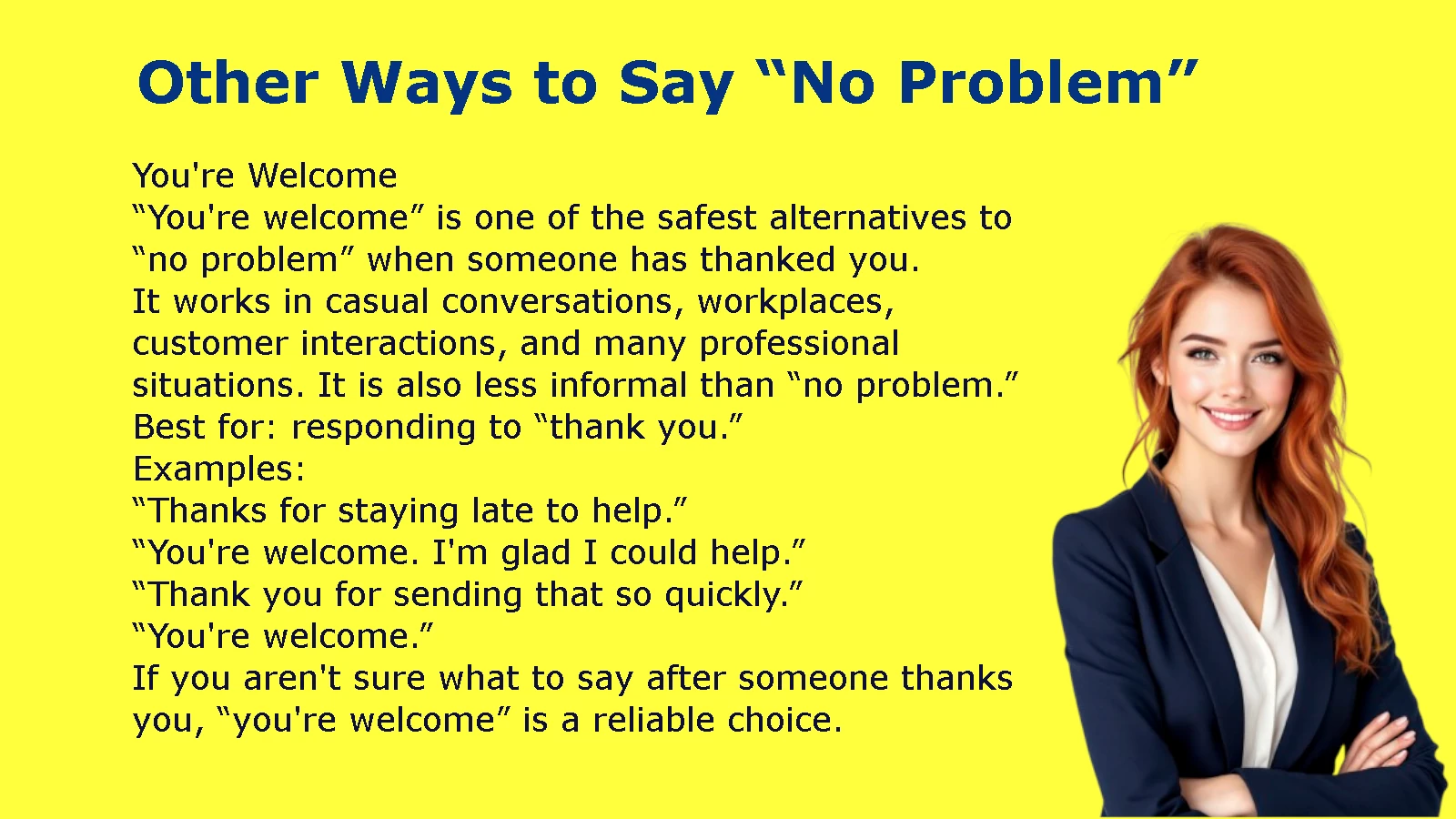
You’re Welcome
“You’re welcome” is one of the safest alternatives to “no problem” when someone has thanked you.
It works in casual conversations, workplaces, customer interactions, and many professional situations. It is also less informal than “no problem.”
Best for: responding to “thank you.”
Examples:
“Thanks for staying late to help.”
“You’re welcome. I’m glad I could help.”
“Thank you for sending that so quickly.”
“You’re welcome.”
If you aren’t sure what to say after someone thanks you, “you’re welcome” is a reliable choice.
No Worries
“No worries” is relaxed, friendly, and common in casual American English.
It can respond to thanks or apologies.
Best for: friends, family, texting, and informal workplace conversations.
Examples:
“Thanks for picking me up.”
“No worries!”
“Sorry I forgot to call.”
“No worries. It happens.”
Because it is casual, it may not be the first choice for a highly formal business email.
My Pleasure
“My pleasure” sounds warm, courteous, and professional.
It works especially well when someone thanks you for providing assistance.
Best for: customers, clients, professional conversations, and polished service interactions.
Examples:
“Thank you for walking me through the process.”
“My pleasure. I’m glad I could help.”
“Thanks for taking care of that.”
“My pleasure.”
It communicates more warmth than a simple “no problem.”
Happy to Help
“Happy to help” is an excellent workplace alternative.
It tells the other person that you were willing to assist rather than simply saying the task wasn’t difficult.
Best for: coworkers, clients, customers, managers, and professional emails.
Examples:
“Thanks for helping me prepare the presentation.”
“Happy to help.”
“I really appreciate you looking into this.”
“Happy to help. Let me know if you need anything else.”
It is friendly without sounding overly casual.
Of Course
“Of course” is particularly useful when someone asks you to do something.
“Could you send me the updated file?”
“Of course.”
It can also respond to thanks:
“Thanks for your help.”
“Of course!”
The exact meaning depends on context.
Best for: everyday conversations, coworkers, friends, and many workplace situations.
Certainly
“Certainly” sounds confident and professional.
It works especially well when agreeing to a request.
“Could you arrange a new appointment?”
“Certainly. I’ll take care of that.”
It is more formal than “sure” or “no problem,” making it useful in customer service and business communication.
Anytime
“Anytime” communicates warmth and suggests you’re willing to help again.
“Thanks for helping me move.”
“Anytime!”
It works particularly well with friends, family, and people you know well.
Best for: casual conversations and relationships where future help is likely.
Not at All
“Not at all” can communicate that something wasn’t an inconvenience.
“Thank you for waiting.”
“Not at all.”
It can also work after an apology:
“Sorry for causing you extra work.”
“Not at all. It’s perfectly fine.”
This phrase can sound somewhat more polished or traditional than “no problem.”
Sure Thing
“Sure thing” is an upbeat, casual way to agree to a request.
“Can you grab me a coffee?”
“Sure thing.”
It is especially natural in conversations with friends, family, and friendly coworkers.
It is less suitable when you need a highly formal tone.
Don’t Mention It
“Don’t mention it” means that the favor was small enough that the other person doesn’t need to thank you.
“Thanks for dropping off my keys.”
“Don’t mention it.”
It is polite and modest, although it can sound slightly traditional compared with expressions such as “no worries” or “happy to help.”
Glad to Help
“Glad to help” sounds warm while remaining professional.
“Thanks for answering all my questions.”
“Glad to help.”
It works particularly well when you want to show genuine willingness without sounding overly formal.
Absolutely
“Absolutely” is an enthusiastic response to a request.
“Could you take a look at this?”
“Absolutely.”
It can also follow gratitude in some contexts:
“Thanks for handling that.”
“Absolutely. Happy to help.”
However, “absolutely” is more naturally an agreement than a direct equivalent of “you’re welcome.”
You Got It
“You got it” is a casual American English expression meaning something like “Sure” or “I’ll take care of it.”
“Can you send me the address?”
“You got it.”
It’s natural among friends and coworkers who have an informal relationship.
No Trouble
“No trouble” emphasizes that the favor or task wasn’t inconvenient.
“Thanks for helping me with the boxes.”
“No trouble.”
It is understandable and natural, although “no worries” or “happy to help” may sound more conversational in many American English settings.
Not a Problem
“Not a problem” is very close to the original phrase.
“Thanks for fixing that.”
“Not a problem.”
It can also respond to a request:
“Can you change the appointment?”
“Not a problem.”
The two phrases are often interchangeable in casual speech.
All Good
“All good” is a casual reassurance.
“Sorry about the mix-up.”
“All good.”
It is especially natural in texting and informal conversations.
Because it is quite relaxed, it isn’t the strongest option for a formal business email.
It Was Nothing
“It was nothing” minimizes the effort you made.
“Thanks for helping me carry everything.”
“It was nothing.”
It can sound humble and friendly when the favor was genuinely small.
However, be careful with serious situations. If someone is expressing deep gratitude for something important, saying “it was nothing” could unintentionally minimize what the gesture meant to them.
It Was My Pleasure
“It was my pleasure” is a more complete and polished version of “my pleasure.”
“Thank you for helping us resolve the issue.”
“It was my pleasure.”
It works well in professional or formal communication, especially when you want to sound courteous without being overly stiff.
Glad I Could Help
“Glad I could help” is particularly useful after you’ve completed a task.
“Thanks for getting that sorted out.”
“Glad I could help.”
It sounds natural in workplace conversations and customer interactions.
I’m Happy to Help
“I’m happy to help” is another strong professional alternative.
“Thank you for taking care of this.”
“I’m happy to help.”
It sounds slightly more complete and deliberate than “happy to help.”
This makes it a good option for professional emails.
Of Course, Anytime
Combining expressions can create a warmer response.
“Thanks again for helping me.”
“Of course, anytime!”
This works best with friends, family, and close coworkers.
It communicates both acceptance of the thanks and willingness to help again.
No Need to Thank Me
“No need to thank me” is a warm response when someone is especially grateful.
“Thank you so much for doing that.”
“No need to thank me. I’m happy to help.”
Use it with people you know well. In a formal setting, “you’re welcome” or “my pleasure” is usually smoother.
Don’t Worry About It
“Don’t worry about it” is most useful after an apology or when someone is concerned about inconveniencing you.
“Sorry I forgot to bring the paperwork.”
“Don’t worry about it. We can handle it tomorrow.”
This is not a direct replacement for “you’re welcome.”
It’s All Right
“It’s all right” is another way to reassure someone after an apology.
“I’m sorry about the delay.”
“It’s all right. We still have plenty of time.”
It sounds neutral and calm.
It’s Okay
“It’s okay” is one of the most natural responses to an apology.
“Sorry I interrupted you.”
“It’s okay.”
It can also reassure someone who worries that they’ve caused an inconvenience.
Again, this phrase is not normally a replacement for “you’re welcome” after thanks.
No Big Deal
“No big deal” means that something was not important or inconvenient.
“Thanks for covering my shift.”
“No big deal.”
It is casual and works best with friends or familiar coworkers.
Avoid it when someone is expressing serious appreciation for a significant effort.
You Bet
“You bet” is a casual American expression that can mean “certainly,” “you’re welcome,” or “of course,” depending on context.
“Could you help me move this?”
“You bet.”
“Thanks for your help.”
“You bet.”
It’s friendly and conversational, but it isn’t appropriate for every professional setting.
Sure
Sometimes the simplest answer works best.
“Can you send that to me?”
“Sure.”
“Sure” is particularly common in texts and everyday conversations.
However, when someone says “thank you,” simply replying “sure” can sound less natural than “you’re welcome,” “no problem,” or “happy to help.”
Consider It Done
“Consider it done” is a confident way to accept a request.
“Could you have these documents ready by Friday?”
“Consider it done.”
It doesn’t directly replace “you’re welcome.” Instead, it replaces “no problem” when the phrase means “Yes, I’ll take care of it.”
Professional Ways to Say “No Problem”
Although “no problem” isn’t inherently rude, it is an informal expression. Cambridge and Collins both identify it as informal, particularly in its conversational uses.
That doesn’t mean you must avoid it at work. In an informal workplace chat, it can be perfectly natural.
Still, client-facing communication, formal correspondence, and sensitive professional situations may call for a more polished response.
Good professional alternatives include:
- You’re welcome
- Happy to help
- My pleasure
- Glad to assist
- Certainly
- Of course
- I’m happy to help
- I’d be glad to help
- It was my pleasure
Best Professional Alternative After “Thank You”
If a client says:
“Thank you for your quick response.”
You could say:
“You’re welcome. I’m glad I could help.”
Or:
“My pleasure. Please let me know if you need anything else.”
Both responses acknowledge the person’s appreciation without sounding overly casual.
Best Professional Alternative When Someone Makes a Request
If a manager says:
“Could you send me the revised figures this afternoon?”
Instead of:
“No problem.”
You could write:
“Certainly. I’ll send them this afternoon.”
Or:
“Of course. I’ll have them ready this afternoon.”
These responses clearly communicate agreement and provide useful confirmation.
Ways to Say “No Problem” at Work
The right phrase depends on your relationship and the situation.
| Situation | Natural Choice | Why It Works |
| Coworker thanks you | Happy to help | Friendly and professional |
| Manager thanks you | You’re welcome | Neutral and respectful |
| Client thanks you | My pleasure | Warm and polished |
| Customer thanks you | My pleasure | Courteous and service-oriented |
| Coworker asks for help | Of course | Helpful and natural |
| Manager assigns a task | Certainly | Confident and professional |
| Close coworker asks a favor | Sure thing | Friendly and relaxed |
| Team member apologizes | It’s okay | Reassuring |
| Client makes a request | I’d be happy to | Professional and positive |
What to Say to Your Boss
When responding to a manager, “you’re welcome,” “certainly,” “of course,” and “happy to help” are usually safe choices.
The best option depends on whether you’re responding to gratitude or accepting a request.
“Thanks for getting that done so quickly.”
“You’re welcome. Glad I could help.”
“Could you update these numbers?”
“Certainly. I’ll take care of it.”
What to Say to a Coworker
With coworkers, you usually have more flexibility.
Natural options include:
- No worries.
- Happy to help.
- Sure thing.
- Of course.
- Anytime.
- No problem.
- Glad to help.
Your workplace culture matters here. A relaxed team may use “no worries” constantly, while a more formal environment may favor “happy to help” or “certainly.”
What to Say to a Customer or Client
Client-facing communication generally benefits from warmth and clarity.
Try:
- My pleasure.
- You’re very welcome.
- Happy to help.
- Certainly.
- I’d be happy to assist.
- Glad I could help.
Avoid extremely casual responses such as “you bet” or “no big deal” when you’re communicating with an unfamiliar client.
Best Alternatives to “No Problem” in an Email
Email gives you more room to be precise, so choose an expression based on what the recipient actually said.
When Someone Thanks You
Thank you for sending the updated information.
A natural response:
You’re welcome. I’m glad I could help.
Or:
My pleasure. Please feel free to reach out if you need anything else.
When Someone Asks You to Do Something
Could you send me the revised document by Thursday?
A professional response:
Certainly. I’ll send the revised document by Thursday.
Or:
Of course. I’ll take care of that and send it over shortly.
When Someone Apologizes
I’m sorry for the delay.
A suitable response:
No worries. Thanks for keeping me updated.
For a more formal setting:
Not at all. Thank you for letting me know.
Casual Ways to Say “No Problem”
Casual conversations give you much more freedom.
Some natural choices include:
- No worries.
- Sure thing.
- Anytime.
- You got it.
- All good.
- No big deal.
- You bet.
- Of course.
- Absolutely.
Casual Alternatives for Friends
“Thanks for picking me up.”
“No worries!”
“Could you send me that photo?”
“Sure thing!”
“Sorry I forgot.”
“All good.”
These short responses sound much more natural in casual speech than highly formal expressions such as “I was happy to assist you.”
Casual Alternatives for Texting
Text messages often favor brevity.
Good options include:
- Sure!
- Yep!
- No worries!
- Anytime!
- Of course!
- You got it!
- All good!
- Absolutely!
The right choice depends on your relationship and the conversation.
Ways to Say “No Problem” After Someone Says “Thank You”
This is where many supposedly interchangeable alternatives actually differ.
| If someone says… | Natural response |
| “Thanks!” | You’re welcome! |
| “Thanks so much!” | My pleasure! |
| “I really appreciate it.” | Happy to help! |
| “Thanks for doing that.” | Of course! |
| “I owe you one.” | Anytime! |
| “Thanks for your help.” | Glad I could help. |
| “Thanks for taking care of this.” | My pleasure. |
| “Thanks for the favor.” | Don’t mention it. |
A Useful Rule
When someone says “thank you,” think about whether you want to communicate:
- Politeness → You’re welcome
- Warmth → My pleasure
- Willingness to help → Happy to help
- Future availability → Anytime
- Casual friendliness → No worries
- Humility → Don’t mention it
This gives you much more control over your tone.
Ways to Respond to “Sorry” Instead of Saying “No Problem”
When someone apologizes, don’t automatically reach for “you’re welcome.”
For example:
“Sorry I’m late.”
You could say:
- It’s okay.
- No worries.
- Don’t worry about it.
- It’s all right.
- No big deal.
- You’re fine.
- Not at all.
When “It’s Okay” Is Better Than “You’re Welcome”
Consider this conversation:
“Sorry I interrupted you.”
“It’s okay.”
“You’re welcome” would sound strange because nobody expressed gratitude.
Now compare:
“Thanks for letting me know.”
“You’re welcome.”
Here, “you’re welcome” makes sense because the person thanked you.
The difference seems simple, but understanding it makes your English sound much more natural.
Ways to Say “No Problem” When Agreeing to a Request
When someone asks you to do something, choose an expression that communicates agreement or willingness.
Good choices include:
- Of course.
- Certainly.
- Absolutely.
- Sure thing.
- You got it.
- I’d be happy to.
- I’m happy to help.
- Consider it done.
For example:
“Could you check these figures?”
Instead of:
“No problem.”
You can say:
“Absolutely. I’ll check them now.”
Or:
“Certainly. I’ll take a look.”
This makes your response more specific and confident.
Warm and Friendly Alternatives to “No Problem”
Sometimes you don’t want to sound merely polite. You want the other person to know that you genuinely enjoyed helping.
Try:
- Happy to help
- Glad to help
- Glad I could help
- My pleasure
- Anytime
- Always happy to help
- Of course
- You’re very welcome
For example:
“Thank you for helping me prepare for the interview.”
A warm response could be:
“I’m glad I could help. I hope it goes really well!”
That feels more personal than a simple “no problem.”
Is “No Problem” Polite or Professional?
“No problem” is generally polite and natural, but it is informal.
That distinction matters.
It is perfectly normal in everyday American English:
“Thanks for grabbing that for me.”
“No problem.”
It is also common in informal workplace communication:
“Can you update the spreadsheet?”
“No problem.”
The issue is not that the expression is inherently rude. Rather, some professional settings may favor more traditional or polished alternatives.
For example:
“Thank you for your assistance.”
could receive:
“My pleasure.”
That sounds more deliberately courteous than:
“No problem.”
Some people also dislike “no problem” because they feel that saying something wasn’t a “problem” subtly frames the favor as something that could have been troublesome. That perception exists, but it does not mean the phrase is universally considered rude or inappropriate. Current dictionary definitions continue to recognize its conventional use as a friendly response to thanks and requests.
The safest approach is to consider audience, relationship, and context.
“No Problem” vs. “No Worries” vs. “You’re Welcome” vs. “My Pleasure”
These expressions overlap, but they aren’t identical.
| Phrase | Usually responds to | Tone | Formality | Main idea |
| No problem | Thanks, requests, apologies | Casual/neutral | Informal-neutral | It wasn’t an issue |
| No worries | Thanks/apologies | Relaxed | Casual | Don’t worry |
| You’re welcome | Thanks | Polite | Neutral | Acknowledges gratitude |
| My pleasure | Thanks | Warm | Professional | I was happy to help |
| Certainly | Requests | Confident | Formal | Yes, I can do that |
| It’s okay | Apologies | Reassuring | Neutral | Don’t worry about it |
| Happy to help | Thanks/assistance | Warm | Professional | I was willing to help |
Which One Sounds Most Natural in American English?
There isn’t one universal winner.
Use “you’re welcome” when someone thanks you and you want a neutral, universally understood response.
Choose “no worries” when you’re speaking casually.
Use “my pleasure” when you want to sound warm and polished.
Pick “happy to help” when you’re in a workplace or service environment and want to sound approachable.
Use “certainly” when someone makes a request and you want a professional, confident response.
Which “No Problem” Alternative Should You Use?
Here’s the quickest way to choose.
| Your Situation | Best Choice |
| Someone says “Thank you” | You’re welcome |
| A client thanks you | My pleasure |
| A coworker thanks you | Happy to help |
| A friend thanks you | No worries |
| Someone apologizes | It’s okay |
| Someone asks for help | Of course |
| Formal request | Certainly |
| Close friend asks a favor | Sure thing |
| Customer thanks you | My pleasure |
| Quick text | No worries / Sure |
| You want to sound warm | Glad to help |
| You want to sound cheerful | Absolutely |
| You want to sound confident | Certainly |
| You want to offer future help | Anytime |
| You want to sound modest | Don’t mention it |
The key is simple: don’t search for a single replacement for “no problem.” Choose a phrase that matches what you’re actually communicating.
Common Mistakes When Replacing “No Problem”
Using Casual Expressions in Formal Emails
A phrase like “you bet” may sound perfectly natural with a friend but unusual in a formal client email.
Instead, use:
- You’re welcome.
- Certainly.
- My pleasure.
- Happy to help.
Saying “You’re Welcome” After an Apology
This is a common context mistake.
“Sorry I’m late.”
“You’re welcome” doesn’t logically answer an apology.
Better:
“It’s okay.”
Or:
“No worries.”
Saying “It’s Okay” When You Mean “Yes”
Suppose your manager asks:
“Could you finish this today?”
“It’s okay” doesn’t clearly communicate agreement.
Better:
“Certainly.”
Or:
“Absolutely. I’ll take care of it.”
Treating Every Alternative as a Direct Synonym
This is the biggest mistake.
“No problem,” “you’re welcome,” “no worries,” “certainly,” and “it’s okay” overlap, but they perform different conversational functions.
Learning that distinction is more useful than memorizing dozens of synonyms.
Natural Examples of “No Problem” Alternatives
Workplace Conversation
Coworker: “Thanks for reviewing that report.”
You: “Happy to help.”
Business Email
Client: “Thank you for sending the updated proposal.”
You: “You’re welcome. Please let me know if you’d like us to clarify anything.”
Customer Service
Customer: “Thanks for taking care of that so quickly.”
Representative: “My pleasure. I’m glad we could resolve it.”
Text Message
Friend: “Can you send me the address?”
You: “Sure thing!”
Conversation With a Friend
Friend: “Thanks for picking me up.”
You: “Anytime!”
Responding to an Apology
Friend: “Sorry I forgot to bring it.”
You: “No worries. You can bring it tomorrow.”
Agreeing to a Request
Coworker: “Could you send me the figures before lunch?”
You: “Absolutely. I’ll send them over shortly.”
Frequently Asked Questions About Other Ways to Say “No Problem”
What is another way to say “no problem”?
Common alternatives include “you’re welcome,” “no worries,” “my pleasure,” “happy to help,” “of course,” “certainly,” “anytime,” and “not at all.” The best choice depends on whether you’re responding to thanks, an apology, or a request.
What is a professional way to say “no problem”?
For professional communication, consider “you’re welcome,” “my pleasure,” “happy to help,” “certainly,” “I’d be happy to assist,” or “glad I could help.”
What can I say instead of “no problem” after someone says thank you?
The most natural choices are “you’re welcome,” “my pleasure,” “happy to help,” “glad I could help,” “anytime,” and “not at all.”
What is a polite way to say “no problem”?
“You’re welcome,” “my pleasure,” “not at all,” and “happy to help” are polite alternatives. The most appropriate choice depends on how formal the conversation is.
Is “no worries” the same as “no problem”?
They overlap, but they’re not identical. “No worries” is more casual and often reassures someone that there is nothing to worry about. “No problem” can also indicate willingness to fulfill a request.
Is “no problem” professional?
It can be acceptable in informal workplace communication, but it is generally classified as an informal expression. In formal client communication or business writing, “you’re welcome,” “my pleasure,” “certainly,” or “happy to help” may sound more polished.
What is a casual way to say “no problem”?
Try “no worries,” “sure thing,” “anytime,” “you got it,” “all good,” “no big deal,” or “you bet.”
What can I say instead of “no problem” in an email?
For a professional email, use “you’re welcome,” “my pleasure,” “happy to help,” “certainly,” or “I’d be happy to assist.”
How do you respond to “thank you” professionally?
Natural professional responses include:
- You’re welcome.
- My pleasure.
- Happy to help.
- Glad I could help.
- It was my pleasure.
- You’re very welcome.
What do you say instead of “no problem” after an apology?
Use “it’s okay,” “no worries,” “don’t worry about it,” “it’s all right,” “not at all,” or “no big deal,” depending on the seriousness and formality of the situation.
Conclusion
There are plenty of other ways to say “no problem,” but the best alternative isn’t always a direct synonym.
If someone says “thank you,” try “you’re welcome,” “my pleasure,” or “happy to help.”
If someone says “sorry,” use “it’s okay,” “no worries,” or “don’t worry about it.”
For professional communication, “happy to help,” “my pleasure,” “certainly,” and “you’re welcome” are dependable choices. For friends and casual texting, “no worries,” “anytime,” “you got it,” and “sure thing” sound more relaxed.
The simplest rule is this: choose the phrase based on the situation, not just the words you’re trying to replace. That small adjustment can make your English sound more natural, confident, and appropriate in almost any conversation.