Looking for other ways to say “Have a Nice Day”? You have plenty of options, from simple phrases such as “Have a great day” and “Enjoy your day” to warmer expressions like “Hope today treats you well” and professional alternatives such as “Enjoy the rest of your day.”
“Have a nice day” is already polite, friendly, and perfectly acceptable. However, repeating the same phrase can make your emails, texts, customer interactions, or everyday conversations sound predictable. The best alternative depends on who you are talking to, when you are saying it, and the tone you want to create.
Here are 27 natural alternatives, organized by tone and situation.
| Alternative | Best for | Tone |
| Have a great day | Almost any situation | Friendly, upbeat |
| Enjoy your day | Casual and professional conversations | Warm, natural |
| Have a wonderful day | Emails and personal messages | Warm, polished |
| Enjoy the rest of your day | Later in the day | Professional, friendly |
| Hope you have a great day | Friends, coworkers, customers | Friendly |
| Wishing you a wonderful day | Emails and formal messages | Polished |
| Have an amazing day | Friends and enthusiastic messages | Energetic |
| Hope your day goes well | Busy or important days | Supportive |
| Have a fantastic day | Casual conversations | Cheerful |
| Make the most of your day | Encouragement | Motivational |
| Have a productive day | Work and school | Professional |
| Take care and enjoy your day | Friends and colleagues | Caring |
| Hope today treats you well | Supportive conversations | Thoughtful |
| Have a lovely day | Friendly or polite situations | Gentle |
| Have a pleasant day | Formal communication | Formal |
| Enjoy the rest of your afternoon | Afternoon conversations | Natural |
| Have a relaxing day | Someone taking time off | Caring |
| Have a good one | Casual conversations | Casual |
| Enjoy the rest of your week | End-of-week conversations | Friendly |
| Hope you have a good one | Texts and casual speech | Relaxed |
| Make today a good one | Encouragement | Upbeat |
| Wishing you a great day ahead | Professional messages | Polished |
| Have a beautiful day | Personal conversations | Warm |
| Enjoy every moment today | Special occasions | Heartfelt |
| Hope you enjoy the rest of your day | Customer service and work | Courteous |
| Take care | Short goodbyes | Caring |
| All the best for today | Work and formal situations | Professional |
What Does “Have a Nice Day” Mean?
“Have a nice day” is a polite expression used to wish someone an enjoyable or pleasant day, usually when ending a conversation or interaction.
The word nice can describe something pleasant or enjoyable, and Cambridge Dictionary specifically gives “Have a nice day!” as an example of this use.
For example:
“Thanks for stopping by. Have a nice day!”
The expression usually functions as a friendly closing rather than a literal instruction. You are not telling someone what they must do. You are expressing a positive wish for the rest of their day.
It can work in many settings:
- Conversations with friends
- Workplace interactions
- Customer service
- Emails
- Phone calls
- Text messages
- Retail transactions
- Appointments
- Meetings
The phrase is broad enough to fit almost any ordinary situation, which is one reason it remains so useful.
Is “Have a Nice Day” Polite?
Yes. “Have a nice day” is polite and grammatically correct.
It is also relatively neutral. That makes it useful when you want to end an interaction pleasantly without sounding overly formal or overly familiar.
The only potential drawback is repetition. If you use the exact phrase dozens of times in emails or customer interactions, it can begin to sound routine.
That does not make the expression bad. It simply means that another phrase may sometimes communicate your intended tone more precisely.
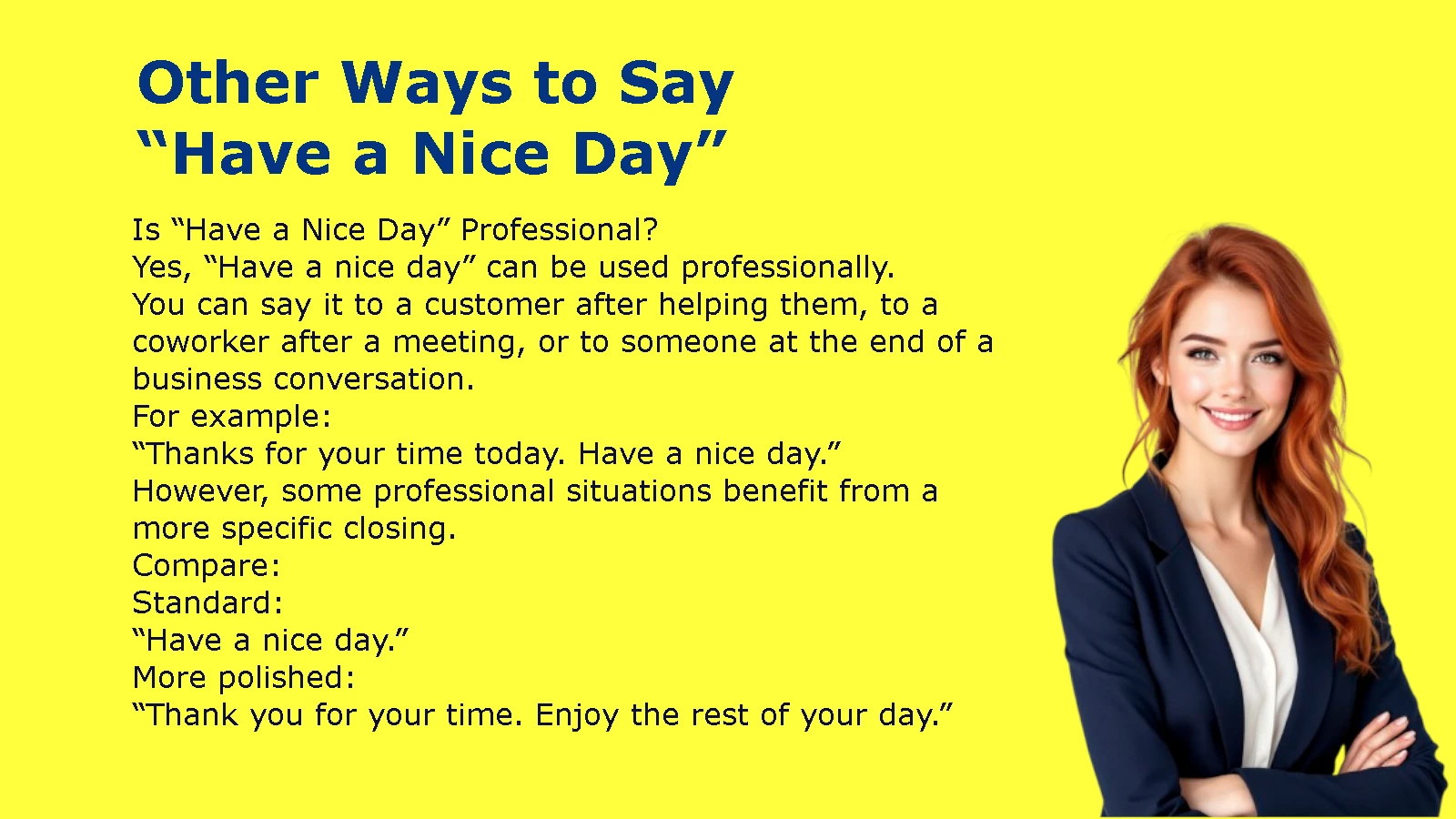
Is “Have a Nice Day” Professional?
Yes, “Have a nice day” can be used professionally.
You can say it to a customer after helping them, to a coworker after a meeting, or to someone at the end of a business conversation.
For example:
“Thanks for your time today. Have a nice day.”
However, some professional situations benefit from a more specific closing.
Compare:
Standard:
“Have a nice day.”
More polished:
“Thank you for your time. Enjoy the rest of your day.”
The second version connects the closing to the interaction and can feel more deliberate.
In professional writing, you can also use:
- “Enjoy the rest of your day.”
- “Wishing you a wonderful day.”
- “Have a great afternoon.”
- “I hope you have a great day.”
- “All the best for today.”
The right choice depends on your relationship with the recipient and the formality of the message.
Why Use Other Ways to Say “Have a Nice Day”?
There is nothing wrong with saying “Have a nice day.” The reason to learn alternatives is not that the original phrase is incorrect.
Instead, alternatives give you more control over your communication.
To Avoid Repetition
If every email ends with the same sentence, your writing can become predictable.
Instead of:
“Thanks for your help. Have a nice day.”
you could write:
“Thanks for your help. Enjoy the rest of your afternoon.”
A small change makes the closing feel more connected to the situation.
To Match Your Tone
“Have a nice day” is neutral. Other expressions can be more specific.
For example:
- Casual: “Have a good one!”
- Professional: “Enjoy the rest of your day.”
- Warm: “Hope today treats you well.”
- Enthusiastic: “Have an amazing day!”
- Motivational: “Make the most of your day.”
- Caring: “Take care and enjoy your day.”
The phrase should match the relationship and situation.
To Sound More Personal
A personalized closing often feels more genuine than a generic one.
If a coworker has an important presentation, for example, you might say:
“Good luck with your presentation. Hope your day goes well!”
That is more relevant than simply saying:
“Have a nice day.”
27 Best Alternatives to “Have a Nice Day”
Here are the most useful alternatives, with explanations and examples.
Have a Great Day
“Have a great day” is probably the easiest replacement for “Have a nice day.”
It keeps the same basic meaning but sounds slightly more enthusiastic. You can use it with friends, coworkers, customers, acquaintances, or strangers.
Example:
“Thanks for coming in. Have a great day!”
Best for: Everyday conversations, work, customer service, and emails.
Tone: Friendly and upbeat.
Enjoy Your Day
“Enjoy your day” puts the emphasis on enjoyment rather than simply wishing the day to be “nice.”
It sounds natural in both spoken and written English.
Example:
“It was great catching up with you. Enjoy your day!”
This works particularly well after a pleasant interaction.
Best for: Friends, coworkers, customers, and casual professional situations.
Tone: Warm and natural.
Have a Wonderful Day
If you want something warmer than “Have a nice day,” try “Have a wonderful day.”
“Wonderful” adds more enthusiasm without making the sentence sound overly casual.
Example:
“Thank you for taking the time to meet with me. Have a wonderful day.”
Best for: Emails, colleagues, customers, friends, and polite messages.
Tone: Warm and polished.
Enjoy the Rest of Your Day
“Enjoy the rest of your day” is especially useful when part of the day has already passed.
For example, if you finish a meeting at 3 p.m., you can say:
“Thanks for meeting with me. Enjoy the rest of your day.”
It sounds natural because you are specifically referring to the remaining part of the day.
Best for: Workplaces, meetings, appointments, customer service, and emails.
Tone: Professional and friendly.
Hope You Have a Great Day
This version sounds slightly more personal because it expresses a hope rather than simply giving a standard farewell.
Example:
“I hope everything goes smoothly with your presentation. Hope you have a great day!”
You can also shorten it to:
“Hope you have a great day!”
Best for: Friends, coworkers, texts, emails, and supportive messages.
Tone: Friendly and sincere.
Wishing You a Wonderful Day
“Wishing you a wonderful day” is a polished alternative that works particularly well in writing.
It has a slightly more formal feel than “Have a wonderful day.”
Example:
“Thank you for your continued support. Wishing you a wonderful day.”
Best for: Professional emails, customer messages, cards, and formal communication.
Tone: Warm and respectful.
Have an Amazing Day
Use “Have an amazing day” when you want more enthusiasm.
It works especially well with friends, family, younger coworkers, or someone who has something exciting planned.
Example:
“You deserve a break after all that work. Have an amazing day!”
Best for: Casual and enthusiastic conversations.
Tone: Energetic and positive.
Hope Your Day Goes Well
“Hope your day goes well” is a particularly useful alternative when someone has a busy or difficult day ahead.
For example:
“I know you have a big meeting today. Hope your day goes well!”
The phrase focuses on how the day unfolds rather than simply wishing the person a pleasant day.
Best for: Coworkers, friends, stressful situations, and supportive conversations.
Tone: Thoughtful and encouraging.
Have a Fantastic Day
“Have a fantastic day” is an enthusiastic version of the standard expression.
It works well when you want to sound cheerful without becoming overly sentimental.
Example:
“Thanks for your help today. Have a fantastic day!”
Best for: Casual conversations, customer service, and friendly emails.
Tone: Cheerful and energetic.
Make the Most of Your Day
This phrase has a more motivational quality.
Instead of simply wishing someone a good day, “Make the most of your day” encourages them to use the day well.
Example:
“You finally have the afternoon off. Make the most of your day!”
Best for: Encouragement, friends, students, coworkers, and motivational messages.
Tone: Positive and motivating.
Have a Productive Day
If you are talking about work, school, studying, or a project, “Have a productive day” can be more relevant than “Have a nice day.”
Example:
“Good luck with your deadline. Have a productive day!”
This phrase is especially appropriate when the person’s plans revolve around getting things done.
Best for: Workplaces, studying, business communication, and professional messages.
Tone: Professional and encouraging.
Take Care and Enjoy Your Day
Combining “take care” with a positive day wish creates a warmer goodbye.
Example:
“It was great seeing you. Take care and enjoy your day!”
This works because “take care” adds a personal element while “enjoy your day” keeps the message upbeat.
Best for: Friends, family, coworkers, and people you know reasonably well.
Tone: Caring and friendly.
Hope Today Treats You Well
“Hope today treats you well” is more expressive than the standard phrase.
It can be particularly appropriate when someone has had a difficult week or is facing an important day.
Example:
“You’ve been dealing with a lot lately. Hope today treats you well.”
Best for: Supportive messages and personal conversations.
Tone: Empathetic and thoughtful.
Have a Lovely Day
“Have a lovely day” is a gentle alternative to “Have a nice day.”
“Lovely” means pleasant or enjoyable, although its use can vary by region and context. Cambridge Dictionary lists it as meaning pleasant or enjoyable and notes that it is mainly UK in this sense.
Example:
“Thanks for stopping by. Have a lovely day!”
Best for: Friendly conversations, customer service, and polite messages.
Tone: Warm and gentle.
Have a Pleasant Day
If you need a more formal alternative, “Have a pleasant day” is a good choice.
“Pleasant” means enjoyable, attractive, friendly, or easy to like, and Cambridge gives “a pleasant day” as an example.
Example:
“Thank you for contacting our office. Have a pleasant day.”
The phrase can sound more formal than “Have a great day,” so it is particularly useful in professional or customer-facing situations.
Best for: Formal communication and customer service.
Tone: Polite and formal.
Enjoy the Rest of Your Afternoon
When the time of day is obvious, making your farewell specific can sound more natural.
For example:
“Thanks for your help. Enjoy the rest of your afternoon!”
This is especially useful in workplaces.
You can also say:
- “Enjoy the rest of your morning.”
- “Enjoy the rest of your evening.”
- “Have a great afternoon.”
- “Have a relaxing evening.”
Best for: Professional conversations and everyday interactions.
Tone: Natural and courteous.
Have a Relaxing Day
If someone is taking time off, recovering from a busy period, or simply planning a quiet day, “Have a relaxing day” may be more appropriate than “Have a nice day.”
Example:
“You’ve worked hard all week. Have a relaxing day!”
Best for: Friends, coworkers, family, and people taking time off.
Tone: Caring and considerate.
Have a Good One
“Have a good one” is one of the most casual alternatives.
It is short, natural, and common in everyday speech.
Example:
“Thanks for stopping by. Have a good one!”
The phrase is intentionally less specific than “Have a nice day.” Depending on the context, “one” can refer to the day or another period of time.
Best for: Casual conversations.
Tone: Relaxed and informal.
Hope You Have a Good One
This is a slightly warmer variation of “Have a good one.”
Example:
“I’ll send the files over this afternoon. Hope you have a good one!”
It works particularly well in texts, chats, and informal workplace communication.
Best for: Text messages, DMs, and casual conversations.
Tone: Relaxed and friendly.
Make Today a Good One
“Make today a good one” is an encouraging alternative.
It suggests that the person has some control over how they approach the day.
Example:
“You’ve got this. Make today a good one!”
Best for: Encouragement and motivational messages.
Tone: Positive and upbeat.
Wishing You a Great Day Ahead
This is a polished alternative that works well in professional writing.
Example:
“Thank you for your time and consideration. Wishing you a great day ahead.”
It can sound more formal than ordinary conversation, so it is generally better suited to emails and written messages.
Best for: Professional emails and customer communication.
Tone: Polished and courteous.
Have a Beautiful Day
“Have a beautiful day” adds emotional warmth to the standard farewell.
It can sound more personal, so consider the relationship before using it in a formal business email.
Example:
“Thank you for being there for me. Have a beautiful day.”
Best for: Friends, family, and personal messages.
Tone: Warm and heartfelt.
Enjoy Every Moment Today
This expression is more reflective than “Have a nice day.”
It encourages someone to appreciate the experiences they have throughout the day.
Example:
“It’s your birthday, so enjoy every moment today!”
Best for: Special occasions and personal messages.
Tone: Heartfelt and positive.
Hope You Enjoy the Rest of Your Day
This is a useful professional variation because it sounds courteous without being overly formal.
Example:
“Thank you for your patience. I hope you enjoy the rest of your day.”
It works particularly well in customer service and workplace communication.
Best for: Customer service, emails, and professional conversations.
Tone: Courteous and warm.
Take Care
Sometimes the best alternative is much shorter.
“Take care” is a common friendly farewell that expresses concern for someone’s well-being.
Example:
“It was great talking with you. Take care!”
Unlike “Have a nice day,” it does not specifically refer to the day. That makes it useful when the timing is irrelevant.
Best for: Friends, family, coworkers, and casual conversations.
Tone: Caring and friendly.
All the Best for Today
“All the best for today” works when someone has something important coming up.
For example:
“Good luck with the interview. All the best for today!”
It is not a direct synonym for “Have a nice day,” but it can serve a similar positive closing function.
Best for: Professional communication, interviews, exams, presentations, and important events.
Tone: Supportive and professional.
Which Alternative to “Have a Nice Day” Should You Use?
The best phrase depends on your situation.
| Situation | Best choice |
| General conversation | Have a great day |
| Customer service | Enjoy the rest of your day |
| Professional email | Wishing you a wonderful day |
| Friend | Have an amazing day |
| Someone having a difficult day | Hope today treats you well |
| Someone with lots of work | Have a productive day |
| Someone taking time off | Have a relaxing day |
| Casual goodbye | Have a good one |
| Important event | All the best for today |
| Afternoon conversation | Enjoy the rest of your afternoon |
| Personal message | Have a beautiful day |
| Motivational message | Make the most of your day |
| Formal customer communication | Have a pleasant day |
Professional Ways to Say “Have a Nice Day”
When writing to a customer, client, manager, colleague, or business contact, you may want something polished but not stiff.
Here are some of the best professional options:
- Enjoy the rest of your day.
- Have a great day.
- Wishing you a wonderful day.
- I hope you have a great day.
- Have a pleasant day.
- Enjoy the rest of your afternoon.
- Wishing you a great day ahead.
- Hope you enjoy the rest of your day.
- All the best for today.
Professional Email Examples
Customer service:
Thank you for reaching out. I’m glad I could help. Enjoy the rest of your day.
Coworker:
Thanks for your input during the meeting. Have a great day!
Client:
Thank you for taking the time to speak with me. Wishing you a wonderful day.
Formal customer communication:
Thank you for contacting our team. We appreciate your patience. Have a pleasant day.
The key is not to make every business closing overly formal. “Have a great day” is often more natural than an unnecessarily elaborate sentence.
Casual Ways to Say “Have a Nice Day”
When you’re talking to friends, family, or someone you know well, you can be more relaxed.
Try:
- Have a good one!
- Have a great day!
- Have an amazing day!
- Enjoy your day!
- Take care!
- Hope you have a good one!
- Make today a good one!
- Have a fantastic day!
- Have a beautiful day!
For a text message, you could write:
“Good luck today! Have an amazing day 😊”
Or:
“Catch you later. Have a good one!”
These feel more natural than forcing a formal expression into a casual conversation.
Warm and Thoughtful Alternatives
Sometimes you want your goodbye to show genuine care.
In those situations, consider:
- Hope today treats you well.
- Take care and enjoy your day.
- Hope your day goes well.
- Have a relaxing day.
- Enjoy every moment today.
- Have a beautiful day.
- Wishing you a wonderful day.
For example:
“I know you’ve got a lot on your plate today. Hope your day goes well.”
That message does more than simply wish someone a pleasant day. It acknowledges their circumstances.
Is “Have a Nice Day” Better Than “Have a Great Day”?
Neither phrase is universally better.
The difference is mainly tone.
Have a nice day is neutral and polite.
Have a great day sounds a little more enthusiastic.
Compare:
“Thank you for visiting. Have a nice day.”
with:
“Thank you for visiting. Have a great day!”
Both are completely natural. The second simply carries a little more energy.
If you want a safe, universal option, “Have a great day” is probably the strongest everyday replacement.
Common Mistakes When Choosing an Alternative
Not every positive phrase works equally well in every situation.
Don’t Use Overly Personal Language in Formal Emails
A phrase such as:
“Have a beautiful day!”
may feel perfectly natural to a friend but slightly personal in a formal business message.
For a client, choose:
“Enjoy the rest of your day.”
Don’t Force Formal Language Into Casual Conversations
“Have a pleasant day” is grammatically fine, but it can sound stiff among close friends.
A friend would probably expect:
“Have a good one!”
rather than:
“Have a pleasant day.”
Don’t Treat Every Alternative as a Direct Synonym
Some expressions change the meaning slightly.
For example:
- “Take care” focuses on well-being.
- “Have a productive day” focuses on accomplishment.
- “Make the most of your day” is motivational.
- “Hope today treats you well” expresses a hope about someone’s experience.
- “Enjoy the rest of your day” specifically refers to the remaining part of the day.
That distinction matters if you want your message to sound natural.
A Quick Decision Guide
If you’re unsure what to say, use this simple rule:
Want a universal phrase?
Have a great day.
Want something professional?
Enjoy the rest of your day.
Want something casual?
Have a good one.
Want to sound caring?
Hope today treats you well.
Want to encourage someone?
Make the most of your day.
Want to sound formal?
Have a pleasant day.
Want to sound enthusiastic?
Have an amazing day!
Want to support someone facing a busy day?
Hope your day goes well.
Frequently Asked Questions About Other Ways to Say “Have a Nice Day”
What is another way to say “Have a Nice Day”?
Some of the most natural alternatives are “Have a great day,” “Enjoy your day,” “Have a wonderful day,” “Enjoy the rest of your day,” and “Hope you have a great day.” The best option depends on the situation and the tone you want.
What is a professional way to say “Have a Nice Day”?
“Enjoy the rest of your day” is one of the best professional alternatives. You can also use “Wishing you a wonderful day,” “Have a pleasant day,” or “Wishing you a great day ahead.”
What is a casual way to say “Have a Nice Day”?
For casual conversations, try “Have a good one,” “Have a great day,” “Enjoy your day,” “Take care,” or “Hope you have a good one.”
How do you say “Have a Nice Day” in a friendly way?
Try “Have a great day!”, “Have an amazing day!”, or “Hope you have a fantastic day!” These sound warmer and more enthusiastic while remaining natural.
What can I say instead of “Have a Nice Day” in an email?
For a professional email, you can say:
- “Enjoy the rest of your day.”
- “Wishing you a wonderful day.”
- “Have a great day.”
- “Hope you enjoy the rest of your day.”
- “Wishing you a great day ahead.”
Choose the one that matches the formality of your relationship with the recipient.
Is “Enjoy your day” better than “Have a Nice Day”?
Not necessarily. “Enjoy your day” is simply a slightly different way of expressing the same general goodwill. “Have a nice day” is more neutral, while “enjoy your day” puts more emphasis on the person’s enjoyment.
Is “Have a good one” the same as “Have a Nice Day”?
In many casual situations, yes. “Have a good one” is an informal farewell that can mean “Have a good day,” although the exact meaning depends on context.
Can I say “Have a Wonderful Day” to a customer?
Yes. “Have a wonderful day” is polite and friendly. However, if you want a slightly more neutral customer-service closing, “Enjoy the rest of your day” is an excellent choice.
Final Thoughts
There are plenty of other ways to say “Have a Nice Day,” but you do not need to replace the phrase every time you use it. It remains a natural, polite, and widely understood expression.
The real advantage of learning alternatives is flexibility.
Say “Have a great day” when you want a universal option. Choose “Enjoy the rest of your day” for professional situations. Use “Have a good one” with friends. When someone is facing a challenging day, “Hope today treats you well” can sound more thoughtful. For encouragement, “Make the most of your day” adds a motivational touch.
The goal is not to find one phrase that is better than every other phrase. It is to choose the expression that fits the person, situation, relationship, and tone.
A small change in wording can make an ordinary goodbye sound more natural, personal, and appropriate.