If you’re looking for other ways to say “I agree,” you have plenty of options depending on the situation, your tone, and how strongly you want to express your agreement. You might say “I agree” in a casual conversation, a professional email, a meeting, a debate, or a discussion with friends, but repeating the same phrase can sometimes feel too simple or formal.
The phrase “I agree” means that you share someone’s opinion, accept their point of view, or believe that what they have said is correct or reasonable. Depending on the context, alternatives such as “I completely agree,” “That’s a good point,” “You’re right,” “Absolutely,” “I feel the same way,” “I couldn’t agree more,” and “That makes sense” can communicate agreement with slightly different levels of emphasis and formality.
In this guide, you’ll discover the best other ways to say “I agree” for different situations, including casual conversations, professional settings, emails, discussions, debates, and strong expressions of agreement. You’ll also see clear examples showing how each alternative works in a sentence.
By the end, you’ll know exactly how to say “I agree” in different ways and which expression sounds most natural for the situation you’re in.
Quick Comparison: Other Ways to Say “I Agree”
| Alternative | Tone | Formality | Strength | Best For |
| I completely agree | Confident | Neutral/Professional | Strong | Meetings, discussions |
| Absolutely | Enthusiastic | Neutral | Strong | Conversations, meetings |
| Exactly | Direct | Casual/Neutral | Strong | Quick responses |
| I couldn’t agree more | Emphatic | Neutral | Very strong | Strong support |
| You’re right | Direct | Neutral | Strong | Confirming someone’s point |
| That’s true | Neutral | Neutral | Moderate | Agreeing with a statement |
| That makes sense | Reasonable | Neutral/Professional | Moderate | Agreeing with reasoning |
| I feel the same way | Warm | Casual/Neutral | Moderate | Personal conversations |
| I’m with you on that | Friendly | Casual | Strong | Friends and coworkers |
| I share your view | Professional | Formal | Strong | Workplace communication |
| I concur | Formal | Formal | Strong | Academic/professional settings |
| I support that | Supportive | Professional | Strong | Plans and proposals |
| We’re on the same page | Collaborative | Professional/Neutral | Moderate | Team discussions |
| Same here | Casual | Informal | Moderate | Texting |
| Totally | Enthusiastic | Informal | Strong | Friends and casual chats |
What Does “I Agree” Mean?
“I agree” normally means that you have the same opinion as another person.
For example:
“I think we should leave earlier tomorrow.”
“I agree.”
The response tells the other person that you share their opinion.
English also uses agree in several related ways. You can agree with a person or opinion, agree about a subject, agree on a decision, or agree to a proposal or arrangement. Cambridge Dictionary distinguishes the meaning of having the same opinion from meanings involving accepting a suggestion or reaching a decision.
That is why replacing “I agree” mechanically with any phrase that sounds similar can sometimes change the meaning.
For example:
- “I agree” = I have the same opinion.
- “I support that” = I approve of or back an idea, plan, or action.
- “That makes sense” = I understand and find your reasoning reasonable.
- “I see your point” = I understand your argument, but I may not completely agree.
- “You’re right” = I agree that your statement or judgment is correct.
Knowing these differences will help you sound more natural and precise.
The Best Alternatives to “I Agree”
Here are 30 useful alternatives, ranging from straightforward expressions to stronger, more conversational choices.
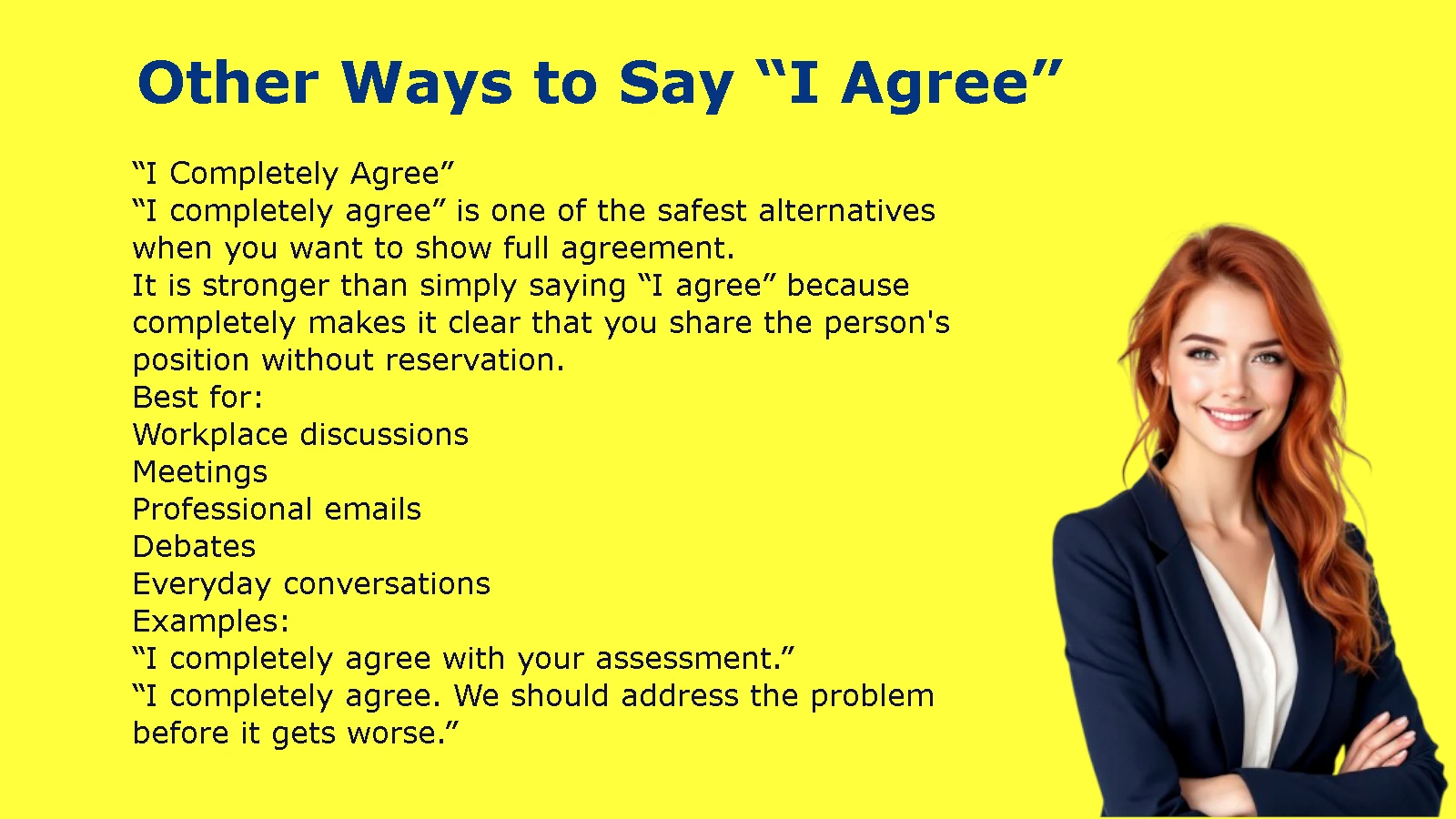
“I Completely Agree”
“I completely agree” is one of the safest alternatives when you want to show full agreement.
It is stronger than simply saying “I agree” because completely makes it clear that you share the person’s position without reservation.
Best for:
- Workplace discussions
- Meetings
- Professional emails
- Debates
- Everyday conversations
Examples:
“I completely agree with your assessment.”
“I completely agree. We should address the problem before it gets worse.”
“I completely agree that customer feedback should be our priority.”
This phrase works particularly well when you want to sound confident without becoming overly formal.
“Absolutely”
“Absolutely” is a concise and enthusiastic way to agree.
It can stand alone as a response or introduce a longer statement.
Examples:
“Do you think we should revise the proposal?”
“Absolutely.”
Or:
“Absolutely. I think your approach will work much better.”
It works in many professional and casual situations. The context and delivery determine whether it sounds calm, enthusiastic, or emphatic.
“Exactly”
“Exactly” is particularly useful when someone has expressed an idea that matches your own thinking.
It often means something closer to “That is precisely what I mean” than merely “I agree.”
Example:
“The problem isn’t the deadline. It’s that we started too late.”
“Exactly. That’s what I’ve been trying to explain.”
This makes “exactly” especially natural in discussions, meetings, debates, and casual conversations.
“I Couldn’t Agree More”
“I couldn’t agree more” expresses very strong agreement.
It essentially means that you agree as strongly as possible.
Examples:
“We need to focus on quality rather than speed.”
“I couldn’t agree more.”
“I couldn’t agree more with your recommendation.”
Use this phrase when you genuinely want to emphasize your agreement. It is stronger than simply saying “I agree.”
“You’re Right”
“You’re right” confirms that the other person’s statement, judgment, or conclusion is correct.
For example:
“We should have checked the figures before sending the report.”
“You’re right. That was an oversight.”
This phrase can sound direct and sincere. It is useful in everyday conversations, workplace discussions, and disagreements when you want to acknowledge that another person has made a valid point.
“That’s True”
“That’s true” is a natural way to acknowledge that someone’s statement is correct.
It often works better than “I agree” when the person has made an observation rather than expressed a personal opinion.
Example:
“The new system takes longer to learn.”
“That’s true, but once everyone gets used to it, it should save us time.”
Notice that “That’s true” can acknowledge one part of an argument without necessarily meaning that you agree with every conclusion the person has drawn.
“That Makes Sense”
“That makes sense” is one of the most useful expressions for professional and everyday communication.
It tells someone that you understand their reasoning and find it logical or reasonable.
“I think we should move the meeting to Friday because everyone will be available.”
“That makes sense.”
However, it is important not to treat this phrase as an exact synonym for “I agree.”
“That makes sense” can mean:
“I understand why you think that.”
It does not always mean:
“I completely share your opinion.”
That subtle distinction makes it especially useful when you want to acknowledge someone’s reasoning without making an absolute commitment.
“I Feel the Same Way”
“I feel the same way” works particularly well when the other person is expressing a personal feeling, preference, or emotional reaction.
Examples:
“I really miss how things used to be.”
“I feel the same way.”
It sounds warmer and more personal than “I agree.”
“I’m With You on That”
“I’m with you on that” is a friendly, conversational way to show agreement.
It works well with friends, coworkers, and people you have a reasonably informal relationship with.
Example:
“We should order pizza instead of cooking tonight.”
“I’m with you on that.”
It is less appropriate in highly formal writing, but it sounds natural in everyday American English.
“I Share Your View”
“I share your view” is a polished alternative for professional communication.
It tells someone that your perspective is aligned with theirs.
Example:
“I share your view that the current process needs to be simplified.”
This works particularly well in:
- Business emails
- Meetings
- Reports
- Presentations
- Professional discussions
It sounds more formal than “I feel the same way” but less stiff than some highly formal expressions.
“I Share Your Perspective”
“I share your perspective” is similar to “I share your view,” but it emphasizes the way someone understands or interprets an issue.
Example:
“I share your perspective on the importance of transparent communication.”
This can be useful when discussing complex subjects because it communicates alignment with someone’s way of looking at an issue.
“I Concur”
“I concur” is a formal way to express agreement.
It is grammatically natural, but it can sound noticeably more formal than ordinary conversation.
Example:
“I concur with the committee’s recommendation.”
Use it when the context is genuinely formal, such as:
- Academic discussions
- Formal reports
- Official statements
- Professional deliberations
- Legal or institutional contexts
Avoid saying “I concur” in a casual text to a friend unless you are intentionally being humorous or overly formal.
Cambridge Dictionary lists concur among expressions associated with having the same opinion as someone else.
“I Support That”
“I support that” is particularly useful when the subject is a proposal, plan, policy, decision, or action.
For example:
“I think we should give the team another week to complete the project.”
“I support that.”
This isn’t always identical to “I agree.”
You might agree that a proposal is sensible without personally committing to support it. “I support that” therefore carries a stronger sense of approval or backing.
“We’re on the Same Page”
“We’re on the same page” means that two or more people have a shared understanding, expectation, or position.
It is especially common in workplace communication.
Examples:
“It sounds like we’re on the same page about the project timeline.”
“Before we move forward, I just want to make sure we’re on the same page.”
This phrase is excellent for teamwork because it communicates alignment rather than merely agreement with one isolated statement.
“Same Here”
“Same here” is a short, informal expression used when you have the same feeling, opinion, or experience.
Example:
“I’m exhausted after that meeting.”
“Same here.”
Or:
“I love this restaurant.”
“Same here.”
It is particularly natural in text messages and casual conversations.
“Totally”
“Totally” is a strongly informal way to say “I completely agree.”
Example:
“That movie was way better than I expected.”
“Totally!”
It works well among friends and in informal digital communication.
It would generally be inappropriate in a formal report or a serious business email.
“For Sure”
“For sure” is another casual agreement phrase.
It can also express certainty or confirmation, so context matters.
Example:
“We should try that new restaurant.”
“For sure.”
It sounds natural in casual American English but should generally be avoided in highly formal writing.
“Definitely”
“Definitely” can express strong agreement or certainty.
Example:
“Do you think we should send the proposal today?”
“Definitely.”
It is short, confident, and useful in both spoken and written communication.
“You’re Absolutely Right”
This is a stronger version of “You’re right.”
It clearly communicates that you believe the other person’s statement or conclusion is correct.
Example:
“We shouldn’t make a decision until we’ve reviewed all the data.”
“You’re absolutely right.”
Because it is emphatic, use it when you genuinely want to give strong confirmation.
“That’s Exactly How I See It”
This expression tells someone that their interpretation matches yours very closely.
Example:
“The biggest issue isn’t the product. It’s how we’re explaining it to customers.”
“That’s exactly how I see it.”
It sounds thoughtful and works particularly well in discussions where you’re explaining a viewpoint.
“I Think You’re Right”
“I think you’re right” is useful when you agree but want to sound slightly less absolute.
Compare:
“You’re right.”
with:
“I think you’re right.”
The second version leaves a little room for uncertainty.
That makes it useful when you have considered someone’s argument but don’t want to sound overly categorical.
“I’m in Complete Agreement”
“I’m in complete agreement” is a formal and emphatic alternative.
Example:
“I’m in complete agreement with the recommendations outlined in the report.”
This works better in formal writing than in ordinary conversation.
In everyday speech, “I completely agree” will usually sound more natural.
“You Said It”
“You said it” is a casual, emphatic way to agree with something someone has said.
Example:
“Mondays are way too busy.”
“You said it.”
It is conversational and can sound playful. Don’t use it in formal business writing.
“Good Point”
“Good point” acknowledges that someone has made a valid observation or argument.
“We should also consider the cost of maintenance.”
“Good point.”
“You Have a Point”
“You have a point” is similar to “good point.”
It often signals partial agreement or acknowledgment.
“You have a point. We probably should have considered that earlier.”
This is useful when you want to validate someone’s reasoning without saying that you agree with everything they have said.
Professional Ways to Say “I Agree”
Professional communication doesn’t always require complicated vocabulary.
In many workplace situations, the clearest expression is still “I agree.” The goal is not to sound sophisticated. The goal is to communicate your position clearly and appropriately.
Useful professional alternatives include:
- I completely agree.
- I agree with your assessment.
- I share your view.
- I share your perspective.
- That makes sense.
- I support that approach.
- I agree with that recommendation.
- We’re on the same page.
- That’s a valid point.
- I think you’re right.
For example:
“I agree with your assessment. The current process creates unnecessary delays.”
This is usually more effective than forcing a phrase such as “I concur” into every professional message.
Best Professional Alternatives for Meetings
Meetings require expressions that sound natural when spoken.
Good options include:
- “Absolutely.”
- “I completely agree.”
- “That’s a good point.”
- “That makes sense.”
- “I support that.”
- “I think you’re right.”
- “We’re on the same page.”
- “I’m with you on that.”
A useful meeting response might be:
“That makes sense. I also think we should test the new process before rolling it out company-wide.”
This is better than simply saying “I agree” because it shows why you agree and moves the discussion forward.
Formal Ways to Say “I Agree”
For formal communication, consider:
- I concur.
- I am in agreement.
- I share your view.
- I share your perspective.
- I am in complete agreement.
- I agree with your assessment.
- I support this position.
- I agree with this conclusion.
Formal vs. Professional: What’s the Difference?
A phrase can be professional without being highly formal.
For example:
“I completely agree with your recommendation.”
sounds professional but natural.
Meanwhile:
“I concur with your assessment.”
sounds more formal and institutional.
Neither is inherently better. Choose based on the relationship and communication setting.
Casual Ways to Say “I Agree”
When you’re talking to friends or communicating casually, you have much more freedom.
Try:
- Exactly!
- Absolutely!
- Totally!
- For sure!
- Same here!
- I’m with you.
- You said it.
- No doubt.
- You’re right.
- I think so too.
For example:
“We should definitely leave early tomorrow.”
“For sure.”
Or:
“That was the best part of the movie.”
“Exactly!”
These phrases sound more conversational than formal alternatives such as “I concur.”
Strong Ways to Say “I Agree”
Sometimes ordinary agreement isn’t enough. You want the other person to know that you strongly support their position.
Use:
- I completely agree.
- I absolutely agree.
- I couldn’t agree more.
- You’re absolutely right.
- That’s exactly how I see it.
- I’m completely with you on that.
- I strongly agree with that view.
The strongest choices should be reserved for genuine conviction.
If you are only mildly persuaded, saying “I couldn’t agree more” may overstate your position.
Ways to Show Partial Agreement Without Saying “I Agree”
This is one of the most useful distinctions when choosing alternatives.
You don’t always agree with someone’s entire argument. Sometimes you agree with one part of it.
In those situations, use:
- I see your point.
- That’s a good point.
- You have a point.
- I can see where you’re coming from.
- That makes sense.
- I agree with you on that point.
- I see it that way in this case.
- That’s a fair point.
“I See Your Point”
“I see your point” means you understand the reasoning behind someone’s position.
It does not necessarily mean full agreement.
“I see your point, but I’m still concerned about the cost.”
This is a valuable phrase in disagreements because it acknowledges the other person’s reasoning without pretending that you have changed your mind.
“That’s a Good Point”
This acknowledges the value of an argument.
“That’s a good point. We should look at the numbers before making a final decision.”
You can use this expression even when you haven’t decided whether you completely agree.
Ways to Say “I Agree” in an Email
The best email phrase depends on what you are agreeing with.
| Situation | Natural Phrase | Example |
| Agreeing with an assessment | I agree with your assessment | I agree with your assessment of the current situation. |
| Supporting a proposal | I support this approach | I support this approach and think we should proceed. |
| Strong agreement | I completely agree | I completely agree with your recommendation. |
| Accepting reasoning | That makes sense | That makes sense given the current timeline. |
| Confirming alignment | We’re on the same page | It looks like we’re on the same page regarding the deadline. |
| Agreeing with a point | That’s a valid point | That’s a valid point, and I’ll include it in the report. |
Professional Email Example
Instead of writing:
I agree that we need to make changes. I agree with your suggestion.”
you can make the email more natural:
“I completely agree with your assessment. The current process is creating unnecessary delays, and I support your suggestion to simplify the approval workflow.”
This communicates agreement and adds useful information.
Ways to Say “I Agree” to Your Boss or Manager
When responding to a manager, clarity and professionalism matter more than fancy vocabulary.
Good choices include:
- I completely agree.
- I agree with your assessment.
- That makes sense.
- I support that approach.
- I think you’re right.
- I agree with that direction.
- I’m aligned with that approach.
For example:
“I agree with your assessment. I think prioritizing the highest-impact tasks first will give us the best result.”
This sounds confident without being overly formal.
Ways to Say “I Agree” to a Coworker
With coworkers, you can usually use a wider range of expressions.
Try:
- “Absolutely.”
- “Exactly.”
- “That’s a good point.”
- “That makes sense.”
- “I’m with you on that.”
- “I completely agree.”
- “We’re on the same page.”
- “You have a point.”
For example:
“I think we should test the new process with one team first.”
“Absolutely. That gives us a chance to identify problems before expanding it.”
The second response is especially effective because it adds reasoning instead of merely repeating agreement.
Ways to Say “I Agree” to a Customer or Client
Customer communication requires a little more care.
You might use:
- I completely understand your concern.
- That’s a fair point.
- I see your point.
- I agree that this needs attention.
- You’re right about that.
- I understand where you’re coming from.
Be careful with “You’re right” if you’re responding to a complaint. It can sound like a direct admission that the company made a mistake.
For example:
“That’s a fair point, and I understand why the delay was frustrating. Let me explain what we can do to resolve it.”
This acknowledges the customer’s concern without making a claim you haven’t verified.
Casual Ways to Say “I Agree” in Texts
Texting allows shorter and more informal responses.
Common choices include:
- Exactly!
- Totally.
- Absolutely.
- Same.
- Same here.
- For sure.
- 100%.
- Yep.
- I’m with you.
- That’s so true.
For example:
“That restaurant is way too expensive.”
“100%.”
Or:
“We should go somewhere else next time.”
“For sure.”
These are natural in informal messaging but don’t belong in a formal report or professional email.
Ways to Say “I Agree” to a Friend
Friends usually need natural conversation rather than formal vocabulary.
You can say:
“Exactly!”
“Totally.”
“Same here.”
“I feel the same way.”
“I’m with you.”
“You said it.”
“For sure.”
Consider this exchange:
Friend: “I think we should leave earlier next time.”
You: “Absolutely. That traffic was brutal.”
The second sentence makes the response feel more natural because it gives a reason for the agreement.
Ways to Say “I Agree” in an Essay or Academic Writing
Academic writing requires more than swapping “I agree” for a fancier synonym.
Useful expressions include:
- I agree with this view because…
- I concur with this interpretation.
- This argument is convincing because…
- The evidence supports this position.
- This perspective is consistent with…
- This interpretation is persuasive because…
- I share this perspective.
For example:
“The evidence supports the view that early intervention produces better long-term outcomes.”
This is often stronger academic writing than repeatedly saying:
“I agree with this.”
“I agree with the author.”
Academic writing benefits from explaining why you agree and connecting the agreement to evidence.
“I Agree” vs. Similar Expressions: What’s the Difference?
These expressions overlap, but they are not interchangeable in every situation.
| Phrase | What It Usually Communicates |
| I agree | Direct agreement |
| I completely agree | Full agreement |
| Exactly | Strong confirmation |
| Absolutely | Strong or enthusiastic agreement |
| You’re right | The other person is correct |
| That’s true | Their statement is correct |
| That makes sense | Their reasoning is logical or understandable |
| I see your point | You understand their argument |
| That’s a good point | Their argument has merit |
| I support that | You back an idea, plan, or action |
| I’m with you | You support or share their position |
| I share your view | Your perspective is aligned |
| We’re on the same page | You share an understanding or position |
| I couldn’t agree more | Very strong agreement |
| Same here | You have the same opinion, feeling, or experience |
This distinction is important because a thesaurus-style substitution isn’t always accurate.
For example:
“I see your point, but I disagree with the conclusion.”
That sentence is completely natural.
By contrast:
“I completely agree, but I disagree with the conclusion.”
creates an obvious contradiction.
How to Choose the Right Alternative to “I Agree”
Choosing the right phrase becomes easier when you ask four questions.
How Strongly Do You Agree?
If you fully support the statement, use:
- I completely agree.
- I couldn’t agree more.
- Absolutely.
- You’re absolutely right.
If you only partly agree, use:
- I see your point.
- That’s a fair point.
- You have a point.
- That makes sense.
Who Are You Talking To?
Your relationship affects the appropriate tone.
| Person | Good Choices |
| Boss | I completely agree; I support that approach |
| Coworker | Absolutely; That makes sense; Good point |
| Client | I understand your point; That’s a fair point |
| Friend | Totally; Exactly; Same here |
| Family member | I feel the same way; You’re right |
| Teacher/professor | I agree with this view; I share this perspective |
| Partner | I feel the same way; I completely agree |
Where Are You Saying It?
The same idea can require different wording depending on the medium.
Email:
“I agree with your recommendation.”
Meeting:
“Absolutely. I think that’s the right approach.”
Text:
“Totally!”
Academic essay:
“The evidence supports this position.”
Friendly conversation:
“I’m with you.”
What Exactly Are You Agreeing With?
This question is often overlooked.
Are you agreeing with:
- Someone’s opinion?
- A factual statement?
- Their reasoning?
- A proposal?
- A decision?
- A feeling?
- A plan?
For example:
“I support that.”
is excellent for a proposal.
But:
“I share your view.”
is more appropriate when discussing an opinion.
Likewise:
“That makes sense.”
is particularly useful when you’re responding to someone’s reasoning.
Common Mistakes When Expressing Agreement
Using “I Concur” Everywhere
“I concur” is correct, but it can sound stiff in ordinary conversation.
With a friend, this:
“I concur with your restaurant selection.”
sounds intentionally formal.
This is much more natural:
“Absolutely. Let’s go.”
Treating “That Makes Sense” as Complete Agreement
You can understand someone’s reasoning without fully agreeing.
“That makes sense, but I’m not convinced it’s the best option.”
This is perfectly natural.
Saying “You’re Right” When You Only Partly Agree
“You’re right” can sound like complete confirmation.
If you only agree with part of what someone said, consider:
“You have a point.”
or:
“I see where you’re coming from.”
Using Slang in Formal Writing
Expressions such as “totally,” “same,” “100%,” and “you said it” work well in casual communication.
They generally don’t belong in:
- Formal reports
- Academic papers
- Official correspondence
- Professional proposals
Overusing “Absolutely”
“Absolutely” is versatile, but repeating it in every response can become another form of repetition.
Instead, alternate naturally:
“That’s a good point.”
“I completely agree.”
“That makes sense.”
“I support that approach.”
Variety should improve precision, not simply replace one repetitive phrase with another.
Frequently Asked Questions About Saying “I Agree”
What Is Another Way to Say “I Agree”?
Some natural alternatives are “Absolutely,” “Exactly,” “I completely agree,” “You’re right,” “That’s true,” “That makes sense,” and “I couldn’t agree more.”
The best choice depends on how strongly you agree and the situation.
What Is the Most Professional Way to Say “I Agree”?
Good professional options include “I completely agree,” “I agree with your assessment,” “I share your view,” “I support that approach,” and “That makes sense.”
You don’t need to use highly formal vocabulary to sound professional.
How Do You Say “I Agree” Casually?
Try “Exactly,” “Totally,” “Absolutely,” “For sure,” “Same here,” “I’m with you,” or “You said it.”
These are generally better suited to conversations, texts, and informal messages.
What Is a Formal Way to Say “I Agree”?
“I concur,” “I am in agreement,” “I share your view,” and “I am in complete agreement” are formal alternatives.
Use them selectively. A formal phrase isn’t automatically more effective.
What Is a Stronger Way to Say “I Agree”?
Use “I completely agree,” “I absolutely agree,” “I couldn’t agree more,” or “You’re absolutely right.”
These expressions communicate stronger conviction than a simple “I agree.”
What Can I Say Instead of “I Agree” in an Email?
For a professional email, try:
- “I completely agree with your recommendation.”
- “I support this approach.”
- “I share your perspective.”
- “That makes sense.”
- “I agree with your assessment.”
- “We’re on the same page.”
Choose the phrase based on what you are actually agreeing with.
How Do You Say “I Agree” to Your Boss?
You can say “I completely agree,” “I agree with your assessment,” “That makes sense,” “I support that approach,” or “I agree with that direction.”
These sound respectful without being excessively formal.
How Do You Say “I Agree” in a Meeting?
Natural choices include “Absolutely,” “I completely agree,” “That makes sense,” “Good point,” “I support that,” and “I’m with you on that.”
When possible, add a short reason to make your contribution more useful.
What Is a Casual Way to Say “I Agree” in a Text?
Try “Totally,” “Exactly,” “Same,” “Same here,” “For sure,” “100%,” or “Absolutely.”
The right choice depends on your relationship with the person.
Is “I Concur” the Same as “I Agree”?
Broadly, yes. “I concur” expresses agreement, but it is more formal than the everyday “I agree.” Cambridge Dictionary includes concur among expressions used to indicate having the same opinion.
Is “That Makes Sense” the Same as “I Agree”?
Not always.
“That makes sense” usually indicates that you understand and find someone’s reasoning logical. You can say it even when you haven’t fully adopted their conclusion.
For example:
“That makes sense, but I still think we should wait.”
This shows understanding without complete agreement.
What Is Another Way to Say “I Agree With You”?
Natural alternatives include “I feel the same way,” “I think you’re right,” “I’m with you on that,” “I share your view,” “That’s exactly how I see it,” and “I couldn’t agree more.”
Quick Reference: Which “I Agree” Phrase Should You Use?
| If you want to… | Use… |
| Sound professional | I completely agree |
| Sound formal | I concur |
| Show very strong agreement | I couldn’t agree more |
| Confirm someone’s point | Exactly |
| Confirm someone is correct | You’re right |
| Agree with reasoning | That makes sense |
| Sound friendly | I’m with you |
| Support a proposal | I support that |
| Sound casual | Totally |
| Reply to a text | Same here |
| Show shared understanding | We’re on the same page |
| Acknowledge a valid argument | That’s a good point |
| Express personal agreement | I feel the same way |
| Show partial agreement | I see your point |
| Agree enthusiastically | Absolutely |
Conclusion
There are plenty of other ways to say “I agree,” but the best alternative isn’t necessarily the fanciest one.
Choose your words according to strength, tone, audience, and context. Say “I completely agree” when you want to express full agreement, “absolutely” when you want a concise and confident response, and “I couldn’t agree more” when your agreement is especially strong.
For professional communication, “I agree with your assessment,” “I share your view,” and “I support that approach” can sound polished without feeling unnatural. In casual conversations, “exactly,” “totally,” “same here,” and “I’m with you” are much more conversational.
And remember that some phrases aren’t true substitutes in every situation. “I see your point” acknowledges someone’s reasoning, while “that makes sense” shows that you understand their logic. Neither necessarily means complete agreement.
The goal isn’t to stop saying “I agree.” It’s to have enough expressions available that you can communicate exactly how and why you agree.