Traduction is a French word that means “translation” in English. If you’ve come across the word “traduction” and wondered what it means, how it is used, or why it appears in French texts, the term is closely connected to translation, language, interpretation, translated text, and communication between languages.
The traduction meaning refers to the act or result of translating words, phrases, sentences, or entire texts from one language into another. However, the exact meaning can depend on the context in which the word is used. Terms such as translation, interpretation, translated version, language conversion, and rendering are related but can have slightly different uses.
In this guide, you’ll learn what “traduction” means, how the French word is used in sentences, how to pronounce it, and how “traduction” differs from related terms such as “translation” and “interprétation.” You’ll also see clear examples to make the meaning easy to understand.
By the end, you’ll know exactly what traduction means and how to understand and use this common French word naturally and correctly.
What Does “Traduction” Mean?
Traduction is the French word for “translation.” In French, it describes the process of transferring a written or spoken message from one language into another while preserving its meaning and, when possible, its style. It can also refer to the resulting translated text. Larousse
For example:
traduction française = French translation
traduction anglaise = English translation
traduction du français vers l’anglais = translation from French into English
So, if someone writes “Je cherche une traduction anglaise”, they mean “I’m looking for an English translation.”
The important point is that traduction is completely ordinary in French. It isn’t an obscure French word or an unusual literary expression. French dictionaries define it directly as the action of translating and as the text produced by that process. Larousse
English is where things become more complicated.
| Word | Language | Main modern meaning |
| traduction | French | Translation |
| translation | English | Converting something from one language to another |
| traduction | English | Rare/historical transmission, transfer, derivation, or translation |
| traduire | French | To translate; also to express or convey |
| translator | English | A person or tool that translates |
The Quick Answer
If you’re asking “What does traduction mean in English?”, the simplest answer is:
Traduction usually means “translation” when it is the French word. As an English word, traduction is rare and historical, with meanings including transmission, transfer, derivation, and, formerly, translation.
That distinction will save you from one of the most common mistakes involving this word.
Traduction Meaning in English
The English word traduction has a surprisingly long history. It wasn’t simply invented as a modern copy of French traduction. Historical English records show several meanings developing around the broad idea of carrying, transferring, or passing something from one place, person, generation, or language to another. Wehd
Older English dictionaries recorded meanings such as:
- transmission from one person to another
- derivation or descent
- propagation
- transportation
- conveyance
- transition
- translation from one language into another
A historical Webster dictionary, for example, defined traduction in terms of derivation, propagation, transmission, conveyance, and transition. It also marked several of these senses as little used, obsolete, or rare. M Shaffer
That history explains why the word can look familiar to an English reader while still sounding strange in an ordinary English sentence.
The Historical Sense of Traduction
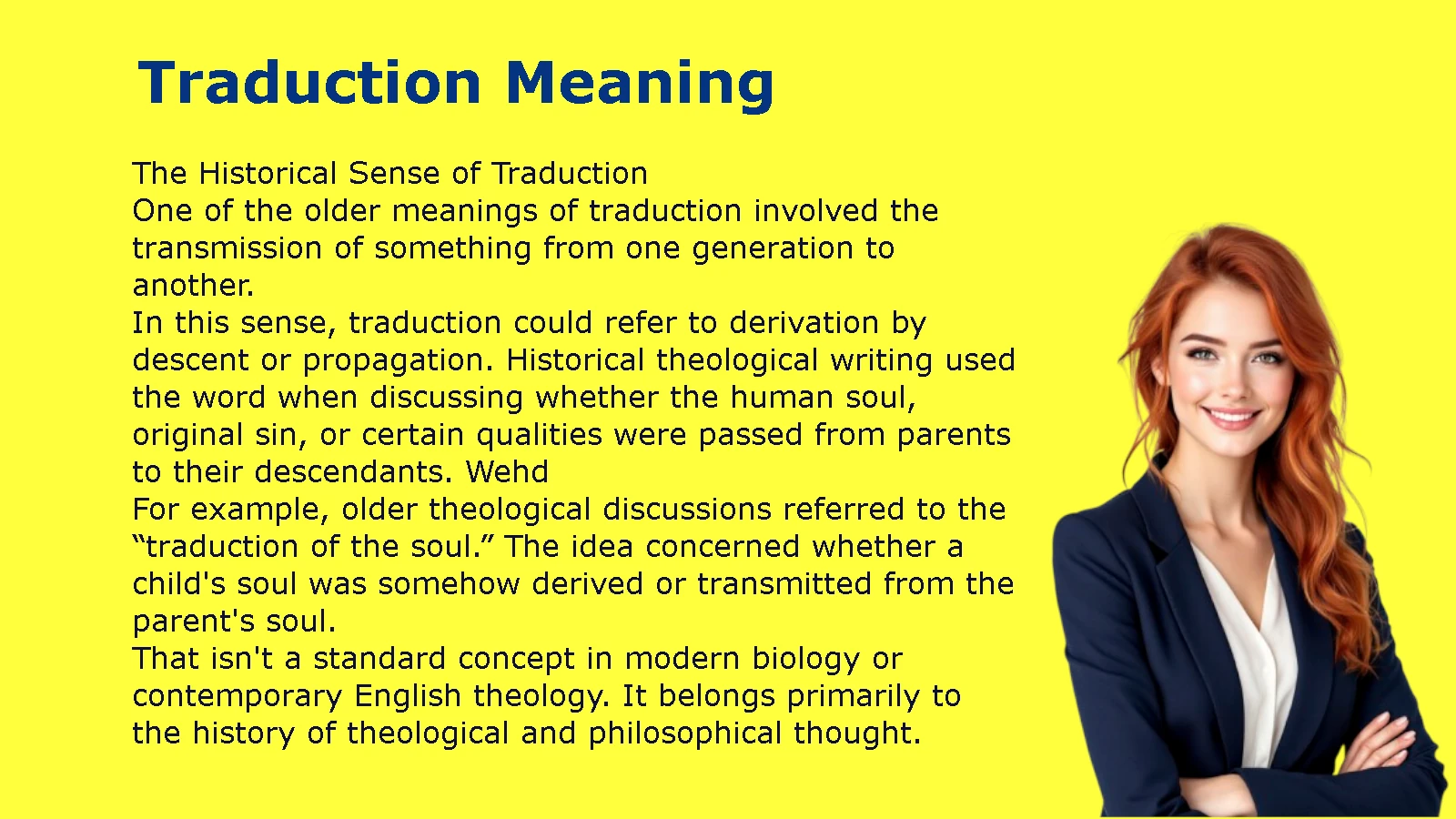
One of the older meanings of traduction involved the transmission of something from one generation to another.
In this sense, traduction could refer to derivation by descent or propagation. Historical theological writing used the word when discussing whether the human soul, original sin, or certain qualities were passed from parents to their descendants. Wehd
For example, older theological discussions referred to the “traduction of the soul.” The idea concerned whether a child’s soul was somehow derived or transmitted from the parent’s soul.
That isn’t a standard concept in modern biology or contemporary English theology. It belongs primarily to the history of theological and philosophical thought.
Dictionary.com still records this specialized historical sense, defining traduction as the transmission of something through inheritance and, in theology, the passing of a soul or sins to one’s descendants. Dictionary
Traduction as Transmission or Transfer
Another historical sense involves moving or transmitting something from one place or source to another.
The World English Historical Dictionary records English examples in which traduction meant conveyance, transportation, or transference. Historical writers could therefore use the word for moving people, animals, objects, or other things from one location to another. Wehd
That meaning fits the word’s deeper history. At its core, the word has long been associated with the idea of carrying something across.
Think of it as a linguistic bridge:
source → crossing → destination
That basic concept can describe physical movement, the transmission of an inherited quality, or the movement of meaning from one language to another.
Traduction as “Translation” in Historical English
Here’s where things get particularly interesting.
Traduction once could mean translation in English. Historical English sources record the word in the sense of translating a work from one language into another. The World English Historical Dictionary gives examples from the 16th through 19th centuries, including references to an English traduction of a work. Wehd
However, that sense is now obsolete or archaic in ordinary English.
You wouldn’t normally write:
“I need a French traduction of this document.”
A modern English speaker would write:
“I need a French translation of this document.”
The second sentence sounds natural. The first sounds deliberately old-fashioned, foreign, or simply incorrect in contemporary English.
Is “Traduction” a Real English Word?
Yes. Traduction appears in English dictionaries and historical English records.
The catch is that being a real English word doesn’t mean being a normal everyday English word.
Collins lists traduction with meanings including “a transmission or communication” and “a translation into a different language.” Collins Dictionary
Historical English sources provide even more senses, including transmission, transportation, derivation, and transition. M Shaffer
So the word has legitimate English credentials. It simply has very little practical value in everyday modern English.
Why You Rarely Hear Traduction in English
Language is shaped by usage. Even when several words technically exist, speakers tend to settle on the forms that sound natural and familiar.
For language conversion, English settled on translation.
That word appears everywhere:
- translation agency
- translation service
- machine translation
- literary translation
- translation software
- translation error
- certified translation
- English translation
- Spanish translation
Replacing translation with traduction would make most modern English readers pause.
This is a useful distinction:
A dictionary word isn’t necessarily a practical word.
Traduction belongs to that category in modern English. It is legitimate, historically interesting, and occasionally useful when discussing older texts, but translation is the standard choice.
Traduction in French
If you’re reading French, there’s no need to hesitate over traduction.
It is a standard French noun meaning translation.
Larousse defines traduction as the action of translating or transposing something into another language. It also uses the word for the translated work itself. Larousse
Cambridge’s French-English Dictionary likewise translates traduction as translation and gives examples involving translating speeches and texts. Cambridge Dictionary
Common French Uses of Traduction
Here are some useful expressions:
| French | English |
| une traduction | a translation |
| la traduction anglaise | the English translation |
| la traduction française | the French translation |
| une traduction littérale | a literal translation |
| une traduction automatique | machine/automatic translation |
| une traduction fidèle | a faithful translation |
| une traduction libre | a free translation |
| faire une traduction | to do/make a translation |
| demander une traduction | to request a translation |
| traduction du français vers l’anglais | translation from French into English |
The word can also appear outside ordinary language translation.
Larousse, for example, lists traduction as a literary term for expressing or manifesting something and as a specialized term in biochemistry for protein synthesis from genetic information carried by RNA. It also records a legal sense involving bringing someone before a court. Larousse
So traduction is actually broader in French than an English reader might expect.
Traduction vs. Translation
The difference between traduction and translation is mostly a matter of language and modern usage.
| Feature | Traduction | Translation |
| Modern French | Common | Not the normal French word for language translation |
| Modern English | Rare | Extremely common |
| Means “translation” | Yes, in French | Yes, in English |
| Historical English use | Yes | Yes |
| Everyday English | No | Yes |
| Common in professional translation | French | English |
This is why translating traduction into English normally gives you translation.
For example:
French:
Cette traduction est excellente.
English:
This translation is excellent.
Not:
This traduction is excellent.
The latter isn’t how contemporary English normally works.
Is Traduction a False Friend?
Traduction can be confusing for English speakers because it looks extremely similar to “translation.”
However, calling it a pure false friend requires a little nuance.
A false friend usually refers to two words in different languages that look or sound similar but have different meanings. Traduction and translation don’t fit that pattern perfectly because the French word genuinely means “translation.”
In fact, the similarity exists for a good historical reason.
Both words belong to a family of words associated with the idea of carrying or transferring something across.
The real source of confusion is therefore not that traduction has nothing to do with translation. It absolutely does.
The problem is that French uses traduction as its normal word while modern English normally uses translation.
That’s better described as a cross-language usage trap than a simple false friend.
Traduction and Translation Etymology
The history of traduction reaches back to Latin.
French traduire comes from Latin traducere, a verb meaning roughly “to lead across,” “to bring across,” or “to cause to pass from one place to another.” The Latin construction combines trans- meaning “across” or “beyond” with ducere, meaning “to lead” or “to conduct.” Larousse
That basic physical idea eventually developed into a figurative one.
If you can carry a person across a river, you can also imagine carrying an idea across a language barrier.
That’s essentially what translation does.
From Physical Transfer to Language Transfer
The semantic journey can be simplified like this:
Latin trans + ducere
↓
lead or carry across
↓
transfer from one place to another
↓
transfer meaning from one language to another
↓
translation / traduction
This connection explains why the French words traduire and traduction are related to English translation even though the modern forms look different.
Larousse gives traduire as deriving from Latin traducere, “faire passer d’un point à un autre,” or roughly “to make something pass from one point to another.” Larousse
The Académie française likewise traces traduire to Latin traducere and explains the older idea of leading or moving something from one point to another. Dictionnaire de l’Académie française
Why Do Traduction and Translation Look Different?
The answer lies partly in the fact that different languages developed related Latin-derived words through different historical paths.
French developed:
Latin traducere → traduire → traduction
English developed its standard language-translation noun as:
translate → translation
The two families overlap historically in their broader concept of transfer, even though their modern forms differ.
Interestingly, French also has the word translation, but it has specialized meanings rather than serving as the everyday French equivalent of English translation. Larousse lists translation in contexts involving movement or transfer, religious relics, mathematics, physics, and related technical uses. Larousse
So the resemblance between traduction and translation isn’t accidental. Their histories simply took different routes.
Traduction vs. Translation vs. Interpretation
One important distinction involves written translation versus spoken interpretation.
People sometimes use these words interchangeably in casual conversation, but professional language work generally separates them.
Translation
Translation normally refers to converting written material from one language into another.
Examples include:
- translating a novel
- translating a contract
- translating a website
- translating subtitles
- translating a scientific paper
- translating a government document
If you convert a French article into English, you’re producing an English translation.
French uses traduction for this same activity.
Interpretation
Interpretation usually refers to spoken language.
For example, imagine a French-speaking diplomat and an English-speaking diplomat meeting in the same room. A language professional listens to one person and conveys the message orally in the other language.
That’s interpreting, not usually “translating” in the professional terminology.
The distinction becomes clearer with a simple example:
| Situation | Preferred English term |
| French novel → English | Translation |
| French contract → English | Translation |
| French website → English | Translation |
| French speaker → English speaker in a meeting | Interpretation |
| Live conference language service | Interpretation |
| Subtitles translated from French | Translation |
French traduction can cover a broad range of language-transfer situations, but English professional terminology often makes a sharper distinction between translation and interpretation.
Traduction and Other Related Words
Several English words overlap with traduction, but they aren’t perfect substitutes.
Translation
Translation is the closest and most useful English equivalent when traduction means language conversion.
It’s the word to choose in almost every modern English sentence.
Rendering
Rendering can mean expressing something in another language or form.
For example:
“The translator’s rendering of the poem preserves the original rhythm.”
It can sound more literary or analytical than translation.
Interpretation
Interpretation has two major uses.
It can mean the act of understanding or explaining something, and it can mean oral language interpretation.
Because of that double meaning, context matters.
Transposition
Transposition refers more broadly to moving something into another form, setting, or system.
In literary or linguistic discussion, it can describe a transformation rather than a straightforward word-for-word translation.
Version
Version can refer to a particular translated form of a work.
For example:
“I prefer this English version of the poem.”
The term doesn’t necessarily describe the translation process itself. It often identifies the resulting text.
Examples of Traduction in Context
Understanding the word becomes much easier when you see it in real sentences.
Traduction in French
Example 1
Je cherche une traduction anglaise de ce livre.
Meaning:
“I’m looking for an English translation of this book.”
Here, traduction refers to the translated work.
Example 2
La traduction du document a pris deux jours.
Meaning:
“The translation of the document took two days.”
Here, it refers to the process or task.
Example 3
Cette traduction est très fidèle à l’original.
Meaning:
“This translation is very faithful to the original.”
Here, traduction means the resulting text.
Example 4
La traduction automatique peut contenir des erreurs.
Meaning:
“Machine translation can contain errors.”
Larousse specifically records traduction automatique for automated translation. Larousse
Traduction in Historical English
Historical English could use the word differently.
A writer might refer to the traduction of animals, meaning their transportation or transfer from one location to another. Historical dictionaries document this sense. M Shaffer
Similarly, theological writers could discuss the traduction of the soul, referring to the supposed transmission or derivation of the soul from parent to child. Dictionary
These examples are useful because they show why simply translating every historical occurrence of traduction as “translation” can produce the wrong meaning.
Traduction in Literature and Older Texts
If you encounter traduction in an old English book, don’t automatically assume the author made a spelling mistake.
Historical English used the word legitimately.
The World English Historical Dictionary records English examples of traduction meaning translation into another language, with examples dating back several centuries. It also records senses involving transportation and inherited transmission. Wehd
This matters when reading:
- older theological works
- historical philosophy
- early scientific writing
- older literary criticism
- antiquarian texts
- historical dictionaries
- digitized books
In such texts, the surrounding sentence determines which sense the writer intended.
A Useful Reading Strategy
When you encounter traduction in an old English passage, ask:
- Is the author discussing languages?
It may mean translation. - Is the author discussing inheritance or descent?
It may mean transmission or derivation. - Is the author discussing movement?
It may mean transportation or transfer. - Is the passage theological?
It may refer to the historical doctrine of transmission of the soul or original sin. - Is the passage modern French?
It almost certainly means translation in the ordinary French sense unless the context indicates a specialized meaning.
That simple checklist prevents a lot of confusion.
Traduction in Specialized French
The French word has uses that go beyond ordinary language translation.
Traduction in Literature
In literary French, traduction can refer to the way an idea, emotion, or artistic concept gets expressed.
Larousse gives a literary sense involving the expression or manifestation of something, not merely the conversion of one language into another. Larousse
For instance, a phrase such as:
La traduction musicale d’un sentiment
can mean something like:
“the musical expression of a feeling.”
In that context, translating traduction simply as “translation” may miss the intended nuance.
Traduction in Biochemistry
French scientific terminology also uses traduction for translation in molecular biology.
In this context, translation is the cellular process in which information carried by messenger RNA is used to synthesize a protein. Larousse explicitly lists this specialized biochemical meaning. Larousse
This is a good reminder that language can reuse the same conceptual metaphor across unrelated fields.
The basic idea remains converting information from one form into another.
Traduction in Law
French also uses traduire quelqu’un en justice, literally involving the idea of bringing someone before justice.
Larousse defines this expression as the act of bringing someone before a court. Larousse
English does not normally use traduction as the equivalent legal term.
Instead, English uses expressions such as:
- bring someone before a court
- prosecute someone
- take someone to court
- bring charges against someone
This is another example of why similar-looking words shouldn’t be transferred mechanically between languages.
How to Pronounce Traduction
The pronunciation depends on whether you’re saying the French word or the rare English word.
French Pronunciation of Traduction
The French pronunciation is approximately:
/tʁa.dyk.sjɔ̃/
A learner can think of it as a three-part rhythm:
tra – duc – tion
The final French nasal vowel is particularly important. It isn’t pronounced like the ordinary English ending in -shun.
French dictionaries give the pronunciation as /tʀadyksjɔ̃/. Cambridge Dictionary
English Pronunciation of Traduction
The historical English word is commonly represented approximately as:
/trəˈdʌkʃən/
The stress falls on the second syllable.
Because traduction is uncommon in modern English, you may hear variation when people encounter it in historical or academic contexts.
The safest approach is to determine which language the word belongs to in the sentence before deciding how to pronounce it.
Is Traduction the Same as Translation?
Not quite, even though the two words are closely related.
If you’re reading French, traduction = translation.
If you’re reading older English, traduction may mean translation, transmission, derivation, transportation, or another historical sense depending on context.
Here’s the simplest way to remember it:
French traduction → English translation
but:
English traduction → rare historical/specialized word
That distinction covers most situations.
Common Mistakes With Traduction
Using Traduction as a Normal English Synonym
A common mistake is to assume that because traduction looks like translation, it can replace it in everyday English.
It can’t.
Write:
I need a translation of this article.
Not:
I need a traduction of this article.
The second version may be understandable, but it sounds unnatural in contemporary English.
Assuming Every Occurrence Means Translation
The opposite mistake can happen when reading historical English.
An old author may use traduction to mean transmission or derivation, especially in theological or philosophical discussions. Historical dictionaries document these senses extensively. M Shaffer
Context is king.
Confusing Traduction With Transcription
French itself distinguishes traduire from transcrire.
To translate means to transfer meaning from one language to another. To transcribe means to reproduce speech or writing in written form or convert it into another writing system. Larousse explicitly warns against treating the two French verbs as interchangeable. Larousse
For example:
- French audio → written French = transcription
- French text → English text = translation
- Greek script → Latin letters = transliteration/transcription, depending on the exact task
Those are different processes.
Traduction vs. Translation: A Quick Comparison
| Question | Traduction | Translation |
| Is it a real word? | Yes | Yes |
| Normal in French? | Yes | No, not for ordinary language translation |
| Normal in modern English? | No | Yes |
| Means translation in French? | Yes | No |
| Had “translation” as an English historical sense? | Yes | Yes |
| Can mean transmission in English? | Yes, historically | Not normally |
| Can have a theological historical sense? | Yes | No |
| Best choice in modern English? | No | Yes |
The table captures the central lesson: shared history doesn’t guarantee identical modern usage.
Frequently Asked Questions About Traduction
Is “traduction” a real English word?
Yes. English dictionaries and historical records recognize traduction. Its English senses include transmission, communication, derivation, transportation, and translation. Several of these uses are rare, archaic, or historical. Dictionary
In normal modern English, however, translation is the word you want when discussing language conversion.
What does traduction mean in French?
In French, traduction means “translation.”
It can refer to the act of translating or to the resulting translated text. French dictionaries also record literary, legal, and scientific uses. Larousse
Is traduction a French word?
Yes. Traduction is a standard French feminine noun.
For example:
une traduction anglaise
means:
an English translation
What is the difference between traduction and translation?
The main difference is modern language usage.
Traduction is the ordinary French word for “translation.”
Translation is the ordinary English word.
Traduction also exists in English, but its historical and specialized uses make it much less common.
Is traduction a false friend?
It is best described as a potentially confusing French-English cognate or usage trap rather than a straightforward false friend.
The French word genuinely means “translation,” and the English historical word could also mean “translation.” The confusion comes from the fact that modern English doesn’t normally use traduction for this purpose.
How do you pronounce traduction?
In French, it is approximately /tʁa.dyk.sjɔ̃/.
In historical English usage, a common pronunciation is approximately /trəˈdʌkʃən/.
The French and English pronunciations therefore sound noticeably different.
What is the synonym of traduction?
If traduction is being used in French to mean language translation, the closest English equivalent is translation.
Depending on context, related English words include:
- rendering
- interpretation
- version
- transposition
- conversion
They aren’t perfect substitutes in every situation.
Does traduction mean interpretation?
Not necessarily.
French traduction primarily refers to translation. English interpretation often refers to spoken language, although the word also has the broader meaning of explaining or understanding something.
Is traduction used in biology?
The French word traduction is used in biochemistry for the cellular process of producing a protein based on information encoded in messenger RNA. Larousse
That specialized scientific meaning shouldn’t be confused with the rare historical English meaning of traduction involving inheritance or transmission.
Final Takeaway: What Does Traduction Really Mean?
The meaning of traduction depends heavily on the language you’re reading.
In modern French, the answer is straightforward:
Traduction means “translation.”
It can describe the act of translating, the resulting translated text, and several specialized forms of translation. French also uses the word in fields such as literature, law, and biochemistry. Larousse
In English, however, traduction is a much rarer word. Historical English sources use it for transmission, derivation, propagation, transportation, transition, and translation. Theological writers historically used it when discussing the transmission or derivation of the soul and inherited sin. Dictionary
The word’s history makes perfect sense once you look at its Latin roots. Traduction ultimately connects with Latin traducere, the idea of leading or carrying across. That concept naturally developed into the transfer of meaning from one language to another. Larousse
So, if you’re writing modern English, stick with translation.
If you’re reading French, traduction is completely normal.
And if you encounter traduction in an old English book, don’t assume it’s a typo. Check the context. You may be looking at a historical word with a much broader meaning than the modern French term.
In one sentence: traduction means “translation” in modern French, while in English it survives mainly as a rare historical word associated with translation, transmission, transfer, and derivation.