If you’re wondering whether northward or northwards is the correct form, the good news is that both words are correct. They share the same basic meaning: toward the north. The main difference lies in how you use them and which form sounds more natural in different varieties of English.
Northward can work as both an adverb and an adjective. Northwards works as an adverb. In American English, northward is generally the more common choice, while northwards is particularly natural in British English.
That small -s can look like a trivial spelling difference, but it changes the grammatical role the word can play. Once you understand that distinction, choosing between the two becomes straightforward.
| Word | Main meaning | Grammatical role | Typical use |
| northward | Toward the north | Adverb, adjective | Broadly used, especially in US English |
| northwards | Toward the north | Adverb | Particularly common in British English |
| northbound | Heading toward the north | Adjective | Trains, roads, traffic, travelers, etc. |
Northward or Northwards: The Quick Answer
Northward and northwards are both correct when they mean “toward the north.” Use northward as an adverb or adjective, while northwards functions as an adverb. For US English, northward is usually the safer default. In British English, northwards is also very natural.
Consider these sentences:
- The birds flew northward.
- The birds flew northwards.
Both are grammatically correct.
Now compare them with:
- The birds began their northward migration.
- The birds began their northwards migration.
The first sentence is correct. The second is not standard because northwards cannot normally function as an adjective before the noun “migration.”
That gives you the simplest rule:
Use northward before a noun. Use either northward or northwards after a verb when describing movement toward the north.
There’s also a regional consideration. If you’re writing for an American audience, northward will usually sound more natural. If you’re writing in British English, northwards is a perfectly normal choice.
What Does Northward Mean?
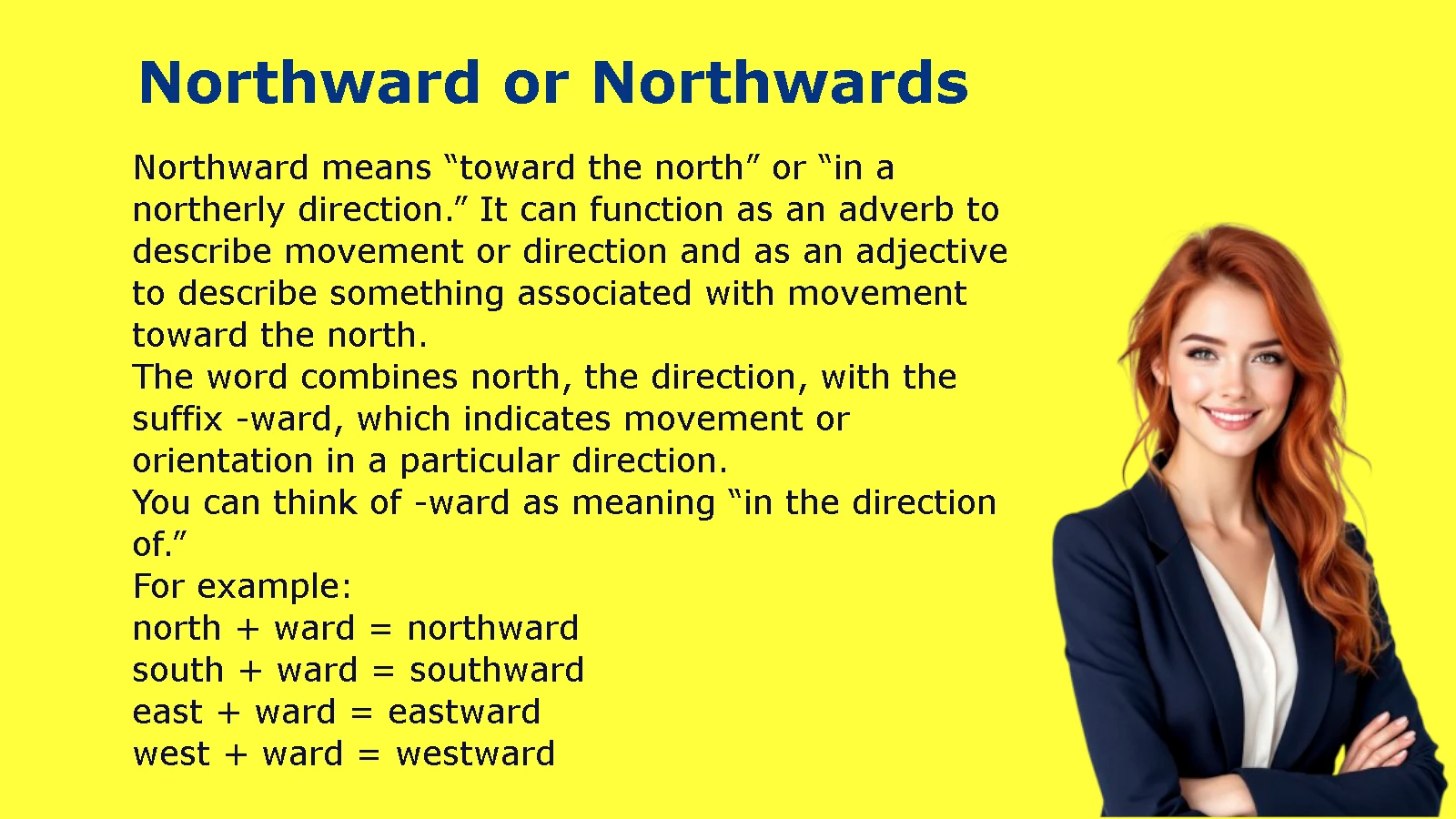
Northward means “toward the north” or “in a northerly direction.” It can function as an adverb to describe movement or direction and as an adjective to describe something associated with movement toward the north.
The word combines north, the direction, with the suffix -ward, which indicates movement or orientation in a particular direction.
You can think of -ward as meaning “in the direction of.”
For example:
- north + ward = northward
- south + ward = southward
- east + ward = eastward
- west + ward = westward
The same pattern appears in words such as homeward, forward, backward, and outward.
Northward as an Adverb
As an adverb, northward tells you where someone or something is moving.
For example:
- The hikers continued northward after lunch.
- The storm moved northward overnight.
- The river flows northward through the valley.
- The expedition headed northward toward the mountains.
- The birds began flying northward in early spring.
In each case, northward modifies the action or describes the direction of movement.
You can usually replace it with a phrase such as “toward the north”:
The hikers continued northward.
The hikers continued toward the north.
The meaning remains essentially the same.
Northward as an Adjective
This is where northward becomes particularly useful.
As an adjective, it can describe a noun that involves movement or orientation toward the north.
Examples include:
- a northward journey
- a northward route
- northward migration
- a northward expansion
- northward movement
- a northward trend
- northward travel
Notice the position of the word. It appears before the noun.
That grammatical position is important because you cannot simply replace northward with northwards.
Correct:
Scientists observed a northward migration of several bird species.
Not standard:
Scientists observed a northwards migration of several bird species.
The meaning you want is clear in both cases, but only northward naturally performs the adjective’s job.
What Does Northwards Mean?
Northwards means “toward the north” or “in a northerly direction.” It functions as an adverb, so it normally describes an action, movement, or direction rather than directly modifying a noun.
For example:
- The travelers headed northwards.
- The river flows northwards.
- The storm moved northwards.
- The birds flew northwards for several hours.
- The road continues northwards from the village.
Here, northwards describes the direction of the action.
You can generally substitute northward without changing the basic meaning:
The travelers headed northwards.
The travelers headed northward.
Both work.
Northwards in a Sentence
The word tends to sound especially natural in sentences involving physical movement.
Consider these examples:
Travel
After leaving the city, we drove northwards along the coast.
Weather
The storm system is moving northwards.
Wildlife
The herd gradually moved northwards in search of food.
Geography
The river runs northwards before reaching the sea.
Exploration
The expedition continued northwards despite the worsening weather.
The word doesn’t mean “more north” or “very far north.” It describes direction toward the north.
That distinction matters.
Is Northwards Correct in American English?
Yes. Northwards is grammatically correct in American English, but northward is generally more common and often sounds more natural to American readers. You should not treat the -s ending as an error simply because American English often favors the shorter form.
For example, an American writer might naturally say:
The storm moved northward.
A British writer might naturally say:
The storm moved northwards.
Neither sentence contains a grammatical error.
The difference is largely one of regional preference and style.
You can see a similar pattern with several directional adverbs:
- toward / towards
- backward / backwards
- forward / forwards
- upward / upwards
- downward / downwards
- afterward / afterwards
American English often favors the shorter form, although the longer forms are not automatically wrong.
Why Northward Often Sounds More Natural in US English
American English frequently uses the -ward form without the additional -s.
For example:
The population is moving westward.
The aircraft traveled eastward.
The road continues southward.
The storm moved northward.
That doesn’t create a hard grammatical rule. It simply reflects common usage.
If your article, report, website, or academic paper targets a primarily American audience, northward is therefore a sensible default.
Northward or Northwards: What Is the Difference?
The central difference between northward and northwards isn’t their basic meaning. Both can describe movement toward the north.
The more useful distinction involves grammar and regional usage.
When to Use Northward
Use northward when:
- You need an adjective before a noun.
- You want an adverb meaning “toward the north.”
- You’re writing primarily for an American audience.
- You want a shorter, broadly understood directional form.
Examples:
The northward migration began in March.
The birds migrated northward.
The highway extends northward.
The company expanded northward into new markets.
When to Use Northwards
Use northwards when:
- You need an adverb describing movement toward the north.
- You’re writing in a style where British English is appropriate.
- The longer directional form fits the rhythm of your sentence.
Examples:
The hikers walked northwards.
The river flows northwards.
The clouds drifted northwards.
The important point is that northwards is not simply an alternative adjective form.
That’s why this works:
The hikers walked northwards.
But this does not follow standard usage:
The hikers planned a northwards journey.
Use:
The hikers planned a northward journey.
Why “Northwards Migration” Is Incorrect
The phrase “northwards migration” causes confusion because northwards and northward have almost identical meanings when used adverbially.
The problem isn’t meaning. It’s grammatical function.
In the phrase northward migration, the word northward modifies the noun migration. It tells you what kind of migration is being discussed.
Here are some parallel examples:
- northward migration
- southward movement
- eastward expansion
- westward travel
The -ward form works naturally as an adjective.
By contrast, northwards is an adverb. It normally modifies a verb:
The birds migrated northwards.
Think of the difference this way:
| Function | Correct example |
| Adjective + noun | northward migration |
| Verb + adverb | migrated northwards |
| Verb + adverb | migrated northward |
| Adjective + noun | northward movement |
| Verb + adverb | moved northwards |
This gives you an easy test.
If the word comes directly before a noun, choose “northward.”
If it describes how or where something moves, either northward or northwards can work.
Northward or Northwards in American English
For American English, northward is usually the most natural choice.
That doesn’t mean northwards is forbidden. It simply means that the shorter form generally fits American usage more comfortably.
Consider these sentences:
The storm is moving northward.
The population has shifted northward.
The birds began a northward migration.
The highway continues northward for another 50 miles.
These examples sound natural in US English.
Examples in American English
Here are some practical examples across different contexts.
Weather
The hurricane is expected to move northward overnight.
Geography
The river bends northward near the border.
Transportation
The train is traveling northward toward Chicago.
Wildlife
Researchers recorded a gradual northward migration.
Business
The company plans a northward expansion into neighboring states.
Population
Housing development has continued northward along the highway.
Notice something interesting: northward works both before nouns and after verbs.
That versatility makes it particularly useful when you’re writing for an American audience.
Northward or Northwards in British English
British English comfortably uses northwards as an adverb.
For example:
The train traveled northwards.
The river flows northwards.
The travelers continued northwards.
At the same time, northward is not wrong in British English. You don’t have to use northwards simply because your audience is British.
This is an important distinction:
Regional preference is not the same thing as grammatical correctness.
A British writer can use northward. An American writer can use northwards. The forms don’t belong exclusively to one country.
The difference is better understood as a matter of frequency, style, and linguistic preference.
Examples in British English
Imagine a travel article describing a road trip:
We headed northwards from London before turning west toward the coast.
Or a geography textbook:
The river flows northwards through the valley.
Or a news report:
The storm is expected to move northwards during the evening.
All three sound perfectly natural in British English.
But British English also permits:
The storm is expected to move northward during the evening.
So don’t mark northward as an American-only word.
Northward or Northwards: Which One Should You Use?
If you want a simple rule, use northward as your default.
It works as both an adjective and an adverb, and it fits naturally into American English.
Use northwards when you want the adverbial form and the style of your English supports it, particularly in British English.
Here’s a practical decision guide:
| Your situation | Recommended form |
| Before a noun | northward |
| American English adverb | northward |
| British English adverb | northward or northwards |
| Formal geographical writing | northward or northwards, depending on style |
| “Toward the north” after a verb | northward or northwards |
| “Toward the north” before a noun | northward |
Quick Decision Examples
Suppose you’re writing about migrating birds.
Situation 1: You need an adjective
The birds began their northward migration.
Use northward.
Situation 2: You need an adverb
The birds began migrating northward.
Use northward.
Situation 3: You prefer British-style adverbial usage
The birds began migrating northwards.
Use northwards.
All three communicate essentially the same directional idea.
Northward vs. Northwards Example Sentences
Seeing the words in real sentences makes the distinction much easier.
Examples With Northward
Here are several examples showing different grammatical uses:
- The hikers traveled northward before sunset.
- The storm continued northward across the plains.
- The river bends northward near the town.
- Scientists documented a northward shift in the species’ range.
- The company announced a northward expansion.
- We followed a northward route along the coast.
- The birds began their northward migration in early spring.
- The road stretches northward for nearly 100 miles.
Notice that northward can appear immediately before a noun or after a verb.
Examples With Northwards
Now look at examples using northwards:
- The travelers continued northwards after crossing the bridge.
- The river flows northwards through the valley.
- The storm moved northwards overnight.
- The birds flew northwards at dawn.
- The road winds northwards toward the mountains.
- We walked northwards until we reached the village.
- The expedition gradually moved northwards.
- The clouds drifted northwards across the region.
Every example uses northwards as an adverb.
That’s the grammatical pattern worth remembering.
Side-by-Side Examples
| Northward | Northwards |
| The train traveled northward. | The train traveled northwards. |
| The birds flew northward. | The birds flew northwards. |
| The road extends northward. | The road extends northwards. |
| northward migration | not: northwards migration |
| northward movement | not: northwards movement |
| northward expansion | not: northwards expansion |
The first three pairs are interchangeable in meaning. The final three illustrate why northward has a wider grammatical role.
Northward vs. Northwards vs. Northbound
Another word often enters this discussion: northbound.
Although northward, northwards, and northbound all relate to northern direction, they aren’t interchangeable in every sentence.
Northward and northwards focus on direction of movement.
Northbound usually describes something that is headed north, particularly transportation, roads, lanes, trains, buses, or travelers.
Compare:
The train is traveling northward.
The train is northbound.
Both are correct, but they emphasize slightly different things.
The first describes the train’s direction of travel.
The second identifies the train as one traveling toward the north, often as a transportation designation.
You might see:
- northbound train
- northbound traffic
- northbound lane
- northbound highway
- northbound passengers
You generally wouldn’t replace these with northwards.
Northward vs. Northbound Examples
The car continued northward along the highway.
This focuses on movement.
The driver entered the northbound lane.
This identifies the lane’s designated direction.
Another example:
The train traveled northward through the countryside.
versus:
We boarded the northbound train.
The distinction becomes much clearer when you think about movement versus designation.
Common Mistakes With Northward and Northwards
The words are simple once you understand the pattern, but several mistakes appear repeatedly.
Using Northwards as an Adjective
One of the most common errors is putting northwards directly before a noun.
For example:
Northwards migration is increasing.
Replace it with:
Northward migration is increasing.
Why?
Because northward can function as an adjective, while northwards is normally an adverb.
The same pattern applies to:
- northward movement
- northward expansion
- northward travel
- northward shift
- northward route
Assuming Northwards Is Wrong
The opposite mistake is just as unhelpful.
Some writers see the extra -s and assume that northwards must be incorrect.
It isn’t.
This sentence is perfectly grammatical:
The travelers moved northwards.
So is:
The travelers moved northward.
You shouldn’t “correct” northwards simply because you’re more accustomed to northward.
Treating American and British Usage as a Grammar Rule
It’s tempting to create a rigid rule:
American = northward
British = northwards
But real English doesn’t work that neatly.
These are preferences, not borders.
Both varieties can use either form. The difference is that some forms occur more naturally or frequently in particular regional styles.
Switching Forms Without a Reason
If you’re writing a long article, report, or academic paper, consistency helps.
You don’t necessarily need to eliminate every occurrence of northwards because you used northward elsewhere. However, if you’re writing specifically in US English, consistently favoring northward will usually give your prose a more natural American feel.
Northward and Northwards in Formal Writing
Both forms can appear in formal writing, including geographical, scientific, environmental, historical, and academic contexts.
The choice often depends on sentence structure.
Consider:
Researchers observed a northward shift in the species’ habitat.
Here, northward is the natural choice because it modifies shift.
Now change the structure:
Researchers observed the species moving northwards.
Here, northwards works because it modifies the movement expressed by moving.
You can also write:
Researchers observed the species moving northward.
Again, both adverbial forms work.
A Useful Editing Test
When proofreading, ask:
Is the word describing a noun, or is it describing an action?
If it describes a noun:
northward migration
If it describes an action:
migrated northward
or:
migrated northwards
This one question solves most usage problems.
Northward and Northwards in Scientific and Geographical Writing
Directional language appears constantly in scientific and geographic writing.
Researchers might describe:
- northward movement
- northward migration
- northward expansion
- northward range shifts
- northward displacement
- northward movement of a weather system
The adjective northward is especially useful because scientific writing frequently places directional terms before nouns.
For example:
The study identified a northward shift in the species’ geographic range.
You could rewrite the same idea with an adverb:
The species’ geographic range shifted northward.
Both are useful. The first uses northward as an adjective; the second uses it as an adverb.
This flexibility makes northward particularly convenient in technical prose.
A Practical Case Study: Choosing the Right Form
Imagine you’re editing a short article about bird migration.
Your draft says:
“The northwards migration of the geese begins in March. The birds then travel northwards for several weeks.”
There are two different grammatical situations here.
The first phrase should be changed:
The northward migration of the geese begins in March.
The second sentence is already fine:
The birds then travel northwards for several weeks.
You could also use:
The birds then travel northward for several weeks.
So the polished version could read:
The northward migration of the geese begins in March. The birds then travel northwards for several weeks before reaching their breeding grounds.
Or, if you prefer a consistent US-English style:
The northward migration of the geese begins in March. The birds then travel northward for several weeks before reaching their breeding grounds.
This example shows why memorizing “use northward” or “use northwards” isn’t enough.
You need to look at the word’s grammatical job in the sentence.
Related Directional Words: Northward, Southward, Eastward, and Westward
The same grammatical pattern applies to the other cardinal directions.
| Direction | -ward form | -wards form |
| North | northward | northwards |
| South | southward | southwards |
| East | eastward | eastwards |
| West | westward | westwards |
The rules are broadly parallel.
You can say:
The travelers moved southward.
or:
The travelers moved southwards.
But before a noun, the -ward form is the natural choice:
southward movement
eastward expansion
westward migration
northward travel
This pattern gives you a useful shortcut. If you already understand eastward vs. eastwards, you can apply the same reasoning to northward vs. northwards.
Is Northward the Same as Toward the North?
In most ordinary contexts, yes.
Northward means toward the north.
Northwards also means toward the north.
For example:
The road runs northward.
means essentially:
The road runs toward the north.
Likewise:
The birds flew northwards.
means:
The birds flew toward the north.
There can be stylistic differences, but there isn’t a major difference in basic directional meaning.
Northward Does Not Mean “Northern”
This distinction is worth remembering.
Northward describes direction.
Northern usually describes location, association, or position.
Compare:
The birds made a northward journey.
This means they traveled toward the north.
The birds live in the northern region.
This describes where they live.
Likewise:
- northward movement = movement toward the north
- northern region = region located in the north
Those words aren’t interchangeable.
Northward vs. Northern
This is another useful distinction for writers.
Northward
Means toward the north.
The hikers walked northward.
Northern
Means located in or associated with the north.
The hikers reached the northern part of the country.
Compare the meaning:
The storm moved northward.
The storm is traveling toward the north.
One describes direction. The other describes position or association.
Northward vs. Northerly
Northerly can also create confusion.
Northerly generally means coming from the north, located toward the north, or oriented in a northern direction, depending on context.
For example:
A northerly wind swept across the region.
Here, the wind comes from the north.
That’s different from:
The birds flew northward.
Here, the birds are moving toward the north.
This distinction is especially important in weather writing.
Northward usually describes where something is going.
Northerly can describe a direction associated with the north, particularly wind.
How to Remember Northward vs. Northwards
If you regularly confuse the two, use this simple memory trick:
Northward has two jobs. Northwards has one.
Northward:
- adjective
- adverb
Northwards:
- adverb
So if you need a word before a noun, reach for northward.
northward migration
northward movement
If you’re describing movement after a verb, either form can work:
moved northward
moved northwards
This isn’t a perfect rule for every possible construction in English, but it’s an excellent practical guide for ordinary writing.
Northward or Northwards: Common Questions Answered
Is northward or northwards correct?
Both are correct. They can both function as adverbs meaning “toward the north.” The important grammatical difference is that northward can also function as an adjective, while northwards normally cannot.
Is northwards grammatically correct?
Yes. Northwards is a standard English adverb meaning “toward the north.” It is particularly common in British English, but American readers can understand it easily.
What is the difference between northward and northwards?
The basic directional meaning is the same. Northward works as both an adjective and an adverb, while northwards works as an adverb. Regional preference also influences which form sounds more natural.
Is northward more American or British?
Northward is especially common in American English, but British English also uses it. You shouldn’t treat it as an exclusively American word.
Can I say “northwards migration”?
No, not in standard usage. Say “northward migration.” In that phrase, northward functions as an adjective modifying migration. Use northwards after a verb: “The birds migrated northwards.”
Which should I use: northward or northwards?
If you’re writing for a US audience, northward is a safe default. If you’re writing in British English, northwards is a natural adverbial choice. When the word directly modifies a noun, use northward.
Northward or Northwards: Final Verdict
So, northward or northwards?
The answer depends on grammar, audience, and context.
Both forms describe movement toward the north. Neither is inherently wrong.
Use northward when you need an adjective:
- northward migration
- northward movement
- northward expansion
- northward journey
- northward route
Use northward or northwards as an adverb:
- moved northward
- moved northwards
- traveled northward
- traveled northwards
- flew northward
- flew northwards
For American English, northward will generally be the more natural choice. In British English, northwards is particularly common, although northward remains perfectly acceptable.
The easiest rule to remember is this:
If the word comes before a noun, use “northward.” If it describes movement toward the north, “northward” and “northwards” can both work.
Once you recognize whether the word is acting as an adjective or an adverb, the choice becomes much easier. You don’t need to memorize a complicated grammar rule. Just look at what the word is doing in the sentence.