Anyway vs. Anyways: The Quick Answer
“Anyway” is the standard spelling and the safest choice in almost every situation. “Anyways” is an informal variant commonly used in casual speech, texting, and conversational writing. “Any way” is different because it refers to a method, manner, or possible approach. When in doubt, use “anyway.”
Here’s the basic distinction:
| Form | Standard English? | Typical use | Example |
| anyway | Yes | Formal and informal | I decided to go anyway. |
| anyways | Informal | Casual speech and writing | Anyways, what happened next? |
| any way | Yes | A method or manner | Is there any way to fix this? |
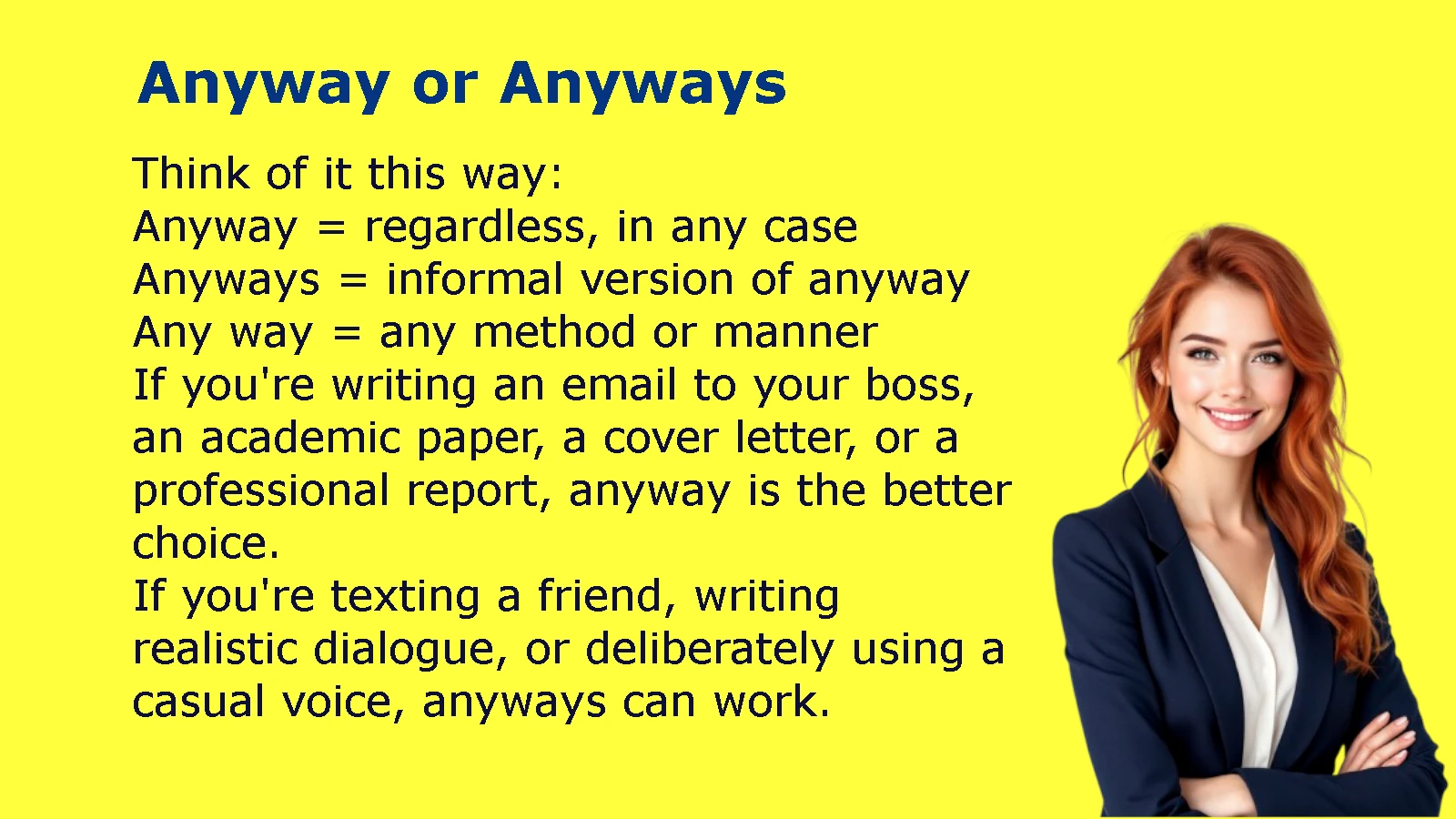
Think of it this way:
- Anyway = regardless, in any case
- Anyways = informal version of anyway
- Any way = any method or manner
If you’re writing an email to your boss, an academic paper, a cover letter, or a professional report, anyway is the better choice.
If you’re texting a friend, writing realistic dialogue, or deliberately using a casual voice, anyways can work.
What Does “Anyway” Mean?
Anyway is an adverb that commonly means “regardless,” “in any case,” or “despite that.” It can also function as a conversational transition when you want to return to the main subject, move past a distraction, or introduce another point.
The word has several closely related uses, so context matters.
Anyway Meaning “Regardless” or “In Any Case”
One of the most common uses of anyway shows that something happens despite another circumstance.
Consider:
I was exhausted, but I went anyway.
The speaker was tired, but that fact didn’t change the final decision.
You could replace anyway with “regardless”:
I was exhausted, but I went regardless.
The meaning remains nearly the same.
Here are more examples:
- It was raining, but we went anyway.
- She knew the answer was probably wrong, but she submitted it anyway.
- The restaurant was expensive, but we ate there anyway.
- I didn’t feel like exercising, so I took a short walk anyway.
- He warned me about the risks, but I tried it anyway.
In each sentence, anyway tells the reader that the previous circumstance didn’t prevent the action.
Anyway as a Transition Word
You can also use anyway to redirect a conversation.
Imagine two friends talking about a vacation. One starts discussing hotel prices, then gets distracted talking about a restaurant. After several minutes, the first friend says:
Anyway, where were we?
Here, anyway doesn’t mean “regardless” in the strictest sense. Instead, it helps the speaker return to the original subject.
This conversational use appears frequently in speech and informal writing.
Examples include:
- Anyway, let’s get back to the main point.
- Anyway, what were you saying?
- Anyway, I wanted to ask you something.
- Anyway, let’s move on.
- Anyway, that’s a story for another day.
This is one reason the word appears so often in dialogue. It acts almost like a conversational reset button.
Anyway at the End of a Sentence
Anyway doesn’t have to appear at the beginning of a sentence.
You can place it near the end when you mean “regardless” or “even without that.”
For example:
I wasn’t going to buy it anyway.
The sentence suggests that the speaker had already decided not to buy it, so another circumstance wouldn’t have changed the outcome.
More examples:
- I didn’t really want to go anyway.
- It wouldn’t have worked anyway.
- We were going to leave anyway.
- She knew about the problem anyway.
- Nobody was going to believe him anyway.
Notice how natural anyway sounds in all of these examples. This position is especially common in casual conversation.
What Does “Anyways” Mean?
Anyways generally means the same thing as “anyway,” but it carries a more informal, conversational tone. It frequently appears in casual speech, texting, social media posts, and dialogue. In formal or edited writing, anyway remains the safer standard choice.
The important point is that “anyways” isn’t simply a random spelling mistake.
People genuinely use it.
Is “Anyways” a Real Word?
Yes.
Anyways is a recognized English word, but its status differs from anyway in terms of register.
The easiest way to understand the distinction is:
Anyways exists, but anyway is the standard form.
English contains many words and expressions that people use naturally in conversation but avoid in formal writing.
That doesn’t necessarily make the informal form meaningless or incomprehensible. It simply means that context determines whether it sounds appropriate.
For example:
Anyways, I’ll call you tomorrow.
This sounds perfectly understandable in a casual conversation.
But in a formal business email, you’d normally write:
Anyway, I’ll call you tomorrow.
The second version is cleaner and more conventional.
When Do People Use “Anyways”?
You’ll most often encounter anyways in relaxed communication.
Common settings include:
- Text messages
- Social media
- Casual emails
- Online conversations
- Informal blogs
- Personal conversations
- Dialogue in fiction
- Humorous writing
For example:
Anyways, what are you doing tonight?
Or:
I didn’t like the movie anyways.
Or:
Anyways, let’s forget about it.
The word can also create a particular voice.
A character who says “anyways” may sound relaxed, spontaneous, youthful, regional, or conversational. A writer might intentionally use the word to make dialogue sound like real speech.
That’s different from using it accidentally in a formal document.
Is “Anyways” Grammatically Correct?
The most useful answer is “It’s acceptable in informal usage, but it isn’t the preferred standard form for formal writing.”
Calling it simply “wrong” misses an important distinction.
Language has different registers. The English you use in a text message doesn’t have to sound identical to the English you use in a legal document.
Compare these:
Anyways, I’ll figure it out.
and:
Anyway, I will determine the appropriate solution.
The first sounds conversational. The second sounds more formal.
Neither requires you to misunderstand the speaker’s meaning.
Still, if you’re taking a grammar test, writing an academic essay, preparing a business document, or trying to sound polished, use anyway.
Anyway or Anyways: What’s the Difference?
The primary difference is formality and standard usage, not basic meaning.
| Feature | Anyway | Anyways |
| Basic meaning | Regardless; in any case | Generally the same |
| Standard form | Yes | No, informal variant |
| Formal writing | Recommended | Usually avoid |
| Casual speech | Common | Common in some varieties |
| Texting | Common | Common |
| Academic writing | Preferred | Usually avoid |
| Professional writing | Preferred | Usually avoid |
| Conversational dialogue | Natural | Natural when an informal voice fits |
Anyway vs. Anyways in Formal Writing
If you’re writing something that will be evaluated, published, submitted, or sent professionally, anyway should be your default.
That includes:
- College essays
- Research papers
- Business reports
- Cover letters
- Resumes
- Professional emails
- Formal presentations
- Official correspondence
- Application letters
For example, instead of:
Anyways, I would like to discuss the results.
Write:
Anyway, I would like to discuss the results.
Even better, in highly formal writing, you may decide that anyway isn’t needed at all:
I would like to discuss the results.
Good writing isn’t about adding formal-sounding words everywhere. It’s about choosing the clearest wording for the situation.
Anyway vs. Anyways in Casual Conversation
Casual conversation gives you more freedom.
If someone says:
Anyways, what are we doing tonight?
Nobody needs a grammar lecture before answering.
The informal form can sound completely natural depending on the speaker and context.
The same applies to dialogue in fiction.
For example:
“Anyways, I don’t think we should go.”
A novelist might choose this wording because it reflects how the character actually speaks.
Changing it to:
“Anyway, I don’t think we should go.”
could make the character sound slightly more polished.
That’s a small difference, but dialogue often depends on small differences.
Does “Anyways” Sound Unprofessional?
It can, especially in formal written communication.
The issue isn’t that readers won’t understand it. They almost certainly will.
The issue is register.
Imagine these two sentences in a job application:
Anyways, I think I’d be a great fit for the position.
Anyway, I believe my experience aligns well with the position.
The second sentence fits professional writing better.
If you’re unsure about the audience, choose anyway. It works in both formal and informal settings, so it gives you more flexibility.
Any Way vs. Anyway: Don’t Confuse Them
This is where the distinction becomes more important.
“Any way” and “anyway” aren’t merely two spellings of the same word. They perform different grammatical jobs.
When to Use “Any Way” as Two Words
Use any way when you’re talking about a method, manner, route, approach, or possible solution.
Consider:
Is there any way to fix this?
Here, way means “method” or “solution.”
You could rewrite the sentence as:
Is there any method of fixing this?
The meaning is still clear.
More examples:
- Is there any way to contact her?
- I’ll help you in any way I can.
- You can arrange the furniture any way you like.
- Is there any way we can solve this problem?
- He couldn’t find any way out of the building.
In all of these examples, way retains its ordinary noun meaning.
When to Use “Anyway” as One Word
Use anyway when it means something like “regardless,” “in any case,” or “despite that.”
For example:
I didn’t want to go, but I went anyway.
You aren’t talking about a method.
You’re saying that despite not wanting to go, you went.
Another example:
Anyway, let’s start the meeting.
Here, anyway functions as a conversational transition.
Compare that with:
Is there any way to start the meeting earlier?
Now way means a method or possibility.
The difference becomes obvious once you look at the surrounding words.
A Simple Trick for Remembering the Difference
Ask yourself:
Am I talking about a method, manner, or possibility?
If yes, any way is probably correct.
Is there any way to make this faster?
If you’re saying regardless or in any case, use anyway.
I don’t have much time, but I’ll help anyway.
If you’re deliberately using casual conversational English, anyways can replace anyway.
Anyways, let’s get started.
A quick memory rule:
Method → any way
Regardless → anyway
Casual version of anyway → anyways
Anyway or Anyways: Examples in Real Sentences
Seeing the words in context is often more useful than memorizing definitions.
Examples With “Anyway”
Here are several common uses:
Meaning “regardless”:
The weather was terrible, but we went anyway.
Meaning “in any case”:
I don’t know whether she’ll come. We’ll start anyway.
Changing the subject:
Anyway, what happened after the meeting?
Returning to a previous topic:
Anyway, let’s get back to the original question.
Sentence-final use:
I wasn’t interested anyway.
Showing that something would have happened regardless:
He was going to leave anyway.
Examples With “Anyways”
These examples work best in casual contexts:
Anyways, what did you decide?
I don’t think it matters anyways.
Anyways, I’ll see you tomorrow.
We were going to leave anyways.
Anyways, that’s enough about work.
In each case, anyway could replace anyways without substantially changing the meaning:
Anyway, what did you decide?
I don’t think it matters anyway.
The main difference is the tone.
Examples With “Any Way”
Now compare these:
Is there any way to make this easier?
I’ll support you in any way I can.
You can organize the files any way you want.
Is there any way we can arrive earlier?
Here, way refers to an approach, method, or manner.
That makes the two-word form necessary.
Anyway vs. Anyways in American English
American English uses anyway extensively in both formal and informal settings, while anyways also appears in casual speech and writing.
The important distinction isn’t simply geography. Context and register matter.
Is “Anyways” Common in American English?
Yes, many American speakers use anyways, particularly in casual conversation.
You may hear it at the beginning of a sentence:
Anyways, what were we talking about?
Or at the end:
I didn’t want to go anyways.
The frequency can vary from speaker to speaker and region to region.
Some people use it constantly. Others almost never say it.
That variation is normal in spoken English.
Anyway vs. Anyways in Spoken English
Spoken language gives people room to use informal forms, repetitions, contractions, fillers, and conversational shortcuts.
Consider this natural exchange:
“So what happened?”
“Well, we missed the train.”
“Anyways, did you get there eventually?”
The conversational environment makes the informal form unsurprising.
Written English doesn’t always work the same way.
A polished article, business proposal, or academic paper usually follows a more standardized register.
Anyway vs. Anyways in American Writing
The distinction becomes especially useful when you’re writing for different audiences.
| Writing situation | Better choice |
| College essay | anyway |
| Business email | anyway |
| Job application | anyway |
| Formal report | anyway |
| Text message | Either, depending on tone |
| Social media post | Either |
| Personal blog | Either |
| Fictional dialogue | Either, depending on character |
| Casual chat | Either |
| Professional website copy | anyway |
The safest default is still anyway.
Which One Should You Use?
If you’re making the decision while writing, you don’t need a complicated grammar test.
Use this three-part rule.
Use “Anyway” When Writing Formally
Choose anyway for:
- Academic assignments
- Business communication
- Professional websites
- Reports
- Applications
- Formal letters
- Edited articles
- Workplace documents
For example:
Anyway, the findings suggest that the company should reconsider its current approach.
That’s clear, conventional, and professional.
“Anyways” Is Fine in Casual Contexts
You can use anyways when you intentionally want a relaxed conversational tone.
For example:
Anyways, I’ll text you when I get home.
Or:
Anyways, enough about that.
There’s nothing inherently confusing about these sentences.
The key question is who you’re talking to and what you’re writing.
Use “Any Way” When You Mean “By Any Method”
This distinction deserves the strongest rule because spacing changes the grammatical meaning.
Compare:
I’ll help you any way I can.
with:
I’ll help you anyway.
The first says “by whatever method I can.”
The second says “regardless” or “in any case.”
Here’s another pair:
Is there any way to repair this?
versus:
We don’t know what happened, but we’ll continue anyway.
The first asks for a solution.
The second says the action will continue regardless of circumstances.
Common Mistakes With Anyway, Anyways, and Any Way
Writing “Anyways” in Formal Contexts
The most common problem isn’t misunderstanding the word. It’s using the right word in the wrong setting.
For example:
Anyways, I am writing to apply for the position.
This isn’t difficult to understand, but it sounds unnecessarily casual for a job application.
Better:
I am writing to apply for the position.
Or, if the transition genuinely helps:
Anyway, I would like to discuss my qualifications.
In formal writing, simplicity often wins.
Using “Anyway” When “Any Way” Is Required
Consider:
Is there anyway to solve this problem?
Many readers will recognize the intended meaning, but the standard form is:
Is there any way to solve this problem?
Why?
Because way means “method” or “solution.”
You could say:
Is there any method to solve this problem?
That confirms the two-word construction.
Here’s another example:
Incorrect for the intended meaning:
You can do it anyway you want.
Correct:
You can do it any way you want.
You’re talking about how something can be done.
Assuming “Anyways” Is Always Incorrect
This is the opposite mistake.
It’s too simplistic to say:
“Anyways” is not a word.
People use it, dictionaries recognize it, and it has a stable meaning in informal English.
A better rule is:
“Anyways” is informal; “anyway” is the standard choice.
That distinction gives you more useful information than simply labeling one form “wrong.”
Confusing “Anyway” With “Anyways”
Because the meanings overlap, writers sometimes treat them as completely interchangeable in every situation.
They’re not.
Consider a formal presentation:
Anyways, I’d like to discuss the next point.
Now compare:
Anyway, I’d like to discuss the next point.
Both are understandable, but the second sounds more polished.
The difference is mainly register, not comprehension.
A Practical Case Study: Choosing the Right Form
Imagine three people writing essentially the same message.
Scenario: Texting a Friend
Anyways, are we still meeting at 7?
This is perfectly natural as casual communication.
Scenario: Sending a Work Email
Anyway, are we still meeting at 7?
The standard form fits the professional context better.
Scenario: Asking About a Method
Is there any way we can move the meeting to 7?
Now any way is required because the writer is asking whether a particular arrangement or method is possible.
The three sentences look similar, but the grammar changes according to the intended meaning.
That’s why spelling alone isn’t enough. You need to understand the job the word is doing in the sentence.
A Quick Decision Table
When you’re stuck between anyway or anyways, use this table.
| If you mean… | Use… | Example |
| Regardless | anyway | I’ll go anyway. |
| In any case | anyway | Anyway, let’s begin. |
| Returning to a topic | anyway | Anyway, where were we? |
| Casual version of “anyway” | anyways | Anyways, let’s leave. |
| A method | any way | Is there any way to help? |
| A manner | any way | Do it any way you like. |
| A possible solution | any way | Is there any way to fix it? |
When you’re uncertain, anyway is the safest choice unless the sentence clearly calls for any way.
Anyway or Anyways: Final Verdict
Anyway is the standard form and the best all-purpose choice.
Anyways is an informal variant that works naturally in casual speech, texting, social media, and conversational dialogue. You don’t need to treat it as meaningless or automatically incorrect. Just recognize that it carries a more informal tone.
Any way is a separate construction. Use it when way means a method, manner, approach, or possible solution.
The simplest rule is:
Use “anyway” by default. Use “anyways” when you intentionally want an informal tone. Use “any way” when you’re talking about a method or manner.
Once you recognize that distinction, the choice becomes almost automatic.
And if you’re editing a professional article, email, application, or report and still hesitate, there’s an easy escape hatch: choose “anyway.” It works in virtually every context where anyways would work, without carrying the same informal flavor.
Frequently Asked Questions
Is “anyways” grammatically correct?
Yes, anyways is recognized as an informal variant of anyway. It’s common in casual speech and informal writing, but anyway remains the better choice for formal, academic, and professional writing.
Is it “anyway” or “anyways” in a sentence?
Both can work when the meaning is “regardless” or “in any case,” but anyway is the standard form. Use anyways when you deliberately want a casual or conversational tone.
Is “anyways” a proper word?
Yes. Anyways is an established informal English word, rather than simply a typographical error. However, its informal status makes anyway preferable in polished or formal writing.
Is it “any way” or “anyway”?
Use any way when way means a method, manner, approach, or possible solution: “Is there any way to fix this?” Use anyway when you mean “regardless” or “in any case”: “I’ll do it anyway.”
Should I use “anyways” in an essay?
Generally, no. Use anyway in academic essays and other formal writing unless you’re deliberately reproducing informal speech or writing dialogue for a character.
What is another word for “anyway”?
Depending on the sentence, alternatives include in any case, regardless, anyhow, nevertheless, and nonetheless. The best replacement depends on whether anyway means “regardless,” introduces a transition, or serves another conversational purpose.
Final Takeaway
The anyway or anyways debate becomes much easier when you stop treating it as a simple right-versus-wrong spelling question.
Anyway is your standard, versatile choice.
Anyways gives you a more casual conversational flavor.
Any way has a different grammatical meaning and refers to a method, manner, or approach.
So, when you’re staring at the sentence and wondering which one belongs there, ask yourself what you mean first. If you’re saying “regardless,” choose anyway. If you’re talking about a method, choose any way. If you’re intentionally writing informal conversation, anyways can fit.
That’s the whole trick. Once you see the difference, you’ll rarely have to second-guess these three forms again.