A nonconcurrence is a lack of agreement, especially when someone does not agree with a decision, opinion, judgment, or proposed action. If you’ve come across the word “nonconcurrence” and wondered what it means, how it is used, or why it appears in legal, business, or official contexts, the term is closely connected to disagreement, dissent, opposition, objections, decisions, and differing opinions.
The nonconcurrence meaning refers to a situation in which two or more people, groups, or authorities do not agree on a matter. The word is often used in formal or institutional settings, particularly when someone declines to approve, support, or agree with a decision. Terms such as disagreement, dissent, opposition, objection, disagreement of opinion, and lack of agreement are related but can have slightly different uses.
In this guide, you’ll learn what “nonconcurrence” means, how the word is used in sentences, where it commonly appears, and how “nonconcurrence” differs from related terms such as “dissent,” “disagreement,” and “nonagreement.” You’ll also see clear examples to make the meaning easy to understand.
By the end, you’ll know exactly what nonconcurrence means and how to use this formal word naturally and correctly.
What Does Nonconcurrence Mean?
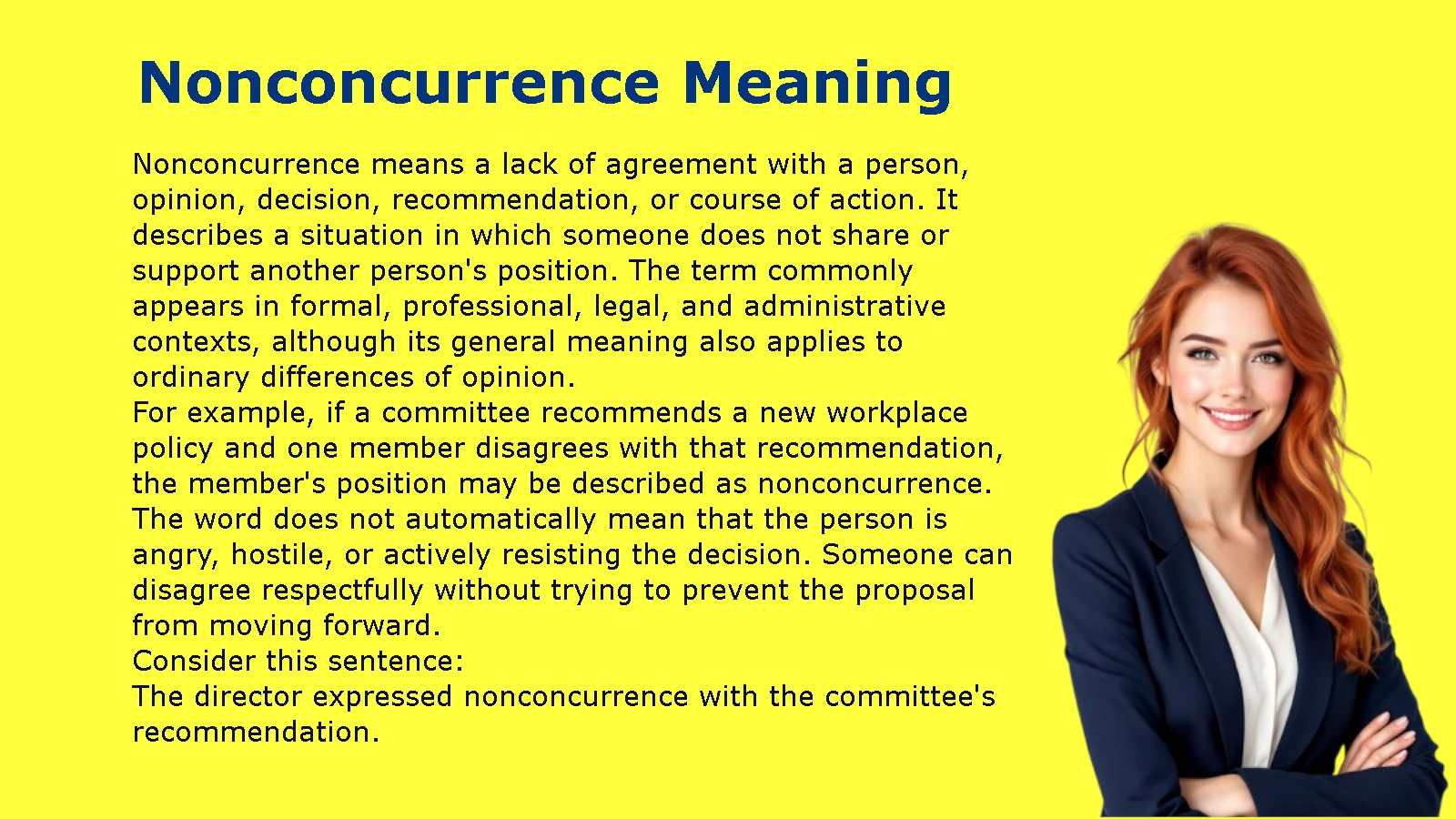
Nonconcurrence means a lack of agreement with a person, opinion, decision, recommendation, or course of action. It describes a situation in which someone does not share or support another person’s position. The term commonly appears in formal, professional, legal, and administrative contexts, although its general meaning also applies to ordinary differences of opinion.
For example, if a committee recommends a new workplace policy and one member disagrees with that recommendation, the member’s position may be described as nonconcurrence.
The word does not automatically mean that the person is angry, hostile, or actively resisting the decision. Someone can disagree respectfully without trying to prevent the proposal from moving forward.
Consider this sentence:
The director expressed nonconcurrence with the committee’s recommendation.
This means the director did not agree with the recommendation. It does not necessarily tell you why the director disagreed or whether the committee changed its decision.
Nonconcurrence Definition in Simple English
In simple English, nonconcurrence means not agreeing with something.
Imagine that your coworkers support a proposal to change the company’s working hours, but you believe the change would create scheduling problems. You explain your concerns and refuse to endorse the proposal. Your position represents nonconcurrence.
Here are a few simple examples:
- Nonconcurrence with a decision: You do not agree with the decision that someone made.
- Nonconcurrence with an opinion: You have a different view from another person.
- Nonconcurrence with a recommendation: You do not support a suggested course of action.
- Nonconcurrence with a policy: You disagree with a proposed or existing rule.
The important point is that nonconcurrence describes the absence of agreement. The word alone does not establish whether the disagreement is justified, whether the person has authority to challenge the decision, or whether anyone must reconsider the matter.
Is Nonconcurrence a Word?
Yes. Nonconcurrence is a recognized English noun used to describe a lack of agreement or a failure to concur.
The word combines two parts:
- Non-: A prefix meaning not or the absence of something.
- Concurrence: Agreement, shared opinion, or the act of agreeing.
Together, these parts create a word that expresses the absence of concurrence.
The standard spelling is nonconcurrence, written as one word. You may also encounter non-concurrence with a hyphen, particularly in specialized documents or sources that follow different editorial conventions.
The related verb is concur, which means to agree. Its negative counterpart in ordinary phrasing is not concur, while nonconcurrence names the state or position of not agreeing.
For example:
- Verb: I concur with your assessment.
- Negative verb phrase: I do not concur with your assessment.
- Noun: My nonconcurrence with the assessment is documented in the report.
All three expressions communicate related ideas, but they serve different grammatical purposes.
Nonconcurrence Meaning in Different Contexts
Nonconcurrence generally means a lack of agreement, but context determines what that disagreement involves. In an informal discussion, it may describe a difference of opinion. In a workplace review or official procedure, it may identify a recorded position that differs from a recommendation or proposed decision.
Understanding the setting is especially important when interpreting formal documents.
Nonconcurrence in Everyday English
In everyday English, nonconcurrence describes a difference of opinion between people. However, the word sounds formal and is uncommon in casual conversation.
Suppose two friends discuss where to spend their vacation. One wants to visit the mountains, while the other prefers a beach. The second friend does not concur with the first friend’s preference.
You could describe this difference as nonconcurrence, but most people would simply call it a disagreement.
Here are some examples:
- Her nonconcurrence with the plan became clear during the discussion.
- The group acknowledged his nonconcurrence but continued exploring other options.
- Their nonconcurrence concerned the budget, not the project’s overall purpose.
These sentences are grammatically sound, although everyday alternatives would often sound more natural.
For example, instead of saying, “Their nonconcurrence concerned the budget,” you could write, “They disagreed about the budget.”
Practical tip: Use nonconcurrence when you need a formal or procedural tone. Choose disagreement when you want ordinary readers to understand your meaning immediately.
Nonconcurrence in Legal Terms
In legal settings, nonconcurrence may describe a judge’s, official’s, or other participant’s lack of agreement with a legal position, recommendation, decision, or proposed outcome. Its precise meaning depends on the jurisdiction, the type of proceeding, and the document in which the term appears.
The distinction matters because legal disagreement can take several forms.
For example, a judge might agree with the final outcome of a case but disagree with part of the reasoning. Another judge might reject the outcome entirely. A legal document may also record that an official does not approve a recommendation submitted for review.
These situations involve different questions, even though each includes a difference of opinion.
Consider this illustrative example:
The reviewing official recorded nonconcurrence with the proposed interpretation of the regulation.
The sentence tells you that the official does not agree with the interpretation. It does not establish that a court has issued a dissenting opinion or that the interpretation has been declared legally invalid.
That distinction prevents a common misunderstanding: nonconcurrence does not automatically mean a formal legal dissent.
A dissenting opinion is a recognized form of judicial writing in which a judge explains disagreement with a court’s decision or the majority’s reasoning. Nonconcurrence is a broader term unless a particular legal procedure gives it a more specific meaning.
When reading a legal document, check what the term refers to:
- A proposed legal interpretation.
- A recommendation submitted for approval.
- A decision made by an official or review panel.
- A judge’s position on a particular issue.
- A procedural step that records disagreement.
Do not assume that nonconcurrence automatically overturns a decision, blocks an action, or creates a legal right. Those consequences depend on the governing rules and the authority of the person expressing disagreement.
Nonconcurrence in Business and the Workplace
In business, nonconcurrence can describe an employee’s, manager’s, auditor’s, or committee member’s disagreement with a recommendation, assessment, strategy, or decision.
Organizations sometimes need to document differing views before approving a major action. Recording nonconcurrence can help distinguish a decision that received broad support from one that proceeded despite an unresolved objection.
For example, imagine that a company’s finance team recommends reducing the customer support budget by 15%. The operations manager believes that the reduction would increase response times and damage customer satisfaction.
The manager submits a written statement explaining the concern. The finance team may still approve the reduction, but the record now shows that the operations manager did not agree with the recommendation.
A suitable sentence would be:
The operations manager formally documented nonconcurrence with the proposed budget reduction.
This statement is more precise than saying the manager was unhappy. It identifies a disagreement about a specific proposal without making assumptions about the manager’s emotions.
Common workplace uses include:
- Performance reviews: A reviewer disagrees with an evaluation or rating.
- Budget approvals: A department challenges a proposed allocation of funds.
- Project planning: A team member disagrees with a timeline or implementation strategy.
- Audit findings: A department disputes a finding or recommendation.
- Policy development: An employee or committee member does not support a proposed policy.
For effective business writing, explain the substance of the disagreement whenever possible.
Instead of writing, “The department expressed nonconcurrence,” consider:
The department expressed nonconcurrence with the revised schedule because it did not allow sufficient time for quality testing.
The second sentence tells readers what the department opposed and why.
Nonconcurrence in Government and Official Documents
Government agencies and other public institutions may use nonconcurrence to record disagreement during administrative reviews, policy assessments, inspections, or approval procedures.
An official may disagree with a recommendation without having the authority to reject it. Alternatively, a formal process may give that official the power to request revisions, submit a separate assessment, or refer the matter to a higher authority.
The word itself does not tell you which situation applies.
For example:
The regional office submitted a statement of nonconcurrence with the proposed inspection findings.
This sentence indicates that the office disagrees with the findings. To understand the procedural consequences, a reader would need to examine the applicable rules and the rest of the document.
In official writing, nonconcurrence can serve several purposes:
- Recordkeeping: It creates a written record of a differing position.
- Accountability: It identifies where an official or department did not agree.
- Review: It may signal that a recommendation requires further examination.
- Decision tracking: It helps distinguish agreement from disagreement during an approval process.
- Clarification: It identifies an unresolved issue that decision-makers may need to address.
A formal record can be useful even when the disagreement does not change the final outcome. It allows future reviewers to understand which concerns were raised and whether decision-makers considered them.
However, the term should not be treated as a universal government procedure. Different agencies may define and process nonconcurrence differently.
Nonconcurrence Examples in Sentences
Sentence examples make the meaning of nonconcurrence easier to understand. The noun typically appears with verbs such as express, record, document, note, or indicate. It also commonly appears in constructions such as “nonconcurrence with a recommendation” or “a statement of nonconcurrence.”
The examples below cover everyday, professional, and administrative situations.
Simple Nonconcurrence Sentence Examples
Here are original sentences showing how the word works in context.
- The committee recorded its nonconcurrence with the proposed changes.
- Her nonconcurrence with the decision surprised the project leader.
- The report clearly explained the reasons for his nonconcurrence.
- Their nonconcurrence centered on the project’s cost rather than its purpose.
- The chairperson acknowledged the objection as evidence of nonconcurrence.
- Despite his nonconcurrence, he agreed to help implement the approved plan.
- The board requested a written explanation of the department’s nonconcurrence.
- Nonconcurrence with the recommendation did not automatically end the review.
- She submitted a statement describing her nonconcurrence with the proposed policy.
- The team discussed the disagreement before documenting its final position.
Notice that the word describes the lack of agreement, while the surrounding sentence provides additional information about the situation.
In sentence seven, for example, the board wants an explanation. The word does not tell readers whether the department’s reasoning is persuasive or whether the board will change its decision.
Formal and Professional Nonconcurrence Examples
Formal settings often require precise language that identifies the subject of disagreement.
Consider these examples:
- Business report: The compliance team recorded nonconcurrence with the proposed risk assessment because it omitted two identified control weaknesses.
- Project review: The engineering department expressed nonconcurrence with the implementation timeline.
- Budget meeting: The finance director documented nonconcurrence with the revised spending forecast.
- Employee evaluation: The employee submitted a written response indicating nonconcurrence with the performance rating.
- Policy review: The advisory panel noted nonconcurrence with the proposed eligibility criteria.
Each sentence identifies a specific disagreement. Some also explain its reason.
Compare the following statements:
| Less informative | More informative |
| The team expressed nonconcurrence. | The team expressed nonconcurrence with the revised deadline because it left no time for testing. |
| The reviewer disagreed. | The reviewer disagreed with the risk assessment because it excluded a major operational concern. |
| The employee objected. | The employee documented nonconcurrence with the rating and provided examples of completed work. |
The more informative examples help readers understand the issue without requiring them to search through several paragraphs for context.
Legal and Administrative Nonconcurrence Examples
The following examples are illustrative. They demonstrate possible wording rather than quote actual legal decisions, regulations, or official policies.
- The reviewing judge did not concur with the reasoning presented in the opinion.
- The agency recorded nonconcurrence with the proposed administrative recommendation.
- The review panel documented its disagreement with the interpretation submitted for consideration.
- The official provided a written explanation of nonconcurrence with the assessment.
- The final report acknowledged the differing positions without resolving every underlying question.
These examples also demonstrate an important writing principle: you do not always need the noun nonconcurrence to express the concept.
For example, “The reviewing judge did not concur with the reasoning” is often clearer than “The reviewing judge expressed nonconcurrence with the reasoning.”
Both communicate disagreement, but the verb phrase is more direct. In legal or administrative documents, however, the noun may be appropriate when it matches the terminology used by the relevant procedure.
A Practical Case Study: Recording Nonconcurrence at Work
Imagine that a software company plans to release a new product feature on June 1. The marketing department supports the date because a major advertising campaign is scheduled for that week. The quality assurance team believes the release should be delayed because several tests remain incomplete.
The quality assurance manager sends this statement:
“The QA team expresses nonconcurrence with the proposed release date because critical testing remains unfinished.”
The project director reviews the concern and decides to keep the release date but reduce the number of features included in the launch.
This example illustrates three important points:
- Nonconcurrence identifies a difference of opinion. It does not necessarily stop a decision.
- A clear reason makes the disagreement useful. The QA team identifies unfinished testing rather than merely rejecting the date.
- The decision-maker remains responsible for the final action. Recording disagreement does not automatically determine the outcome.
The same approach can help organizations handle disagreements constructively. Document the position, explain the reasoning, identify the relevant evidence, and clarify who has authority to make the final decision.
Synonyms for Nonconcurrence
Several English words can replace nonconcurrence, but they do not all communicate exactly the same thing. The best synonym depends on whether you want to describe a simple difference of opinion, a formal challenge, active resistance, or a refusal to approve something.
For everyday writing, disagreement is usually the most natural choice. For formal or specialized writing, dissent, objection, or opposition may fit better.
Common Synonyms for Nonconcurrence
| Synonym | Meaning | Best use |
| Disagreement | A difference of opinion | Everyday conversation and professional writing |
| Dissent | An expressed difference of opinion or position | Formal discussions, politics, and legal contexts |
| Objection | An expression of opposition or a reason against something | Meetings, reviews, and legal proceedings |
| Opposition | Resistance to an idea, proposal, or action | Policies, plans, and proposed changes |
| Nonagreement | A state of not agreeing | Explanatory or specialized contexts |
| Disapproval | An unfavorable opinion about something | Conduct, proposals, and decisions |
| Difference of opinion | A situation in which people hold different views | Neutral, accessible communication |
| Rejection | A refusal to accept something | Applications, proposals, and offers |
| Disagreement in principle | Opposition based on underlying beliefs or values | Ethical, strategic, and policy discussions |
| Reservation | A concern or qualification about something | Cautious support or conditional approval |
These terms overlap, but they are not interchangeable in every sentence.
For example, someone may express nonconcurrence without actively opposing the proposal. Someone who raises an objection usually identifies a reason for concern. A person who rejects a proposal goes further by refusing to accept it.
Nonconcurrence vs. Disagreement
Nonconcurrence and disagreement both describe a lack of agreement, but disagreement is more common and conversational. Nonconcurrence tends to sound formal and may be used when an organization needs to record a person’s position within a defined process.
Compare these sentences:
- I disagree with your suggestion.
- I express nonconcurrence with your suggestion.
Both communicate a lack of agreement. The first sounds natural in ordinary conversation. The second sounds more formal and may fit a documented review.
The difference is primarily one of tone and context, not a universal difference in the strength of the disagreement.
Use disagreement when writing for a general audience. Choose nonconcurrence when the formal tone or established terminology of a document makes it appropriate.
Nonconcurrence vs. Dissent
Dissent means expressing or holding a different opinion from an accepted, prevailing, or official position. Nonconcurrence more broadly indicates that someone does not agree.
For example:
The committee member expressed dissent from the majority’s position.
This suggests that the member holds or expresses a contrary view.
By contrast:
The committee member documented nonconcurrence with the recommendation.
This identifies the lack of agreement without necessarily implying a broader challenge to the majority’s position.
In judicial settings, dissenting opinion has a more specific meaning. It refers to a judge’s written disagreement with a court’s decision or reasoning. Nonconcurrence alone does not establish that such an opinion exists.
Nonconcurrence vs. Objection
An objection is an expression of opposition, disapproval, or concern, often accompanied by a reason. Nonconcurrence simply indicates that agreement is absent.
For example:
- Nonconcurrence: The reviewer did not agree with the proposed assessment.
- Objection: The reviewer objected to the assessment because it relied on incomplete data.
The second sentence gives a reason for the disagreement. That reason may be important in a meeting, formal review, or legal proceeding.
An objection can also have procedural consequences in certain settings. Nonconcurrence does not automatically carry those consequences.
Nonconcurrence vs. Opposition
Opposition often suggests a more active or sustained effort to resist an idea, policy, proposal, or action.
Suppose a manager does not agree with a proposed schedule but accepts the final decision. The manager’s position can be described as nonconcurrence.
If the manager organizes a formal campaign to prevent the schedule from being adopted, opposition may describe the situation more accurately.
The distinction is not absolute. People can oppose a proposal simply by stating that they disagree. However, opposition often emphasizes resistance, while nonconcurrence emphasizes the absence of agreement.
Nonconcurrence vs. Nonagreement
Nonagreement is a literal way to describe the absence of agreement. However, it is generally less idiomatic than disagreement in everyday English.
Nonconcurrence may sound appropriate in a formal record, while nonagreement may appear in explanatory or technical language. Neither word is automatically better in every context.
For most readers, the clearest options are:
- Use disagreement for ordinary communication.
- Use nonconcurrence when formal or procedural wording fits.
- Use nonagreement only when the surrounding context makes it useful and natural.
What Is the Opposite of Nonconcurrence?
The most direct opposite of nonconcurrence is concurrence, which means agreement or a shared position. Other suitable antonyms include agreement, accord, consensus, and assent, although each word carries a slightly different meaning.
The best choice depends on what kind of agreement you want to describe.
Common Antonyms of Nonconcurrence
| Antonym | Meaning | Example |
| Concurrence | Agreement or a shared position | The director expressed concurrence with the recommendation. |
| Agreement | A shared opinion or acceptance of a proposal | The team reached an agreement on the schedule. |
| Accord | Harmony or agreement between people or groups | The departments acted in accord with the revised policy. |
| Consensus | A general agreement among a group | The panel reached a consensus after discussing the evidence. |
| Assent | Formal or explicit agreement | The official gave assent to the proposed change. |
| Approval | Acceptance or authorization | The board granted approval for the project. |
These terms have different levels of precision. Concurrence is the closest direct antonym because it mirrors the original word. Consensus usually refers to a group agreement, while approval can indicate authorization rather than simply sharing an opinion.
Nonconcurrence vs. Concurrence
The prefix non- reverses the meaning of concurrence.
Consider these paired examples:
- The reviewer expressed concurrence with the report. The reviewer agreed with it.
- The reviewer expressed nonconcurrence with the report. The reviewer did not agree with it.
Another example:
- The department recorded concurrence with the recommendation.
- The department recorded nonconcurrence with the recommendation.
The change is small, but the meaning is the opposite.
In formal documents, check whether concurrence refers merely to agreement or to a particular approval step. Agreement and authorization are related concepts, but they are not always identical.
For example, an employee may agree that a project is worthwhile without having the authority to approve its budget. Similarly, an official may agree with a recommendation while another person retains the final decision-making power.
How to Use Nonconcurrence Correctly
Nonconcurrence is a noun. It names a state or instance of not agreeing rather than describing the act of disagreement as a verb.
The word commonly appears in formal statements, written evaluations, reports, and discussions about decisions. Correct usage depends on connecting it clearly to the opinion, decision, or recommendation in question.
Nonconcurrence in a Sentence
Several sentence patterns work naturally with nonconcurrence.
Express nonconcurrence with something
This pattern identifies the act of communicating disagreement.
The department expressed nonconcurrence with the proposed changes.
Record nonconcurrence with something
This construction emphasizes documentation.
The reviewer recorded nonconcurrence with the findings.
A statement of nonconcurrence
This phrase refers to a written or spoken declaration of disagreement.
The manager submitted a statement of nonconcurrence.
The reason for nonconcurrence
This pattern introduces an explanation.
The report identified insufficient evidence as the reason for nonconcurrence.
Nonconcurrence regarding an issue
This construction identifies the subject of disagreement.
The panel discussed nonconcurrence regarding the proposed funding arrangement.
The preposition with is especially natural when identifying the decision or position someone does not agree with. Regarding can also work when introducing a broader subject.
Whenever possible, avoid leaving the object unclear. A sentence such as “The team documented nonconcurrence” may be grammatically correct, but readers may wonder what the team disagreed with.
Is Nonconcurrence Formal or Informal?
Nonconcurrence is generally a formal word. It suits professional correspondence, administrative reports, policy reviews, and other contexts where precise documentation matters.
It is less natural in casual conversation.
For example:
- Formal: I wish to document my nonconcurrence with the proposed assessment.
- Neutral: I disagree with the proposed assessment.
- Casual: I don’t agree with that assessment.
Each sentence communicates a similar idea, but the tone changes.
Formal language can be useful when you need to create a clear record of your position. However, using technical vocabulary unnecessarily can make a message harder to understand.
A useful rule is to match your language to the audience. If the readers expect formal terminology, nonconcurrence may be appropriate. If you are speaking with coworkers during an ordinary discussion, disagreement is usually clearer.
Common Mistakes to Avoid
Although nonconcurrence is relatively straightforward, several mistakes can make its use confusing.
Treating nonconcurrence as automatic rejection
Not agreeing with a proposal does not necessarily mean rejecting it outright. Someone may disagree with part of a recommendation while accepting the final decision.
Assuming it always means legal dissent
Nonconcurrence is broader than a formal dissenting opinion. Do not describe every instance of disagreement as a judicial dissent.
Confusing disagreement with active resistance
A person can disagree without trying to prevent a decision from moving forward. Use opposition when the context emphasizes resistance.
Using the word without identifying the issue
A statement such as “The reviewer expressed nonconcurrence” leaves out useful information. Explain what the reviewer disagreed with whenever the context allows.
Making the sentence unnecessarily complicated
Compare these examples:
- Wordy: The committee’s position constituted an expression of nonconcurrence with the recommendation.
- Clearer: The committee did not agree with the recommendation.
The formal version may suit a specialized report, but the simpler sentence is often better for general readers.
Assuming the hyphen changes the meaning
The spellings nonconcurrence and non-concurrence generally express the same concept. Follow the relevant style guide or the terminology used in the document rather than inventing a distinction between them.