Have you ever stopped while writing because you weren’t sure whether mischievous or mischevious was the correct spelling? You’re not alone. The two forms look very similar, and the extra e in mischevious can seem natural because of the way some people pronounce the word.
Mischievous is the correct spelling. Mischevious is a common misspelling that incorrectly adds an e before the v. Mischievous means playful, naughty, or likely to cause minor trouble, especially in a fun or harmless way.
The correct spelling is:
m-i-s-c-h-i-e-v-o-u-s
Mischevious is not an alternative spelling of mischievous. It is simply a misspelling and should not be used in standard English.
| Spelling | Correct? | Meaning |
| Mischievous | ✅ Correct | Playfully troublesome, naughty, or causing minor trouble |
| Mischevious | ❌ Incorrect | Misspelling of mischievous |
The confusion is understandable. Many people pronounce mischievous as though it contains an extra syllable, which can make the incorrect spelling mischevious feel logical when writing the word from memory. This is why people often search for mischievous vs mischevious, mischievous or mischevious, which spelling is correct, mischievous or mischevious, or how to spell mischievous.
The key point is simple: mischievous is correct; mischevious is incorrect.
In this guide, you’ll learn the complete difference between Mischievous vs Mischevious, including their meaning, pronunciation, correct spelling, origin, and usage. You’ll also learn why mischevious is incorrect, how to remember the correct spelling of mischievous, and how to use the word correctly in clear English sentences.
Mischievous vs Mischevious: Quick Answer
Mischievous is the correct spelling in standard English.
Mischevious is an incorrect spelling and should not be used in formal or edited writing.
| Spelling | Correct? | Part of speech | Meaning |
| mischievous | ✅ Yes | Adjective | Playfully troublesome or slightly harmful |
| mischevious | ❌ No | — | Misspelling of mischievous |
For example:
The mischievous child hid his sister’s shoes.
Here, mischievous describes behavior that is troublesome but playful rather than seriously harmful.
Another example is:
She gave me a mischievous smile.
The smile suggests that she may be planning something playful, cheeky, or slightly naughty.
By contrast, this spelling is incorrect:
❌ She gave me a mischevious smile.
The correction is:
✅ She gave me a mischievous smile.
There is no American-versus-British spelling distinction here. Mischievous is the standard spelling in both varieties of English.
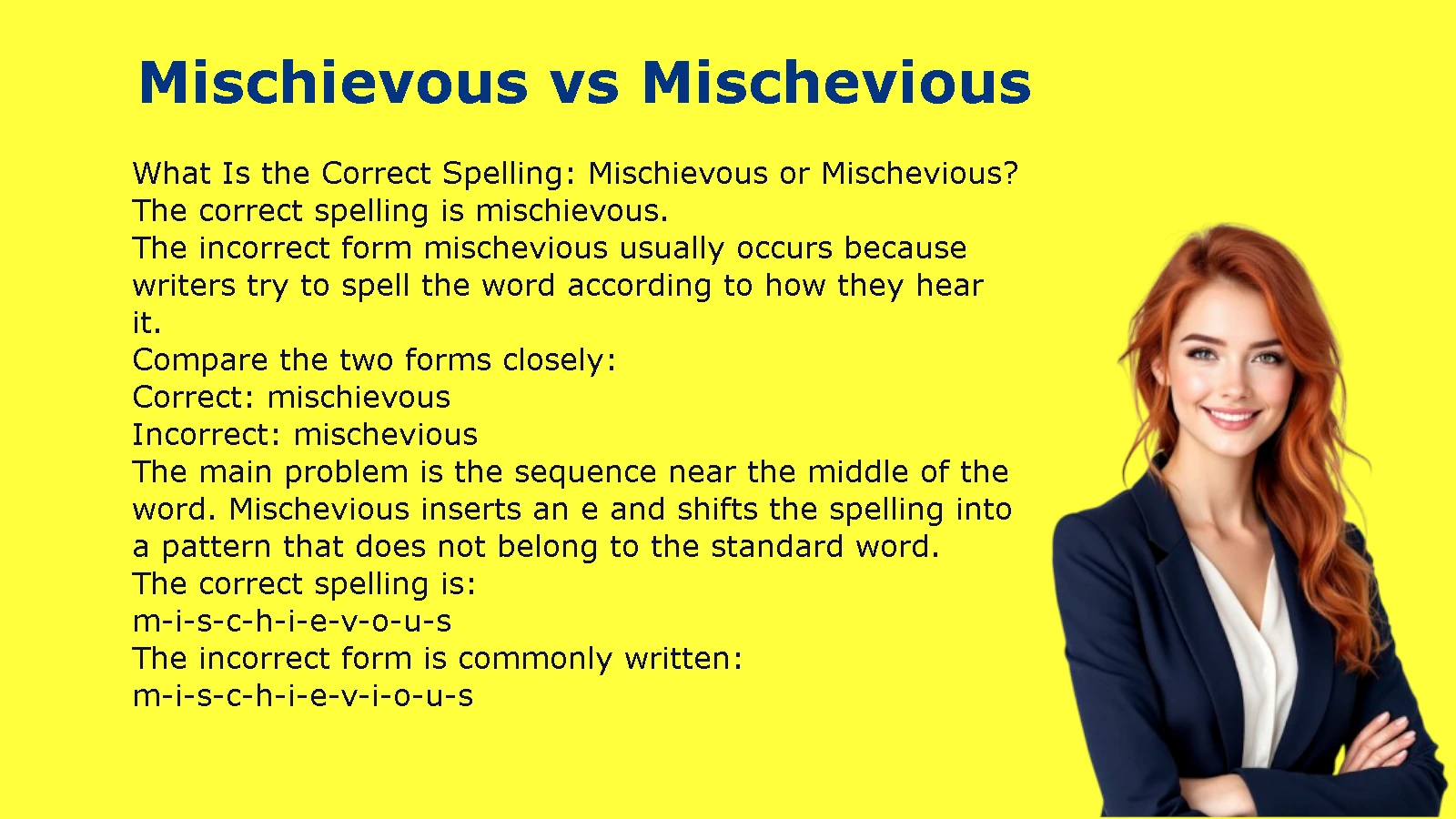
What Is the Correct Spelling: Mischievous or Mischevious?
The correct spelling is mischievous.
The incorrect form mischevious usually occurs because writers try to spell the word according to how they hear it.
Compare the two forms closely:
Correct: mischievous
Incorrect: mischevious
The main problem is the sequence near the middle of the word. Mischevious inserts an e and shifts the spelling into a pattern that does not belong to the standard word.
The correct spelling is:
m-i-s-c-h-i-e-v-o-u-s
The incorrect form is commonly written:
m-i-s-c-h-i-e-v-i-o-u-s
That extra i before the o is one of the easiest ways to recognize the mistake.
Why the Correct Spelling Looks Unusual
English spelling does not always correspond neatly to pronunciation. That is especially true with words whose spellings have developed through older forms of English and French.
Mischievous is one of those words.
Oxford traces the word to Middle English and Anglo-Norman French. Its older meanings were associated with unfortunate or harmful circumstances, while the modern sense of being playfully troublesome developed later.
So the spelling should not be reconstructed simply from the way the word sounds.
That is an important lesson with many English spelling questions:
Pronunciation can help you say a word, but it does not always tell you how to spell it.
Why Is Mischevious a Common Misspelling?
The spelling mischevious is understandable as a mistake because the spoken word does not make every letter obvious.
When people hear the word, they may mentally connect its sound to a spelling such as:
mischievious
That form feels plausible because English contains many words in which -ie-, -iev-, and similar letter combinations occur.
However, mischievous has its own established spelling.
There are several reasons the mistake can happen.
Pronunciation Influences Spelling
The pronunciation of mischievous varies somewhat between major English varieties, but neither standard pronunciation requires the spelling mischevious.
Cambridge gives the US pronunciation as /ˈmɪs.tʃə.vəs/ and the UK pronunciation as /ˈmɪs.tʃɪ.vəs/.
Because the middle sounds can be reduced or pronounced quickly, a writer may not have a clear mental picture of the letters.
This is especially common when someone has mostly heard the word rather than read it.
The Word Looks Related to Mischief
There is another source of confusion: mischief.
The words are closely related:
- mischief — noun
- mischievous — adjective
- mischievously — adverb
- mischievousness — noun
Seeing mischief may encourage someone to construct a spelling such as mischievious.
But the adjective is spelled:
mischievous
not:
mischievious
English Spelling Does Not Always Follow Simple Rules
English contains many words whose spellings have to be learned as established forms rather than generated from pronunciation.
For example, knowing how a word sounds does not necessarily tell you whether a vowel is represented by e, i, ea, or another combination.
Mischievous is a good example of why visual familiarity matters.
The more often you see the correct spelling, the easier it becomes to recognize the incorrect version.
Mischievous Meaning and Definition
Mischievous is an adjective describing someone or something that causes minor trouble, often in a playful or humorous way.
Cambridge defines it as behavior that is slightly bad but not intended to cause serious harm or damage. It also uses the word for something that expresses or suggests mischief.
Oxford gives a closely related definition: someone who enjoys playing tricks or annoying people, while also noting a more formal use for actions or statements that cause trouble.
The word can therefore describe both people and things associated with troublesome behavior.
For example:
- a mischievous child
- a mischievous dog
- a mischievous grin
- a mischievous smile
- a mischievous joke
- a mischievous prank
- a mischievous look
- a mischievous comment
Mischievous Does Not Always Mean Bad
Context matters.
If someone says:
The boy is mischievous.
They may mean that he likes playing tricks or getting into harmless trouble.
That is different from saying:
The boy is malicious.
Malicious suggests an intention to cause harm.
Mischievous is often much lighter.
A child who hides a parent’s keys as a joke may be mischievous. Someone who deliberately damages property to hurt another person is not normally described merely as mischievous.
This difference is important because mischievous often carries a playful or mildly critical tone.
How Do You Pronounce Mischievous?
Mischievous has more than one established pronunciation across English varieties.
Cambridge lists:
- UK: /ˈmɪs.tʃɪ.vəs/
- US: /ˈmɪs.tʃə.vəs/
Oxford lists the pronunciation as /ˈmɪstʃɪvəs/.
The important point for spelling is that the pronunciation does not justify writing mischievious or mischevious.
The standard spelling remains:
mischievous
Is Mischievous Three Syllables?
Yes. Standard dictionary pronunciations represent the word with three syllables.
You can think of the structure approximately as:
mis-chie-vous
The exact vowel quality differs by accent, but the word is not spelled according to an imagined extra syllable.
The pronunciation is one reason this word generates spelling confusion. Some speakers may reduce the middle vowel in ordinary speech, which can make the written form less obvious to someone learning the word by ear.
Does Mischievous Have a Commonly Misplaced Stress?
The modern standard pronunciation puts the primary stress at the beginning of the word.
Oxford represents it as:
/ˈmɪstʃɪvəs/
The apostrophe before the first syllable indicates primary stress.
Historical pronunciation patterns were different. Etymonline notes that stress on the second syllable was once common in literary usage but later became dialectal or jocular.
For modern standard English, however, the pronunciation shown in major learner dictionaries is the useful reference.
Mischievous vs Mischevious Examples
The easiest way to understand the difference is to put both forms into sentences.
Correct Examples With Mischievous
The mischievous puppy stole a sock and ran under the table.
The puppy is behaving playfully and causing minor trouble.
She gave him a mischievous grin before hiding the gift.
The grin suggests that she knows she is doing something playful or secretive.
The children were feeling mischievous after dinner.
Here, mischievous describes a mood or tendency toward playful troublemaking.
His mischievous joke made everyone laugh.
The joke caused some playful disruption rather than serious harm.
The cat has a mischievous look in its eyes.
The adjective describes an appearance suggesting that the animal may do something troublesome.
Incorrect Examples With Mischevious
These sentences contain the spelling error:
❌ The mischevious child drew on the wall.
Correct:
✅ The mischievous child drew on the wall.
Another example:
❌ He gave her a mischevious smile.
Correct:
✅ He gave her a mischievous smile.
And:
❌ The puppy looked mischevious after knocking over the plant.
Correct:
✅ The puppy looked mischievous after knocking over the plant.
The meaning does not change when you correct the spelling. The problem is simply that mischevious is not the standard spelling.
Mischievous in a Sentence
Mischievous can appear in several grammatical patterns.
Describing a Person
My little brother was mischievous when our parents left the room.
The adjective describes his behavior.
Describing an Animal
The mischievous dog grabbed the newspaper and ran away.
The word suggests playful troublemaking.
Describing an Expression
She wore a mischievous smile.
Here, the word describes what the smile seems to communicate.
Describing Behavior
The teacher noticed the students’ mischievous behavior.
The adjective modifies the noun behavior.
Describing a Joke or Trick
He played a mischievous prank on his friend.
The action is troublesome but presented as playful rather than seriously harmful.
Describing a Statement
Mischievous can also have a more formal meaning.
Oxford specifically notes that it can describe an action or statement that causes trouble, including something that may damage someone’s reputation.
For example:
The article contained several mischievous claims about the company.
In this context, the word does not necessarily describe a playful childlike prank. It can suggest that the statements are harmful or troublesome.
That broader sense is worth remembering because mischievous is not restricted to children.
Mischievous vs Mischief
Mischief and mischievous are closely related, but they have different grammatical roles.
| Word | Part of speech | Example |
| mischief | Noun | The children were up to mischief. |
| mischievous | Adjective | The children were mischievous. |
| mischievously | Adverb | He smiled mischievously. |
| mischievousness | Noun | Her mischievousness was obvious. |
The simplest distinction is:
Mischief = the troublesome behavior
Mischievous = describing someone or something associated with that behavior
Compare:
The children were causing mischief.
with:
The children were mischievous.
The first sentence uses a noun. The second uses an adjective.
You can also write:
He smiled mischievously.
Here, mischievously is an adverb describing how he smiled.
Mischievous Synonyms
| Synonym | Main idea | Typical tone |
| playful | Fun-loving or lighthearted behavior | Positive/neutral |
| naughty | Disobedient or badly behaved | Mildly negative |
| impish | Playfully troublesome | Playful |
| prankish | Inclined to practical jokes | Playful |
| cheeky | Bold or slightly disrespectful | Informal |
| roguish | Charming but slightly troublesome | Often playful |
| troublesome | Causing problems | More negative |
Mischievous vs Naughty
These words overlap, particularly when describing children.
The mischievous boy hid his sister’s toy.
This suggests playful troublemaking.
The naughty boy refused to follow the teacher’s instructions.
This emphasizes disobedience.
Someone can be both mischievous and naughty, but the words highlight different aspects of the behavior.
Mischievous vs Playful
Playful is generally more positive.
A playful child may simply enjoy games and jokes.
A mischievous child tends to go a step further by creating minor trouble or playing tricks.
For example:
The playful puppy chased the ball.
Nothing troublesome is implied.
But:
The mischievous puppy stole my shoe.
Now the animal has caused a small problem in a playful way.
Mischievous vs Impish
Impish is one of the closer alternatives to mischievous.
Both can describe a person who behaves in a playful, slightly troublesome way.
He gave me an impish grin.
He gave me a mischievous grin.
Both sentences suggest a knowing, playful expression.
The difference is mainly one of nuance and style. Impish can sound slightly more literary or character-focused, while mischievous is more common in everyday English.
Is Mischievous a Word?
Yes. Mischievous is a standard English word.
It is an adjective listed in major dictionaries, including Cambridge and Oxford.
Its primary modern meaning concerns playful or mildly troublesome behavior.
Examples include:
- a mischievous child
- a mischievous smile
- a mischievous dog
- a mischievous prank
- a mischievous look
The word also has a formal use for actions or statements that cause trouble. Oxford specifically records this sense.
So if you are wondering whether mischievous is a legitimate English word, there is no uncertainty:
Yes, it is.
Is Mischevious a Word?
Mischevious is not the standard spelling of an English word.
In ordinary modern English writing, it is best treated as a misspelling of mischievous.
This distinction matters because an incorrect spelling can still appear frequently online.
A word does not become a standard alternative spelling simply because many people type it incorrectly.
For example:
❌ mischevious
✅ mischievous
If you encounter mischevious in an email, article, school assignment, or social media post, the intended word is almost certainly mischievous.
Common Mistakes With Mischievous
Adding an Extra I
The most obvious mistake is:
❌ mischevious
instead of:
✅ mischievous
Remember that the standard spelling is mischievous, not mischievious.
Writing Mischievious
Another form that appears because of the same spelling confusion is:
❌ mischievious
The correct form remains:
✅ mischievous
The word does not need an extra i before the o.
Confusing Mischievous With Mischief
Because mischief is the related noun, writers sometimes try to build the adjective directly from what they see in the noun.
The relationship is real, but the spelling must still be learned:
mischief → mischievous
not:
mischief → mischievious
Spelling the Word From Sound Alone
This is probably the most useful lesson.
If you have only heard the word, its spelling may be difficult to reconstruct accurately.
That is why reading matters.
When you repeatedly see:
mischievous
your brain begins to recognize the word as a visual pattern.
A Practical Case Study: Correcting Mischievous in a Sentence
Imagine that a student writes:
❌ The mischievious puppy was very playful and kept stealing socks.
There are no major grammar problems in the sentence. The problem is the spelling of one adjective.
The correction is:
✅ The mischievous puppy was very playful and kept stealing socks.
Now consider a workplace sentence:
❌ The report included several mischievious statements about the competitor.
The intended meaning is that the statements were troublesome or potentially harmful.
The corrected version is:
✅ The report included several mischievous statements about the competitor.
This second example is useful because it shows that mischievous is not limited to children or playful situations. Oxford records a formal sense involving actions or statements that cause trouble.
The key lesson is simple: correcting the spelling does not require rewriting the sentence. Replace mischevious with mischievous.
How to Remember the Correct Spelling of Mischievous
A good spelling strategy is to focus on the exact sequence rather than trying to spell the word entirely from pronunciation.
Remember:
mischievous
not:
mischevious
One useful memory cue is to connect the word to mischief:
mischief → mischievous
You can also visually break the spelling into:
mis + chiev + ous
The middle sequence chiev is the part worth paying attention to.
Another useful technique is to write the word several times:
- mischievous
- mischievous
- mischievous
- mischievous
Then put it into a sentence:
The mischievous puppy escaped through the open gate.
Using the word in context helps reinforce both its spelling and meaning.
A Simple Memory Rule
When you’re unsure, remember:
Mischievous has no extra i before the final ous.
That helps distinguish it from the common incorrect form mischievious.
Mischievous vs Mischevious in Formal Writing
Use mischievous whenever you need the standard English adjective.
That includes:
- School assignments
- Essays
- Academic writing
- Business emails
- Reports
- Resumes
- Cover letters
- Articles
- Presentations
- Professional correspondence
Avoid mischevious in all of these contexts.
Even though a reader can probably understand what you mean, a spelling mistake can make otherwise polished writing look careless.
Consider:
The mischievous behavior of the students was documented by the teacher.
This is standard English.
Compare it with:
The mischevious behavior of the students was documented by the teacher.
The second sentence communicates the same intended meaning, but the spelling is incorrect.
What About Informal Texting?
Informal communication is more forgiving of spelling mistakes, abbreviations, and typos.
Someone might type mischevious in a text message, and the recipient will probably understand it.
That does not make the spelling correct.
If you’re writing something that will be published, graded, submitted, or sent professionally, use mischievous.
Mischievous Word Forms
Knowing the related forms can make the spelling easier to remember.
Mischief
Mischief is the noun.
The children were getting into mischief.
Mischievous
Mischievous is the adjective.
The children were mischievous.
Mischievously
Mischievously is the adverb.
He smiled mischievously.
Cambridge defines mischievously as doing something in a slightly bad way without intending serious harm and gives examples involving smiling and winking.
Mischievousness
Mischievousness is the noun referring to the quality or state of being mischievous.
The important spelling pattern remains the same: mischiev-.
Mischievous in Different Contexts
The word can take on slightly different shades of meaning depending on what it modifies.
A Mischievous Child
A child described as mischievous is usually playful, cheeky, and prone to minor trouble.
The mischievous boy put a rubber snake in his sister’s backpack.
The action is a prank rather than serious wrongdoing.
A Mischievous Animal
Animals can also be described as mischievous when they repeatedly cause minor problems.
Our mischievous cat knocked the plant off the windowsill.
The word gives the animal a playful personality.
A Mischievous Smile
A mischievous smile often suggests that someone knows a secret, has played a trick, or is about to do something amusing.
She gave him a mischievous smile before revealing the surprise.
The word describes the expression rather than the person directly.
A Mischievous Statement
In formal contexts, mischievous can describe a statement that causes trouble or misleads people.
The lawyer challenged what he described as a mischievous claim.
Here, the meaning is more serious than the playful sense associated with children.
Oxford explicitly distinguishes this formal sense from the ordinary sense involving playful tricks.
Facts About Mischievous
Here are the key facts worth remembering:
- Mischievous is the correct spelling.
- Mischevious is a misspelling.
- Mischievous is an adjective.
- The word can describe people, animals, behavior, expressions, actions, jokes, and statements.
- Its common meaning involves playful or mildly troublesome behavior.
- It can also have a more formal sense involving actions or statements that cause trouble.
- Cambridge gives different UK and US pronunciations.
- Oxford traces the word to Middle English through Anglo-Norman French.
- The modern playful sense developed later than the word’s earlier meanings connected with misfortune and harm.
- The related noun is mischief.
- The related adverb is mischievously.
- The spelling does not change between standard American and British English.
Frequently Asked Questions About Mischievous vs Mischevious
Is mischievous or mischievious correct?
Mischievous is correct.
Mischievious is a common misspelling.
Is mischevious a word?
No. Mischevious is not the standard spelling. The correct form is mischievous.
Why do people spell mischievous as mischievious?
The mistake is likely influenced by pronunciation and by the way the letters appear to fit familiar English spelling patterns. The spoken form does not make the exact written sequence obvious.
How do you spell mischievous correctly?
Spell it:
m-i-s-c-h-i-e-v-o-u-s
The correct word is mischievous.
How do you pronounce mischievous?
Cambridge lists UK /ˈmɪs.tʃɪ.vəs/ and US /ˈmɪs.tʃə.vəs/.
Is mischievous a noun or adjective?
Mischievous is an adjective.
For example:
The mischievous child laughed.
The related noun is mischief.
What is a synonym for mischievous?
Depending on context, possible synonyms include playful, naughty, impish, prankish, cheeky, and roguish.
They are not exact substitutes in every sentence, so choose one according to the intended tone.
Is mischievous the same as naughty?
Not exactly.
Both can describe poorly behaved children, but mischievous often suggests playful troublemaking, while naughty more directly suggests disobedience or bad behavior.
Is mischievous always negative?
No.
In everyday English, it is often playful or mildly critical rather than strongly negative. A mischievous grin, for example, can be affectionate or humorous.
However, the word can have a more negative or formal sense when describing statements or actions that cause trouble.
What is the difference between mischief and mischievous?
Mischief is a noun, while mischievous is an adjective.
The children caused mischief.
The children were mischievous.
The first sentence names the troublesome behavior. The second describes the children.
Final Answer: Mischievous vs Mischevious
When choosing between mischievous vs mischevious, there is a clear answer:
Mischievous is the correct spelling.
Mischevious is incorrect.
The confusion is understandable because mischievous does not have a spelling that can be reliably reconstructed from pronunciation alone. The word also has a somewhat unusual relationship with its related noun mischief, which can encourage incorrect spellings.
Still, the standard form is easy to identify once you remember the key sequence:
mischievous
not:
mischevious or mischievious
Mischievous is an adjective that commonly describes someone or something that is playfully troublesome, cheeky, or inclined to cause minor trouble. It can describe children, animals, smiles, jokes, behavior, and actions. In more formal contexts, it can also describe statements or actions that cause trouble.
So if you’re writing an essay, email, article, report, or school assignment, use mischievous.
One final memory trick is enough:
mischief → mischievous
Keep that spelling in mind, and you won’t need the extra i found in the common misspelling.