Have you ever wondered whether wonderful or wonderfull is the correct spelling? You’re not alone. The two forms look almost identical, and the extra l in wonderfull can seem natural because many English words double their final consonant in certain forms.
Wonderful is the correct spelling. Wonderfull is a common misspelling that incorrectly adds an extra l at the end of the word. Wonderful is an adjective meaning extremely good, enjoyable, impressive, or pleasing.
The correct spelling is:
w-o-n-d-e-r-f-u-l
Wonderfull is not an alternative spelling of wonderful. It is simply a misspelling and should not be used in standard English.
| Spelling | Correct? | Meaning |
| Wonderful | ✅ Correct | Extremely good, enjoyable, impressive, or pleasing |
| Wonderfull | ❌ Incorrect | Misspelling of wonderful |
The confusion is understandable because wonderful comes from the word wonder, followed by the suffix -ful, which means “full of” or “characterized by.” However, when -ful is added, it is spelled with one l, not two. The same pattern appears in words such as beautiful, helpful, careful, and powerful.
People often search for wonderful vs wonderfull, wonderful or wonderfull, which spelling is correct, wonderful or wonderfull, or how to spell wonderful when they want to confirm the correct form. The key point is simple: wonderful is correct, while wonderfull is incorrect.
In this guide, you’ll learn the complete difference between Wonderful vs Wonderfull, including their meaning, spelling, pronunciation, origin, and usage. You’ll also learn why wonderfull is incorrect, how to remember the correct spelling of wonderful, and how to use the word naturally in clear English sentences.
Quick Answer: Wonderful or Wonderfull?
| Spelling | Correct? | Explanation |
| Wonderful | ✅ Yes | Standard English spelling |
| Wonderfull | ❌ No | Common spelling mistake |
| Wonderfully | ✅ Yes | Correct adverbial form |
| Wonderfulness | ✅ Yes | Correct noun form |
The simple rule
Think of the word as:
wonder + ful = wonderful
Not:
wonder + full = wonderfull
The suffix -ful is normally written with one l, even though the separate word full has two ls. Cambridge gives examples such as beautiful, harmful, peaceful, and wonderful when explaining adjective formation with -ful.
Example:
We had a wonderful time at the beach.
Not:
We had a wonderfull time at the beach.
Wonderful vs Wonderfull: The Key Difference
The difference is entirely about spelling and standard usage.
Wonderful is an established English adjective. It can describe something that is extremely good, enjoyable, impressive, or capable of causing wonder. Cambridge defines it as “extremely good” and provides examples involving people, experiences, and situations.
Wonderfull, with two ls at the end, is not the standard spelling of this adjective.
Compare the two forms
| Feature | Wonderful | Wonderfull |
| Standard English word | Yes | No |
| Correct spelling | Yes | No |
| Part of speech | Adjective | — |
| Pronunciation | /ˈwʌn.dɚ.fəl/ in US English | Not a standard separate pronunciation |
| Meaning | Extremely good, impressive, or causing wonder | — |
| Example | She is a wonderful teacher. | ❌ She is a wonderfull teacher. |
The important point is that wonderfull does not have a different meaning from wonderful. It is simply an incorrect spelling when someone intends to write the adjective wonderful.
Is Wonderful a Correct Word?
Yes. Wonderful is a standard English word and an adjective.
Cambridge lists wonderful as an adjective and gives the meanings associated with something being extremely good, pleasant, enjoyable, or likable.
Merriam-Webster also treats wonderful as an adjective and gives senses connected with something being of a very good kind or causing wonder or astonishment.
What does wonderful mean?
Wonderful can mean:
- extremely good
- excellent
- very enjoyable
- highly pleasing
- impressive
- amazing
- causing wonder or admiration
The exact shade of meaning depends on context.
For example:
She is a wonderful friend.
Here, wonderful describes a person’s qualities.
We had a wonderful vacation.
Here, it describes an enjoyable experience.
The view from the mountain was wonderful.
Here, it suggests that the view was highly impressive or beautiful.
What a wonderful idea!
Here, the speaker is expressing strong approval.
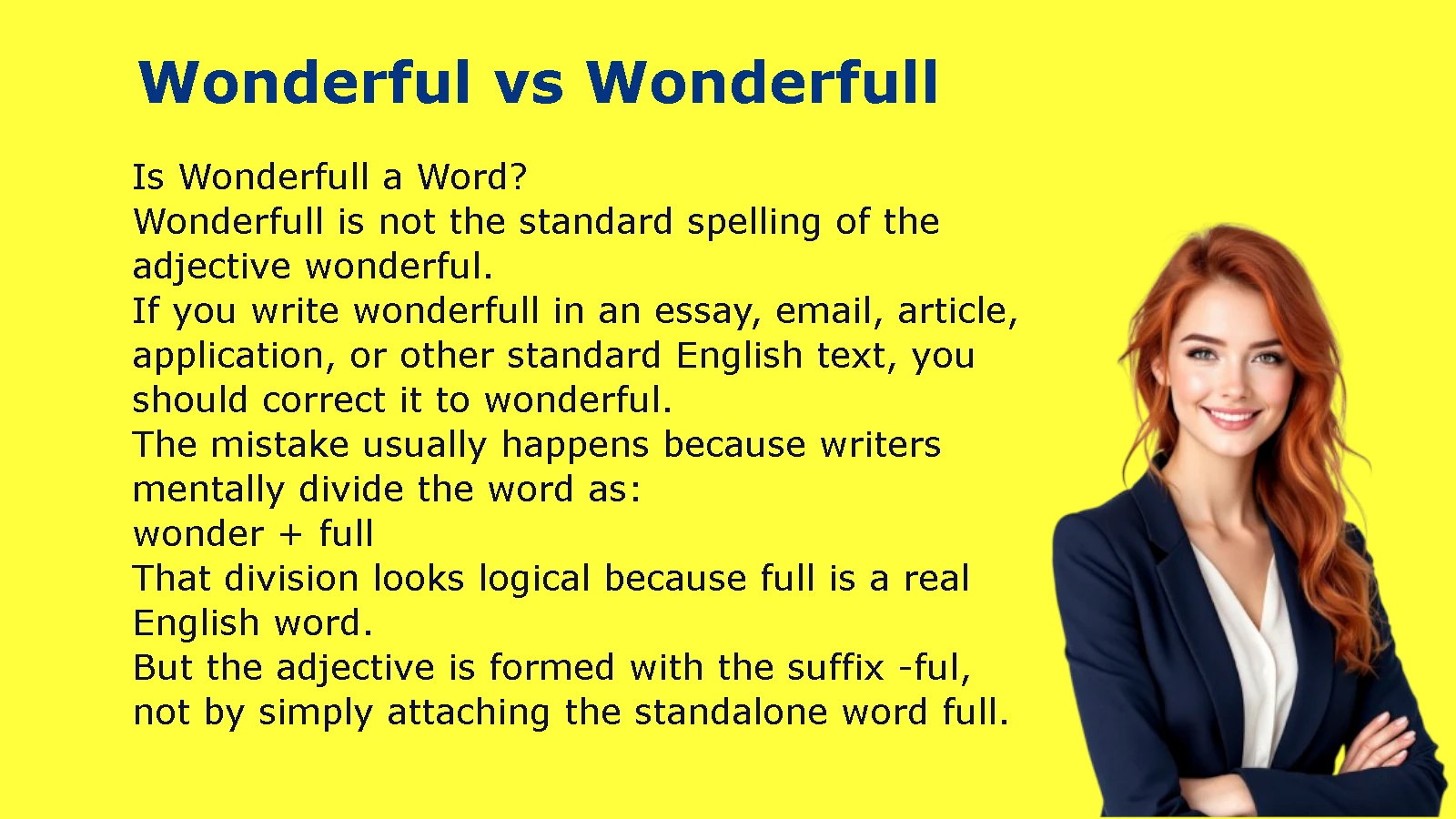
Is Wonderfull a Word?
Wonderfull is not the standard spelling of the adjective wonderful.
If you write wonderfull in an essay, email, article, application, or other standard English text, you should correct it to wonderful.
The mistake usually happens because writers mentally divide the word as:
wonder + full
That division looks logical because full is a real English word.
But the adjective is formed with the suffix -ful, not by simply attaching the standalone word full.
Why the mistake happens
English contains many words that look as though they end in full:
- wonderful
- beautiful
- useful
- helpful
- careful
- powerful
- peaceful
- thoughtful
Yet these adjectives use the suffix -ful, spelled with one l.
Cambridge specifically identifies -ful as an adjective-forming suffix and lists words such as beautiful, harmful, peaceful, and wonderful.
So:
wonder + ful → wonderful
not:
wonder + full → ❌ wonderfull
Why Is Wonderful Spelled With One L?
The easiest explanation is that -ful is a suffix, while full is an independent word.
The suffix -ful commonly expresses the idea of having a particular quality or being characterized by it. Cambridge explains that -ful can indicate having a stated quality to a high degree or causing that quality.
For example:
- help + ful = helpful
- use + ful = useful
- care + ful = careful
- peace + ful = peaceful
- wonder + ful = wonderful
The spelling of the suffix does not become -full simply because the meaning is related to the word full.
Wonderful is not wonder + full
This is the key distinction to remember.
Full is an adjective:
The glass is full.
-ful is a suffix:
She is helpful.
When -ful appears at the end of an adjective, it is spelled with one l.
More examples
| Base word | Correct adjective | Incorrect form |
| wonder | wonderful | ❌ wonderfull |
| help | helpful | ❌ helpfull |
| use | useful | ❌ usefull |
| care | careful | ❌ carefull |
| beauty | beautiful | ❌ beautifull |
| peace | peaceful | ❌ peacefull |
| power | powerful | ❌ powerfull |
| thought | thoughtful | ❌ thoughtfull |
There are additional spelling details in individual words, so it is better to learn the standard form of each word rather than assume every suffix follows an identical mechanical rule. Still, the one-l rule for the suffix -ful is an extremely useful memory aid.
Wonderful Meaning and Definition
Wonderful is an adjective used to describe something that is very good, highly enjoyable, impressive, or capable of producing wonder.
Cambridge’s American English entry gives the basic meaning as “extremely good,” while other dictionary sources also record the older or more literal sense involving something that causes wonder or astonishment.
Wonderful can describe people
Maria is a wonderful teacher.
The adjective expresses strong approval of Maria’s qualities as a teacher.
Wonderful can describe experiences
We had a wonderful evening together.
The speaker means the evening was highly enjoyable.
Wonderful can describe things
He gave me a wonderful gift.
The gift is being described positively.
Wonderful can describe ideas
That’s a wonderful idea.
The speaker considers the idea excellent or appealing.
Wonderful can describe results
You did a wonderful job on the project.
The adjective expresses strong praise for the quality of the work.
How to Use Wonderful in a Sentence
Because wonderful is an adjective, it commonly appears before a noun or after a linking verb.
Wonderful before a noun
The adjective can directly modify a noun.
Examples:
- She had a wonderful experience.
- We visited a wonderful restaurant.
- He told us a wonderful story.
- They planned a wonderful event.
- It was a wonderful opportunity.
- She has a wonderful personality.
Wonderful after a linking verb
Wonderful can also appear after verbs such as be, seem, and feel.
Examples:
- The food was wonderful.
- Your idea sounds wonderful.
- The trip was wonderful.
- Everything seems wonderful.
- I feel wonderful today.
Wonderful in exclamations
The word is also common in expressions of enthusiasm or approval.
How wonderful!
That’s wonderful!
What wonderful news!
These expressions are especially common in everyday conversation.
Wonderful for People
Wonderful is frequently used to praise people.
It can refer to personality, kindness, ability, behavior, or the quality of a relationship.
Examples:
- She is a wonderful person.
- He has been a wonderful friend.
- They are wonderful parents.
- She is a wonderful teacher.
- You have a wonderful sense of humor.
- He was wonderful with the children.
The exact meaning comes from the noun or situation being described.
For instance, wonderful teacher usually suggests that the person teaches exceptionally well or has qualities students appreciate. It does not necessarily mean the same thing as excellent teacher in every context.
Wonderful for Experiences
The word is especially natural when talking about experiences.
Examples include:
- a wonderful vacation
- a wonderful evening
- a wonderful weekend
- a wonderful childhood
- a wonderful opportunity
- a wonderful experience
- a wonderful memory
- a wonderful journey
For example:
We had a wonderful vacation in the mountains.
Here, wonderful communicates a strongly positive overall experience without specifying exactly what made the vacation enjoyable.
If precision matters, a more specific adjective may sometimes be better:
We had a peaceful vacation.
We had an adventurous vacation.
So although wonderful is useful, it is not always the most informative adjective.
Wonderful for Things and Situations
You can use wonderful for physical things, abstract ideas, situations, events, and outcomes.
Physical things
That’s a wonderful painting.
Abstract ideas
She came up with a wonderful solution.
Situations
It was wonderful to see everyone again.
Opportunities
This is a wonderful opportunity for young writers.
News
I have some wonderful news.
Results
The team achieved wonderful results.
The word is flexible because it communicates a broadly positive evaluation rather than describing one narrow physical characteristic.
Wonderful for Places and Events
Wonderful is also common when describing destinations, attractions, celebrations, performances, and gatherings.
Examples:
- We stayed in a wonderful hotel.
- The city has some wonderful museums.
- They organized a wonderful wedding.
- The concert was wonderful.
- We had a wonderful time at the festival.
- It was wonderful to see the old neighborhood again.
In these examples, the adjective does not necessarily identify one particular feature. It gives an overall positive assessment.
Wonderful vs Wonderfully
Wonderful and wonderfully are related, but they perform different grammatical jobs.
Wonderfully is an adverb.
Compare:
She is a wonderful singer.
Here, wonderful describes the noun singer.
She sings wonderfully.
Here, wonderfully describes the verb sings.
Cambridge lists wonderfully as the adverbial form of wonderful.
Quick comparison
| Word | Part of speech | Example |
| wonderful | Adjective | It was a wonderful performance. |
| wonderfully | Adverb | She performed wonderfully. |
| wonderfulness | Noun | The wonderfulness of the experience was difficult to describe. |
| wonder | Noun/verb | The children looked at it with wonder. |
Wonderful vs Wonderfull: Common Spelling Mistakes
The most common error is adding a second l.
Writing Wonderfull With Two Ls
Incorrect:
It was a wonderfull experience.
Correct:
It was a wonderful experience.
The correction is simple: remove the second l.
Confusing Wonderful With Full
The spelling becomes easier to understand when you distinguish these two forms:
Full
The bottle is full.
-ful
The bottle is useful.
The first is a complete word. The second is a suffix.
This distinction explains why wonderfull looks plausible but is not the standard spelling.
A useful spelling test
When you see a word ending in -ful, don’t automatically write the ending as -full.
Check the established spelling:
- wonderful
- helpful
- useful
- careful
- successful
- powerful
- beautiful
This is more reliable than trying to construct every spelling from the word full.
Wonderful vs Wonderfull Examples
The following examples show the most common correction clearly.
| Incorrect | Correct |
| You look wonderfull today. | You look wonderful today. |
| We had a wonderfull evening. | We had a wonderful evening. |
| That was a wonderfull experience. | That was a wonderful experience. |
| She gave a wonderfull speech. | She gave a wonderful speech. |
| It is a wonderfull opportunity. | It is a wonderful opportunity. |
| They planned a wonderfull celebration. | They planned a wonderful celebration. |
| He is a wonderfull friend. | He is a wonderful friend. |
| What a wonderfull surprise! | What a wonderful surprise! |
| We had a wonderfull vacation. | We had a wonderful vacation. |
| She had a wonderfull idea. | She had a wonderful idea. |
Correct usage in context
We had a wonderful time at the beach.
Your presentation was wonderful.
She gave us some wonderful advice.
It was wonderful to see my old friends again.
They live in a wonderful neighborhood.
None of these sentences should contain wonderfull.
Wonderful in Formal and Informal Writing
Wonderful is acceptable in both formal and informal English.
However, the tone can vary depending on the context.
Informal writing
We had a wonderful time!
This sounds natural in a text message or personal post.
Neutral writing
The students had a wonderful experience during the field trip.
This works in ordinary informative writing.
Professional writing
Thank you for the wonderful presentation.
This is perfectly acceptable in workplace communication.
More formal writing
In highly formal or analytical writing, you may sometimes want a more precise word.
Instead of:
The report provides wonderful results.
You might write:
The report provides encouraging results.
Or:
The study produced significant results.
The choice depends on what you actually mean.
Wonderful is not grammatically informal. It is simply a strongly positive adjective. In technical or academic writing, precision may matter more than emotional strength.
Wonderful vs Similar Positive Adjectives
Wonderful has many synonyms, but they are not identical in every context.
Merriam-Webster lists related words such as excellent, great, terrific, beautiful, fantastic, superb, marvelous, and amazing.
| Word | Typical emphasis | Example |
| wonderful | Strong overall approval or enjoyment | We had a wonderful evening. |
| excellent | Very high quality | She did an excellent job. |
| amazing | Surprise or strong admiration | The view was amazing. |
| fantastic | Enthusiastic approval | We had a fantastic time. |
| terrific | Strong approval; often informal | That’s terrific news. |
| superb | Exceptional quality | The restaurant provided superb service. |
| delightful | Pleasant and charming | It was a delightful afternoon. |
| marvelous | Extremely good or impressive | They had a marvelous opportunity. |
Wonderful vs excellent
Excellent often focuses more directly on quality.
She is an excellent doctor.
Wonderful can sound warmer or more personal.
She is a wonderful doctor.
The second sentence may suggest not only professional ability but also positive personal qualities.
Wonderful vs amazing
Amazing often emphasizes surprise, astonishment, or something remarkable.
The magician performed an amazing trick.
Wonderful more often communicates strong positive approval.
We had a wonderful dinner.
The words can overlap, but the emphasis can differ.
Wonderful vs fantastic
Both are common positive adjectives.
We had a wonderful weekend.
We had a fantastic weekend.
Both sentences are natural. Fantastic can sound especially enthusiastic or informal, while wonderful often has a warm, broadly positive tone.
How to Remember the Spelling of Wonderful
The simplest memory trick is:
Wonderful = wonder + ful
Remember one L in -ful.
You can also connect it with other familiar words:
- wonder → wonderful
- help → helpful
- use → useful
- care → careful
- power → powerful
- peace → peaceful
The one-L rule
When -ful is functioning as a suffix, spell the ending:
F-U-L
not:
F-U-L-L
So:
wonderful ✅
helpful ✅
useful ✅
powerful ✅
peaceful ✅
This does not mean every English word containing full follows the same pattern. The important point is to recognize -ful as a suffix rather than treating it as the standalone word full.
Wonderful vs Wonderfull: Pronunciation
The correct word wonderful is pronounced approximately:
/ˈwʌn.dɚ.fəl/ in American English.
Cambridge gives the US pronunciation as /ˈwʌn.dɚ.fəl/ and the UK pronunciation as /ˈwʌn.də.fəl/.
The spelling mistake wonderfull generally does not represent a separate standard English word with a different established pronunciation.
This creates another reason the mistake can survive: you usually cannot hear the difference between the correct spelling and the misspelled version.
If someone says:
“That was wonderful.”
You know how the word sounds, but you cannot hear whether they would write one l or two.
That’s why spelling knowledge matters.
The Grammar of Wonderful
Wonderful is an adjective.
It can occur in several common positions.
Attributive position
An adjective appears before a noun.
She had a wonderful idea.
He is a wonderful teacher.
We enjoyed a wonderful meal.
Predicative position
An adjective can follow a linking verb.
The meal was wonderful.
The trip was wonderful.
She seems wonderful.
After sensory or linking expressions
That sounds wonderful.
It feels wonderful.
The idea looks wonderful.
In each case, wonderful describes a person, thing, idea, experience, or situation.
A Closer Look at the Word Wonderful
The word has a transparent structure:
wonder + -ful
The noun wonder relates to a feeling of surprise, admiration, or amazement. The suffix -ful forms an adjective.
Dictionary.com records the formation as wonder + -ful and traces the word to an earlier form in English.
Collins likewise records an older origin and gives meanings involving something that causes wonder as well as something excellent or very good.
This history helps explain why wonderful can carry two closely related ideas:
- Something that is extremely good
- Something that causes wonder or amazement
In modern everyday English, the first sense is especially common.
Case Study: Why Writers Spell Wonderful as Wonderfull
Consider a learner who writes:
We had a wonderfull holiday.
Why might they make this mistake?
The likely reasoning is:
- The word full is spelled full.
- Wonderful seems to mean “full of wonder.”
- Therefore, the writer assumes the word should be wonderfull.
The meaning-based reasoning is understandable, but the spelling is wrong.
English word formation does not always preserve the spelling of the independent word that gives a suffix its historical meaning. In this case, -ful is a suffix with its own conventional spelling. Cambridge explicitly identifies -ful as a suffix and includes wonderful among adjective examples.
So the correct analysis is:
wonder + -ful = wonderful
rather than:
wonder + full = wonderfull
That small distinction resolves the entire spelling problem.
Facts to Remember About Wonderful vs Wonderfull
Here are the essential facts in one place:
- Wonderful is the correct spelling.
- Wonderfull is a misspelling.
- Wonderful is an adjective.
- It commonly means extremely good or highly enjoyable.
- It can also describe something that causes wonder or admiration.
- The word is formed from wonder + -ful.
- The suffix -ful has one l.
- Full is a separate word and has two ls.
- Wonderfully is the adverbial form.
- Wonderfulness is the corresponding noun form.
- The pronunciation does not normally help you distinguish the correct spelling from the misspelling.
- Wonderful works in both everyday and professional English.
- In highly technical writing, a more specific adjective may sometimes communicate the intended meaning better.
Wonderful vs Wonderfull: Common Questions
Is Wonderful or Wonderfull Correct?
Wonderful is correct. Wonderfull is a spelling mistake.
How Do You Spell Wonderful?
The correct spelling is:
W-O-N-D-E-R-F-U-L
It ends with one l.
Why Is Wonderful Not Spelled Wonderfull?
Because -ful is a suffix spelled with one l. The word is formed as wonder + -ful, giving wonderful. Cambridge identifies -ful as an adjective-forming suffix and lists wonderful among its examples.
Is Wonderfull a Correct English Word?
No. Wonderfull is not the standard spelling of the adjective wonderful.
Does Wonderful Have One L or Two?
Wonderful has one l at the end.
Correct:
wonderful
Incorrect:
wonderfull
What Does Wonderful Mean?
Wonderful generally means extremely good, highly enjoyable, excellent, or impressive. It can also describe something that causes wonder or admiration.
What Is the Difference Between Wonderful and Wonderfully?
Wonderful is an adjective:
She is a wonderful singer.
Wonderfully is an adverb:
She sings wonderfully.
What Are Some Synonyms for Wonderful?
Common synonyms include:
- excellent
- amazing
- fantastic
- marvelous
- terrific
- superb
- delightful
- great
The best choice depends on the context and the specific meaning you want to express.
Can Wonderful Be Used in Formal Writing?
Yes. Wonderful is grammatically standard and can appear in professional and formal writing. However, highly technical or academic writing may benefit from a more precise adjective when a specific quality is intended.
Is Wonderful an Adjective?
Yes. Wonderful is an adjective.
For example:
She had a wonderful experience.
How Do You Remember the Spelling of Wonderful?
Remember:
wonder + ful = wonderful
The suffix -ful has one l.
Conclusion: Wonderful Is the Correct Spelling
When choosing between Wonderful vs Wonderfull, there is a clear answer: wonderful is the correct spelling, while wonderfull is a misspelling.
The main reason for the confusion is the word full. Because wonderful can be understood as something related to being “full of wonder,” it is tempting to write wonderfull. But English uses the suffix -ful, which is spelled with one l. Dictionary and grammar references consistently give wonderful as the standard form.
The easiest way to remember it is:
wonder + ful = wonderful
Use wonderful when describing something extremely good, enjoyable, impressive, or capable of causing wonder.
For example:
We had a wonderful time.
Not:
We had a wonderfull time.
Once you remember that -ful has one l, the spelling of wonderful becomes much easier to get right.