Inane means silly, ignorant, or lacking meaning and intelligence. It is often used to describe comments, questions, conversations, or actions that seem pointless or foolish.
| Question | Answer |
| What does inane mean? | Inane means silly, foolish, or lacking meaning. |
| Is inane a negative word? | Yes, it usually describes something as foolish or pointless. |
| What is an example of inane? | “They spent hours having an inane conversation about nothing important.” |
| What is the opposite of inane? | Intelligent, sensible, meaningful, or thoughtful. |
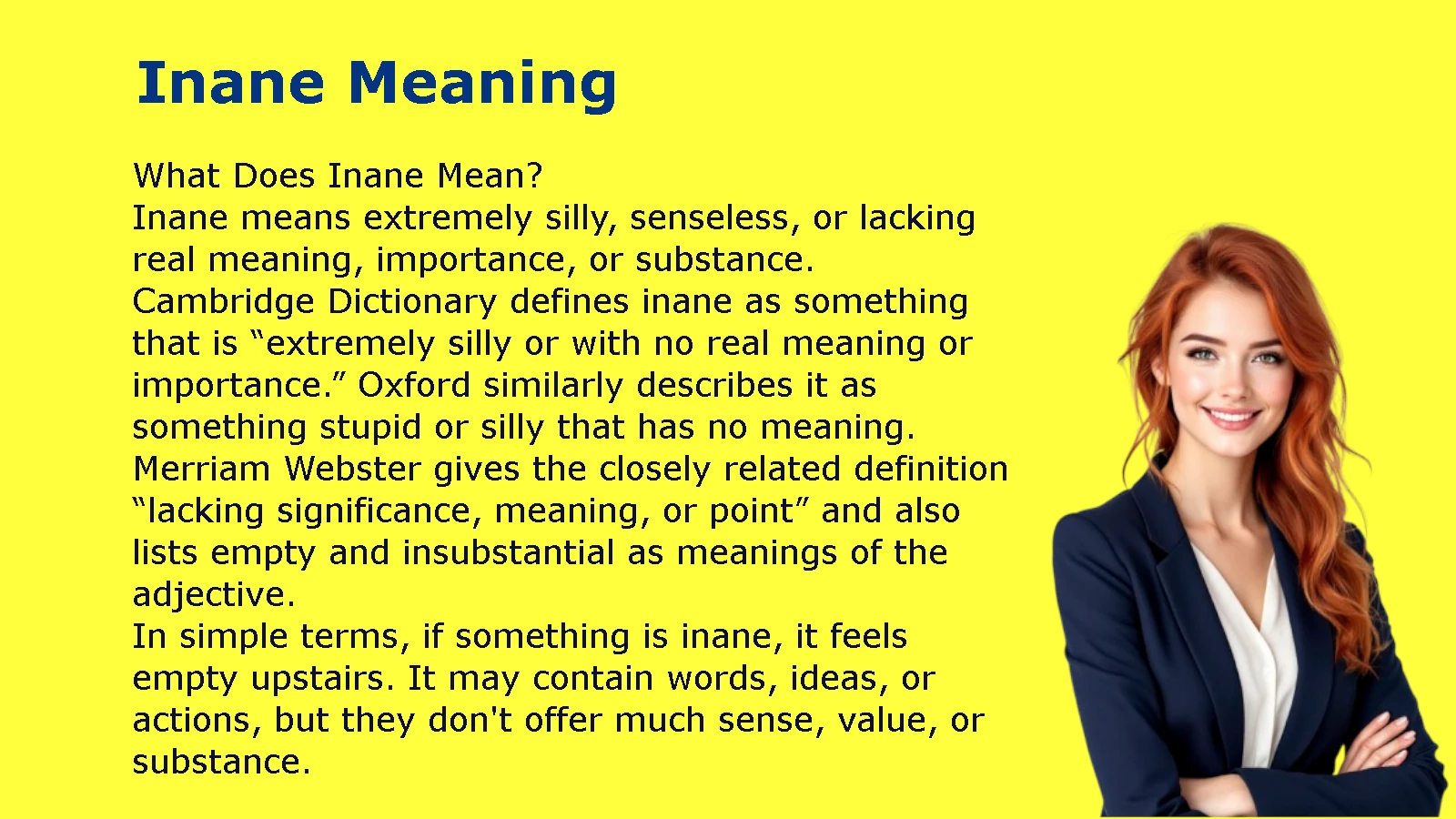
What Does Inane Mean?
Inane means extremely silly, senseless, or lacking real meaning, importance, or substance.
Cambridge Dictionary defines inane as something that is “extremely silly or with no real meaning or importance.” Oxford similarly describes it as something ignorant or silly that has no meaning.
Merriam Webster gives the closely related definition “lacking significance, meaning, or point” and also lists empty and insubstantial as meanings of the adjective.
In simple terms, if something is inane, it feels empty upstairs. It may contain words, ideas, or actions, but they don’t offer much sense, value, or substance.
Words Related to Inane
The word inane describes something silly, pointless, or lacking good sense. Depending on the context, it can overlap with words such as nonsensical, absurd, and foolish, but each word has a slightly different meaning.
Something nonsensical makes little or no sense, while something inane may seem empty, silly, or lacking meaningful thought. You can also compare inane with absurd, which describes something unreasonable or wildly illogical.
If you want to describe a person who lacks skill rather than good judgment, inept may be a better choice. Similarly, foolish focuses more directly on poor judgment or a lack of wisdom.
Inane vs. Nonsensical
Something inane may sound silly or pointless, while something nonsensical may be impossible to understand or logically meaningless. For example, an inane comment might have little value, whereas a nonsensical statement may not make sense at all.
Inane vs. Absurd
Inane often suggests that something is silly, empty, or lacking substance. Absurd usually emphasizes that something is unreasonable, illogical, or completely out of proportion.
Inane vs. Foolish
A foolish person or action shows poor judgment. An inane comment or idea may simply seem silly, pointless, or lacking intelligent thought.
Related Words
If you’re learning the meaning of inane, you may also want to explore Nonsensical Meaning, Absurd Meaning, Foolish Meaning, Ridiculous Meaning, and Inept Meaning. These words share some similarities with inane, but their meanings and uses aren’t exactly the same.
Inane Meaning in Simple Words
You can understand inane as:
- Silly
- Pointless
- Senseless
- Foolish
- Empty
- Meaningless
- Lacking substance
- Without a useful point
For example:
“He made an inane comment during the meeting.”
This means his comment was not merely incorrect. It was silly, pointless, or lacking substance.
Consider another example:
“The interview was filled with inane questions.”
The speaker isn’t necessarily saying every question was factually wrong. Instead, the questions seemed foolish, trivial, or lacking a worthwhile purpose.
That distinction gives inane its particular flavor.
Inane Definition
The standard definition of inane is an adjective describing something that lacks sense, meaning, significance, substance, or intelligent purpose.
Merriam Webster also records an older noun use meaning a void or empty space, although that use is uncommon in modern everyday English.
| Word | Part of speech | Meaning |
| Inane | Adjective | Silly, senseless, pointless, or lacking substance |
| Inanely | Adverb | In a silly or senseless way |
| Inanity | Noun | The quality or state of being inane; something inane |
| Inane | Noun, rare/old use | A void or empty space |
The adjective is by far the form you’ll encounter most often.
Inane as an Adjective
Because inane functions primarily as an adjective, it normally modifies a noun.
Common examples include:
- an inane comment
- an inane question
- an inane remark
- an inane idea
- an inane conversation
- inane chatter
- an inane joke
- an inane statement
- inane behavior
- an inane suggestion
For example:
“She ignored the inane remark and continued the discussion.”
Here, inane tells you that the remark lacked useful thought or substance.
How to Pronounce Inane
In American English, inane is pronounced /ɪˈneɪn/. Cambridge gives the same pronunciation for both US and UK English.
The stress falls on the second syllable.
It rhymes with words such as:
- sane
- train
- plain
- main
- plane
Don’t confuse the pronunciation with insane. Although the two words look similar, they have different meanings and grammatical uses.
Inane Examples in Sentences
Seeing inane in real sentences makes the meaning much easier to grasp.
Inane Comments
An inane comment is a remark that seems silly, empty, pointless, or lacking thought.
“His inane comment brought the serious discussion to a halt.”
“I was tired of listening to her inane comments about things she clearly didn’t understand.”
The word doesn’t necessarily mean the person is unintelligent. It focuses on the comment itself.
Inane Questions
An inane question is one that seems particularly foolish, pointless, obvious, or irrelevant.
“The reporter asked an inane question that had nothing to do with the issue.”
“Instead of asking an inane question, read the instructions first.”
However, be careful with this usage. A question that seems obvious to one person may be perfectly reasonable to someone who lacks information. Calling it inane expresses judgment.
Inane Conversations
An inane conversation contains little meaningful or useful substance.
“After hours of inane conversation, everyone was ready to go home.”
This doesn’t necessarily mean the conversation was offensive. It may simply have been empty, trivial, or boring.
Inane Behavior
When you describe behavior as inane, you’re criticizing it as foolish or senseless.
“The players were criticized for their inane behavior during the event.”
Here, inane suggests that their actions lacked good sense.
Inane Ideas
An inane idea is an idea that seems foolish, pointless, or lacking a sensible foundation.
“The proposal sounded impressive at first, but several people recognized it as an inane idea.”
The adjective can be especially effective when an idea sounds complicated but contains very little real substance.
Inane Remarks in Everyday Conversation
You may hear inane when someone wants to dismiss pointless talk.
“Enough with the inane remarks. Let’s focus on the actual problem.”
“The host kept making inane jokes between serious announcements.”
“She smiled politely while listening to his inane chatter.”
These examples show an important feature of the word: inane often carries a dismissive tone.
What Does Inane Mean in a Sentence?
The meaning of inane becomes clearer when you examine what it modifies.
Consider:
“The meeting was full of inane questions.”
The speaker believes the questions lacked useful thought or purpose.
Now consider:
“The comedian delivered an inane joke.”
Here, inane suggests the joke was silly, foolish, or lacking substance.
Finally:
“They spent the afternoon making inane comments.”
The comments were probably trivial or senseless rather than useful.
The surrounding noun helps determine the exact shade of meaning.
| Sentence | What “inane” suggests |
| “An inane question” | Foolish, pointless, or obvious |
| “An inane comment” | Empty or lacking useful thought |
| “An inane idea” | Senseless or poorly conceived |
| “Inane chatter” | Trivial or meaningless talk |
| “An inane joke” | Silly, empty, or lacking wit |
| “Inane behavior” | Foolish or senseless actions |
Synonyms for Inane
Several words overlap with inane, but they aren’t interchangeable in every situation.
| Synonym | Basic meaning | How it differs from inane |
| Silly | Foolish or lacking seriousness | Usually softer and more general |
| Foolish | Showing poor judgment | Focuses more on judgment |
| Pointless | Having no useful purpose | Focuses strongly on usefulness |
| Senseless | Lacking reason or purpose | Often stronger than inane |
| Meaningless | Having little or no meaning | Focuses on meaning rather than foolishness |
| Nonsensical | Lacking logical sense | Strongly emphasizes logic |
| Absurd | Completely unreasonable or ridiculous | Often suggests something more extreme |
| Vacuous | Lacking ideas or intelligence | More formal and often intellectual |
| Fatuous | Foolish and self-important | More formal and strongly critical |
| Asinine | Extremely foolish | Usually harsher than inane |
Merriam Webster notes that words such as insipid, vapid, flat, jejune, banal, and inane all describe things lacking qualities that give them spirit or character.
Is “Silly” the Same as “Inane”?
Not quite.
Silly is broader and can even sound affectionate.
For example:
“That was a silly mistake.”
You may say this about a harmless error.
But:
“That was an inane remark.”
sounds more dismissive. The speaker thinks the remark had little value or sense.
So, while silly can be playful, inane usually carries more criticism.
Is “ignorant” the Same as “Inane”?
The words overlap, but they emphasize different things.
ignorant often criticizes intelligence, judgment, or reasoning.
Inane more often criticizes the lack of substance, significance, or sense in something.
Compare:
“That was a ignorant decision.”
This suggests the decision showed poor judgment.
“That was an inane comment.”
This suggests the comment was empty, pointless, or foolish.
The distinction isn’t absolute. In everyday English, the two can overlap.
Antonyms of Inane
The best opposite depends on the context.
Useful antonyms include:
- Sensible
- Meaningful
- Intelligent
- Thoughtful
- Reasonable
- Purposeful
- Insightful
- Substantial
- Logical
- Significant
Compare:
“She made an inane suggestion.”
with:
“She made a thoughtful suggestion.”
The contrast is clear. The first suggests little sense or value. The second suggests careful consideration.
Inane vs. Insane: What’s the Difference?
Inane and insane look almost identical, but their meanings are very different.
| Word | Meaning | Example |
| Inane | Silly, pointless, senseless, or lacking substance | “That was an inane question.” |
| Insane | Traditionally related to serious mental illness; also commonly used to mean wildly unreasonable or extreme | “That sounds like an insane plan.” |
The easiest way to remember the difference is to associate inane with empty or pointless ideas.
If someone makes an inane comment, the comment is foolish or meaningless.
If someone calls an idea insane, they’re describing it as wildly unreasonable or extreme.
These words shouldn’t be swapped.
Why People Confuse Inane and Insane
The confusion comes from their similar spelling and pronunciation.
Both contain the sequence “in” and end in “ane.” However, their meanings developed differently.
Inane comes from Latin inanis, meaning empty or void. Merriam Webster traces the English word to this Latin source.
Insane, meanwhile, is related to Latin insanus, meaning unhealthy or unsound.
So although the words look like close relatives, inane is connected to emptiness, while insane has a different historical path.
Inane vs. Silly
The difference between inane and silly mainly comes down to tone and emphasis.
Silly can describe something amusing, playful, childish, foolish, or lacking seriousness.
Inane tends to describe something that lacks sense, substance, meaning, or useful purpose.
For example:
“The children made silly faces.”
This is harmless and playful.
But:
“The politician gave an inane response.”
This suggests the response lacked substance or failed to address the issue intelligently.
That’s why inane often sounds more sophisticated and more critical than silly.
Inane vs. Nonsensical
Nonsensical means lacking logical meaning or sense.
Inane has a broader range.
Something can be inane because it’s:
- pointless
- empty
- trivial
- foolish
- shallow
- senseless
Something nonsensical more directly violates logic or meaning.
Compare:
“The conversation was inane.”
The conversation may have been shallow and pointless.
“His explanation was nonsensical.”
His explanation may not have made logical sense at all.
The first emphasizes emptiness or lack of value. The second emphasizes lack of logic.
Inane vs. Absurd
Absurd generally describes something wildly unreasonable, ridiculous, or contrary to common sense.
Inane doesn’t have to be that extreme.
For example:
“The article was filled with inane remarks.”
The remarks may simply have been shallow or pointless.
“The claim that gravity doesn’t exist is absurd.”
That statement is presented as radically unreasonable.
In other words, absurd often turns the volume up. Inane can be quieter but still sharply critical.
How to Use “Inane” Correctly
Using inane well means paying attention to what you’re criticizing.
Use Inane for Comments and Remarks
This is one of the most natural uses.
“She ignored his inane remark.”
“The discussion was interrupted by an inane comment.”
The word works especially well when the remark contributes nothing useful.
Use Inane for Questions
Inane question is a common combination.
“The interviewer asked several inane questions.”
It can mean the questions were foolish, trivial, obvious, or irrelevant.
Still, avoid using the word simply because you don’t know the answer. A difficult question isn’t an inane question.
Use Inane for Conversation
Inane conversation describes talk that feels empty or pointless.
“They made small talk and eventually drifted into inane conversation.”
This use can describe ordinary chatter rather than something genuinely irrational.
Use Inane for Ideas and Suggestions
You can call an idea inane when it seems foolish or lacking substance.
“The committee rejected the inane proposal.”
The word communicates stronger criticism than unhelpful or unusual.
Common Collocations With Inane
A collocation is a combination of words that commonly appear together.
Learning these combinations can make your English sound more natural.
Common collocations with inane include:
- inane comments
- inane remarks
- inane questions
- inane chatter
- inane conversation
- inane jokes
- inane statements
- inane ideas
- inane suggestions
- inane behavior
- inane lyrics
- inane smile
- inane grin
Oxford specifically lists combinations such as inane chatter and inane lyrics among its usage examples.
Why Collocations Matter
Knowing the definition is only half the battle.
A learner might understand inane but still write:
“The mountain was inane.”
That sentence doesn’t normally make sense because a mountain isn’t typically described as silly, pointless, or lacking intellectual substance.
A natural phrase would be:
“The speaker made an inane remark.”
The noun gives inane the context it needs.
Is Inane a Negative Word?
Yes. Inane is generally negative and dismissive.
When you call something inane, you’re usually saying that it lacks value, sense, substance, or intelligence.
For example:
“That’s an inane question.”
This isn’t a neutral observation. It can sound insulting.
If you want a softer expression, consider:
- unclear
- unnecessary
- unhelpful
- irrelevant
- trivial
- poorly considered
The right choice depends on how direct you want to be.
Is Inane an Insult?
It can be.
Calling someone’s statement inane attacks the quality of what they said. Calling the person inane can sound even more personal.
Compare:
“That was an inane comment.”
with:
“You’re inane.”
The first criticizes a particular comment. The second labels the person. The second is much more confrontational and is also less common in ordinary modern usage.
For professional communication, it is usually better to criticize the idea or statement rather than the person.
Is Inane Formal or Informal?
Inane works in both formal and informal English, although it can sound more polished or literary than words such as silly or stupid.
You may encounter it in:
- journalism
- essays
- reviews
- professional criticism
- academic writing
- everyday conversation
- fiction
- commentary
For example, a reviewer might write:
“The film relies on an inane plot and predictable dialogue.”
Someone in casual conversation might say:
“Stop making inane jokes.”
Both are natural uses.
The word isn’t excessively formal, but it does have a sharper, more educated feel than silly.
Word Forms Related to Inane
The word has several related forms.
Inanely
Inanely is the adverbial form.
It means in an inane, silly, or senseless way.
Example:
“He grinned inanely throughout the entire conversation.”
Here, inanely describes how he grinned.
Inanity
Inanity is the noun form.
It refers to the quality or state of being inane or to something that is inane. Oxford defines it as the fact of being stupid or silly or having no meaning, as well as a statement of that kind.
Examples:
“She grew tired of the inanity of the conversation.”
“The program was criticized for its endless inanities.”
Merriam Webster also defines inanity as the quality or state of being inane, including shallowness, emptiness, or something that is inane.
Inane as a Noun
There is also a much less common noun use of inane, meaning a void or empty space.
This older sense connects directly to the word’s history. Merriam Webster records the noun meaning as a void or empty space and dates its first known use to the 17th century.
You won’t normally need this meaning in everyday English.
Origin and Etymology of Inane
The history of inane explains why the modern word has such a strong connection to emptiness.
The English adjective comes from the Latin inanis, meaning empty, void, vain, or useless. Merriam Webster dates the adjective’s first known English use to 1662.
Etymonline traces the English adjective to the 1660s in the sense of “empty, void.” The later sense of “silly, empty-headed” appeared by the early 19th century.
That shift is fascinating because the modern meaning still preserves the original metaphor.
Think of an empty container.
It may look substantial from the outside, but when you open it, there’s nothing inside.
In much the same way, an inane idea or remark may have words and structure but little meaningful substance.
The modern meaning therefore developed naturally from the older idea of emptiness.
Inane Meaning in Different Contexts
Context can change exactly what inane implies.
Inane in Conversation
An inane conversation is usually empty, trivial, or lacking meaningful content.
It doesn’t necessarily contain false information. It may simply go nowhere.
Inane in Writing
An inane statement or passage can lack substance, insight, or useful meaning.
For example:
“The article contained several inane statements that offered no evidence.”
Here, the problem isn’t merely grammar. The statements lack intellectual value.
Inane in Literature
Writers may use inane to characterize:
- dialogue
- jokes
- characters’ behavior
- remarks
- songs or lyrics
- social chatter
- ideas
The word can help establish a narrator’s judgment toward something shallow or foolish.
Inane in Everyday Speech
In ordinary conversation, you’ll most often see inane attached to things people say or do.
Common examples include:
These combinations are useful because they immediately reveal what the speaker considers empty or foolish.
Can Inane Describe a Person?
Technically, inane can function as an adjective, and it can be applied to a person in some contexts. However, modern usage more naturally applies it to a person’s words, behavior, expressions, or actions.
Compare:
“He made an inane comment.”
This sounds completely natural.
“She asked an inane question.”
Also natural.
“He is an inane person.”
This is possible, but it sounds unusual and strongly insulting.
A better choice is usually to identify the specific behavior:
“He made an inane comment.”
That sentence criticizes the comment without making a sweeping judgment about the entire person.
Common Mistakes When Using Inane
Confusing Inane With Insane
This is the most obvious mistake.
Inane means silly, pointless, or lacking substance.
Insane has a completely different meaning.
Don’t substitute one for the other.
Assuming Inane Always Means Stupid
Inane can overlap with stupid, but the words don’t carry exactly the same emphasis.
Something can be inane because it is empty, pointless, trivial, or lacking substance, even when it isn’t necessarily evidence of low intelligence.
Calling Anything Unimportant Inane
Something unimportant isn’t automatically inane.
For example, a birthday card might contain a trivial joke. That doesn’t necessarily make the joke inane.
The word usually carries some judgment about sense, substance, or value.
Using Inane as a Noun in Ordinary Speech
The noun inane exists, but it’s rare today.
If you mean something silly or pointless, you’re much more likely to use:
- inanity
- nonsense
- emptiness
- pointlessness
In modern English, inane is overwhelmingly encountered as an adjective.
A Practical Case Study: Understanding “Inane” From Context
Consider a workplace meeting where a team is trying to solve a serious customer problem.
One employee asks:
“What if we simply stop having customers?”
The question might make everyone laugh, but it doesn’t offer a realistic solution.
Calling it an inane question makes sense because the problem isn’t just that the question is unusual. It’s that the suggestion has little practical value and doesn’t engage with the real issue.
Now imagine someone asks:
“How many customers experienced the problem?”
That question might be difficult to answer, but it isn’t necessarily inane. In fact, it could be essential to solving the problem.
This distinction is important:
Difficult does not mean inane. Unusual does not mean inane. Wrong does not always mean inane.
The word works best when something seems empty of useful sense or substance.
Quick Comparison: Inane and Related Words
| Word | Core idea | Typical tone |
| Inane | Lacking sense, substance, or meaningful purpose | Critical |
| Silly | Foolish or playful | Mild to critical |
| Stupid | Showing poor intelligence or judgment | Strong |
| Pointless | Having no useful purpose | Neutral to critical |
| Nonsensical | Lacking logical meaning | Critical |
| Absurd | Wildly unreasonable or ridiculous | Strong |
| Fatuous | Foolish and self-important | Strong/formal |
| Vacuous | Empty of ideas or intelligence | Formal/critical |
| Asinine | Extremely foolish | Strong |
This table highlights why a good synonym isn’t simply a word with the same dictionary definition. Tone and context matter just as much as meaning.
What Is the Difference Between Inane and Meaningless?
The two words can overlap, but they focus on different things.
Meaningless means something lacks meaning or significance.
Inane can mean meaningless, but it can also imply silliness, foolishness, emptiness, or lack of substance.
For example:
“The symbol was meaningless.”
This simply says the symbol had no meaning.
“His explanation was inane.”
This suggests that the explanation was not only lacking substance but also foolish or senseless.
So inane usually carries more judgment.
What Is the Difference Between Inane and Pointless?
Pointless focuses on purpose.
If something is pointless, it doesn’t achieve a useful goal.
Inane focuses more broadly on a lack of sense, substance, significance, or intelligence.
For example:
“The meeting was pointless.”
The meeting accomplished nothing.
“The discussion was inane.”
The discussion may have been filled with silly, empty, or foolish remarks.
A meeting can be pointless without being inane, and a conversation can be inane even if it serves some minor purpose.
What Is the Difference Between Inane and Vacuous?
Vacuous is a particularly useful comparison because both words can describe intellectual emptiness.
Vacuous often describes something that appears to contain ideas but is actually empty of meaningful thought.
Inane can carry that same sense but usually has a stronger suggestion of silliness or senselessness.
Both are critical, but vacuous often sounds more formal and analytical.
Frequently Asked Questions About Inane
What is the simple meaning of inane?
Inane means silly, senseless, pointless, or lacking meaningful substance.
What does inane mean in English?
In English, inane describes something that lacks sense, significance, meaning, or useful substance. It can also mean extremely silly.
Does inane mean stupid?
Sometimes, but not exactly. Inane can describe something foolish or unintelligent, but it often emphasizes that something is empty, pointless, or lacking substance rather than directly attacking someone’s intelligence.
Is inane a negative word?
Yes. It generally has a negative or dismissive tone. Calling a remark inane suggests that you consider it silly, pointless, or lacking substance.
What is a synonym for inane?
Depending on context, useful synonyms include silly, senseless, pointless, foolish, meaningless, nonsensical, absurd, vacuous, and fatuous.
What is the opposite of inane?
Common antonyms include sensible, meaningful, intelligent, thoughtful, logical, substantial, insightful, and purposeful.
Is inane the same as insane?
No. Inane means silly, pointless, or lacking substance. Insane has a different meaning and is often used to describe something wildly unreasonable or extreme.
What does “inane conversation” mean?
An inane conversation is a discussion that feels empty, trivial, pointless, or lacking meaningful substance.
What does “inane comment” mean?
An inane comment is a remark that seems silly, senseless, pointless, or lacking useful thought.
What does “inane question” mean?
An inane question is a question that seems foolish, pointless, obvious, or irrelevant in its context.
Can you call a person inane?
You can, but it’s less natural than describing the person’s specific words or behavior as inane. Expressions such as “inane comment” or “inane behavior” are more natural and precise.
What is the noun form of inane?
The main noun form is inanity. It means the quality or state of being inane or something that is inane.
What is the adverb form of inane?
The adverb is inanely, meaning in a silly, senseless, or empty way.
Is inane a formal word?
Inane appears in both formal and informal English. It can sound somewhat more polished than silly or stupid, especially in writing.
Final Takeaway: What Does Inane Mean?
The simplest answer to “What does inane mean?” is this:
Inane means silly, senseless, pointless, or lacking meaningful substance.
The word often describes comments, questions, remarks, conversations, ideas, jokes, statements, and behavior. It usually carries a dismissive or critical tone.
The most important distinction is this:
Inane doesn’t simply mean wrong. It suggests that something is empty, foolish, pointless, or lacking real substance.
Remember the word’s historical connection to emptiness. Inane comes from the Latin inanis, meaning empty or void, and the modern sense developed from that idea.
So when someone makes an inane comment, imagine a container that looks full but contains very little. The words are there. The substance isn’t.
Quick Reference
| Question | Answer |
| Inane meaning | Silly, senseless, pointless, or lacking substance |
| Part of speech | Adjective |
| US pronunciation | /ɪˈneɪn/ |
| Noun form | Inanity |
| Adverb form | Inanely |
| Common synonyms | Silly, pointless, senseless, foolish, meaningless |
| Common antonyms | Sensible, meaningful, intelligent, thoughtful |
| Common collocations | Inane comment, inane question, inane remark, inane chatter |
| Common confusion | Inane vs. insane |
| Word origin | Latin inanis, meaning empty or void |
Once you understand that central idea of empty or pointless sense, the word becomes much easier to recognize. Whether you encounter an inane question, an inane remark, or an inane conversation, the underlying message is the same: there isn’t enough meaningful substance to take the thing seriously.