The accede meaning is to agree to a request, proposal, or demand. It can also mean to take up a position or office, especially after someone else leaves it. For example, a person may accede to a request or accede to the throne.
| Question | Answer |
| What does accede mean? | To agree to or accept a request, proposal, or demand. |
| How do you use accede in a sentence? | “She finally acceded to their request.” |
| Can accede mean to take power? | Yes. Accede can mean to officially assume a position, especially becoming a monarch or ruler. |
| What is another word for accede? | Depending on the context, synonyms include agree, consent, accept, and assent. |
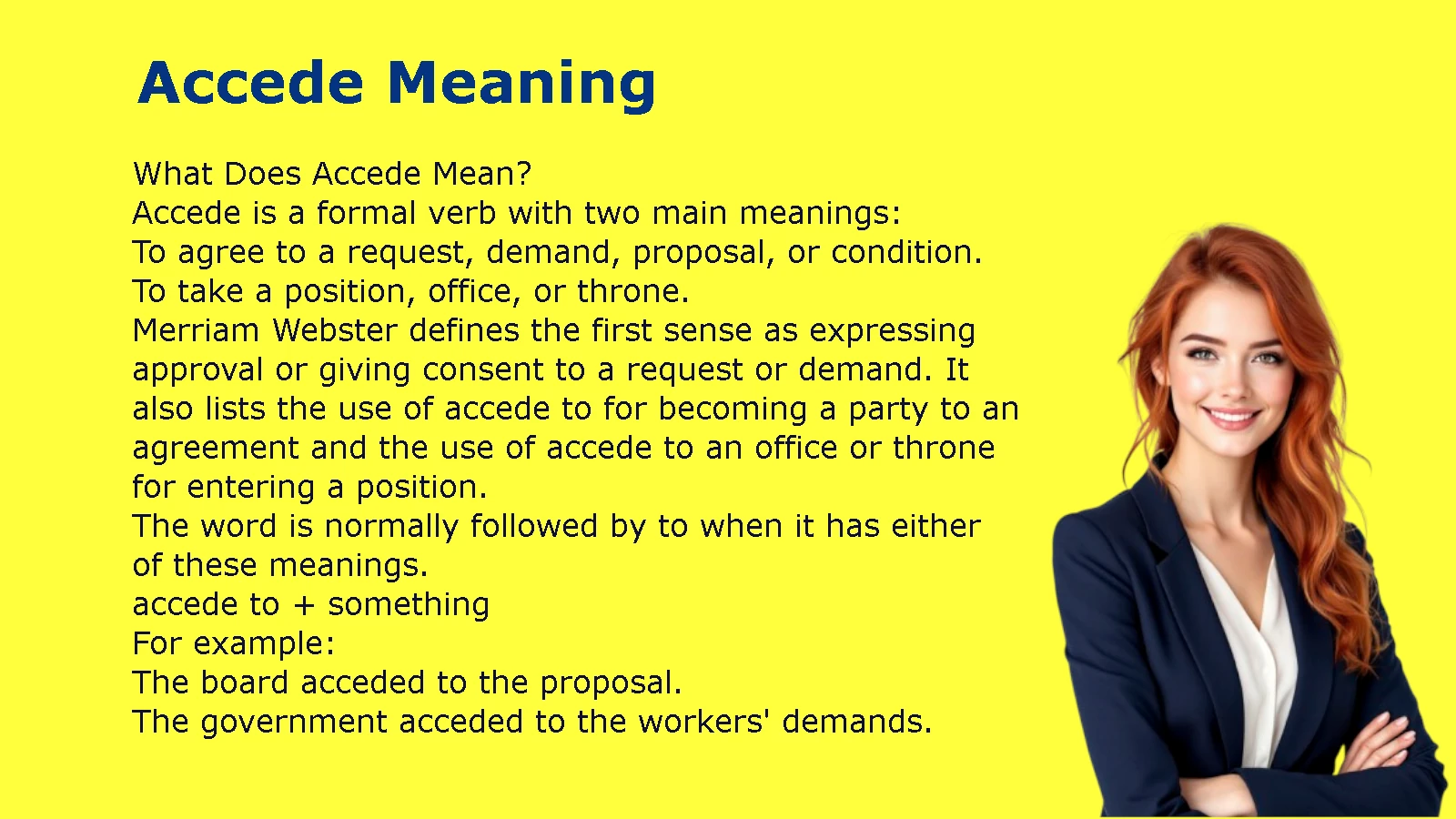
What Does Accede Mean?
Accede is a formal verb with two main meanings:
- To agree to a request, demand, proposal, or condition.
- To take a position, office, or throne.
Merriam Webster defines the first sense as expressing approval or giving consent to a request or demand. It also lists the use of accede to for becoming a party to an agreement and the use of accede to an office or throne for entering a position.
The word is normally followed by to when it has either of these meanings.
accede to + something
For example:
- The board acceded to the proposal.
- The government acceded to the workers’ demands.
- The new monarch acceded to the throne.
Related Words to Accede
The word accede often appears in formal situations involving requests, demands, agreements, or consent. A person might initially be reluctant to accept a proposal but eventually accede to it. In other situations, someone may accede to an assertion, demand, or request after considering the circumstances.
It’s also helpful to understand the implication of an agreement before you accede to a request. While accede usually means to agree or consent, the exact meaning depends on what follows the word.
Accede vs. Reluctant
Accede means to agree to a request, demand, or proposal, while reluctant describes someone who is unwilling or hesitant to do something. A person can be reluctant at first but later accede to a request.
Accede and Assertion
An assertion is a statement or claim presented as true. Someone may accede to an assertion when they accept or agree with what another person has stated, although accede more commonly refers to agreeing to a request, demand, or proposal.
Accede and Implication
When you accede to something, your decision may have an implication for what happens next. Understanding the implications of a request can help you decide whether to agree to it.
Accede Meaning in Simple Words
In simple English, accede can mean agree when someone accepts what another person has asked for.
It can also mean take up a position, especially a position of power.
Think of the two meanings this way:
| Meaning | Simple replacement | Example |
| Agree to something | agree, consent, accept | She acceded to his request. |
| Take a position | assume, take office, become | He acceded to the throne. |
The surrounding words usually make the intended meaning obvious.
Accede Pronunciation and Part of Speech
Accede is a verb. Its standard pronunciation is:
/əkˈsiːd/
The stress falls on the second syllable. The word has the same ending sound as proceed, succeed, and exceed.
Its main grammatical forms are:
| Form | Word | Example |
| Base form | accede | They may accede to the request. |
| Third person singular | accedes | She accedes to the terms. |
| Past tense | acceded | The company acceded to the demand. |
| Past participle | acceded | The government has acceded to the agreement. |
| Present participle | acceding | The country is acceding to the treaty. |
Oxford lists accede as an intransitive formal verb and gives the forms acceded and acceding.
The Two Main Meanings of Accede
To Agree to a Request or Demand
The most common modern meaning of accede is to agree to something that someone has asked for.
This often involves a request, demand, proposal, condition, or set of terms. The agreement may be willing, but the word often carries a slight sense of yielding or giving in.
This is why accede to often appears in situations involving negotiation, pressure, disagreement, or competing interests.
Other examples include:
- The company acceded to the union’s demands.
- The committee acceded to the proposed changes.
- After several hours of discussion, the director acceded to the request.
- The government refused to accede to the protesters’ demands.
- The seller finally acceded to the buyer’s conditions.
Cambridge similarly defines accede to something as agreeing to do what people have asked you to do and labels the expression as formal.
To Take a Position, Office, or Throne
The second major meaning is different.
Accede can mean to enter or take up a position of authority, especially when someone becomes a monarch.
The classic expression is:
accede to the throne
If a person accedes to the throne, that person becomes king or queen.
For example:
- Queen Victoria acceded to the throne in 1837.
- The young prince acceded to the throne after his father’s death.
- He acceded to power following the leadership transition.
Oxford also recognizes this meaning as achieving a high position, particularly becoming king or queen.
This use explains the noun accession, which can refer to the act of taking a position or becoming a monarch.
Accede to an Agreement
There is another formal use worth knowing.
Accede to an agreement can mean to become a party to an agreement.
This meaning appears frequently in legal, diplomatic, and international contexts.
For example:
- The country acceded to the treaty.
- The government agreed to accede to the terms of the agreement.
- Several states have acceded to the convention.
Here, accede doesn’t simply mean that someone said “yes.” It can describe formally joining or accepting the terms of an established agreement.
How to Use Accede in a Sentence
The most important grammar pattern is:
accede to + noun or noun phrase
The word to matters.
You can say:
- accede to a request
- accede to a demand
- accede to a proposal
- accede to a condition
- accede to the terms
- accede to an agreement
- accede to the throne
- accede to power
- accede to office
You normally wouldn’t write “accede the request” when you mean agree to it.
Accede to a Request
When someone accedes to a request, they agree to what another person has asked.
Examples:
- The teacher acceded to the student’s request for an extension.
- My parents eventually acceded to my request.
- The manager acceded to the employee’s request for flexible hours.
In ordinary conversation, agree to usually sounds more natural:
The manager agreed to the employee’s request.
The version with accede sounds more formal.
Accede to Demands
Accede to demands is especially common when one person or group has more leverage than another.
Examples:
- The company acceded to the workers’ demands.
- The government declined to accede to the protesters’ demands.
- The negotiators eventually acceded to several of the other side’s demands.
The word can suggest that the person agreeing has yielded after resistance or pressure.
Merriam Webster specifically notes that accede often implies yielding to another person’s needs or requests, sometimes under pressure or with reluctance.
Accede to the Throne
Accede to the throne means become king or queen.
For example:
Queen Victoria acceded to the throne in 1837.
This is a historical and formal expression. It doesn’t mean that Victoria agreed to something involving a throne. Instead, accede means that she entered the position of monarch.
That’s an important distinction.
Compare:
- The king acceded to the council’s demands. = The king agreed to the demands.
- The prince acceded to the throne. = The prince became king.
Accede Examples
Seeing the word in different settings makes its meaning much easier to recognize.
Meaning “Agree”
- The board acceded to the committee’s recommendation.
- She finally acceded to his request.
- The company acceded to the workers’ demands.
- The government would not accede to the opposition’s conditions.
- After further negotiations, both sides acceded to the proposed terms.
- The director reluctantly acceded to the request.
- The school acceded to the parents’ appeal.
- The owner eventually acceded to the buyer’s offer.
“Take Office or Power”
- The prince acceded to the throne after his father’s death.
- The new leader acceded to power during a period of political uncertainty.
- She acceded to the presidency after winning the election.
- He acceded to office following the resignation of his predecessor.
in Everyday Context
Although accede is grammatically correct in ordinary situations, it can sound more formal than necessary.
Instead of:
I acceded to my friend’s request to drive.
Most people would simply say:
I agreed to my friend’s request to drive.
However, accede becomes more natural in formal writing:
The organization acceded to the committee’s recommendations.
The difference isn’t about correctness. It’s about register.
Accede Synonyms
The best synonym depends on which meaning you want.
Synonyms for Accede Meaning “Agree”
Common alternatives include:
- agree
- consent
- assent
- accept
- comply
- yield
- concede
- acquiesce
- submit
- approve
These words overlap, but they aren’t identical.
| Word | Main idea | Typical nuance |
| Agree | Accept an idea or proposal | Neutral and very common |
| Consent | Give permission or approval | Often formal |
| Assent | Express agreement | Formal, often intellectual or official |
| Acquiesce | Accept without protest | Often suggests reluctance or silence |
| Comply | Do what someone requires | Focuses on following a demand or rule |
| Concede | Admit or give something up | Often follows disagreement |
| Yield | Give way to another side | Suggests pressure or opposition |
| Accede | Agree to a request or demand | Formal and often suggests yielding |
Merriam Webster’s thesaurus notes that accede can overlap with agree, assent, acquiesce, and consent, while emphasizing that accede often suggests yielding under pressure.
Synonyms for Accede Meaning “Take Office”
When accede means taking a position, useful alternatives include:
- assume
- take office
- take power
- become
- succeed to
- inherit
For example:
He acceded to the throne.
can become:
He became king.
Or:
He assumed the throne.
The alternatives may change the exact emphasis, so context matters.
Accede vs. Agree
Accede and agree can both mean accepting a request or proposal, but agree is much more common in everyday English.
Compare:
She agreed to the request.
She acceded to the request.
Both are correct. The second sounds more formal and can suggest that she yielded after some resistance.
The easiest rule is:
Use “agree” for ordinary conversation. Use “accede” when the formal tone or sense of yielding matters.
Accede vs. Agree: Quick Comparison
| Feature | Accede | Agree |
| Meaning | Agree to a request or demand | Have the same opinion or accept something |
| Register | Formal | Neutral |
| Everyday use | Less common | Extremely common |
| Suggests yielding | Often | Not necessarily |
| Can mean taking office | Yes | No |
One important point is that agree has a wider range of meanings. You can agree with a person, agree that something is true, agree on a plan, or agree to do something.
Accede is more restricted. Its agreement sense generally appears as accede to something.
Accede vs. Concede
These verbs overlap when someone gives way after disagreement, but their meanings aren’t the same.
Accede means to agree to a request, demand, or proposal.
Concede can mean to admit that something is true or to give something up.
Compare:
The company agreed to the demands.
The company conceded that the workers had a valid argument.
Another example:
After negotiations, the government acceded to the demand.
During the debate, the minister conceded the point.
The first focuses on accepting a demand. The second focuses on admitting a point.
Accede vs. Exceed
These two words look similar, but their meanings are completely different.
Accede means:
- agree to something
- consent to something
- take a position or office
Exceed means:
- go beyond a limit
- be greater than an amount
- surpass something
Compare:
The company acceded to the request.
The expenses exceeded the budget.
A useful memory trick is to associate exceed with going beyond a limit.
If a person accedes to a demand, the person agrees to it.
If a cost exceeds a budget, the cost goes beyond it.
Accede vs. Access
Accede and access share a historical connection, but modern English uses them differently.
Access means the ability or permission to enter, reach, obtain, or use something.
For example:
Employees have access to the database.
Accede, on the other hand, means to agree to something or take a position.
The government acceded to the agreement.
Cambridge defines access as the method or possibility of getting near a place or person and also uses it for the ability to obtain or use something.
Quick Comparison
| Word | Meaning | Example |
| Accede | Agree or take a position | She acceded to the request. |
| Access | Enter, reach, or use | She accessed the database. |
| Exceed | Go beyond | The cost exceeded the budget. |
These words may look like members of the same spelling family, but you shouldn’t use them interchangeably.
Is Accede Positive or Negative?
Accede is neither inherently positive nor negative. Its emotional tone depends on the situation.
For example:
The manager readily acceded to the employee’s reasonable request.
This sounds positive or at least cooperative.
Now consider:
The government reluctantly acceded to the demands.
This suggests resistance, pressure, or an unwanted compromise.
The verb itself describes the act of agreeing. The surrounding words tell you whether that agreement was enthusiastic, reluctant, strategic, or forced.
Words such as reluctantly, finally, eventually, and under pressure often appear naturally with accede because the verb can carry the idea of yielding.
Is Accede a Formal Word?
Yes. Accede is generally considered formal.
Cambridge labels accede to something as formal, while Oxford also identifies the verb as formal.
You’ll see it more often in:
- legal writing
- diplomatic language
- political reporting
- business documents
- historical writing
- formal negotiations
- discussions of treaties and agreements
- descriptions of royal succession
In casual conversation, people usually choose simpler alternatives.
For example:
Formal:
The board acceded to the proposal.
Everyday:
The board agreed to the proposal.
Neither sentence is wrong. The first simply sounds more formal.
Common Grammar Patterns With Accede
Learning the phrases that naturally follow accede can make the word much easier to use.
Accede to a Request
Meaning: agree to something someone has asked for.
Example:
The principal acceded to the student’s request for an extension.
Accede to a Demand
Meaning: agree to something demanded by another person or group.
Example:
The company refused to accede to the union’s demands.
Accede to a Proposal
Meaning: accept or agree to a suggested plan.
Example:
The committee eventually acceded to the proposal.
Accede to Conditions
Meaning: accept specific conditions.
Example:
The buyer acceded to the seller’s conditions.
Accede to the Terms
Meaning: accept the stated terms of an arrangement.
Example:
Both parties agreed to accede to the terms of the settlement.
Accede to an Agreement or Treaty
Meaning: formally become a party to an agreement or treaty.
Example:
The country acceded to the international convention.
Accede to the Throne
Meaning: become king or queen.
Example:
The monarch acceded to the throne in 1837.
Accede to Power
Meaning: take a position of political authority.
Example:
The new leader acceded to power during a difficult period.
Common Mistakes With Accede
Using Accede Without “To”
One of the most common mistakes is leaving out to when accede means agree.
Incorrect:
The company acceded the workers’ demands.
Better:
The company acceded to the workers’ demands.
The standard construction is accede to something. Merriam Webster and Oxford both show this pattern in their definitions and examples.
Confusing Accede With Exceed
Don’t use exceed when you mean agree.
Incorrect:
The manager exceeded to the request.
Correct:
The manager acceded to the request.
Exceed means to go beyond a limit or amount.
Confusing Accede With Access
Don’t use access when you mean agree.
Incorrect:
The government accessed to the demands.
Correct:
The government acceded to the demands.
Access generally means to enter, reach, obtain, or use something.
Using Accede When “Agree” Sounds More Natural
A sentence can be grammatically correct and still sound unnecessarily formal.
For example:
I acceded to my brother’s request to watch a movie.
This isn’t wrong. However, most people would naturally say:
I agreed to my brother’s request to watch a movie.
Save accede for situations where the formal tone fits or where the sense of yielding matters.
Word Forms of Accede
The verb has several standard forms.
Accede
This is the base form.
The committee may accede to the request.
Acceded
This is both the simple past and past participle.
The board acceded to the proposal.
The government has acceded to the terms.
Acceding
This is the present participle.
The country is acceding to the treaty.
These forms follow the normal spelling pattern for verbs ending in -e. When -ed is added, the final e remains, producing acceded. When -ing is added, the final e drops, producing acceding.
Accede Etymology
The history of accede helps explain why its meanings involve both approaching something and agreeing to it.
The word entered English in the early 15th century from Latin accedere, meaning “approach, go to, come near, enter upon.” The Latin verb combined ad, meaning “to,” with cedere, meaning “to go” or “yield.”
Over time, the idea of approaching or entering something developed into the modern senses connected with entering a position and coming into agreement.
The same Latin source is also connected with words such as access, accessible, and accession.
That connection makes the word family easier to remember:
- accede → agree or enter a position
- access → enter or reach
- accessible → easy to reach or understand
- accession → the act of joining or taking a position, especially a throne
Accede Meaning in Different Contexts
Accede in Business
Business writing may use accede when describing negotiations or formal decisions.
For example:
After several meetings, the supplier acceded to the retailer’s revised terms.
The sentence suggests that the supplier eventually accepted terms that had been proposed or negotiated.
In a casual email, however, agreed to would usually be more natural.
Accede in Politics
Political writing frequently uses accede to when discussing demands, negotiations, or agreements.
For example:
The administration refused to accede to the opposition’s demands.
The expression works particularly well when two sides have competing interests.
Accede in Law and Formal Writing
Legal and administrative language often favors precise formal verbs.
Examples include:
- accede to the terms of a contract
- accede to a request
- accede to an agreement
- accede to a settlement
- accede to a convention
Here, the word often signals formal acceptance rather than casual agreement.
Accede in History and Royal Contexts
Historical writing commonly uses accede to the throne.
For example:
Queen Victoria acceded to the throne in 1837.
This use is distinct from the agreement sense. The person isn’t agreeing to a request. The person is entering a position of authority.
Cambridge specifically gives accede to the throne and accede to power as expressions meaning to become a monarch or take a position of power.
A Simple Case Study: Understanding Accede From Context
Consider these three sentences:
The employee acceded to the manager’s request.
The government acceded to the union’s demands.
The prince acceded to the throne.
The same verb appears in every sentence, but the context changes its meaning.
| Sentence | Meaning of accede | Why |
| Employee acceded to the request | Agreed | A request was accepted |
| Government acceded to demands | Yielded or agreed | Demands were accepted |
| Prince acceded to the throne | Took office | He became monarch |
This is the key to understanding accede. Don’t memorize the word as having one rigid definition. Look at what follows it.
If you see request, demand, proposal, terms, or conditions, think agree or yield.
If you see throne, office, or power, think take a position.
Accede vs. Similar Words at a Glance
| Word | Core meaning | Example |
| Accede | Agree to something; take office | They acceded to the demand. |
| Agree | Accept, share an opinion, or reach agreement | They agreed to the plan. |
| Assent | Express formal agreement | She assented to the proposal. |
| Acquiesce | Accept without active protest | He acquiesced to the decision. |
| Concede | Admit or give something up | She conceded the point. |
| Comply | Act according to a demand or rule | They complied with the order. |
| Access | Enter, reach, or use | They accessed the records. |
| Exceed | Go beyond a limit | Sales exceeded expectations. |
This comparison shows why a thesaurus alone isn’t enough. Two words can share a dictionary definition while carrying different tones and grammatical patterns.
Frequently Asked Questions About Accede
What does accede mean in simple terms?
Accede usually means to agree to a request, demand, or proposal. It can also mean to take a position of authority, especially to become a monarch.
What does “accede to” mean?
Accede to means to agree to or accept something that has been requested or proposed.
For example:
The company acceded to the workers’ demands.
It can also mean taking a position:
The prince acceded to the throne.
What is an example of accede?
A simple example is:
The manager acceded to the employee’s request for additional time.
Here, acceded to means agreed to.
Is accede a synonym for agree?
Yes, in some contexts. However, accede is more formal and often suggests yielding to a request or demand.
Agree is much more common in everyday English.
Is accede a formal word?
Yes. Dictionaries such as Cambridge and Oxford label the relevant use as formal.
It commonly appears in legal, political, diplomatic, historical, and business writing.
What is the opposite of accede?
When accede means agree, possible opposites include:
- refuse
- reject
- deny
- decline
- dissent
- oppose
The best choice depends on the context.
For example:
The board acceded to the proposal.
Opposite:
The board rejected the proposal.
What is the difference between accede and concede?
Accede means to agree to a request, demand, or proposal.
Concede can mean to admit that something is true or to give something up after resistance.
The company acceded to the demand.
The manager conceded the point.
What is the difference between accede and exceed?
Accede means agree or take a position.
Exceed means go beyond a limit or amount.
The board acceded to the proposal.
The cost exceeded the budget.
What is the difference between accede and access?
Accede means agree to something or take a position.
Access means enter, reach, obtain, or use something.
They acceded to the terms.
They accessed the records.
Is “accede to” grammatically correct?
Yes. Accede to is the standard construction when the verb means agreeing to or accepting something.
Examples include:
- accede to a request
- accede to demands
- accede to a proposal
- accede to the terms
- accede to the throne
What does “accede to the throne” mean?
Accede to the throne means to become king or queen.
For example:
Queen Victoria acceded to the throne in 1837.
It describes the formal succession to the position of monarch.
Final Takeaway: What Does Accede Mean?
The easiest way to remember accede meaning is to focus on its two major uses.
Accede = agree to something when it refers to a request, demand, proposal, condition, or agreement.
The company acceded to the workers’ demands.
Accede = take a position when it refers to a throne, office, or position of power.
The prince acceded to the throne.
The word is formal, so everyday English usually favors simpler choices such as agree, accept, or take office. Still, accede has a useful place in formal writing because it can express more than simple agreement. It often suggests yielding to another person’s request or demand, while its historical and political use describes entering a position of authority.
One final distinction is worth keeping in mind:
Accede means to agree or assume a position.
Exceed means to go beyond.
Access means to enter, reach, or use.
Once those three words stop blending together, accede becomes a much easier word to recognize and use correctly.