The feckless meaning is lacking strength, effectiveness, or determination. It describes someone who is weak, incapable, or unwilling to take action and get things done.
| Question | Answer |
| What does feckless mean? | Feckless means weak, ineffective, irresponsible, or lacking determination. |
| Who is a feckless person? | A feckless person is someone who lacks responsibility, strength, or purpose. |
| Is feckless a negative word? | Yes, feckless usually has a negative meaning. |
| What is an example of feckless? | “His feckless approach to work caused several problems.” |
A feckless person may appear inept because they fail to handle tasks effectively. However, feckless usually emphasizes a lack of initiative or determination, while inept focuses more on a lack of skill or ability.
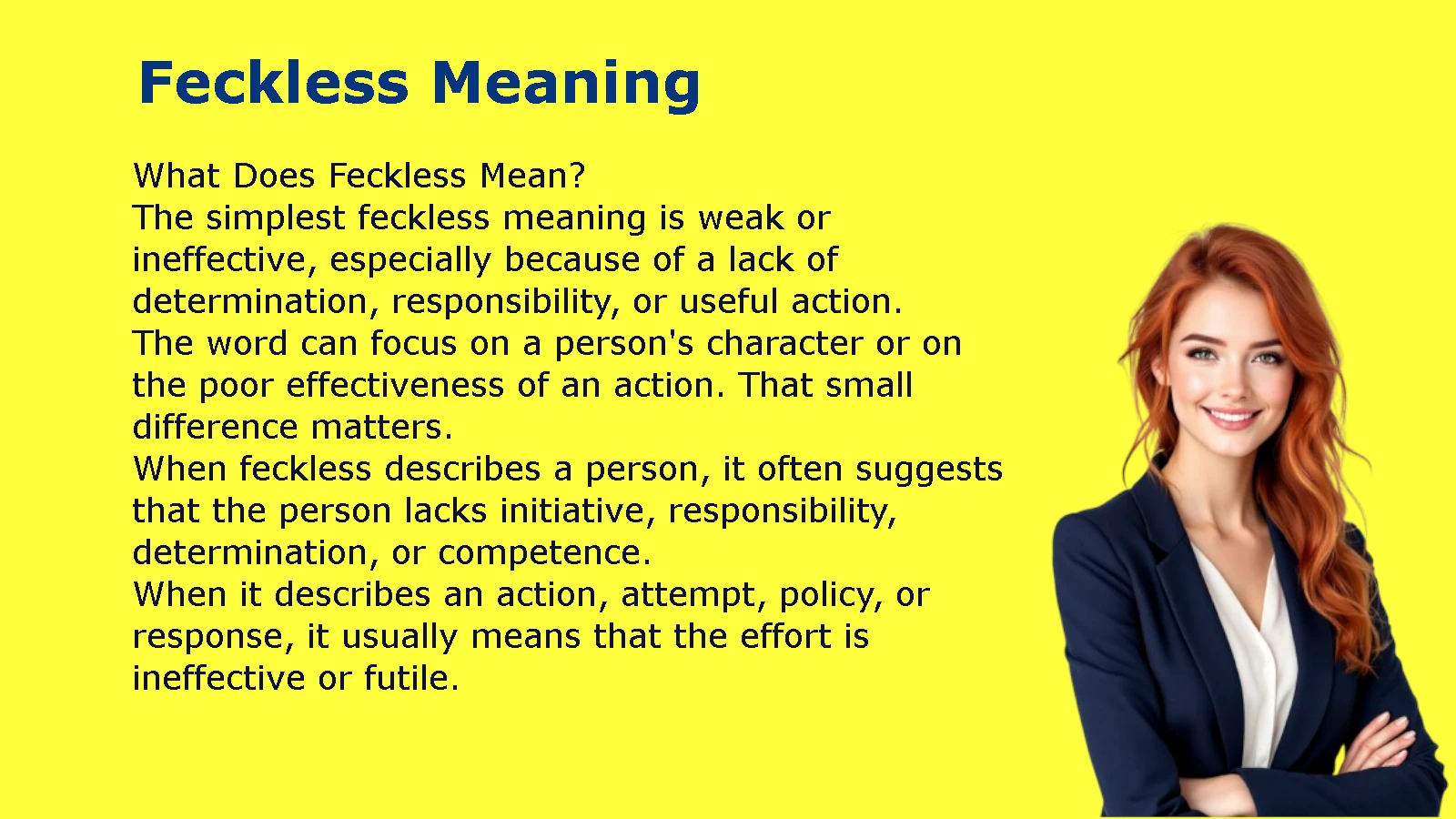
What Does Feckless Mean?
The simplest feckless meaning is weak or ineffective, especially because of a lack of determination, responsibility, or useful action.
The word can focus on a person’s character or on the poor effectiveness of an action. That small difference matters.
When feckless describes a person, it often suggests that the person lacks initiative, responsibility, determination, or competence.
When it describes an action, attempt, policy, or response, it usually means that the effort is ineffective or futile.
A person can also seem reluctant to act, but the two words aren’t identical. Someone who is reluctant may simply be hesitant or unwilling, whereas a feckless person is often characterized by a broader lack of energy, initiative, or effectiveness.
Feckless definition at a glance
| Word | Definition |
| Feckless | Weak, ineffective, irresponsible, or lacking determination |
| Part of speech | Adjective |
| Tone | Usually negative or disapproving |
| Pronunciation | /ˈfek.ləs/ |
| Noun form | Fecklessness |
| Adverb form | Fecklessly |
| Origin | Scots and northern English dialect |
| First known use | Around 1585 |
Merriam-Webster defines feckless as “weak, ineffective” and also gives the sense “worthless, irresponsible.” It records the word’s first known use as around 1585.
What Does It Mean to Call Someone Feckless?
Calling someone feckless is usually a criticism of their ability or character.
Imagine a manager who knows a project is failing but refuses to make decisions, avoids responsibility, and lets problems continue. Calling that manager feckless suggests more than simple inexperience. It paints a picture of someone who fails to act effectively when action is needed.
The word can suggest several related qualities:
- Weak character
- Lack of determination
- Poor judgment
- Irresponsibility
- Ineffectiveness
- Lack of initiative
- Incompetence
- Indifference to responsibilities
However, feckless doesn’t always mean that someone is simply lazy.
A person might work hard yet still behave in a feckless way if their efforts are poorly directed, ineffective, or lacking in purpose. In other words, effort alone doesn’t automatically make someone effective.
Cambridge’s learner dictionary emphasizes that a feckless person is unwilling to work or take responsibility for their actions.
Being pessimistic doesn’t necessarily make someone feckless. A pessimistic person expects poor results, while a feckless person lacks the drive or effectiveness needed to take meaningful action.
Feckless Meaning in Simple English
If you need an easy definition, think of feckless as:
Someone who doesn’t have enough strength, determination, responsibility, or effectiveness to get things done properly.
For things rather than people, the meaning shifts slightly:
Something feckless is ineffective, futile, or unlikely to achieve its intended result.
Here are a few quick examples:
- He was a feckless leader.
He lacked the determination and effectiveness needed to lead. - The committee made a feckless attempt to solve the problem.
Its attempt was ineffective and accomplished little. - Her feckless response only made the situation worse.
Her response showed little effectiveness or useful action.
This flexibility makes feckless more interesting than a simple synonym such as weak.
Is Feckless a Negative Word?
Yes. Feckless usually has a negative or disapproving meaning.
Oxford explicitly labels the word “disapproving.”
That matters because feckless doesn’t merely describe a lack of ability in a neutral way. It often expresses the speaker’s judgment about that weakness.
Compare these sentences:
- He is inexperienced.
- He is indecisive.
- He is feckless.
The first sentence simply states that he lacks experience. The second focuses on his difficulty making decisions. The third carries a broader criticism. It can suggest weakness of character, irresponsibility, ineffectiveness, or a lack of determination.
So, if you describe a coworker as feckless, don’t expect the word to sound like a harmless observation. It can sting.
Feckless Examples in Sentences
The best way to understand a word is to see it doing real work in a sentence.
Examples describing a person
- The feckless employee missed another deadline without explaining what went wrong.
- His feckless approach to his responsibilities frustrated everyone on the team.
- She considered her former business partner charming but ultimately feckless.
- The novel portrays him as a feckless young man who avoids difficult decisions.
- A feckless leader can allow small problems to grow into major ones.
In these examples, feckless suggests more than a single mistake. The criticism concerns a pattern of weak, irresponsible, or ineffective behavior.
Examples describing leadership
- The organization suffered under feckless leadership.
- The board criticized the director’s feckless response to the crisis.
- Employees lost confidence after months of feckless decision making.
- The mayor was accused of being feckless when the situation demanded quick action.
Here, the word highlights a failure to act effectively.
Examples describing an attempt or effort
- Their feckless attempt to repair the machine solved nothing.
- The company launched a feckless campaign that failed to attract customers.
- His feckless effort to settle the dispute satisfied neither side.
- The committee’s feckless response left the main issue unresolved.
In this context, feckless comes close to ineffective, futile, or ineffectual.
Examples describing behavior
- His feckless behavior caused unnecessary problems for his family.
- The manager grew tired of her employee’s feckless attitude.
- The character’s feckless behavior becomes a major source of conflict in the story.
These sentences focus on conduct rather than one isolated action.
Feckless Meaning in Different Contexts
Context can sharpen the meaning of feckless. The basic idea remains the same, but the criticism changes depending on what the word describes.
Feckless person
A feckless person typically lacks determination, responsibility, or effectiveness.
The person may avoid responsibility, fail to follow through, make poor decisions, or simply lack the drive to handle important matters.
Example:
The feckless assistant kept postponing important tasks and never took responsibility for the delays.
The sentence doesn’t necessarily mean the assistant never worked. Instead, it emphasizes a pattern of ineffective or irresponsible behavior.
Feckless leader
A feckless leader lacks the resolve or effectiveness needed to lead successfully.
The word works particularly well here because leadership requires action. A leader who constantly hesitates, avoids responsibility, or responds poorly to serious problems may be described as feckless.
Example:
The company needed decisive leadership, but the feckless director avoided every difficult choice.
Feckless attempt
A feckless attempt is an ineffective or poorly executed effort.
Example:
They made a feckless attempt to repair the leaking roof and ended up causing more damage.
Here, feckless focuses less on character and more on the poor quality of the attempt.
Feckless response
A feckless response is weak, ineffective, or inadequate.
Example:
The agency’s feckless response failed to address the public’s concerns.
This use is especially common when discussing institutions, organizations, leadership, and public actions. Merriam-Webster gives a modern example involving a response that was well-intentioned but ultimately ineffective.
Feckless Synonyms
Several words can replace feckless, but they don’t all carry exactly the same meaning.
Common feckless synonyms include:
- Ineffective
- Ineffectual
- Irresponsible
- Incompetent
- Weak
- Futile
- Worthless
- Indecisive
- Aimless
- Shiftless
- Useless
- Hopeless
Collins lists irresponsible, useless, hopeless, incompetent, feeble, worthless, futile, and ineffectual among related terms.
However, these words aren’t interchangeable in every sentence.
Feckless vs. ineffective
Ineffective means something fails to produce the desired result.
Feckless can mean ineffective, but it can also suggest weakness, irresponsibility, or lack of determination.
- The treatment was ineffective.
The treatment didn’t work. - The doctor gave a feckless response.
The response was weak or inadequate and may also suggest poor judgment or lack of resolve.
Feckless vs. incompetent
Incompetent usually means lacking the skill, knowledge, or ability required to do something properly.
Feckless has a broader emotional and character-based sense.
Someone can be inexperienced without being feckless. Likewise, someone can lack technical skill without being irresponsible.
- The inexperienced technician made a mistake.
- The incompetent technician repeatedly failed to perform the job correctly.
- The feckless technician ignored the problem and refused to take responsibility.
Each adjective points to something different.
Feckless vs. irresponsible
Irresponsible focuses directly on failing to behave responsibly.
Feckless can include irresponsibility, but it can also suggest weakness, ineffectiveness, or a lack of determination.
So:
Irresponsible = fails to act responsibly.
Feckless = weak, ineffective, or irresponsible in a broader sense.
Feckless vs. lazy
These words overlap, but lazy is not a perfect synonym for feckless.
A lazy person avoids work or effort. A feckless person may actually make an effort but still lack effectiveness, determination, or responsibility.
For example, someone might spend hours working on a project yet make no progress because they cannot make decisions or organize their efforts. That person might be feckless without necessarily being lazy.
Feckless Antonyms
The opposite of feckless depends on the sense being used.
If feckless means ineffective, the strongest antonyms include:
- Effective
- Efficient
- Successful
- Productive
- Powerful
- Useful
If it describes someone’s character or behavior, useful antonyms include:
- Responsible
- Determined
- Capable
- Competent
- Decisive
- Dependable
- Reliable
- Purposeful
Feckless vs. capable
A feckless person struggles to act effectively or responsibly.
A capable person has the ability to handle tasks successfully.
Feckless vs. determined
A feckless person may lack the resolve needed to follow through.
A determined person keeps working toward a goal despite difficulties.
Feckless vs. responsible
A feckless person may avoid responsibility or handle it poorly.
A responsible person accepts duties and follows through on them.
Feckless Word Forms
The word has two useful derived forms: fecklessly and fecklessness.
| Word | Part of Speech | Meaning | Example |
| feckless | Adjective | Weak, ineffective, or irresponsible | He was a feckless manager. |
| fecklessly | Adverb | In a weak or ineffective way | They acted fecklessly during the crisis. |
| fecklessness | Noun | Weakness or irresponsible behavior | His fecklessness became obvious. |
Oxford defines fecklessness as weakness of character or behavior that isn’t responsible. Collins also lists fecklessly and fecklessness as derived forms.
How to use “fecklessly”
Use fecklessly when you want to describe how someone acts.
Example:
The committee responded fecklessly to the growing problem.
This means the committee responded in an ineffective, weak, or irresponsible manner.
How to use “fecklessness”
Use fecklessness when talking about the quality itself.
Example:
The report criticized the fecklessness of the organization’s response.
The noun turns the adjective into a concept: the quality of being feckless.
Feckless Pronunciation
In American English, feckless is pronounced:
/ˈfek.ləs/
Cambridge gives the same basic phonetic pronunciation for both US and UK English.
The word has two syllables, with the stress on the first syllable.
The pronunciation begins with the short vowel sound found in words such as head, followed by the consonants and a relaxed second syllable.
Where Does the Word Feckless Come From?
The history of feckless is surprisingly practical.
The word comes from Scots, with related usage in northern English dialect. Its key element is feck, an older form related to effect and carrying senses connected with value, efficacy, or effectiveness.
Add the suffix -less, which means “without,” and the original idea becomes something like without effect or efficacy.
Merriam-Webster traces feckless to Scots fectles, meaning “valueless” or “futile,” from fek or fect, meaning “value” or “efficacy,” combined with -less.
Oxford similarly traces the word to Scots and northern English dialect feck, from a form of effect, plus -less.
The basic word structure
You can think of its historical construction like this:
feck + less → feckless
The suffix -less appears in many English words:
- hopeless = without hope
- careless = without care
- fearless = without fear
- powerless = without power
- feckless = historically, without effect or efficacy
The connection to effect helps explain why the modern word can mean ineffective.
What Does “Feck” Mean?
The unusual word feck is the key to understanding the origin of feckless.
In Scots, feck developed as a shortened form related to effect. Historical meanings included ideas such as value, efficacy, or effectiveness.
Merriam-Webster explains the historical connection by noting that Scots feck could mean “majority” or “effect” and ultimately came from Middle English effect.
The history also explains why feckless makes logical sense. If something has no feck, it has no useful effect or efficacy.
Etymonline dates feckless to the 1590s and describes it as coming from feck meaning “effect, value, vigor,” plus -less.
When Was Feckless First Used?
The word has been around for centuries.
Merriam-Webster records the first known use of feckless as circa 1585.
Collins places its origin in the 16th century, while Etymonline dates the word to the 1590s. These dates aren’t necessarily contradictory because dictionaries use different historical evidence and dating conventions.
The important point is simple: feckless is not a modern internet invention or recent slang. It has been part of English vocabulary for hundreds of years.
Feckless in Modern English
Although feckless has old roots, it remains useful in modern English.
It frequently appears when writers want to criticize:
- Weak leadership
- Ineffective organizations
- Poor decisions
- Irresponsible behavior
- Failed efforts
- Lack of determination
- Ineffectual responses
Merriam-Webster’s current dictionary entry includes recent examples from publications such as The Atlantic, USA Today, The New Yorker, and Vulture, showing that the word continues to appear in contemporary writing.
The word also has a slightly formal flavor. Collins labels it formal and disapproving, while Oxford marks it as disapproving.
That makes it more common in journalism, criticism, literature, essays, and formal commentary than in everyday casual conversation.
Is Feckless the Same as Useless?
Not quite.
Useless usually means that something has no practical use or that someone is incapable of doing something effectively.
Feckless can carry that idea, but it adds another layer. It can suggest weak character, lack of determination, irresponsibility, or poor initiative.
Compare:
The old printer is useless.
The printer doesn’t work or isn’t useful.
The technician was feckless.
The criticism targets the technician’s behavior or effectiveness. The word may suggest that the person failed to act properly, lacked determination, or didn’t take responsibility.
So, while useless can sometimes replace feckless, the emotional and contextual meaning isn’t identical.
Is Feckless the Same as Incompetent?
Again, there is overlap, but the words aren’t identical.
Incompetent means lacking the ability, skill, or knowledge to do something successfully.
Feckless can describe incompetence, but it may also criticize someone’s character, initiative, determination, or sense of responsibility.
Consider two employees:
- One employee tries hard but doesn’t have the technical skills for a complicated task. That employee may be incompetent at the task.
- Another employee understands the task but repeatedly avoids responsibility, makes weak decisions, and refuses to act. That employee may be feckless.
The distinction is subtle but useful.
Is Feckless the Same as Weak?
Weak is broader than feckless.
Someone can be physically weak, emotionally weak, financially weak, or weak in an argument. Feckless doesn’t cover all those meanings.
Instead, it usually points toward weakness in effectiveness, character, determination, or responsibility.
For example:
The bridge is weak.
This describes physical strength.
The leader is feckless.
This describes ineffective or weak leadership and possibly a lack of determination or responsibility.
That’s why feckless works best when the weakness affects someone’s ability or willingness to act effectively.
How to Use Feckless Correctly
Because feckless has several related meanings, context helps you use it naturally.
Use “feckless” before a noun
This is one of the most common patterns.
Examples include:
- feckless leader
- feckless employee
- feckless response
- feckless attempt
- feckless effort
- feckless behavior
- feckless government
- feckless policy
- feckless decision
Use “be” with feckless
You can also use the adjective after forms of be:
- He was feckless.
- The manager seemed feckless.
- Their leadership became increasingly feckless.
Use “fecklessly” for actions
When describing how someone acts, use the adverb:
- They responded fecklessly.
- He handled the situation fecklessly.
- The organization acted fecklessly.
Use “fecklessness” for the quality
When discussing the behavior as a general quality, use the noun:
- His fecklessness frustrated the team.
- The report exposed the fecklessness of the response.
Common Mistakes With Feckless
A few distinctions can prevent awkward usage.
Mistake: Assuming feckless only means lazy
It doesn’t.
Lazy focuses on an unwillingness to work or make an effort. Feckless can involve laziness, but it more broadly suggests weakness, ineffectiveness, irresponsibility, or lack of determination.
Mistake: Using feckless as a neutral synonym for inexperienced
Being inexperienced isn’t the same as being feckless.
A new employee may lack experience but still be energetic, responsible, and determined. Calling that person feckless would imply a much stronger criticism.
Mistake: Assuming feckless only describes people
It doesn’t.
You can describe an attempt, response, policy, effort, strategy, or form of leadership as feckless when it is weak or ineffective.
Mistake: Treating it as casual slang
Feckless is a legitimate established English adjective with centuries of recorded use. Dictionaries generally present it as formal or disapproving rather than casual slang.
A Quick Case Study: Understanding the Difference
Consider this workplace situation.
A team has an important deadline. One employee has little experience, so they make several mistakes. However, they ask questions, accept feedback, and work hard to improve.
Another employee has plenty of experience but repeatedly avoids difficult decisions. They ignore warnings, blame coworkers when problems appear, and never take responsibility.
Which employee is more likely to be described as feckless?
The second employee.
The first employee is inexperienced. The second displays the combination of poor responsibility, weak initiative, and ineffective action that feckless often conveys.
This example shows why simply translating feckless as “bad” or “lazy” misses the word’s real meaning.
Feckless Meaning: Synonyms and Differences at a Glance
| Word | Main idea | How it differs from feckless |
| Ineffective | Doesn’t produce the desired result | Focuses mainly on results |
| Incompetent | Lacks necessary skill or ability | Focuses on ability |
| Irresponsible | Fails to act responsibly | Focuses on responsibility |
| Lazy | Avoids work or effort | Focuses on willingness to work |
| Indecisive | Struggles to make decisions | Focuses on decision making |
| Weak | Lacks strength | Much broader meaning |
| Futile | Has little or no chance of success | Usually describes an action or effort |
| Worthless | Has little or no value | Stronger focus on value |
| Aimless | Lacks direction or purpose | Focuses on direction |
| Ineffectual | Fails to produce an intended effect | Very close to one sense of feckless |
The strongest synonym depends on what you want to emphasize. Collins groups feckless with words such as irresponsible, incompetent, ineffectual, futile, and worthless, but those words each highlight different parts of the meaning.
Feckless Meaning: Antonyms at a Glance
| Feckless quality | Opposite |
| Ineffective | Effective |
| Irresponsible | Responsible |
| Indecisive | Decisive |
| Incompetent | Competent |
| Weak | Strong |
| Aimless | Purposeful |
| Unreliable | Dependable |
| Unproductive | Productive |
| Unsuccessful | Successful |
| Lacking determination | Determined |
Choosing the right antonym depends on the context. If you’re talking about a failed plan, effective is probably the best opposite. If you’re describing someone’s character, responsible, capable, or determined may fit better.
Frequently Asked Questions About Feckless
What is the meaning of feckless?
Feckless means weak, ineffective, lacking determination, or irresponsible. When used about a person, it often suggests weak character or poor responsibility. When used about an action or effort, it can mean ineffective or futile.
Is feckless a bad word?
It isn’t a swear word or vulgar expression. However, feckless is usually negative and disapproving. Calling someone feckless can be a fairly strong criticism of their character or effectiveness. Oxford specifically labels the word “disapproving.”
Does feckless mean lazy?
Not exactly. Lazy means unwilling to work or make an effort. Feckless can include laziness but more often suggests weakness, ineffectiveness, irresponsibility, or a lack of determination.
Does feckless mean incompetent?
Sometimes, but not always. Incompetent focuses on a lack of ability or skill. Feckless can describe someone who lacks effectiveness or responsibility even when skill isn’t the main issue.
What is a simple synonym for feckless?
Depending on the context, simple synonyms include ineffective, irresponsible, weak, incompetent, or indecisive.
What is the opposite of feckless?
Common antonyms include effective, capable, responsible, competent, determined, decisive, and dependable.
What is the noun form of feckless?
The noun is fecklessness, meaning the quality or state of being feckless.
What is the adverb form of feckless?
The adverb is fecklessly, meaning in a weak, ineffective, or irresponsible manner.
Is feckless formal or informal?
Feckless generally has a formal or literary feel rather than sounding like everyday casual speech. Collins labels it formal and disapproving.
Where does the word feckless come from?
Feckless comes from Scots, with related northern English dialect usage. It developed from feck, a shortened form related to effect, plus -less, meaning “without.” The historical sense therefore connects to being without effect, value, or efficacy.
Final Takeaway: What Does Feckless Mean?
The clearest feckless meaning is weak, ineffective, lacking determination, or irresponsible.
The word can describe a person who repeatedly fails to take responsibility or act with purpose. It can also describe an effort, response, policy, or attempt that achieves little.
The meaning becomes easier to remember when you connect the word to its history. Feck was associated with effect, value, and efficacy, while -less means without. Historically, then, something feckless was essentially without useful effect.
In short:
- Feckless is an adjective.
- It means weak, ineffective, irresponsible, or lacking determination.
- It can describe people and things.
- It usually has a negative or disapproving tone.
- Fecklessly is the adverb.
- Fecklessness is the noun.
- The word comes from Scots, with roots connected to effect.
- Its first known use dates to around 1585 according to Merriam-Webster.
- Strong context dependent synonyms include ineffective, incompetent, irresponsible, weak, futile, and ineffectual.
- Common antonyms include effective, responsible, capable, competent, and determined.
Once you understand that range, feckless becomes much more precise than simply calling someone “lazy” or “weak.” It describes a particular kind of weakness: the failure to act with enough effectiveness, responsibility, or determination to get something done properly.