Have you ever wondered whether the correct spelling is guacamole or guacomole? The difference in Guacamole vs Guacomole is easy to overlook because the two spellings contain almost the same letters. However, only one is the standard spelling, while the other is a common misspelling.
Guacamole is the correct spelling, while guacomole is an incorrect spelling. Guacamole refers to a popular Mexican dip or sauce made primarily from mashed avocados, often with ingredients such as lime juice, onion, tomato, cilantro, and seasonings. The correct spelling remains guacamole in both American English and British English.
Examples:
- I ordered guacamole with my tacos.
- She made fresh guacamole for the party.
The confusion is understandable. People often search for guacamole vs guacomole, guacamole or guacomole, which spelling is correct, or guacomole meaning in English because the placement of the letters a and o can be easy to mix up. However, guacomole is not an accepted alternative spelling of guacamole. If you’re writing the name of this avocado-based dish, guacamole is the form you should use.
In this guide, you’ll learn the complete difference between Guacamole vs Guacomole, including their meaning, pronunciation, origin, correct spelling, and usage. You’ll also discover why guacomole is commonly misspelled and see clear examples to help you remember the correct spelling.
Guacamole vs Guacomole: Which Is Correct?
The answer is straightforward: guacamole is correct, while guacomole is not the standard spelling.
Here’s the difference at a glance:
| Spelling | Correct? | Meaning | Standard English Usage |
| Guacamole | Yes | An avocado-based dip, sauce, or spread | Standard |
| Guacomole | No | Usually intended to mean guacamole | Misspelling |
The incorrect form guacomole doesn’t describe a different food. In most cases, someone who writes guacomole simply means guacamole.
That distinction matters because the two spellings aren’t competing regional forms in standard English. They don’t represent two different versions of the dish.
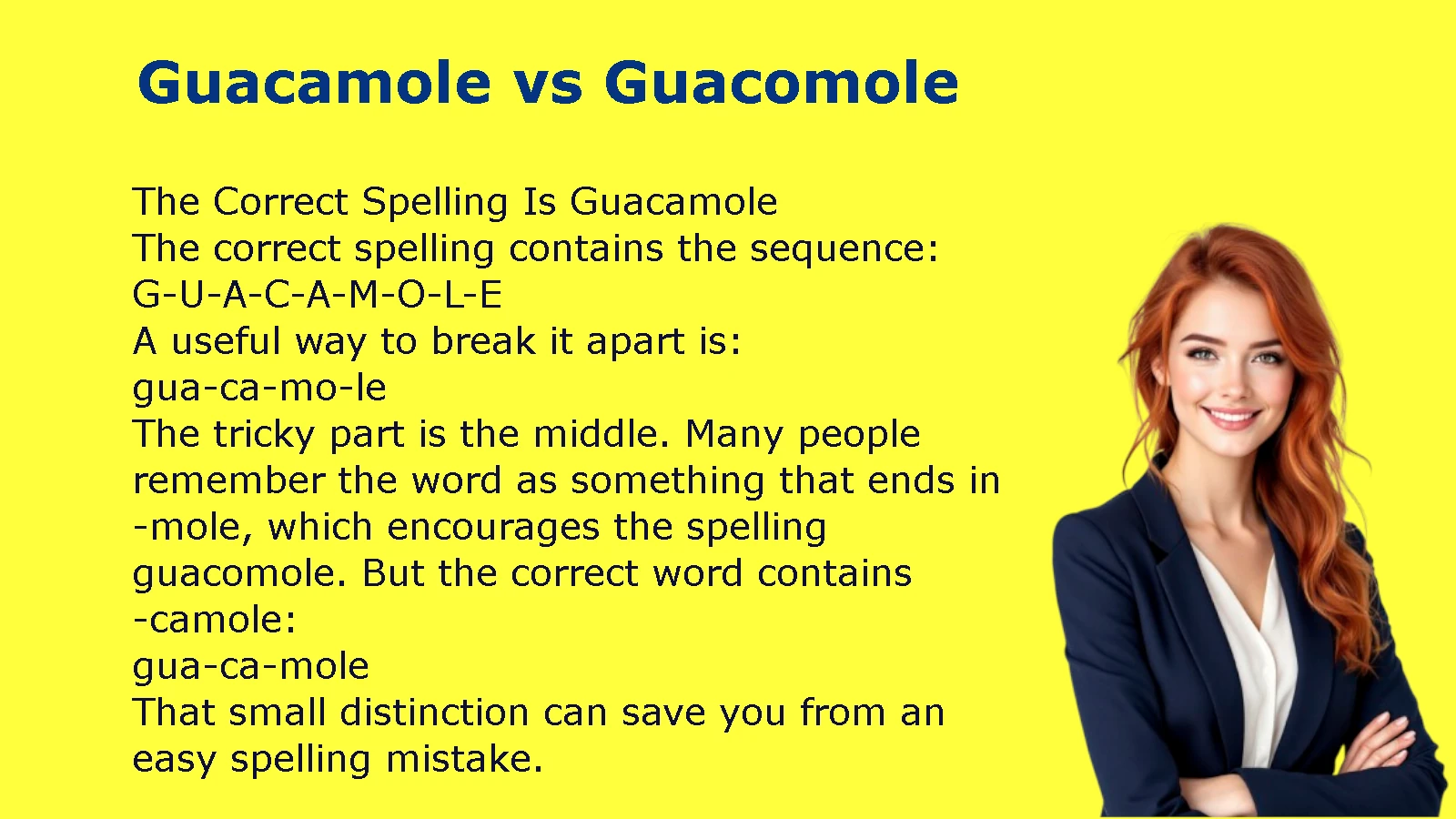
The Correct Spelling Is Guacamole
The correct spelling contains the sequence:
G-U-A-C-A-M-O-L-E
A useful way to break it apart is:
gua-ca-mo-le
The tricky part is the middle. Many people remember the word as something that ends in -mole, which encourages the spelling guacomole. But the correct word contains -camole:
gua-ca-mole
That small distinction can save you from an easy spelling mistake.
Guacomole Is a Common Misspelling
When people write guacomole, they generally aren’t referring to another recognized English food term. They’re spelling guacamole incorrectly.
The mistake is understandable because English speakers often spell unfamiliar borrowed words according to how they sound. Guacamole comes through Spanish from Nahuatl, so its spelling doesn’t follow the patterns of an ordinary native English word.
In other words, your brain may try to simplify the unfamiliar spelling. Unfortunately, that shortcut produces guacomole, which isn’t the standard form.
What Does Guacamole Mean?
Guacamole is a thick avocado-based food commonly served as a dip, spread, sauce, or accompaniment.
Oxford defines it as a Mexican dish made from avocado mixed with ingredients such as onions, tomatoes, and chiles.
The American Heritage Dictionary similarly describes guacamole as a thick paste of mashed avocado that is often combined with citrus juice, onion, and seasonings.
In practical terms, think of guacamole as seasoned avocado prepared in a form that’s easy to scoop, spread, or serve alongside other foods.
A typical modern preparation might include:
- Mashed avocado
- Lime juice
- Chopped onion
- Tomato
- Cilantro
- Jalapeño or another chile
- Salt
However, there isn’t one universal recipe that defines every bowl of guacamole. Ingredients and preparation methods vary.
For example, one person may prefer chunky avocado with tomato and onion. Another may make a smoother version with avocado, lime, chile, and salt. Both can still be described as guacamole.
What Is Guacamole Used For?
Guacamole works with far more than tortilla chips.
You may find it served with:
- Tacos
- Burritos
- Tortilla chips
- Quesadillas
- Nachos
- Grilled meats
- Eggs
- Sandwiches
- Salads
- Rice bowls
- Vegetables
- Toast
Because avocado has a creamy texture and mild flavor, guacamole can play several roles on a plate. It can act as a dip, topping, spread, or side dish.
Why Is Guacamole Spelled This Way?
The spelling becomes much easier to remember once you understand the word’s history.
Guacamole ultimately comes from Classical Nahuatl, an Indigenous language of central Mexico. The Nahuatl term āhuacamōlli referred to an avocado-based sauce or preparation. Historical dictionary records connect the word with āhuacatl, meaning avocado, and mōlli, meaning sauce or a related preparation.
The word later entered Spanish as guacamole, and English adopted the Spanish form.
That history explains why the spelling may feel unusual to English speakers. It’s a borrowed word with a long linguistic journey rather than a word created according to modern English spelling patterns.
The Word Comes From Nahuatl
The basic structure is often explained as:
āhuacatl + mōlli → āhuacamōlli
The first element relates to avocado. The second relates to sauce or a ground preparation.
The Nahuatl Dictionary records ahuacamolli as a term for guacamole and notes that it entered Spanish and English as guacamole.
The Gran Diccionario Náhuatl from the National Autonomous University of Mexico also records historical forms of ahuacamolli, including a 1571 entry associated with a preparation of avocado and chile.
That historical evidence gives the modern spelling some serious roots. Guacamole isn’t an arbitrary spelling.
Guacamole and Mole Have a Linguistic Connection
Here’s where the spelling confusion gets especially interesting.
The ending -mole isn’t completely unrelated to the history of the word. The Nahuatl element mōlli refers to sauce or a related preparation, and the Spanish word mole also has roots in Nahuatl. Merriam-Webster notes this connection when discussing words from Nahuatl that entered English.
So when someone sees guacamole and instinctively writes guacomole, the mistake isn’t completely random. The word’s history really does involve a form related to mole.
Still, modern English uses guacamole as the standard spelling.
Why Do People Spell Guacamole as Guacomole?
The misspelling guacomole likely develops from a combination of pronunciation, memory, and familiarity with the word mole.
The Word Has an Unfamiliar Letter Pattern
English contains many words with predictable spelling patterns. Guacamole doesn’t feel quite as predictable.
A person may remember the beginning correctly:
gua-ca-
Then they hear the final portion and mentally reconstruct it as:
-mole
That produces:
gua-ca + mole = guacamole
But when the syllables aren’t clearly remembered, the letters can shift around and result in:
guacomole
The difference is small, yet spelling depends on putting those letters in exactly the right order.
The Word Sounds Different From How It Looks
English speakers may pronounce guacamole in ways that don’t map neatly onto its written form.
Oxford lists English pronunciations including forms represented as /ˌɡwækəˈməʊleɪ/ and /ˌɡwækəˈməʊli/.
American English commonly uses a pronunciation along the lines of gwah-kuh-MOH-lee or gwah-kuh-MOH-lay, depending on the speaker.
That variation can make the spelling less obvious.
The Word Mole Creates Extra Confusion
English speakers already know the word mole.
It can refer to a small burrowing mammal, a spot on the skin, or a Mexican sauce depending on context. When people encounter guacamole, they may naturally notice the familiar sequence mole inside the word.
That association can make guacomole feel plausible even though the spelling isn’t correct.
How to Pronounce Guacamole
Guacamole is commonly pronounced approximately as:
gwah-kuh-MOH-lee
Another English pronunciation ends with a sound closer to:
gwah-kuh-MOH-lay
The exact pronunciation can vary between English varieties and between English and Spanish.
Oxford provides multiple English pronunciations, including forms ending in sounds represented by -lee and -lay.
In Spanish, the pronunciation follows Spanish sound patterns and is commonly represented as /ɡwakaˈmole/.
The important point for spelling is simple: don’t let the way the word sounds convince you to write guacomole.
Break Guacamole Into Syllables
For spelling practice, divide it like this:
gua-ca-mo-le
Then remember the full form:
guacamole
This approach works better than trying to memorize the entire word as one large block.
Guacamole Meaning in a Sentence
Seeing the correct spelling in context makes it easier to remember.
Example: Restaurant
We ordered tortilla chips with fresh guacamole.
Here, guacamole identifies the avocado-based dip served with the chips.
Example: Recipe
Mash the avocados before adding the lime juice and seasonings to make guacamole.
The word functions as the name of the finished food.
Example: Casual Conversation
I could eat a whole bowl of guacamole with those chips.
In everyday conversation, guacamole commonly works as an uncountable food noun.
Example: Tacos
The tacos came topped with fresh guacamole and cilantro.
Here, guacamole functions as a topping.
Example: Food Writing
This restaurant serves creamy guacamole with house-made tortilla chips.
The spelling remains guacamole, regardless of whether you’re writing casually or professionally.
Guacamole vs Guacomole in Everyday Writing
The spelling difference may seem minor, but correct spelling matters when you’re publishing information other people will read.
You should use guacamole in:
- Restaurant menus
- Recipes
- Food blogs
- Cookbooks
- School assignments
- Business websites
- Product descriptions
- Social media posts
- Restaurant reviews
- Newspaper articles
- Marketing materials
A typo in a private text message probably won’t cause much trouble. However, repeated misspellings on a business website can make the writing look careless.
Imagine a restaurant menu advertising:
Fresh Guacomole With Tortilla Chips
The food might taste fantastic, but the spelling mistake immediately stands out.
The correct version is:
Fresh Guacamole With Tortilla Chips
One letter arrangement makes the difference.
Common Mistakes With Guacamole
The most obvious mistake is guacomole, but remembering the correct structure helps prevent other errors too.
| Incorrect or confused form | Standard form |
| guacomole | guacamole |
| guacamolee | guacamole |
| guacamol | guacamole in standard English |
| guacamole with letters rearranged | guacamole |
It’s worth noting that guacamol is not simply another random misspelling in every context. Spanish has regional variation, and ASALE’s Diccionario de americanismos records guacamol as a form used in several countries and contexts.
That’s different from guacomole. The latter is generally a misspelling of the standard English word guacamole.
A Simple Memory Trick
Try remembering the word in two parts:
GUA-CA + MOLE
Then put them together:
GUA-CAMOLE
The critical sequence is:
CAMO
Not:
COMO
So if you’re deciding between guacamole and guacomole, look at the middle:
- gua-ca-mole ✅
- gua-co-mole ❌
That tiny spelling check can prevent the mistake.
Is Guacamole a Spanish Word?
Yes. Guacamole is used in Spanish, although its deeper origin goes back to Nahuatl.
The Spanish word is guacamole, and Spanish also has the regional form guacamol in some areas. ASALE’s dictionary records guacamole across several Spanish-speaking regions and gives guacamol as an alternative regional form in places including Central America and Cuba.
This is an important distinction.
The fact that Spanish has a regional form guacamol doesn’t make guacomole correct. The spellings are different:
guacamole
guacamol
guacomole
Only the first is the standard English form.
Is Guacomole a Word?
In standard English usage, guacomole is best treated as a misspelling of guacamole.
If you search for guacomole, you’ll likely find people using it when they mean the avocado-based food. But online appearances don’t automatically make a spelling standard.
This is especially important when you’re writing for an audience.
A word can appear thousands of times online and still be considered a spelling error. Search engines, social media, user-generated content, and informal posts contain plenty of typos.
For formal or edited English, use:
guacamole
What Is Guacamole Made Of?
Although recipes vary, avocado provides the defining base of guacamole.
Oxford describes the dish as avocado mixed with ingredients such as onion, tomatoes, and chiles.
Common ingredients include:
| Ingredient | Typical purpose |
| Avocado | Main ingredient and creamy base |
| Lime juice | Adds acidity and brightness |
| Onion | Adds crunch and savory flavor |
| Tomato | Adds freshness and texture |
| Chile or jalapeño | Adds heat |
| Cilantro | Adds herbal flavor |
| Salt | Brings the flavors together |
Not every recipe uses all of these ingredients.
That’s an important point because guacamole doesn’t have to follow one rigid recipe. Different cooks and regions use different combinations, textures, and levels of seasoning.
Why Avocado Matters Most
Without avocado, the dish generally stops fitting the ordinary meaning of guacamole.
The avocado gives the mixture its characteristic creamy texture. It also provides the rich flavor that balances sharper ingredients such as lime, onion, and chile.
Other ingredients modify the base rather than replacing it.
Guacamole in American English
Guacamole has become a familiar English food term, particularly in the United States.
American English dictionaries treat it as an established noun rather than requiring readers to understand Spanish before they can use the word. The American Heritage Dictionary lists it as a noun meaning a thick paste of mashed avocado often combined with citrus juice, onion, and seasonings.
Collins likewise lists guacamole as an uncountable noun in American English and gives pronunciations used in American English.
That means you can comfortably write sentences such as:
We made guacamole for the party.
You don’t need quotation marks around guacamole. You also don’t need to italicize it simply because it originated in another language.
It’s now a familiar part of everyday English vocabulary.
A Closer Look at the Word’s History
The history of guacamole stretches much further back than its popularity in modern restaurants.
Historical Nahuatl sources record forms of ahuacamolli centuries ago. The Gran Diccionario Náhuatl includes an entry connected with a 1571 work by Alonso de Molina. That historical record describes a preparation involving avocado and chile.
The linguistic path can be simplified like this:
Classical Nahuatl → Spanish → English
More specifically:
āhuacatl + mōlli → āhuacamōlli → guacamole → English guacamole
The first element relates to avocado, while the second relates to sauce or a ground preparation. The Nahuatl Dictionary specifically explains the formation as ahuacatl + molli and notes that the term entered Spanish and English as guacamole.
Why This History Helps With Spelling
Etymology isn’t just an interesting side note. It can help explain why a word looks the way it does.
If you know that guacamole developed from ahuacamolli, the spelling starts to look less random.
The middle sequence -cam- belongs to the historical structure of the word. That makes it easier to remember why guacamole has an a after the c.
Instead of memorizing a strange-looking word, you’re connecting it to its history.
Guacamole vs Guacomole: A Quick Comparison
Here’s the entire issue in one table:
| Feature | Guacamole | Guacomole |
| Standard English spelling | Yes | No |
| Refers to avocado-based dip | Yes | Usually intended to |
| Standard dictionary form | Yes | No |
| Spanish form | Yes | No |
| Historical origin | Nahuatl through Spanish | Not the standard form |
| Recommended in formal writing | Yes | No |
| Common online typo | Sometimes | Yes |
If you’re unsure, there’s really only one form to choose in standard English: guacamole.
A Practical Spelling Check
Suppose you’re writing one of these sentences:
I made homemade ______ for the party.
Which spelling belongs in the blank?
Guacamole.
Now try:
Can you pass the ______?
Again:
Guacamole.
And:
The restaurant serves spicy ______ with tortilla chips.
Still:
Guacamole.
The context doesn’t change the spelling.
Whether you’re talking about homemade food, a restaurant dish, or a store-bought product, the standard English spelling remains guacamole.
Case Study: Why a Small Spelling Error Can Change the Quality of Food Content
Consider two food-blog headlines:
Version A:
Easy Homemade Guacamole Recipe
Version B:
Easy Homemade Guacomole Recipe
Both headlines communicate the intended topic. However, Version A uses the established dictionary spelling, while Version B contains a visible error.
For a food website, spelling matters because readers expect recipes and ingredient names to look polished. A single typo may not ruin an article, but repeated errors can weaken the reader’s confidence in the content.
The lesson is broader than this one word:
When a borrowed word looks unfamiliar, verify the spelling instead of relying only on pronunciation.
Frequently Asked Questions About Guacamole vs Guacomole
Is guacamole or guacomole correct?
Guacamole is the correct standard English spelling. Guacomole is a misspelling.
How do you spell guacamole?
The correct spelling is:
G-U-A-C-A-M-O-L-E
A useful syllable breakdown is:
gua-ca-mo-le
Is guacomole a word?
Guacomole is generally considered a misspelling of guacamole in standard English. It doesn’t represent the standard name of a different dish.
What does guacamole mean?
Guacamole is an avocado-based dish, dip, spread, or sauce. Recipes commonly combine mashed avocado with ingredients such as onion, tomato, chile, lime juice, cilantro, and salt.
Is guacamole a Spanish word?
Yes. Guacamole is a Spanish word, and it ultimately comes from Classical Nahuatl āhuacamōlli.
What is the origin of the word guacamole?
The word ultimately comes from Nahuatl āhuacamōlli, which is associated with avocado and sauce. It entered Spanish and then English as guacamole.
Why is guacamole sometimes spelled guacomole?
The misspelling probably comes from the way the word sounds and from the familiar word mole. Because guacamole is an unfamiliar spelling pattern for many English speakers, the letters can get rearranged in memory.
Is guacamole spelled with an A or an O after the C?
The standard spelling has an A after the first C:
gua-ca-mole
So the correct form is guacamole, not guacomole.
How do you pronounce guacamole?
English has more than one accepted pronunciation. Common English forms sound approximately like gwah-kuh-MOH-lee or gwah-kuh-MOH-lay. Oxford lists multiple English pronunciations.
What is guacamole made from?
The primary ingredient is avocado. Recipes may also include lime or lemon juice, onion, tomato, chile, cilantro, and salt.
Is guacamole the same as avocado dip?
Not necessarily. Guacamole is a specific avocado-based preparation with a long culinary and linguistic history. The broader phrase avocado dip can describe many different recipes that may not follow traditional guacamole preparations.
Is guacamole countable or uncountable?
In ordinary English, guacamole is generally used as an uncountable noun.
For example:
We ordered some guacamole.
You normally wouldn’t say:
We ordered three guacamoles.
However, in specialized contexts, speakers may use plural forms when referring to different varieties or preparations. The ordinary everyday use remains uncountable.
Final Answer: Guacamole vs Guacomole
The spelling question has a simple answer:
Guacamole is correct.
Guacomole is a misspelling.
The correct word contains -camole, not -comole:
gua-ca-mole ✅
gua-co-mole ❌
The word has an interesting history. Guacamole entered English through Spanish and ultimately traces back to the Nahuatl term āhuacamōlli, associated with avocado and sauce. Historical Nahuatl sources document forms of the word centuries ago.
So the next time you’re writing about tacos, tortilla chips, or your favorite avocado dip, stick with guacamole.
When in doubt, remember the middle:
GUA-CA-MOLE.
That little A is the key.