Have you ever wondered whether the correct spelling is focaccia or foccacia? The difference in Focaccia vs Foccacia is easy to overlook, especially because the word contains several letters that can make its spelling tricky. However, only one form is considered the standard spelling in English.
Focaccia is the correct spelling, while foccacia is a common misspelling. Focaccia refers to a type of Italian flatbread, typically made with flour, water, yeast, olive oil, and salt. The word comes from Italian and is widely used in English when discussing Italian food and baking.
Examples:
- We ordered fresh focaccia with olive oil and herbs.
- She baked a rosemary focaccia for dinner.
The confusion is understandable. People often search for focaccia vs foccacia, focaccia or foccacia, which spelling is correct, or foccacia meaning in English because the extra c in foccacia can seem natural when spelling the word. However, foccacia is not the standard spelling. The correct form is focaccia, with the letters c-c followed by i-a.
In this guide, you’ll learn the complete difference between Focaccia vs Foccacia, including their meaning, pronunciation, origin, correct spelling, and usage. You’ll also discover why foccacia is commonly misspelled and see clear examples to help you remember the correct spelling.
Focaccia vs Foccacia: Quick Answer
Focaccia is the correct spelling.
Foccacia is a common misspelling created by putting an extra c into the word.
| Spelling | Correct? | Meaning |
| Focaccia | ✅ Yes | An Italian-style flatbread |
| Foccacia | ❌ No | Misspelling of focaccia |
The correct spelling is:
F-O-C-A-C-C-I-A
Notice where the double c appears. It comes after a, giving you:
fo-ca-cc-ia
The incorrect form adds another c near the beginning:
fo-cca-cia
That small change makes a big difference in written English.
The easiest way to remember it
Think of the word in three parts:
FO + CA + CCIA
That gives you:
FOCACCIA
The double c belongs in the -ccia portion. You don’t need an extra c after the first two letters.
What Does Focaccia Mean?
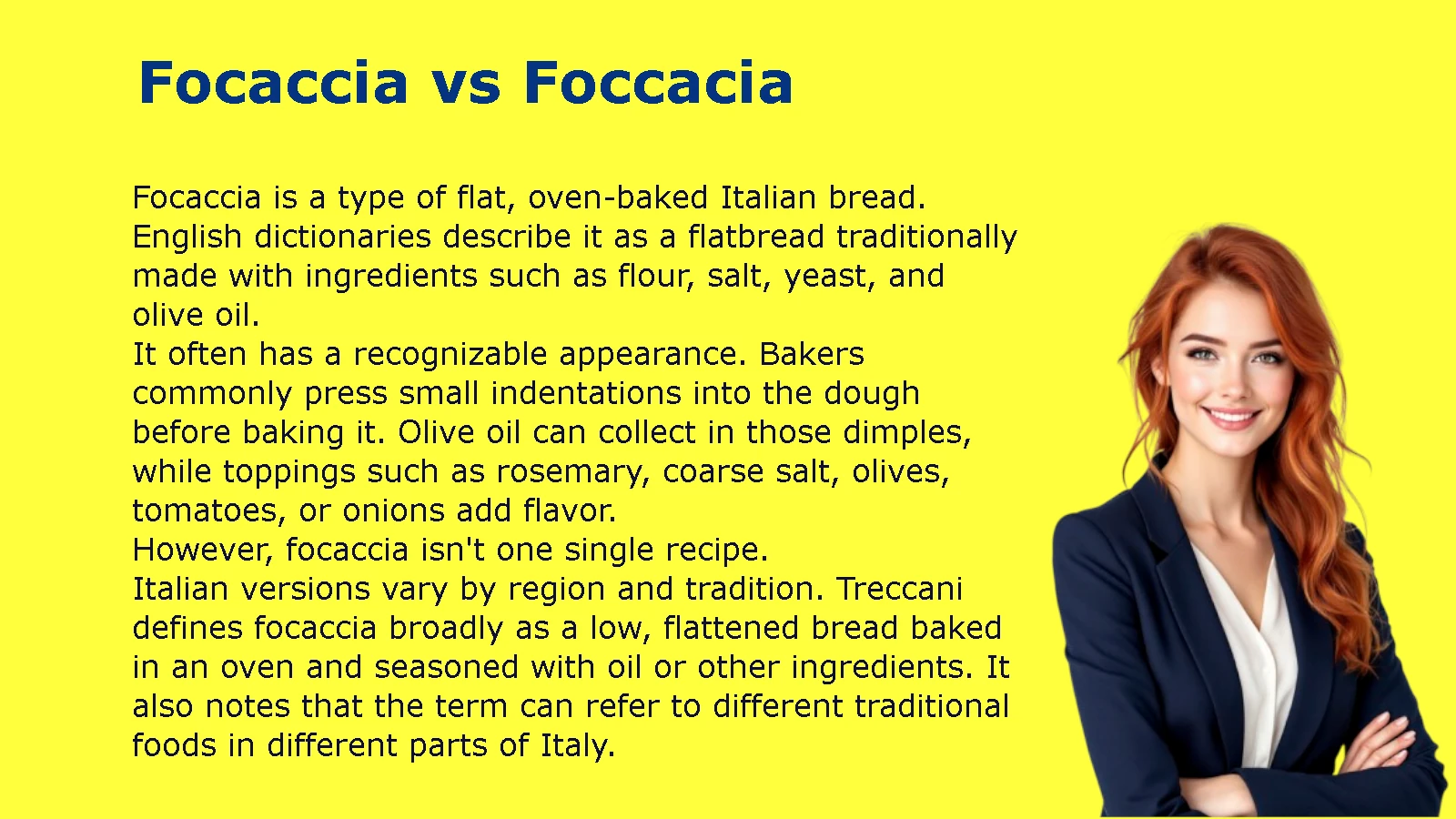
Focaccia is a type of flat, oven-baked Italian bread. English dictionaries describe it as a flatbread traditionally made with ingredients such as flour, salt, yeast, and olive oil.
It often has a recognizable appearance. Bakers commonly press small indentations into the dough before baking it. Olive oil can collect in those dimples, while toppings such as rosemary, coarse salt, olives, tomatoes, or onions add flavor.
However, focaccia isn’t one single recipe.
Italian versions vary by region and tradition. Treccani defines focaccia broadly as a low, flattened bread baked in an oven and seasoned with oil or other ingredients. It also notes that the term can refer to different traditional foods in different parts of Italy.
That regional variety matters because the word describes a broader family of baked foods rather than one rigid recipe.
What makes focaccia different from ordinary bread?
Focaccia generally has a flatter shape and a more prominent relationship with olive oil than a typical loaf of bread. Its surface may be deeply dimpled, and the bread often develops a golden crust while remaining soft inside.
A typical focaccia may include:
- Wheat flour
- Water
- Yeast
- Salt
- Olive oil
- Herbs
- Vegetables or other toppings
Of course, recipes can vary considerably.
Is Focaccia or Foccacia Correct?
Focaccia is correct.
The standard spelling contains eight letters:
F O C A C C I A
The misspelled version foccacia contains an extra c near the beginning:
F O C C A C I A
This isn’t a case like color and colour, where two established spelling forms exist. It also isn’t like theater and theatre, which represent accepted regional variants.
Instead, foccacia is simply a misspelling of focaccia in standard English usage.
Focaccia vs Foccacia spelling
The difference becomes much easier to see when the words sit side by side:
Correct: FOCACCIA
Incorrect: FOCCACIA
The correct version follows this sequence:
FO + CA + CC + IA
Once that pattern becomes familiar, the spelling becomes much easier to reproduce.
Why Is Foccacia Commonly Misspelled?
The spelling foccacia looks believable because the pronunciation doesn’t make every letter obvious.
That’s a common problem with words borrowed from other languages. When you hear a word before you see it written, your brain often tries to construct a spelling based on familiar English patterns.
In this case, someone may remember that the word has a strong k/ch-like consonant sound and several c letters. The result can be an unnecessary extra c.
Another problem comes from the visual structure of the word.
Look at these forms:
- focaccia
- foccacia
They look almost identical. Only one letter separates them.
That makes the error particularly easy to overlook during proofreading.
The double C can cause confusion
The correct spelling already contains cc:
foca + ccia
Someone who remembers that the word has multiple c sounds or letters may place the second c in the wrong position.
However, spelling isn’t determined by how many consonants you hear. The established written form is focaccia.
How Do You Spell Focaccia?
The correct spelling is:
Focaccia
Letter by letter:
F – O – C – A – C – C – I – A
A useful visual breakdown is:
FO | CA | CCIA
The most important part to remember is CCIA at the end.
Don’t write:
FOCC…
Write:
FOCA…
Then continue with:
CCIA
Put together, you get:
FOCACCIA
A simple spelling trick
Think:
FOCA + CCIA = FOCACCIA
The first c comes before the a. The double c comes after it.
That simple distinction helps prevent the most common error.
Common correct expressions
You’ll often see focaccia used in phrases such as:
- focaccia bread
- rosemary focaccia
- garlic focaccia
- olive focaccia
- homemade focaccia
- fresh focaccia
- focaccia sandwich
- focaccia recipe
- Italian focaccia
For example:
We served rosemary focaccia with the soup.
Or:
She baked a fresh tray of focaccia for the weekend.
How Do You Pronounce Focaccia?
The pronunciation varies somewhat between English varieties.
Cambridge gives the US pronunciation as /fəˈkɑːtʃ.i.ə/ and the UK pronunciation as /fəˈkætʃ.ə/.
For American English, the pronunciation can be approximated as:
fuh-KAH-chee-uh
The stress falls on the middle portion.
The Italian pronunciation is represented by Treccani as /fo’katʃ:a/.
Focaccia
fuh-KAH-chee-uh
Give feedback
Why pronunciation can lead to spelling mistakes
When people hear focaccia, they don’t necessarily hear the spelling f-o-c-a-c-c-i-a.
That’s especially true if they’re unfamiliar with Italian spelling patterns.
The c sequence represents sounds that don’t map neatly onto what an English speaker might expect from the letters alone. As a result, someone can pronounce the word correctly while still writing it incorrectly.
That’s why pronunciation and spelling should be learned separately.
Focaccia Meaning and Origin
The word focaccia comes from Italian. Treccani traces it to Late Latin focacia, derived from focus, meaning hearth or fireplace.
That origin fits the traditional idea of a flat bread cooked in or around a hearth.
The history of the word also helps explain why focaccia has a distinctive Italian spelling. It isn’t an English word created from modern English spelling patterns. English adopted the Italian culinary term.
Cambridge likewise identifies focaccia as a flatbread originally from Italy.
What does the name have to do with a hearth?
The connection is fairly direct.
A hearth was historically a central place for cooking with fire. The Latin root focus referred to a hearth or fireplace, and the later word focacia developed from that root.
This etymology gives the word an interesting connection between fire, cooking, and bread.
It also shows why changing the spelling casually isn’t a good idea. The established spelling comes from a long linguistic history rather than an arbitrary arrangement of letters.
Focaccia vs Foccacia in a Sentence
Seeing the word in context makes the spelling difference easier to remember.
Correct examples
Here are natural examples using focaccia:
- We bought fresh focaccia from the bakery.
- The restaurant serves rosemary focaccia with olive oil.
- She made homemade focaccia for dinner.
- The sandwich came on toasted focaccia.
- He topped the focaccia with cherry tomatoes and herbs.
- This recipe produces a soft and airy focaccia.
- We dipped pieces of warm focaccia in olive oil.
- The bakery sells several varieties of focaccia.
Each example uses the standard spelling.
Incorrect examples
These sentences contain the common misspelling:
- ❌ We bought fresh foccacia from the bakery.
- ❌ She made homemade foccacia for dinner.
- ❌ The sandwich came on toasted foccacia.
- ❌ He ordered rosemary foccacia.
The correction is simple:
- ✅ We bought fresh focaccia from the bakery.
- ✅ She made homemade focaccia for dinner.
- ✅ The sandwich came on toasted focaccia.
- ✅ He ordered rosemary focaccia.
A useful editing tip
If you’re proofreading a recipe or food article, search specifically for foccacia.
Because the incorrect version looks so similar to the correct one, ordinary proofreading can miss it. A quick search-and-replace check can catch the error before publication.
Focaccia vs Foccacia: Key Differences
The two forms don’t describe two different foods.
The difference is simply spelling.
| Feature | Focaccia | Foccacia |
| Standard spelling | ✅ Yes | ❌ No |
| Refers to Italian flatbread | Yes | Intended to refer to it |
| Recognized English form | Yes | No |
| Italian spelling | Yes | No |
| Common in recipes | Yes | Usually an error |
| Suitable for formal writing | Yes | No |
| Extra c near the beginning | No | Yes |
The important point is that foccacia doesn’t name a separate variety of bread.
If someone writes foccacia, readers can usually understand what they mean from context. However, understanding an error doesn’t turn it into a correct spelling.
What Is Focaccia Bread?
Focaccia bread is a flat, oven-baked Italian bread commonly made with flour, salt, yeast, and olive oil. Cambridge uses essentially this definition in its English dictionary.
The phrase focaccia bread is common in American English even though focaccia itself already identifies the bread.
It can be served in several ways:
- Alongside soups and salads
- As a sandwich bread
- With olive oil for dipping
- As an appetizer
- With herbs and vegetables baked into the surface
- As a side dish with Italian meals
Its texture can range from relatively thin and crisp to thick and airy depending on the style and recipe.
Why is focaccia often dimpled?
Those familiar little depressions aren’t merely decorative.
Bakers commonly press their fingers into the dough before baking. The indentations create the characteristic uneven surface associated with many styles of focaccia.
They can also hold olive oil and toppings, helping distribute flavor across the bread.
The result is one of the food’s most recognizable features: a golden, oil-rich crust with a soft interior and a visibly dimpled surface.
Focaccia in American English
The word focaccia has become familiar in American food culture.
You’ll find it in restaurant menus, bakery displays, supermarket sections, cookbooks, food blogs, and sandwich descriptions.
Cambridge lists American English pronunciation separately from British English pronunciation and treats focaccia as an established English noun.
That means you don’t need to replace it with a generic phrase such as “Italian flatbread” when writing for an American audience.
Focaccia is already an established word in English.
Where you might encounter the word
You may see focaccia in:
- Bakery menus
- Italian restaurant menus
- Grocery stores
- Sandwich shops
- Cooking websites
- Recipe books
- Food magazines
- Restaurant reviews
- Culinary school materials
- Home-baking discussions
Because the word appears in so many food-related contexts, learning its correct spelling can be useful beyond a single recipe.
Focaccia vs Foccacia: A Simple Spelling Comparison
Here’s the mistake in its simplest form:
FOCACCIA ✅
FOCCACIA ❌
The correct form has:
F O C A C C I A
The incorrect form has:
F O C C A C I A
Notice the key difference:
FOCA → correct beginning
FOCCA → incorrect beginning
The correct spelling doesn’t put two c letters together until after the a.
Visual spelling breakdown
F O C A C C I A
| | | | | | | |
F O C A C C I A
↑
double C
A quick mental check can help:
Foca + ccia = focaccia
Not:
Focca + cia = foccacia
Common Focaccia Spelling Mistakes
Although foccacia is the most obvious mistake, people can make other errors when trying to reproduce the word from memory.
Common problems include:
- Adding an extra c
- Moving the double c
- Omitting one of the c letters
- Replacing part of the ending
- Writing the word based solely on pronunciation
The best solution isn’t to memorize several incorrect forms. Instead, lock in the correct pattern:
FOCACCIA
Once you’ve learned that sequence, the alternatives become much easier to identify as errors.
Focaccia vs Foccacia: Why the Extra C Matters
At first glance, adding one letter might seem trivial. In spelling, however, one letter can change an accepted word into an error.
Consider other familiar examples:
- accommodate, not acommodate
- necessary, not neccessary
- occasion, not ocassion
- embarrass, not embarass
The same principle applies to focaccia.
A misspelled word can still be understandable. However, polished writing aims for the established spelling, especially in professional content, menus, recipes, educational material, and published work.
Focaccia vs Foccacia: How to Remember the Correct Spelling
The easiest strategy is to stop thinking of the word as one long string of letters.
Break it into:
FO | CA | CCIA
Then rebuild it:
FO + CA + CCIA = FOCACCIA
The key is the middle:
CA comes before CC.
That prevents the common mistake of turning the beginning into FOCCA.
Another quick memory trick
Think:
FOCA → CCIA
The first part ends with a single c.
The second part starts with the double c.
So:
FOCA + CCIA
That’s FOCACCIA.
Is Focaccia the Same as Italian Flatbread?
In broad English usage, focaccia refers to an Italian flatbread. Cambridge describes it as a type of flat bread originally from Italy and lists flour, salt, yeast, and olive oil among its typical ingredients.
However, it’s worth avoiding the idea that every Italian flatbread is focaccia.
Italy has many regional breads and flatbreads. Treccani’s definition itself reflects that regional diversity by noting different meanings and preparations associated with focaccia in different parts of Italy.
So Italian flatbread works as a general description, but focaccia identifies a specific culinary category.
Focaccia vs Pizza: Are They the Same?
Focaccia and pizza share some similarities, especially because both can use wheat flour, water, yeast, and olive oil. However, they’re not simply the same food.
Focaccia is generally treated as a bread or flatbread. Pizza typically involves a dough base topped with ingredients and baked as a finished dish.
The distinction becomes especially clear when you look at traditional Italian terminology. Treccani defines pizza as a baked preparation based on dough that is commonly flattened and topped with different ingredients.
Focaccia, by contrast, is defined as a low, flattened bread seasoned with oil or other ingredients.
In other words, the two foods can overlap in technique and ingredients without becoming identical.
Focaccia vs Foccacia: A Real-World Writing Case
Imagine a bakery creating a menu.
The menu lists:
Rosemary Foccacia
Tomato Foccacia
Garlic Foccacia
The meaning is obvious. Customers understand that the bakery sells focaccia.
Still, the spelling is wrong.
A polished menu should use:
Rosemary Focaccia
Tomato Focaccia
Garlic Focaccia
The same principle applies to a food blog. If an article repeatedly uses foccacia, readers may notice the error even if the content itself is accurate.
That matters because spelling affects perceived credibility. When readers see a familiar culinary term written incorrectly several times, they may question the accuracy of the rest of the article.
Focaccia vs Foccacia in Recipes
Recipes provide another common setting where this spelling confusion appears.
For example:
Preheat the oven and prepare the focaccia dough.
That’s correct.
You might also see:
Let the focaccia rise until the dough becomes airy.
Again, correct.
But:
Let the foccacia rise until the dough becomes airy.
That’s the same word with the wrong spelling.
Useful recipe phrases
If you’re writing about this bread, these combinations are standard and natural:
- focaccia dough
- focaccia recipe
- focaccia bread
- focaccia toppings
- focaccia sandwich
- homemade focaccia
- fresh focaccia
- Italian focaccia
- rosemary focaccia
- garlic focaccia
The spelling remains focaccia in each phrase.
Frequently Asked Questions About Focaccia vs Foccacia
Is focaccia spelled with one C or two Cs?
Focaccia contains two consecutive Cs in the latter part of the word.
The correct spelling is:
F-O-C-A-C-C-I-A
So while the word contains several c letters overall, the double c appears after the a.
Is foccacia a correct spelling?
No. Foccacia is a misspelling of focaccia.
The standard spelling is focaccia.
What is the difference between focaccia and foccacia?
There is no difference in the food they are intended to describe.
Focaccia is the correct spelling. Foccacia adds an unnecessary c near the beginning of the word.
How do you spell focaccia bread?
The correct spelling is:
Focaccia bread
Not:
Foccacia bread
What does focaccia mean?
Focaccia is an Italian flatbread. English dictionaries describe it as a type of flat bread traditionally made with ingredients such as flour, salt, yeast, and olive oil.
How do you pronounce focaccia?
In US English, Cambridge gives the pronunciation /fəˈkɑːtʃ.i.ə/.
A simple approximation is fuh-KAH-chee-uh.
Why do people spell focaccia as foccacia?
The most likely reason is simple spelling confusion. The word already contains a double c, and its pronunciation doesn’t make the written sequence immediately obvious to everyone.
As a result, writers may accidentally move or add a c.
Is focaccia an English word?
Yes. Focaccia is an established English noun used to describe the Italian flatbread. Cambridge includes it in its English dictionary.
The word originally comes from Italian, so its spelling retains its Italian form.
Is focaccia always made with olive oil?
Olive oil is strongly associated with traditional focaccia, and Cambridge includes olive oil among the typical ingredients in its definition.
However, recipes and regional styles can vary. Focaccia isn’t limited to one universal ingredient list.
Does focaccia have to be flat?
Focaccia is generally characterized as a low, flattened bread, although thickness can vary considerably among recipes and regional styles. Treccani describes it as a low and flattened bread baked in an oven.
Is foccacia another type of Italian bread?
No. Foccacia isn’t a separate standard type of Italian bread. In normal English usage, it is simply a misspelling of focaccia.
Final Verdict: Focaccia or Foccacia?
When choosing between focaccia vs foccacia, there’s a clear winner.
Correct: Focaccia
Incorrect: Foccacia
The correct spelling is:
F-O-C-A-C-C-I-A
The word refers to an Italian flatbread traditionally associated with flour, salt, yeast, and olive oil. Its name comes through Italian from Late Latin focacia, which Treccani connects to Latin focus, meaning hearth or fireplace.
The easiest way to remember the spelling is:
FO + CA + CCIA = FOCACCIA
So the next time you write a recipe, order a sandwich, describe a bakery item, or publish an article about Italian bread, use focaccia.
Foccacia may look close, but it isn’t the standard spelling.