The fulfill vs. fullfill distinction is simple: fulfill is the standard American English spelling, with one l after the prefix ful and a double l at the end. In contrast, fullfill is incorrect in standard English. Related forms include fulfills, fulfilled, fulfilling, fulfillment, and fulfillment of a promise, which follow their own spelling patterns.
Fulfill is the correct spelling, while fullfill is a common misspelling. The word fulfill means to complete a task, meet a requirement, satisfy a need, or carry out a promise. If you’ve come across the words “fulfill” and “fullfill” and wondered which one to use, the correct choice is closely connected to spelling rules, word meanings, grammar, writing, obligations, promises, and responsibilities.
In this guide, you’ll learn whether “fulfill” or “fullfill” is correct, what the word means, how to use it in sentences, and why people often misspell it. You’ll also see clear examples and comparisons to help you distinguish the correct spelling from the incorrect one.
By the end, you’ll know exactly how to spell “fulfill” correctly and how to use it naturally and confidently in your writing.
Fulfill vs Fullfill at a Glance
Fulfill is the correct American English spelling, while fullfill is a misspelling. Both forms may look plausible at first glance, but only fulfill follows the standard spelling. British English commonly uses fulfil, which has one fewer L than the American form.
| Spelling | Correct? | Explanation | Example |
| Fulfill | Yes | Standard American English spelling | We must fulfill the contract. |
| Fullfill | No | Contains an extra L | Incorrect: We must fullfill the contract. |
| Fulfil | Yes, in British English | Standard British spelling | She hopes to fulfil her ambition. |
| Fulfilled | Yes | Past tense and past participle | They fulfilled their promise. |
| Fulfilling | Yes | The -ing form of fulfill | Teaching can be a fulfilling career. |
| Fulfillment | Yes, in American English | Noun describing satisfaction or completion | The work gave him a sense of fulfillment. |
| Fulfilment | Yes, in British English | British spelling of the noun | The role brought her personal fulfilment. |
The main rule is straightforward: use fulfill when writing in American English, use fulfil when following standard British spelling, and avoid fullfill in either variety.
Fulfill: The Correct Spelling
Fulfill is a verb that means to carry out a promise, meet a requirement, perform a duty, or achieve something desired. It can also describe satisfying a need or making an expectation a reality. The word appears in personal conversations, formal writing, education, business, and customer service.
For example:
- The company must fulfill its obligations to customers.
- She worked hard to fulfill her dream of becoming a journalist.
- Every applicant must fulfill the admission requirements.
- He wanted to fulfill the promise he had made to his grandfather.
- The new position helped her fulfill her professional ambitions.
In each sentence, fulfill describes making something happen or meeting an existing expectation.
What Does Fulfill Mean?
The meaning of fulfill depends on what follows it. It commonly refers to meeting an obligation, carrying out a commitment, achieving a goal, or satisfying a need.
Here are its main uses.
To carry out a promise or commitment
When you fulfill a promise, you do what you said you would do.
Example: Daniel fulfilled his promise to help his neighbor repair the fence.
To meet a requirement or condition
When you fulfill a requirement, you satisfy a condition that must be met.
Example: The candidate fulfilled every requirement listed in the job advertisement.
To achieve a goal or ambition
When you fulfill an ambition, you turn a long-term desire into reality.
Example: After years of training, Nadia fulfilled her ambition of opening a dance studio.
To satisfy a need or expectation
When something fulfills a need, it provides what someone wants or requires.
Example: The redesigned website fulfills the need for a simpler online ordering process.
To perform a duty or responsibility
When you fulfill a responsibility, you carry out the task or obligation expected of you.
Example: The project manager fulfilled her responsibilities by delivering the report before the deadline.
These meanings share one central idea: fulfill involves meeting an obligation, expectation, need, or desired outcome.
Fulfill in Example Sentences
The following original sentences show how fulfill works in different situations.
| Context | Example sentence | Meaning |
| Personal goals | I saved money for years to fulfill my dream of traveling across Japan. | Achieve an ambition |
| Business | The supplier must fulfill the order by Friday. | Complete an obligation |
| Education | Students must fulfill the attendance requirement to pass the course. | Meet a condition |
| Family | She fulfilled her promise to visit her aunt every weekend. | Keep a commitment |
| Employment | The employee fulfilled all the duties assigned to him. | Perform responsibilities |
| Customer service | We will fulfill your request as soon as possible. | Carry out a request |
| Personal satisfaction | Volunteering at the shelter helped him fulfill his desire to serve the community. | Satisfy a personal desire |
Notice that fulfill often appears before a noun, such as promise, requirement, dream, request, or responsibility. These combinations make the intended meaning clear.
Fullfill: Is This Spelling Correct?
Fullfill is incorrect in both American and British English. The word contains three Ls, while the American spelling fulfill contains two. The British form fulfil contains one. Adding an extra L does not create a recognized alternative spelling.
You may encounter fullfill in online comments, hurried messages, schoolwork, or unedited documents. Its appearance in published or user-generated writing does not make it correct.
Consider these examples:
- Incorrect: The manager promised to fullfill every request.
- Correct: The manager promised to fulfill every request.
- Incorrect: He hopes to fullfill his lifelong ambition.
- Correct: He hopes to fulfill his lifelong ambition.
- Incorrect: The business failed to fullfill the customer’s order.
- Correct: The business failed to fulfill the customer’s order.
The correction is simple: remove the extra L and write fulfill in American English.
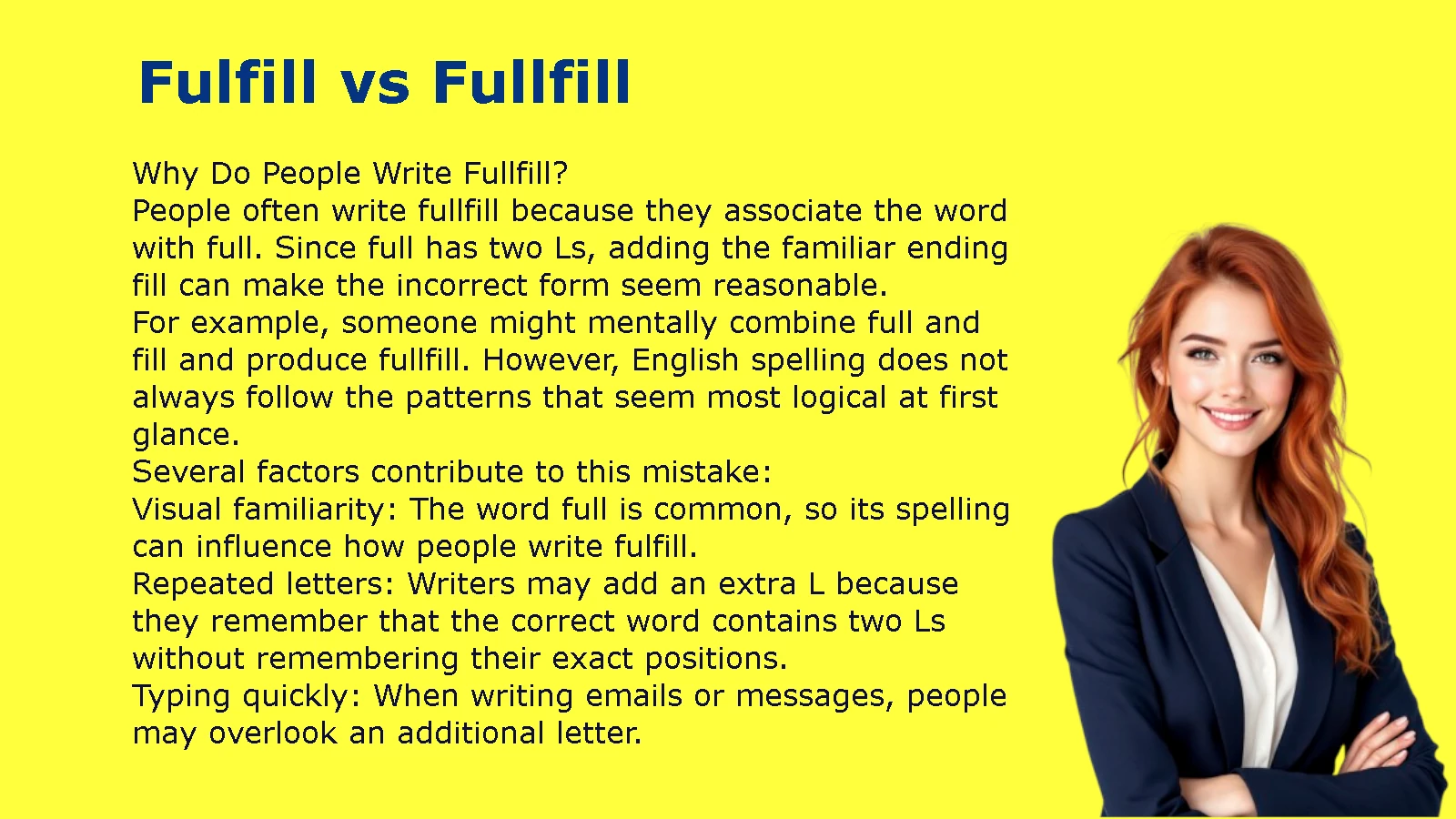
Why Do People Write Fullfill?
People often write fullfill because they associate the word with full. Since full has two Ls, adding the familiar ending fill can make the incorrect form seem reasonable.
For example, someone might mentally combine full and fill and produce fullfill. However, English spelling does not always follow the patterns that seem most logical at first glance.
Several factors contribute to this mistake:
- Visual familiarity: The word full is common, so its spelling can influence how people write fulfill.
- Repeated letters: Writers may add an extra L because they remember that the correct word contains two Ls without remembering their exact positions.
- Typing quickly: When writing emails or messages, people may overlook an additional letter.
- Unfamiliar word structure: Some writers may not have seen the word often enough to recognize its standard spelling immediately.
The best solution is to memorize the complete word rather than reconstructing it from full.
Fullfill vs Fulfill: Correct and Incorrect Examples
Compare the following pairs to recognize the mistake quickly.
| Incorrect sentence | Correct sentence |
| We need to fullfill the agreement. | We need to fulfill the agreement. |
| She hopes to fullfill her ambitions. | She hopes to fulfill her ambitions. |
| The company fullfilled the order yesterday. | The company fulfilled the order yesterday. |
| He is fullfilling his duties. | He is fulfilling his duties. |
| The work provides a sense of fullfillment. | The work provides a sense of fulfillment. |
The error can affect more than the base verb. When you add grammatical endings, you must preserve the correct spelling of the word.
Use fulfilled, fulfilling, and fulfillment in American English, not fullfilled, fullfilling, or fullfillment.
Why Is Fulfill Spelled With Two L’s?
The American English spelling fulfill contains two Ls because that is the established spelling of the word. It is not formed by simply adding a suffix to the adjective full. Its spelling reflects the word’s historical development and the conventions of modern English.
The difference becomes easier to understand when you look at the complete letter sequence:
F-U-L-F-I-L-L
The first L appears after fu, and the second L appears at the end. There is no third L between the first and second parts of the word.
The Word’s Origin and Spelling
Fulfill developed from older English forms related to the idea of completing, carrying out, or bringing something to completion. Its history is connected to older Germanic word forms that expressed the idea of filling or completing something fully.
The modern American spelling preserves the double-L form. British English uses the shorter spelling fulfil.
For everyday writing, you do not need to reconstruct the word’s historical development to spell it correctly. The useful distinction is between the established modern forms:
- American English: fulfill
- British English: fulfil
- Incorrect in both: fullfill
The spelling difference is a convention, not a difference in the word’s basic meaning.
Why Fulfill Has Double L but Fullfill Is Wrong
The easiest way to understand the difference is to count the letters rather than focus on how the words look as a whole.
In American English, fulfill has six letters:
- F
- U
- L
- F
- I
- L
- L
In fact, fulfill has seven letters, including two Ls. The spelling can be remembered as FUL + FILL, with the first part contributing one L and the second part contributing two Ls in the visual pattern. The important point is that the correct complete spelling contains two Ls in total, not three.
Fullfill adds an unnecessary L after the first two letters, producing an incorrect three-L sequence.
A practical proofreading method is to compare the two forms directly:
- Correct: fulfill
- Incorrect: fullfill
If you see two consecutive Ls immediately after fu, check the word carefully. That pattern signals the common misspelling.
Fulfill vs Fullfill Examples
Examples are often more useful than memorizing a spelling rule in isolation. The following situations show how to correct fullfill in everyday writing, school assignments, and professional communication.
| Situation | Incorrect usage | Correct usage |
| Promise | I will fullfill my promise to you. | I will fulfill my promise to you. |
| Work | The team must fullfill its duties. | The team must fulfill its duties. |
| School | Students must fullfill the course requirements. | Students must fulfill the course requirements. |
| Shopping | The seller will fullfill the order tomorrow. | The seller will fulfill the order tomorrow. |
| Career | She hopes to fullfill her professional goals. | She hopes to fulfill her professional goals. |
| Contract | Both parties must fullfill the agreement. | Both parties must fulfill the agreement. |
| Personal growth | The experience helped him fullfill his potential. | The experience helped him fulfill his potential. |
| Customer service | We aim to fullfill every valid request. | We aim to fulfill every valid request. |
Case Study: A School Assignment
Imagine a student writing the following sentence in an English assignment:
“Every student should fullfill the requirements before submitting the final project.”
The sentence communicates the intended idea, but the spelling is incorrect. The corrected version reads:
“Every student should fulfill the requirements before submitting the final project.”
The correction changes only one word. The grammar and meaning remain the same.
Lesson: A word can be used correctly in context but still contain a spelling error. Always check the spelling separately from grammar and sentence meaning.
Case Study: A Business Email
Suppose a customer-service representative writes:
“We are working hard to fullfill your request and deliver the replacement item by Thursday.”
The representative’s message is clear, but the misspelling can make the email look less polished. A corrected version would be:
“We are working hard to fulfill your request and deliver the replacement item by Thursday.”
This small edit helps maintain a professional standard, particularly in communication with customers, suppliers, and business partners.
Lesson: In professional writing, correct spelling supports clarity and credibility. It is especially important in customer-facing messages, contracts, proposals, and formal reports.
How to Remember the Spelling of Fulfill
The simplest way to remember the American spelling is to memorize fulfill as a complete word. Avoid building it from the word full, which can lead you to add an extra L.
Use these techniques to reinforce the correct spelling.
Remember the Two L’s
The word fulfill contains two Ls in total. One comes before the second F, and the other appears at the end.
Write it slowly once:
F-U-L-F-I-L-L
Then compare it with the incorrect form:
F-U-L-L-F-I-L-L
The incorrect version has an extra L before the second F.
You can also use this quick reminder:
Fulfill has two Ls; fullfill has one L too many.
This trick focuses on the exact difference instead of relying on a vague memory of the word’s appearance.
Connect Fulfill With Fulfillment
Learning related forms helps reinforce the base spelling. In American English, the common word family includes:
| Word | Part of speech | Example |
| Fulfill | Verb | We must fulfill the agreement. |
| Fulfills | Verb, third-person singular | She fulfills her responsibilities. |
| Fulfilled | Past tense or past participle | They fulfilled the contract. |
| Fulfilling | Present participle or adjective | He finds the work fulfilling. |
| Fulfillment | Noun | The achievement gave her a sense of fulfillment. |
These words share the same basic spelling pattern. Learning them together can make it easier to recognize and correct mistakes.
Remember that adding endings may change the form of the word. For example, fulfill becomes fulfilled by doubling the final L before adding -ed. The result is still spelled with two Ls in total? No. Fulfilled contains three Ls: one before the F and two at the end. This is correct because the base word already has a final double L, and the spelling retains that sequence when adding the ending.
Likewise, fulfilling contains three Ls, while fulfillment contains three Ls. Do not apply the two-L count for the base verb to every related word.
Fulfill in Different Contexts
The verb fulfill can describe many kinds of commitments and achievements. Its meaning becomes more precise when you consider the noun or phrase that follows it.
Fulfill a Promise
To fulfill a promise means to do what you said you would do. The phrase emphasizes trust and commitment.
Examples:
- Maya fulfilled her promise to teach her younger brother how to swim.
- The company fulfilled its promise to replace the damaged equipment.
- He finally fulfilled a promise he had made to his childhood friend.
Use this phrase when the focus is on keeping one’s word.
Fulfill a Requirement
To fulfill a requirement means to meet a stated condition, rule, or qualification.
Examples:
- Applicants must fulfill the experience requirements before applying.
- The building fulfills the safety requirements for the new facility.
- She completed two additional courses to fulfill her graduation requirements.
In formal writing, meet a requirement is also common. Fulfill often emphasizes satisfying the condition as part of a larger obligation.
Fulfill a Responsibility
To fulfill a responsibility means to carry out a duty or obligation.
Examples:
- The supervisor fulfilled her responsibility by reporting the equipment failure.
- Parents and teachers can work together to fulfill their responsibilities toward students.
- Each team member must fulfill the duties assigned to the role.
This usage appears frequently in workplace communication, education, family discussions, and formal writing.
Fulfill a Dream or Ambition
To fulfill a dream or ambition means to achieve something a person has wanted for a long time.
Examples:
- Opening a neighborhood bakery helped Luis fulfill his dream.
- She fulfilled her ambition of publishing a collection of short stories.
- The scholarship gave him an opportunity to fulfill his goal of studying engineering.
This meaning often has an emotional dimension. It suggests that achieving the goal matters personally, not merely that a task has been completed.
Fulfill vs Fulfillment vs Fulfilling
Although these words share the same root, they perform different grammatical roles. Choosing the correct form depends on how you use it in a sentence.
| Word | Grammatical role | Meaning | Example |
| Fulfill | Verb | Carry out, achieve, or meet | We will fulfill the agreement. |
| Fulfillment | Noun | The act of completing something or a feeling of satisfaction | The work gave him fulfillment. |
| Fulfilling | Present participle or adjective | Currently carrying out an action, or providing satisfaction | She finds teaching fulfilling. |
| Fulfilled | Past tense, past participle, or adjective | Completed an obligation or achieved satisfaction | They fulfilled their promise. |
When to Use Fulfill
Use fulfill when the sentence needs an action word.
- The supplier must fulfill the order.
- She hopes to fulfill her ambitions.
- We fulfilled the conditions of the agreement.
When to Use Fulfillment
Use fulfillment when referring to the act of meeting an obligation or the satisfaction that comes from achieving something.
- The fulfillment of the contract took three months.
- He found fulfillment in helping young athletes.
- The warehouse handles order fulfillment for the online store.
In business, order fulfillment has a specific practical meaning: the process of receiving, preparing, packing, and delivering customer orders.
When to Use Fulfilling
Use fulfilling as a verb form or an adjective.
- The organization is fulfilling its commitment to local families.
- She has a fulfilling career in environmental research.
In the first sentence, fulfilling describes an ongoing action. In the second, it describes a career that provides satisfaction.
Fulfill vs Other Related Words
Fulfill overlaps with several common verbs, but these words are not always interchangeable. Understanding their differences helps you choose a more precise expression.
Fulfill vs Complete
Fulfill often means meeting an obligation, expectation, or need. Complete usually means finishing a task, activity, or process.
Compare:
- The contractor fulfilled the terms of the agreement.
- The contractor completed the renovation.
The first sentence focuses on meeting agreed conditions. The second focuses on finishing the work.
However, the words sometimes overlap. You might say that a person completed a requirement or fulfilled a requirement. Both can be correct, depending on the emphasis.
Fulfill vs Accomplish
Fulfill often emphasizes satisfying a duty, expectation, or ambition. Accomplish emphasizes successfully achieving a task or objective.
Examples:
- She fulfilled her responsibility to train the new employees.
- She accomplished her goal of increasing sales by 15 percent.
The first sentence focuses on a responsibility. The second highlights a measurable achievement.
For personal goals, either verb may work, but fulfill a dream is a particularly natural expression when the goal has personal meaning.
Fulfill vs Satisfy
Fulfill and satisfy can both describe meeting a condition or expectation. However, satisfy often emphasizes meeting a standard, need, or demand, while fulfill can emphasize carrying out an obligation or making an expectation a reality.
Examples:
- The candidate fulfilled the requirements for the position.
- The candidate satisfied the interview panel’s expectations.
You can also say that a product fulfills a need or satisfies a need. The best choice depends on the sentence and the emphasis you want to create.
Fulfill in American and British English
The spelling of fulfill differs between American and British English. Both varieties are standard, so the right choice depends on your audience and the style of English you are using.
| Word form | American English | British English |
| Base verb | Fulfill | Fulfil |
| Third-person singular | Fulfills | Fulfils |
| Past tense | Fulfilled | Fulfilled |
| Present participle | Fulfilling | Fulfilling |
| Noun | Fulfillment | Fulfilment |
The base verb and noun show the most visible differences. American English uses fulfill and fulfillment, while British English commonly uses fulfil and fulfilment.
The past-tense and -ing forms retain the doubled final consonant in both varieties.
For example:
- American: The team will fulfill its obligations.
- British: The team will fulfil its obligations.
- American: She found fulfillment in her new role.
- British: She found fulfilment in her new role.
Neither variety uses fullfill as the standard spelling.
If you’re writing for an American audience, use fulfill consistently. If you’re writing for a British audience, fulfil is generally the preferred base form. Consistency matters more than mixing conventions.
Common Misspellings of Fulfill
The base word is not the only form that writers misspell. Related words can also cause confusion, especially when people add endings or apply American and British conventions inconsistently.
| Incorrect spelling | Correct American English | Correct British English |
| Fullfill | Fulfill | Fulfil |
| Fullfilled | Fulfilled | Fulfilled |
| Fullfilling | Fulfilling | Fulfilling |
| Fullfillment | Fulfillment | Fulfilment |
| Fulfiled | Fulfilled | Fulfilled |
| Fulfilement | Fulfillment | Fulfilment |
A useful distinction: fulfil is not a misspelling in itself. It is the standard British English form. It may be unsuitable in an American English document, but that does not make it incorrect in British usage.
How to Check Your Spelling
Before submitting an assignment, sending an important email, or publishing an article, use this quick checklist:
- Check whether you’re using American or British English.
- Confirm that the base verb is fulfill or fulfil, depending on your chosen variety.
- Remove the extra L if you’ve written fullfill.
- Check related forms such as fulfilled, fulfilling, and fulfillment.
- Read the complete sentence to make sure the word fits the intended meaning.
- Use your document’s spell-checking tool, but review its language setting first.
Spell-checkers may accept both American and British variants when configured for multiple English varieties. They may also miss a spelling error if the incorrect form appears in a custom dictionary. A quick manual check remains useful.
Frequently Asked Questions
Is it fulfill or fullfill?
Fulfill is correct in American English. Fullfill is incorrect because it contains an extra L. British English commonly uses fulfil. Choose the form that matches your audience and use it consistently.
Why does fulfill have two L’s?
The American spelling fulfill has two Ls as part of its established word form. It is not spelled by simply combining full with fill. Remember the complete spelling rather than adding letters based on the familiar word full.
Is fulfill correct in American English?
Yes. Fulfill is the standard American English spelling. The related American noun is fulfillment, and the common verb forms include fulfills, fulfilled, and fulfilling.
Is fulfil correct in British English?
Yes. Fulfil is the standard British English base form. Its noun form is generally fulfilment. Both fulfilled and fulfilling are standard forms in British and American English.
Is fullfill ever correct?
Fullfill is not a standard spelling in American or British English. If you mean carrying out a promise, meeting a requirement, or achieving a goal, use fulfill in American English or fulfil in British English.
How do you spell fulfilled?
The correct spelling is fulfilled in both American and British English. It is the past-tense and past-participle form of fulfill or fulfil. For example: “The team fulfilled every condition in the agreement.”
Is it fulfillment or fulfilment?
Both are correct, but they belong to different spelling conventions. Fulfillment is standard in American English, while fulfilment is standard in British English. Use the form that matches the rest of your document.
What is the difference between fulfill and fulfil?
The difference is regional spelling, not meaning. Fulfill is standard in American English, while fulfil is standard in British English. Both verbs can mean to carry out a promise, meet a requirement, or achieve an ambition.
How do you use fulfill in a sentence?
Use fulfill when describing an action that meets an obligation, requirement, or goal.
Examples:
- The company must fulfill its agreement with the supplier.
- He worked hard to fulfill his ambition.
- The student fulfilled all the graduation requirements.
Does fulfill have two or three L’s?
The base form fulfill has two Ls. However, related forms such as fulfilled, fulfilling, and fulfillment have three Ls because the final double-L spelling is retained when the relevant ending is added.
Is fullfill a typo or an alternative spelling?
It is a misspelling, not an accepted alternative spelling. The correct American form is fulfill, and the standard British form is fulfil. Avoid fullfill in formal and informal writing.
Final Answer: Fulfill or Fullfill?
The correct spelling is fulfill in American English. Fullfill is incorrect because it contains an extra L. In British English, the standard form is fulfil.
Remember these three points:
- Write fulfill for American English.
- Write fulfil for British English.
- Never use fullfill as the standard spelling.
If you’re unsure, check the word family as well: fulfills, fulfilled, fulfilling, and fulfillment are standard American forms.
Use the correct spelling in your next email, assignment, or article. Once you remember the difference between fulfill and fullfill, this common spelling mistake becomes much easier to avoid.