The desperate vs. desparate distinction is simple: desperate is the standard English spelling, while desparate is a misspelling. You can use desperate to describe someone who urgently wants a job, a person who needs help, or a situation in which someone feels they have very few options. Related words include urgently, hopeless, distressed, frantic, and determined, although each has a slightly different meaning.
The correct spelling is desperate, not desparate. The word describes someone who feels an urgent need for something or is willing to take extreme measures because of fear, difficulty, or a lack of hope. If you’ve come across the words “desperate” and “desparate” and wondered which spelling is correct, the confusion often comes from how the word sounds when spoken quickly. The term is commonly used in contexts involving urgency, strong emotions, difficult situations, relationships, survival, and the need for immediate help.
In this guide, you’ll learn why “desperate” is correct, why “desparate” is incorrect, how to remember the right spelling, and how to use “desperate” in sentences. You’ll also see common spelling mistakes, practical examples, and related words to help you understand the difference.
By the end, you’ll know exactly how to spell desperate and how to use it naturally and correctly in everyday writing.
Desperate vs Desparate at a Glance
Desperate is the standard English spelling. Desparate is incorrect and should not appear in formal or informal writing when you intend to use the word desperate. Both forms may look plausible to an unsure writer, but only one is accepted as the correct spelling.
| Feature | Desperate | Desparate |
| Spelling status | Correct | Incorrect |
| Meaning | Feeling an extreme need or urgency | No standard English meaning |
| Part of speech | Adjective | Misspelling |
| Example | She was desperate for a job. | She was desparate for a job. |
| Appropriate in formal writing | Yes | No |
The easiest way to remember the difference is to focus on the letters E-R in the middle of desperate. When you write the word, check that you have included the correct vowel before the r.
Quick answer: If you are choosing between desperate and desparate, always use desperate.
Desperate: The Correct Spelling
The word desperate describes someone who feels an extreme need for something or believes that a situation has become so serious that ordinary solutions may not be enough. It can also describe a situation involving danger, urgency, or little hope of success.
For example, a person who has applied for dozens of jobs without receiving an offer might feel desperate for work. Similarly, a family facing an urgent financial problem might desperately need assistance.
The word can express a powerful emotion, a pressing need, or a serious condition. Its exact meaning depends on the sentence.
What Does Desperate Mean?
Desperate means experiencing an extreme need, urgency, or loss of hope that may lead someone to take unusual or risky action. It commonly describes people who urgently want help, money, attention, or success. It can also describe dangerous situations in which someone must act quickly to avoid a serious outcome.
Consider these examples:
- Extreme need: After months without work, Daniel was desperate for a job.
- Urgency: The rescue team made a desperate attempt to reach the stranded hikers.
- Loss of hope: She felt desperate after every available solution failed.
- Strong desire: He was desperate to prove that he could manage the project.
- Serious circumstances: The family faced a desperate situation when their home was damaged by the storm.
Although the word often suggests distress, it does not always describe a person who has completely lost hope. Someone can be desperate to win a competition, for example, because they want the outcome very badly.
The word also carries a stronger emotional meaning than ordinary expressions such as want or need. Saying “I need a new phone” usually expresses a practical requirement. Saying “I am desperate for a phone” suggests a much stronger need or urgency.
Desperate in a Sentence
The following original examples show how desperate works in different situations.
| Context | Example sentence | Meaning |
| Employment | Maya was desperate to find work before her savings ran out. | She urgently needed a job. |
| Money | The shop owner was desperate for funds to pay the rent. | The owner faced serious financial pressure. |
| Relationships | He was desperate to repair his friendship with Omar. | He strongly wanted to restore the relationship. |
| Education | The student made a desperate attempt to finish the assignment before class. | The student tried urgently under pressure. |
| Safety | The climber made a desperate call for help. | The climber urgently needed assistance. |
| Competition | The team was desperate for a win after three consecutive defeats. | The team strongly wanted to win. |
| Family | Her parents were desperate to hear that she had arrived safely. | They were extremely anxious for news. |
Notice that desperate usually appears before a noun or after a linking verb such as be, feel, or seem.
Examples include:
- A desperate request
- A desperate measure
- She feels desperate.
- They were desperate for answers.
It can also appear in the construction desperate to + verb, as in “He was desperate to leave the crowded room.”
Desparate: Is This Spelling Correct?
Desparate is not the correct spelling of the standard English word. Writers sometimes use it when they intend to write desperate, but the extra or substituted vowel makes the word incorrect. In edited writing, replace desparate with desperate.
For example:
Incorrect: The company was desparate to attract new customers.
Correct: The company was desperate to attract new customers.
The correction does not change the intended meaning. It simply restores the standard spelling.
Why Do People Misspell Desperate as Desparate?
People often misspell desperate because they remember how the word sounds without remembering its exact letter sequence. English spelling does not always provide an obvious clue to the correct vowel, especially when an unstressed syllable receives little emphasis in ordinary speech.
Several factors can contribute to this error.
Pronunciation and spelling do not always match perfectly. When people hear a word repeatedly, they may form an approximate mental spelling based on its sound. That approach works for some words but fails with others.
Writers may rely on visual guesses. Someone who has not memorized the spelling might assume that desparate looks right, especially when writing quickly.
Typing errors can go unnoticed. A writer may accidentally replace an e with an a and continue writing without reviewing the word.
Autocorrect may not catch every mistake. A spelling checker may flag desparate, but a writer should not depend on software alone. Some errors remain unnoticed, particularly when the writer ignores spelling suggestions or uses an unreliable checking tool.
To avoid the mistake, do not try to spell the word from sound alone. Learn the sequence D-E-S-P-E-R-A-T-E and check it whenever you are unsure.
Why Is Desperate Spelled With an E?
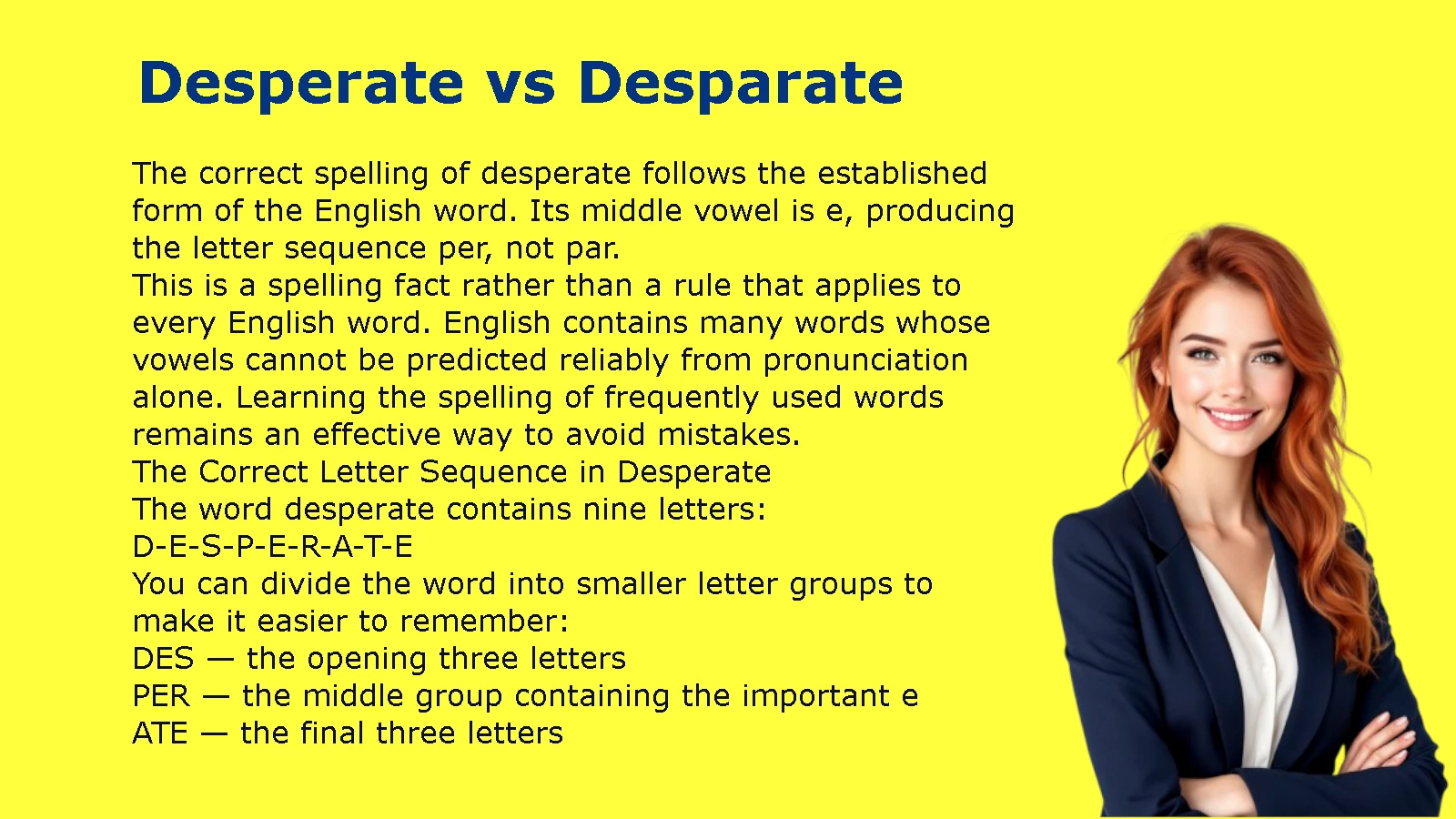
The correct spelling of desperate follows the established form of the English word. Its middle vowel is e, producing the letter sequence per, not par.
This is a spelling fact rather than a rule that applies to every English word. English contains many words whose vowels cannot be predicted reliably from pronunciation alone. Learning the spelling of frequently used words remains an effective way to avoid mistakes.
The Correct Letter Sequence in Desperate
The word desperate contains nine letters:
D-E-S-P-E-R-A-T-E
You can divide the word into smaller letter groups to make it easier to remember:
- DES — the opening three letters
- PER — the middle group containing the important e
- ATE — the final three letters
These groups are a spelling aid, not a claim that the word has three separate meaningful parts.
The most important comparison is:
- Correct: desperate
- Incorrect: desparate
When proofreading, pay special attention to the letter immediately before r. If you see an a in that position, check whether you intended to write desperate.
The Origin of the Word Desperate
The word desperate developed through French from Latin desperatus, the past participle of desperare, meaning “to despair” or “to give up hope.” The Latin verb combines de- with sperare, meaning “to hope.”
This origin helps explain why the modern word is associated with hopelessness, extreme need, and urgent action.
Over time, English usage expanded beyond the idea of having no hope. Today, people also use desperate to describe an intense desire or a situation that demands immediate action.
For example, “She was desperate to succeed” emphasizes a powerful desire, while “They took desperate measures” suggests that the circumstances were serious enough to justify unusual action.
Understanding this development can help you connect the word’s meaning to its modern uses. However, its historical origin does not provide a shortcut for predicting the spelling. You still need to remember the correct form: desperate.
Desperate vs Desparate Examples
Comparing incorrect and correct sentences is one of the most practical ways to learn the spelling. The examples below show how a single letter can make a sentence look unpolished even when the intended meaning remains clear.
| Incorrect sentence | Correct sentence |
| Liam was desparate for a second chance. | Liam was desperate for a second chance. |
| The family was desparate for help. | The family was desperate for help. |
| She made a desparate attempt to save the project. | She made a desperate attempt to save the project. |
| The business became desparate for new customers. | The business became desperate for new customers. |
| I am desparate to know what happened. | I am desperate to know what happened. |
| They were desparate to avoid losing the contract. | They were desperate to avoid losing the contract. |
A School Assignment Example
Imagine that a student writes the following sentence in an English assignment:
“The character became desparate when he realized that he had lost his only chance to escape.”
The meaning is understandable, but the spelling is incorrect. The teacher or proofreading software may mark the word as an error.
The corrected version reads:
“The character became desperate when he realized that he had lost his only chance to escape.”
The correction preserves the sentence’s meaning and improves its accuracy.
Lesson: When using desperate in essays, reports, or examinations, remember that a familiar word can still contain a spelling mistake. Review the exact letters instead of relying on how the word looks at first glance.
A Business Sentence Example
Consider a business owner preparing an email to a supplier:
“We are desparate to receive the replacement parts before Friday.”
The sentence communicates urgency, but the misspelling can make the message appear less carefully prepared.
A corrected version is:
“We are desperate to receive the replacement parts before Friday.”
Depending on the business relationship, a more measured alternative might be “We urgently need the replacement parts before Friday.” This wording communicates the deadline without the strong emotional tone that desperate can carry.
The best choice depends on the intended message. The spelling, however, does not change: desperate is correct.
How to Remember the Spelling of Desperate
You do not need a complicated spelling rule to remember desperate. A short letter pattern, repeated practice, and a quick proofreading habit can make the correct form easier to recall.
Remember the E Before R
Focus on the middle of the word:
DESP-E-RATE
The e before r is the letter that distinguishes the correct spelling from desparate.
When you write the word, mentally check the sequence PER. This method works particularly well if you tend to replace the vowel with an a.
For example:
- Desperate for answers
- Desperate for a job
- Desperate to succeed
The more often you recognize the correct form in meaningful sentences, the easier it becomes to remember.
Break Desperate Into Smaller Parts
Instead of trying to recall all nine letters at once, practice writing the word in three groups:
DES + PER + ATE
Then join the groups together:
DESPERATE
Write the complete word a few times while looking at the correct spelling. Next, cover it and try to reproduce it from memory. Check your result, paying special attention to the second e.
This exercise is more useful than copying the word repeatedly without checking whether you remember its structure.
Practice With a Memory Sentence
Try this simple reminder:
“Desperate needs an E before R.”
The sentence points directly to the spelling feature that causes confusion.
You can also practice with a short set of related sentences:
- I am desperate for an answer.
- She was desperate to find her keys.
- They made a desperate attempt to finish.
- He desperately wanted another chance.
Write these sentences from memory and check the spelling afterward. Using the word in context helps you recognize it more naturally than memorizing an isolated letter sequence.
Desperate in Different Contexts
The word desperate can describe a strong need, a powerful desire, or a serious situation. Its meaning becomes clearer when you examine the words that appear around it.
Desperate for Help
People use this expression when they urgently need assistance.
Examples:
- After the storm damaged their home, the residents were desperate for help.
- The lost hiker was desperate for someone to answer his emergency call.
- She was desperate for advice before making the difficult decision.
The phrase desperate for help suggests more than a casual request. It indicates that the person considers the assistance necessary or urgent.
Desperate for Money
This expression usually describes serious financial pressure.
Examples:
- After losing his job, Marcus was desperate for money to cover his rent.
- The small business was desperate for funds to pay its suppliers.
- She was desperate for money but refused to accept an offer that seemed dishonest.
The phrase does not automatically mean that someone is poor. It describes the urgency of the need in a particular situation. A person with savings may still feel desperate for money if a large, immediate expense exceeds the available funds.
Desperate to Succeed
This construction expresses an intense desire to achieve a goal.
Examples:
- Nina was desperate to succeed in her first management role.
- The young athlete was desperate to qualify for the national competition.
- He was desperate to prove that his business idea could work.
The phrase may communicate determination, but it can also suggest excessive pressure. Someone who is desperate to succeed might work harder, take unnecessary risks, or become overly concerned about failure.
A Desperate Situation
A desperate situation involves serious difficulties, urgent needs, or very limited options.
Examples:
- The rescue workers faced a desperate situation as the floodwater continued to rise.
- With the deadline approaching and the main system offline, the team faced a desperate situation.
- The family found itself in a desperate situation after an unexpected emergency expense.
The phrase describes the circumstances rather than necessarily describing someone’s personality. A person can face a desperate situation without being generally desperate or behaving recklessly.
Desperate vs Desperately: What’s the Difference?
Desperate is an adjective that describes a person, feeling, need, or situation. Desperately is an adverb that describes how someone does something or how strongly someone feels a need or desire. Both are correct spellings, but they perform different grammatical functions.
| Word | Part of speech | Example |
| Desperate | Adjective | She was desperate for a solution. |
| Desperately | Adverb | She desperately searched for a solution. |
Desperate as an Adjective
An adjective describes a noun or provides information about a subject through a linking verb.
Examples:
- The desperate customer asked for an explanation.
- He felt desperate after receiving the rejection letter.
- They made a desperate attempt to reach the finish line.
- The situation seemed desperate.
In each sentence, desperate describes a person, an attempt, or a situation.
A useful pattern is be desperate for something or be desperate to do something.
For example, “The company is desperate for new orders” describes the company’s urgent need. “The company is desperate to attract investors” describes its strong desire to achieve an objective.
Desperately as an Adverb
An adverb can modify a verb, an adjective, or another adverb. Desperately often emphasizes urgency, intensity, or the strength of a desire.
Examples:
- The passengers desperately searched for an exit.
- I desperately need a few hours of sleep.
- She wanted the opportunity desperately.
- The team worked desperately to repair the damaged equipment.
Compare these sentences:
- Desperate: He was desperate for help.
- Desperately: He desperately needed help.
The first describes his condition. The second emphasizes the intensity of his need.
Remember that desperately contains the same spelling sequence as desperate, followed by -ly. The correct forms are desperate and desperately, not desparate and desparately.
Desperate vs Desperation: What’s the Difference?
Desperate is an adjective, while desperation is a noun. The adjective describes a person or situation experiencing extreme need or urgency. The noun names the feeling or state of being desperate.
| Word | Part of speech | Example |
| Desperate | Adjective | She was desperate for an answer. |
| Desperation | Noun | Her desperation grew as the deadline approached. |
Desperate as an Adjective
Use desperate when describing someone or something.
Examples:
- The desperate father called every nearby hospital.
- They made a desperate attempt to save the damaged equipment.
- She was desperate to hear from her family.
The word answers questions such as “What kind of attempt?” or “How did the person feel?”
Desperation as a Noun
Use desperation when referring to the emotional state itself.
Examples:
- His desperation became clear when he asked for help a third time.
- She accepted the offer out of desperation rather than genuine interest.
- The team worked with a sense of desperation as the final minutes passed.
The noun often appears after prepositions such as in or out of.
For example, “He acted in desperation” means that his action arose from an extreme state of need or distress.
The distinction is straightforward: a desperate person may experience desperation.
Common Misspellings of Desperate
The following forms are incorrect when the intended word is desperate. Recognizing these variations can help you identify errors in your own writing.
| Misspelling | Correct spelling | Main issue |
| Desparate | Desperate | Incorrect vowel |
| Desprate | Desperate | Missing letter |
| Desperete | Desperate | Incorrect vowel |
| Desperrate | Desperate | Extra letter |
| Desparately | Desperately | Incorrect vowel in the base word |
| Desparation | Desperation | Incorrect vowel in the related noun |
These mistakes may occur when people type quickly, remember only part of the word, or rely on pronunciation rather than the standard spelling.
A practical way to catch them is to check the entire word rather than correcting only the first error you notice. For example, changing desparate to desperate is not enough if the sentence also contains a misspelling of desperately.
When proofreading a longer document, search for likely incorrect forms such as despar or desperr. Then review each result in context. This method can help you locate repeated errors in essays, articles, reports, and website content.
Desperate vs Other Commonly Confused Words
One useful comparison is desperate vs disparate. These words look similar, but they have different meanings and are both correctly spelled English words.
| Word | Meaning | Example |
| Desperate | Experiencing extreme need or urgency | The team was desperate for a victory. |
| Disparate | Fundamentally different or unlike one another | The report compared two disparate approaches. |
Desperate: Extreme Need or Urgency
Use desperate when describing a serious need, a powerful desire, or a difficult situation.
Examples:
- The residents were desperate for clean water.
- He made a desperate attempt to recover the lost files.
- She was desperate to find a solution before the deadline.
The word often carries an emotional sense of urgency.
Disparate: Fundamentally Different
Use disparate when discussing things that differ significantly in nature, type, or character.
Examples:
- The research team combined data from two disparate sources.
- The company brought together employees with disparate professional backgrounds.
- The proposal tried to connect two disparate ideas.
The distinction is important in academic and professional writing. If you mean that two systems are very different, disparate may be the right word. If you mean that someone urgently needs something, use desperate.
Do not replace one with the other simply because their spellings look similar.
Pronunciation of Desperate
The word desperate is commonly pronounced /ˈdɛspərət/ in American English, with some variation across accents. It has three syllables, and the stress falls on the first syllable.
The pronunciation can help you recognize the word, but it may not reveal the exact spelling. In ordinary speech, the middle vowel can sound weak, making it difficult to determine whether the written letter is e or a.
To practice the word:
- Say it slowly and identify its three syllables.
- Stress the first syllable.
- Look at the written form while saying the word.
- Write it from memory and compare your spelling with the correct version.
The goal is to connect the spoken word with its written form. Pronunciation practice alone cannot replace learning the standard spelling.
Is Desperate Spelled Differently in American and British English?
No. Desperate has the same standard spelling in American English and British English. The incorrect form desparate is not the accepted British variant or an alternative American spelling.
| English variety | Correct spelling | Incorrect form |
| American English | Desperate | Desparate |
| British English | Desperate | Desparate |
| Canadian English | Desperate | Desparate |
| Australian English | Desperate | Desparate |
Regional accents may affect pronunciation, but they do not change the standard spelling of this word.
For example, an American writer might say, “I am desperate for a vacation,” while a British writer might say, “She was desperate to find a solution.” Both use the same spelling.
This makes desperate different from words that have recognized regional spelling variants, such as color/colour or organize/organise in certain style conventions.
If you are writing for a US audience, a UK audience, or an international audience, use desperate.
Frequently Asked Questions
Is Desparate a Correct Spelling?
No. Desparate is a misspelling of desperate. Use desperate when describing an extreme need, a strong desire, or a serious situation. For example, “The family was desperate for help” is correct.
Is It Desperate or Desparate?
Desperate is correct. The word contains an e before the r in its middle section. Desparate replaces that letter with an a, making it incorrect.
How Do You Spell Desperate Correctly?
Spell it D-E-S-P-E-R-A-T-E. The word has nine letters. If you often write desparate, focus on the PER sequence in the middle to help you remember the correct vowel.
Why Do People Spell Desperate as Desparate?
People may confuse the vowels because the middle syllable is not strongly emphasized in ordinary speech. Typing quickly and relying on how a word sounds can also cause spelling errors. Memorizing the written form helps prevent the mistake.
What Does Desperate Mean?
Desperate means experiencing an extreme need, urgency, or loss of hope. Someone might be desperate for money, desperate to find work, or desperate for help. The word can also describe a serious situation that demands urgent action.
What Is the Difference Between Desperate and Desperately?
Desperate is an adjective that describes someone or something. Desperately is an adverb that describes an action or emphasizes the intensity of a need. For example, “She was desperate for help” and “She desperately needed help” are both correct.
What Is the Noun Form of Desperate?
The noun form is desperation. It refers to the state or feeling of being desperate. For example, “He acted out of desperation” means that an extreme need or difficult situation influenced his actions.
Is Desperate Spelled the Same in American and British English?
Yes. Both American and British English use desperate. The spelling does not change between these varieties, although pronunciation may vary by region.
Final Answer: Desperate or Desparate?
The correct spelling is desperate, not desparate. Use it when describing an extreme need, an urgent situation, a strong desire, or a feeling of hopelessness.
Remember the key spelling detail: desperate contains an E before R. The complete spelling is D-E-S-P-E-R-A-T-E.
Before submitting an assignment, publishing an article, or sending a professional email, check that you have used the correct form. If you want to strengthen your spelling further, practice related words such as desperately and desperation, and review other commonly confused pairs such as separate vs. seperate.