Have you ever hesitated while writing because you weren’t sure whether colleague or collegue was the correct spelling? You’re not alone. The two spellings look very similar, and the missing a in collegue can be easy to overlook when writing quickly.
Colleague is the correct spelling. Collegue is a common misspelling and is not an accepted standard spelling of the word. Colleague means a person you work with, especially someone who belongs to the same profession, organization, or workplace.
The correct spelling is:
c-o-l-l-e-a-g-u-e
| Spelling | Correct? | Meaning |
| Colleague | ✅ Correct | A person you work with or who belongs to the same profession |
| Collegue | ❌ Incorrect | Misspelling of colleague |
The confusion is understandable because colleague contains an unusual sequence of vowels in the middle of the word. When writing from memory, it’s easy to leave out the a and accidentally write collegue. However, collegue is not an alternative spelling of colleague; it is simply a misspelling.
People often search for colleague vs collegue, colleague or collegue, which spelling is correct, colleague or collegue, and how to spell colleague when they want to confirm the correct form.
In this guide, you’ll learn the complete difference between Colleague vs Collegue, including their meaning, pronunciation, correct spelling, origin, and usage. You’ll also learn why collegue is incorrect, how to remember the spelling of colleague, and how to use the word correctly in everyday and professional English.
Quick Answer: Colleague vs Collegue
Colleague is the correct spelling.
Collegue is an incorrect spelling and should not be used in standard English.
| Word | Correct? | Meaning |
| Colleague | Yes | A person you work with or professionally associate with |
| Collegue | No | A common misspelling of colleague |
Correct example
My colleague helped me prepare the presentation.
Incorrect example
My collegue helped me prepare the presentation.
The difference is only one letter, but that letter matters. The correct spelling is colleague, with a before the g:
c-o-l-l-e-a-g-u-e
A useful way to remember it is to focus on the ending -league.
Colleague vs Collegue: Which Spelling Is Correct?
When comparing colleague vs collegue, there is no difference in meaning because collegue is not the standard spelling of the word. The correct English word is colleague.
Oxford defines colleague as a person you work with, particularly in a profession or business. Cambridge similarly defines it as one of a group of people who work together.
So if you are writing an email, report, essay, résumé, application, or workplace message, use colleague.
Colleague Is the Correct Spelling
The standard spelling is:
Colleague
The word contains two l letters after the initial co, followed by ea, then gue:
colleague
The spelling can be separated visually as:
col + league
Although this division is useful as a spelling reminder, it should not be treated as a modern word-building rule. The word has a historical origin in French and Latin rather than being formed in English from the noun league. Oxford traces it to French collègue and Latin collega.
Collegue Is a Common Misspelling
Collegue is an incorrect spelling of colleague.
The most obvious difference is the missing a:
- colleague → correct
- collegue → incorrect
This error is understandable because the pronunciation does not clearly signal every letter in the spelling. In ordinary speech, the word is pronounced approximately with two syllables, so a writer may remember the sound without remembering the exact sequence of letters.
The problem becomes especially noticeable in professional writing.
For example:
Please discuss this with your colleague before Friday.
Using collegue in the same sentence creates a spelling error even though the intended meaning remains clear.
What Does Colleague Mean?
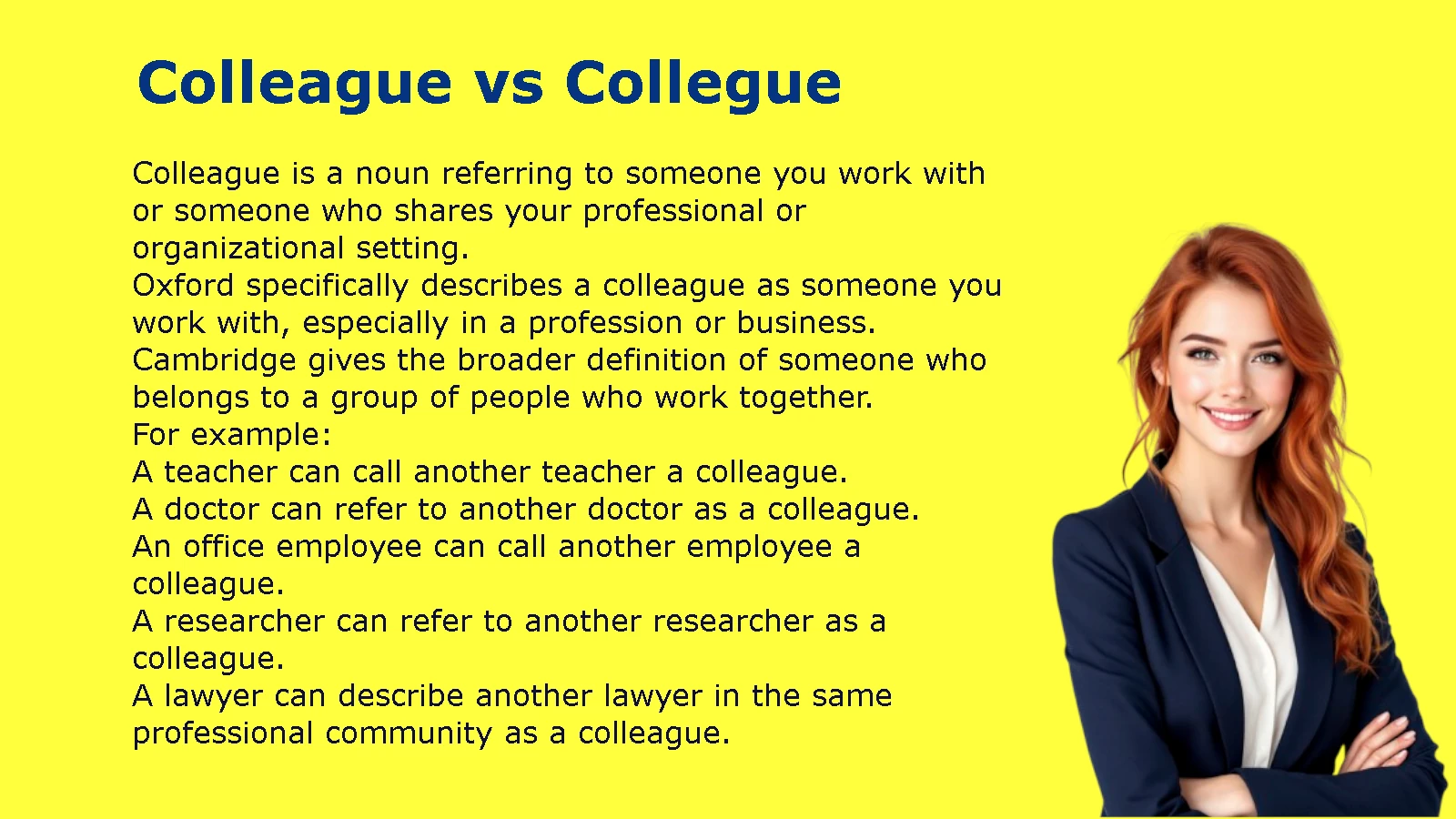
Colleague is a noun referring to someone you work with or someone who shares your professional or organizational setting.
Oxford specifically describes a colleague as someone you work with, especially in a profession or business.
Cambridge gives the broader definition of someone who belongs to a group of people who work together.
For example:
- A teacher can call another teacher a colleague.
- A doctor can refer to another doctor as a colleague.
- An office employee can call another employee a colleague.
- A researcher can refer to another researcher as a colleague.
- A lawyer can describe another lawyer in the same professional community as a colleague.
The relationship does not necessarily mean that two people have the same job title. The important idea is that they work together or belong to the same professional or organizational environment.
Colleague in the Workplace
The most common use of colleague relates to employment.
Consider:
I spoke with my colleague about the new project.
The sentence tells us that the person being discussed works with the speaker or is part of the same professional environment.
The word can describe people at different levels of an organization:
- a junior colleague
- a senior colleague
- a former colleague
- a new colleague
- a trusted colleague
- a close colleague
- a professional colleague
For example:
She asked a senior colleague for advice.
Here, colleague identifies the professional relationship, while senior provides information about the person’s position or experience.
Colleague in Academic Settings
Colleague is also common in universities, schools, research institutions, and other academic environments.
For example:
The professor discussed the research with her colleagues.
In this context, the colleagues may be other professors, researchers, or academic professionals.
Oxford’s examples include references to colleagues at universities and people working together in professional fields.
The word can therefore apply beyond a traditional office.
Colleague Does Not Necessarily Mean Friend
A colleague and a friend are not automatically the same thing.
A colleague is defined by a professional or organizational relationship. A friendship is based on a personal relationship.
Two people can be:
- colleagues but not friends
- friends and colleagues
- former colleagues and current friends
- colleagues who rarely interact socially
For example:
Maria is my colleague, but we don’t socialize outside work.
The sentence makes the distinction clear. Their professional relationship makes them colleagues, while their personal relationship does not necessarily make them friends.
Why Is Colleague Often Misspelled as Collegue?
The spelling collegue is easy to produce because the word contains sounds that do not make every letter obvious.
When people write from pronunciation, they may remember something close to the sound but omit the a in the middle.
Another source of confusion is the word college.
Compare:
- college
- colleague
- collegue
The first two are legitimate English words, but collegue is not the standard spelling of the professional term.
The visual similarity between college and colleague can make the spelling harder to remember.
The Important Letter in Colleague
The key spelling difference is the a:
colle + a + gue
Not:
colle + gue
So when checking your writing, look specifically for this sequence:
colleague
A quick proofreading trick is to search your document for collegue. If you find it, replace it with colleague.
How to Spell Colleague Correctly
The correct spelling is:
C-O-L-L-E-A-G-U-E
There are several parts worth paying attention to:
- co
- ll
- ea
- gue
The most commonly omitted letter is the a.
Correct and Incorrect Forms
| Form | Status |
| colleague | Correct |
| collegue | Incorrect |
| colleagues | Correct plural |
| collegues | Incorrect plural |
The plural is particularly useful to remember because the same spelling pattern remains:
colleague → colleagues
Do not remove the a when making the word plural.
Colleague Pronunciation
The pronunciation of colleague can vary slightly between British and American English.
Cambridge gives the British pronunciation as /ˈkɒl.iːɡ/ and the American pronunciation as /ˈkɑː.liːɡ/.
The word has two syllables in these standard pronunciations.
The final part sounds like league, although the pronunciation of the entire word is not simply the same as saying college.
The spelling and pronunciation relationship is one reason the word can be difficult for learners and writers. Some letters are not strongly represented by separate sounds.
The important point is that pronunciation should not be used to reconstruct the spelling letter by letter.
Correct spelling: colleague
Common misspelling: collegue
Colleague in Different Contexts
The meaning of colleague remains broadly consistent, but the people described as colleagues can differ depending on the setting.
Colleague in the Workplace
This is the most familiar context.
I asked my colleague to review the report.
The colleague may work in the same department or elsewhere in the same organization.
Another example:
Several colleagues attended the meeting.
Here, the plural colleagues refers to multiple people connected to the speaker through work.
Colleague in Education
Teachers, professors, researchers, and other education professionals can refer to one another as colleagues.
The teacher discussed the curriculum with her colleagues.
The word is particularly natural when describing professional relationships among educators.
Colleague in a Professional Field
The term can also extend beyond people employed by the same organization.
Oxford’s definition includes professional contexts, and examples include people working with colleagues at other universities or in other locations.
For example:
Researchers from several universities shared their findings with colleagues abroad.
In this sentence, the researchers may not work for the same employer. They are still colleagues because they participate in the same professional field.
Colleague vs Coworker
Colleague and coworker overlap considerably, but they are not identical in every context.
Cambridge lists co-worker as a synonym of colleague.
In everyday American English, coworker commonly means someone who works with you, especially at the same workplace.
Colleague can sound somewhat broader or more professional. It can refer to someone in the same profession or field even when that person does not work for the same employer.
| Word | General meaning | Typical use |
| Colleague | Someone you work with or professionally associate with | Professional and workplace settings |
| Coworker | Someone who works with you | Everyday workplace language |
| Workmate | Someone you work with | More common in some varieties of English |
| Associate | Someone connected professionally or organizationally | More formal or context-dependent |
Consider these examples:
My coworker sits next to me.
This strongly suggests a shared workplace.
I met several colleagues at the medical conference.
The people may work for different organizations but belong to the same professional field.
Therefore, colleague and coworker can overlap, but context determines which word sounds most natural.
Colleague vs College
Both are completely different words.
Colleague
A colleague is a person you work with or professionally associate with.
My colleague is working on the project.
College
A college is an educational institution or, depending on the variety of English and context, a division or organized body within a larger institution.
She attends college in Boston.
The spelling difference is substantial:
colleague → person
college → educational institution or another established sense of the noun
A useful warning is not to let the first four letters mislead you. Although college appears inside the beginning of colleague visually, the words have different meanings and different historical development.
Colleague Synonyms
Several words can have a similar meaning to colleague, but they are not interchangeable in every sentence.
Coworker
A person who works with you.
I asked my coworker about the schedule.
Workmate
A person you work with. This word is particularly familiar in British and other varieties of English.
She went to lunch with a workmate.
Associate
A person connected with you through work, business, or another professional relationship.
He is a business associate of mine.
Associate can be broader than colleague, so the two words should not automatically be treated as exact equivalents.
Peer
A person who is at a similar level, status, age group, or professional position.
The researchers presented their findings to their peers.
A peer does not necessarily work with you directly.
Teammate
A person on the same team.
My teammate helped me finish the presentation.
A teammate can be a colleague, but the word emphasizes membership in the same team.
Fellow Professional
This phrase emphasizes that someone belongs to the same profession.
She spoke with fellow professionals about the new standards.
The phrase can work where colleague would be too broad or where the professional connection is the main point.
What Is the Plural of Colleague?
The plural of colleague is colleagues.
Singular: colleague
Plural: colleagues
Examples:
My colleague is attending the meeting.
My colleagues are attending the meeting.
The spelling keeps the a:
colleagues
A common mistake is:
collegues
That spelling is incorrect because it carries the same missing-a error as collegue.
Colleagues in Sentences
Here are several natural examples:
- My colleagues helped me complete the report.
- She introduced me to her new colleagues.
- Several colleagues attended the conference.
- His former colleagues sent him a farewell card.
- The researchers discussed the results with their colleagues.
Common Mistakes With Colleague
Spelling is the biggest problem, but several other mistakes are worth knowing.
Writing Collegue Instead of Colleague
This is the central spelling error.
Incorrect:
I spoke to my collegue yesterday.
Correct:
I spoke to my colleague yesterday.
Remember the a before g.
Writing Collegues Instead of Colleagues
The same mistake appears in the plural.
Incorrect:
My collegues approved the proposal.
Correct:
My colleagues approved the proposal.
The plural is formed by adding s to colleague:
colleague → colleagues
Confusing Colleague With College
These words are visually related but have different meanings.
Incorrect interpretation:
My college helped me prepare the report.
If you mean a person who works with you, the correct word is:
My colleague helped me prepare the report.
College refers to an institution or another established organizational sense, not normally to a person you work with.
Assuming Every Colleague Is a Coworker
The terms can overlap, but colleague can be used for people in the same profession or professional community who do not necessarily work for the same employer.
For example:
Doctors from different hospitals exchanged ideas with their colleagues.
Here, the professional relationship is more important than having the same employer.
Colleague in Formal and Professional Writing
Colleague is entirely appropriate in professional writing.
You can use it in:
- Business emails
- Reports
- Academic papers
- Workplace notices
- Professional biographies
- Research writing
- Corporate communications
- Letters
- Internal documentation
For example:
I discussed the proposal with my colleagues before submitting the final version.
The word is neutral and professional.
It is also useful when you want to describe a professional relationship without making the relationship sound overly personal.
Compare:
Sarah is my friend.
This emphasizes a personal relationship.
Sarah is my colleague.
This emphasizes a professional relationship.
Both statements can be true at the same time:
Sarah is both my colleague and my friend.
Practical Case Study: Correcting a Workplace Email
Consider a simple workplace email containing this sentence:
I will discuss the issue with my collegue and get back to you.
The meaning is understandable, but collegue is misspelled.
The corrected sentence is:
I will discuss the issue with my colleague and get back to you.
Now consider the plural:
I will discuss the issue with my collegues.
The corrected form is:
I will discuss the issue with my colleagues.
This small correction matters because workplace writing is often judged not only by what it communicates but also by how accurately it is written.
How to Remember Colleague vs Collegue
The easiest spelling reminder is to focus on league.
Think:
col + league = colleague
This is a spelling aid rather than a claim about the word’s actual modern etymological formation.
Another useful technique is to remember the critical sequence:
LEA
The correct word contains:
colleA…
The misspelling removes the A:
colleG…
When proofreading, look for colleague rather than trying to remember the word from its pronunciation.
A Simple Memory Rule
Remember:
A colleague has an A.
The phrase is short, and it highlights the exact letter that is most often omitted.
The Origin of the Word Colleague
The spelling becomes easier to understand when you look at its history.
Oxford traces colleague to French collègue, ultimately from Latin collega, meaning a partner in office.
Etymonline dates the English noun to the 1530s and likewise traces it through French to Latin collega.
The Latin formation relates to the idea of being appointed or chosen together for an official role. The historical meaning therefore connects naturally with the modern idea of people working together.
Dictionary.com also traces the word through Middle French collegue to Latin collēga.
This history is useful because it shows that the spelling is not simply an arbitrary modern variation of college. It has its own historical development.
Colleague vs Collegue: Examples at a Glance
| Situation | Correct sentence |
| Workplace | My colleague helped me with the report. |
| Academic | She discussed the research with her colleagues. |
| Professional | He met several colleagues at the conference. |
| Former workplace | I still keep in touch with a former colleague. |
| Team setting | My colleague is leading the project. |
| Plural | All my colleagues attended the meeting. |
The pattern remains the same in every example: colleague is the correct spelling.
Frequently Asked Questions About Colleague vs Collegue
Is colleague or collegue correct?
Colleague is correct. Collegue is a misspelling.
Is collegue a word?
Collegue is not the standard English spelling of the word meaning a person you work with. Use colleague instead.
What does colleague mean?
A colleague is someone you work with or professionally associate with. Oxford specifically describes a colleague as someone you work with, especially in a profession or business.
How do you spell colleague?
The correct spelling is:
C-O-L-L-E-A-G-U-E
The most commonly forgotten letter is the a before g.
How do you pronounce colleague?
Cambridge lists the standard UK pronunciation as /ˈkɒl.iːɡ/ and the US pronunciation as /ˈkɑː.liːɡ/.
What is the plural of colleague?
The plural is colleagues.
Example:
I work closely with my colleagues.
Is colleague the same as coworker?
The meanings overlap. A coworker is generally someone who works with you, while colleague can have a somewhat broader professional meaning and may refer to someone in the same profession or professional community.
What is a synonym for colleague?
Depending on context, possible synonyms include coworker, workmate, associate, peer, and teammate. However, these words have slightly different meanings and should not always be substituted mechanically.
Why do people spell colleague as collegue?
The spelling is easy to confuse because the pronunciation does not clearly reveal every letter, and colleague resembles other words such as college. The missing a is the key error in collegue.
Is colleague a formal word?
Yes. Colleague is a standard, neutral word that works well in both everyday and professional communication.
Can students be colleagues?
Yes, depending on the context. The word generally describes people who work together or share a professional or organizational setting. In academic contexts, teachers, professors, researchers, and other professionals commonly use colleague.
Can a former coworker be a former colleague?
Yes. Former colleague is a natural expression for someone you previously worked with or professionally associated with.
Key Takeaway: Colleague or Collegue?
When choosing between colleague vs collegue, the answer is straightforward:
Colleague is correct. Collegue is incorrect.
The correct word means a person you work with or professionally associate with. It is common in workplaces, businesses, universities, research environments, and other professional settings.
The spelling to remember is:
colleague
The plural is:
colleagues
The most common error is leaving out the a and writing collegue or collegues.
If you are writing an email, report, essay, application, or professional document, use colleague every time.