Muzjiks is an informal or nonstandard spelling associated with muzhiks, a transliteration of the Russian word мужик, traditionally referring to a peasant, common man, or working-class Russian man. If you’ve come across the word “muzjiks” and wondered what it means, how it is spelled, or where it comes from, the term is closely connected to Russian culture, peasants, rural life, working-class men, common people, and Russian history.
The muzjiks meaning generally refers to Russian peasants or ordinary rural men, especially in historical contexts involving Imperial Russia. The spelling muzhiks is more common in English, while muzjiks is a less common transliteration. Depending on the context, the word can describe peasant men, commoners, villagers, or ordinary working men, and its tone can vary from historical and descriptive to informal or derogatory.
In this guide, you’ll learn what “muzjiks” means, where the word comes from, how it is used in sentences, why different spellings such as “muzhiks” and “muzjiks” exist, and how the term relates to Russian peasants and working-class men. You’ll also see clear examples to make the meaning easy to understand.
By the end, you’ll know exactly what muzjiks means, how it is spelled, and how to use this historical Russian term naturally and correctly.
Quick Answer: What Does Muzjiks Mean?
Muzjiks is a plural form referring to Russian peasant men, especially in historical descriptions of rural Russia.
The singular is muzhik or muzjik, while muzjiks is one English plural form. Dictionaries also record spellings such as moujik, mujik, and muzhiks.
Muzjiks Meaning at a Glance
| Term | Meaning |
| Muzjiks | Russian peasant men; plural |
| Muzhik | A Russian peasant; singular |
| Muzjik | Variant English transliteration of muzhik |
| Muzhiks | Another plural spelling |
| Moujik | Alternative English spelling |
| Мужик | Russian Cyrillic form |
| Muzh | Russian word associated with “man” or “husband” |
The important point is that the historical English meaning is narrower than every possible modern Russian use.
What Does Muzjiks Mean?
The word muzjiks generally refers to Russian peasants, particularly male peasants associated with the countryside of Imperial Russia.
English dictionaries define muzhik as a Russian peasant, with some specifically connecting the term to Russia under the tsars.
The term is especially common in English-language discussions of:
- Russian history
- Imperial Russia
- Russian serfdom
- 19th-century rural society
- Russian literature
- Peasant life
- Historical translations from Russian
For example:
The novel portrays the lives of Russian muzjiks in the countryside.
Here, muzjiks clearly means Russian peasant men, not simply “men.”
That distinction matters because the original Russian word мужик has meanings that extend beyond the historical English sense.
Is Muzjiks a Russian Word?
The underlying Russian word is мужик, pronounced with the stress on the second syllable in standard Russian: мужи́к. The spelling muzjiks is an English transliteration rather than the original Cyrillic spelling.
Russian dictionaries list мужик as a noun.
English has adopted several transliterations because Russian Cyrillic letters do not map one-to-one onto ordinary English spelling.
That is why you may encounter:
- muzhik
- muzjik
- muzjiks
- muzhiks
- mujik
- moujik
They are different transliteration or plural forms associated with the same Russian word.
Muzjiks Meaning in Russian History
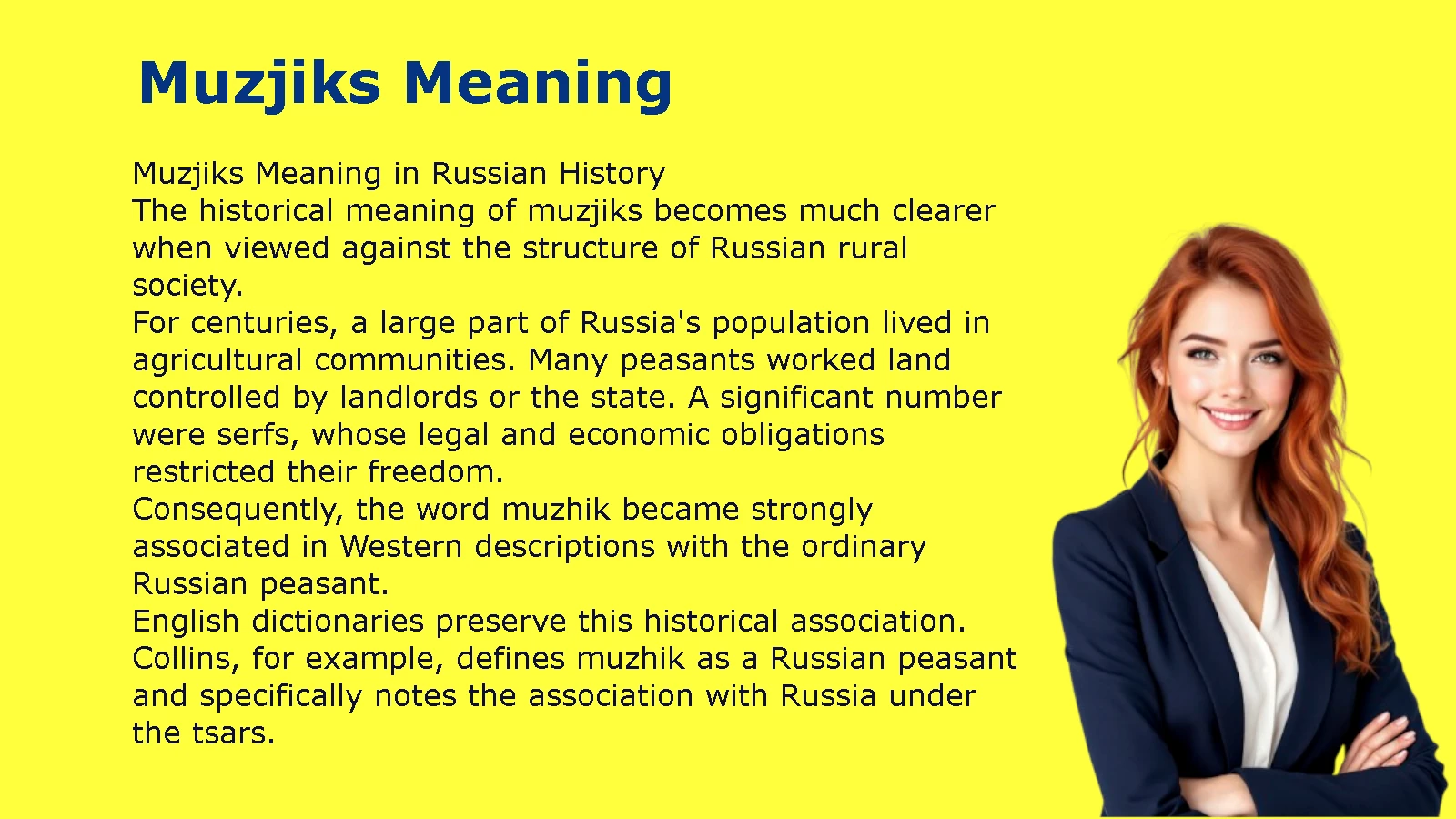
The historical meaning of muzjiks becomes much clearer when viewed against the structure of Russian rural society.
For centuries, a large part of Russia’s population lived in agricultural communities. Many peasants worked land controlled by landlords or the state. A significant number were serfs, whose legal and economic obligations restricted their freedom.
Consequently, the word muzhik became strongly associated in Western descriptions with the ordinary Russian peasant.
English dictionaries preserve this historical association. Collins, for example, defines muzhik as a Russian peasant and specifically notes the association with Russia under the tsars.
Muzjiks and Russian Serfdom
It is important not to treat muzhik and serf as exact synonyms.
A muzhik was a type of Russian man or peasant. A serf was a person subject to a particular system of legally enforced obligations.
Therefore:
Every Russian serf was not simply synonymous with “muzhik,” and every use of muzhik does not necessarily identify a man’s exact legal status.
Historical sources can use muzhik more broadly to describe a rural peasant.
This distinction becomes particularly important when reading translated Russian literature. A translator may preserve muzhik because the Russian term carries social and cultural associations that the simple English word peasant does not completely reproduce.
The Emancipation of 1861
One of the most important dates for understanding Russian peasants is 1861, when Tsar Alexander II issued the emancipation reform that ended serfdom for millions of peasants in the Russian Empire.
The reform changed the legal status of former serfs, but it did not instantly eliminate poverty, rural inequality, or the social importance of the peasant class.
As a result, muzhik continued to appear in discussions of Russian rural society long after 1861.
This historical background explains why the word often appears alongside terms such as:
- Russian peasant
- serf
- village
- landowner
- Russian Empire
- tsar
- agriculture
- peasant commune
What Is a Muzhik? The Singular Form of Muzjiks
Muzhik is the singular form behind muzjiks.
A simple way to understand the relationship is:
One muzhik → several muzjiks
However, English spelling varies because the word has been transliterated from Russian in different ways.
The American Heritage Dictionary lists moujik, mujik, and muzjik as variants of muzhik.
Muzhik vs. Muzjiks
| Form | Number | Basic historical meaning |
| muzhik | Singular | A Russian peasant man |
| muzjik | Singular variant | A Russian peasant man |
| muzjiks | Plural | Russian peasant men |
| muzhiks | Plural variant | Russian peasant men |
| moujik | Usually singular | Russian peasant |
| mujik | Variant spelling | Russian peasant |
The spelling muzjiks is therefore not a completely different word from muzhik. It represents a pluralized English form of the transliterated Russian term.
Muzjiks Meaning in English
In English, muzjiks is primarily encountered in historical, literary, or cultural contexts.
A dictionary definition is much narrower than the range of meanings found in contemporary Russian.
For English readers, the safest basic interpretation is:
Muzjiks = Russian peasant men, especially in historical contexts.
The word often retains a specifically Russian cultural setting rather than functioning like an ordinary synonym for men.
Historical English Usage
Consider these examples:
The novel describes the hardships faced by the muzjiks.
The meaning is Russian peasants.
The estate depended on the labor of hundreds of muzjiks.
Again, the context points to male peasants working in a rural economy.
The writer contrasts the aristocracy with the muzjiks.
Here, the word helps establish a social-class contrast between the upper classes and rural peasants.
The term therefore carries historical information that would disappear if every occurrence were translated simply as men.
Muzjiks Pronunciation
Muzjiks can be pronounced differently depending on the English pronunciation system being used, while the underlying Russian pronunciation provides the clearest linguistic reference.
For the singular muzhik, English dictionaries give pronunciations such as /muːˈʒɪk/ and related variants.
The Russian word is мужи́к, with stress on the final syllable.
The ж sound is similar to the sound represented by the zh in transliterations of Russian words. It resembles the sound in the middle of the English word measure.
muzjiks
MOO-zhiks
Add to flashcards
Give feedback
Because English transliterations vary, you may hear slightly different pronunciations in English-language material.
Muzjiks Etymology: Where Does the Word Come From?
The etymology of muzhik connects it with the Russian word муж, muzh, meaning man or husband.
Dictionary sources trace muzhik to Russian muzhík, connecting it with muzh and a diminutive suffix -ik.
The relationship can be represented simply as:
muzh → muzhik
The historical development is more nuanced than saying that muzhik literally means only “little man.” Over time, the word developed specific social meanings, including its association with the peasant population.
The Word Muzh
Russian муж has meanings related to man and husband. The Russian orthographic dictionary lists муж with meanings connected to men and spouses.
That makes muzh relevant when researching muzhik, but the two words should not be treated as interchangeable.
Muzh can mean “husband” or “man,” whereas historical muzhik is strongly associated with the Russian peasant.
How Muzjiks Was Used in Russian Society
The word’s social meaning is one reason it appears so often in historical writing.
A scholarly discussion of Russian peasant terminology distinguishes muzhik from krestyanin, the more formal Russian term for “peasant.” It notes that muzhik is an informal word and that it can carry connotations of a rough or uncultivated rural man in literary representations.
That does not mean every Russian use of muzhik is insulting.
Instead, the word’s tone depends heavily on context.
Three Important Contexts
Historical:
Muzhik can refer to a male Russian peasant, particularly in accounts of Imperial Russia.
Literary:
The term may evoke the rural population, village life, poverty, physical labor, or the social distance between peasants and elites.
Modern colloquial Russian:
Мужик can mean something closer to man, guy, or bloke, depending on the speaker and context. Contemporary Russian dictionaries and language resources record these broader uses.
This is why translating мужик mechanically as peasant in every modern sentence can produce an incorrect translation.
Muzjiks Meaning in Russian Literature
Russian literature is one of the main reasons the term became familiar to English-speaking readers.
Nineteenth-century Russian writers frequently wrote about the countryside, class relationships, poverty, agriculture, serfdom, and the lives of ordinary people. In English translations, muzhik was sometimes retained instead of being translated simply as peasant.
The word can therefore function as more than a dictionary label.
It can establish a particular social and cultural perspective.
Dostoevsky and the Russian Peasant
The term appears in the titles and discussions of works associated with Russian literature. For example, Fyodor Dostoevsky wrote “The Peasant Marey”, whose Russian title is Мужик Марей (Muzhik Marey). The story was published in 1876 and concerns Dostoevsky’s recollection of a childhood encounter with a peasant who had been a serf.
That example shows why understanding the word’s historical meaning matters.
If muzhik were interpreted only as “man,” an English reader could miss the social identity built into the original title.
Muzjiks vs. Russian Peasants
The phrase Russian peasant is often the most straightforward English translation of historical muzhik.
However, the terms are not perfectly identical in every context.
Russian peasant is an English descriptive phrase.
Muzhik is a culturally specific Russian term whose meanings have changed according to historical period and context.
A useful comparison is:
| Term | Main focus |
| Muzhik | Russian male peasant; broader colloquial meanings in modern Russian |
| Russian peasant | English description of a peasant in Russia |
| Krestyanin | Formal Russian term for peasant |
| Serf | Person subject to the legal institution of serfdom |
| Muzh | Man or husband |
The distinction between muzhik and krestyanin is especially useful when reading historical material. A scholarly treatment of Russian peasant terminology identifies krestyanin as the more dominant term for “peasant,” while describing muzhik as a more informal term.
Muzjiks vs. Muzh
Muzhik and muzh are related, but they do not mean the same thing.
The Russian word муж (muzh) can mean man or husband. The Russian word мужик (muzhik) has a historical sense connected with a peasant and also has broader colloquial meanings in contemporary Russian.
Simple Comparison
| Word | Typical meaning |
| Muzh | Man; husband |
| Muzhik | Historically, peasant; colloquially, man/guy in modern contexts |
| Muzjiks | Plural English form referring historically to Russian peasant men |
For example, translating муж as peasant would normally be incorrect.
Likewise, translating every occurrence of мужик as husband would also be incorrect.
Context determines the appropriate meaning.
Is Muzjiks Still Used Today?
The answer depends on whether you mean English or Russian.
In English, muzhik, mujik, moujik, and muzjik are primarily associated with Russian peasants and historical Russia. Contemporary English dictionaries preserve that historical sense.
Modern Russian is different.
The Russian word мужик remains in use with several meanings. Contemporary language resources give meanings such as guy/man, peasant in a historical context, and boor or uncouth person, depending on usage.
Therefore, an English reader should not assume that a modern Russian speaker who says мужик is talking about a peasant.
Why Context Matters
Compare these two hypothetical sentences:
В деревне жили бедные мужики.
In a historical rural context, мужики can refer to peasants.
Now consider:
Он нормальный мужик.
Here, the meaning is closer to “He’s a decent guy/man.”
The same Russian word therefore requires contextual interpretation.
Common Transliteration Variants of Muzjiks
One of the biggest sources of confusion is spelling.
Russian uses the Cyrillic alphabet, so when мужик is written in the Latin alphabet, different transliteration systems and English conventions can produce different spellings.
Common forms include:
- muzhik
- muzjik
- muzjiks
- muzhiks
- mujik
- moujik
The American Heritage Dictionary specifically lists moujik, mujik, and muzjik as variants. Collins likewise records moujik, mujik, and muzjik.
Which Spelling Is Correct?
For the English historical noun, muzhik is a widely recognized spelling.
Muzjik is also a recognized variant.
Muzjiks is the plural form you may encounter when an English writer chooses muzjik as the singular.
So it is better to think of these as transliteration variants, rather than assuming that every spelling represents a completely separate word.
Historical Context: Muzjiks and the Russian Peasant Class
Understanding the term requires more than memorizing a dictionary definition.
The Russian peasant population was not a single uniform group. Its economic position, legal status, land access, and relationship with landlords or state authorities could differ considerably across time and place.
That complexity is important because “muzhik” is a social and cultural label, not a precise description of every individual’s legal status.
Before 1861
Before the emancipation of the serfs, many Russian peasants lived under systems of obligation to landlords or the state.
A serf’s obligations could involve labor, payments, and restrictions on movement.
This is the historical setting in which Western readers often encounter descriptions of the Russian muzhik.
After 1861
The emancipation reform transformed the legal position of Russia’s serfs, but the rural population remained economically and socially significant.
The word muzhik therefore continued to appear in descriptions of Russian village life after emancipation.
Its historical association with the peasant class did not disappear simply because the legal institution of serfdom changed.
Real-World Examples of Muzjiks
Examples are particularly useful because the word can change meaning depending on context.
Example: Historical Writing
The estate was worked by hundreds of muzjiks.
Meaning: Male Russian peasants associated with the estate’s agricultural labor.
Example: Russian Literature
The author describes the hardships endured by the muzjiks.
Meaning: Rural Russian peasants, particularly in a historical or literary setting.
Example: Social Contrast
The aristocrats viewed the muzjiks as part of the rural population beneath them.
Meaning: The word establishes a social distinction between elites and peasants.
Example: Modern Russian Context
He is a decent muzhik.
Depending on the Russian context, this can mean something closer to a decent man or guy, rather than “a peasant.”
This difference illustrates why dictionary definitions must be interpreted alongside context.
A Practical Case Study: Why Context Changes the Translation
Imagine that you are translating a Russian historical novel.
You encounter:
мужики работали в поле
A literal word-for-word approach might tempt a learner to translate мужики as men.
That translation is grammatically possible in some contexts, but the surrounding historical setting may make peasants the more informative choice.
Now imagine:
Он настоящий мужик.
Translating this as “He is a real peasant” would likely miss the intended modern colloquial sense.
The better approach is therefore:
Identify the historical period → examine the surrounding sentence → determine the social context → choose the English meaning.
This method avoids treating мужик as if it had only one permanent definition.
Common Mistakes About the Muzjiks Meaning
Assuming Muzjiks Simply Means Men
The Russian word is related to muzh, but historical muzhik has a specific association with peasants.
Better approach: Check the context before translating it as man.
Treating Muzhik and Muzh as Identical
They are related etymologically but have different meanings.
Muzh can mean man or husband, while muzhik has historical and colloquial meanings that differ from it.
Assuming Every Muzhik Is a Serf
The terms are related historically but are not synonyms.
A serf describes a legal and social status under serfdom. Muzhik describes a Russian male peasant and can be used more broadly.
Assuming Muzhik Always Means Peasant in Russian
This is one of the most important mistakes to avoid.
Modern Russian uses мужик in colloquial senses including man and guy.
Thinking Muzjiks Is the Only English Spelling
English-language sources use multiple transliterations, including muzhik, muzjik, mujik, and moujik.
Related Russian Terms You May Encounter
The word muzjiks often appears in texts containing other historical Russian terms.
Muzh Meaning
Muzh (муж) means man or husband, depending on context. The word is related etymologically to muzhik.
Krestyanin Meaning
Krestyanin (крестьянин) is the standard Russian term for peasant. In historical discussions, it can be more formal and precise than the informal muzhik.
Versts Meaning
A verst was an old Russian unit of distance. Historical texts about rural Russia may use verst or versts when describing distances between villages, estates, or towns.
Knout Meaning
A knout was a Russian whip historically associated with punishment. The word appears in some Western historical accounts of Imperial Russia.
It should not be confused with muzhik: muzhik describes a person or social identity, while knout describes an instrument of punishment.
Armyak Meaning
An armyāk was a type of traditional coarse outer garment associated historically with Russian peasants and other rural people.
These terms sometimes appear together in historical literature because they belong to the same broad vocabulary of descriptions of Russian rural life.
Muzjiks Meaning: Historical vs. Modern Usage
The following table summarizes the distinction that matters most:
| Context | Likely meaning of muzhik |
| English historical text | Russian peasant |
| Imperial Russian history | Male peasant, often rural |
| 19th-century Russian literature | Peasant/rural man, with literary social associations |
| Historical translation | Often “peasant” |
| Modern Russian conversation | Man, guy, bloke, depending on context |
| Derogatory modern context | Boor or uncouth man |
| English plural muzjiks | Usually Russian peasants in historical contexts |
This distinction is supported by English dictionary definitions and contemporary Russian-language resources that record both the historical and modern colloquial senses.
Facts to Remember About the Muzjiks Meaning
Here are the most important facts in one place:
- Muzjiks is a plural English form associated with Russian мужик.
- Muzhik is the common English singular spelling.
- The historical English meaning is Russian peasant, particularly a male peasant.
- The word is strongly associated with Imperial Russia and Russian rural society.
- Muzhik and serf are not exact synonyms.
- Muzh means “man” or “husband” and is related to muzhik.
- English has several transliteration variants, including muzjik, mujik, moujik, and muzhik.
- In modern Russian, мужик can mean man, guy, or bloke depending on context.
- The historical “peasant” meaning should not automatically be applied to every modern Russian occurrence.
- Russian krestyanin is a more formal term for “peasant” than the informal muzhik.
- Russian literature helped introduce muzhik into English-language discussions of Russian rural life.
FAQs About Muzjiks
What does muzjiks mean in English?
Muzjiks generally means Russian peasant men, especially in historical descriptions of Russia. The singular is muzhik or muzjik.
What is the singular of muzjiks?
The singular form is commonly written muzhik or muzjik. English sources also use moujik and mujik.
What is a muzjik?
A muzjik is a variant spelling of muzhik, meaning a Russian peasant, particularly in historical English usage.
What does muzhik mean in Russian?
The Russian word мужик has several meanings. Historically, it can mean peasant. In contemporary colloquial Russian, it can also mean man, guy, or bloke, with the exact sense determined by context.
Is muzjiks a Russian word?
Muzjiks is an English transliterated plural form. The original Russian word is мужик, while the Russian plural is мужики.
How do you pronounce muzjiks?
English pronunciations vary. The singular muzhik is commonly represented in dictionaries with pronunciations using a zh sound, such as /muːˈʒɪk/.
Is muzjiks the same as Russian peasants?
In historical English usage, yes, broadly. Muzhik is commonly defined as a Russian peasant. However, the original Russian word has broader meanings, so the historical English definition should not automatically be applied to every modern Russian use.
What is the difference between muzh and muzhik?
Muzh (муж) can mean man or husband. Muzhik (мужик) historically refers to a peasant and can have broader colloquial meanings in modern Russian.
Is muzjiks still used today?
The English word remains recognizable, but it is primarily encountered in historical or literary contexts. The underlying Russian word мужик is still used in contemporary Russian with several meanings.
Is muzjiks a Scrabble word?
Whether muzjiks is accepted in a particular Scrabble dictionary depends on the specific word list and edition being used. The spelling is recognized in English-language dictionaries as the plural of muzjik.
Conclusion: Muzjiks Meaning in Simple Terms
Muzjiks means Russian peasant men, particularly in historical English writing about Imperial Russia. The singular form is usually muzhik, although muzjik, mujik, and moujik are also found.
The word becomes much easier to understand once you separate its historical English meaning from the broader meanings of Russian мужик. Historically, muzhik is strongly associated with the Russian peasant class. In modern Russian, however, мужик can also mean a man or guy, and in some contexts it can describe an uncouth or rough person.
Its connection to муж (muzh) helps explain its etymology, while Russian history explains why the term became so closely associated with peasants. English dictionaries continue to define muzhik primarily as a Russian peasant, especially in the context of tsarist Russia.
So, when you encounter muzjiks in an English historical or literary text, the safest interpretation is usually Russian peasants or Russian peasant men. When you encounter мужик in modern Russian, however, always examine the surrounding context before choosing an English translation.