A kamabana is a Japanese word associated with a traditional decorative display, particularly one used to represent or celebrate a special occasion. If you’ve come across the term “kamabana” and wondered what it means, where it comes from, or how it is used, the word is connected with Japanese culture, traditional decoration, celebrations, symbolism, and seasonal customs.
The Kamabana meaning refers to a traditional Japanese decorative arrangement made with carefully selected natural materials, often associated with cultural or ceremonial settings. Depending on the context, the term may be used to describe a particular style of decoration or an arrangement with symbolic significance. Related ideas include Japanese decorations, traditional displays, floral arrangements, seasonal decorations, and ceremonial customs.
In this guide, you’ll learn what “kamabana” means, where the term comes from, how it is used, and what it represents in Japanese culture. You’ll also see clear examples and explanations to make the meaning easier to understand.
By the end, you’ll have a clear understanding of Kamabana meaning and how to recognize and use this distinctive Japanese cultural term correctly.
Kamabana Meaning at a Glance
The simplest way to understand kamabana meaning is to look at the documented uses side by side.
| Term or spelling | Meaning or reference | Context |
| kāmabāṇa | An arrow of the god of love | Sanskrit and Indian literary tradition |
| Kamabana | Transliteration or simplified spelling associated with kāmabāṇa | English-language transliteration |
| Kāmabāṇa in Kannada | One of the five arrows of the Love-God Kāma; also the effect or pang of sexual desire | Kannada |
| kamabana | A recorded non-scientific name associated with Magnolia champaca | Botanical and regional naming |
| Magnolia champaca | The accepted botanical name for the plant associated with the recorded kamabana name | Botany |
The Sanskrit term is the most important linguistic explanation when kamabana is being used to represent kāmabāṇa. A Sanskrit dictionary defines kāmabāṇa as an arrow of the god of love.
A Kannada-English etymological dictionary gives the related form kāmabāṇa additional meanings, including the arrows of Kāma, the effects or pangs of sexual desire, and a symbolic association with the number five.
There is also a separate documented botanical use: Kew’s Medicinal Plant Names Services lists kamabana as a non-scientific name referring to Magnolia champaca.
So, if you found kamabana in a dictionary, religious text, literary work, plant reference, or name database, the surrounding context is essential.
What Does Kamabana Mean?
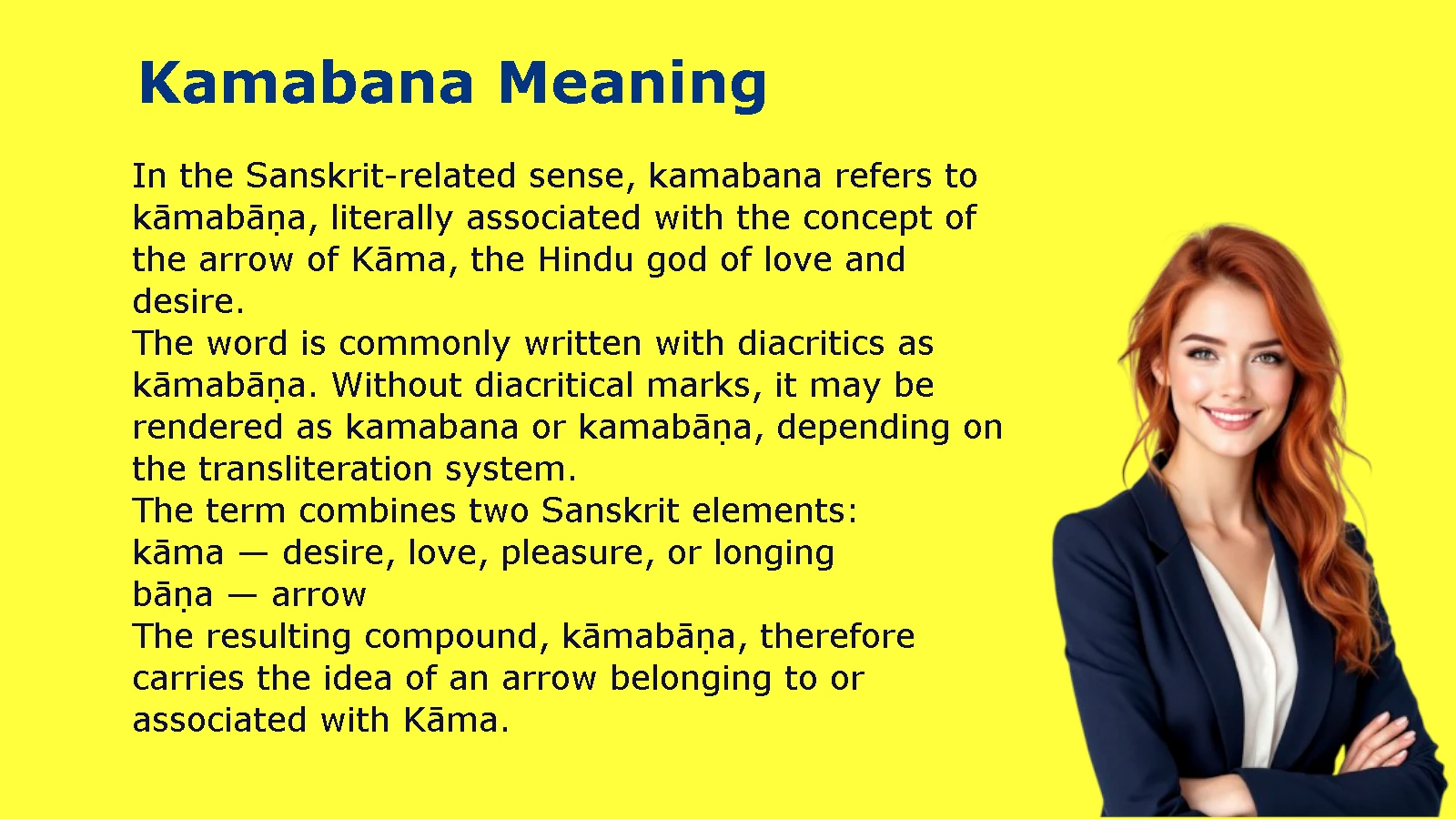
In the Sanskrit-related sense, kamabana refers to kāmabāṇa, literally associated with the concept of the arrow of Kāma, the Hindu god of love and desire.
The word is commonly written with diacritics as kāmabāṇa. Without diacritical marks, it may be rendered as kamabana or kamabāṇa, depending on the transliteration system.
The term combines two Sanskrit elements:
- kāma — desire, love, pleasure, or longing
- bāṇa — arrow
The resulting compound, kāmabāṇa, therefore carries the idea of an arrow belonging to or associated with Kāma.
Sanskrit dictionaries explicitly record the compound as an “arrow of the god of love.”
What Is Kāma?
Kāma has a much broader meaning than simply romantic love.
The Kannada-English Etymological Dictionary records kāma with meanings including desire, wish, yearning, longing, lust, and love of pleasure. It also identifies Kāma as Manmatha, the god of love.
That broader meaning helps explain why kāmabāṇa can carry both romantic and desire-related associations.
In traditional Indian mythology, Kāma is associated with inspiring love and desire. His arrows therefore work as a symbolic image: rather than physically injuring someone, they represent the sudden emotional effect of attraction or desire.
Kamabana and Kāmabāṇa: Why the Spellings Differ
One of the biggest sources of confusion is the difference between kamabana and kāmabāṇa.
Sanskrit uses sounds that are not always represented precisely when words are written in plain English letters. Academic transliteration uses diacritical marks to distinguish particular vowel and consonant sounds.
For example:
kāmabāṇa → kamabana
The second form removes the diacritics. This does not necessarily create a completely different word. It can simply be a simplified Roman spelling.
The same issue appears with many Sanskrit terms.
| Diacritical spelling | Simplified spelling |
| kāma | kama |
| bāṇa | bana or baṇa |
| kāmabāṇa | kamabana |
However, simplified spelling can create ambiguity. Once diacritics disappear, different original words may look identical or nearly identical.
That is why kamabana meaning should not be determined from spelling alone.
The source and surrounding sentence can tell you whether the writer means the Sanskrit concept, a regional term, or something else.
Kamabana Origin and Etymology
The Sanskrit-related form kāmabāṇa is a compound built from kāma and bāṇa.
The Meaning of Kāma
The first element, kāma, refers broadly to desire, longing, love, or pleasure. The exact interpretation depends on context.
In philosophical and religious discussions, kāma can have a wider meaning than sexual desire. In ordinary literary contexts, it may describe romantic attraction, longing, or sensual desire.
The Kannada-English Etymological Dictionary specifically records kāma as meaning desire, wish, yearning, longing, lust, and love of pleasure, while also connecting the term with Manmatha, the god of love.
The Meaning of Bāṇa
The second element, bāṇa, means arrow in the relevant Sanskrit compound.
That produces the literal concept of:
kāma + bāṇa = the arrow of Kāma
The resulting word is kāmabāṇa.
Sanskrit dictionary sources independently record the compound with this meaning.
Why an Arrow?
The arrow is a metaphor for the sudden force of attraction.
An arrow strikes its target quickly. In the same symbolic framework, the arrows of Kāma represent desire entering the mind or heart and producing emotional or romantic effects.
This makes kāmabāṇa more than a literal object. It is also a literary image for the experience of being affected by love or desire.
Kamabana in Indian Literary and Religious Tradition
The concept behind kāmabāṇa belongs to a long Indian literary and religious tradition in which Kāma’s arrows symbolize attraction and desire.
The term appears in Sanskrit textual material and is also reflected in later Indian-language dictionaries and literary sources. Wisdom Library’s Sanskrit references identify kāmabāṇa in Sanskrit textual passages, while its dictionary compilation also records related forms.
The image is particularly useful in poetry because it gives writers a compact way to describe the emotional impact of attraction.
Instead of saying that someone suddenly became intensely attracted to another person, a literary text can describe that person as being struck by Kāma’s arrows.
That imagery is understandable even when the expression is not being used literally.
The Five Arrows of Kāma
A particularly important detail appears in the Kannada-English Etymological Dictionary.
It defines kāmabāṇa as referring to any of the five arrows of the Love-God Kāma. The same entry also gives the related meanings of the effect or pang of sexual desire and a symbolic association with the number five.
This explains why the term may appear in discussions of Kāma’s weapon rather than simply as a generic synonym for love.
The five-arrow idea is therefore an important part of the traditional meaning when kāmabāṇa is discussed in this context.
Kamabana Meaning in Kannada
The Kannada evidence adds an important layer to the definition.
The Kannada-English Etymological Dictionary records ಕಾಮಬಾಣ (kāmabāṇa) with three related meanings:
- any of the five arrows of Kāma
- the effect, influence, or pang of sexual desire
- a symbol for the number five
This means that the word can describe both the mythological object and its emotional effect.
That distinction is useful when translating the term.
A translation that simply says “arrow” can miss the figurative meaning. Depending on the sentence, the intended idea may be the experience of being overcome by desire rather than an actual physical arrow.
Is Kamabana a Real Word?
Yes, documented forms related to kamabana exist, but the exact status depends on which form you mean.
The fully marked Sanskrit form kāmabāṇa is a documented Sanskrit compound. Sanskrit dictionary sources define it as an arrow of the god of love.
The unaccented spelling kamabana is less precise because it removes the transliteration marks that distinguish the original Sanskrit sounds.
There is also independent evidence for kamabana as a botanical common or regional name associated with Magnolia champaca. Kew’s Medicinal Plant Names Services records it as a non-scientific name connected with that plant.
Therefore, it would be inaccurate to claim that kamabana is exclusively a slang term or that it has only one dictionary meaning.
Its interpretation depends on the source.
Kamabana as a Plant Name
One of the most interesting documented uses of kamabana is botanical.
Kew’s Medicinal Plant Names Services lists kamabana as a non-scientific name associated with Magnolia champaca (L.) Baill. ex Pierre. The record notes that the medicinal source used the older scientific name Michelia champaca L. and identifies kamabana as a non-scientific name.
This is important because it demonstrates that kamabana is not limited to Sanskrit mythology.
What Is Magnolia champaca?
Magnolia champaca is a flowering tree in the magnolia family.
The plant has a long history of use and recognition in South and Southeast Asian cultures. Its strongly fragrant flowers have also contributed to its importance in traditional plant knowledge.
When kamabana appears in a botanical or medicinal-plant database, therefore, it may refer to this plant rather than to Kāma’s arrows.
The two meanings should not be merged simply because their Roman spellings are similar.
Kamabana and Michelia champaca
Older botanical literature commonly used Michelia champaca for the species now treated as Magnolia champaca.
Kew’s database specifically connects the recorded non-scientific name kamabana with Magnolia champaca and notes Michelia champaca as the scientific name used in the cited medicinal source.
That gives us a useful identification chain:
kamabana → recorded non-scientific plant name → Magnolia champaca
This is separate from:
kamabana → simplified spelling → kāmabāṇa → arrow of Kāma
Context determines which chain applies.
Kamabana Meaning in Different Contexts
The easiest way to avoid misunderstanding kamabana is to examine where the word appears.
| Context | Likely interpretation |
| Sanskrit dictionary | kāmabāṇa, an arrow of Kāma |
| Hindu mythology | Kāma’s symbolic arrow or arrows |
| Indian poetry | A metaphor for love, attraction, or desire |
| Kannada dictionary | Kāma’s arrow, desire’s effect, or related symbolic meaning |
| Botanical source | A recorded name for Magnolia champaca |
| General English | Not a common standalone English vocabulary word |
| Social media | Meaning cannot safely be determined without context |
The final row is especially important.
A word that looks unusual online should not automatically be classified as slang. Search results alone cannot establish a new internet meaning.
How Kamabana Is Used in a Sentence
Because kamabana can refer to different documented concepts, the examples should make the intended meaning clear.
Examples Related to Kāmabāṇa
The poem describes the lover as being struck by the arrows of Kāma.
Here, the expression refers to the traditional image of love affecting someone suddenly.
The Sanskrit term kāmabāṇa refers to an arrow associated with the god of love.
This sentence uses the dictionary meaning directly.
The poet compares intense attraction to a kāmabāṇa piercing the heart.
In this example, the arrow functions as a metaphor for desire.
The story describes the hero as suffering under Kāma’s arrows.
The expression refers to romantic or sensual desire rather than a physical attack.
Examples Related to the Botanical Name
The botanical record lists kamabana as a non-scientific name associated with Magnolia champaca.
Here, kamabana is a plant name.
Researchers may encounter the name kamabana when consulting regional names for Magnolia champaca.
The context makes the botanical meaning explicit.
Why Context Matters
Notice that the same Roman spelling can point to completely different subjects.
One sentence concerns Indian mythology and poetry.
Another concerns botanical nomenclature.
That is why a good definition should not force one meaning onto every occurrence.
How to Pronounce Kamabana
Pronunciation depends on whether kamabana is being used as a simplified spelling of Sanskrit kāmabāṇa or as the recorded botanical name.
For the Sanskrit form, the more precise transliteration is:
kāmabāṇa
The long vowels marked by macrons matter in scholarly transliteration.
A simplified English rendering may appear as:
ka-ma-ba-na
However, this approximation does not fully represent the Sanskrit pronunciation.
The Kannada-English Etymological Dictionary provides a phonetic representation for kāmabāṇa as [kʰəˈməbəːɳə], showing that the original pronunciation is more specific than simply reading the English letters one by one.
For ordinary English readers, the safest approach is to recognize kamabana as a simplified Roman spelling rather than assume that its English pronunciation perfectly reproduces the original-language form.
Kamabana vs. Kāmabāṇa
These spellings are closely related but should not be treated as equally precise.
| Feature | Kamabana | Kāmabāṇa |
| Writing system | Simplified Roman spelling | Diacritic transliteration |
| Source-language precision | Lower | Higher |
| Related language | Sanskrit-derived usage | Sanskrit |
| Basic meaning | Depends on context | Arrow of Kāma |
| Common in scholarly transliteration | Less likely | More likely |
| Easy for English readers | Yes | Less familiar |
The important difference is transliteration precision.
Diacritics communicate information that plain English letters cannot always show. Removing them makes a term easier to type but can make its original pronunciation and identity less obvious.
Common Misunderstandings About Kamabana
Several mistakes can occur when someone searches for kamabana meaning.
Mistaking It for Modern English Slang
There is no strong evidence in the sources reviewed here that kamabana is an established mainstream English slang term.
The documented sources instead connect the spelling to Sanskrit-related kāmabāṇa and to a botanical name.
Assuming Every Occurrence Means “Arrow”
The Sanskrit-related meaning involves an arrow, but the botanical record uses kamabana as a plant name.
Therefore, “arrow” is not an appropriate definition for every occurrence of the exact Roman spelling.
Ignoring Diacritics
Kāmabāṇa and kamabana are not equally precise representations.
The first preserves transliteration information. The second is easier to type but can conceal the original sounds.
Confusing the Symbol With a Physical Weapon
When kāmabāṇa appears in poetry or mythology, the arrow frequently functions as a symbol of desire and attraction.
Reading it as an ordinary weapon can therefore miss the literary meaning.
Assuming the Plant Name and Sanskrit Compound Are the Same Etymological Word
The available evidence establishes that kamabana is a recorded plant name and that kāmabāṇa is a Sanskrit compound. It does not, by itself, establish that every use of the botanical name derives directly from the Sanskrit compound.
A careful article should keep those uses separate rather than invent an etymological connection.
Is Kamabana Slang?
Kamabana should not automatically be classified as slang.
The documented Sanskrit form kāmabāṇa is a traditional lexical item associated with Kāma and his arrows. Sanskrit dictionary sources record it as a noun.
The Kannada dictionary likewise treats kāmabāṇa as a noun with established meanings.
Meanwhile, Kew records kamabana as a non-scientific plant name.
None of those uses requires a slang interpretation.
If someone uses kamabana in a social-media post with a new meaning, the surrounding post would need to be examined before assigning that meaning to the word.
Kamabana and Similar Terms
Several terms are conceptually related to kāmabāṇa, although they are not exact synonyms.
| Term | Basic idea | Relationship to Kamabana |
| Kāma | Desire, love, pleasure, or longing | The deity/concept associated with the arrow |
| Manmatha | Name associated with Kāma | Another name for the god of love |
| Bāṇa | Arrow | The second element in kāmabāṇa |
| Kāmabāṇa | Arrow of Kāma | The precise Sanskrit-related term |
| Desire | Strong wish or longing | One figurative concept connected with the term |
| Cupid’s arrow | Western metaphor for falling in love | A useful cross-cultural comparison, not an exact translation |
The comparison with Cupid’s arrow is particularly useful for English readers.
Both images represent love or attraction as something that strikes a person.
The cultural traditions behind them, however, are different.
Kamabana and Cupid’s Arrow
An English-speaking reader may understand kāmabāṇa more quickly when it is compared conceptually with the familiar idea of Cupid’s arrow.
Both expressions use an arrow as a metaphor for romantic attraction.
The difference is cultural:
- Kāmabāṇa belongs to an Indian/Sanskrit tradition involving Kāma.
- Cupid’s arrow belongs to the Greco-Roman tradition surrounding Cupid or Eros.
- Neither expression should be treated as a literal translation of the other.
- Both use the image of an arrow to represent the powerful effect of love or attraction.
This comparison is useful for understanding the imagery, but the terms remain culturally distinct.
A Closer Look at the Five Arrows
The five-arrow association deserves separate attention because it appears explicitly in Kannada dictionary evidence.
The Kannada-English Etymological Dictionary describes kāmabāṇa as any of the five arrows of the Love-God Kāma.
This explains why some references use the plural idea of Kāma’s arrows rather than referring to one generic arrow.
In traditional descriptions, these arrows represent different effects associated with attraction and desire.
However, individual lists and names of the five arrows can vary among sources and traditions. A definition page should therefore avoid presenting one particular five-arrow list as universally accepted unless the specific textual tradition is identified.
That distinction keeps the explanation accurate.
Case Study: Why the Same Spelling Can Produce Different Definitions
Consider a hypothetical researcher who finds kamabana in two sources.
The first is a Sanskrit dictionary.
The second is a botanical database.
At first glance, the researcher might assume the sources disagree.
They do not necessarily disagree.
The first source is using the spelling in relation to kāmabāṇa, the arrow of Kāma. Sanskrit dictionary sources document that meaning directly.
The botanical source uses kamabana as a non-scientific name associated with Magnolia champaca.
The lesson is straightforward:
The source determines the meaning.
A spelling-based search can reveal multiple lexical records, but the surrounding context tells you which one applies.
Why Search Results for Kamabana Can Be Confusing
Rare words often create messy search results because several languages can use similar Roman spellings.
A search engine may remove diacritics, combine transliteration variants, or match related words.
For kamabana, this creates at least two documented pathways:
Path one:
kāmabāṇa → kamabana → arrow of Kāma
Path two:
kamabana → regional/non-scientific plant name → Magnolia champaca
The searcher therefore needs to look beyond the first short definition.
A reliable meaning page should identify the source language, spelling, and subject before giving a definitive explanation.
Is Kamabana Used in Social Media?
There is no sufficient evidence in the sources reviewed here to establish kamabana as a widespread social-media slang term.
That does not mean an individual cannot use the word online in a particular way.
It means that an isolated social-media occurrence is not enough to establish a recognized dictionary meaning.
If you encounter kamabana in a post, check:
- What language is the post using?
- Is the discussion about mythology or literature?
- Is the conversation about plants or traditional medicine?
- Does the writer use diacritics such as ā or ṇ elsewhere?
- Is the word being used as a proper name?
- Does the surrounding sentence provide a definition?
These clues can distinguish the established uses from an individual or newly created usage.
How to Use Kamabana Correctly
If you are writing about the Sanskrit concept, kāmabāṇa is the more precise form.
Use it when discussing:
- Sanskrit vocabulary
- Kāma and Indian mythology
- Sanskrit literature
- traditional descriptions of love and desire
- literary metaphors involving Kāma’s arrows
If your source specifically uses kamabana as a plant name, preserve that spelling when identifying the regional or non-scientific name.
Example of Precise Usage
In Sanskrit terminology, kāmabāṇa refers to an arrow of Kāma, the god of love.
This sentence identifies the language and meaning.
For botanical writing:
Kamabana is recorded as a non-scientific name associated with Magnolia champaca.
That sentence identifies the botanical context and avoids confusing it with the Sanskrit term.
Kamabana Meaning: What the Evidence Actually Shows
The available evidence supports several concrete conclusions.
First, kāmabāṇa is a documented Sanskrit compound meaning an arrow of the god of love.
Second, Kannada dictionary evidence gives the related form kāmabāṇa additional meanings connected with the five arrows of Kāma and the effects or pangs of sexual desire.
Third, the unaccented form kamabana can represent a simplified Roman spelling, but removing diacritics makes the original linguistic form less precise.
Fourth, kamabana is independently recorded as a non-scientific name associated with Magnolia champaca.
Finally, there is no strong evidence in these authoritative and dictionary-oriented sources that kamabana is a mainstream English internet slang term.
These distinctions are more useful than forcing the word into a single modern definition.
Frequently Asked Questions About Kamabana
What does Kamabana mean?
Kamabana can refer to the Sanskrit-derived kāmabāṇa, meaning an arrow of the god of love, Kāma. The spelling is also recorded as a non-scientific plant name associated with Magnolia champaca.
What does Kāmabāṇa mean?
Kāmabāṇa means an arrow of Kāma, the god of love and desire. Sanskrit dictionary sources explicitly give this definition.
What does Kamabana mean in Kannada?
The Kannada form kāmabāṇa can refer to one of Kāma’s five arrows, the effect or pang of sexual desire, or a symbolic association with the number five.
Is Kamabana a Sanskrit word?
The Sanskrit form is more precisely written kāmabāṇa. The spelling kamabana is a simplified Roman representation that removes some of the diacritical information.
Is Kamabana slang?
There is no strong evidence from the sources examined here that kamabana is established mainstream English slang. Documented uses instead include the Sanskrit-related kāmabāṇa and a botanical name associated with Magnolia champaca.
What is the literal meaning of Kāmabāṇa?
The compound can be understood as Kāma’s arrow or the arrow of Kāma. Kāma relates to desire, love, or pleasure, while bāṇa means arrow.
What is Kamabana in botany?
Kamabana is recorded by Kew’s Medicinal Plant Names Services as a non-scientific name associated with Magnolia champaca. The database also identifies Michelia champaca as the scientific name used in the medicinal source where the name occurs.
Is Kamabana the same as Kāmabāṇa?
They can represent the same Sanskrit-related term when kamabana is being used as an unmarked Roman spelling of kāmabāṇa. However, kamabana also has a documented botanical use, so the context must be checked.
What does the arrow of Kāma symbolize?
The arrow symbolizes the powerful effect of love, attraction, and desire. In literary usage, being struck by Kāma’s arrow can describe someone suddenly affected by romantic or sensual desire.
How is Kāmabāṇa pronounced?
The original Sanskrit pronunciation is more precise than the simple English reading of “kamabana.” The Kannada-English Etymological Dictionary provides a phonetic transcription for kāmabāṇa as [kʰəˈməbəːɳə].
Is Kamabana a common English word?
No. Kamabana is not a standard everyday English vocabulary word. Its documented uses are tied primarily to Sanskrit/Indian-language terminology and a regional botanical name.
Final Takeaway on Kamabana Meaning
The meaning of kamabana depends on the context in which you encounter the spelling.
When it represents the Sanskrit term kāmabāṇa (कामबाण), it means an arrow of Kāma, the god of love and desire. Traditional and Kannada dictionary sources also associate the term with Kāma’s five arrows and the effects of sexual desire.
The spelling kamabana has another documented use as a non-scientific name for Magnolia champaca, according to Kew’s Medicinal Plant Names Services.
So the most accurate definition is not simply one word.
Kamabana can refer to the Sanskrit-derived concept of Kāma’s arrow, while the same Roman spelling is also documented as a plant name. Context, language, and source determine which meaning applies.
For precise Sanskrit writing, kāmabāṇa is the preferable transliteration because its diacritics preserve information lost in the simplified spelling kamabana.