A argument is a claim, reason, or set of reasons used to support a point of view, while arguement is a common misspelling of the word. If you’ve come across “argument vs arguement” and wondered which spelling is correct, the key difference is simple: argument is the standard English spelling, while arguement is incorrect.
The argument meaning refers to a statement or series of reasons used to support or challenge an idea, opinion, or conclusion. The word can also describe a disagreement or verbal dispute between people. Related terms such as debate, discussion, disagreement, dispute, reasoning, claim, evidence, and point of view can overlap with argument, but they do not always have exactly the same meaning or use.
In this guide, you’ll learn whether “argument” or “arguement” is correct, why “arguement” is commonly misspelled, how to use “argument” in sentences, and how the word differs from related terms such as “debate,” “discussion,” and “disagreement.” You’ll also see clear examples to help you remember the correct spelling.
By the end, you’ll know exactly why argument is correct and arguement is incorrect, so you can use the word confidently in everyday, academic, and professional writing.
Quick Answer: Argument vs Arguement
| Spelling | Correct? | Meaning |
| argument | ✅ Yes | A disagreement, reason, claim, or set of reasons |
| arguement | ❌ No | Common misspelling of argument |
The correct form is argument
Argument is the standard English spelling in both American and British English. Cambridge gives the same spelling for its US and UK entries, although pronunciation differs slightly between the varieties.
Examples:
- We had an argument about where to go.
- Her argument was supported by strong evidence.
- The lawyer presented a detailed argument in court.
- His main argument is that the policy needs to change.
The incorrect form is arguement
Arguement is a common spelling error. It is not the standard spelling of the noun.
So, if you are writing an email, essay, report, article, application, or professional document, use argument.
Easy rule: Write argue as a verb, but argument as the noun.
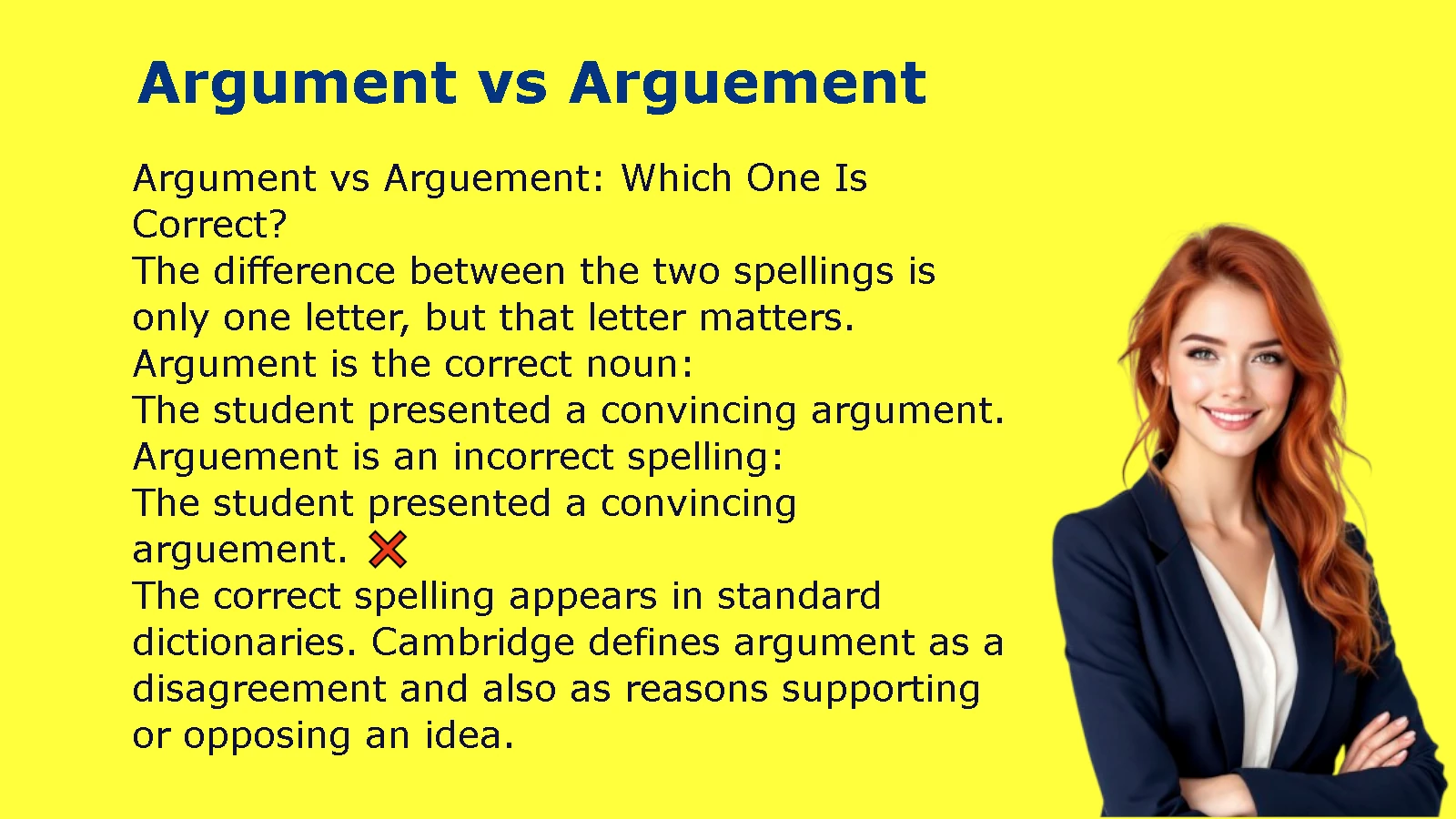
Argument vs Arguement: Which One Is Correct?
The difference between the two spellings is only one letter, but that letter matters.
Argument is the correct noun:
The student presented a convincing argument.
Arguement is an incorrect spelling:
The student presented a convincing arguement. ❌
The correct spelling appears in standard dictionaries. Cambridge defines argument as a disagreement and also as reasons supporting or opposing an idea.
Argument vs arguement at a glance
| Feature | Argument | Arguement |
| Standard English | Yes | No |
| Dictionary spelling | Yes | No |
| Correct noun | Yes | No |
| Used in American English | Yes | No |
| Used in British English | Yes | No |
| Extra e after u | No | Yes |
| Recommended in formal writing | Yes | No |
The simplest correction is therefore:
arguement → argument
What Does Argument Mean?
Argument is a noun with several related meanings. The exact meaning depends on context.
Cambridge identifies argument as both a disagreement and a set of reasons supporting an opinion or position. Dictionary.com also lists meanings involving reasoning, persuasion, subject matter, mathematics, and computing.
Argument as a disagreement
In everyday conversation, an argument can mean a disagreement between people.
For example:
My brother and I had an argument about the car.
Here, argument describes a conflict or disagreement.
More examples:
- They had an argument over the restaurant bill.
- I don’t want to get into an argument with you.
- The couple had an argument about their vacation plans.
- Their argument lasted for nearly an hour.
This meaning can involve anger, but argument does not always mean an angry fight. The surrounding context determines the intensity.
Argument as a reason or set of reasons
In academic, professional, legal, and persuasive writing, an argument can mean a reason or collection of reasons used to support a position.
For example:
The report presents a strong argument for investing in public transportation.
Here, nobody is necessarily fighting. The word refers to a reasoned case.
Collins defines argument in this sense as a statement or set of statements used to convince people that an opinion is correct.
Consider these examples:
- She made a strong argument for changing the schedule.
- The researchers developed an argument based on several studies.
- His central argument was easy to understand.
- The lawyer’s argument relied on the available evidence.
This distinction is important because argument can be constructive rather than confrontational.
Why Is Arguement Incorrect?
The spelling arguement looks tempting because the verb is argue.
You might reason:
argue + ment = arguement
That looks logical at first glance, but the established English noun is argument.
The correct word family
| Word | Correct spelling |
| Verb | argue |
| Past tense | argued |
| Present participle | arguing |
| Noun | argument |
| Adjective | argumentative |
| Noun | argumentation |
Notice the difference:
- argue
- argument
The final e in argue does not remain in argument.
Why does the spelling change?
The noun argument is not simply a modern mechanical combination of the complete spelling argue plus -ment. Its history goes back through Middle English and Old French to Latin argumentum. Dictionary.com dates the English word to the 14th century and traces it through Old French to Latin.
Etymonline similarly traces argument to Old French arguement and Latin argumentum, related to arguere.
That history helps explain why treating the spelling as a simple argue + ment formula can be misleading.
The practical rule
You do not need to memorize the entire etymology to spell it correctly.
Remember:
argue → argument
Not:
argue → arguement
Argument Spelling: A Simple Way to Remember It
A useful memory trick is to focus on the ending:
ARGU + MENT = ARGUMENT
Do not insert another E between the U and M.
Compare the spellings
Correct:
A R G U M E N T
Incorrect:
A R G U E M E N T
The incorrect version contains an extra E after the U.
You can also remember the phrase:
An argument has one “e” before the final “nt.”
The word contains an e, but it does not appear in the argue form before -ment.
A quick spelling test
If you are typing the word and see:
arguement
stop and remove the e after u:
argument
That simple visual check can prevent the most common spelling mistake.
Argument Pronunciation
The pronunciation can also contribute to uncertainty.
Cambridge gives the UK pronunciation as approximately /ˈɑːɡ.jə.mənt/ and the US pronunciation as /ˈɑːrɡ.jə.mənt/.
The word is commonly pronounced roughly like:
AR-gyuh-mənt
The pronunciation does not include a separate syllable corresponding to the incorrect spelling arguement.
American and British pronunciation
| Variety | Approximate pronunciation |
| American English | AR-gyuh-mənt |
| British English | AR-gyuh-mənt |
The exact sound varies by accent, but the spelling remains argument in both varieties.
Argument Examples in Sentences
Understanding the word in context makes the spelling easier to remember.
Everyday disagreement
We had an argument about who should drive.
Their argument started over something very small.
She apologized after the argument.
Academic writing
The essay develops an argument about the effects of technology.
The author supports the main argument with historical evidence.
A clear thesis helps organize an academic argument.
Professional communication
His argument for extending the deadline was reasonable.
The manager presented an argument for changing the workflow.
The report makes a strong argument for additional training.
Legal context
The attorney presented a detailed argument before the court.
The defense built its argument around the available evidence.
Persuasive writing
The article makes an argument for reducing unnecessary expenses.
Her central argument is supported by several examples.
Technical context
The function accepts two arguments.
This final example illustrates an important point: argument has meanings beyond disagreement.
Argument in American and British English
There is no standard American-versus-British spelling difference here.
Both varieties use:
argument
Neither standard variety changes the word to arguement.
Cambridge provides both UK and US entries under the spelling argument.
| English variety | Correct | Incorrect |
| American English | argument | arguement |
| British English | argument | arguement |
| Canadian English | argument | arguement |
| Australian English | argument | arguement |
Therefore, you should not treat arguement as a British spelling.
That is an important distinction because some English words genuinely have different spellings across varieties, such as color/colour and organize/organise. Argument/arguement is not one of those cases.
Argument vs Discussion
Argument and discussion can overlap, but they are not always interchangeable.
A discussion is generally a conversation in which people exchange ideas, information, or opinions. An argument can involve disagreement or can refer to a reasoned case supporting a particular position.
| Argument | Discussion |
| Can involve disagreement | May involve disagreement or agreement |
| Can mean a reasoned case | Usually means an exchange of ideas |
| Can describe a heated dispute | Does not necessarily imply conflict |
| Common in persuasive writing | Common in conversational and academic contexts |
| Can be a reason supporting a position | Can explore several viewpoints |
Examples
We had a discussion about the new schedule.
This does not tell us that anyone became angry.
We had an argument about the new schedule.
This suggests disagreement and may suggest conflict.
In academic writing, however, argument has another meaning:
The paper’s argument is that early intervention improves outcomes.
That does not mean the paper contains a quarrel. It means the paper presents a position supported by reasoning.
Argument vs Debate
Argument and debate are closely related, but the words emphasize different things.
A debate generally involves competing viewpoints being presented and examined. An argument can refer to the reasoning used to support one side.
Compare these examples
The students participated in a debate about the proposal.
This describes the overall activity.
Each student presented an argument supporting their position.
This describes the reasoning or case presented by an individual participant.
The distinction becomes clearer in formal contexts:
| Term | Typical focus |
| Argument | A reason, case, or disagreement |
| Debate | An organized exchange of opposing views |
| Discussion | An exchange of ideas or information |
| Dispute | A disagreement or conflict, often over a specific matter |
An argument can occur during a debate, but the two words are not exact synonyms in every context.
Argument vs Parameter
This distinction becomes particularly important in programming.
In ordinary English, an argument can mean a reason supporting a position. In programming, an argument is a value supplied to a function when the function is called.
For example:
calculateTotal(25, 10)
Here, 25 and 10 are arguments passed to the function.
MDN specifically distinguishes an argument from a parameter: arguments are values supplied as input, while parameters are the names used in the function definition to refer to those values.
Argument vs parameter in programming
| Term | Meaning |
| Argument | The actual value supplied to a function |
| Parameter | The variable/name defined to receive that value |
For example:
function greet(name)
Here, name is the parameter.
When you call:
greet(“Maria”)
“Maria” is the argument.
This technical meaning has nothing to do with an argument between two people.
Common Mistakes With Argument
The most obvious error is writing arguement, but several other mistakes are worth watching.
Writing arguement
Incorrect:
We had a serious arguement yesterday.
Correct:
We had a serious argument yesterday.
Assuming argue + ment keeps the final e
The spelling of the verb does not mean the noun must retain every letter.
Correct:
argue → argument
Confusing argument with argue
Argue is a verb.
They argue about politics.
Argument is a noun.
They had an argument about politics.
You cannot normally replace one with the other without changing the grammatical structure.
Using argument when disagreement is not intended
The word argument can mean a reasoned case, but context matters.
Compare:
Her argument convinced the committee.
Here, argument means her reasoning or case.
She had an argument with her colleague.
Here, it means a disagreement.
Understanding both meanings prevents confusion when reading or writing.
Is Arguement Ever Correct?
Arguement is not the standard spelling of the noun argument.
If you encounter arguement online, in an email, or in an informal post, its appearance does not make it an accepted spelling.
The standard form is:
argument
This is true whether you mean:
- a disagreement,
- a reason,
- a set of reasons,
- a persuasive case,
- a legal position,
- a mathematical concept, or
- a programming value.
Dictionary sources consistently give argument as the standard form.
Argument: Synonyms and Related Words
The best synonym depends on which meaning of argument you intend.
Synonyms for argument meaning disagreement
- disagreement
- dispute
- quarrel
- altercation
- conflict
These words are not identical.
For example, quarrel often suggests a personal disagreement, while dispute can describe a disagreement over a particular issue.
Synonyms for argument meaning reason or case
- reason
- case
- claim
- rationale
- reasoning
- point
- grounds
For example:
She presented a strong argument for the proposal.
Could become:
She presented a strong case for the proposal.
But replacing argument with quarrel would completely change the meaning.
A useful comparison
| Word | Typical meaning |
| Argument | Reasoned case or disagreement |
| Reason | Explanation or basis for a conclusion |
| Case | Set of reasons supporting a position |
| Dispute | Serious disagreement |
| Quarrel | Personal or angry disagreement |
| Debate | Exchange of opposing views |
| Discussion | Exchange of ideas or information |
Argument in Different Contexts
One reason this word deserves more than a simple spelling correction is its wide range of uses.
Argument in everyday English
In everyday speech, argument often refers to a disagreement:
I had an argument with my roommate.
The meaning is usually obvious from the surrounding context.
Argument in academic writing
In an academic paper, an argument is generally the central position or case developed through reasoning and evidence.
For example:
The paper’s central argument is that early education can influence later academic outcomes.
A strong academic argument usually has a clear claim and supporting evidence.
Argument in professional writing
Businesses may use argument when discussing a proposal or position:
The report provides a convincing argument for upgrading the system.
Here, the word does not imply that employees are fighting.
Argument in law
In legal contexts, an argument can refer to the reasoning or position presented by a lawyer or party.
For example:
The attorney’s argument focused on the available evidence.
Argument in mathematics
The word also has specialized mathematical meanings. Dictionary.com lists argument as a term involving the independent variable of a function and, in certain contexts, an angle associated with a complex number.
Argument in programming
In programming, an argument is a value supplied to a function.
For example:
function greet(name) {
return “Hello, ” + name;
}
greet(“Alex”);
Here, “Alex” is the argument passed to greet.
This technical definition is documented by MDN.
The History of the Word Argument
The history of argument also explains why it should not be treated as a simple modern spelling construction.
Etymonline traces the English noun to Middle English usage through Old French arguement and ultimately to Latin argumentum, meaning reasoning, evidence, support, or proof.
Dictionary.com dates its first recorded English use to approximately 1325–1375 and likewise traces it through Old French to Latin.
The meaning has also developed over time.
Earlier uses emphasized reasoning, evidence, and support for a proposition. The meaning associated with a quarrel or verbal disagreement developed later. Etymonline dates the sense of argument as a quarrel to the early 20th century.
That history is useful because many modern speakers primarily associate argument with a fight, while formal writing often uses it to mean a reasoned case.
Argument vs Arguement: A Practical Case Study
Imagine a student writing an essay.
First draft
My main arguement is that students need more practical experience.
The meaning is clear, but the spelling is incorrect.
Corrected version
My main argument is that students need more practical experience.
Now the sentence uses the standard spelling.
The word also has the correct academic meaning: a central position supported by reasoning.
What the student should remember
The problem is not the meaning. The problem is the spelling.
Arguement ❌
Argument ✅
This is why checking the final spelling matters even when a sentence sounds completely natural.
How to Use Argument Correctly
Here are several useful patterns.
Argument + about
They had an argument about money.
This commonly introduces the subject of a disagreement.
Argument + over
The two neighbors had an argument over the property line.
Over often introduces the issue that caused the disagreement.
Argument + for
She made an argument for extending the deadline.
This introduces the position being supported.
Argument + against
The report presents an argument against the proposal.
This introduces the position being opposed.
Strong argument
There is a strong argument for changing the policy.
Main argument
The author’s main argument appears in the second section.
Compelling argument
She presented a compelling argument supported by evidence.
These patterns are particularly useful in formal and academic writing.
Argument Grammar: Is It a Noun or Verb?
Argument is a noun.
The related verb is argue.
| Word | Part of speech | Example |
| argue | Verb | They argue about the issue. |
| argument | Noun | They had an argument. |
| argued | Verb | She argued that the plan was too expensive. |
| arguing | Verb form | They were arguing about the decision. |
| argumentative | Adjective | He can be argumentative during meetings. |
| argumentation | Noun | The course focuses on formal argumentation. |
This distinction is helpful when correcting sentences.
Incorrect noun usage
We had an argue yesterday. ❌
Correct noun usage
We had an argument yesterday. ✅
Correct verb usage
We argued yesterday. ✅
Plural of Argument
The plural of argument is:
arguments
Examples:
- The lawyers presented their arguments.
- The paper examines several competing arguments.
- Their arguments became increasingly detailed.
- The students compared the two arguments.
There is no spelling change other than adding -s.
argument → arguments
Why Do People Spell Argument as Arguement?
The error is understandable because English contains many words where adding a suffix preserves the original spelling.
A writer may naturally look at:
argue
and mentally build:
argue + ment
The resulting arguement feels visually plausible.
Pronunciation can also contribute because the word is not pronounced exactly as a reader might expect from the letters in argue.
The important point is that a spelling that looks logically constructed is not necessarily the established English form.
Other familiar words also have spelling patterns that cannot always be predicted simply by attaching a suffix to the base word. Learning the established form is often more reliable than trying to construct it letter by letter.
Facts to Remember About Argument vs Arguement
Keep these points in mind whenever you encounter this spelling question:
- Argument is the correct spelling.
- Arguement is a misspelling.
- The correct spelling is used in both American and British English.
- Argument is a noun.
- Argue is the related verb.
- An argument can mean a disagreement.
- It can also mean a reason or set of reasons supporting a position.
- In academic writing, an argument can be the central case or position developed by a writer.
- In programming, an argument is a value passed to a function.
- Parameter and argument have different technical meanings in programming.
- The plural is arguments.
- The correct spelling is argument, not arguement.
Argument vs Arguement FAQs
Is argument or arguement correct?
Argument is correct. Arguement is a misspelling.
We had an argument about the decision.
How do you spell argument?
The correct spelling is:
A-R-G-U-M-E-N-T
Not:
A-R-G-U-E-M-E-N-T
Is arguement a word?
Arguement is not the standard spelling of the English noun. The correct form is argument.
Why is arguement spelled incorrectly?
The mistake usually comes from assuming that the noun is formed by simply adding -ment to the complete spelling of argue. The established noun is argument, without the extra e.
Is argument spelled differently in British English?
No. Argument is the standard spelling in both British and American English. Cambridge lists the same spelling for both varieties.
What is the plural of argument?
The plural is arguments.
The students presented several arguments.
Is argument a noun or a verb?
Argument is a noun. The related verb is argue.
They argued about the problem.
Their argument lasted an hour.
What is the difference between argument and disagreement?
A disagreement generally means that people do not share the same opinion. An argument can mean a disagreement, but it can also mean a reasoned case supporting a position.
What is the difference between an argument and a debate?
A debate is generally an exchange of opposing views, often in an organized setting. An argument can be one side’s reasoning or can refer to a disagreement itself.
What is the difference between an argument and a discussion?
A discussion is an exchange of ideas or information and does not necessarily involve disagreement. An argument may involve disagreement or may refer to a reasoned position.
What is an argument in programming?
In programming, an argument is a value supplied to a function when it is called. A parameter is the name used in the function definition to receive that value.
Can argument mean a reason?
Yes. In formal and persuasive contexts, an argument can mean a reason or set of reasons used to support or oppose a position.
Conclusion: Argument or Arguement?
When choosing between argument vs arguement, there is only one standard spelling to use:
Argument is correct.
Arguement is incorrect.
The confusion is understandable because the word is related to argue, but the noun does not retain the final e from argue. The correct form is argument in both American and British English.
The word itself has several meanings. It can describe an everyday disagreement, a reasoned case, a set of supporting reasons, a legal position, a mathematical concept, or a programming value.
So, whether you are writing an essay, email, report, legal document, or piece of code documentation, remember the simple rule:
Argue → Argument
If you see arguement in your writing, remove the extra e and use argument instead.