Aggressive vs Agressive is a common spelling question because the two forms look almost identical, but only one is correct in standard English. If you’ve wondered whether the correct spelling is “aggressive” or “agressive,” the answer is closely connected to English spelling patterns, pronunciation, and the double g and double s used in the standard form.
The aggressive meaning refers to someone or something that is forceful, hostile, confrontational, or strongly assertive, depending on the context. The correct spelling is aggressive, with two g’s and two s’s. Agressive is a common misspelling and should generally be avoided in standard English. Related terms such as hostile, forceful, assertive, confrontational, combative, and pushy can have similar meanings, but they are not always interchangeable.
In this guide, you’ll learn whether “aggressive” or “agressive” is correct, why “aggressive” has two g’s and two s’s, how to remember the spelling, and how to use the word correctly in sentences. You’ll also see clear examples and common spelling mistakes to help you avoid confusion.
By the end, you’ll know exactly why aggressive is the correct spelling and how to use this commonly misspelled word naturally and correctly.
Quick Answer: Aggressive or Agressive?
| Spelling | Correct? | Explanation |
| Aggressive | ✅ Yes | Standard English spelling |
| Agressive | ❌ No | Common misspelling |
| Aggresive | ❌ No | Missing one s |
| Agresive | ❌ No | Missing one g and one s |
The correct spelling is:
Aggressive
The easiest way to remember it is to focus on the repeated letters:
GG + SS
So the middle of the word looks like this:
a + gg + re + ss + ive
Correct spelling
The customer became aggressive during the argument.
Incorrect spelling
The customer became agressive during the argument.
The second sentence contains a spelling error because agressive is missing the second g.
What Is the Correct Spelling: Aggressive or Agressive?
The correct spelling is aggressive.
Agressive is a misspelling that results from dropping one of the two g’s. It can look plausible because English contains many words where a single consonant appears between vowels, and repeated consonants can be easy to overlook when writing quickly.
However, standard dictionaries list aggressive, not agressive, as the adjective. Cambridge gives the pronunciation as /əˈɡres.ɪv/ in both British and American English listings and defines the word in several contexts.
Compare the spellings carefully:
- Aggressive → correct
- Agressive → incorrect
- Aggresive → incorrect
- Agresive → incorrect
A useful visual check is:
AGG + RESS + IVE
The repeated letters are not optional.
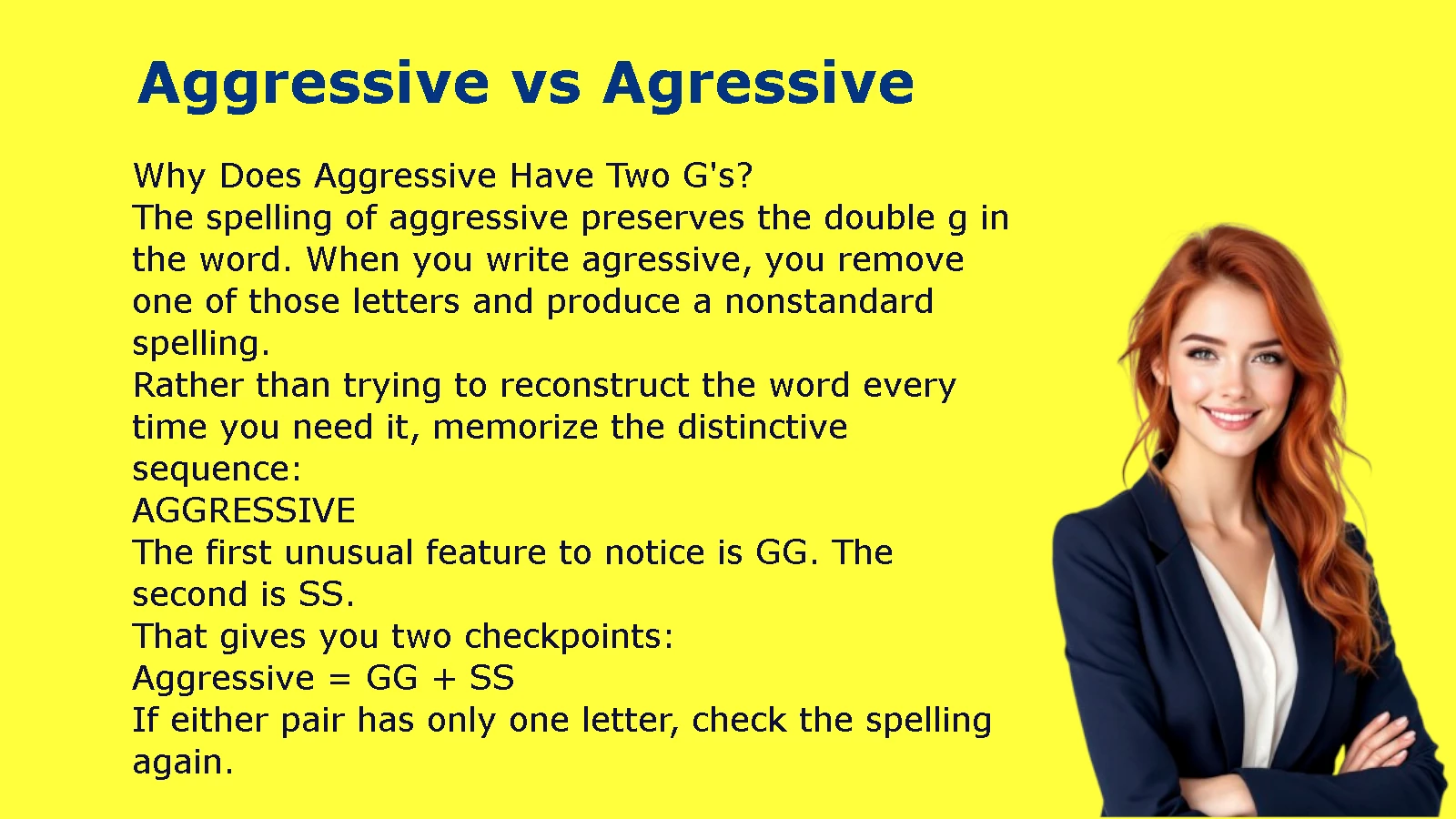
Why Does Aggressive Have Two G’s?
The spelling of aggressive preserves the double g in the word. When you write agressive, you remove one of those letters and produce a nonstandard spelling.
Rather than trying to reconstruct the word every time you need it, memorize the distinctive sequence:
AGGRESSIVE
The first unusual feature to notice is GG. The second is SS.
That gives you two checkpoints:
Aggressive = GG + SS
If either pair has only one letter, check the spelling again.
Aggressive Meaning
Aggressive generally describes someone or something that uses force, pressure, or strong action.
One major meaning concerns behavior. In this sense, an aggressive person may show anger and a willingness to attack or confront others. Cambridge defines this sense as showing anger and a willingness to attack other people.
For example:
The man became aggressive when the security guard asked him to leave.
Here, aggressive describes hostile or confrontational behavior.
The word also has a broader meaning. Someone can be described as aggressive when they are highly determined to win or succeed and use forceful methods to achieve that goal. Cambridge gives examples involving aggressive marketing, election campaigns, negotiation, and competition.
For example:
The company adopted an aggressive marketing strategy.
That sentence does not necessarily mean the company physically attacked anyone. Instead, aggressive means unusually forceful, competitive, or ambitious.
Main meanings of aggressive
The meaning depends heavily on context:
| Context | Meaning |
| Personal behavior | Angry, hostile, or confrontational |
| Physical behavior | Willing to attack or use force |
| Business | Highly forceful or competitive |
| Marketing | Strong and persistent promotional activity |
| Sports | Forceful and highly competitive |
| Negotiation | Firm, demanding, or forceful |
| Medicine | Serious, fast-growing, or requiring strong treatment |
That range is important because aggressive does not always mean violent.
Aggressive Pronunciation
Aggressive is pronounced approximately as:
uh-GRESS-iv
The stress falls on the second syllable. Cambridge gives the pronunciation /əˈɡres.ɪv/.
The pronunciation can actually help with the spelling because the word has a clear gress sound in the middle.
A common mistake is to let the pronunciation influence the spelling too strongly. English spelling does not always represent every sound with a one-to-one relationship, so hearing aggressive does not automatically tell you that the written form needs GG + SS.
The safest approach is to memorize the complete spelling:
aggressive
Why Is Agressive Incorrect?
Agressive is incorrect because it omits one of the two g’s in aggressive.
Compare them letter by letter:
Correct:
A G G R E S S I V E
Incorrect:
A G R E S S I V E
The incorrect version has only one g.
This is a spelling error, not a difference between British and American English. Unlike pairs such as colour/color or organise/organize, agressive is not a standard regional alternative to aggressive.
The spelling pattern to remember
Break the word into manageable pieces:
ag + gressive
Or use the visual pattern:
AGG + RESS + IVE
The most useful memory cue is:
Aggressive has double G and double S.
That gives you a quick way to proofread the word.
Aggressive vs Agressive Examples
Seeing the correct and incorrect forms side by side makes the distinction straightforward.
| Incorrect | Correct |
| He became agressive during the meeting. | He became aggressive during the meeting. |
| The dog appeared agressive. | The dog appeared aggressive. |
| She took an agressive approach. | She took an aggressive approach. |
| The company launched an agressive campaign. | The company launched an aggressive campaign. |
| His tone sounded agressive. | His tone sounded aggressive. |
| They used an agressive strategy. | They used an aggressive strategy. |
| The player adopted an agressive style. | The player adopted an aggressive style. |
| The negotiator was described as agressive. | The negotiator was described as aggressive. |
The important point is simple: replace agressive with aggressive in every one of these sentences.
Aggressive in a Sentence
The meaning of aggressive changes slightly depending on the noun it modifies.
Describing a person
The manager became aggressive when the employee challenged his decision.
Here, the word refers to confrontational behavior.
Describing an animal
The dog became aggressive when a stranger entered the yard.
In this context, aggressive behavior may involve threatening or attacking.
Describing business
The company pursued an aggressive expansion strategy.
Here, the meaning is forceful and ambitious rather than necessarily hostile.
Describing marketing
The brand used an aggressive marketing campaign to attract new customers.
The expression refers to strong, competitive, or persistent marketing activity. Cambridge specifically lists aggressive marketing tactics as an example of the nonviolent sense of the word.
Describing sports
The team played an aggressive style of basketball.
Here, the word can describe forceful and highly competitive play.
Describing negotiation
She took an aggressive negotiating position.
This suggests that she used a particularly forceful or demanding approach.
Describing medicine
In specialized medical language, aggressive can describe a disease or condition that progresses rapidly or becomes worse quickly. Cambridge also uses the term for strong treatment used in serious medical situations.
For example:
The doctors were concerned about the tumor’s aggressive growth.
This is a specialized use and should not be confused with the everyday meaning involving anger or hostility.
How to Remember the Spelling of Aggressive
The simplest memory trick is:
Aggressive = GG + SS
Think of the word as four pieces:
AGG + RESS + IVE
That is easier to remember than trying to memorize all ten letters individually.
Use the double-letter test
Whenever you write the word, check two things:
- Does it have GG after the initial A?
- Does it have SS before IVE?
If the answer is yes, you probably have the correct spelling:
AGG RESS IVE
If you see:
AG RESS IVE
you have written agressive, which is incorrect.
Connect the related words
The related noun aggression also begins with aggr-:
- aggressive
- aggression
- aggressor
- aggressively
- aggressiveness
Seeing the same beginning across these words can make aggr- easier to remember.
Common Mistakes With Aggressive
The most common errors involve dropping one or more repeated letters.
Agressive
Agressive has one g instead of two.
❌ agressive
✅ aggressive
This is the exact spelling error in the phrase aggressive vs agressive.
Aggresive
Aggresive has two g’s but only one s.
❌ aggresive
✅ aggressive
Remember that the word contains both repeated consonants.
Agresive
Agresive drops one g and one s.
❌ agresive
✅ aggressive
This version is even farther from the standard spelling.
Agressivee
Another occasional error is adding an unnecessary e at the end.
❌ agressivee
✅ aggressive
The word ends in -ive, not -ivee.
Agressive vs Aggressive in Formal Writing
Spelling matters particularly in professional and academic writing.
A typo in an informal text may be understood from context, but repeated spelling errors can distract readers in:
- resumes
- cover letters
- academic assignments
- business reports
- professional emails
- presentations
- websites
- published articles
A spelling checker can catch many instances of agressive, but learning the correct form is better than relying entirely on automated correction.
Aggressive Word Forms
Aggressive belongs to a larger word family. Understanding these related forms helps you recognize the spelling pattern.
| Word | Part of speech | Meaning | Example |
| aggressive | Adjective | Forceful, hostile, or strongly competitive | He took an aggressive approach. |
| aggressively | Adverb | In an aggressive manner | The company expanded aggressively. |
| aggression | Noun | Aggressive behavior or action | The incident involved aggression. |
| aggressor | Noun | A person or group that initiates an attack | The aggressor was identified. |
| aggressiveness | Noun | The quality of being aggressive | His aggressiveness was noticeable. |
Cambridge recognizes aggressiveness in both behavior-related and determination-related senses, while its dictionary entry for aggressive includes behavioral, competitive, business, and medical uses.
Aggressively
Aggressively is the adverb form.
The company is aggressively pursuing new customers.
It tells you how something is being done.
Aggression
Aggression is a noun.
The incident involved aggression toward another player.
Merriam-Webster’s thesaurus associates aggression with concepts such as hostility, combativeness, and an inclination to fight or quarrel.
Aggressor
An aggressor is a person or group that initiates an attack or hostile action.
The investigation attempted to identify the aggressor.
Aggressive vs Aggression
These two words are related but perform different grammatical jobs.
Aggressive is an adjective:
He has an aggressive personality.
Aggression is a noun:
His aggression caused concern.
A useful test is to ask what the sentence needs.
If you need to describe a person, action, strategy, or condition, use aggressive.
If you need to name the behavior or quality itself, use aggression.
Compare the two
| Aggressive | Aggression |
| Adjective | Noun |
| Describes something | Names a behavior or quality |
| an aggressive player | the player’s aggression |
| aggressive behavior | displays of aggression |
| an aggressive strategy | unnecessary aggression |
Is Aggressive Always a Negative Word?
No.
The word often has a negative meaning when it describes hostile or threatening behavior. Cambridge’s primary behavioral definition connects it with anger and willingness to attack.
However, aggressive can be neutral or even favorable when it describes determination, competition, or forceful action.
Consider these examples:
The customer became aggressive toward the staff.
This is clearly negative.
Now compare:
The sales team used an aggressive growth strategy.
Here, aggressive means highly forceful or ambitious. It does not necessarily imply anger or violence.
The same distinction appears in sports:
The defender played an aggressive game.
The meaning is likely closer to forceful, intense, or highly competitive than personally hostile.
Context therefore matters.
Aggressive in business
Business English frequently uses aggressive to describe strong competitive action. Cambridge’s Business English definition describes it as something done in a very forceful and competitive way to gain an advantage.
Common expressions include:
- aggressive marketing
- aggressive expansion
- aggressive pricing
- aggressive sales strategy
- aggressive growth
- aggressive competition
- aggressive recruiting
- aggressive negotiation
For example:
The startup adopted an aggressive expansion strategy.
The phrase suggests that the company is pursuing expansion rapidly or forcefully.
Aggressive vs Passive-Aggressive
Both are related expressions, but they describe different styles of behavior.
Aggressive behavior is typically direct and forceful. A person may openly confront someone, raise their voice, issue threats, or attempt to dominate an interaction.
Passive-aggressive behavior is generally indirect. Instead of openly expressing hostility or disagreement, someone may communicate it through indirect resistance, deliberate delay, sarcasm, or other indirect actions.
Simple comparison
| Aggressive | Passive-aggressive |
| Directly confrontational | Indirectly confrontational |
| Openly expresses anger or hostility | May conceal anger or resentment |
| Uses direct pressure | Uses indirect resistance |
| “You’re not doing this correctly.” | “Sure, I’ll get to it eventually.” |
These descriptions are broad behavioral distinctions. Actual interactions can be more complicated than either label suggests.
Aggressive vs Assertive
Aggressive and assertive are sometimes confused because both can involve being firm and expressing what you want.
The difference is mainly in how that firmness is expressed.
Assertive communication generally means expressing your needs, views, or boundaries clearly while respecting the other person’s rights.
Aggressive communication can involve imposing your wishes through hostility, intimidation, excessive pressure, or disregard for others.
Compare:
Assertive: “I disagree with that proposal, and I’d like to explain why.”
Aggressive: “Your proposal is ridiculous. We’re doing it my way.”
The first statement is firm without being inherently hostile. The second uses a confrontational tone.
This distinction is especially useful in workplace communication because someone can be confident and forceful without being aggressive.
Aggressive vs Hostile
Aggressive and hostile overlap, but they are not perfect synonyms.
Hostile generally emphasizes opposition, unfriendliness, or antagonism.
Aggressive can emphasize action, force, pressure, or willingness to attack.
For example:
The customer was hostile toward the staff.
This emphasizes an unfriendly or antagonistic attitude.
The customer became aggressive toward the staff.
This can suggest that the person’s behavior became actively confrontational or threatening.
The best word depends on what you want to emphasize.
Aggressive Synonyms
The appropriate synonym depends on context.
When aggressive means hostile
Possible alternatives include:
- hostile
- confrontational
- antagonistic
- combative
- belligerent
- fierce
When aggressive means forceful
Possible alternatives include:
- forceful
- assertive
- determined
- vigorous
- energetic
- strong
When aggressive means competitive
Possible alternatives include:
- competitive
- ambitious
- driven
- enterprising
- determined
These words are not interchangeable in every sentence.
For example, replacing aggressive with assertive can change the meaning considerably. Likewise, hostile usually carries a stronger negative implication than competitive.
When Should You Use Aggressive?
Use aggressive when you need an adjective describing forceful, hostile, highly competitive, or rapidly progressing behavior or action.
Here are several common patterns:
Aggressive behavior
The school has rules against aggressive behavior.
Aggressive approach
The company took an aggressive approach to international expansion.
Aggressive strategy
The team developed an aggressive strategy for increasing sales.
Aggressive marketing
The brand is known for its aggressive marketing.
Aggressive player
The coach praised the player’s aggressive style.
Aggressive treatment
The doctors considered aggressive treatment because the condition was serious.
In each case, the surrounding words help determine which sense of aggressive is intended.
A Practical Spelling Case Study
Imagine that you are writing a business report and want to use the phrase:
The company adopted an agressive marketing strategy.
At first glance, the sentence looks perfectly understandable. The problem is the spelling.
The correct version is:
The company adopted an aggressive marketing strategy.
Why?
Because the standard spelling contains GG:
aggressive
The meaning of the sentence does not change. Only the spelling needs correction.
Now consider another sentence:
The company aggressively expanded into new markets.
Here, aggressively is the adverbial form. The same aggr- spelling pattern remains.
This demonstrates why learning the word family is useful: recognizing aggressive, aggressively, aggression, and aggressor can reinforce the spelling of each related form.
Facts to Remember About Aggressive vs Agressive
Here are the essential facts in one place:
- Aggressive is the correct spelling.
- Agressive is a misspelling.
- Aggressive contains two g’s.
- Aggressive contains two s’s.
- The pronunciation is approximately uh-GRESS-iv.
- Aggressive is an adjective.
- Aggression is a noun.
- Aggressively is an adverb.
- Aggressor is a noun.
- Aggressiveness is a noun.
- Aggressive can describe hostile behavior.
- Aggressive can also describe forceful competition or determination.
- In medical contexts, aggressive can describe a serious condition that progresses quickly or strong treatment.
- Aggressive is not always synonymous with violent.
- Aggressive and assertive are not interchangeable.
- The easiest spelling memory aid is GG + SS.
Frequently Asked Questions About Aggressive vs Agressive
Is aggressive spelled with one or two g’s?
Aggressive is spelled with two g’s:
AGGRESSIVE
The spelling contains GG immediately after the initial A.
Is aggressive spelled with one or two s’s?
It has two s’s:
AGGRESSIVE
The middle-to-late portion is SSIVE.
A useful memory pattern is therefore:
GG + SS
Is agressive a word?
Agressive is not the standard English spelling of the word. It is a common misspelling of aggressive.
If you mean the adjective describing someone or something as forceful, hostile, or highly competitive, use aggressive.
Why do people spell aggressive as agressive?
The error usually occurs because the writer drops one of the repeated letters. Since aggressive has both GG and SS, it contains two places where a repeated consonant can be accidentally reduced to one.
The safest way to avoid the error is to remember:
aggressive = GG + SS
What is the meaning of aggressive?
Aggressive can mean showing anger and a willingness to attack. It can also describe someone or something that uses forceful methods and is strongly determined to win or succeed.
For example:
The dog became aggressive.
and:
The company launched an aggressive marketing campaign.
The first example concerns behavior. The second describes a forceful business strategy.
How do you spell aggressive correctly?
Spell it:
A-G-G-R-E-S-S-I-V-E
The two most important features are GG and SS.
What is the noun form of aggressive?
The main related noun forms are aggression and aggressiveness.
Use aggression when referring to aggressive behavior or action:
The incident involved physical aggression.
Use aggressiveness when referring to the quality or degree of being aggressive:
The player’s aggressiveness helped the team compete.
Cambridge recognizes aggressiveness in both attacking behavior and determination to win or succeed.
What is the difference between aggressive and assertive?
Aggressive can imply hostility, excessive force, confrontation, or pressure.
Assertive generally describes clear and confident communication or behavior without necessarily implying hostility.
For example:
She was assertive during the negotiation.
means she expressed herself firmly and confidently.
She was aggressive during the negotiation.
suggests a more forceful, confrontational, or demanding approach.
What is the difference between aggressive and passive-aggressive?
Aggressive behavior is generally direct and forceful, while passive-aggressive behavior tends to express resistance, anger, or hostility indirectly.
The two terms should not be treated as interchangeable.
Can aggressive have a positive meaning?
Yes, depending on context.
In business, sports, marketing, or competition, aggressive can describe a highly determined or forceful approach rather than physical hostility.
For example:
The company pursued an aggressive growth strategy.
Here, the word describes the intensity of the strategy, not an attack on another person.
Is aggressive a noun or adjective?
Aggressive is an adjective.
Examples:
- an aggressive player
- an aggressive strategy
- aggressive behavior
- an aggressive campaign
The related noun is aggression.
What is the adverb form of aggressive?
The adverb is aggressively.
The company is aggressively pursuing new opportunities.
It describes the manner in which an action is performed.
Final Takeaway: Aggressive vs Agressive
When choosing between aggressive vs agressive, there is only one correct standard spelling:
Aggressive ✅
Agressive ❌
The easiest way to remember it is GG + SS:
A-G-G-R-E-S-S-I-V-E
The word itself has several meanings. It can describe hostile or confrontational behavior, but it can also refer to forceful competition, determined action, business strategies, marketing, sports, or rapidly progressing medical conditions.
Remembering the word family can make the spelling even easier:
aggressive → aggressively → aggression → aggressor → aggressiveness
So, whenever you are unsure whether to write agressive or aggressive, look for the double letters.
GG + SS = aggressive.