Have you ever wondered whether adolescent or adolecent is the correct spelling? Adolescent vs Adolecent can be confusing because the two words look almost identical, especially when you’re writing quickly. However, only one is the correct spelling, while the other is a common spelling mistake.
Adolescent is the correct spelling, while adolecent is a misspelling. The word adolescent refers to a person who is developing from a child into an adult, usually during the teenage years. It can also describe anything related to this stage of development. Adolecent has no separate meaning or usage in standard English.
Examples:
- The adolescent struggled to adjust to the changes of teenage life.
- Parents often notice significant changes during adolescent development.
The confusion is understandable. People often search for adolescent vs adolecent, adolescent or adolecent, which spelling is correct, or adolecent meaning in English because the missing s in adolecent can be easy to overlook. But here’s the key point: adolecent is not an alternative spelling of adolescent. The correct form contains an s: adolescent.
In this guide, you’ll learn the complete difference between Adolescent vs Adolecent, including their meaning, pronunciation, origin, correct spelling, and usage. You’ll also discover why adolecent is commonly misspelled and see clear examples to help you remember the correct spelling.
Adolescent vs Adolecent: Which Spelling Is Correct?
Adolescent is the correct spelling.
Adolecent is incorrect.
The difference is just one letter, but that letter matters. The standard spelling contains sc near the end:
adolescent
Break the word into a useful visual pattern:
a-d-o-l-e-s-c-e-n-t
The incorrect version drops the s:
a-d-o-l-e-c-e-n-t
That makes adolecent look plausible at first glance. It isn’t, though. Standard English uses adolescent, not adolecent.
| Spelling | Correct? | Meaning |
| adolescent | ✅ Yes | A young person developing into adulthood; also an adjective relating to adolescence |
| adolecent | ❌ No | Misspelling of adolescent |
So, if you’re writing an essay, article, report, email, school assignment, or professional document, use adolescent.
The easiest spelling check
When you’re unsure, connect the word to adolescence.
Both words contain the same central spelling:
- adolescent
- adolescence
That connection gives you a simple memory hook. If you remember adolescence, you’ll have a much easier time remembering adolescent.
What Does Adolescent Mean?
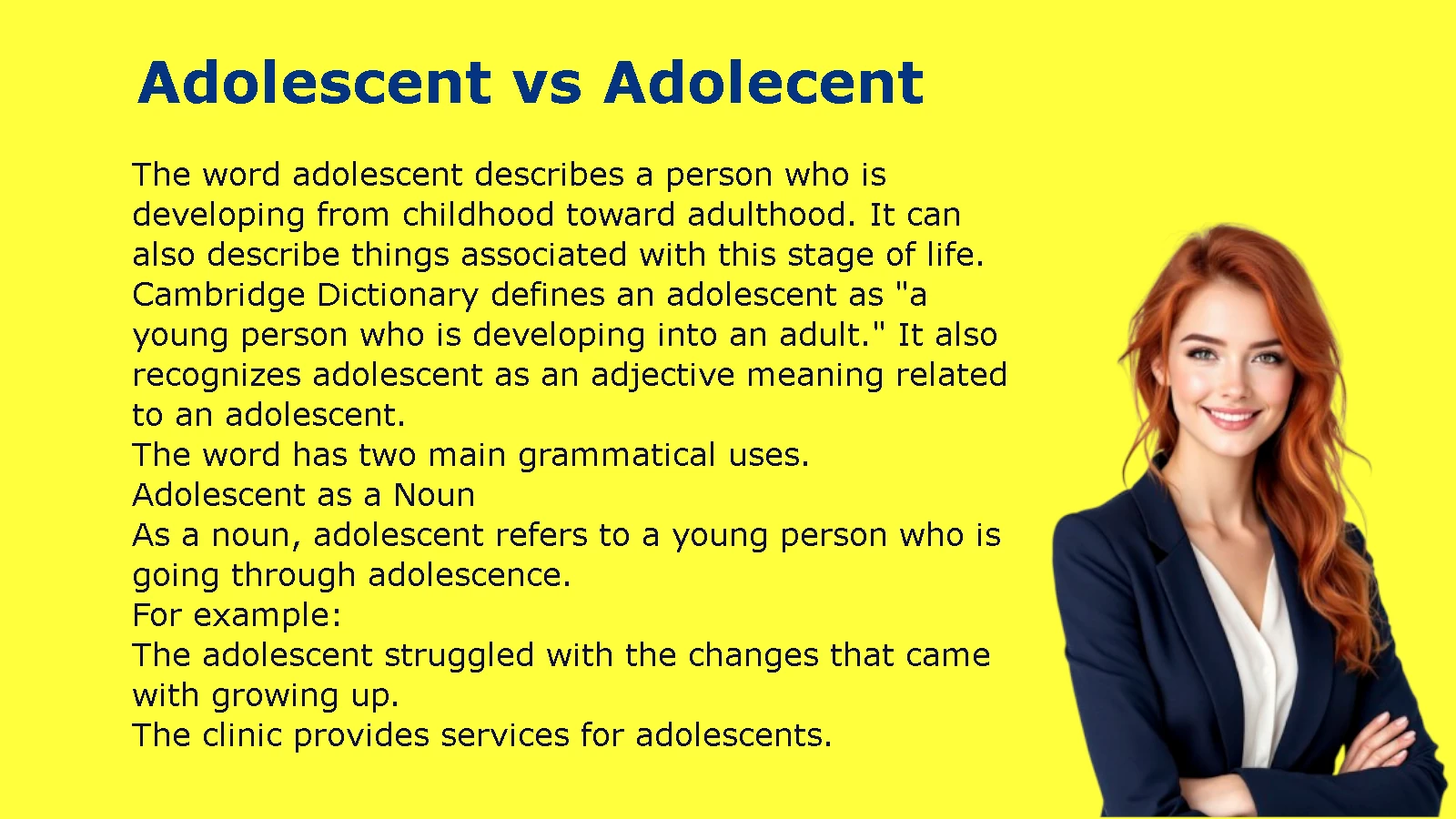
The word adolescent describes a person who is developing from childhood toward adulthood. It can also describe things associated with this stage of life.
Cambridge Dictionary defines an adolescent as “a young person who is developing into an adult.” It also recognizes adolescent as an adjective meaning related to an adolescent.
The word has two main grammatical uses.
Adolescent as a Noun
As a noun, adolescent refers to a young person who is going through adolescence.
For example:
- The adolescent struggled with the changes that came with growing up.
- The clinic provides services for adolescents.
- Several adolescents participated in the research project.
- The teacher worked closely with each adolescent.
- Parents often notice significant changes during their child’s adolescent years.
The plural form is adolescents.
You can therefore write:
The program supports adolescents from different backgrounds.
You wouldn’t write adolescent’s unless you’re showing possession.
For example:
The adolescent’s parents attended the meeting.
Here, adolescent’s means something belongs to one adolescent.
Adolescent as an Adjective
Adolescent can also act as an adjective.
In this role, it describes something connected with adolescence or young people in this stage of development.
Common combinations include:
- adolescent development
- adolescent health
- adolescent behavior
- adolescent psychology
- adolescent medicine
- adolescent mental health
- adolescent development
- adolescent education
- adolescent girls
- adolescent boys
- adolescent relationships
For example:
Researchers examined adolescent development during the study.
Here, adolescent doesn’t refer to a particular person. It describes the type of development being discussed.
This distinction becomes especially useful in academic and professional writing.
What Does Adolecent Mean?
Adolecent is a misspelling of adolescent.
It doesn’t represent a separate standard English word with a different definition. If you see adolecent in a sentence, the writer almost certainly intended to write adolescent.
For example:
❌ The program helps adolecent students.
The corrected version is:
✅ The program helps adolescent students.
Another example:
❌ Adolescence can be a challenging period for an adolecent.
The corrected sentence is:
✅ Adolescence can be a challenging period for an adolescent.
This distinction matters because spelling errors can change how polished your writing appears. In casual messages, someone might understand adolecent immediately. In formal writing, however, the error can distract the reader.
Why Is Adolescent Often Misspelled as Adolecent?
The spelling mistake makes sense when you look at how the word sounds.
Adolescent contains several syllables, and the s isn’t always strongly emphasized in ordinary speech. When people write the word based mainly on how it sounds, they may leave out the letter.
The pronunciation also doesn’t give you a simple one-to-one spelling pattern. Cambridge lists the US pronunciation as approximately /ˌæd.əˈles.ənt/.
That’s one reason spelling mistakes can occur even when someone knows exactly what the word means.
Other factors include:
- The word has several syllables.
- The s can be easy to overlook.
- Adolecent visually resembles the correct spelling.
- Writers may confuse it with related words.
- Fast typing can cause letters to disappear.
- People sometimes spell unfamiliar words according to pronunciation.
In other words, adolecent isn’t a random-looking mistake. It’s a predictable spelling error caused by the similarity between the two forms.
How to Remember the Spelling of Adolescent
The best trick is to remember the related noun adolescence.
Think of the pair:
adolescent → adolescence
Both contain sc.
Another useful method is to divide the spelling visually:
ADOL + ESC + ENT
The middle ESC gives you a useful checkpoint.
You can also memorize this simple rule:
If you can spell adolescence, you can spell adolescent.
For example:
- adolescent
- adolescence
- adolescents
- adolescent development
All of these forms retain the s.
A quick spelling test
Before submitting a document, look at the word and ask:
Did I include the S after “adole”?
If yes, you probably have the correct form:
adolescent
If the word appears as:
adolecent
add the missing s.
It’s a tiny check that prevents a very common-looking mistake.
Adolescent and Adolescence: What’s the Difference?
Although adolescent and adolescence are closely related, they aren’t interchangeable.
Adolescent usually refers to the person or describes something related to that person or developmental stage.
Adolescence refers to the stage or period itself.
| Word | Part of Speech | Meaning | Example |
| adolescent | Noun | A young person developing toward adulthood | The adolescent joined the program. |
| adolescent | Adjective | Relating to adolescence | The study examined adolescent health. |
| adolescence | Noun | The developmental period between childhood and adulthood | Adolescence can involve major changes. |
Think of the distinction this way:
Person → adolescent
Period → adolescence
So:
The adolescent experienced rapid changes during adolescence.
That sentence shows the relationship clearly.
How Old Is an Adolescent?
Age definitions can vary depending on the organization and context. The World Health Organization generally defines adolescents as people aged 10 to 19. It describes adolescence as a distinct phase of life between childhood and adulthood.
WHO also commonly divides this group into:
- Young adolescents: ages 10–14
- Older adolescents: ages 15–19
However, age isn’t the only factor involved in the concept of adolescence. WHO notes that adolescence involves biological, developmental, and social changes and that societies can define the transition from childhood to adulthood differently.
That explains why adolescent and teenager shouldn’t always be treated as perfect synonyms.
Why the age distinction matters
A teenager is specifically someone between 13 and 19 years old according to Cambridge Dictionary.
The WHO definition of adolescence starts earlier, at age 10.
That creates an important difference.
A 12-year-old can be considered an adolescent under the WHO definition, but that person isn’t a teenager.
Likewise, the terms can serve different purposes in professional writing. Medical, developmental, educational, and public-health contexts often use adolescent because it describes a developmental stage rather than simply an age ending in “-teen.”
Adolescent vs Teenager
Adolescent and teenager overlap, but they aren’t identical.
A teenager is defined by age: someone from 13 through 19.
An adolescent is described in relation to a developmental stage. WHO uses ages 10 through 19 for its standard public-health definition.
| Term | Typical definition | Main emphasis |
| Adolescent | Generally ages 10–19 in WHO usage | Developmental stage |
| Teenager | Ages 13–19 | Numerical age |
| Youth | Often ages 15–24 in WHO usage | Broader social and demographic category |
| Young people | Often ages 10–24 in WHO usage | Broad age grouping |
These categories can overlap.
For example, a 16-year-old can accurately be described as both an adolescent and a teenager.
A 12-year-old may be an adolescent under WHO’s definition but isn’t technically a teenager.
This distinction becomes particularly useful when writing about public health, education, psychology, or human development.
Adolescent vs Juvenile
Adolescent and juvenile can overlap when they refer to young people, but they carry different meanings and associations.
Adolescence emphasizes development toward adulthood.
Juvenile can refer more broadly to something young or immature. In legal contexts, juvenile can also refer to a young person who falls under a juvenile justice system.
That difference makes adolescent the better choice when you’re specifically discussing developmental stages.
Compare these examples:
The researchers studied adolescent development.
This clearly focuses on development during adolescence.
The juvenile appeared in court.
This sentence has a very different tone and context. It could refer to the legal status of a young person.
Replacing one word with the other can therefore change the meaning or tone of a sentence.
How to Use Adolescent Correctly
The easiest way to use adolescent correctly is to identify whether you need a noun or an adjective.
Using adolescent as a noun
Use adolescent when the word itself refers to the young person.
Examples:
The adolescent spoke with the counselor.
Each adolescent completed a questionnaire.
The program offers support to adolescents.
Several adolescents attended the workshop.
Notice how you can replace adolescent with a phrase such as young person.
Using adolescent as an adjective
Use adolescent before another noun when you want to describe something related to adolescence.
Examples:
The researchers examined adolescent health.
Schools play an important role in adolescent development.
The study focused on adolescent behavior.
Doctors received training in adolescent medicine.
Here, adolescent modifies another noun.
Common phrases with adolescent
Some combinations occur frequently in academic, medical, educational, and public-health writing:
| Phrase | Meaning |
| adolescent health | Health issues affecting adolescents |
| adolescent development | Physical, cognitive, emotional, and social development during adolescence |
| adolescent behavior | Behavior associated with adolescents |
| adolescent psychology | Psychological study related to adolescents |
| adolescent medicine | Medical care focused on adolescents |
| adolescent mental health | Mental health among adolescents |
| adolescent education | Education involving adolescents |
| adolescent girls | Girls in adolescence |
| adolescent boys | Boys in adolescence |
These phrases also demonstrate why the adjective form matters. You aren’t saying that health or development is an adolescent. You’re describing the area of health or development associated with adolescence.
Examples of Adolescent in a Sentence
Seeing the word in different contexts makes its usage easier to understand.
Everyday examples
The adolescent wanted more independence from his parents.
She became more confident during her adolescent years.
The school created a support group for adolescents.
Academic examples
The researchers examined changes in adolescent behavior.
The paper discusses factors that influence adolescent development.
The study included adolescents from several schools.
Healthcare examples
The clinic provides specialized services for adolescent patients.
Nutrition plays an important role in adolescent development.
Healthcare providers need to understand the changing needs of adolescents.
Educational examples
Teachers often work with adolescents who have different learning needs.
The program encourages adolescents to develop practical life skills.
Formal writing examples
Adolescent development involves complex physical, cognitive, emotional, and social changes.
The policy aims to improve access to appropriate services for adolescents.
The WHO describes adolescence as a period involving rapid physical, cognitive, and psychosocial growth. Those changes can affect how young people think, make decisions, manage relationships, and interact with the world.
What Does Adolescent Mean in a Developmental Context?
The word becomes more meaningful when you look beyond its basic dictionary definition.
Adolescence isn’t simply a period when someone gets older. It involves several kinds of development happening together.
Physical development
Puberty brings major physical changes. Growth patterns change, reproductive maturation occurs, and the body develops characteristics associated with adulthood.
Cognitive development
Adolescents also experience important changes in thinking and reasoning. They increasingly develop the ability to consider abstract ideas, evaluate possibilities, and think about consequences.
Emotional development
Emotional experiences can become more complex during adolescence. Young people may develop a stronger sense of identity, independence, and personal values.
Social development
Relationships also change. Adolescents often become more independent from parents while placing greater importance on friendships, peer relationships, and social identity.
WHO emphasizes that adolescence involves physical, cognitive, and psychosocial growth rather than simply a change in chronological age.
That broader meaning explains why adolescent appears frequently in fields such as medicine, psychology, education, sociology, and public health.
Common Misspellings of Adolescent
The missing s in adolecent isn’t the only spelling problem people can make.
Here are several incorrect forms to watch for:
| Incorrect spelling | Correct spelling |
| ❌ adolecent | ✅ adolescent |
| ❌ adolescant | ✅ adolescent |
| ❌ adolocent | ✅ adolescent |
| ❌ adolesent | ✅ adolescent |
| ❌ adolecent | ✅ adolescent |
The safest approach isn’t to memorize every possible mistake. Remember the correct form:
adolescent
Then connect it with:
adolescence
Both contain the s.
A Practical Usage Case: Choosing the Right Word
Imagine you’re writing this sentence:
The program provides counseling for ______ students.
You have two choices:
- adolecent
- adolescent
The answer is adolescent.
Now consider another sentence:
The program focuses on the challenges of ______.
Here, adolescence is correct because you’re referring to the developmental period rather than the person.
Compare the two:
The adolescent received counseling.
The counselor discussed challenges associated with adolescence.
This simple person-versus-period distinction can help you choose between the related words quickly.
Why Correct Spelling Matters in Formal Writing
A single missing letter might seem minor, but spelling affects readability and credibility.
Consider an academic paper containing the sentence:
The study examined adolecent mental health.
The reader can probably understand what the writer means. Still, the misspelling can make the sentence look less polished.
Now compare:
The study examined adolescent mental health.
The second version looks professional and follows standard English spelling.
This matters especially in:
- School assignments
- College essays
- Research papers
- Medical documents
- Professional reports
- Websites and articles
- Applications
- Business communications
- Educational materials
Correct spelling doesn’t automatically make writing good. It does remove unnecessary distractions.
Adolescent vs Adolecent: Quick Comparison
| Feature | Adolescent | Adolecent |
| Standard English spelling | ✅ Yes | ❌ No |
| Dictionary word | ✅ Yes | ❌ No |
| Can function as a noun | ✅ Yes | ❌ No |
| Can function as an adjective | ✅ Yes | ❌ No |
| Refers to a young person | ✅ Yes | ❌ No |
| Can describe things related to adolescence | ✅ Yes | ❌ No |
| Appropriate for formal writing | ✅ Yes | ❌ No |
| Commonly used in health and education | ✅ Yes | ❌ No |
The verdict is straightforward: use adolescent every time you mean the standard English word.
A Note on the Word’s Broader Meaning
The word adolescent can occasionally carry a figurative meaning when it describes an adult.
For example:
His adolescent behavior frustrated everyone in the room.
Here, the speaker isn’t necessarily saying that the person is an adolescent. The person could be an adult who is behaving in a childish or immature way.
Cambridge recognizes this adjective use, including descriptions of adult behavior that seems silly or childish.
That gives adolescent a second layer of meaning in some contexts.
Compare:
The adolescent student laughed loudly.
Here, adolescent describes the person’s developmental stage.
His adolescent behavior annoyed his colleagues.
Here, adolescent describes behavior that seems immature.
Context tells you which meaning applies.
The Connection Between Adolescent and Adolescence
The spelling relationship between these words is useful because they come from the same linguistic family.
Adolescent refers to the person or describes something connected with that stage.
Adolescence refers to the stage itself.
You can remember the relationship like this:
DEVELOPMENTAL STAGE
│
Adolescence
│
┌───────────┴───────────┐
│ │
Person Related
│ description
Adolescent Adolescent health
Adolescent development
This connection isn’t merely useful for vocabulary. It also helps you understand why the spelling contains the s.
Frequently Asked Questions About Adolescent vs Adolecent
Is adolecent a correct word?
No. Adolecent is a misspelling. The correct spelling is adolescent.
Is it adolescent or adolecent?
The correct form is adolescent.
Remember the s:
adolescent
What is the meaning of adolescent?
Adolescent means a young person who is developing toward adulthood. It can also function as an adjective describing something related to adolescence.
How do you spell adolescent?
The correct spelling is:
A-D-O-L-E-S-C-E-N-T
A useful memory aid is adolescence because both words contain the s.
What age is an adolescent?
The World Health Organization defines adolescents as people aged 10–19.
However, definitions can vary by context and organization. Age alone doesn’t capture every biological, psychological, or social aspect of adolescence.
Is an adolescent the same as a teenager?
Not exactly.
A teenager is a person aged 13–19. An adolescent is generally understood as someone going through adolescence, and WHO uses ages 10–19 for its standard definition.
Therefore, a 12-year-old can be an adolescent but isn’t a teenager.
What is the difference between adolescent and adolescence?
Adolescent refers to a person or describes something related to that developmental stage.
Adolescence refers to the developmental period itself.
For example:
The adolescent participated in the study.
The study examined adolescence and cognitive development.
Can adolescent be an adjective?
Yes. Adolescent commonly works as an adjective.
Examples include:
- adolescent health
- adolescent development
- adolescent behavior
- adolescent medicine
- adolescent psychology
What is the plural of adolescent?
The plural is adolescents.
Example:
The program provides educational resources for adolescents.
Can adolescent describe an adult?
Yes. As an adjective, adolescent can sometimes describe an adult or adult behavior that seems immature or childish.
For example:
His adolescent sense of humor surprised his coworkers.
Why do people spell adolescent as adolecent?
The mistake likely comes from the word’s pronunciation and the fact that the s can be easy to overlook. The two spellings also look extremely similar.
The safest solution is to associate adolescent with adolescence.
Final Verdict: Adolescent or Adolecent?
There is no real spelling contest here. Adolescent is the correct word.
✅ Adolescent — correct
❌ Adolecent — incorrect
Use adolescent when you mean a young person developing toward adulthood or when you’re describing something related to adolescence. The word can function as both a noun and an adjective.
For the spelling, remember the key letter:
adoleScent
Then connect it with adolescence.
The distinction is simple, but remembering it can save you from a surprisingly easy spelling mistake. When in doubt, don’t drop the s.