Have you ever wondered whether disappoint or disapoint is the correct spelling? Disappoint vs Disapoint can be confusing because the two words look almost identical, but one contains an important letter that’s easy to overlook.
Disappoint is the correct spelling, while disapoint is a common misspelling. The verb disappoint means to make someone feel unhappy or let down because something did not happen as expected. Unlike spelling differences such as minimize and minimise, this is not a difference between American and British English. Disappoint is the standard spelling in both varieties.
Examples:
- I didn’t want to disappoint my parents.
- The poor performance disappointed the fans.
The confusion is understandable. People often search for disappoint vs disapoint, disappoint or disapoint, which spelling is correct, or disapoint meaning in English because the second p is easy to miss when writing or typing the word quickly. However, disapoint is not an accepted alternative spelling of disappoint. The correct form has two p’s: disappoint.
In this guide, you’ll learn the complete difference between Disappoint vs Disapoint, including their meaning, pronunciation, origin, correct spelling, and usage. You’ll also discover why disapoint is commonly misspelled and see clear examples to help you remember the correct spelling.
Disappoint or Disapoint: Which One Is Correct?
The answer is straightforward: disappoint is correct, while disapoint is incorrect in standard English.
| Spelling | Correct? | Meaning |
| disappoint | ✅ Yes | To fail to meet someone’s expectations, hopes, or wishes |
| disapoint | ❌ No | A misspelling of disappoint |
Major dictionaries recognize disappoint as a standard English verb. Merriam-Webster defines it as failing to meet an expectation or hope. Cambridge gives a similar definition, describing it as failing to satisfy someone’s hopes, wishes, or expectations. Merriam-Webster: Disappoint Cambridge Dictionary: Disappoint
So, if you’re writing a sentence such as:
I don’t want to disappoint my parents.
you should use disappoint, not disapoint.
The same rule applies to related forms such as disappointed, disappointing, and disappointment.
Is Disapoint a Word?
No. Disapoint is not the standard spelling of the English verb.
If you see disapoint in an informal message, online comment, school assignment, or other piece of writing, it usually represents a spelling error rather than a separate word with its own meaning.
For example:
- ❌ I don’t want to disapoint you.
- ✅ I don’t want to disappoint you.
The difference is only one letter, but that letter matters.
English contains many words in which doubled consonants can disappear during spelling. Because disappoint is pronounced as a natural sequence of sounds rather than as individual letters, writers sometimes hear or remember only one p.
What Does Disappoint Mean?
Disappoint means to fail to meet someone’s expectations, hopes, wishes, or standards.
You can use the verb when a person, event, product, decision, result, or situation doesn’t turn out as someone expected.
For example:
The movie disappointed me because I expected a stronger ending.
The speaker expected something better from the movie. Because the movie failed to meet that expectation, it disappointed the speaker.
Cambridge defines disappoint as failing to satisfy someone’s hopes or expectations or making someone feel unhappy because something wasn’t as good as expected. Oxford similarly explains that the verb can describe something that makes someone feel sad because it doesn’t happen or isn’t as good as hoped. Oxford Learner’s Dictionaries: Disappoint
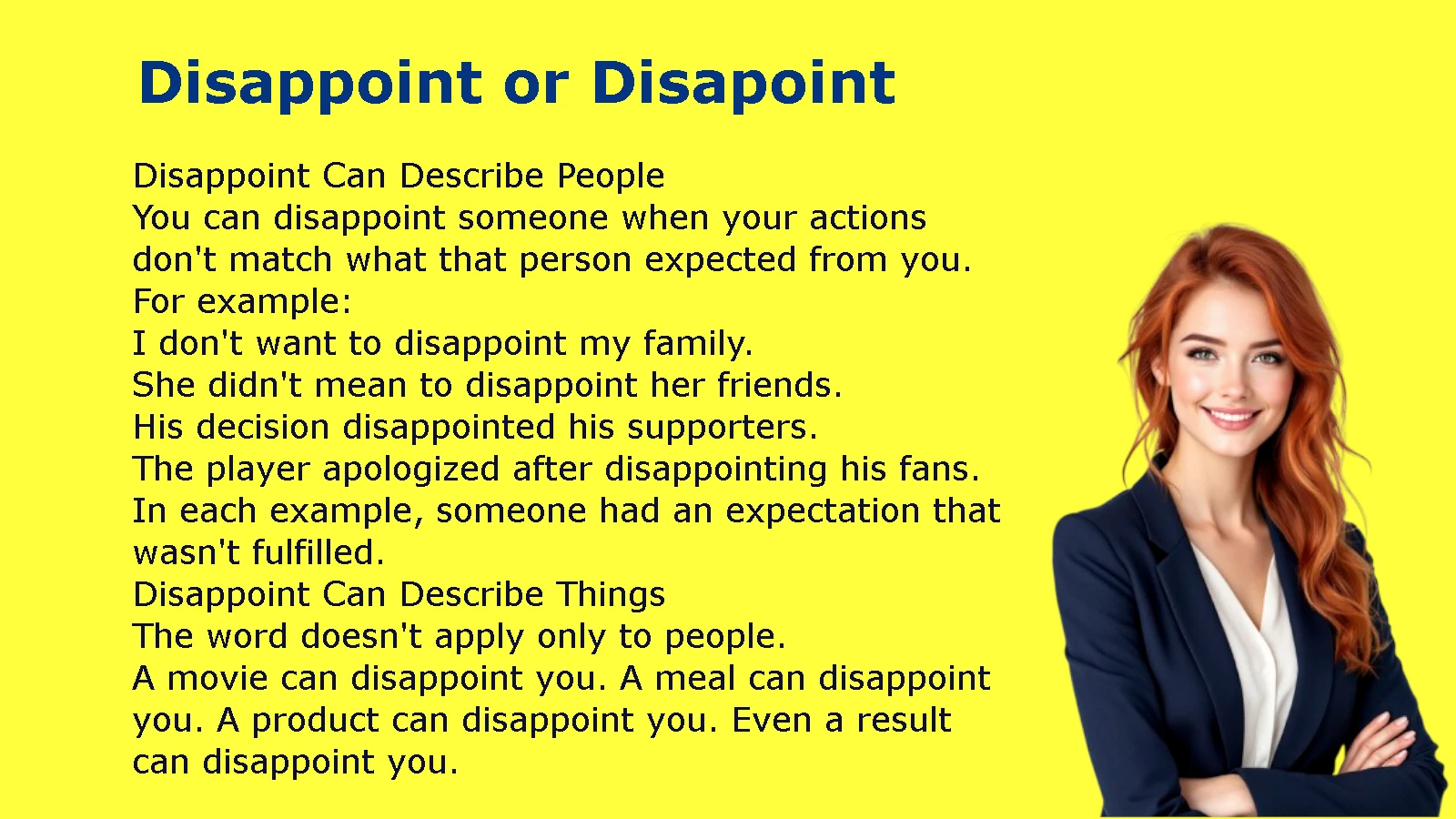
Disappoint Can Describe People
You can disappoint someone when your actions don’t match what that person expected from you.
For example:
- I don’t want to disappoint my family.
- She didn’t mean to disappoint her friends.
- His decision disappointed his supporters.
- The player apologized after disappointing his fans.
In each example, someone had an expectation that wasn’t fulfilled.
Disappoint Can Describe Things
The word doesn’t apply only to people.
A movie can disappoint you. A meal can disappoint you. A product can disappoint you. Even a result can disappoint you.
Consider these examples:
- The new restaurant disappointed us.
- The final episode disappointed many viewers.
- The product disappointed customers who expected better quality.
- The team’s performance disappointed its supporters.
This use is especially common when something falls below an expected standard.
Disappoint Can Also Describe Yourself
You can also disappoint yourself.
For example:
I studied hard, but my exam result disappointed me.
Here, the result didn’t necessarily hurt someone else. Instead, it failed to match the speaker’s own hopes or expectations.
That’s an important part of the word’s meaning. Disappoint focuses on the gap between what someone expected and what actually happened.
Why Is Disappoint Spelled With Two P’s?
The easiest way to understand the spelling is to look at appoint.
The word is formed historically from dis- and a form related to appoint. Modern dictionaries connect disappoint with Middle French desapointer and Old French desappointer. Merriam-Webster traces the English verb to Middle English disappointen and Middle French desapointer.
For modern spelling purposes, the useful connection is:
appoint → disappoint
Notice the two p’s in appoint:
a pp oint
When the prefix dis- is added, those two p’s remain:
dis + appoint = disappoint
That’s why the correct spelling contains two p’s.
The Double-P Connection
Compare these related words:
- appoint
- appointed
- appointing
- appointment
- disappoint
- disappointed
- disappointing
- disappointment
The pp remains visible throughout the word family.
This gives you a useful spelling pattern:
| Word | Correct spelling |
| Appoint | appoint |
| Appointed | appointed |
| Appointing | appointing |
| Appointment | appointment |
| Disappoint | disappoint |
| Disappointed | disappointed |
| Disappointing | disappointing |
| Disappointment | disappointment |
Once you remember appoint, the spelling of disappoint becomes much easier.
Disappoint vs. Disapoint
The main difference between disappoint and disapoint is correctness.
Disappoint is the standard English spelling and functions as a verb. Disapoint is simply an incorrect spelling of that word.
| Feature | Disappoint | Disapoint |
| Standard English spelling | Yes | No |
| Dictionary word | Yes | No |
| Verb | Yes | No |
| Contains two p’s | Yes | No |
| Means “fail to meet expectations” | Yes | Intended meaning only |
| Appropriate in formal writing | Yes | No |
There’s no separate meaning that distinguishes the two spellings. If someone writes disapoint, they generally intend disappoint.
Correct and Incorrect Examples
Here are some quick comparisons:
- ❌ The decision will disapoint many people.
- ✅ The decision will disappoint many people.
- ❌ I didn’t mean to disapoint you.
- ✅ I didn’t mean to disappoint you.
- ❌ The result was disapointing.
- ✅ The result was disappointing.
- ❌ It was a major disapointment.
- ✅ It was a major disappointment.
Notice something important: removing the second p creates the same problem in related forms.
Examples of Disappoint in a Sentence
The verb disappoint works naturally in many everyday situations. Here are examples that show its most common patterns.
Disappoint Someone
I don’t want to disappoint my parents.
She didn’t want to disappoint her team.
We tried our best because we didn’t want to disappoint our customers.
The structure disappoint + person is common when someone fails to meet another person’s expectations.
Something Disappoints Someone
The poor performance disappointed the coach.
The canceled event disappointed thousands of fans.
The low-quality materials disappointed the buyer.
In these sentences, the subject causes the feeling of disappointment.
Disappoint Yourself
I was hoping to get a higher score, so I disappointed myself.
He felt that he had disappointed himself by giving up too early.
This construction focuses on personal expectations.
Disappoint as an Intransitive Verb
Disappoint can also appear without a direct object in certain contexts.
For example:
The new restaurant didn’t disappoint.
This means the restaurant met or exceeded expectations.
Oxford lists both transitive and intransitive uses of disappoint.
A phrase such as doesn’t disappoint has also become a familiar way to say that something performs as expected or turns out well.
Disappointed vs. Disappointing
One of the most common problems with disappoint involves its related forms.
Disappointed and disappointing don’t mean exactly the same thing.
Disappointed
It describes the person or group experiencing the feeling.
I was disappointed by the result.
The person feels disappointment.
The fans were disappointed after the loss.
The fans experienced the feeling.
Merriam-Webster defines disappointed as being defeated in expectation or hope.
Disappointing
Disappointing describes the person, thing, event, or result that causes the feeling.
The result was disappointing.
The result caused disappointment.
It was a disappointing performance.
The performance failed to meet expectations.
A simple way to remember the difference is:
-ed = the person feels it
-ing = the thing causes it
Compare:
I was disappointed because the movie was disappointing.
The person feels disappointed. The movie creates that feeling.
Disappoint vs. Disappointing vs. Disappointed
These forms belong to the same word family, but they serve different grammatical roles.
| Form | Function | Example |
| disappoint | Base verb | I don’t want to disappoint you. |
| disappoints | Third-person singular verb | The result disappoints him. |
| disappointed | Past tense/past participle or adjective | She felt disappointed. |
| disappointing | Present participle/adjective | The result was disappointing. |
| disappointment | Noun | The result was a disappointment. |
| disappointingly | Adverb | The team performed disappointingly. |
Oxford lists disappoint, disappoints, disappointed, and disappointing as forms of the verb.
What Is the Noun Form of Disappoint?
The most common noun form is disappointment.
A disappointment can refer to the feeling that follows an unmet expectation. It can also refer to a person, thing, event, or result that causes that feeling.
For example:
Missing the final was a huge disappointment.
The canceled concert was a disappointment for many fans.
Losing after such a strong season was a real disappointment.
The noun uses the same double p:
disappoint → disappointment
That spelling connection provides another useful memory aid.
Dictionary.com traces disappointment to disappoint plus the suffix -ment and records the modern noun meaning as the act or state of being disappointed or something that causes disappointment.
Common Misspellings of Disappoint
Although disapoint is the spelling in this comparison, it isn’t the only mistake people make.
Some writers also produce forms such as:
- disapoint ❌
- dissapoint ❌
- dissappoint ❌
- disappiont ❌
- disapointed ❌
- disapointing ❌
- disapointment ❌
The correct forms are:
- disappoint ✅
- disappointed ✅
- disappointing ✅
- disappointment ✅
The most useful strategy isn’t memorizing every incorrect version. Instead, remember the structure dis + appoint.
Once you know that appoint contains pp, you have a reliable spelling anchor for the entire word family.
How to Remember the Spelling of Disappoint
A good spelling trick should make the word easier rather than give you another complicated rule to memorize.
Remember “Appoint”
Start with:
appoint
Then add dis-:
dis + appoint
That gives you:
disappoint
The double p comes from appoint.
Use the “One S, Two P’s” Trick
You can also remember the spelling visually:
DIS + APPOINT
That gives you one s and two p’s.
So:
disappoint ✅
not:
disapoint ❌
This works especially well if you frequently confuse the number of consonants in the middle of the word.
Connect It With Appointment
Another useful connection is appointment.
You already know:
appointment
Now remove the ending and focus on the middle:
appo…
That same pp appears in:
disappoint
disappointed
disappointing
disappointment
Think of the word family as a chain. Once one spelling becomes familiar, the others become easier to recognize.
The Word History of Disappoint
The history of disappoint explains more than just its spelling. It also shows how the meaning changed over time.
The word has roots in French. Merriam-Webster traces it through Middle English disappointen to Middle French desapointer. The original sense involved removing someone from an appointed position.
The modern meaning developed later.
The Online Etymology Dictionary notes that the modern sense of frustrating someone’s expectations or desires emerged in the late 15th century. The meaning later extended to plans and other things that failed to be fulfilled.
That change is fairly logical when you consider the underlying idea.
An appointment involves something being arranged or established. To disappoint originally involved undoing or removing an arrangement or appointment. Over time, the word developed its broader modern sense of frustrating an expectation.
So today’s meaning isn’t random. It reflects a long shift in how English speakers used the word.
Does Disappoint Have a Negative Meaning?
Usually, yes.
Disappoint normally describes an outcome that falls short of what someone wanted, expected, or hoped would happen.
However, the emotional intensity can vary.
For example:
The restaurant’s dessert was slightly disappointing.
This suggests mild dissatisfaction.
Compare that with:
The cancellation was deeply disappointing.
That sentence expresses a much stronger reaction.
The word itself doesn’t tell you exactly how severe the disappointment is. Context and modifiers provide that information.
Common modifiers include:
- slightly disappointing
- somewhat disappointing
- disappointing
- very disappointing
- deeply disappointing
- extremely disappointing
- seriously disappointing
Disappoint vs. Let Down
Disappoint and let down often communicate similar ideas, but they don’t always sound the same.
It works well in both everyday and formal writing:
The decision disappointed many employees.
Let down sounds more conversational:
The decision really let many employees down.
Merriam-Webster lists let down, fail, displease, upset, and dissatisfy among words related to disappoint.
The best choice depends on the context.
For a formal report, disappoint may fit better. In a casual conversation, let down can sound more natural.
Disappoint vs. Fail
These words overlap, but they aren’t interchangeable in every sentence.
Fail focuses on not succeeding or not achieving something.
The team failed to win the game.
Disappoint focuses on the effect that failure has on expectations or feelings.
The team’s loss disappointed its fans.
The first sentence describes the outcome. The second highlights the unmet expectations of the fans.
You can even use both:
The team failed to reach the final, which disappointed its supporters.
That sentence shows the distinction clearly.
Disappoint in Formal and Informal Writing
Disappoint works comfortably across different types of English.
You can use it in:
- academic writing
- business communication
- news writing
- reviews
- personal messages
- everyday conversation
- essays
- professional reports
For example, a business report might say:
The company’s results disappointed investors.
A casual message might say:
Sorry to disappoint you, but I can’t make it tonight.
The spelling doesn’t change with the level of formality.
What changes is the surrounding vocabulary and tone.
A Quick Spelling Test
If you’re still unsure whether to write disappoint or disapoint, use this quick test:
Step 1: Find the familiar word inside it.
appoint
Step 2: Check its spelling.
a + pp + oint
Step 3: Add dis-.
dis + appoint
Step 4: Keep the two p’s.
disappoint
This method is more reliable than trying to remember the word as a long string of letters.
Common Questions About Disappoint or Disapoint
Is Disappoint spelled with one P or two?
Disappoint is spelled with two p’s.
The correct spelling is:
disappoint
The incorrect form is:
disapoint
Remember the word appoint, which also contains two p’s.
Is Disapoint a word?
No. Disapoint is not the standard spelling of the English verb. Use disappoint instead.
What does disappoint mean?
Disappoint means to fail to meet someone’s expectations, hopes, wishes, or standards.
For example:
I don’t want to disappoint my friends.
What is the past tense of disappoint?
The past tense is disappointed.
For example:
The result disappointed the fans.
The spelling still contains the double p.
What is the present participle of disappoint?
The present participle is disappointing.
For example:
The performance was disappointing.
What is the noun form of disappoint?
The common noun form is disappointment.
For example:
The cancellation was a disappointment.
Why does disappoint have two P’s?
The spelling connects to appoint, which contains two p’s. The historical development of disappoint also traces back through French forms related to appoint.
Is “disappointing” spelled with two P’s?
Yes.
The correct spelling is:
disappointing
Not:
disapointing
Can a movie disappoint you?
Yes. You can use disappoint for anything that fails to meet expectations.
For example:
The movie disappointed me because the ending felt rushed.
Can you say “doesn’t disappoint”?
Yes. Doesn’t disappoint is a common expression meaning that something performs well or meets expectations.
For example:
This restaurant never disappoints.
The expression can suggest that the speaker consistently has a positive experience.
Final Verdict: Disappoint or Disapoint?
When choosing between disappoint and disapoint, there’s no tricky exception to remember.
Disappoint is correct.
Disapoint is incorrect.
The easiest way to remember the spelling is to connect it with appoint:
dis + appoint = disappoint
Because appoint contains two p’s, disappoint keeps them.
The same spelling appears in its related forms:
- disappoint
- disappoints
- disappointed
- disappointing
- disappointment
- disappointingly
The word means to fail to meet someone’s expectations, hopes, wishes, or standards. It can describe people, products, performances, decisions, results, events, and situations.
So, when you’re writing your next sentence, don’t drop that second p.
I don’t want to disappoint you. ✅
That’s the spelling to remember.