Other ways to say “I don’t know” are useful when you want to express uncertainty, admit that you lack information, or politely tell someone that you cannot answer a question. Depending on the situation, you can choose a casual phrase like “I’m not sure,” a professional alternative like “I don’t have that information,” or a more conversational expression such as “I have no idea.”
The “I don’t know” meaning is used when you do not have the knowledge, information, or certainty needed to answer something. However, the best alternative depends on your tone, context, relationship with the listener, and level of certainty. Expressions such as “I’m not sure,” “I have no idea,” “I couldn’t say,” “I’m uncertain,” “I don’t have an answer,” and “That’s beyond me” can communicate similar ideas but are not always interchangeable.
In this guide, you’ll discover the best ways to say “I don’t know” in casual, polite, professional, formal, and texting situations. You’ll also learn which alternatives sound natural in conversation, how to use them in sentences, and how phrases such as “I’m not sure” differ from stronger expressions like “I have no idea.”
By the end, you’ll know exactly how to say “I don’t know” in different situations without sounding repetitive, rude, or uncertain when a more appropriate expression would work better.
Quick Answer: What Are Other Ways to Say “I Don’t Know”?
Some of the most useful alternatives to “I don’t know” include:
| Alternative | Tone | Formality | Best For |
| I’m not sure | Neutral | Neutral | Everyday conversation |
| I’m not certain | Polite | Formal | Work and academic settings |
| I have no idea | Casual | Informal | Friends and family |
| I can’t say for sure | Neutral | Neutral | Uncertain information |
| I couldn’t say | Polite | Formal | Opinions and predictions |
| I don’t have that information | Professional | Formal | Work and customer service |
| I’d need to verify that | Professional | Formal | Business communication |
| I haven’t checked yet | Honest | Neutral | Unverified information |
| Let me find out | Helpful | Professional | Work and customer service |
| I’ll check and get back to you | Professional | Formal | Emails and workplace conversations |
| I’m not familiar with that | Neutral | Neutral/Formal | Subjects you don’t know |
| I wouldn’t want to speculate | Careful | Formal | Important or uncertain matters |
| Beats me | Casual | Informal | Friends |
| Your guess is as good as mine | Playful | Informal | Casual conversations |
| I’m drawing a blank | Casual | Informal | When you can’t remember |
There is an important distinction among these expressions. “I’m not sure” communicates uncertainty, while “I don’t have that information” points to a lack of information. “Let me find out” goes one step further by showing that you intend to get the answer.
That distinction can make your communication sound much more precise.
The Best Other Ways to Say “I Don’t Know”
These are some of the most versatile alternatives. They work in different situations without sounding overly formal or unnatural.
I’m Not Sure
“I’m not sure” is probably the most useful all-purpose alternative to “I don’t know.”
It sounds softer and less absolute. You may know something about the subject but lack enough confidence to give a definite answer.
“What time does the meeting start?”
“I’m not sure. I think it’s at 10.”
This phrase works with friends, coworkers, managers, teachers, and acquaintances. It also sounds natural in emails.
Best for: Everyday conversation, work, school, and email.
I’m Not Certain
“I’m not certain” communicates uncertainty in a slightly more formal way.
It works particularly well when accuracy matters and you don’t want to make a claim you cannot support.
Best for: Professional conversations, academic writing, meetings, and formal communication.
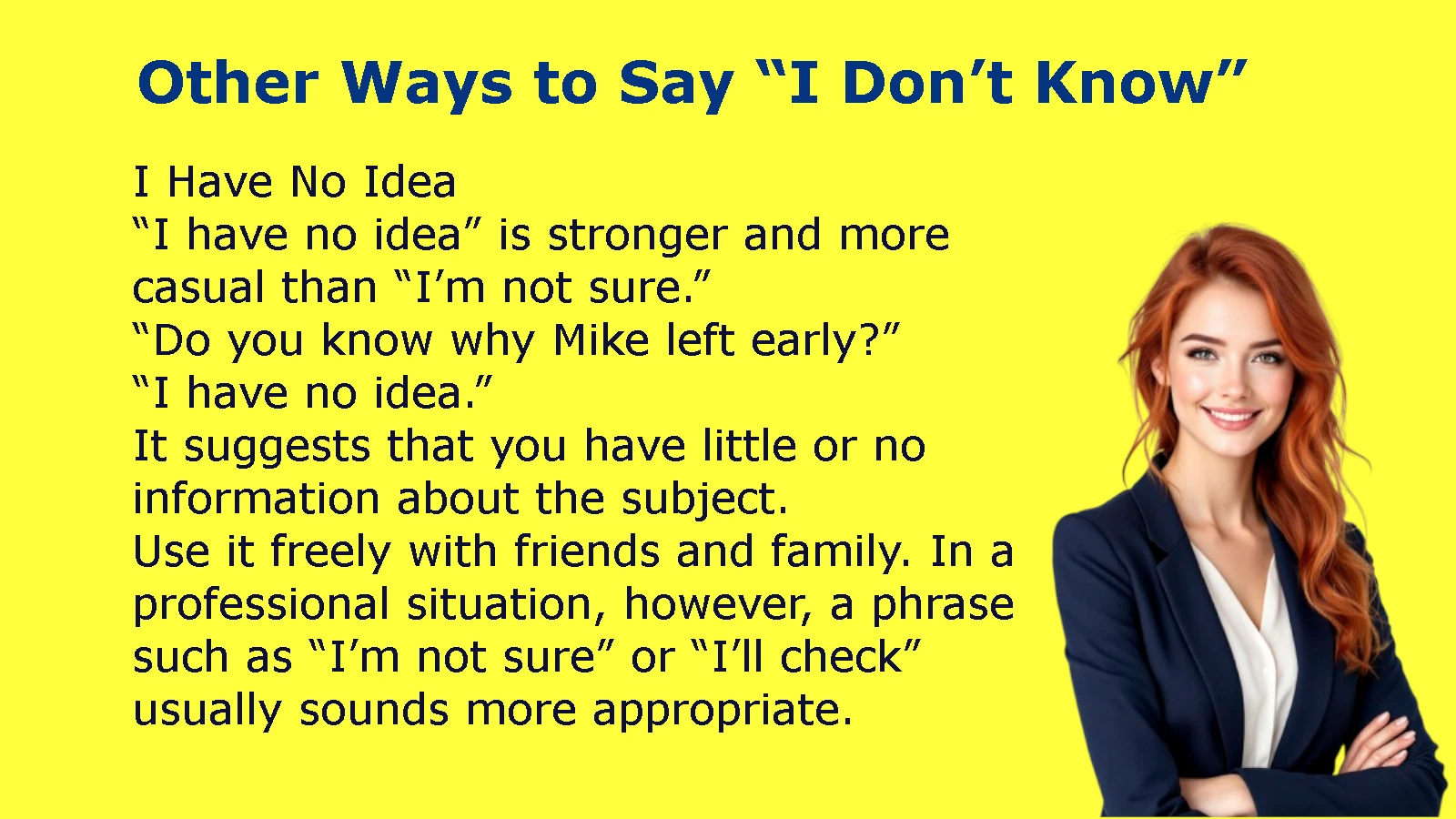
I Have No Idea
“I have no idea” is stronger and more casual than “I’m not sure.”
“Do you know why Mike left early?”
“I have no idea.”
It suggests that you have little or no information about the subject.
Use it freely with friends and family. In a professional situation, however, a phrase such as “I’m not sure” or “I’ll check” usually sounds more appropriate.
I Can’t Say for Sure
This phrase is useful when you have an opinion or suspicion but cannot confirm it.
“I can’t say for sure, but I think the shipment will arrive tomorrow.”
It avoids pretending that an uncertain answer is a fact.
Best for: Predictions, estimates, uncertain information, and professional conversations.
I Couldn’t Say
“I couldn’t say” is a polite way to indicate that you cannot confidently answer a question.
“Do you think the company will extend the deadline?”
“I couldn’t say.”
It can sound somewhat formal, so it is more common in careful conversation than casual texting.
I’m Unsure
“I’m unsure whether that version is compatible with the new system.”
It is particularly useful in writing because it clearly communicates uncertainty without sounding dismissive.
I Don’t Have That Information
This is an excellent professional alternative.
“I don’t have that information at the moment, but I can check with the operations team.”
Unlike “I don’t know,” this phrase identifies the specific problem: you currently don’t possess the information.
It works well in customer service, business emails, meetings, and workplace conversations.
I Haven’t Checked Yet
Use this when the answer may be available, but you have not verified it.
“Has Sarah submitted the report?”
“I haven’t checked yet.”
This is different from “I don’t know.” You might be able to answer immediately after checking.
I’m Not Familiar With That
This phrase works when you don’t have sufficient knowledge or experience with a particular subject.
“Are you familiar with that software?”
“I’m not familiar with it.”
It is more specific than simply saying “I don’t know.”
I Need More Information
Sometimes you cannot answer because the question does not contain enough details.
“Which option should we choose?”
“I need more information before I can recommend one.”
This response can sound more thoughtful than giving an unsupported answer.
Professional Ways to Say “I Don’t Know”
In professional communication, honesty is not the problem. The problem is giving a response that sounds like you are ending the conversation without offering any direction.
A professional response often follows this pattern:
Acknowledge the uncertainty + explain what you will do next.
For example:
“I’m not sure about the revised deadline. I’ll check the project schedule and get back to you this afternoon.”
This is more useful than simply saying:
“I don’t know.”
Current workplace-focused guides similarly emphasize responses such as “I’m not sure,” “Let me check,” “I’ll get back to you,” and “Let me confirm that for you.”
Let Me Check
“Let me check” is short, natural, and professional.
“I’m not sure which version the client received. Let me check.”
It works particularly well when you can access the information quickly.
Let Me Find Out
This phrase tells the other person that you are willing to obtain the answer.
“I don’t have that detail right now. Let me find out.”
It works well with customers, coworkers, and managers.
I’ll Check and Get Back to You
This is one of the strongest choices for professional emails and workplace communication.
“I’m not certain about the delivery date. I’ll check and get back to you by this afternoon.”
The phrase gives the other person a clear next step.
I’ll Have to Check
“I’ll have to check the latest figures before I can give you an accurate answer.”
It works well in both spoken and written workplace communication.
I’d Need to Verify That
Use this when accuracy is especially important.
“I’d need to verify that before confirming the figures.”
This phrase communicates caution without sounding incapable.
I’ll Look Into It
“I’ll look into it” means you will investigate the matter.
“I’m not familiar with the issue yet, but I’ll look into it.”
It is useful when the answer requires more than a quick check.
I’ll Get Back to You
This is useful when you cannot answer immediately but intend to respond later.
“I don’t have the updated numbers in front of me. I’ll get back to you once I’ve checked them.”
Only use this phrase when you genuinely intend to follow up.
I Need to Confirm That
This works well when you suspect you know the answer but want to verify it first.
“I believe the meeting is on Thursday, but I need to confirm that.”
I Haven’t Verified That Yet
This phrase is especially useful when discussing information that could be inaccurate if repeated without confirmation.
“I’ve heard that the policy is changing, but I haven’t verified that yet.”
I Don’t Want to Give You Incorrect Information
This is a useful customer-service and professional phrase.
“I don’t want to give you incorrect information, so let me confirm that first.”
It frames the lack of an immediate answer as a commitment to accuracy.
Polite Ways to Say “I Don’t Know”
Sometimes you want to acknowledge that you don’t know something without sounding abrupt.
Try these alternatives:
- I’m not quite sure.
- I’m not certain about that.
- I’m afraid I don’t know.
- I can’t say for certain.
- I’d rather not guess.
- I wouldn’t want to speculate.
- I don’t have enough information to say.
- I’d need to check before giving you an answer.
I’m Not Quite Sure
Adding “quite” softens the statement slightly.
“I’m not quite sure how the new system works.”
I Can’t Say for Certain
This is more formal than “I’m not sure.”
“I can’t say for certain whether the plan will work.”
I’d Rather Not Guess
This is useful when an inaccurate answer could cause problems.
“I’d rather not guess. Let me check the documentation first.”
It shows that you value accuracy.
I Wouldn’t Want to Speculate
This phrase is especially appropriate when the information is uncertain or sensitive.
“I wouldn’t want to speculate about what caused the delay.”
It means you prefer not to present an assumption as a fact.
Casual Ways to Say “I Don’t Know”
With friends and family, you don’t need corporate language.
Natural casual alternatives include:
- No idea.
- No clue.
- Beats me.
- Who knows?
- I have no clue.
- Your guess is as good as mine.
- I couldn’t tell you.
- I’m drawing a blank.
- I wish I knew.
- You got me.
- I dunno.
No Idea
“Where did he go?”
“No idea.”
This is extremely common in casual conversation.
No Clue
“No clue” is similarly informal.
“How does this thing work?”
“No clue.”
Beats Me
“Beats me” is a casual idiom meaning “I don’t know.”
“Why is the printer doing that?”
“Beats me.”
It is conversational and should generally be avoided in formal emails.
Your Guess Is as Good as Mine
This phrase means that you know no more than the person asking.
“Do you know when they’ll announce the results?”
“Your guess is as good as mine.”
It can be playful, but depending on the context, it can also sound slightly dismissive.
I’m Drawing a Blank
Use this when you cannot remember something.
“What was the name of that restaurant?”
“I’m drawing a blank.”
This is not always a direct substitute for “I don’t know” because it often implies temporary failure to remember rather than complete lack of knowledge.
Helpful Alternatives That Show Initiative
One of the most useful ways to replace “I don’t know” is to show what you will do next.
Compare these:
“I don’t know.”
with:
“I’m not sure, but I’ll check.”
The second answer acknowledges uncertainty while keeping the conversation moving.
Let Me Find Out
“I’m not sure who handles that. Let me find out.”
I’ll Check
“I don’t have the updated schedule. I’ll check.”
I’ll Look Into It
“I haven’t seen the issue before, but I’ll look into it.”
Let Me Confirm
“Let me confirm the details before I give you an answer.”
I’ll Ask Someone Who Knows
This is useful when another person has the necessary expertise.
“I’m not familiar with that system, but I’ll ask someone who knows.”
Let’s Find Out
This is friendly and collaborative.
“I’m not sure why the program crashed. Let’s find out.”
This approach is especially useful when you want to avoid making the conversation about your lack of knowledge.
Other Ways to Say “I Don’t Know” When You Need More Information
Sometimes the problem isn’t that you know nothing. The question simply doesn’t provide enough context.
I Need More Context
“I’m not sure which solution would work best.
I Need More Information
“I need more information before I can give you an accurate answer.”
Could You Give Me More Details?
Instead of responding with “I don’t know,” ask for the information necessary to answer.
“Could you give me a few more details? I want to make sure I understand the situation.”
I’d Need to Know More
“I’d need to know more about the current setup before recommending a solution.”
These phrases are particularly useful at work because they show that you are trying to solve the problem rather than simply rejecting the question.
Other Ways to Say “I Don’t Know” When You Lack Expertise
Sometimes you don’t know because the subject falls outside your knowledge.
That’s Outside My Area of Expertise
This is formal and professional.
“That’s outside my area of expertise, but I can connect you with someone who specializes in it.”
I’m Not the Best Person to Answer That
This is a polite way to redirect a question.
“I’m not the best person to answer that, but our finance team can help.”
I’m Not Familiar Enough With That Subject
This is better than pretending to have expertise you don’t have.
How to Say “I Don’t Know” at Work
The right phrase depends on the situation.
| Situation | Better Response | Why It Works |
| Your boss asks for an unknown fact | “I’ll check and get back to you.” | Shows ownership |
| A coworker asks about an unfamiliar process | “I’m not familiar with that process.” | Honest and specific |
| A client asks for unverified information | “I’d need to verify that first.” | Protects accuracy |
| Someone asks about a deadline | “I’m not certain of the timeline yet.” | Communicates uncertainty |
| A customer asks something you don’t know | “Let me check that for you.” | Keeps the interaction helpful |
| You need more context | “I’d need a little more information.” | Explains the limitation |
| You lack expertise | “That’s outside my area of expertise.” | Sets a clear boundary |
| You don’t want to guess | “I wouldn’t want to speculate.” | Emphasizes accuracy |
The most professional response isn’t necessarily the most complicated one. Simple, specific, and helpful usually works best.
How to Say “I Don’t Know” to Your Boss
You don’t need to pretend to know everything.
If your boss asks a question you cannot answer, try:
“I’m not sure, but I’ll check and get back to you.”
Or:
“I don’t have the latest figures. I’ll verify them and send them over.”
If you genuinely need more time:
“I’d need to review the data before I can give you an accurate answer.”
These responses are direct while demonstrating accountability.
Avoid using overly casual expressions such as “Beats me” or “No clue” with a manager unless your workplace culture clearly supports that style.
How to Say “I Don’t Know” to a Coworker
With coworkers, you generally have more flexibility.
You could say:
“I’m not sure.”
“I haven’t checked yet.”
“Let me look into it.”
“I have no idea, but I’ll ask Sarah.”
“I’m not familiar with that process.”
The best option depends on your relationship and the seriousness of the question.
How to Say “I Don’t Know” to a Customer or Client
Customer-facing communication deserves extra care.
A customer usually doesn’t just want to know whether you know. They want to know whether their problem can be solved.
Instead of:
“I don’t know.”
try:
“I’m not sure, but let me check that for you.”
Or:
“I don’t have that information right now. Let me confirm it and get back to you.”
Or:
“I want to make sure I give you the correct information. Let me verify that first.”
The important principle is don’t invent an answer just to appear knowledgeable.
A truthful response followed by a concrete next step is usually much more useful.
How to Say “I Don’t Know” in an Email
Written communication benefits from clarity.
Instead of writing:
“I don’t know when the report will be ready.”
you could write:
“I’m not certain of the completion date yet. I’ll confirm the timeline and update you by tomorrow.”
Another option:
“I don’t have the latest information on the delivery schedule. I’ll check with the logistics team and get back to you.”
For a formal email, phrases such as “I’d need to verify that,” “I’m not certain,” and “I’ll confirm and get back to you” generally fit better than slang.
How to Say “I Don’t Know” in a Text Message
Texting is much less formal.
Natural options include:
- “Not sure.”
- “No idea.”
- “No clue.”
- “I dunno.”
- “Beats me.”
- “Haven’t checked yet.”
- “IDK.”
- “Who knows?”
- “Your guess is as good as mine.”
For example:
Friend: “What time are we meeting?”
You: “Not sure. I’ll ask Jake.”
Short answers are often more natural in texting because the medium itself encourages concise communication.
Funny and Playful Ways to Say “I Don’t Know”
If the situation is lighthearted, you can add humor.
That’s Above My Pay Grade
“Why did management change the schedule?”
“That’s above my pay grade.”
This is humorous and often implies that the speaker does not have authority or access to the information.
Your Guess Is as Good as Mine
“Who do you think is going to win?”
“Your guess is as good as mine.”
I’m Drawing a Blank
“What was her name again?”
“I’m drawing a blank.”
You Got Me
“Do you know why the website is down?”
“You got me.”
I Wish I Knew
“When are they finally going to announce it?”
“I wish I knew.”
These phrases are best reserved for informal conversations.
“I Don’t Know” vs. “I’m Not Sure”
These phrases are close, but they aren’t identical.
“I don’t know” is more direct. It normally communicates that you do not have the answer.
“I’m not sure” emphasizes uncertainty. It leaves more room for the possibility that you have an idea but aren’t confident enough to state it as fact.
Compare:
“Who is coming to the party?”
“I don’t know.”
This suggests you have no information.
Now:
“Is John coming to the party?”
“I’m not sure.”
This suggests you may have incomplete information.
Which One Should You Use?
Use “I’m not sure” when uncertainty is the main issue.
Use “I don’t know” when you genuinely have no information.
“I Don’t Know” vs. “I Have No Idea”
“I have no idea” is stronger and more casual.
“What caused the problem?”
“I don’t know.”
Neutral.
“What caused the problem?”
“I have no idea.”
Stronger and more informal.
In a professional setting, “I have no idea” can sound unnecessarily blunt. A phrase such as “I’m not sure” is usually safer.
“I Don’t Know” vs. “I Haven’t Checked”
These expressions describe two different situations.
“I don’t know” says you do not have the answer.
“I haven’t checked” says you have not yet taken the step necessary to find the answer.
For example:
“Is the report finished?”
“I don’t know.”
You have no information.
Or:
“Is the report finished?”
“I haven’t checked yet.”
You may be able to answer after checking.
This distinction is particularly useful in professional communication.
“I Don’t Know” vs. “Let Me Find Out”
“Let me find out” is not simply a synonym for “I don’t know.”
It communicates uncertainty plus action.
“I don’t know who handles that.”
versus:
“I’m not sure who handles that. Let me find out.”
The second response gives the listener confidence that the issue can move forward.
“I Don’t Know” vs. “That’s a Good Question”
“That’s a good question” can sometimes be used when you don’t immediately know the answer.
However, it isn’t a direct synonym.
“What caused the decline in sales?”
“That’s a good question.”
The speaker hasn’t actually said they don’t know.
The phrase can acknowledge that the question requires thought, but it should not become a way to avoid answering.
A stronger response is:
“That’s a good question. I don’t have the figures in front of me, so let me check.”
Choosing the Right Alternative to “I Don’t Know”
Use this decision guide when you aren’t sure which phrase fits.
| What You Want to Communicate | Best Phrase |
| You genuinely don’t know | I don’t know |
| You’re uncertain | I’m not sure |
| You know nothing about it | I have no idea |
| You need to verify something | I’d need to verify that |
| You haven’t checked | I haven’t checked yet |
| You’ll investigate | I’ll look into it |
| You’ll get an answer | Let me find out |
| You’ll respond later | I’ll get back to you |
| You need more details | I need more information |
| You lack expertise | That’s outside my area of expertise |
| You don’t want to guess | I wouldn’t want to speculate |
| You want to sound casual | No idea |
| You want to sound humorous | Beats me |
| You can’t make a prediction | I couldn’t say |
| You can’t remember | I’m drawing a blank |
Common Mistakes When Saying “I Don’t Know”
Replacing the phrase isn’t automatically an improvement.
Using Slang in Professional Situations
“Beats me” may sound friendly with a coworker but careless with a client.
Using Overly Formal Language in Casual Conversations
Saying:
“I am unable to provide that information at this time.”
to a friend asking where you want to eat would sound unnatural.
A simple:
“I’m not sure.”
would work better.
Pretending to Know Something
Never choose a confident-sounding phrase merely to avoid admitting uncertainty.
An inaccurate answer can cause more problems than an honest “I don’t know.”
Promising to Check Without Following Up
If you say:
“I’ll check and get back to you.”
you should actually follow up.
Otherwise, the phrase can make your communication less trustworthy.
Using “I’m Not Aware” When You Mean “I’m Not Sure”
“I’m not aware” generally concerns whether you have knowledge of a fact or situation.
“I’m not sure” is broader and more natural for uncertainty.
How Native American English Speakers Use These Phrases
In everyday American English, “I’m not sure” is one of the safest alternatives because it sounds natural across many situations.
Other common conversational choices include:
- “I have no idea.”
- “No idea.”
- “Not sure.”
- “I couldn’t tell you.”
- “Beats me.”
- “I haven’t checked.”
- “I don’t know yet.”
Professional speakers often add a next step:
“I’m not sure. Let me check.”
“I don’t have that information right now, but I’ll find out.”
“I’d need to verify that.”
The important point is that native speakers don’t necessarily avoid “I don’t know.” It is a completely normal English phrase. The alternative should be chosen because it communicates something more specific, not simply because “I don’t know” is supposedly wrong.
40 Other Ways to Say “I Don’t Know”
Here is a practical reference list:
- I’m not sure.
- I’m not certain.
- I’m unsure.
- I have no idea.
- I can’t say for sure.
- I couldn’t say.
- I don’t have that information.
- I don’t have enough information.
- I’m not familiar with that.
- I’m not aware of that.
- I haven’t checked yet.
- I haven’t confirmed that.
- I need more information.
- I need more context.
- I’d need to verify that.
- Let me check.
- Let me find out.
- I’ll find out.
- I’ll look into it.
- I’ll have to check.
- I’ll check and get back to you.
- I’ll get back to you.
- I need to confirm that.
- I wouldn’t want to speculate.
- I’d rather not guess.
- That’s outside my area of expertise.
- I’m not the best person to answer that.
- That’s a good question.
- Beats me.
- Your guess is as good as mine.
- Who knows?
- No idea.
- No clue.
- I have no clue.
- I couldn’t tell you.
- I’m drawing a blank.
- I wish I knew.
- You got me.
- That’s above my pay grade.
- I can’t give you a definite answer.
Not all 40 phrases are interchangeable in every situation. That is exactly why context matters more than simply memorizing a long synonym list.
Quick Guide to Formality
| Phrase | Formality | Natural Context |
| I’m not sure | Neutral | Almost anywhere |
| I’m not certain | Formal | Work, academic |
| I don’t have that information | Professional | Work, customer service |
| I’d need to verify that | Professional | Business |
| Let me find out | Professional/Neutral | Work, everyday |
| I’ll check and get back to you | Professional | Email, workplace |
| I have no idea | Casual | Friends, family |
| No clue | Very casual | Friends |
| Beats me | Casual | Informal conversation |
| Your guess is as good as mine | Casual | Friends, coworkers |
| I’d rather not guess | Neutral/Professional | Important questions |
| I wouldn’t want to speculate | Formal | Sensitive topics |
FAQ: Other Ways to Say “I Don’t Know”
What is another way to say “I don’t know”?
Some natural alternatives are “I’m not sure,” “I’m not certain,” “I have no idea,” “I couldn’t say,” and “I don’t have that information.” The best choice depends on how formal the situation is and whether you are uncertain or completely unaware.
What is a professional way to say “I don’t know”?
Try “I’m not sure,” “I’d need to verify that,” “I don’t have that information right now,” “Let me check,” or “I’ll confirm and get back to you.” In professional settings, adding a next step can make the response more helpful.
How do you politely say “I don’t know”?
You can say “I’m not quite sure,” “I’m not certain,” “I can’t say for certain,” or “I’d rather not guess.” If possible, explain what you can do next.
How do you say “I don’t know” casually?
Common casual expressions include “No idea,” “No clue,” “Beats me,” “I have no idea,” “Who knows?” and “Your guess is as good as mine.”
What can I say instead of “I don’t know” in an email?
For a professional email, use phrases such as “I’m not certain,” “I’d need to verify that,” “I don’t have that information at the moment,” or “I’ll check and get back to you.”
How do you say “I don’t know” without sounding rude?
Use a softer phrase such as “I’m not sure” and, when appropriate, add a helpful next step.
For example:
“I’m not sure, but I can check that for you.”
This sounds more collaborative than simply ending the response with “I don’t know.”
Is “I’m not sure” the same as “I don’t know”?
Not exactly. “I don’t know” usually communicates a lack of knowledge, while “I’m not sure” emphasizes uncertainty. Someone who says “I’m not sure” may have an idea but lack enough confidence to give a definite answer.
Is “I have no idea” rude?
Not necessarily. It is common and natural in casual American English. However, it can sound too blunt or informal in professional situations, especially with customers, clients, or senior colleagues.
Is “I’m not aware” a good alternative to “I don’t know”?
It can be, especially when discussing whether you have knowledge of a particular fact or situation. For example, “I’m not aware of any changes” sounds natural in professional communication. It does not always work as a replacement for general uncertainty.
What is a confident way to say “I don’t know”?
Try “I’d need to verify that,” “I don’t have enough information to answer accurately,” or “I’m not sure yet, but I’ll find out.” These phrases acknowledge uncertainty while showing that you care about accuracy.
What is a funny way to say “I don’t know”?
For casual conversations, try “Beats me,” “Your guess is as good as mine,” “You got me,” “I’m drawing a blank,” or “That’s above my pay grade.” These expressions are playful, so avoid them when a serious or professional tone is needed.
What is the difference between “I don’t know” and “I couldn’t say”?
“I don’t know” directly states that you lack the answer. “I couldn’t say” is more indirect and often suggests that you cannot confidently make a judgment or prediction.
Conclusion: Choose the Phrase That Fits the Situation
There are plenty of other ways to say “I don’t know,” but the best alternative isn’t always the most sophisticated one.
If you’re simply uncertain, “I’m not sure” is usually the safest choice. If you need to verify information, “I’d need to check” or “Let me find out” works better. In a professional email, “I’ll check and get back to you” communicates both honesty and responsibility. With friends, “No idea,” “Beats me,” or “Your guess is as good as mine” may sound more natural.
The most useful rule is simple:
Don’t just communicate that you don’t know. When appropriate, communicate what you can do next.
Instead of:
“I don’t know.”
you can often say:
“I’m not sure, but I’ll find out.”
That small change can make your response sound more helpful, confident, and purposeful without pretending that you know something you don’t.