Have you ever hesitated while spelling Wednesday and wondered whether it should be written as Wednesday or Wendsday? The difference may seem small, but this is a common spelling mistake because the word’s pronunciation doesn’t closely match its spelling.
Wednesday is the correct spelling, while wendsday is a common misspelling. The word Wednesday refers to the day of the week that comes after Tuesday and before Thursday. Unlike spelling differences such as color and colour, Wednesday has one standard spelling in both American English and British English.
Examples:
- We have a meeting scheduled for Wednesday.
- The store will reopen next Wednesday.
The confusion is understandable. People often search for Wednesday or Wendsday, Wednesday vs Wendsday, which spelling is correct, or how to spell Wednesday because the word is usually pronounced more like “Wens-day” than it looks on the page. However, wendsday is not an accepted alternative spelling. The correct form is Wednesday.
In this guide, you’ll learn the complete difference between Wednesday or Wendsday, including the meaning, pronunciation, origin, correct spelling, and usage of the word. You’ll also discover why Wednesday is so often misspelled and see clear examples to help you remember the correct spelling.
Wednesday vs. Wendsday: Quick Answer
Here’s the simple answer:
| Spelling | Correct? | Meaning |
| Wednesday | ✅ Yes | The day after Tuesday and before Thursday |
| Wendsday | ❌ No | A misspelling of Wednesday |
| Wensday | ❌ No | A common misspelling of Wednesday |
| Wednsday | ❌ No | Another incorrect spelling |
Wednesday is the standard spelling used in modern English dictionaries. Cambridge defines Wednesday as the day of the week after Tuesday and before Thursday. It also lists the common abbreviation Wed.
So if you’re wondering, “Is it Wednesday or Wendsday?”, the answer is straightforward:
Wednesday is correct. Wendsday is incorrect.
The extra d in the middle matters.
What Is the Correct Spelling: Wednesday or Wendsday?
Wednesday Is the Correct Spelling
The correct spelling is:
W-E-D-N-E-S-D-A-Y
The word contains two d’s:
We d nes d ay
That middle d is one of the letters people often lose when they spell the word according to its pronunciation.
For example:
- Wednesday morning
- Wednesday afternoon
- Wednesday evening
- Wednesday night
- next Wednesday
- last Wednesday
- every Wednesday
The spelling stays the same regardless of how you use the word.
Wendsday Is a Misspelling
Wendsday isn’t a standard alternative spelling of Wednesday.
Instead, it usually appears because someone has tried to spell the word based on its spoken form. Since the word is commonly pronounced /ˈwenz.deɪ/, the spelling Wendsday can seem logical.
There’s one problem: English spelling doesn’t always follow pronunciation letter for letter.
The same issue appears in words such as:
- February
- business
- Wednesday
- vegetable
- comfortable
People often pronounce these words differently from how they might expect from their written forms. Wednesday is especially tricky because its spelling preserves historical information that isn’t obvious in modern speech.
Wednesday Meaning
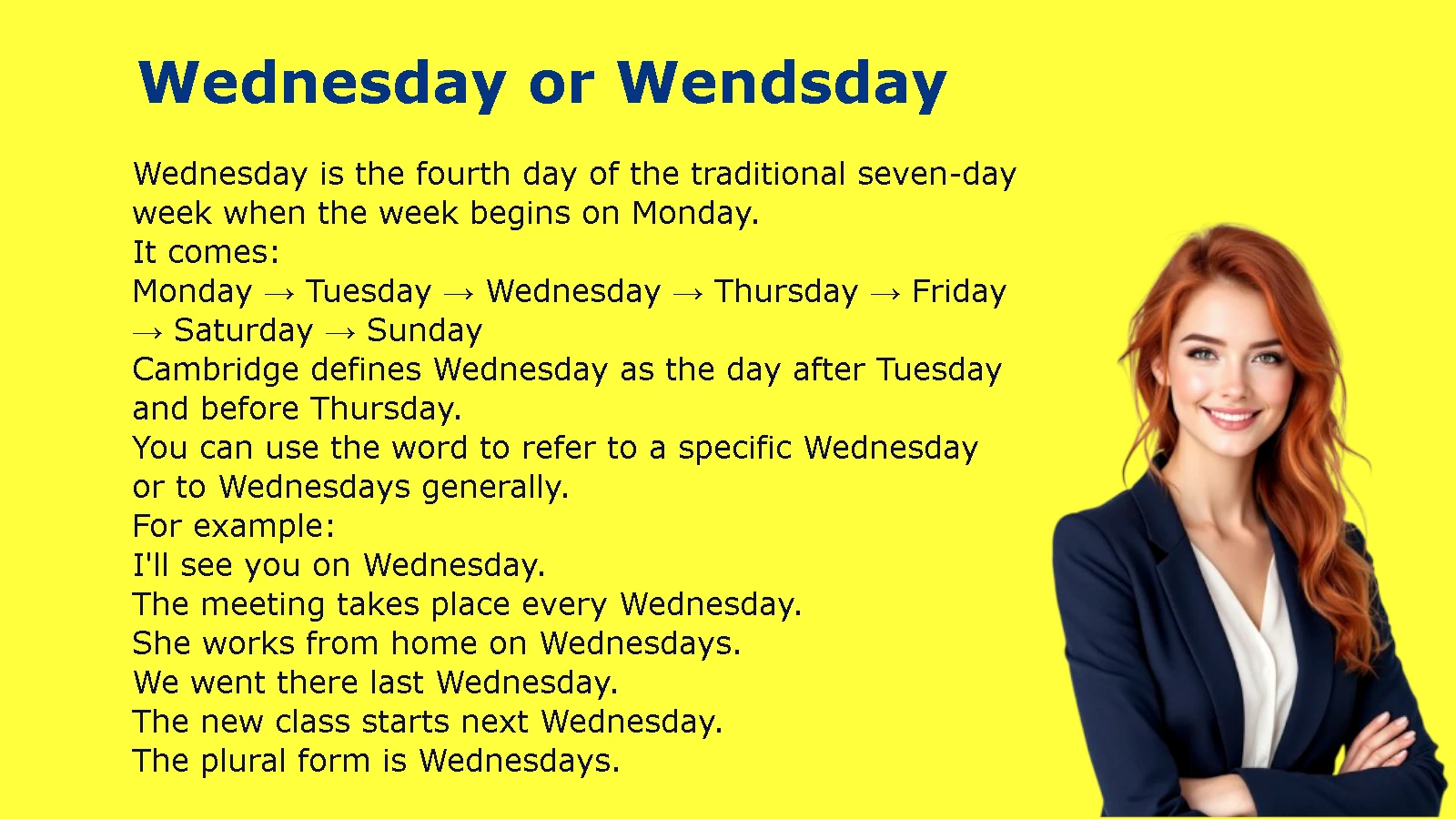
it is the fourth day of the traditional seven-day week when the week begins on Monday.
It comes:
Monday → Tuesday → Wednesday → Thursday → Friday → Saturday → Sunday
Cambridge defines Wednesday as the day after Tuesday and before Thursday.
You can use the word to refer to a specific Wednesday or to Wednesdays generally.
For example:
- I’ll see you on Wednesday.
- The meeting takes place every Wednesday.
- She works from home on Wednesdays.
- We went there last Wednesday.
- The new class starts next Wednesday.
The plural form is Wednesdays.
Wednesday as a Specific Day
When you talk about one particular Wednesday, you can use the singular form:
The appointment is on Wednesday.
When you talk about the day as a recurring event, use the plural:
We have staff meetings on Wednesdays.
The spelling doesn’t change apart from the plural -s.
Common Expressions With Wednesday
Several phrases commonly appear with Wednesday:
- Wednesday morning
- Wednesday afternoon
- Wednesday evening
- Wednesday night
- next Wednesday
- last Wednesday
- this Wednesday
- every Wednesday
- on Wednesday
- by Wednesday
- Wednesdays
These expressions are useful because they show how naturally the word fits into everyday English.
Why Is Wednesday So Difficult to Spell?
Wednesday is difficult because its pronunciation has been reduced over time while its traditional spelling has remained.
If you pronounced every letter in a highly literal way, the written form would seem much easier to explain. Modern English doesn’t work that way.
Cambridge gives the US pronunciation as /ˈwenz.deɪ/. The first syllable sounds approximately like wenz, followed by day.
That creates a noticeable gap:
Spelling: Wednesday
Common pronunciation: WENZ-day
The letters d and parts of the middle of the word aren’t pronounced in the way a learner might expect.
As a result, someone who hears the word and then tries to write it from memory might produce:
- Wendsday
- Wensday
- Wednsday
Those spellings reflect the sound more closely than the traditional spelling does. They’re still incorrect in standard English.
The Middle D Causes Much of the Confusion
Look closely at the correct spelling:
W E D N E S D A Y
Now compare it with the common error:
W E N D S D A Y
The letters have shifted because the writer is trying to represent the sound rather than reproduce the established spelling.
A useful way to think about it is this:
Your ears hear “Wenz-day,” but your eyes need to remember “Wednesday.”
That’s why memorizing the written form works better than trying to reconstruct it from pronunciation.
How to Pronounce Wednesday
The standard US pronunciation is:
/ˈwenz.deɪ/
The stress falls on the first syllable. Cambridge gives the same basic pronunciation for both US and UK English.
A simple learner-friendly approximation is:
WENZ-day
The first part rhymes roughly with the beginning of words such as lens and tens, while the second part sounds like day.
Why Doesn’t Wednesday Sound Like It Is Spelled?
English has changed considerably over hundreds of years. Pronunciation can shift while spelling remains more conservative.
In the case of Wednesday, the shortened pronunciation has a long history. Historical records show that a contracted pronunciation was already established by the 15th century.
So the pronunciation isn’t a modern mistake or sloppy version of the word. The shortened form has been part of English for centuries.
That’s an important distinction.
People aren’t necessarily “pronouncing Wednesday incorrectly” when they say WENZ-day. That’s the normal modern pronunciation.
Where Does the Word Wednesday Come From?
The spelling of Wednesday makes much more sense when you look at its history.
The modern word comes from Middle English Wednes-dai, which developed from Old English wodnesdæg, meaning “Woden’s day.” Woden was the Old English form of the name associated with the Germanic god better known as Odin.
The name also reflects an older connection between days of the week and planetary or Roman divine names.
The Old English name was essentially a Germanic translation of Latin dies Mercurii, meaning “day of Mercury.” Other Germanic languages preserve related forms.
This history explains why the word doesn’t behave like a simple modern compound that you could easily spell from its pronunciation.
Wednesday Has Had Different Historical Spellings
Modern English spelling didn’t appear overnight.
Middle English sources contain several forms related to Wednesday, including wedenisdai, wedinsdai, and wensdai.
That history is fascinating because it shows that spelling variation wasn’t always an error in the modern sense. English spelling was much less standardized in earlier periods.
Today, however, standard written English has settled on:
Wednesday
Historical variants shouldn’t be confused with modern misspellings such as Wendsday.
Wednesday Spelling Examples
Seeing the word in context makes the correct form easier to recognize.
Correct Examples
We have a meeting on Wednesday.
The store closes early on Wednesday.
I’ll send you the report by Wednesday.
She plays tennis every Wednesday.
The class begins next Wednesday.
We visited the museum last Wednesday.
The office is open Wednesday morning.
He usually works late on Wednesdays.
Notice that the spelling stays Wednesday in every example.
Incorrect Examples
The following sentences contain the common spelling error:
We have a meeting on Wendsday. ❌
I’ll send you the report by Wendsday. ❌
She plays tennis every Wendsday. ❌
The problem isn’t the sentence structure. The problem is the spelling of the day.
The correct versions are:
We have a meeting on Wednesday. ✅
I’ll send you the report by Wednesday. ✅
She plays tennis every Wednesday. ✅
Wednesday in a Sentence
Here are examples that show several common uses of the word.
Everyday Conversation
Are you free on Wednesday?
I’ll call you Wednesday evening.
We can meet next Wednesday.
Work and Business
Please send the final document by Wednesday.
The team has its weekly meeting every Wednesday.
The deadline falls on Wednesday afternoon.
School and Education
The exam is scheduled for Wednesday.
Our science class meets every Wednesday.
The students submitted their projects last Wednesday.
Scheduling
The appointment is on Wednesday at 10 a.m.
Can we move the meeting to Wednesday?
The service will resume Wednesday morning.
These examples also show why correct spelling matters. A misspelled day of the week can look careless in professional or academic writing, especially when it appears in schedules, invitations, notices, or formal correspondence.
Why Do People Spell Wednesday as Wendsday?
The main reason is the gap between pronunciation and spelling.
When people hear WENZ-day, they don’t hear every letter in Wednesday.
That creates a natural temptation to write something like Wendsday. The error isn’t random. It follows a recognizable pattern: the writer is trying to make the spelling match the sound.
Consider the difference:
Written: Wednesday
Heard: Wenz-day
Common misspelling: Wendsday
The misspelling therefore feels logical from a phonetic perspective.
However, standard spelling isn’t determined only by sound. English contains many words whose established spellings preserve historical forms or conventions.
Wednesday is one of them.
Wednesday vs. Wendsday: A Detailed Comparison
| Feature | Wednesday | Wendsday |
| Standard English spelling | Yes | No |
| Refers to the day of the week | Yes | Intended to, but misspelled |
| Found in dictionaries as the standard word | Yes | No |
| Contains the traditional spelling | Yes | No |
| Appropriate in formal writing | Yes | No |
| Common spelling mistake | No | Yes |
| Pronunciation | /ˈwenz.deɪ/ | Intended to represent the same word |
The distinction is simple: Wednesday is the established English word, while Wendsday is an incorrect spelling of it.
Common Wednesday Misspellings
Wendsday isn’t the only spelling mistake people make.
Because of the word’s pronunciation, several shortened or rearranged versions can appear.
| Misspelling | Correct Form |
| Wendsday | Wednesday |
| Wensday | Wednesday |
| Wednsday | Wednesday |
| Wensdey | Wednesday |
| Wednsday | Wednesday |
The most useful correction strategy is to focus on the standard form rather than memorizing every possible mistake.
In other words, you don’t need a mental catalog of wrong spellings. You only need to remember:
Wednesday
Is Wensday Correct?
No. Wensday is also a misspelling.
It’s easy to see why someone might write it. The pronunciation WENZ-day doesn’t clearly reveal the letters in the middle of the word.
Still, standard English requires:
Wednesday
Not:
Wensday
The same principle applies to Wendsday. Neither spelling should replace the standard form.
Is Wednsday Correct?
No. Wednsday is another misspelling of Wednesday.
This version usually results from removing a vowel from the middle of the word. Although it may look close to the correct spelling, it doesn’t follow the standard form.
Remember the complete spelling:
W-E-D-N-E-S-D-A-Y
Writing the word from memory in chunks can make it easier:
Wed + nes + day
That isn’t a pronunciation guide. It’s simply a visual spelling trick.
How to Remember the Spelling of Wednesday
A good memory trick should make the spelling easier, not create another complicated rule.
Remember the Two Ds
One of the simplest tricks is:
Wednesday has two Ds.
Look at the word:
WeDnesDay
The capitalized letters highlight the two D’s:
WeDnesDay
This helps because one of the most common mistakes is dropping a d.
Break Wednesday Into Chunks
Instead of trying to memorize all nine letters at once, divide the word visually:
Wed + nes + day
Now you can rebuild it:
- Wed
- nes
- day
Put them together:
Wed + nes + day = Wednesday
The middle chunk may look unusual, but that’s exactly why the visual pattern can help.
Remember “Day” at the End
The last three letters are easy:
day
So once you’ve remembered the middle section, the ending doesn’t need much thought.
Wednesday = Wed + nes + day
Don’t Spell It by Sound
This may be the most important tip.
If you try to spell Wednesday exactly as it sounds, you may end up with Wendsday or Wensday.
Instead, treat Wednesday as a word whose spelling you memorize separately from its pronunciation.
That’s a useful strategy for many irregular English spellings.
Wednesday Capitalization Rules
Wednesday should normally begin with a capital W.
Days of the week are capitalized in standard English because they function as proper names.
Correct:
- Wednesday
- Monday
- Tuesday
- Thursday
- Friday
Incorrect in standard usage:
- wednesday
- monday
- tuesday
For example:
The meeting is on Wednesday.
Not:
The meeting is on wednesday.
If Wednesday appears at the beginning of a sentence, it remains capitalized as usual:
Wednesday is usually my busiest day.
The capitalization isn’t optional in standard English writing.
Wednesday Abbreviations
The standard abbreviation is commonly written as Wed.
Cambridge also lists Weds as a written abbreviation in its learner’s dictionary.
Examples include:
- Wed.
- Weds.
In calendars and schedules, you may also see Wed without a period, depending on the style guide or design convention being used.
For formal writing, follow the style required by your organization, school, publication, or document.
A Quick Case Study: Why Wendsday Looks Right
Imagine someone hears a coworker say:
“The meeting is on WENZ-day.”
They’ve never seen the word written down.
When asked to type it, they might write:
Wendsday
Why?
Because the spelling appears to follow the sound:
Wenz + day
This isn’t a failure to understand the meaning. The person knows exactly which day the speaker means. The problem lies in English orthography, where the historical spelling doesn’t map neatly onto the modern pronunciation.
Now compare that with someone who has learned the written form:
Wednesday
Even though they pronounce it WENZ-day, they know the spelling is a fixed conventional form.
That’s the key lesson: pronunciation can help you say Wednesday, but visual memory helps you spell it.
Why the Historical Background Matters
The history of Wednesday also explains why the spelling isn’t as strange as it first appears.
The Old English form wodnesdæg literally referred to Woden’s day. Over time, the word changed in pronunciation and spelling as English evolved. The modern form developed through Middle English and eventually became standardized as Wednesday.
The pronunciation contracted centuries ago. Historical evidence places that shortened pronunciation as far back as the 15th century.
So the difference between spelling and pronunciation isn’t a recent quirk. It’s the result of a much longer linguistic process.
Wednesday and Woden
Woden was the Old English name corresponding to the Germanic deity known as Odin in Old Norse tradition. The name survives in the word Wednesday.
The connection becomes clearer when you compare the historical form:
wodnesdæg → Wednes-dai → Wednesday
Modern speakers don’t normally think about Woden when they say Wednesday. The historical connection has simply remained embedded in the spelling.
Interesting Fact: Other Languages Handle Wednesday Differently
English isn’t the only language with a historically interesting name for Wednesday.
Some Germanic languages retain names related to Woden or Odin. For example, Swedish onsdag and related forms connect historically with the same Germanic tradition.
German takes a completely different approach. Mittwoch literally means “middle of the week.”
That contrast is a reminder that day names don’t have to follow one universal naming system.
English kept a historical Germanic divine name in Wednesday, while German uses a straightforward description of the day’s position in the week.
Wednesday vs. Wendsday: Which One Should You Use?
Use Wednesday every time you mean the fourth day of the week.
Use Wednesday in:
- Emails
- School assignments
- Essays
- Business documents
- Calendar entries
- Invitations
- Articles
- Websites
- Text messages
- Social media posts
- Formal correspondence
Avoid Wendsday in:
- Professional writing
- Academic work
- Published content
- Resumes
- Business communication
- Formal invitations
- Official schedules
If Wendsday appears in an informal text message, the reader will probably understand what you mean. However, being understandable isn’t the same as being correct.
For polished writing, choose the standard spelling.
Wednesday Spelling Cheat Sheet
When you need a quick reminder, use this:
| Question | Answer |
| Correct spelling? | Wednesday |
| Incorrect spelling? | Wendsday |
| Other common error? | Wensday |
| Pronunciation? | /ˈwenz.deɪ/ |
| Day of the week? | After Tuesday, before Thursday |
| Abbreviation? | Wed. |
| Plural? | Wednesdays |
| Capitalized? | Yes |
| Easy memory trick? | Remember the two Ds |
Frequently Asked Questions About Wednesday or Wendsday
Is it Wednesday or Wendsday?
Wednesday is correct. Wendsday is a misspelling.
Is Wendsday a word?
Wendsday isn’t the standard spelling of the English word for the day after Tuesday. The correct form is Wednesday.
How do you spell Wednesday correctly?
Spell it:
W-E-D-N-E-S-D-A-Y
A useful visual breakdown is:
Wed + nes + day
Does Wednesday have two Ds?
Yes. Wednesday contains two d’s.
The first appears after We, while the second appears before ay:
WeDnesDay
Remembering those two d’s can help prevent the common spelling Wendsday.
Is Wensday correct?
No. Wensday is a misspelling of Wednesday.
Is Wednsday correct?
No. Wednsday is also incorrect. The standard spelling is Wednesday.
Why is Wednesday spelled with a D?
The spelling comes from the historical development of the word. Modern Wednesday developed from Old English wodnesdæg, meaning “Woden’s day.” The modern pronunciation later became contracted.
Why doesn’t Wednesday sound like it is spelled?
English pronunciation changed over time while the written form retained historical elements. The modern pronunciation is commonly /ˈwenz.deɪ/, which doesn’t correspond neatly to every letter in the written word.
How do you pronounce Wednesday?
In standard US English, Wednesday is pronounced /ˈwenz.deɪ/, approximately WENZ-day.
What day comes before Wednesday?
Tuesday comes before Wednesday.
What day comes after Wednesday?
Thursday comes after Wednesday.
Is Wednesday capitalized?
Yes. Wednesday is normally capitalized because days of the week are proper names.
What is the plural of Wednesday?
The plural is Wednesdays.
For example:
We meet on Wednesdays.
What is the abbreviation for Wednesday?
Wed. is a common abbreviation. Weds is also listed as an abbreviation in some dictionaries.
Final Verdict: Wednesday or Wendsday?
The answer is clear: Wednesday is the correct spelling, while Wendsday is a misspelling.
The confusion comes mainly from pronunciation. Modern English speakers commonly pronounce Wednesday as WENZ-day, so writing Wendsday can seem perfectly reasonable when you’re spelling the word by sound.
However, the standard written form preserves the historical spelling:
Wednesday
If you struggle to remember it, focus on the two d’s:
WeDnesDay
You can also break it into Wed + nes + day. Most importantly, don’t try to rebuild the spelling from its pronunciation every time you write it.
Correct: Wednesday ✅
Incorrect: Wendsday ❌
Once you remember that pattern, one of English’s most notorious day-name spellings becomes much easier to handle.