Thought is the correct spelling, while thoght is a common misspelling that occurs when the letters are placed in the wrong order. If you’ve come across “thought” and wondered whether “thoght” is also correct, the confusion usually comes from the unusual spelling and pronunciation of this common English word.
The thought vs thoght distinction is simple: thought is the standard English spelling and can refer to an idea, opinion, or mental process. It is also the past tense and past participle of “think.” The spelling thoght is incorrect and does not appear as a standard English word. Related terms such as think, thinking, idea, opinion, belief, reflection, and consideration can have connected meanings but are used differently depending on the context.
In this guide, you’ll learn which spelling is correct, what “thought” means, why “thoght” is incorrect, how to use “thought” in sentences, and how to avoid this common spelling mistake. You’ll also see clear examples and a simple comparison table to make the difference easy to understand.
By the end, you’ll know exactly why thought is correct and how to use this word naturally and correctly in your writing.
Thought vs Thoght at a Glance
The basic difference is straightforward:
- Thought = the correct English spelling.
- Thoght = an incorrect spelling of thought.
- Thought can be a verb or a noun.
- As a verb, thought is the past tense and past participle of think.
- As a noun, thought can mean an idea, opinion, mental process, or consideration.
- Thoght is not a standard English word.
Cambridge Dictionary lists thought as the past simple and past participle of think. It also defines the noun as an idea, opinion, or the activity of thinking about something.
| Word | Correct spelling? | Part of speech | Meaning |
| thought | Yes | Verb, noun | Past form of think; an idea, opinion, or mental activity |
| thoght | No | — | Misspelling of thought |
Quick examples
Correct:
I thought you were already home.
Incorrect:
I thoght you were already home.
The second sentence should use thought, not thoght.
Thought: Meaning and Definition
The word thought has more than one grammatical use, but its meanings are closely connected to the verb think.
Oxford lists thought as a noun for something that you think of or remember, as well as for the process of thinking. It also gives uses involving care, intention, and consideration.
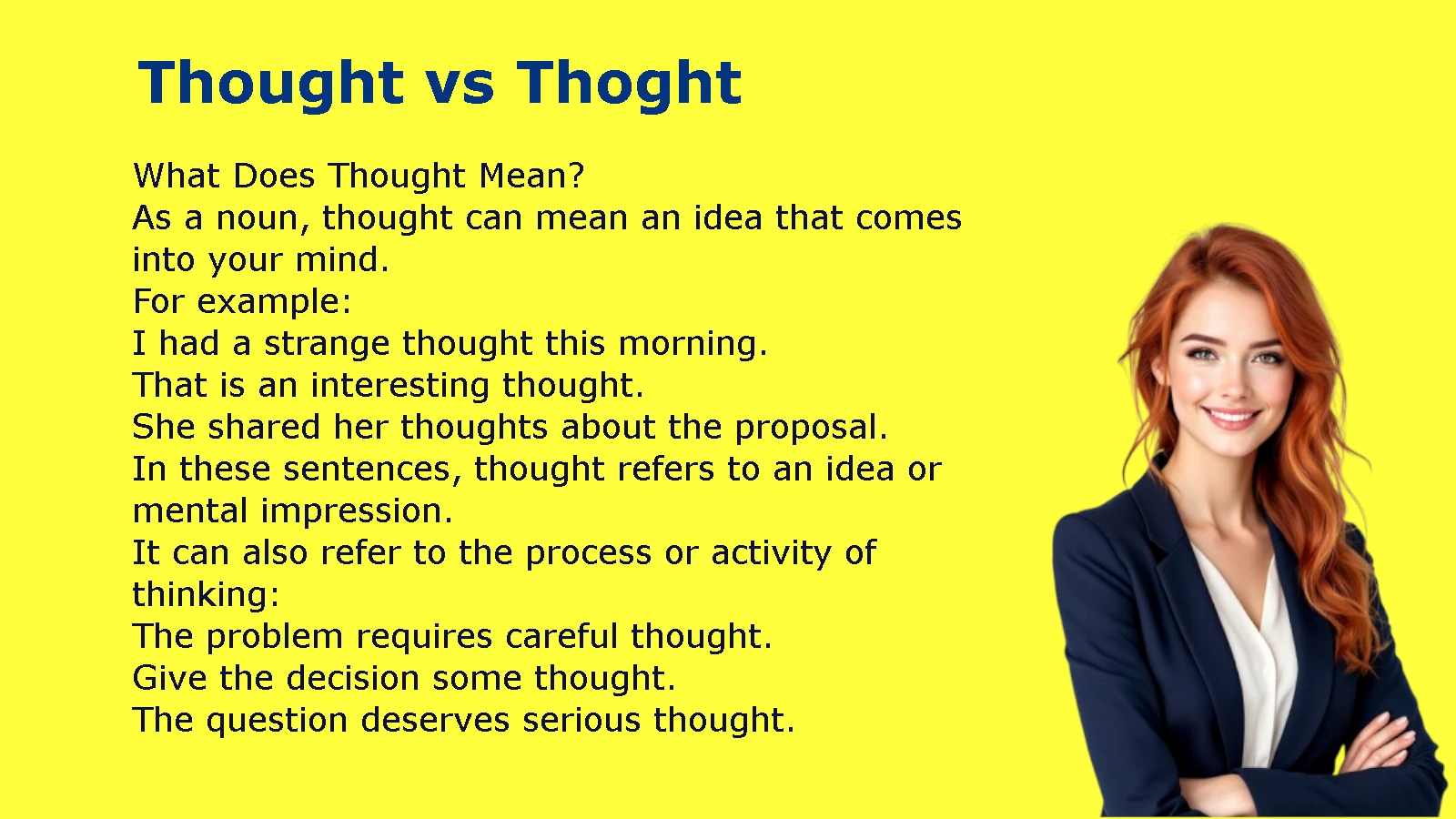
What Does Thought Mean?
As a noun, thought can mean an idea that comes into your mind.
For example:
- I had a strange thought this morning.
- That is an interesting thought.
- She shared her thoughts about the proposal.
In these sentences, thought refers to an idea or mental impression.
It can also refer to the process or activity of thinking:
- The problem requires careful thought.
- Give the decision some thought.
- The question deserves serious thought.
Cambridge similarly defines the noun thought as the act of thinking or considering something, an idea or opinion, or a set of ideas about a subject.
Thought as the Past Tense of Think
The other major use of thought is grammatical.
The verb think is irregular. Its forms are:
| Verb form | Word |
| Base form | think |
| Present tense | think / thinks |
| Past tense | thought |
| Past participle | thought |
| -ing form | thinking |
Oxford gives thought as both the past simple and past participle of think.
For example:
- Present: I think this is correct.
- Past: I thought this was correct.
- Present perfect: I have thought about it.
- Past perfect: I had thought about it already.
This is important because thought is not simply a noun. It is also one of the principal forms of the verb think.
Thought as a Noun
When thought is a noun, it usually describes an idea, opinion, mental activity, or consideration.
For example:
Idea
I just had a thought.
Opinion
What are your thoughts on the matter?
Mental activity
The problem requires careful thought.
Consideration
We need to give the proposal some thought.
Oxford also identifies thought in expressions involving care or concern, such as spare a thought for someone, and intention, as in thought of doing something.
Thoght: Is It a Correct Word?
No. Thoght is not the standard spelling of an English word.
If you intended the common English word pronounced approximately like thawt in many varieties of English, the correct spelling is:
thought
not:
thoght
The spelling thoght usually occurs because the writer accidentally rearranges or omits letters while typing or spelling.
Why Thoght Is Incorrect
The correct word contains the sequence:
t-h-o-u-g-h-t
The incorrect form removes the u:
t-h-o-g-h-t
That small difference changes the spelling completely.
English contains many words in which letters are not pronounced exactly as they appear. Thought is a good example because the written form -ought has a pronunciation that learners cannot always predict simply by looking at the letters.
The spelling therefore needs to be learned as a whole rather than reconstructed from pronunciation.
Is Thoght Ever Acceptable in English?
In standard English writing, no.
You may encounter thoght in:
- casual online typing
- social media posts
- text messages
- comments
- drafts
- learner writing
- documents containing spelling errors
Its appearance in a sentence does not give it a separate standard definition.
For example:
I thoght the store was closed.
The reader will probably understand what the writer meant, but thoght should be corrected to thought.
Why People Write Thoght Instead of Thought
There are several practical reasons a person might type thoght.
Fast typing is one possibility. When people type quickly, they may accidentally omit a letter.
Another reason is uncertain spelling. Because the pronunciation of thought does not transparently reveal the spelling, someone who has mostly encountered the word in speech may have difficulty reproducing its written form.
There is also simple letter-order or letter-omission error. The writer knows the intended word but leaves out the u.
These errors do not create a new English word.
Thought vs Thoght: The Key Difference
The most important fact about thought vs thoght is that they are not two different words with different meanings.
There is only one standard word here:
thought
Thoght is the misspelled form.
| Feature | Thought | Thoght |
| Standard English word | Yes | No |
| Correct spelling | Yes | No |
| Meaning | Yes | No standard meaning |
| Verb form | Past tense/past participle of think | Not applicable |
| Noun | Yes | Not applicable |
| Used in formal writing | Yes | No |
| Recommended in academic writing | Yes | No |
This makes thought vs thoght different from comparisons such as accept vs except, where both forms are legitimate words with different meanings.
With thought and thoght, there is no semantic distinction to learn. The issue is spelling.
Thought Meaning With Examples
Understanding the different uses of thought makes it easier to recognize when the word is needed.
Thought as a Verb
As a verb, thought describes something someone believed, considered, remembered, or had in mind in the past.
Examples:
- I thought you knew the answer.
- She thought the meeting started at ten.
- We thought they were already there.
- He thought about changing his plans.
- I thought I had locked the door.
In each case, thought relates to the past form of think.
Oxford gives examples of think meaning to have a particular idea or opinion and shows thought as its past form.
Compare:
I think he is at home.
with:
I thought he was at home.
The first sentence refers to a present belief or opinion. The second uses the past form.
Thought as a Noun
As a noun, thought refers to an idea, opinion, or mental activity.
Examples:
- I had a thought.
- What are your thoughts?
- She gave the problem careful thought.
- That thought never occurred to me.
- His thoughts turned to his family.
The noun can be countable or uncountable depending on the meaning.
For example:
I had a thought.
Here, thought means a particular idea.
But:
The problem requires careful thought.
Here, it refers more generally to the process of thinking.
Thought in Common Expressions
The word appears in many established English expressions.
Give it some thought means to consider something carefully.
Give the proposal some thought before making a decision.
Second thoughts means doubts or a changed opinion after reconsideration.
She had second thoughts about accepting the offer.
Food for thought refers to something that gives you something interesting or serious to consider.
The documentary provided plenty of food for thought.
A train of thought refers to a connected sequence of ideas.
The interruption caused me to lose my train of thought.
Oxford records these and other established expressions involving thought.
How to Use Thought Correctly
The easiest way to use thought correctly is to identify whether it is functioning as a verb or a noun.
Thought as the Past Tense of Think
Use thought when you need the past form of think.
Present:
I think she is right.
Past:
I thought she was right.
Present:
They think the plan will work.
Past:
They thought the plan would work.
This irregular change from think to thought is a key feature of the verb.
It is not:
I thinked she was right.
The correct form is:
I thought she was right.
Cambridge identifies thought as both the past tense and past participle of think.
Thought in Questions
Thought commonly appears in questions about past beliefs or opinions.
Examples:
- What did you think about the movie?
- What did you think would happen?
- Did you think I was serious?
- What had you thought before you heard the news?
Notice that after did, English normally uses the base form think, not thought:
Did you think about it?
Not:
Did you thought about it?
This is an important grammatical distinction.
Thought in Negative Sentences
The same principle applies to negative sentences with did not or didn’t.
Correct:
I didn’t think it would rain.
Incorrect:
I didn’t thought it would rain.
Why? Because did already carries the past tense, so the main verb returns to its base form:
did + think
rather than:
did + thought
Thought in Common Expressions
Many natural English phrases contain thought.
Examples include:
- give it some thought
- give thought to something
- second thoughts
- on second thought
- without a second thought
- food for thought
- train of thought
- spare a thought for someone
These expressions are useful because they show how thought operates as a noun rather than merely as the past tense of think. Oxford’s dictionary entry documents these established expressions.
Common Misspellings of Thought
Thoght
The most relevant misspelling in this comparison is:
thoght
Correct:
thought
Incorrect:
thoght
The difference is the missing u.
Other Common Typing Errors
People can make many accidental variations of a word while typing, but that does not mean those forms are recognized English words.
For thought, the safest strategy is to remember its complete spelling:
T-H-O-U-G-H-T
Breaking the word into its meaningful grammatical relationship can also help:
think → thought
This connection is more useful than trying to spell the word entirely from its pronunciation.
Thought vs Though vs Through vs Tough
One reason thought can be confusing is that it resembles several other English words.
The most important related-looking forms are though, through, and tough.
| Word | Meaning | Example |
| thought | Past form of think; an idea or mental activity | I thought about the problem. |
| though | Despite that; however | Though it was late, we continued. |
| through | From one side or end to another; by way of | We walked through the park. |
| tough | Difficult, strong, or able to withstand difficulty | It was a tough decision. |
These words are not interchangeable.
Thought vs Though
Thought and though differ by the letters t and u and, more importantly, by meaning and pronunciation.
I thought about your suggestion.
Here, thought is related to think.
Though it was raining, we went outside.
Here, though introduces a contrast.
A useful memory clue is:
thought = think in the past
though = despite that/however
Thought vs Through
Through has a completely different meaning.
We drove through the tunnel.
Here, through describes movement from one side or part of something to another.
Compare:
I thought about the tunnel.
The words look somewhat similar, but their meanings are unrelated.
Thought vs Tough
Tough is an adjective.
It can describe something difficult:
The exam was tough.
It can also describe something strong or resistant:
This material is tough.
By contrast:
I thought the exam was easy.
Here, thought is the past tense of think.
Thought vs Thoght in a Sentence
Seeing the words in complete sentences makes the difference particularly clear.
Correct Examples With Thought
I thought you were coming today.
She thought carefully before answering.
That is an interesting thought.
What are your thoughts on the subject?
We had given the proposal considerable thought.
He lost his train of thought during the presentation.
I had second thoughts about the decision.
All of these uses are standard English.
Incorrect Examples With Thoght
The following sentences contain the misspelling:
I thoght you were coming.
She thoght about the problem.
That was my first thoght.
I thoght the answer was different.
In every case, replace thoght with thought.
Corrected:
I thought you were coming.
She thought about the problem.
That was my first thought.
I thought the answer was different.
How to Correct Thoght in Your Writing
If you see thoght in a document, the correction is simple:
thoght → thought
However, it is worth checking the entire sentence because the problem may involve grammar as well as spelling.
For example:
I didn’t thought about it.
There are actually two issues. The spelling of thought is correct in isolation, but after didn’t, the verb should be think.
Correct:
I didn’t think about it.
So proofreading should check both spelling and grammatical form.
Why Is Thought So Easy to Misspell?
The spelling of thought is challenging because English spelling does not always map neatly onto pronunciation.
Oxford gives the pronunciation as /θɔːt/ in its British entry, while its American dictionary gives /θɔt/. Cambridge likewise provides British and American pronunciations.
This means that a learner hearing the word may not naturally infer all of its letters.
The sequence -ought is particularly important.
Compare:
- thought
- bought
- brought
- fought
- sought
These words share a spelling pattern but do not necessarily behave like words whose pronunciation can be guessed from each individual letter.
Pronunciation Does Not Tell You Every Letter
Someone may hear thought and mentally represent it as a simple sound rather than as:
t-h-o-u-g-h-t
That can make an omission such as thoght more likely.
This is one reason spelling practice should involve seeing and writing the complete word, not merely memorizing how it sounds.
How to Remember the Spelling of Thought
A few simple techniques can make thought easier to remember.
Remember Think → Thought
The strongest memory connection is grammatical:
think → thought
If you remember that thought is the irregular past form of think, the spelling becomes easier to retrieve.
For example:
I think about it today.
I thought about it yesterday.
Remember the “U” in Thought
If thoght is the spelling you frequently type by mistake, focus specifically on the u:
thoUght
You can mentally highlight the letter that gets omitted.
Learn the Word as a Whole
Do not try to spell thought entirely from its pronunciation.
Instead, memorize the written form:
THOUGHT
Then reinforce it through sentences:
I thought about it.
She thought it was funny.
That thought occurred to me.
Give it some thought.
Seeing the word repeatedly in context helps connect its spelling, meaning, and grammar.
Thought Pronunciation and Word Forms
How to Pronounce Thought
Thought is commonly pronounced approximately like “thawt” in many varieties of English.
The exact vowel differs between accents. Cambridge lists British and American pronunciations, and Oxford also distinguishes British and American pronunciation entries.
The pronunciation should not be used as a spelling guide for every letter.
Think, Thought, and Thoughtful
The word belongs to a broader family of related forms.
| Word | Function | Example |
| think | Verb | I think about the problem. |
| thought | Past tense/past participle of think | I thought about the problem. |
| thought | Noun | I had a thought. |
| thinking | Verb form/noun | She is thinking about it. |
| thoughtful | Adjective | That was a thoughtful gesture. |
| thinker | Noun | He is a careful thinker. |
Oxford identifies thinking as the process of thinking and thinker as a person who thinks seriously or in a particular way.
Related Words and Forms
Some common related words include:
- think
- thought
- thinking
- thoughtful
- thoughtfully
- thinker
- unthinkable
- rethink
- overthink
The spelling of each word is different, so it is useful to learn them individually rather than assuming that every derivative follows the same pattern.
Thought vs Thoght: Common Mistakes to Avoid
The most common problems are straightforward.
Mistake: Writing Thoght
Incorrect:
I thoght about it.
Correct:
I thought about it.
Mistake: Treating Thoght as a Different Word
There is no standard distinction in which thought means one thing and thoght means another.
Thoght is simply a misspelling.
Mistake: Confusing Thought With Though
Incorrect:
Though about the answer.
Correct:
Thought about the answer.
Thought is connected to think. Though is a conjunction or adverb used for contrast or concession.
Mistake: Confusing Thought With Through
Incorrect:
I walked thought the door.
Correct:
I walked through the door.
Here, through indicates movement.
Mistake: Using Thought After Did
Incorrect:
Did you thought about it?
Correct:
Did you think about it?
Because did already marks the past tense, the main verb takes its base form.
A Practical Case Study: Correcting a Short Paragraph
Consider this short paragraph:
I thoght about the problem yesterday. At first, I though the answer was obvious, but then I walked through the examples again. After giving it some thought, I realized that my first answer was wrong.
There are two different issues here.
The first error is:
thoght → thought
The second is:
though → thought
The corrected paragraph is:
I thought about the problem yesterday. At first, I thought the answer was obvious, but then I walked through the examples again. After giving it some thought, I realized that my first answer was wrong.
Notice that thought appears twice with different grammatical roles:
- I thought about the problem — past-tense verb.
- giving it some thought — noun.
Meanwhile, through remains correct because it describes movement through the examples.
This illustrates why understanding meaning and grammar is more reliable than simply checking whether words look similar.
Quick Comparison: Thought vs Thoght
If you only need the answer quickly, remember this:
| Question | Answer |
| Which spelling is correct? | Thought |
| Is thoght a standard English word? | No |
| What is the past tense of think? | Thought |
| What can thought mean as a noun? | An idea, opinion, or process of thinking |
| Is thought used in formal writing? | Yes |
| Should thoght be used in formal writing? | No |
| What is the common correction? | Thoght → thought |
| Is thought related to think? | Yes |
| Is thought the same as though? | No |
| Is thought the same as through? | No |
The simple rule: If you mean the past tense of think or an idea in your mind, spell it thought, not thoght.
FAQs About Thought vs Thoght
Is Thought or Thoght Correct?
Thought is correct.
Thoght is a misspelling and should normally be corrected to thought.
What Does Thought Mean?
Thought has two major uses. As a verb, it is the past tense and past participle of think. As a noun, it can mean an idea, opinion, or the process of thinking. Cambridge and Oxford both document these uses.
Is Thoght a Word?
No. Thoght is not a standard English word. It is generally an incorrect spelling of thought.
Why Do People Spell Thought as Thoght?
The error can happen because thought has an unusual spelling and pronunciation. Someone may omit the u while typing quickly or while trying to spell the word from its pronunciation.
How Do You Spell Thought Correctly?
The correct spelling is:
T-H-O-U-G-H-T
A useful association is:
think → thought
What Is the Difference Between Thought and Though?
Thought is the past tense of think or a noun referring to an idea or mental process.
Though is used to express contrast or concession.
Examples:
I thought about the problem.
Though it was difficult, I continued.
What Is the Difference Between Thought and Through?
Thought relates to thinking.
Through generally describes movement from one side or part of something to another, or movement by means of something.
Examples:
I thought about your idea.
We walked through the building.
Is Thought the Past Tense of Think?
Yes. Thought is the past simple and past participle of think.
Examples:
I think about it every day.
I have thought about it carefully.
Can Thought Be a Noun?
Yes.
For example:
That is an interesting thought.
Here, thought is a noun meaning an idea.
It can also describe the activity of thinking:
The decision requires careful thought.
Conclusion: Thought Is the Correct Spelling
The difference between thought vs thoght is ultimately a matter of correct spelling, not meaning.
Thought is the standard English word. It can be the past tense and past participle of think, as in I thought about the problem, and it can be a noun meaning an idea, opinion, or process of thinking.
Thoght, on the other hand, is not a standard English word. It is a misspelling, usually caused by leaving out the u in thought.
The easiest way to remember the correct form is:
think → thought
and:
thoght ❌ → thought ✅
It is also useful to distinguish thought from similar-looking words such as though, through, and tough. They have different meanings and grammatical functions, even though their spellings can cause confusion.
If you’re proofreading your writing, the rule is simple: whenever you mean the past form of think or the noun thought, use thought.
Correct: I thought about it.
Incorrect: I thoght about it.
Once you connect thought with think, the spelling becomes much easier to remember.