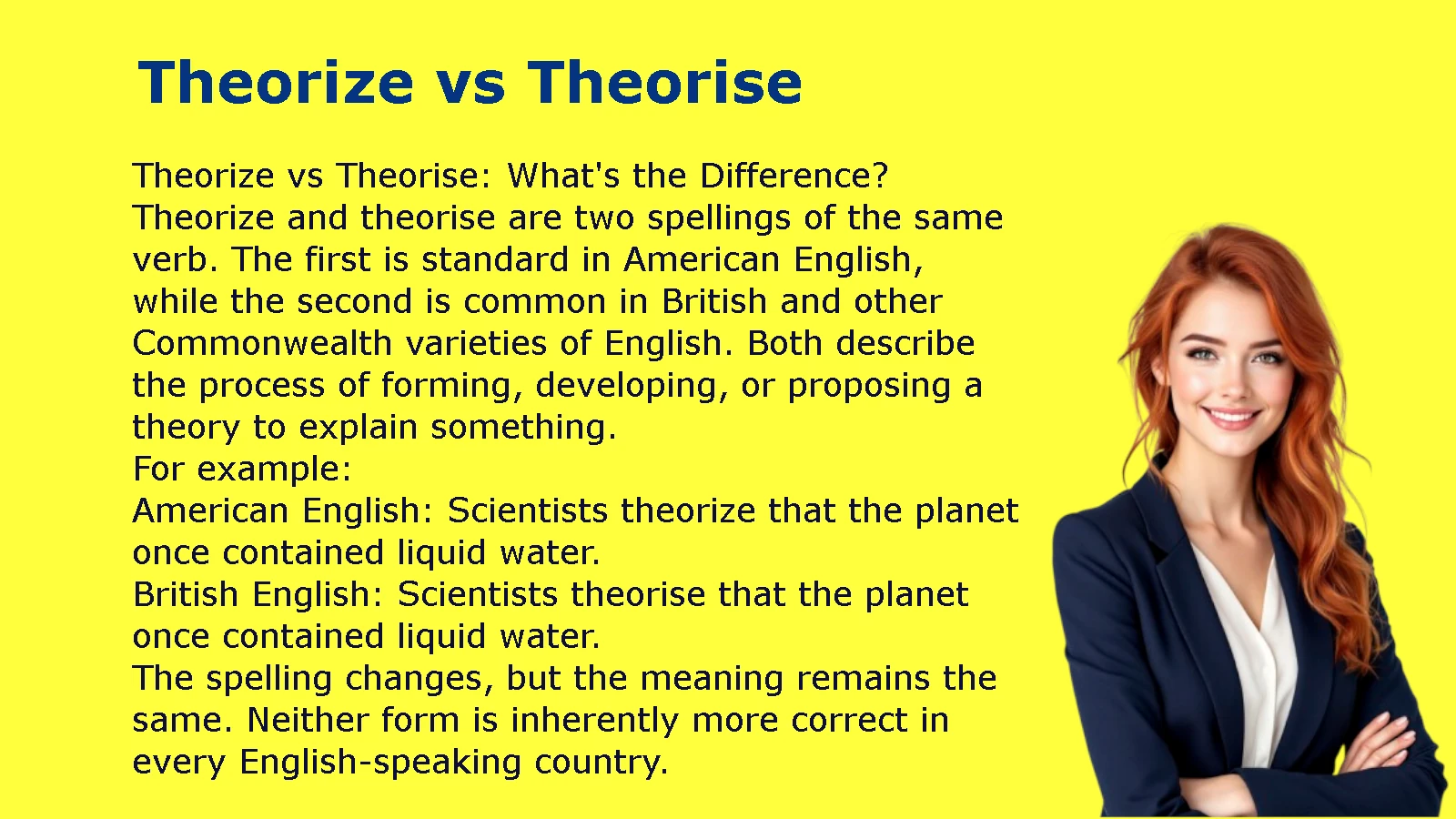
The difference between Theorize vs Theorise comes down to regional spelling conventions, not meaning. American English generally uses theorize, while British, Australian, and New Zealand English commonly use theorise. Both spellings mean to develop or propose a theory about something. However, British writers may also use theorize when following Oxford spelling, and Canadian usage can vary by style guide.
Understanding the difference between American English spelling, British English spelling, Oxford spelling, and other regional conventions helps you choose the right form for essays, research papers, business documents, and everyday writing. The same distinction appears in related words, including theorized vs. theorised and theorizing vs. theorising.
Theorize vs Theorise: What’s the Difference?
Theorize and theorise are two spellings of the same verb. The first is standard in American English, while the second is common in British and other Commonwealth varieties of English. Both describe the process of forming, developing, or proposing a theory to explain something.
For example:
- American English: Scientists theorize that the planet once contained liquid water.
- British English: Scientists theorise that the planet once contained liquid water.
The spelling changes, but the meaning remains the same. Neither form is inherently more correct in every English-speaking country.
Theorize: The Preferred American Spelling
Theorize is the standard spelling in American English. American dictionaries and most major US editorial conventions use the -ize ending in this word.
Writers use theorize when they discuss possible explanations, scientific hypotheses, philosophical ideas, or assumptions about a situation.
Consider these examples:
- Researchers theorize that sleep helps the brain organize memories.
- Historians theorize that changes in trade contributed to the city’s decline.
- I can only theorize about why the project failed.
- The professor asked students to theorize about the causes of the economic shift.
In each sentence, theorize describes the act of proposing an explanation. It does not automatically mean the explanation has been proven.
American writers should generally choose theorize for school assignments, reports, articles, and professional correspondence unless a specific publication requires another convention.
Theorise: The Standard British Spelling
Theorise is common in mainstream British English. It follows a spelling pattern in which certain words ending in -ize in American English end in -ise in British English.
Examples include:
- The researchers theorise that the treatment may affect memory.
- Several historians theorise that the conflict began earlier than previously believed.
- We can only theorise about the author’s intentions.
- The lecturer encouraged students to theorise about the character’s motivation.
British writers often use theorise in academic assignments, newspapers, professional documents, and general publications.
However, British spelling is not governed by one universal rule that requires every word to end in -ise. Some British publications follow Oxford spelling, which favors -ize in appropriate words. Therefore, theorize is also an accepted spelling in British English when the chosen style allows it.
Do Theorize and Theorise Mean the Same Thing?
Yes. Theorize and theorise have the same definition, grammatical function, and general pronunciation in standard English. The difference is orthographic, meaning it concerns how the word is written.
Both spellings refer to forming or proposing a theory about an event, observation, problem, or idea.
For example:
- The engineer theorizes that repeated vibration caused the damage.
- The engineer theorises that repeated vibration caused the damage.
Both sentences communicate the same idea. The spelling simply reflects the writer’s preferred English convention.
One important distinction concerns the meaning of the verb itself. To theorize is to develop or propose an explanation. It does not necessarily mean to prove that explanation through observation, experimentation, or evidence.
A researcher may theorize that a certain chemical reaction explains an unexpected result. The researcher must still test the idea before treating it as an established finding.
Theorize vs Theorise in American, British, and Canadian English
Regional English conventions influence the spelling of many verbs. The choice between theorize and theorise follows a familiar pattern, but the rules differ slightly across countries.
American English: Theorize
American English generally favors -ize in words such as theorize, organize, recognize, and realize.
This convention appears in mainstream American dictionaries and many US publishing styles. As a result, American readers usually expect theorize rather than theorise.
Here are some examples:
| American spelling | Example sentence |
| Theorize | Scientists theorize about the origin of the signal. |
| Theorized | The team theorized that pressure caused the failure. |
| Theorizing | The researcher is theorizing about a possible connection. |
| Theorizer | The theorizer proposed an explanation for the unusual result. |
The word theorizer is grammatically possible, although it is less common than theorist. In most situations, theorist is the more natural noun for a person who develops or studies theories.
For American schoolwork, workplace writing, and most US-focused content, use theorize and its related -ize forms.
British English: Theorise or Theorize?
British English commonly uses theorise, particularly in publications that follow traditional British -ise spelling.
This pattern also appears in words such as organise, recognise, and realise. Writers who follow this convention should apply it consistently.
Examples include:
- The committee theorised that the missing documents had been removed deliberately.
- The historian is theorising about the origins of the custom.
- Several researchers have theorised that the two events were connected.
However, British English also includes the Oxford spelling convention. Under that convention, writers use -ize in words where the suffix is appropriate, so theorize may appear in British books, academic publications, and professional writing.
The practical rule is straightforward: follow the publication’s spelling policy rather than assuming every British writer must use theorise.
Canadian English: Which Spelling Is Preferred?
Canadian English can use both theorize and theorise, depending on the dictionary, publication, or editorial style being followed.
Many Canadian editorial conventions favor -ize endings in words such as organize and recognize. However, individual publications may follow different house styles, so writers should check the rules that apply to their document.
For example:
- A Canadian journal following an -ize convention may use: “The authors theorize that the pattern reflects a broader change.”
- A publication following an -ise convention may use: “The authors theorise that the pattern reflects a broader change.”
Both sentences are understandable. For formal Canadian writing, use the spelling specified by the relevant journal, institution, or publisher.
Australian and New Zealand English: Theorise
Australian and New Zealand English commonly favor theorise, following the -ise pattern used in mainstream spelling conventions in both countries.
You may encounter this spelling in education, government communications, newspapers, and professional publications.
Examples include:
- Australian English: Researchers theorise that the new method could improve soil quality.
- New Zealand English: The historians theorise that the settlement developed through several stages.
- Australian academic writing: The authors theorised that the difference resulted from changes in temperature.
Related forms usually follow the same pattern:
- Theorise
- Theorised
- Theorising
- Theoriser
When writing for Australian or New Zealand readers, theorise is generally the natural default. Still, check any applicable house style, particularly when submitting work to an international journal.
Theorize vs Theorise: Comparison Table
The following table summarizes the common spelling preferences and shows how the verb changes in different forms.
| English variety or style | Base verb | Past tense | Continuous form | Example |
| American English | Theorize | Theorized | Theorizing | Scientists theorize about the result. |
| Mainstream British English | Theorise | Theorised | Theorising | Scientists theorise about the result. |
| Australian English | Theorise | Theorised | Theorising | Scientists theorise about the result. |
| New Zealand English | Theorise | Theorised | Theorising | Scientists theorise about the result. |
| Oxford spelling | Theorize | Theorized | Theorizing | Scientists theorize about the result. |
Canadian English may follow either convention depending on the reference or style guide.
The most useful takeaway is that the spelling convention carries through the related forms. If you choose theorise, use theorised and theorising as well. If you choose theorize, use theorized and theorizing.
Mixing these forms in the same document can make the writing look inconsistent.
Oxford Spelling: Why Some British Writers Use Theorize
Oxford spelling is an important exception to the simple rule that American English uses -ize and British English uses -ise. It helps explain why both spellings can appear in British academic and professional writing.
What Is Oxford Spelling?
Oxford spelling is a style convention associated with Oxford University Press. It generally favors the -ize ending in words where that suffix is appropriate, including theorize, organize, and recognize.
Although the convention is associated with a British institution, it does not follow the common British preference for -ise in these words.
Oxford spelling does not mean that every word containing an s should be changed to a z. It applies to particular spelling patterns and does not eliminate established forms such as analyse or advertise.
The choice depends on the word’s accepted spelling and the rules of the style being followed.
Is Theorize Correct in British English?
Yes. Theorize is acceptable in British English when the writer follows Oxford spelling or another convention that uses the -ize ending.
Compare these examples:
- A British newspaper following an -ise style might write: “The scientists theorise that the planet once had an atmosphere.”
- A British academic publication following Oxford spelling might write: “The scientists theorize that the planet once had an atmosphere.”
Neither sentence is automatically wrong because of its spelling. Each reflects a different editorial convention.
This distinction matters for students and researchers who submit work to international publications. A journal’s preferred spelling may differ from the conventions taught in a local school or used by a local newspaper.
Which Spelling Should Academic Writers Choose?
Academic writers should follow the journal’s author instructions, university guidelines, or publisher’s style manual.
Before submitting a paper, check these details:
- Preferred English variety: Does the journal request American, British, or another form of English?
- Spelling convention: Does it use -ize, -ise, or a mixture of established forms?
- Consistency requirements: Does the editor expect the same spelling throughout the manuscript?
- Reference tools: Which dictionary or style manual does the publication recommend?
For example, a researcher writing a thesis at a British university may use theorise if that is the institution’s convention. The same researcher might use theorize when preparing a manuscript for a journal that explicitly follows Oxford spelling.
The goal is not to choose the spelling that looks more sophisticated. It is to meet the requirements of the intended audience and publication.
Theorizing vs. Theorising: How to Spell Related Word Forms
The difference between theorize and theorise does not disappear when the verb changes tense. The spelling pattern normally remains consistent across related forms.
Theorized vs. Theorised
Theorized is the past-tense and past-participle form associated with theorize. Theorised is the corresponding form associated with theorise.
Both describe an act of proposing or developing a theory that occurred in the past or has been completed.
Examples:
- American English: The research team theorized that the temperature change affected the sample.
- British English: The research team theorised that the temperature change affected the sample.
- American English: Several scholars have theorized about the origins of the practice.
- British English: Several scholars have theorised about the origins of the practice.
The grammar is identical. Only the spelling differs.
Use theorized in documents following an -ize convention and theorised in documents following an -ise convention.
Theorizing vs. Theorising
Theorizing is the -ing form of theorize, while theorising is the -ing form of theorise.
Writers use these forms as present participles or gerunds.
A present participle can appear in a continuous verb phrase:
- American: The scientist is theorizing about the unexpected result.
- British: The scientist is theorising about the unexpected result.
A gerund functions as a noun:
- American: Theorizing without evidence can lead to weak conclusions.
- British: Theorising without evidence can lead to weak conclusions.
Both versions are grammatically correct within their respective spelling conventions.
Notice that the -ing ending does not remove the regional distinction. Writers should retain the spelling pattern used in the base verb.
Theorizer vs. Theoriser
Theorizer and theoriser are possible agent nouns formed from the verb. They refer to someone who theorizes or theorises.
However, these words are relatively uncommon in ordinary English. The noun theorist is usually more natural when describing someone who develops, studies, or works with theories.
Compare the following sentences:
- Less common: The theorizer presented a new explanation for the phenomenon.
- More natural: The theorist presented a new explanation for the phenomenon.
The second sentence is generally the better choice in academic and professional writing.
Use theorizer or theoriser only when that particular form suits the context. You do not need to create an agent noun simply because the verb has one.
Does the Spelling Change When You Add a Suffix?
The spelling convention generally remains consistent when you add common verb endings.
| Word form | -ize convention | -ise convention |
| Base verb | Theorize | Theorise |
| Third-person singular | Theorizes | Theorises |
| Past tense | Theorized | Theorised |
| Past participle | Theorized | Theorised |
| Present participle or gerund | Theorizing | Theorising |
| Agent noun | Theorizer | Theoriser |
For example, a writer using theorize should normally write theorizes, theorized, and theorizing. A writer using theorise should normally write theorises, theorised, and theorising.
One related point is worth remembering: theorist is a separate, established noun. It does not change to theorizist or theorisist.
How to Use Theorize and Theorise in Sentences
Understanding the spelling rule is useful, but examples show how the verb works in real writing. Theorize and theorise often appear in science, history, philosophy, education, and everyday discussion.
Scientific and Academic Examples
In research writing, the verb often introduces a proposed explanation for an observation or result.
Examples:
- American English: Researchers theorize that repeated exposure to noise may affect concentration.
- British English: Researchers theorise that repeated exposure to noise may affect concentration.
- American English: The team theorized that the material became weaker under extreme heat.
- British English: The team theorised that the material became weaker under extreme heat.
- American English: The authors are theorizing about a possible relationship between sleep and memory.
- British English: The authors are theorising about a possible relationship between sleep and memory.
These sentences work because the verb describes a proposed explanation rather than a confirmed finding.
When writing about scientific results, be careful not to overstate what the word means. If researchers have tested and supported an explanation, verbs such as demonstrate, find, or show may be more precise, depending on the evidence.
Everyday Examples
The verb also works outside academic settings. People often theorize about someone’s behavior, the cause of a problem, or the reason an unexpected event occurred.
Examples:
- I can only theorize about why the package arrived late.
- We can theorise that the meeting was postponed because the manager was unavailable.
- She theorized that the strange noise came from the old heating system.
- They spent the afternoon theorising about what had happened to the missing keys.
These examples show that theorizing does not require a formal scientific study. It can describe ordinary reasoning, especially when the speaker lacks enough information to reach a definite conclusion.
However, context matters. In casual conversation, guess, speculate, or suppose may sound more natural than theorize.
Historical and Philosophical Examples
Historians and philosophers use the verb to discuss possible causes, interpretations, and explanations.
Examples:
- American English: Historians theorize that trade routes influenced the growth of the settlement.
- British English: Historians theorise that trade routes influenced the growth of the settlement.
- American English: Philosophers have theorized about the nature of knowledge for centuries.
- British English: Philosophers have theorised about the nature of knowledge for centuries.
In these contexts, the verb signals an attempt to explain something that may be difficult to observe directly or establish with certainty.
For instance, historians may compare written records, archaeological findings, and economic evidence before proposing why a settlement expanded. Their theory may be plausible, but the strength of the explanation depends on the evidence supporting it.
The same principle applies to philosophical arguments. A writer can theorize about justice, identity, or knowledge without claiming that every part of the proposed explanation has been conclusively established.
Common Mistakes to Avoid
Choosing between theorize and theorise is simple once you know the regional rule. Still, writers can make mistakes when they apply the convention inconsistently or misunderstand the word’s meaning.
Treating One Regional Spelling as Universally Wrong
A common mistake is assuming that theorise is misspelled because American English uses theorize, or that theorize is wrong because a British publication uses theorise.
Neither assumption is accurate.
Both forms are established English spellings. The correct choice depends on the English variety or style convention used for the document.
For example, a US student should generally use theorize in an American English essay. An Australian student will usually choose theorise. A British academic following Oxford spelling may use theorize instead.
The best spelling is the one that matches your writing context.
Mixing Spelling Conventions in the Same Document
Inconsistent spelling can distract readers and make an otherwise polished document appear insufficiently edited.
Consider this example:
The researchers theorize that the change affected the results. Later, they began theorising about a second explanation.
The sentence switches from the -ize pattern to the -ise pattern. Although readers can understand it, the inconsistency is unnecessary in a document that follows one spelling convention.
A consistent American version would be:
The researchers theorize that the change affected the results. Later, they began theorizing about a second explanation.
A consistent British -ise version would be:
The researchers theorise that the change affected the results. Later, they began theorising about a second explanation.
To avoid this problem, choose your spelling convention before drafting. Then use your word processor’s language settings and proofing tools to catch inconsistencies.
Confusing Theorizing With Proving
Another mistake is using theorize when the context requires a stronger claim.
To theorize means to propose or develop a theory. It does not automatically mean to verify an explanation or establish it as fact.
Compare these sentences:
- “The researchers theorized that the substance caused the reaction.” This describes a proposed explanation.
- “The researchers demonstrated that the substance caused the reaction.” This suggests that evidence established the relationship.
- “The researchers found an association between the substance and the reaction.” This describes an observed relationship without necessarily establishing causation.
These verbs are not interchangeable in every context. In scientific writing, choose the one that accurately represents the evidence.
A hypothesis may be plausible without being proven. Similarly, an observed association does not automatically establish that one factor caused another.
Assuming Every British Word Uses -ise
British English commonly uses -ise in words such as theorise and organise, but not every word ending in -ize in American English follows the same pattern in British English.
For example, analyse is standard in mainstream British spelling, while theorize is acceptable under Oxford spelling.
Avoid applying a blanket rule that changes every z to s. Instead, check the specific word and the style guide you are following.
Frequently Asked Questions
Is “theorise” a spelling error?
No. Theorise is a standard spelling in mainstream British, Australian, and New Zealand English. American English generally prefers theorize. The Oxford spelling convention also accepts theorize in British writing, so the correct choice depends on the style being followed.
Is “theorize” correct in British English?
Yes. Theorize is correct in British English when the writer follows Oxford spelling or another convention that favors -ize endings. Many British publications use theorise, but British English does not require every publication to follow that pattern.
Which spelling should I use in a scientific paper?
Follow the journal’s author guidelines or your institution’s style guide. Use theorize if the publication follows American or Oxford spelling, and use theorise if it follows a mainstream British or similar -ise convention. Keep the spelling consistent throughout the manuscript.
Do theorize and theorise have different meanings?
No. Theorize and theorise mean the same thing: to form or propose a theory about something. Their difference is regional spelling, not meaning or grammatical function.
Is it theorizing or theorising?
Both forms are correct. Theorizing follows the -ize spelling convention used in American English and Oxford spelling, while theorising follows the -ise convention common in mainstream British, Australian, and New Zealand English.
Does Canadian English use theorize or theorise?
Canadian English can use both forms, depending on the publication’s spelling convention. Many Canadian editorial styles favor -ize endings in words such as organize, but writers should check the dictionary or house style specified for their document.
Conclusion: Choose the Right Spelling for Your Audience
The difference between Theorize vs Theorise is straightforward: American English generally favors theorize, while mainstream British, Australian, and New Zealand English commonly use theorise. Both spellings have the same meaning, and theorize is also acceptable in British writing that follows Oxford spelling.
The related forms follow the same pattern. Choose theorized and theorizing when using the -ize convention, or theorised and theorising when using the -ise convention.
Before submitting an essay, research paper, or professional document, check the relevant style guide and make sure your spelling remains consistent. If you’re writing for a general audience, match the spelling to your readers’ regional expectations.













